Clearalist vs SignalHire 2026: Accuracy, Pricing & Data Compared
Clearalist vs SignalHire compared head-to-head on accuracy, pricing, phone data, and bulk workflows — plus where a leaner email finder beats both.
Picking between Clearalist and SignalHire usually comes down to one question: do you need clean, verified work emails at predictable cost, or do you need a phone-heavy recruiting tool that scrapes profiles in bulk? They look similar on a feature grid, but they're built for different jobs — and the wrong choice shows up as bounced sends and burned credits within a week.
This is a neutral, hands-on comparison. We'll break down accuracy, pricing, data coverage, and the workflows each tool actually fits, then show where a focused email finder like Tomba undercuts both on cost-per-valid-contact.
TL;DR — Clearalist vs SignalHire in 2026#
- SignalHire is the better fit for recruiters and anyone who needs mobile phone numbers alongside emails, with a large profile database and a LinkedIn extension.
- Clearalist leans toward sales and marketing list-building, with cleaner B2B email output and lighter phone coverage.
- Both charge by credits, and per-contact economics get expensive fast once you scale past a few thousand lookups a month.
- Accuracy varies by data type: work emails are reasonably strong on both, personal emails and direct dials are where the gap (and the bounce risk) appears.
- If your core need is verified work email at a flat, predictable price, a dedicated email finder like Tomba often beats both on cost and bounce rate — start with the free tier before committing.
What is Clearalist and who is it for?#
Clearalist positions itself as a B2B lead-generation and contact-data platform. The pitch is straightforward: build targeted prospect lists, pull business emails, and push them into your outreach or CRM. It targets sales teams, agencies, and marketers who want list-building and enrichment in one place rather than stitching together a scraper plus a verifier.
Its strengths show up in structured B2B workflows — searching by company or role, exporting a clean list, and enriching rows you already have. Phone coverage exists but isn't the headline; emails are the primary deliverable. If your motion is email-first outbound and you care more about list hygiene than direct dials, Clearalist is aimed at you.
The trade-off is depth on contact data. Clearalist's database is smaller than the largest players, so coverage on long-tail companies, non-US regions, and niche roles can thin out. That's the classic small-database problem: great hit rates on common targets, frustrating gaps on the ones nobody else has either.
What is SignalHire and who is it for?#
SignalHire is a contact-finding and recruiting platform built around a large profile database and a browser extension. Its differentiator is multi-channel contact data — work email, personal email, and direct phone numbers — pulled from a single profile lookup. That phone coverage is why recruiters and talent teams gravitate to it; sourcing candidates often means a mobile number, not an inbox.
SignalHire also bundles ATS-style features and team workflows, which pushes it beyond a pure data tool. For a recruiting org, that's a feature. For a lean sales team that just wants verified emails to feed a sequencer, it's surface area you pay for and don't use.
The catch is the same one that hits every "we have everything" provider: breadth comes at the cost of consistency. Personal emails and direct dials are inherently harder to keep fresh, so verify before you trust a SignalHire phone number or personal address in a live campaign. You can read more about how multi-source data is assembled and why it decays on SignalHire's own site.
Clearalist vs SignalHire: the head-to-head comparison#
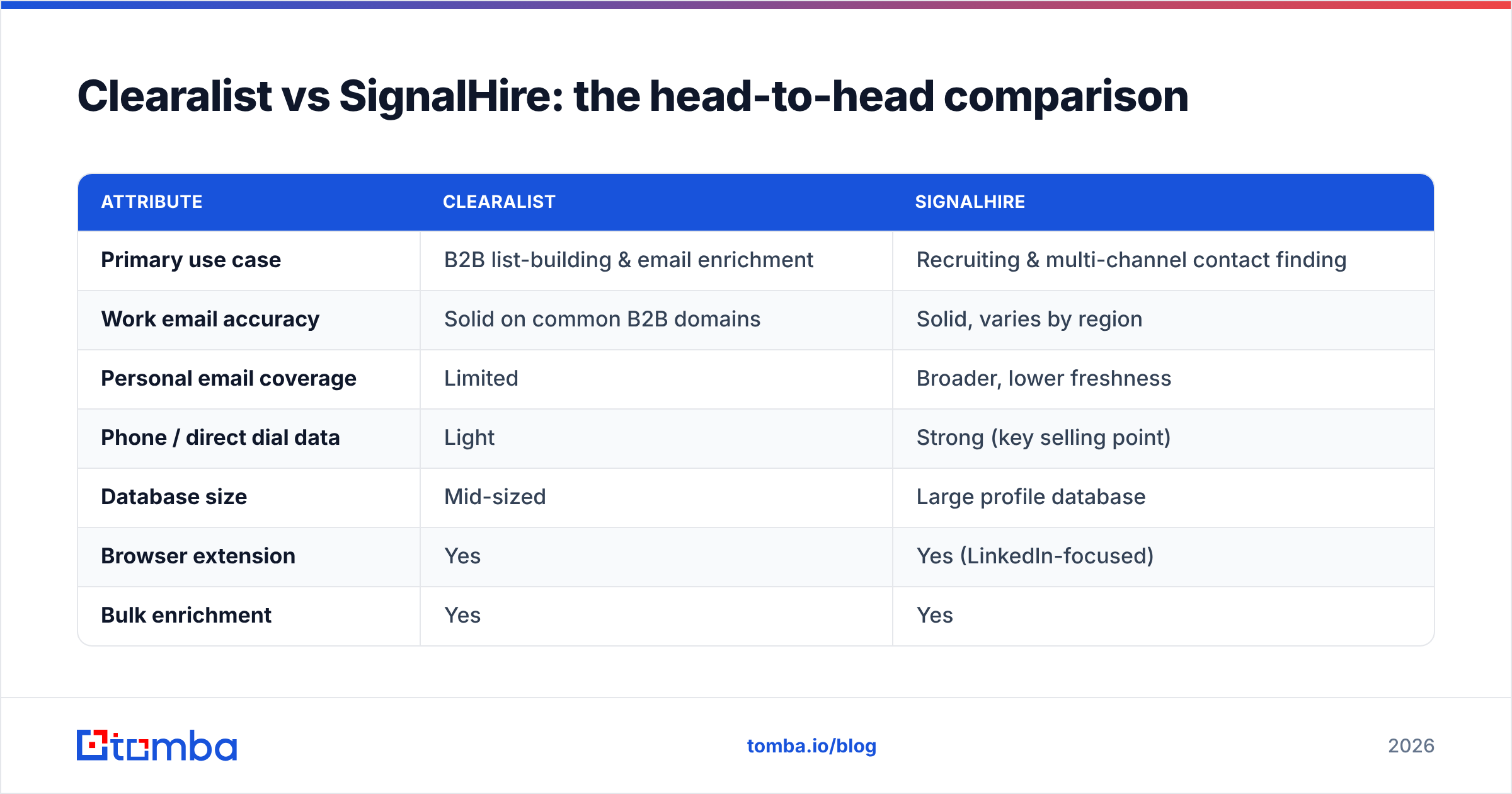
Here's the side-by-side on the attributes that actually change your results. Treat the numbers as directional — every provider's accuracy depends heavily on your target segment.
| Attribute | Clearalist | SignalHire |
|---|---|---|
| Primary use case | B2B list-building & email enrichment | Recruiting & multi-channel contact finding |
| Work email accuracy | Solid on common B2B domains | Solid, varies by region |
| Personal email coverage | Limited | Broader, lower freshness |
| Phone / direct dial data | Light | Strong (key selling point) |
| Database size | Mid-sized | Large profile database |
| Browser extension | Yes | Yes (LinkedIn-focused) |
| Bulk enrichment | Yes | Yes |
| Best-fit team | Sales & marketing | Recruiters & talent teams |
| Pricing model | Credit-based | Credit-based |
The pattern is clear: SignalHire wins on phone and personal data breadth, Clearalist wins on focused B2B email cleanliness, and both charge per credit — which becomes the deciding factor at scale.
Which tool is more accurate?#
Accuracy depends on which data type you mean. For verified work emails on well-known companies, both land in a similar, acceptable range. The divergence appears on the hard stuff: personal emails, direct dials, and contacts at small or international companies.
Think of contact data like milk in a fridge. Work emails are the long-life carton — they decay slowly because corporate email patterns are stable. Direct dials and personal emails are fresh milk; they go off fast as people change jobs, swap numbers, and update profiles. SignalHire stocks more fresh milk, which means more variety but also more cartons near their expiry date. Clearalist stocks fewer types but rotates a tighter set.
This is why a standalone email verifier matters regardless of which tool you pick. No provider should be trusted blind — running every list through verification before you send is the single biggest lever on bounce rate, and it protects your sender reputation. If you skip that step, a 6% invalid rate quietly torches your email deliverability and your domain ends up in spam folders you can't easily climb out of.

How do Clearalist and SignalHire price compare?#
Both run on credits, and that's where the real cost conversation lives. A credit model looks cheap at the entry tier and gets expensive once you scale, because you pay per lookup whether or not the contact is fresh, and often whether or not the result is even returned.
The trap is cost-per-valid-contact, not cost-per-credit. If a $99 plan gives you 1,000 credits but 15% of returned contacts bounce or are stale, your effective cost per usable contact is meaningfully higher than the sticker math suggests. Recruiting tools with heavy phone data tend to have higher per-credit costs because direct dials are pricier to source.
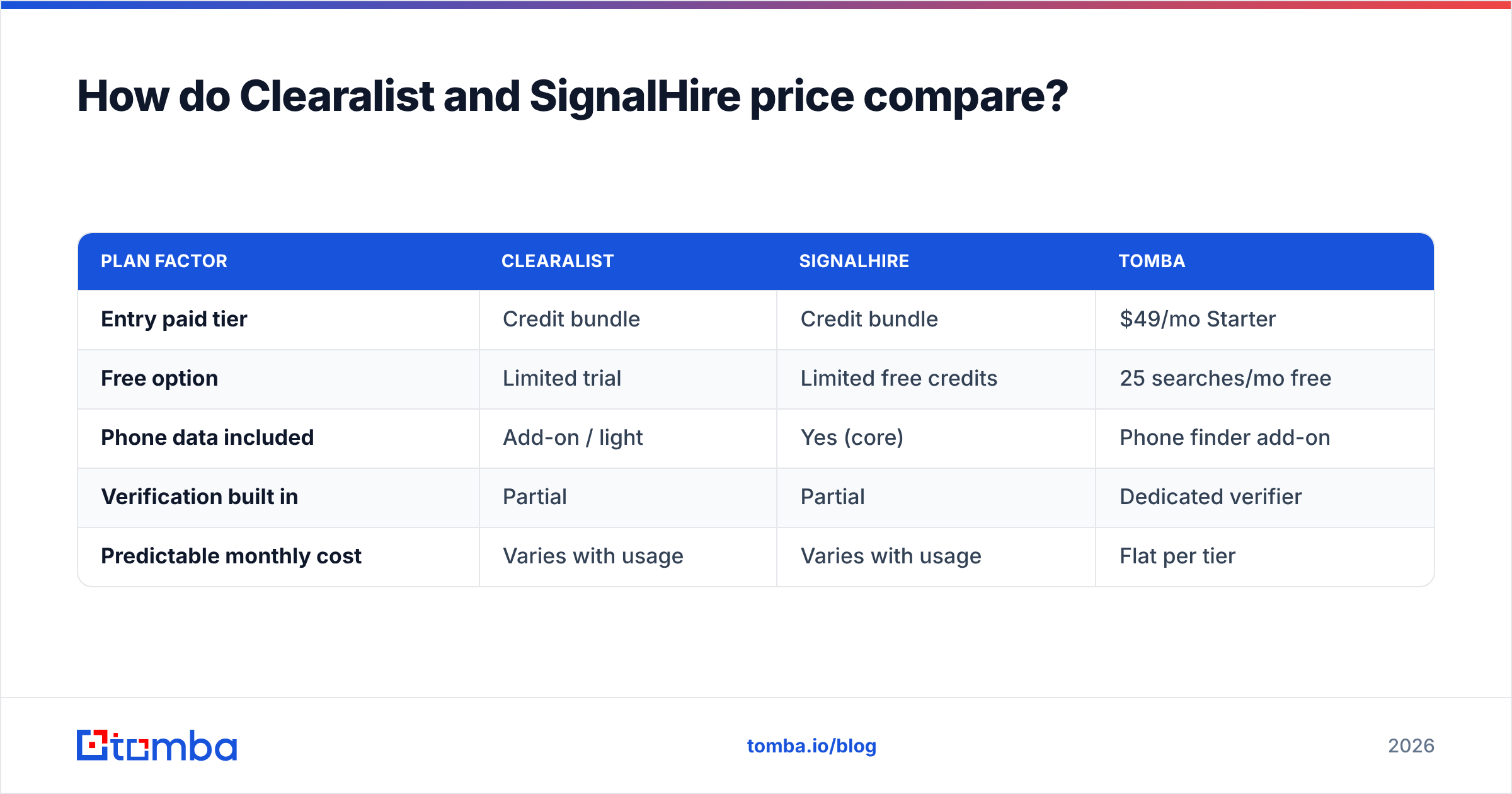
Here's a simplified view of how the three pricing approaches stack up. Exact tiers change, so confirm current numbers on each vendor's pricing page before you buy.
| Plan factor | Clearalist | SignalHire | Tomba |
|---|---|---|---|
| Entry paid tier | Credit bundle | Credit bundle | $49/mo Starter |
| Free option | Limited trial | Limited free credits | 25 searches/mo free |
| Phone data included | Add-on / light | Yes (core) | Phone finder add-on |
| Verification built in | Partial | Partial | Dedicated verifier |
| Predictable monthly cost | Varies with usage | Varies with usage | Flat per tier |
Tomba's published pricing details run Free (25 searches), Starter at $49/mo, Growth at $99/mo, and Pro at $249/mo — a flat structure that makes your cost-per-valid-contact predictable instead of a moving target. For comparison shopping across the category, third-party review sites like G2 are useful for surfacing real user complaints about credit burn and stale data that vendors don't advertise.
When should you choose SignalHire over Clearalist?#
Choose SignalHire when:
- You recruit or source candidates. Mobile numbers are non-negotiable for talent outreach, and SignalHire's phone coverage is its strongest asset.
- You need personal emails, not just work addresses — for example, reaching people who've left a company or freelancers without corporate domains.
- You work primarily from LinkedIn and want a profile-to-contact extension that returns multiple channels per lookup.
- You want light ATS-style workflow features bundled with your data tool.
Choose Clearalist when:
- You're building B2B email lists for marketing or sales sequences and want cleaner work-email output.
- You value list hygiene over channel breadth and don't need direct dials.
- You enrich existing CRM rows with company and email data more than you cold-source new contacts.
- Your targets are mainstream companies where a mid-sized database has strong coverage.
Neither is wrong — they're optimized for different jobs. The mistake is buying a recruiting-grade phone tool for an email-only sales motion, or a list-builder for a phone-heavy recruiting team.
Is there a better-value alternative for email-first teams?#
If your core need is verified work email at predictable cost, a focused email finder usually beats a do-everything platform. This is the classic specialist-versus-generalist trade: a Swiss Army knife does ten things adequately; a chef's knife does one thing exceptionally. For email-first outbound, you want the chef's knife.
That's where Tomba fits the conversation. It's built around the email finder and pairs it with a verifier, domain search for pulling every address at a company, a catch-all verifier for the domains most tools choke on, and bulk processing for list work. You can also layer in data enrichment and a phone finder when you genuinely need multi-channel — without paying recruiting-tool prices on every single lookup.
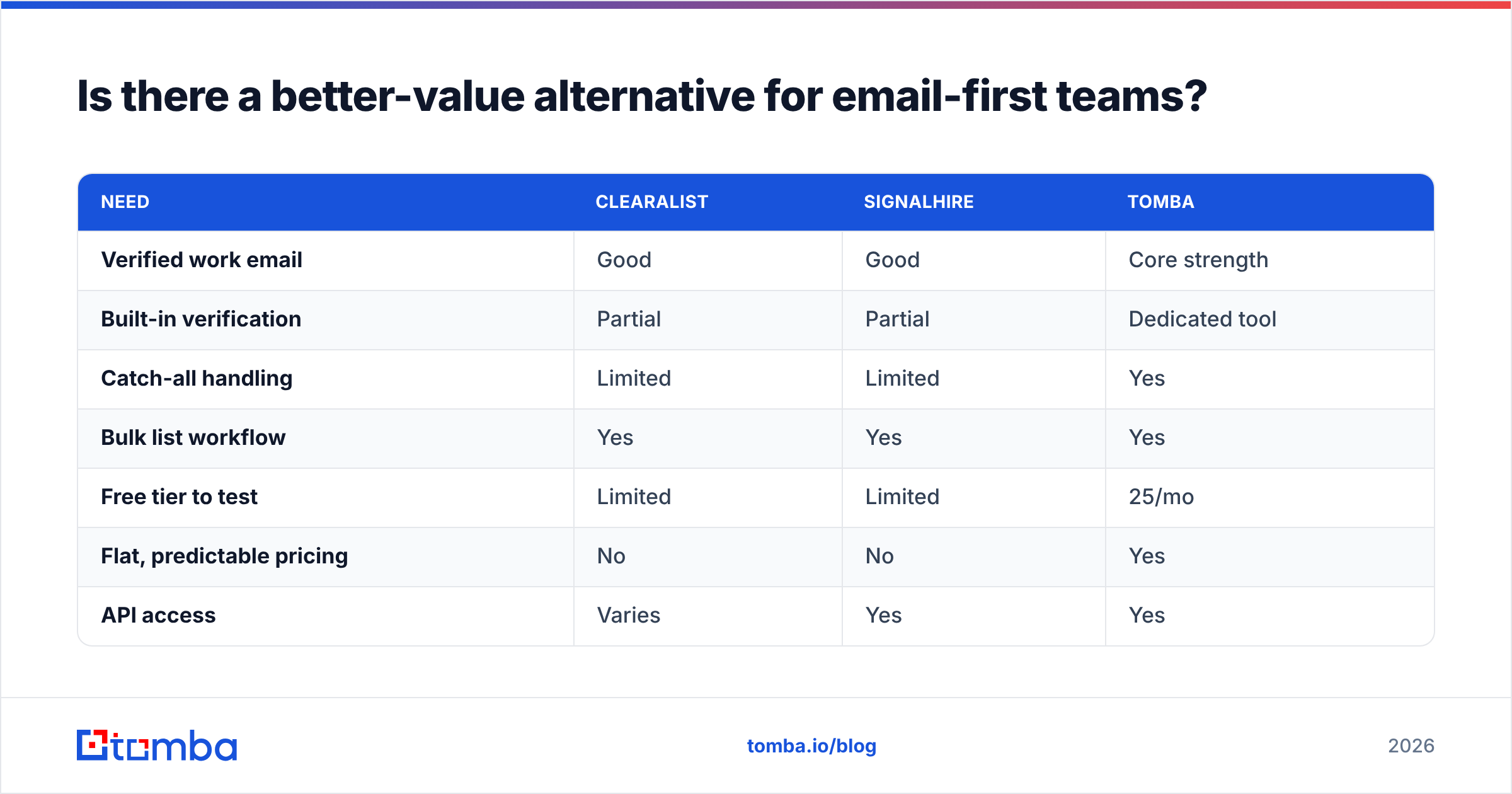
Here's how a specialist stacks against the two generalists for an email-first sales team:
| Need | Clearalist | SignalHire | Tomba |
|---|---|---|---|
| Verified work email | Good | Good | Core strength |
| Built-in verification | Partial | Partial | Dedicated tool |
| Catch-all handling | Limited | Limited | Yes |
| Bulk list workflow | Yes | Yes | Yes |
| Free tier to test | Limited | Limited | 25/mo |
| Flat, predictable pricing | No | No | Yes |
| API access | Varies | Yes | Yes |
The honest caveat: if phone numbers are your primary deliverable, SignalHire's depth is hard to match, and a pure email tool won't replace it. But for the large share of B2B teams whose real bottleneck is getting a clean inbox to land in, paying generalist prices for phone data you rarely use is just budget leakage.

How do you actually test which one fits?#
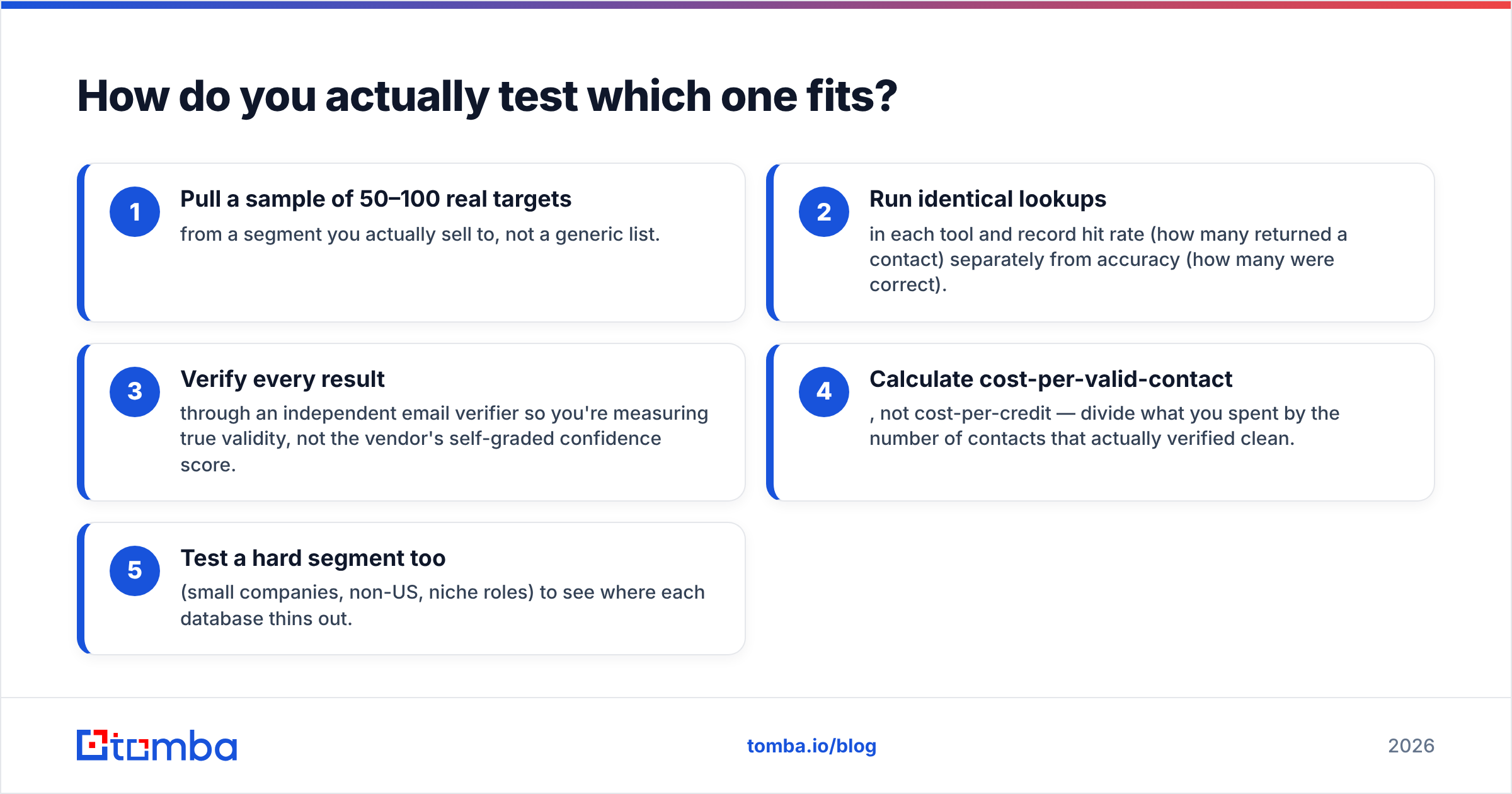
Don't decide on a feature grid — decide on your own data. Run the same controlled test against each tool:
- Pull a sample of 50–100 real targets from a segment you actually sell to, not a generic list.
- Run identical lookups in each tool and record hit rate (how many returned a contact) separately from accuracy (how many were correct).
- Verify every result through an independent email verifier so you're measuring true validity, not the vendor's self-graded confidence score.
- Calculate cost-per-valid-contact, not cost-per-credit — divide what you spent by the number of contacts that actually verified clean.
- Test a hard segment too (small companies, non-US, niche roles) to see where each database thins out.
That five-step test tells you more in an afternoon than a month of reading comparison posts — including this one. Most teams find the ranking flips once they weight by valid contacts instead of raw returns, and that's exactly the number your CFO cares about.
Clearalist vs SignalHire: the verdict#
SignalHire wins for recruiting and multi-channel sourcing; Clearalist wins for clean B2B email list-building; and an email-first sales team is often overpaying for both. All three points can be true at once because they're answering different questions.
If you live in LinkedIn, chase candidates, and need mobile numbers, SignalHire earns its credit cost. If you build marketing lists and want tidy work emails inside a lead-gen workflow, Clearalist is a reasonable pick. But if your real job is getting verified work emails into a sequencer at a price you can forecast, neither generalist is the most efficient tool for it.
Try Tomba's email finder on your toughest 25 prospects free — no credit burn, no commitment. Run the same list through Clearalist and SignalHire, verify all three outputs, and compare cost-per-valid-contact. Let the bounce rate and the invoice settle the argument instead of the marketing copy. When email accuracy and predictable pricing are what move your number, the specialist usually proves it in a single test.
// get started
Find, verify and enrich your first contacts today
Start on the free plan with 25 searches a month, then scale when your team is ready.
Free plan · No credit card required · GDPR & CCPA
// about the author