Clearbit Pricing in 2026: Plans, Real Costs & Alternatives
Clearbit's pricing went quote-only after the HubSpot acquisition. Here's what data enrichment actually costs in 2026, how credits work, and cheaper ways to get the same emails.
Clearbit pricing is one of the hardest numbers to pin down in B2B data, and that is by design. Since HubSpot acquired Clearbit and folded it into Breeze Intelligence, the old self-serve tiers disappeared behind "talk to sales" and credit packs. If you are trying to budget for data enrichment in 2026, this guide gives you the real picture — how the model works, where costs hide, and when a simpler tool covers the same job for a fraction of the price.
TL;DR#
- Clearbit no longer publishes flat pricing. After the HubSpot acquisition it became HubSpot Breeze Intelligence, sold through credit packs and bundled into HubSpot seats — expect a sales call before a number.
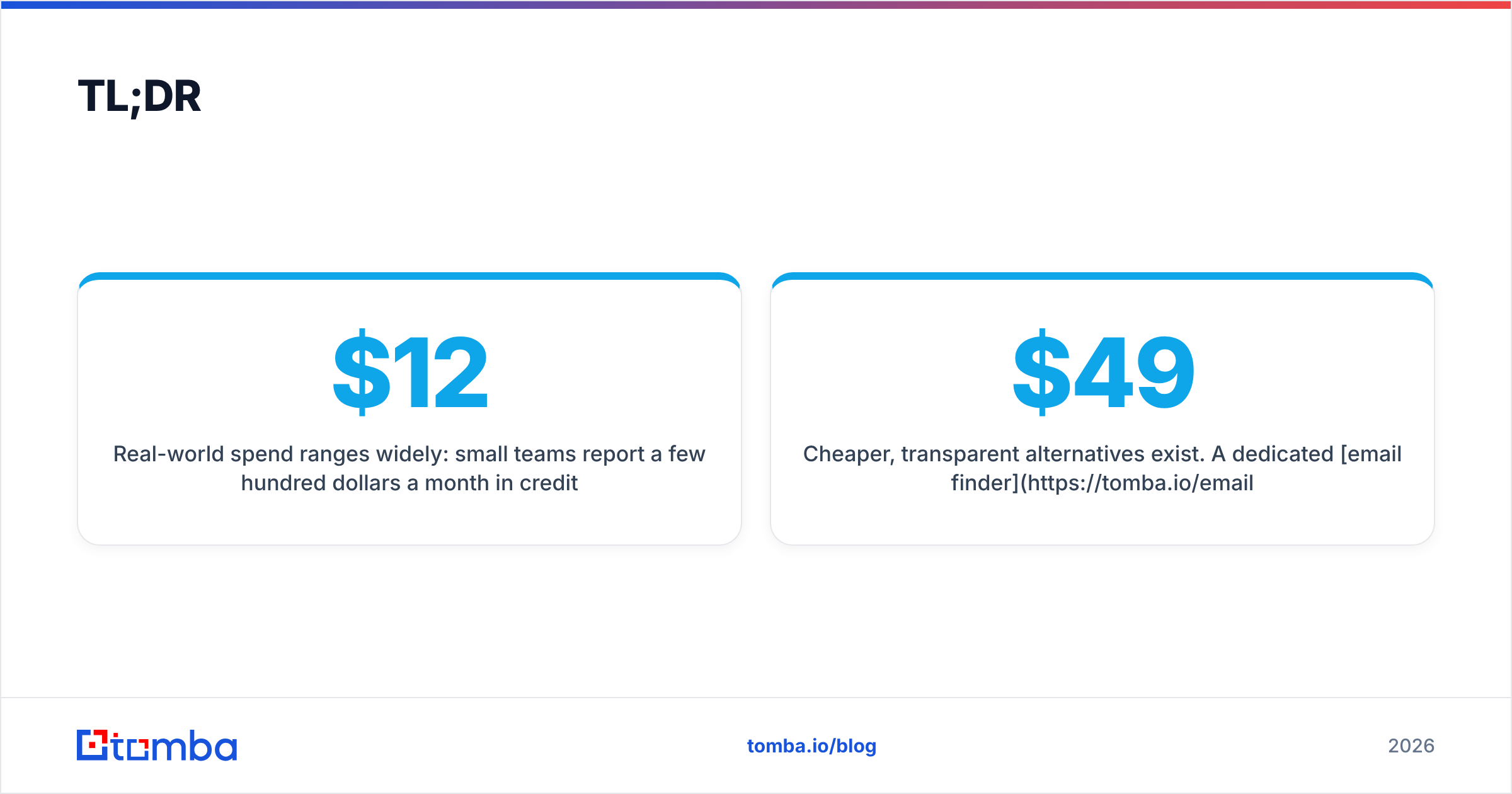
- Real-world spend ranges widely: small teams report a few hundred dollars a month in credits; mid-market and enterprise deals routinely land in the $12,000–$50,000+/year range once volume and seats are added.
- Credits are consumed per enrichment, so cost scales with how dirty and how large your list is — not with how many useful contacts you actually get.
- You are paying for the HubSpot ecosystem, not just emails. If you do not live inside HubSpot, much of that premium is wasted.
- Cheaper, transparent alternatives exist. A dedicated email finder like Tomba starts at a published $49/mo with a free tier, no quote call required.
What is Clearbit pricing actually based on?#
Clearbit pricing is credit-based and quote-gated — you buy enrichment credits, and the price per credit drops as you commit to higher volume and longer contracts. Think of it like a wholesale account at a warehouse club: the sticker price is hidden until you sit down with a rep, and your "discount" depends on how much you promise to spend up front.
Under HubSpot's Breeze Intelligence branding, the model breaks down into a few moving parts:
- Credits — the core currency. One credit is spent each time you enrich a record (a person, a company, or a website visitor). Buy more, pay less per credit.
- Seats and tier — Breeze Intelligence features are gated behind HubSpot's paid hubs, so your effective cost includes whatever HubSpot plan unlocks the data.
- Data products — enrichment, prospecting, reveal (anonymous visitor de-anonymization), and form-shortening each draw from credits at different rates.
- Contract length — annual commitments unlock the better per-credit rates; month-to-month is rarely offered at scale.
- Overages — burn through your credit allotment early and you top up, often at a worse marginal rate than your original pack.
The practical consequence: two companies enriching the same number of records can pay very different totals depending on data hygiene, ecosystem lock-in, and negotiation leverage.
How much does Clearbit cost in 2026?#
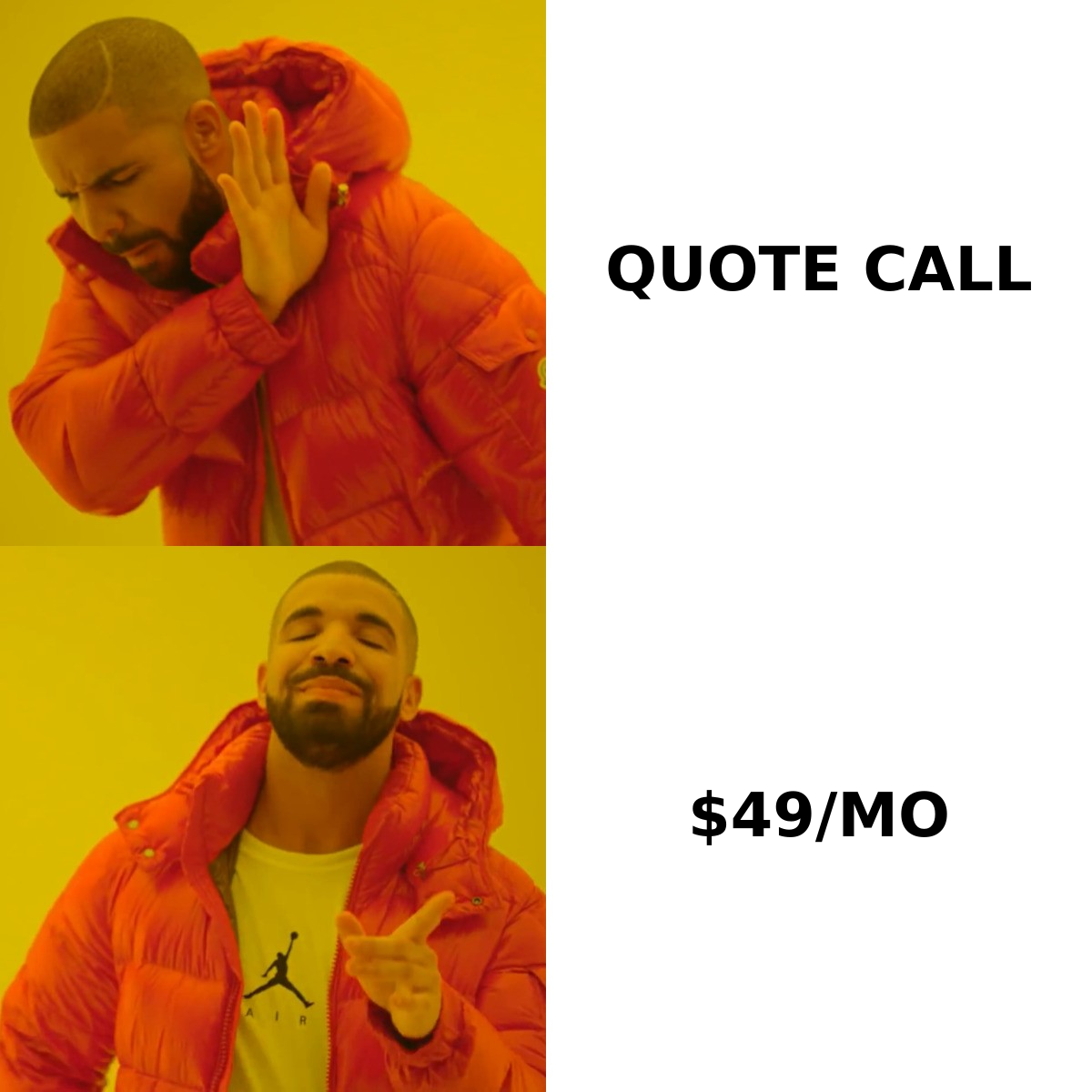
There is no single published price, but reported deals cluster into three bands. Because Clearbit/Breeze figures come from sales negotiations rather than a pricing page, the numbers below are synthesized from public reviews on G2 and buyer reports — treat them as ranges, not guarantees.
| Tier (typical) | Who it fits | Reported annual cost | Pricing model | Public sign-up? |
|---|---|---|---|---|
| Entry credits | Solo / small team testing enrichment | ~$1,500–$6,000 | Small credit pack, often via HubSpot | No — sales-assisted |
| Growth | SMB with active HubSpot use | ~$12,000–$24,000 | Credits + Hub seats | No — quote required |
| Enterprise | Mid-market / large RevOps | ~$30,000–$50,000+ | Volume credits, custom data, SLAs | No — annual contract |
| Add-ons | Anyone needing reveal/prospecting | Variable | Extra credit draw | No — bundled in quote |
A few honest caveats:
- These are directional. Your mileage depends on credit volume, HubSpot tier, and how hard you push in procurement.
- The floor is rising. Since the migration to Breeze Intelligence, the truly cheap self-serve Clearbit entry points have largely vanished.
- Credits expire. Annual credit pools that reset mean unused enrichment is money left on the table.
If your team is small or your enrichment needs are episodic, that floor can feel steep for what amounts to email and firmographic data. This is exactly where buyers start hunting for a Clearbit alternative with a published rate card.
Why is Clearbit pricing so opaque?#
Opaque pricing is a deliberate enterprise sales strategy — it maximizes deal size and protects margins, but it shifts cost discovery onto you. When a vendor hides the number, every buyer negotiates from zero, and the vendor captures more from those willing to pay more.
That is fine if you are a large RevOps team with budget and a procurement function. It is painful if you are:
- A founder or small sales team who just needs verified emails this quarter.
- A growth marketer who wants to test enrichment before committing to a year.
- A RevOps lead comparing five tools and unable to line them up on price.
Clearbit's depth is real — its firmographic and technographic data has long been respected. But depth you cannot price is hard to justify. Compare that to a tool that lists pricing openly: Free (25 searches/mo), Starter $49/mo, Growth $99/mo, Pro $249/mo, Enterprise custom. You know the number before the demo.
What do you actually get for Clearbit's price?#
You get deep enrichment plus tight HubSpot integration — but you pay for the whole bundle whether or not you use all of it. Breeze Intelligence's value concentrates in a few capabilities:
- Person & company enrichment — append firmographics, role, seniority, and tech stack to records.
- Reveal / visitor de-anonymization — identify the companies behind anonymous website traffic.
- Prospecting — build lists from Clearbit's database inside HubSpot.
- Form shortening — auto-fill fields from known data to cut form friction.
- Native HubSpot workflows — enrichment triggers that fire inside the CRM you already use.
The catch: that last point is the whole pitch. If HubSpot is your system of record, the integration is genuinely valuable. If it is not — if you run Salesforce, Pipedrive, a spreadsheet, or your own app — you are paying an ecosystem premium for data you could source more cheaply elsewhere. For most teams, the recurring need is narrower than the bundle: find a correct email, verify it, enrich a few key fields, move on.

How does Clearbit pricing compare to alternatives?#
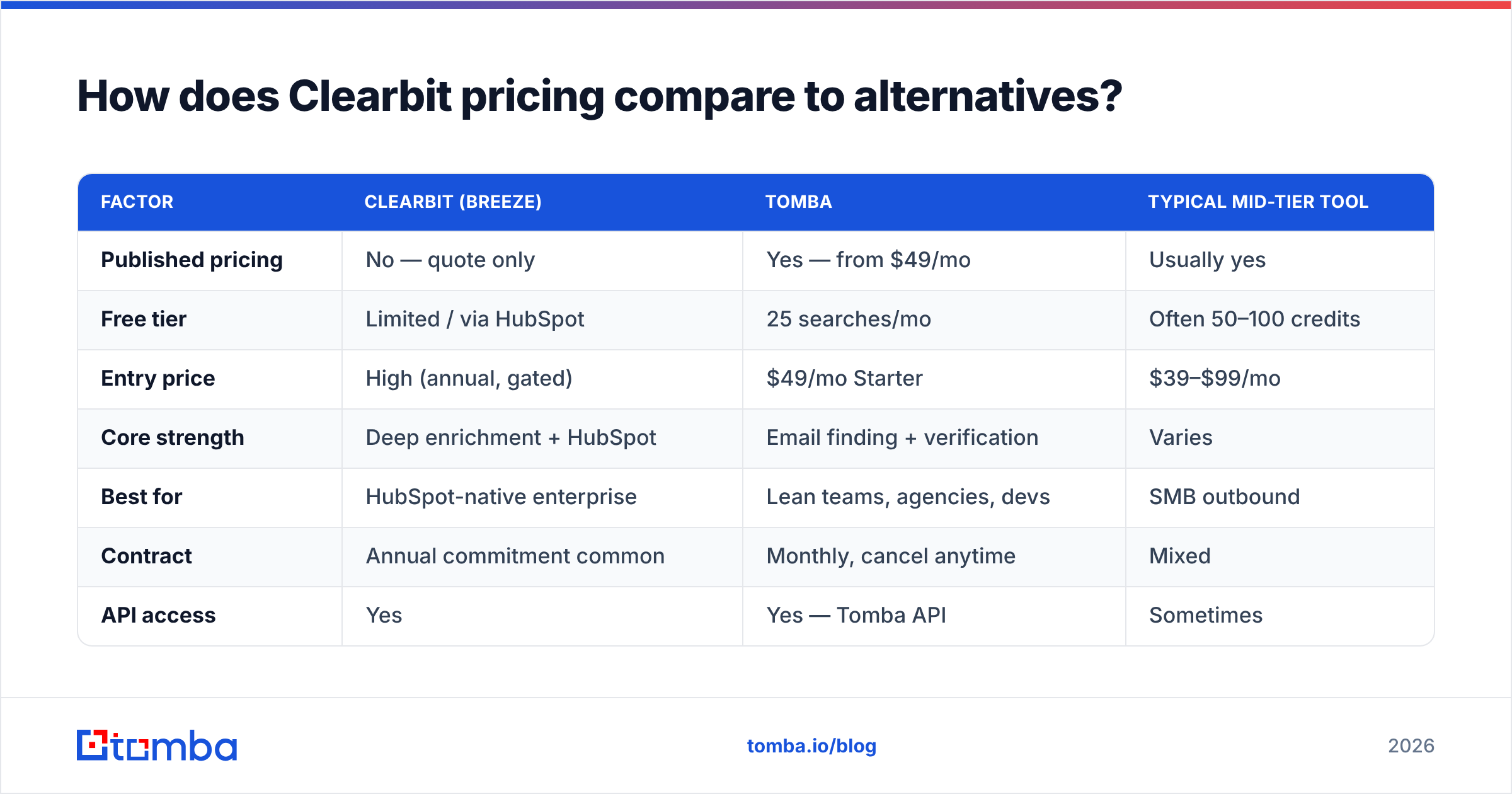
Against dedicated email-finding and enrichment tools, Clearbit is the premium, ecosystem-locked option — and you pay for it. Here is a straight comparison on the dimensions buyers care about most.
| Factor | Clearbit (Breeze) | Tomba | Typical mid-tier tool |
|---|---|---|---|
| Published pricing | No — quote only | Yes — from $49/mo | Usually yes |
| Free tier | Limited / via HubSpot | 25 searches/mo | Often 50–100 credits |
| Entry price | High (annual, gated) | $49/mo Starter | $39–$99/mo |
| Core strength | Deep enrichment + HubSpot | Email finding + verification | Varies |
| Best for | HubSpot-native enterprise | Lean teams, agencies, devs | SMB outbound |
| Contract | Annual commitment common | Monthly, cancel anytime | Mixed |
| API access | Yes | Yes — Tomba API | Sometimes |
The point is not that Clearbit is bad — it is that you should only pay enterprise prices when you use enterprise features. If your real job is "get me a verified email for this person at this company," a focused tool wins on cost and speed.
When Clearbit is worth it#
- You are a HubSpot power user and want native enrichment baked into workflows.
- You need website visitor reveal and technographic depth at scale.
- You have the budget and a procurement process to negotiate volume credits.
When it is overkill#
- You mostly need accurate emails and basic firmographics.
- You are not committed to the HubSpot ecosystem.
- You want predictable, published pricing without an annual contract.
- You are a small team, agency, or solo operator testing the waters.
What's the cheaper way to get the same data?#
Unbundle the job. Most of what teams buy Clearbit for — finding and verifying contact data — can be done with a purpose-built stack that publishes its prices. Here is a practical, lower-cost path:
- Find emails by domain or name with an email finder. Feed it a company domain and a name; get the verified professional email back.
- Verify before you send using an email verifier so bounces do not wreck your sender reputation.
- Enrich the records that matter with data enrichment — append role, company, and social data only where you need it, instead of burning credits on every row.
- Search whole companies at once via domain search to pull every public email pattern for a target account.
- Scale in batches with the bulk tools when you are running a real campaign, not one lookup at a time.
The difference in spend is stark. Where a Breeze Intelligence contract starts in the thousands per year, this approach starts at a published $49/mo and scales predictably as you grow. You trade ecosystem lock-in for transparency and control — and for most outbound and enrichment work, that is the better trade.
Is Clearbit's data accuracy worth the premium?#
Data quality matters more than brand, and no vendor is perfect — so verify regardless of who you buy from. Clearbit has a strong reputation for firmographic depth, but enrichment accuracy degrades over time as people change jobs and companies restructure. That decay is universal; it is not a reason to pay a premium or a discount.
What actually protects your campaigns is a verification step at send time. A correct-looking email that bounces still damages your sender reputation, and reputation damage costs far more than any per-credit price difference. Whatever tool you choose, build verification into the workflow rather than trusting any database to be permanently fresh. Tomba's data sources and verification approach are documented openly at our-data, which is worth comparing against any vendor that asks you to take accuracy on faith.
Frequently asked questions about Clearbit pricing#
Does Clearbit have a free plan? There is no straightforward self-serve free tier anymore. Limited free enrichment may be available through HubSpot's free tools, but the full Breeze Intelligence feature set requires a paid HubSpot plan and credits. For a genuine free starting point, tools like Tomba offer 25 searches per month at no cost.
How much does Clearbit cost per month? Clearbit does not publish a monthly price. Costs are driven by annual credit packs and HubSpot seats, so monthly-equivalent spend ranges from a few hundred dollars for small credit packs to several thousand for mid-market and enterprise deals.
Is Clearbit the same as HubSpot Breeze Intelligence? Effectively, yes. After the acquisition, Clearbit's products were rebranded and absorbed into HubSpot's Breeze Intelligence. The standalone Clearbit experience has been progressively merged into HubSpot.
What is the cheapest Clearbit alternative? For email finding and verification specifically, a dedicated tool with published pricing — starting around $49/mo — is dramatically cheaper than an enterprise enrichment contract, and you skip the sales call entirely.
The bottom line on Clearbit pricing#
Clearbit pricing in 2026 is opaque, credit-based, annual, and tied to the HubSpot ecosystem. That makes it a strong fit for HubSpot-native enterprise teams with budget and deep enrichment needs — and a poor fit for everyone who just needs accurate, verified contact data without committing to a contract sized for a much larger company.
If your real job is finding and verifying professional emails, start with the Tomba Email Finder. You get published pricing from $49/mo, a free tier to test with 25 searches, an open API, and built-in verification — no quote call, no annual lock-in, and no paying for a bundle you will not use. Spin it up, run your first list today, and only scale spend when your pipeline does.
// get started
Find, verify and enrich your first contacts today
Start on the free plan with 25 searches a month, then scale when your team is ready.
Free plan · No credit card required · GDPR & CCPA
// about the author