Clearbit vs Datanyze (2026): Which B2B Data Tool Wins?
Clearbit vs Datanyze compared on data accuracy, technographics, pricing, and enrichment in 2026 — plus a leaner alternative when both feel too heavy.
Clearbit vs Datanyze: Which B2B Data Tool Actually Fits Your Stack in 2026?
You're not really choosing between two logos. You're choosing how your team finds, enriches, and trusts contact data — and whether you'll pay enterprise rates for a platform when a focused tool would do the same job for a fraction of the cost.
TL;DR
- Clearbit (now Breeze Intelligence under HubSpot) is best if you live inside HubSpot and want real-time enrichment and form-shortening baked into your CRM. It's powerful but increasingly locked to that ecosystem.
- Datanyze is a lightweight, Chrome-extension-first prospecting tool for technographics and quick contact pulls. It's cheap to start but thin on coverage and freshness.
- Accuracy and freshness are where both stumble for cold outbound — enrichment platforms enrich what you already have; they're weaker at finding net-new verified emails.
- If your real job is finding and verifying email addresses at scale, a dedicated email finder like Tomba beats both on cost-per-valid-email.
- Budget reality: Datanyze starts cheap but caps fast; Clearbit/Breeze is effectively enterprise-tier. Tomba's pricing starts at $49/mo with a free tier.
What are Clearbit and Datanyze, really?#
Think of these two as different tools in the same toolbox. Clearbit is the enrichment engine — you hand it an email or a domain and it hands back a full company and person profile. Datanyze is the spyglass — you point it at a website or LinkedIn profile and it tells you the tech they run and a contact or two.
Clearbit was acquired by HubSpot and rebranded as Breeze Intelligence in 2024. That matters: the standalone Clearbit product is being absorbed into HubSpot's platform, so its future is tightly coupled to whether you're a HubSpot customer. If you are, enrichment is seamless. If you're not, you're increasingly a second-class citizen.
Datanyze, owned by ZoomInfo, has gone the opposite direction — it stayed small and cheap, positioned as an entry-level prospecting extension for individual reps rather than a data backbone for a whole RevOps team.
)
How do Clearbit and Datanyze compare head-to-head?#
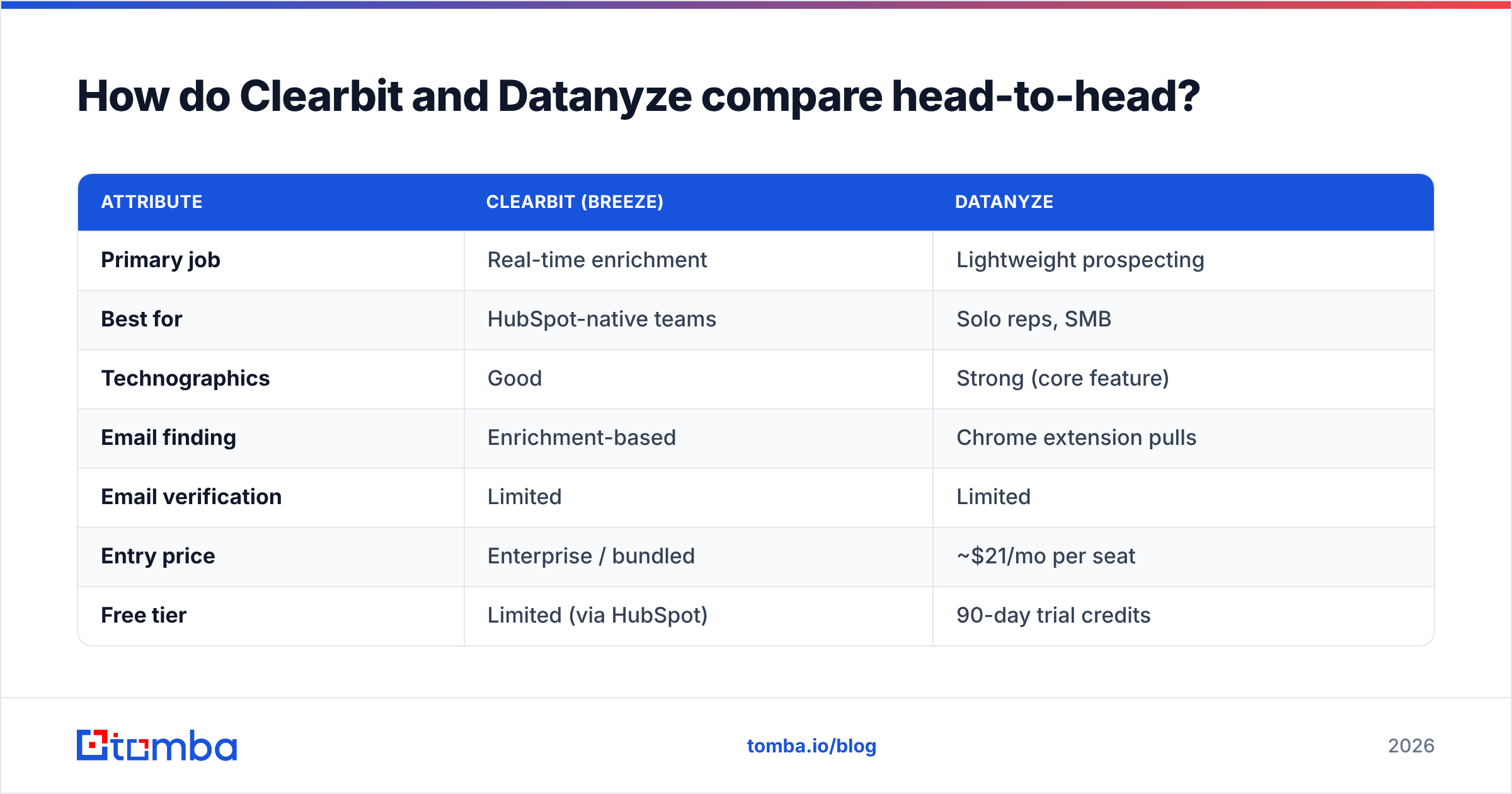
Here's the side-by-side on the attributes that actually drive a buying decision. Read it as "what job is this hire for," not "which is objectively better."
| Attribute | Clearbit (Breeze) | Datanyze |
|---|---|---|
| Primary job | Real-time enrichment | Lightweight prospecting |
| Best for | HubSpot-native teams | Solo reps, SMB |
| Technographics | Good | Strong (core feature) |
| Email finding | Enrichment-based | Chrome extension pulls |
| Email verification | Limited | Limited |
| Entry price | Enterprise / bundled | ~$21/mo per seat |
| Free tier | Limited (via HubSpot) | 90-day trial credits |
| API access | Yes (robust) | Minimal |
| Standalone future | Uncertain (HubSpot-tied) | Stable but static |
The pattern is clear. Clearbit goes deep inside one ecosystem; Datanyze goes wide but shallow. Neither was built primarily to find and verify cold email addresses at volume — that's a different category, and it's the gap most outbound teams actually feel.
Which one has better data accuracy?#
Accuracy depends on what you're measuring. For firmographic and company-level data, Clearbit/Breeze is the stronger of the two — it aggregates from a wide source set and refreshes on demand when a record is touched. Datanyze's company data is decent for technographics but its contact records go stale because the underlying database isn't refreshed as aggressively.
But here's the trap with both: enrichment accuracy and deliverable email accuracy are not the same number. An enrichment platform can confidently return a "verified" company and still hand you a role-based or outdated mailbox that bounces. If you're sending cold email, a bounce rate above 3-4% starts hurting your sender reputation — and neither tool is built to be your last line of defense there.
That's why serious outbound teams run a dedicated email verifier on every list before sending, regardless of where the data came from. Enrichment tells you who; verification tells you whether the message will actually land. For a primer on why bounces compound, see the breakdown of email deliverability in Tomba's glossary.
A quick way to pressure-test any vendor's accuracy claim:
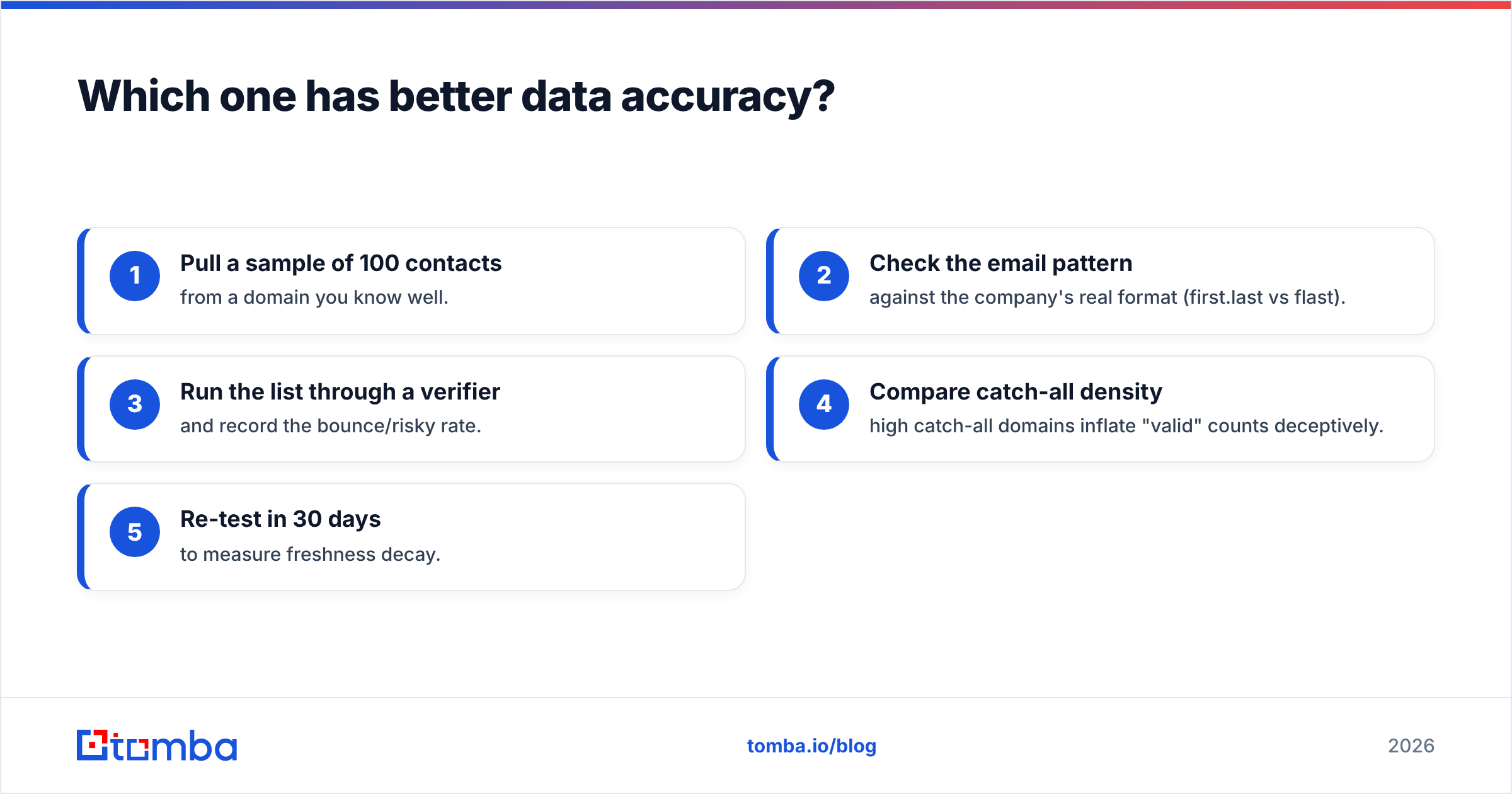
- Pull a sample of 100 contacts from a domain you know well.
- Check the email pattern against the company's real format (first.last vs flast).
- Run the list through a verifier and record the bounce/risky rate.
- Compare catch-all density — high catch-all domains inflate "valid" counts deceptively.
- Re-test in 30 days to measure freshness decay.
Do this once and the marketing numbers stop mattering — you'll see the real cost-per-valid-contact.
Is Clearbit better than Datanyze for enrichment?#
Yes — for enrichment specifically, Clearbit wins. It was purpose-built for it. The real-time API, the form-shortening (auto-filling fields so prospects type less), and the native HubSpot workflows are genuinely strong if that's your stack. Datanyze doesn't seriously compete here; enrichment isn't its core job.
But "better at enrichment" comes with a price tag and a lock-in cost. Since the HubSpot acquisition, getting Breeze Intelligence outside of HubSpot is awkward, and pricing is no longer the transparent self-serve model Clearbit was once known for. You're buying into an ecosystem, not just a data feed.
If you want enrichment without the platform marriage, a standalone data enrichment API lets you enrich records inside whatever CRM you already run — Salesforce, Pipedrive, a spreadsheet, or your own app — without rebuilding your stack around one vendor.
)
Is Datanyze better than Clearbit for quick prospecting?#
For a solo rep who wants a Chrome extension that surfaces a phone number and tech stack while browsing LinkedIn, Datanyze is the lighter, cheaper pick. It starts around $21/seat/month and gets you moving in minutes. There's no implementation project, no RevOps sign-off, no API integration sprint.
The ceiling is the problem. Datanyze caps credits quickly, its contact coverage outside US mid-market is patchy, and it doesn't scale into a team-wide data operation. It's a personal tool, not infrastructure. The moment you need bulk lists, deduplication, or programmatic access, you've outgrown it.
This is where the "neither" answer gets honest. If your bottleneck is volume of verified contacts, you want a tool whose entire reason for existing is finding emails — not a prospecting sidebar or an enrichment bus. Tomba's bulk email finder and domain search are built for exactly that: feed a list of companies, get back verified contacts with confidence scores.
How does pricing compare across all three options?#
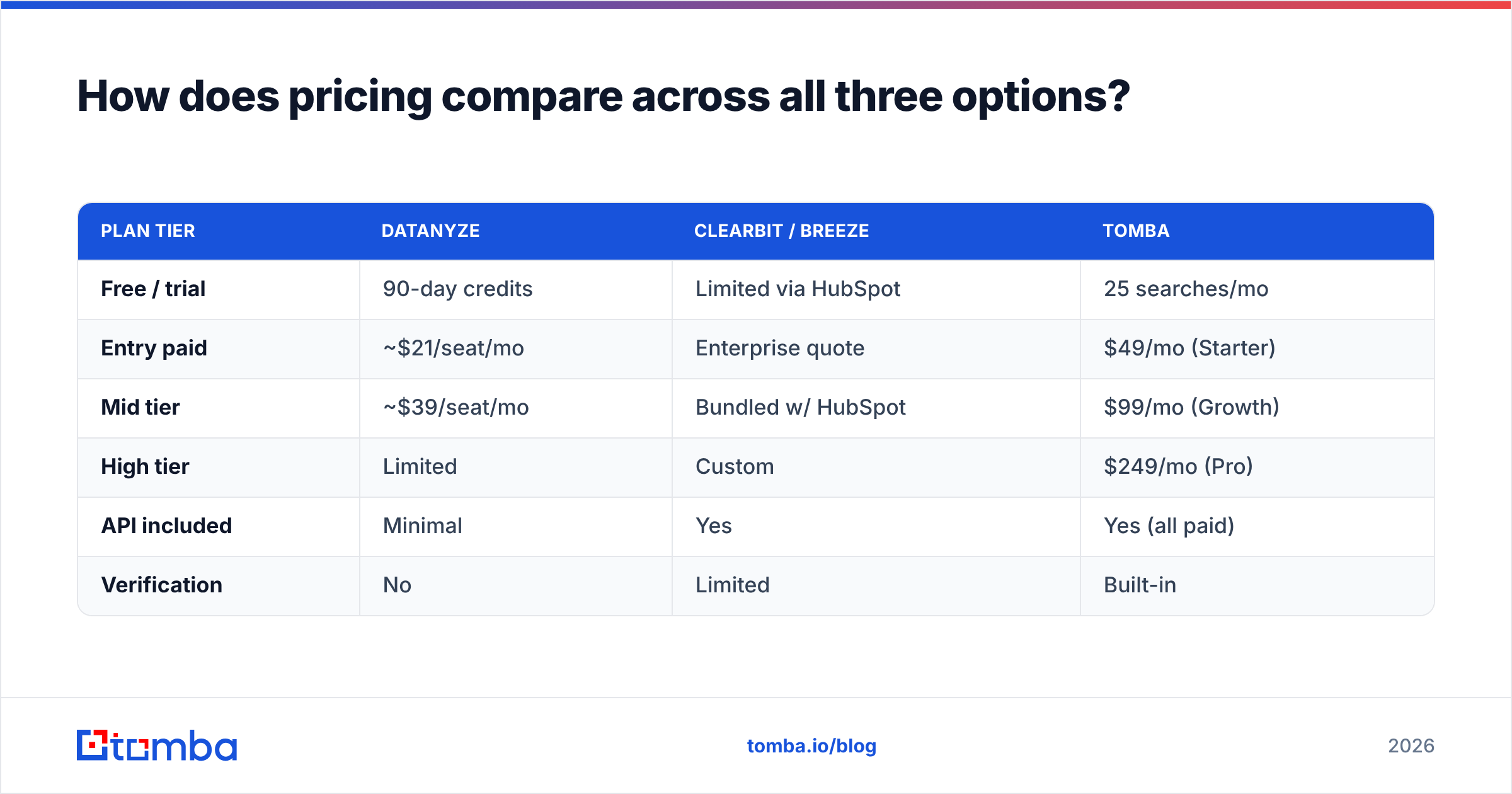
Pricing is where the three tools separate most sharply. Datanyze is cheap-to-start but capped. Clearbit/Breeze is effectively enterprise. Tomba sits in the middle with transparent self-serve tiers and a real free plan.
| Plan tier | Datanyze | Clearbit / Breeze | Tomba |
|---|---|---|---|
| Free / trial | 90-day credits | Limited via HubSpot | 25 searches/mo |
| Entry paid | ~$21/seat/mo | Enterprise quote | $49/mo (Starter) |
| Mid tier | ~$39/seat/mo | Bundled w/ HubSpot | $99/mo (Growth) |
| High tier | Limited | Custom | $249/mo (Pro) |
| API included | Minimal | Yes | Yes (all paid) |
| Verification | No | Limited | Built-in |
The honest read: if you're a single rep who wants technographics, Datanyze's $21 is hard to beat for that narrow job. If you're a HubSpot shop with budget, Breeze is the path of least resistance. But if you're measuring cost per verified email for outbound, a focused finder-plus-verifier wins on unit economics — you're not paying for a platform you only use 10% of.
You can see Tomba's full pricing details without talking to a sales rep, which is itself a tell about who each tool is built for.
What about API access and automation?#
If you're automating — enriching leads on signup, scoring inbound, or running outbound at scale — API quality matters more than the UI. Clearbit historically had one of the best-documented enrichment APIs in the category, and that strength carries into Breeze, though access terms have tightened post-acquisition. Datanyze's API is minimal; it's not the tool you build a pipeline on.
For developers, the relevant comparison is integration surface and reliability. Tomba exposes a full email finder API, plus a CLI and an MCP server for AI agents, so you can wire finding-and-verifying into the same automation that handles your enrichment. Native integrations with HubSpot, Salesforce, Zapier, and Google Sheets mean you don't have to choose between "in my CRM" and "in my code."
A practical architecture a lot of teams land on: use one tool for company-level enrichment, and a dedicated finder/verifier for the contact layer. They're not mutually exclusive — they're solving different halves of the problem.
When should you pick a dedicated email finder instead?#
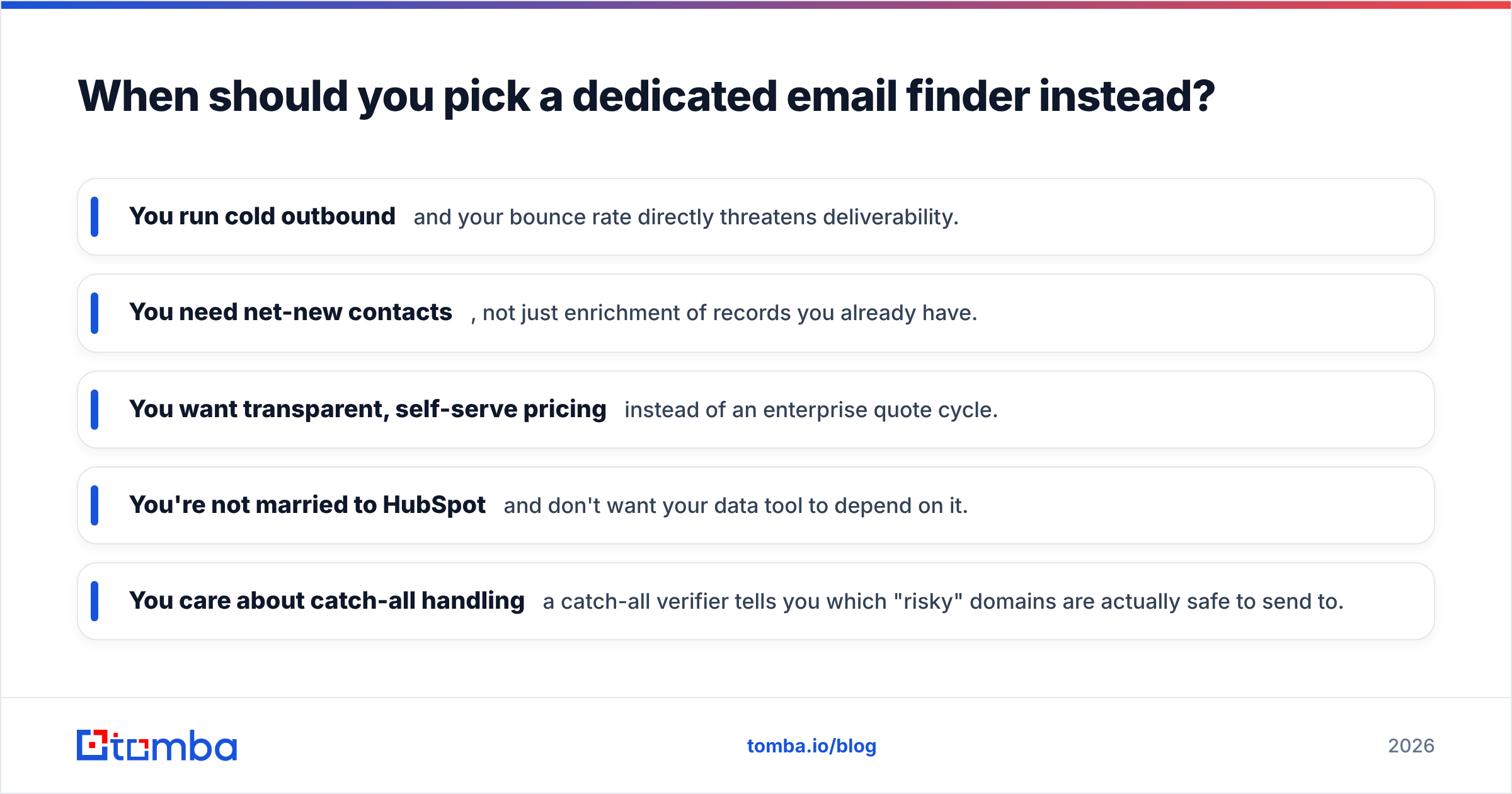
Pick a dedicated finder when finding and verifying contacts is the job to be done, not a side feature. Concretely, that's when:
- You run cold outbound and your bounce rate directly threatens deliverability.
- You need net-new contacts, not just enrichment of records you already have.
- You want transparent, self-serve pricing instead of an enterprise quote cycle.
- You're not married to HubSpot and don't want your data tool to depend on it.
- You care about catch-all handling — a catch-all verifier tells you which "risky" domains are actually safe to send to.
Clearbit and Datanyze are fine at what they were built for. But both treat email-finding as a byproduct of another workflow, and it shows in coverage and verification depth. According to peer reviews on G2, the most common complaint across enrichment tools is exactly this: great company data, unreliable contact emails.
For context on where these tools sit in the broader market, HubSpot's own enrichment documentation describes Breeze Intelligence as an enhancement to the CRM rather than a standalone data product — which confirms the direction of travel. If you want to go deeper on the category mechanics, the data enrichment overview is a neutral starting point.
So, Clearbit or Datanyze — what's the verdict?#
Choose Clearbit/Breeze if you're a HubSpot team that wants enrichment baked into the CRM and has the budget. Choose Datanyze if you're a solo rep who wants cheap technographics and a quick Chrome-extension pull. Choose neither if your actual bottleneck is finding and verifying email addresses at scale — because that's a category both tools only dabble in.
The smartest setup for most outbound teams isn't picking one of these two. It's running enrichment where it makes sense and pairing it with a tool whose whole job is delivering verified, deliverable contacts.
That's the gap Tomba fills. Start with the Tomba Email Finder to pull verified professional emails by name, domain, or company, then verify the whole list before you send. The free tier gives you 25 searches a month to test the accuracy against your own known contacts — run the 100-contact pressure-test above and let the bounce rate decide. No enterprise quote, no ecosystem lock-in, $49/mo when you're ready to scale.
Find the email. Verify it. Then send. That's the whole job — and it deserves a tool built for exactly that.
Ready to find emails that actually work?
Join 150,000+ professionals who stopped guessing and started sending. Free credits on signup — no credit card required.
Get the Tomba newsletter
Practical outbound tactics and product updates — once every two weeks.
About the author