Clearbit vs Demandbase 2026: Which ABM Data Platform Wins?
A neutral, hands-on breakdown of Clearbit vs Demandbase in 2026 — enrichment depth, intent data, pricing, and where a leaner stack beats both.
Choosing between Clearbit and Demandbase usually means choosing between two very different jobs that happen to share a "B2B data" label. One enriches records and reveals who's on your website. The other runs full account-based advertising and orchestration across a sales-and-marketing motion. Picking the wrong one wastes a five- or six-figure budget on capabilities you'll never switch on.
This is a neutral teardown of Clearbit vs Demandbase for 2026 — what each platform actually does, where they overlap, what they cost, and when a leaner, contact-data-first stack does the part you genuinely need for a fraction of the price.
TL;DR#
- Clearbit (now HubSpot Breeze Intelligence) is an enrichment and reveal layer — it fills in company/contact fields and identifies anonymous traffic. Best for HubSpot-centric teams that want clean data and form shortening.
- Demandbase is a full account-based marketing (ABM) platform — intent data, advertising, account orchestration, and a sales intelligence module. Best for enterprise teams running coordinated, multi-channel ABM.
- They overlap on firmographic enrichment and intent, but Demandbase is an order of magnitude larger in scope, price, and onboarding effort.
- Pricing diverges hard: Clearbit/Breeze is credit- and seat-based; Demandbase is a custom enterprise contract usually starting in the tens of thousands per year.
- If your real need is accurate contact and email data feeding a CRM or outbound tool, neither platform is the cheapest route — a focused data enrichment provider covers it for far less.
What is Clearbit?#
Clearbit is a B2B data enrichment and website intelligence tool. It was acquired by HubSpot and now ships as Breeze Intelligence, though many teams still refer to it as Clearbit. Its core jobs are simple and well-defined:
- Enrichment — take an email or domain and return firmographics (industry, size, revenue, tech stack) plus contact attributes.
- Reveal — de-anonymize website visitors by matching IP to company, so you can see which accounts browse without filling out a form.
- Form shortening — auto-fill or hide fields you can enrich behind the scenes, lifting conversion.
- Scoring and routing — push enriched data into HubSpot/Salesforce to qualify and route leads.
Clearbit's strength is being a quiet, accurate plumbing layer. If you live in HubSpot, the native integration is the cleanest on the market. Its weakness is that it is only a data layer — it does not run advertising, it does not orchestrate plays, and its standalone roadmap narrowed after the HubSpot acquisition. You can read what the product looks like today on the official clearbit.com site.

What is Demandbase?#
Demandbase is a full account-based GTM platform. Where Clearbit is a layer, Demandbase is a system. It bundles several products that historically were sold separately:
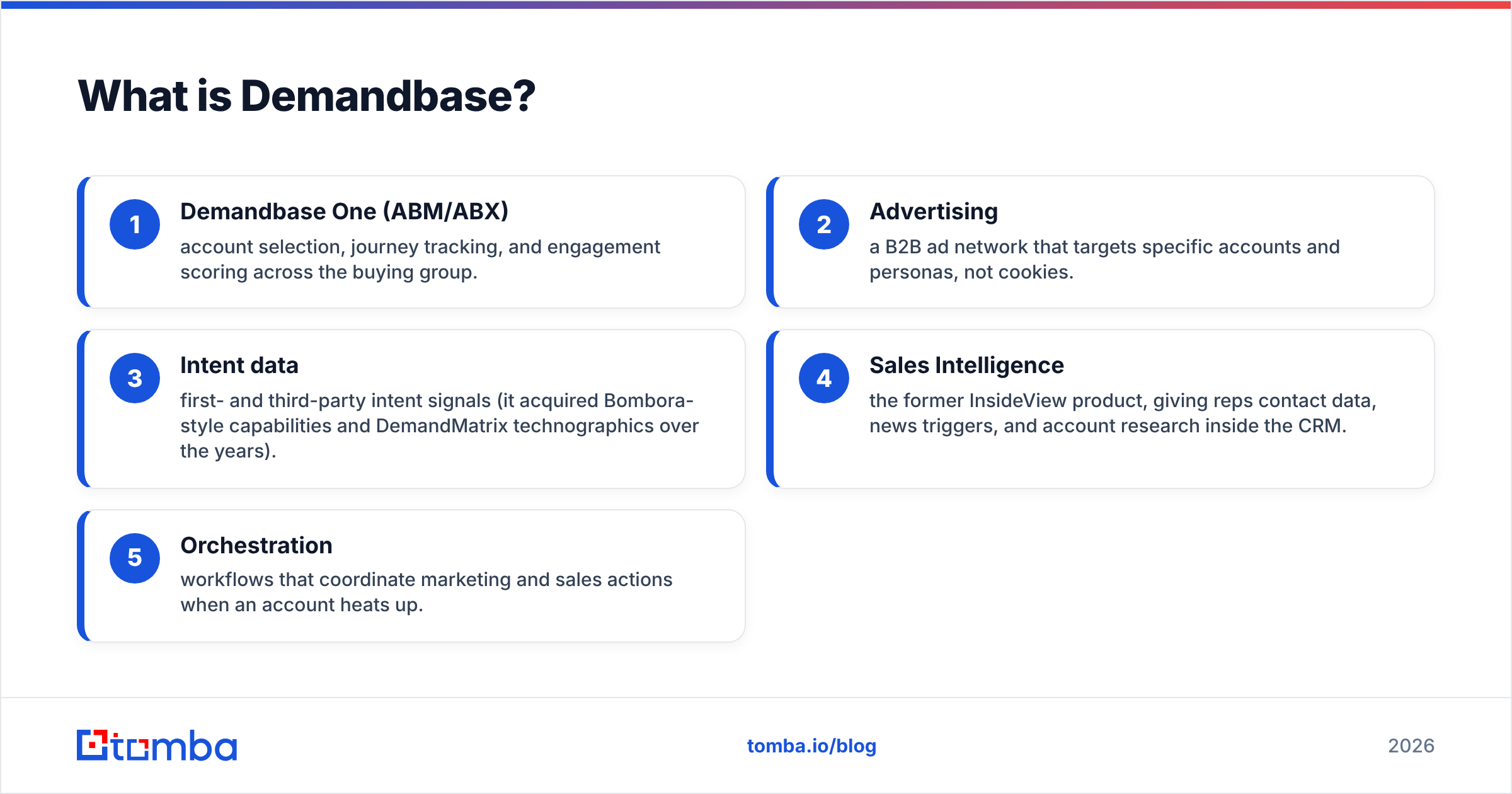
- Demandbase One (ABM/ABX) — account selection, journey tracking, and engagement scoring across the buying group.
- Advertising — a B2B ad network that targets specific accounts and personas, not cookies.
- Intent data — first- and third-party intent signals (it acquired Bombora-style capabilities and DemandMatrix technographics over the years).
- Sales Intelligence — the former InsideView product, giving reps contact data, news triggers, and account research inside the CRM.
- Orchestration — workflows that coordinate marketing and sales actions when an account heats up.
Demandbase is built for enterprise revenue teams who want one pane of glass for targeting, advertising, and sales alignment. That scope is the selling point and the cost. Onboarding is a project measured in weeks, not an afternoon. Check the capability list on demandbase.com and the verified-buyer reviews on G2 before assuming you'll use even half of it.
Clearbit vs Demandbase: how do they compare head-to-head?#
Here's the side-by-side on the dimensions that actually drive a buying decision.
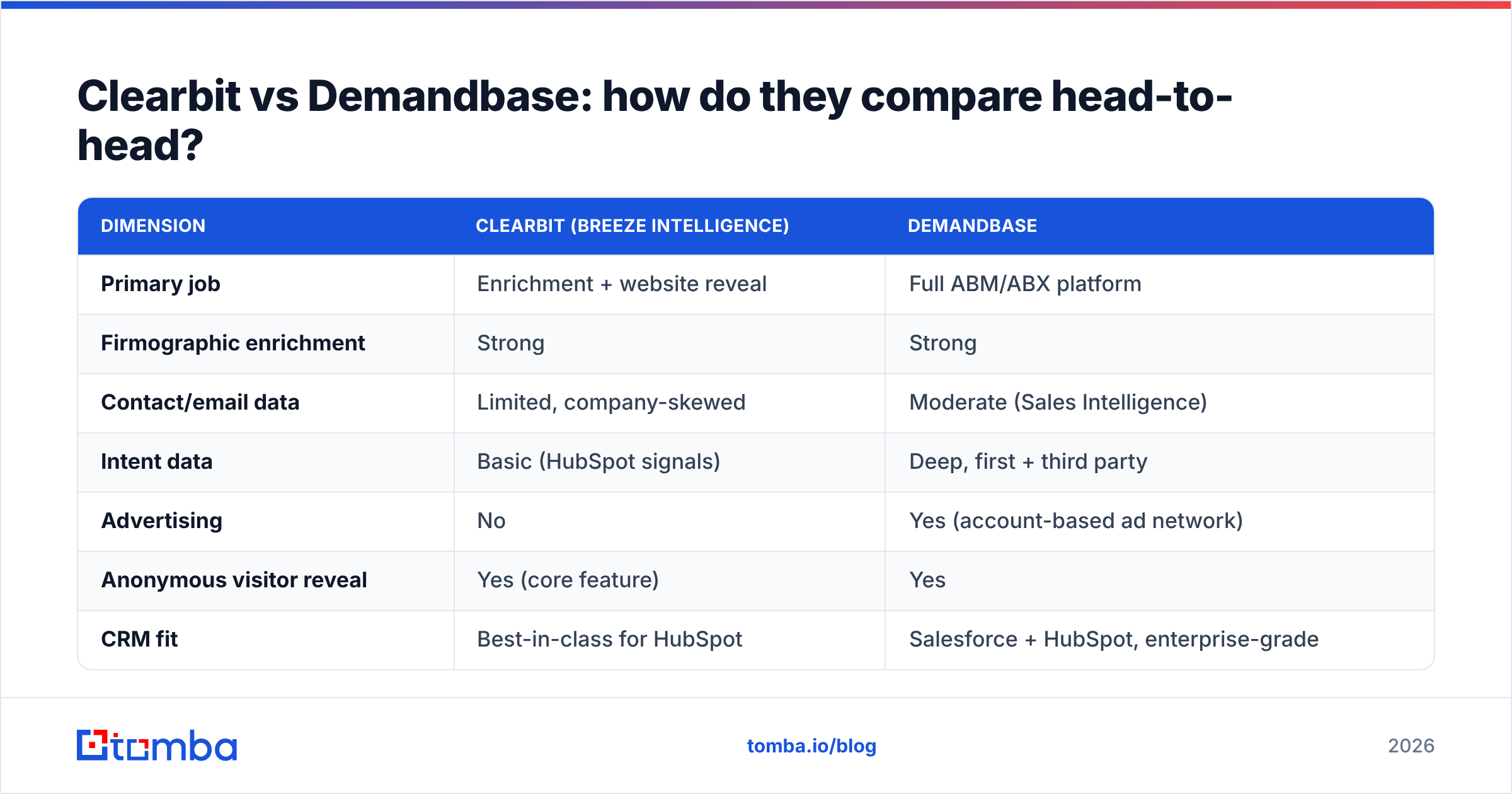
| Dimension | Clearbit (Breeze Intelligence) | Demandbase |
|---|---|---|
| Primary job | Enrichment + website reveal | Full ABM/ABX platform |
| Firmographic enrichment | Strong | Strong |
| Contact/email data | Limited, company-skewed | Moderate (Sales Intelligence) |
| Intent data | Basic (HubSpot signals) | Deep, first + third party |
| Advertising | No | Yes (account-based ad network) |
| Anonymous visitor reveal | Yes (core feature) | Yes |
| CRM fit | Best-in-class for HubSpot | Salesforce + HubSpot, enterprise-grade |
| Setup effort | Hours | Weeks (guided onboarding) |
| Buyer profile | SMB to mid-market | Mid-market to enterprise |
| Starting price | Credit/seat based, low four figures | Custom, typically $20K–$80K+/yr |
The pattern is consistent: Demandbase wins on breadth, Clearbit wins on simplicity and HubSpot-native cleanliness. Neither is "better" in the abstract — they answer different questions. If your question is "how do I run coordinated account advertising and intent-based plays," that's Demandbase. If it's "how do I keep my CRM records clean and see who's on my site," that's Clearbit.
Which one has better data accuracy?#
Accuracy depends on the field type, and this is where buyers get surprised. Both platforms are strong on firmographics — company size, industry, revenue bands, and HQ location are reliable on both. The gap shows up on contact-level data: direct dials, verified work emails, and current job titles.
Clearbit historically skewed company-first; its person-level coverage thinned outside of well-documented companies. Demandbase's Sales Intelligence (the InsideView lineage) is broader on contacts but is bundled into a larger contract you may not want. In both cases, email data is enriched and inferred — it is not necessarily verified deliverable at the moment you send.
That distinction matters more than any vendor benchmark. An enriched email that bounces still hurts your sender reputation. If contact accuracy is your actual priority, you want a provider whose core job is finding and verifying the address — not a platform where contact data is a secondary module. That's exactly the gap a dedicated email verifier closes before a campaign ships.
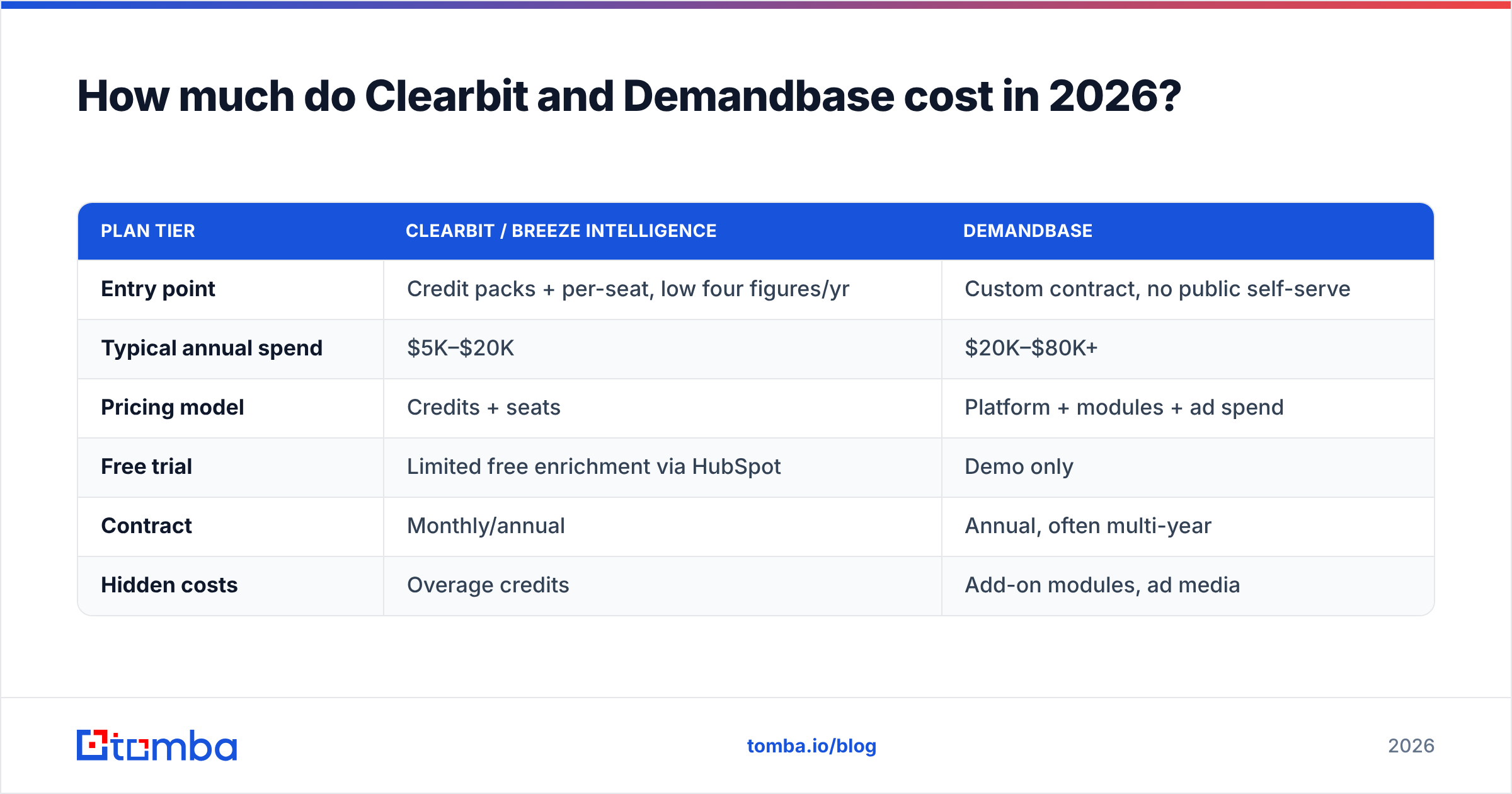
How much do Clearbit and Demandbase cost in 2026?#
Pricing is the cleanest way to tell these tools apart, because it reflects who each is built for.
| Plan tier | Clearbit / Breeze Intelligence | Demandbase |
|---|---|---|
| Entry point | Credit packs + per-seat, low four figures/yr | Custom contract, no public self-serve |
| Typical annual spend | $5K–$20K | $20K–$80K+ |
| Pricing model | Credits + seats | Platform + modules + ad spend |
| Free trial | Limited free enrichment via HubSpot | Demo only |
| Contract | Monthly/annual | Annual, often multi-year |
| Hidden costs | Overage credits | Add-on modules, ad media |
Two things to flag. First, Demandbase's number scales with the modules you light up — advertising and intent add materially to the base. Second, neither tool's price is justified if all you need is contact data and enrichment for an outbound or RevOps workflow. That's the over-buying trap: paying for an ABM engine to do the job of a bulk email finder.
When should you choose Clearbit?#
Pick Clearbit (Breeze Intelligence) when:
- You're a HubSpot shop. The native integration is the cleanest enrichment experience in that ecosystem, full stop.
- Your main pain is dirty CRM data. Auto-enrichment on form fill and ongoing record refresh is exactly what it's for.
- You want website reveal without a platform commitment. Seeing which accounts browse anonymously is a strong, contained use case.
- You're SMB to mid-market and don't need an ad network or multi-touch orchestration.
Skip it if you need account-based advertising, deep third-party intent, or a standalone roadmap independent of HubSpot's priorities.
When should you choose Demandbase?#
Pick Demandbase when:
- You run true ABM at scale. Coordinated targeting across advertising, marketing, and sales is its reason to exist.
- Intent data drives your motion. First- and third-party signals feeding account prioritization is a genuine strength.
- You need account-based advertising. Few competitors run a B2B ad network this mature.
- You have the team to operate it. Demandbase rewards organizations with a RevOps function and dedicated ABM owners; it punishes teams that buy it and under-staff it.
Skip it if you're a small team, your budget is five figures total, or your real need is contact data rather than orchestration.
Is there a leaner alternative to both?#
Yes — and it depends on what part of these platforms you actually use. Most teams evaluating Clearbit vs Demandbase are really after one or two jobs: clean contact data, verified emails, and maybe website visitor identification. You don't need a six-figure ABM suite for that.
A focused stack splits the job:
- Contact discovery and emails — a dedicated email finder returns verified work emails by name, domain, or company, with deliverability checked at the source.
- Enrichment — append firmographics and contact attributes through an enrichment API instead of a bundled platform module.
- Verification — confirm addresses are deliverable before send, including catch-all verification that most enrichment tools skip.
- Visitor reveal — identify anonymous traffic with a standalone website visitor reveal tool rather than a full ABM license.
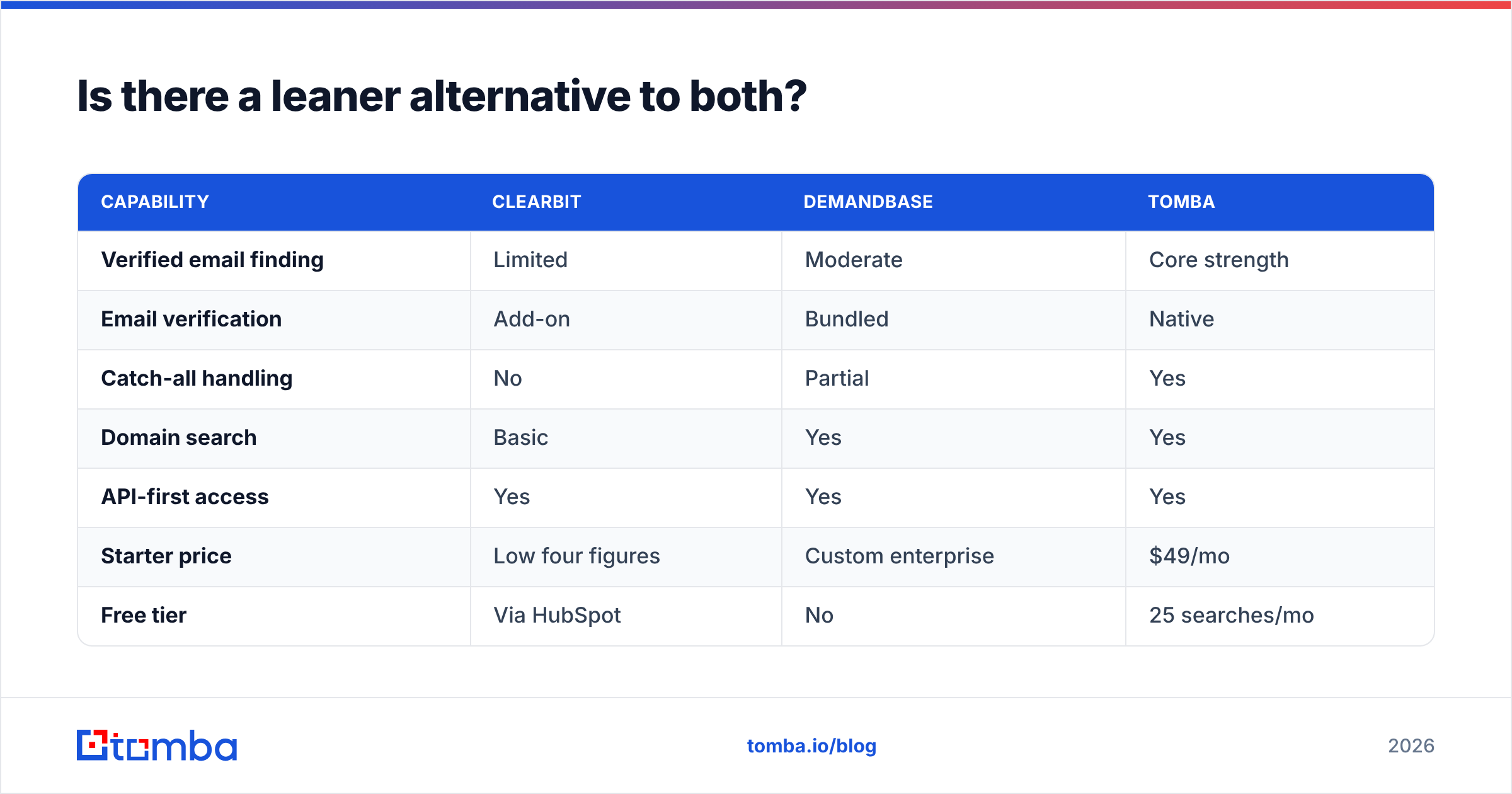
Here's how that approach stacks up against the two incumbents on the contact-data job specifically:
| Capability | Clearbit | Demandbase | Tomba |
|---|---|---|---|
| Verified email finding | Limited | Moderate | Core strength |
| Email verification | Add-on | Bundled | Native |
| Catch-all handling | No | Partial | Yes |
| Domain search | Basic | Yes | Yes |
| API-first access | Yes | Yes | Yes |
| Starter price | Low four figures | Custom enterprise | $49/mo |
| Free tier | Via HubSpot | No | 25 searches/mo |
The point isn't that Tomba replaces a full ABM platform — it doesn't run account advertising. The point is that the contact-data layer of Clearbit and Demandbase, the part most buyers actually touch daily, is available standalone for a fraction of the cost. Compare the full Tomba pricing against a Demandbase contract and the math is hard to ignore: a Free tier at 25 searches/mo, Starter at $49/mo, Growth at $99/mo, and Pro at $249/mo.
If you're specifically shopping for a Clearbit alternative or a Demandbase alternative, the decision usually comes down to whether you're buying a platform or buying data. Buy the platform only if you'll operate the platform.
How do you actually decide?#
Run this three-question filter before you sign anything:
- Do I need advertising and orchestration, or just data? If just data, neither full platform is your cheapest path.
- What's my CRM? Pure HubSpot tilts toward Clearbit; complex Salesforce-driven enterprise motions tilt toward Demandbase.
- Who operates it after the sale? Demandbase without a RevOps owner becomes expensive shelfware; Clearbit runs itself.
Most mid-market teams discover they over-scoped. They wanted clean, verified contacts flowing into outreach and a CRM — and they were about to pay enterprise ABM prices for it. Match the tool to the job, not to the logo.
The bottom line#
Clearbit and Demandbase aren't really competitors so much as two points on a spectrum: Clearbit is a tidy enrichment-and-reveal layer (now living inside HubSpot), and Demandbase is a heavyweight ABM platform for teams that run coordinated account advertising and intent plays. Choose Clearbit for HubSpot-native data hygiene, Demandbase for enterprise account-based GTM — and choose neither if the only thing you actually need is accurate, verified contact data.
If that last line is you, start with the data layer. The Tomba Email Finder finds professional email addresses by domain, name, or company and verifies them before they hit your sequence — no enterprise contract, no weeks-long onboarding, and a free tier to test against your own target accounts today. Spend the budget you saved on the campaigns themselves.
// get started
Find, verify and enrich your first contacts today
Start on the free plan with 25 searches a month, then scale when your team is ready.
Free plan · No credit card required · GDPR & CCPA
// about the author