Clearbit vs DiscoverOrg 2026: B2B Data Platforms Compared
Clearbit and DiscoverOrg shaped modern B2B data — but both got absorbed by bigger platforms. Here's how they actually compare in 2026, and what to use instead.
Clearbit vs DiscoverOrg: Which B2B Data Platform Wins in 2026?
If you're comparing Clearbit vs DiscoverOrg today, you're really comparing two products that no longer exist in their original form. Both were category-defining B2B data tools. Both got swallowed by larger companies. And the choice you're actually making in 2026 is less "which of these two" and more "which philosophy of data fits my go-to-market motion — and what do I use now that both are bundled into platforms I may not want."
This guide breaks down what each tool was built for, how they differ, where they ended up, and how to pick a stack that gets you accurate contact data without a five-figure annual commitment.
TL;DR#
- Clearbit = real-time enrichment and firmographic API, built for marketers and developers. It now lives inside HubSpot as Breeze Intelligence.
- DiscoverOrg = deep, human-verified org charts and direct-dial sales intelligence, built for outbound sales teams. It merged with ZoomInfo in 2019 and the brand was retired.
- They never really competed head-to-head: Clearbit enriched records you already had; DiscoverOrg sold you the records and the org map.
- Both are now expensive, platform-locked, and overkill if you mainly need verified emails and direct contact data.
- For most teams, a focused email finder plus enrichment — like Tomba — covers 80% of the job at a fraction of the cost.
What is Clearbit and what was it built for?#
Clearbit is a real-time data enrichment platform. Its core idea: you give it one identifier — an email, a domain, an IP address — and it returns a rich profile of firmographic and demographic attributes (company size, industry, tech stack, revenue band, role, seniority).
Marketers loved it because it shortened lead forms. Instead of asking a prospect for 11 fields, you ask for an email and let Clearbit fill in the rest. Developers loved the API. RevOps teams loved Clearbit Reveal, which de-anonymized website traffic by matching IPs to companies.
In late 2023, HubSpot acquired Clearbit, and over 2024–2025 it was folded into the HubSpot ecosystem and rebranded Breeze Intelligence. The standalone product and its independent API were progressively deprecated. If you're not a HubSpot customer in 2026, Clearbit-as-you-remember-it is mostly gone.

What is DiscoverOrg and how is it different?#
DiscoverOrg approached data from the opposite end. Rather than enriching records you already had, it sold you the records — and not just contact rows, but detailed, human-verified organizational charts.
DiscoverOrg's differentiator was a research team that manually confirmed reporting structures, direct-dial phone numbers, and buying-committee maps inside target accounts. For an outbound SDR trying to reach a VP of Engineering at a 4,000-person company, that org chart was gold. You knew who reported to whom, who controlled budget, and which direct line actually rang the right desk.
In 2019, DiscoverOrg merged with ZoomInfo (technically DiscoverOrg acquired ZoomInfo and took the ZoomInfo name). The DiscoverOrg brand was retired, and its intelligence became part of the ZoomInfo platform you see today.
So the honest framing: Clearbit vs DiscoverOrg is a comparison of two data philosophies — automated enrichment versus human-verified sales intelligence — both of which now live inside larger suites.
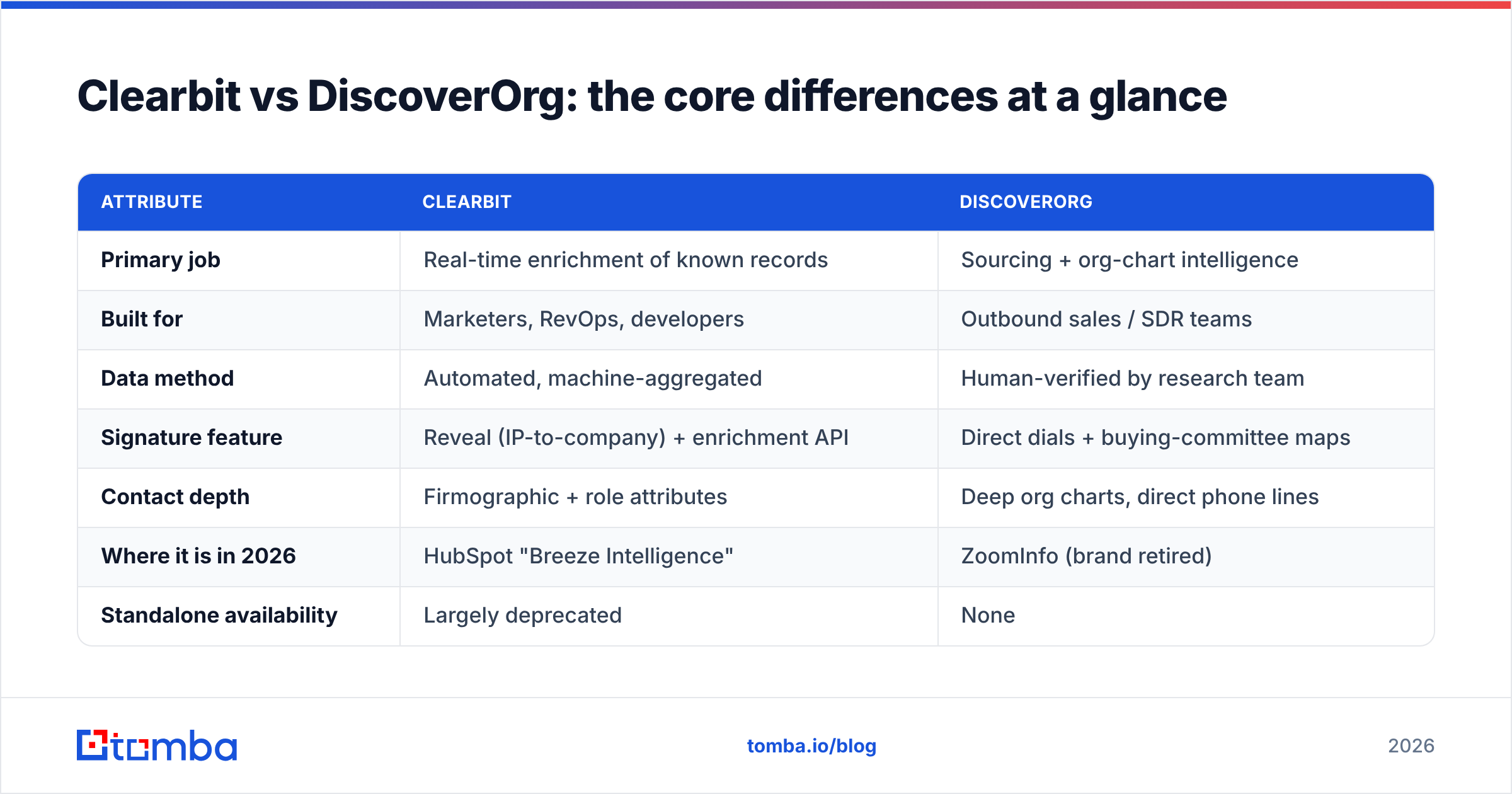
Clearbit vs DiscoverOrg: the core differences at a glance#
Here's how the two platforms compared at their peak, and where each lives now.
| Attribute | Clearbit | DiscoverOrg |
|---|---|---|
| Primary job | Real-time enrichment of known records | Sourcing + org-chart intelligence |
| Built for | Marketers, RevOps, developers | Outbound sales / SDR teams |
| Data method | Automated, machine-aggregated | Human-verified by research team |
| Signature feature | Reveal (IP-to-company) + enrichment API | Direct dials + buying-committee maps |
| Contact depth | Firmographic + role attributes | Deep org charts, direct phone lines |
| Where it is in 2026 | HubSpot "Breeze Intelligence" | ZoomInfo (brand retired) |
| Standalone availability | Largely deprecated | None |
| Typical cost | High; bundled into HubSpot tiers | Enterprise; 5-figure annual |
The pattern is clear: both delivered serious value, both got absorbed, and both now require committing to a much larger (and pricier) platform to access.
Which one had better data accuracy?#
It depends on the data type — and both have a structural weakness now.
DiscoverOrg generally won on contact accuracy and direct dials because humans verified the records. When a person verifies that Jane Doe is the Director of IT and her direct line is X, that record starts more accurate than a machine-aggregated guess. The trade-off: human verification is slow, so coverage was narrower and the data aged between refresh cycles.
Clearbit generally won on breadth and freshness of firmographic data because automation scales. It could enrich millions of records in real time with company attributes and tech-stack signals. The trade-off: automated email and direct-contact data is only as good as its sources, and personal contact accuracy lagged behind human-verified providers.
Here's the catch in 2026: all aggregated B2B data decays. Roughly 25–30% of contact data goes stale every year as people change jobs. A platform's accuracy claim on day one means little if you're not re-verifying at the moment of outreach. That's why a live email verifier matters more than any vendor's headline accuracy number — you verify the address right before you hit send, not whenever the database was last refreshed.
For more on how contact data is sourced and why verification beats static databases, see where Tomba gets its data.
What does Clearbit vs DiscoverOrg cost in 2026?#
Neither is a casual purchase, and neither sells the original product cleanly anymore.
- Clearbit / Breeze Intelligence is now metered inside HubSpot. You generally need a qualifying HubSpot subscription, and enrichment credits are bundled or sold as add-ons. There's no simple standalone "Clearbit plan" to buy.
- DiscoverOrg / ZoomInfo is sold as annual enterprise contracts, frequently in the $15,000–$40,000+/year range depending on seats, credits, and modules. There is no self-serve monthly tier and pricing is quote-based.
If your actual need is "find and verify B2B contacts reliably," paying enterprise SaaS pricing for a bundled intelligence suite is a lot of overhead. This is where a focused tool changes the math.
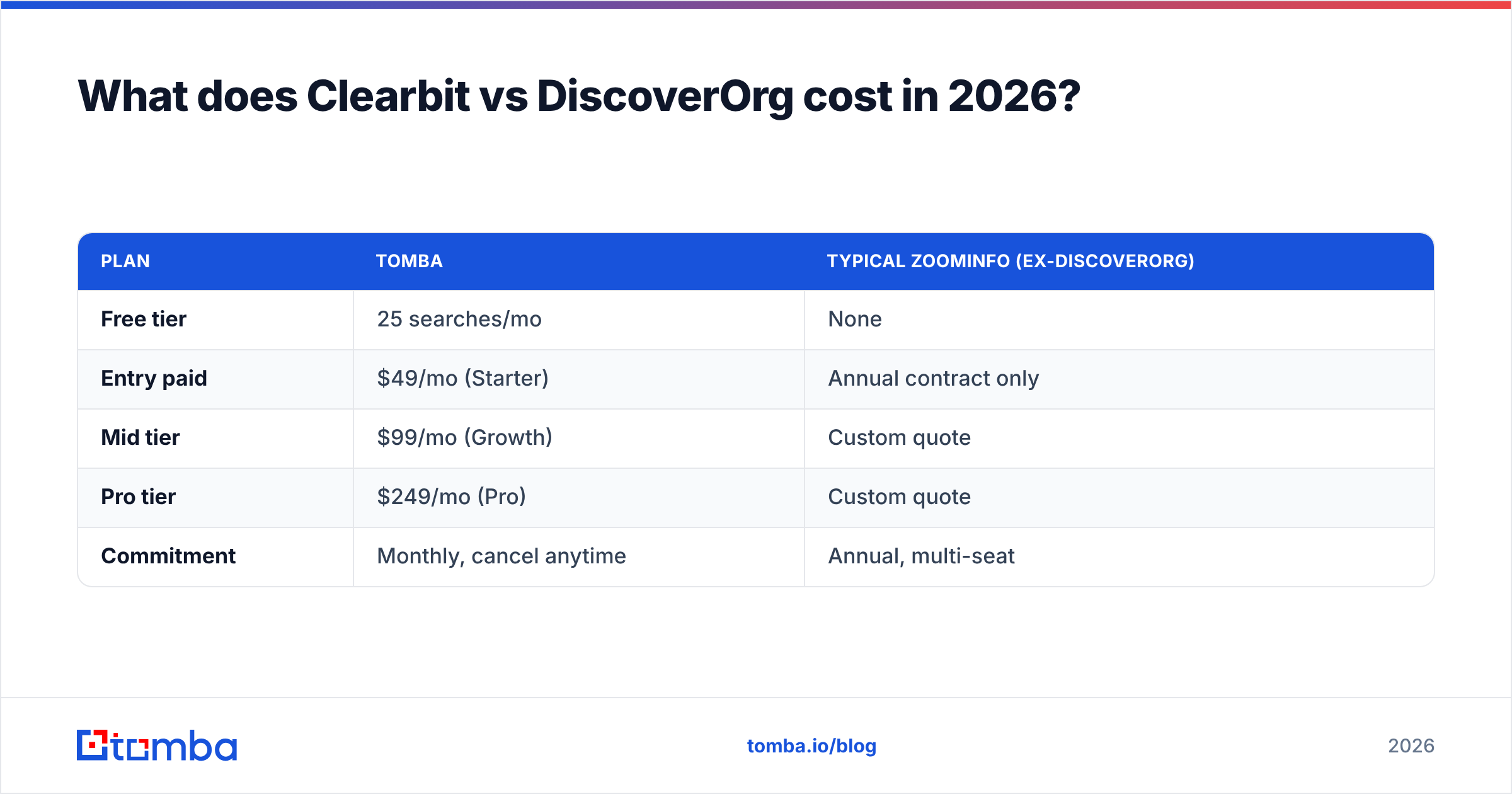
| Plan | Tomba | Typical ZoomInfo (ex-DiscoverOrg) |
|---|---|---|
| Free tier | 25 searches/mo | None |
| Entry paid | $49/mo (Starter) | Annual contract only |
| Mid tier | $99/mo (Growth) | Custom quote |
| Pro tier | $249/mo (Pro) | Custom quote |
| Commitment | Monthly, cancel anytime | Annual, multi-seat |
See full Tomba pricing for credit counts per tier. The point isn't that Tomba does everything ZoomInfo does — it doesn't run a 100-person human research team. The point is that most teams don't need that. They need accurate emails, verified contacts, and enrichment, on a monthly plan they can actually expense.

Is Clearbit better than DiscoverOrg for your team?#
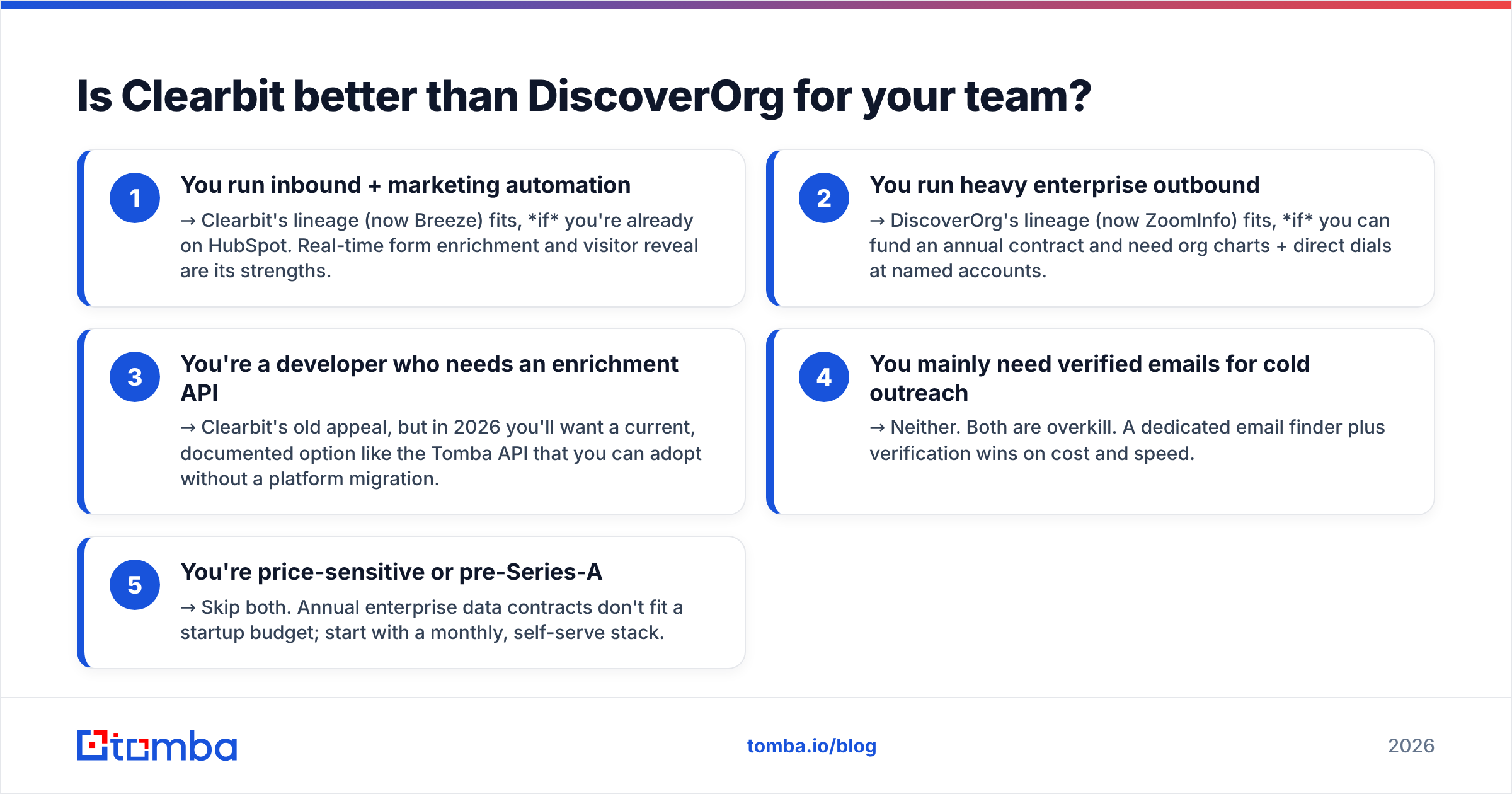
Match the tool to the motion. Use this to decide quickly:
- You run inbound + marketing automation → Clearbit's lineage (now Breeze) fits, if you're already on HubSpot. Real-time form enrichment and visitor reveal are its strengths.
- You run heavy enterprise outbound → DiscoverOrg's lineage (now ZoomInfo) fits, if you can fund an annual contract and need org charts + direct dials at named accounts.
- You're a developer who needs an enrichment API → Clearbit's old appeal, but in 2026 you'll want a current, documented option like the Tomba API that you can adopt without a platform migration.
- You mainly need verified emails for cold outreach → Neither. Both are overkill. A dedicated email finder plus verification wins on cost and speed.
- You're price-sensitive or pre-Series-A → Skip both. Annual enterprise data contracts don't fit a startup budget; start with a monthly, self-serve stack.
The uncomfortable truth most comparison posts skip: the "winner" between Clearbit and DiscoverOrg is usually "neither, for what you actually do." They were enterprise tools that became enterprise-platform features. If your job is reaching the right person, you can assemble a sharper, cheaper stack.
What's the practical alternative in 2026?#
Build around the job, not the brand. The job is almost always: find the right contact, confirm the email is real, enrich it with context, and reach out.
A lean modern stack looks like this:
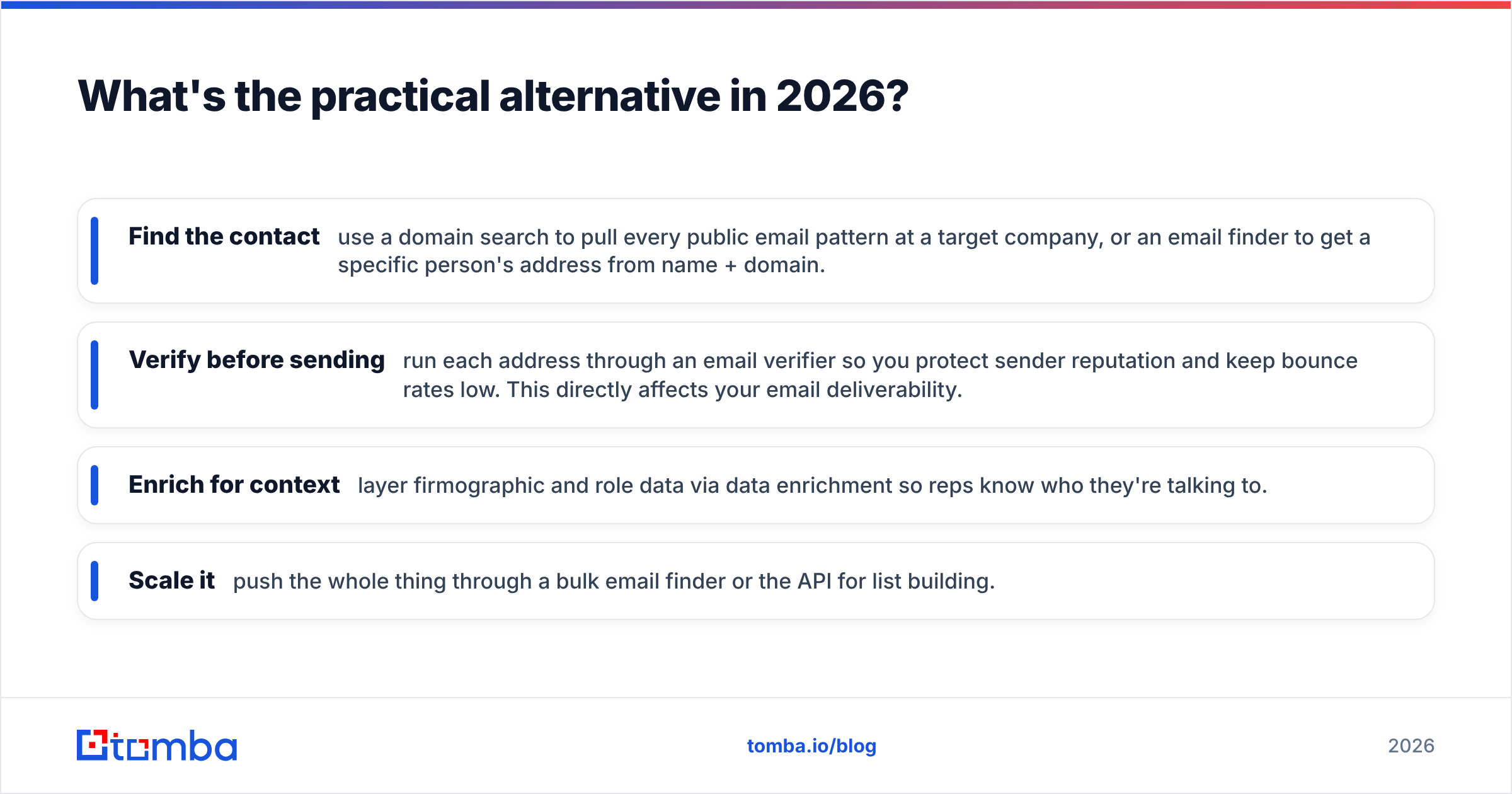
- Find the contact — use a domain search to pull every public email pattern at a target company, or an email finder to get a specific person's address from name + domain.
- Verify before sending — run each address through an email verifier so you protect sender reputation and keep bounce rates low. This directly affects your email deliverability.
- Enrich for context — layer firmographic and role data via data enrichment so reps know who they're talking to.
- Scale it — push the whole thing through a bulk email finder or the API for list building.
This is the part Clearbit and DiscoverOrg made you buy an entire platform to get. You can now buy just the parts you use.
For deeper comparisons on enrichment-specific tooling, the Clearbit alternative breakdown covers feature-by-feature differences if Clearbit's deprecation is your specific pain point.
How do these tools handle deliverability and data hygiene?#
This is the dimension buyers underrate. A database can have a 95% "accuracy" stat and still wreck your sending if you blast unverified addresses.
Every bounce signals to mailbox providers that you might be a spammer, which degrades your sender reputation and lands future mail in spam — even mail to good addresses. Neither Clearbit nor DiscoverOrg was primarily a deliverability tool; they're data sources. You still need a verification layer between the data and the send.
The cleanest workflow:
- Pull contacts (finder / domain search).
- Verify in bulk and drop risky/invalid addresses.
- For ambiguous domains, run a catch-all verifier so you handle accept-all servers correctly instead of guessing.
- Only then load into your sequencer.
Treating data and verification as one continuous pipeline — rather than buying a static database and hoping — is what separates teams with 1% bounce rates from teams stuck in spam folders. For authoritative guidance on enrichment categories and vendor evaluation, G2's data enrichment category is a reasonable neutral starting point, and HubSpot's own documentation explains where Clearbit/Breeze now sits.
Clearbit vs DiscoverOrg: the honest verdict#
There's no single winner, because they were built for different jobs and both stopped being standalone products:
- Choose Clearbit's path (Breeze/HubSpot) if you live in HubSpot and want automated enrichment + visitor reveal baked into your marketing stack.
- Choose DiscoverOrg's path (ZoomInfo) if you run enterprise outbound, need verified org charts and direct dials, and can fund an annual contract.
- Choose neither if your real need is verified emails and contact data without platform lock-in or five-figure commitments — which describes most teams in 2026.
The market moved. The valuable, repeatable work — find the person, verify the address, enrich the record — got unbundled. You no longer have to buy a whole intelligence platform to do it well.
Start with the part you actually use#
If your goal is reaching real people at real companies, skip the platform tax. Use the Tomba Email Finder to find verified professional emails by name, domain, or company, then verify and enrich them in the same flow — on a monthly plan starting at $49, with a free tier to test first. You get the contact-data outcome Clearbit and DiscoverOrg were famous for, without inheriting an enterprise contract or a deprecated API. See the plans and put your first 25 searches to work today.
Ready to find emails that actually work?
Join 150,000+ professionals who stopped guessing and started sending. Free credits on signup — no credit card required.
Get the Tomba newsletter
Practical outbound tactics and product updates — once every two weeks.
About the author