Clearbit vs FullContact 2026: B2B Data Enrichment Compared
Clearbit vs FullContact in 2026: how the two enrichment platforms compare on data coverage, pricing, identity resolution, and which one actually fits a lean B2B sales team.
Clearbit vs FullContact: Which B2B Data Enrichment Platform Wins in 2026?
You are choosing between two of the longest-running names in data enrichment, and the marketing pages will not tell you which one fits your team. This breakdown does. We compare Clearbit (now folded into HubSpot's Breeze Intelligence) and FullContact (now part of the broader identity-resolution stack) on coverage, pricing, accuracy, and developer experience — then show where a leaner tool beats both for pure prospecting.
TL;DR#
- Clearbit is now HubSpot Breeze Intelligence. It is the strongest pick if you already live inside HubSpot and want firmographic enrichment baked into your CRM workflows.
- FullContact is an identity-resolution specialist. It shines at stitching fragmented customer records (emails, devices, social handles) into one profile — more a martech/identity play than a sales-prospecting tool.
- Neither is cheap or self-serve. Both push you toward annual contracts, and pricing is opaque once you outgrow the entry tier.
- If your real job is finding and verifying B2B email addresses for outbound, a focused tool like Tomba covers that slice at a fraction of the cost — transparent Tomba pricing starts at $49/mo.
- Decision rule: HubSpot shop → Clearbit. Identity stitching across channels → FullContact. Outbound prospecting on a budget → a dedicated email finder.
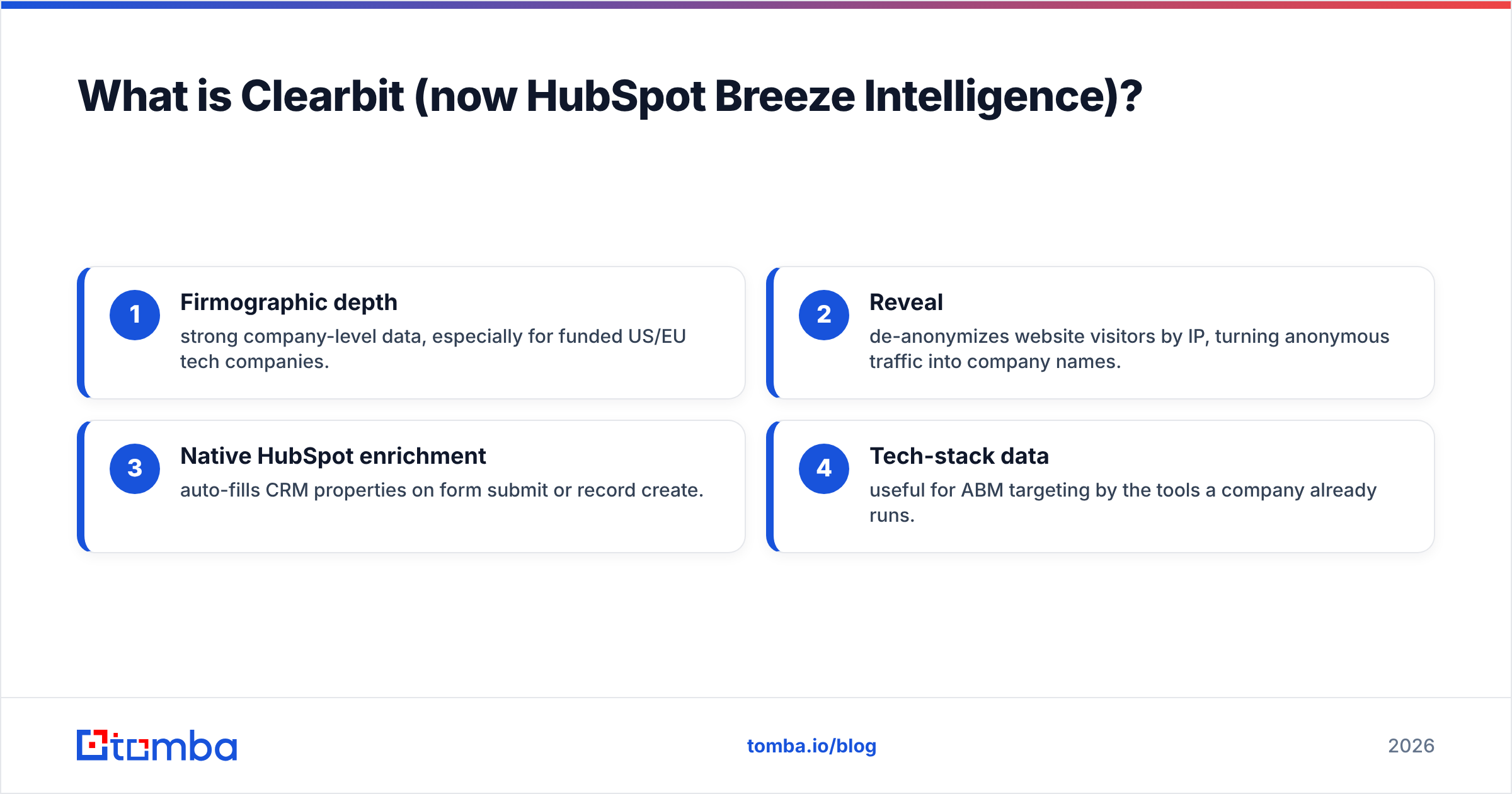
What is Clearbit (now HubSpot Breeze Intelligence)?#
Clearbit is a B2B data provider that enriches a company or person record from a single data point — usually an email or domain — and returns firmographic and demographic attributes: company size, industry, revenue, tech stack, role, seniority, and more. In 2023 HubSpot acquired Clearbit, and by 2025 the product was rebranded and absorbed into Breeze Intelligence, HubSpot's native enrichment layer.
That history matters. Clearbit as a standalone API still works, but the roadmap, support, and pricing now orbit HubSpot. If you are a HubSpot customer, enrichment happens inside your CRM with credits — no glue code required. If you are not, you are increasingly a second-class citizen on a platform built to sell HubSpot seats.
Clearbit's core strengths:
- Firmographic depth — strong company-level data, especially for funded US/EU tech companies.
- Reveal — de-anonymizes website visitors by IP, turning anonymous traffic into company names.
- Native HubSpot enrichment — auto-fills CRM properties on form submit or record create.
- Tech-stack data — useful for ABM targeting by the tools a company already runs.

What is FullContact?#
FullContact is an identity resolution platform. Its job is less "find me a new prospect" and more "take these scattered, partial records and tell me they are all the same human." Feed it an email, a phone number, a social handle, or a device ID, and it resolves them into a unified person or household profile, then enriches that profile with demographic and social attributes.
FullContact has pivoted hard toward identity and privacy-safe resolution for advertisers, data platforms, and brands doing customer data unification. It is the tool a CDP or a marketing-data team reaches for, not usually the tool an SDR opens before a cold-email sprint.
FullContact's core strengths:
- Identity graph — best-in-class for matching fragmented records across channels.
- Social enrichment — historically strong at appending social profiles and photos.
- PersonAPI / Enrich API — clean developer endpoints for real-time lookups.
- Privacy posture — built around consented, privacy-forward resolution.
The trade-off: FullContact is not designed to generate net-new outbound contact lists. If you hand it a domain and ask "who are the VPs of marketing here," that is not its sweet spot.
Clearbit vs FullContact: side-by-side comparison#
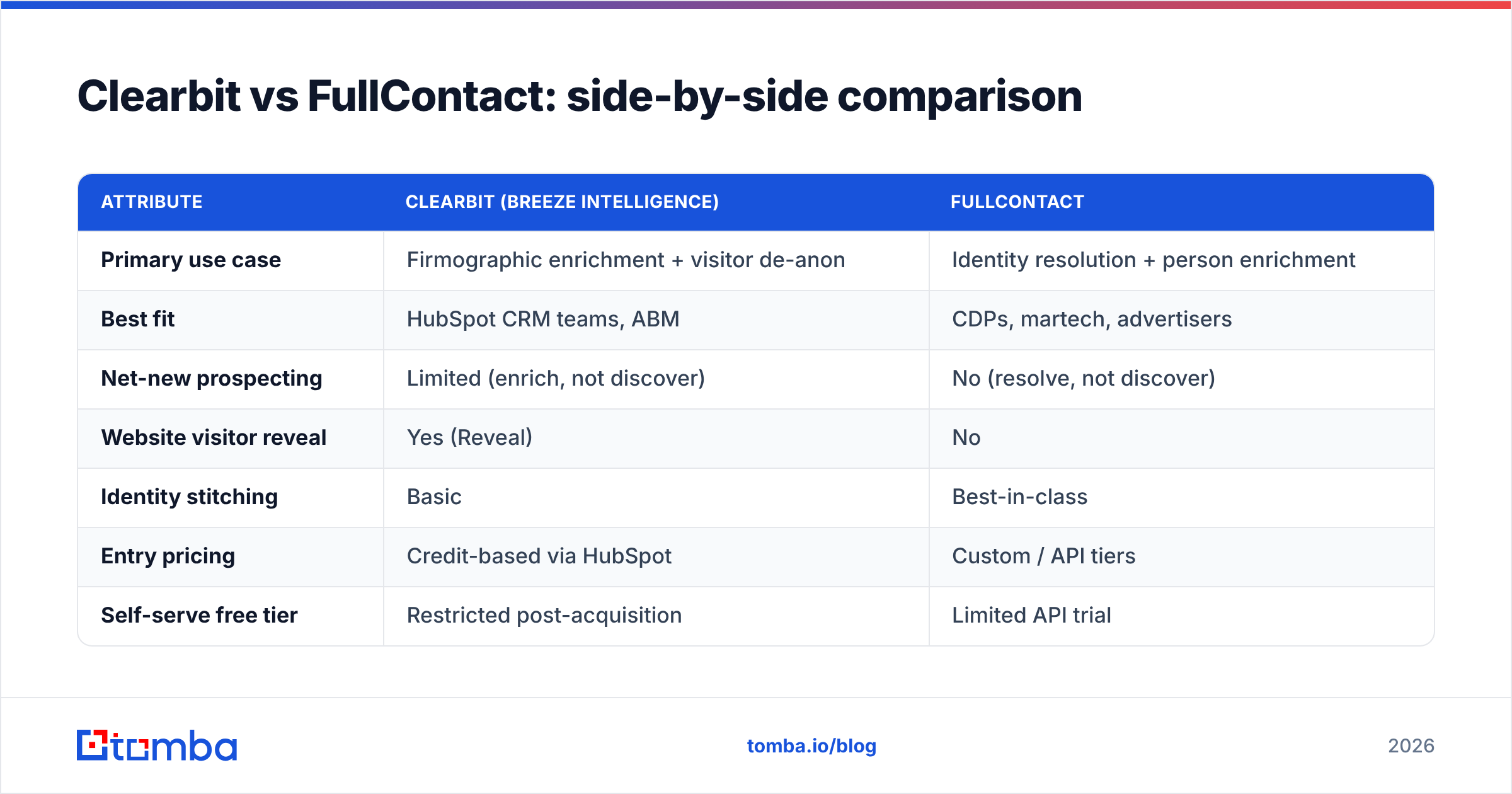
Here is the head-to-head on the attributes that actually drive a buying decision.
| Attribute | Clearbit (Breeze Intelligence) | FullContact |
|---|---|---|
| Primary use case | Firmographic enrichment + visitor de-anon | Identity resolution + person enrichment |
| Best fit | HubSpot CRM teams, ABM | CDPs, martech, advertisers |
| Net-new prospecting | Limited (enrich, not discover) | No (resolve, not discover) |
| Website visitor reveal | Yes (Reveal) | No |
| Identity stitching | Basic | Best-in-class |
| Entry pricing | Credit-based via HubSpot | Custom / API tiers |
| Self-serve free tier | Restricted post-acquisition | Limited API trial |
| Transparent public pricing | No | No |
| Standalone API future | Uncertain (HubSpot-led) | Stable |
| Email verification | Not a core feature | Not a core feature |
The pattern is clear: these are enrichment and identity platforms, not prospecting engines. Both assume you already have a record to enrich. Neither is built to go from "I want CMOs at 200 SaaS companies" to a verified, send-ready list.
)
Is Clearbit better than FullContact for B2B sales?#
For most B2B sales teams, Clearbit is the more natural fit — but only if you are on HubSpot. The reasoning is mechanical: Clearbit's enrichment now fires automatically inside HubSpot workflows, scoring leads and filling firmographic fields the moment a record is created. FullContact has no equivalent native CRM motion; it is an API you build against.
But "better for sales" comes with a giant asterisk. Sales teams usually need three things from a data tool:
- Discovery — surface new contacts that match an ICP.
- Enrichment — fill in detail on contacts you already have.
- Verification — confirm the email is real before you send.
Clearbit and FullContact both do #2 well. Neither does #1 or #3 the way a dedicated prospecting stack does. That gap is exactly why teams pair an enrichment platform with a focused email tool — or skip the enrichment giant entirely when the budget is tight.
How much do Clearbit and FullContact cost in 2026?#
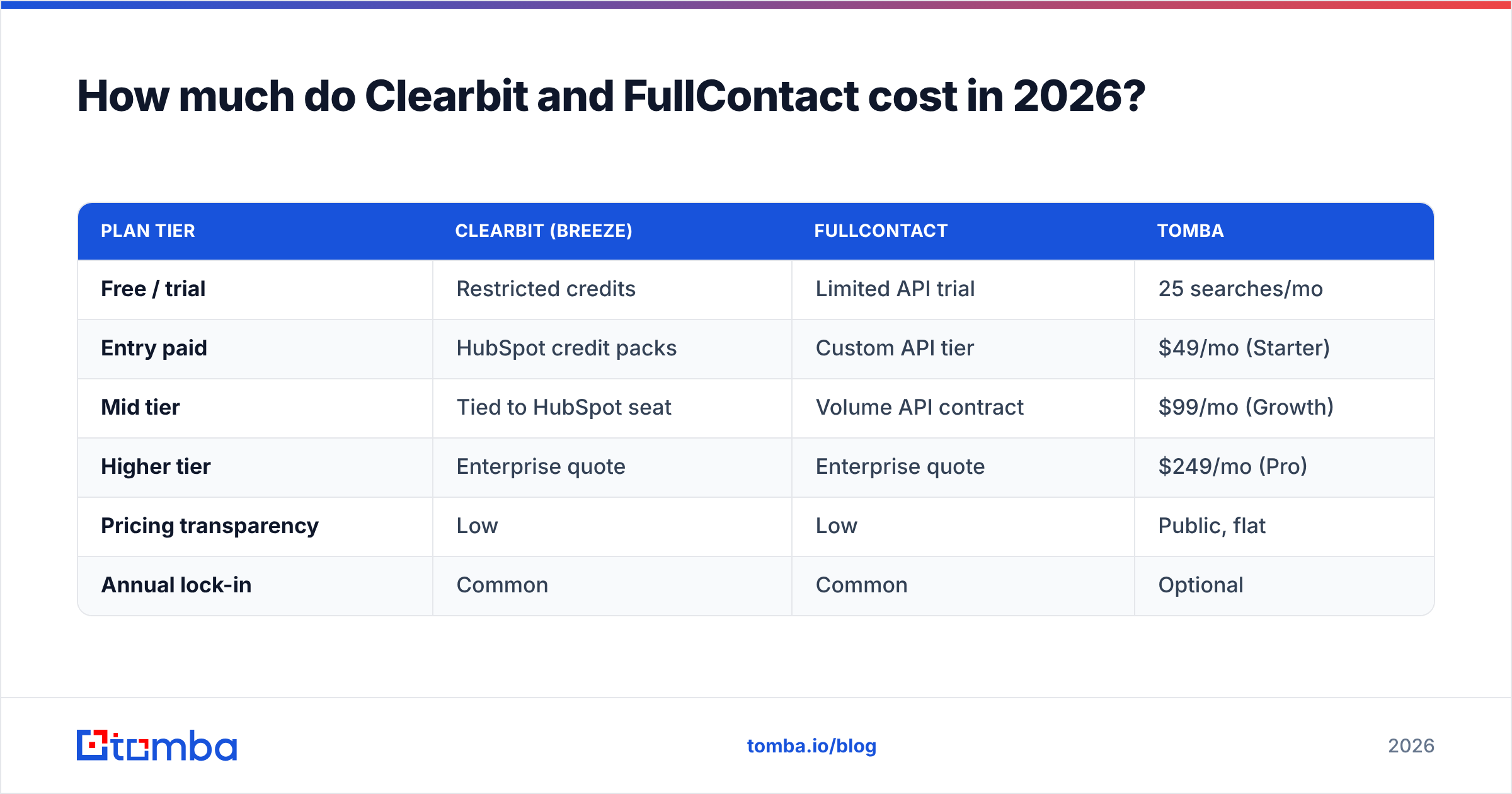
Neither vendor publishes clean, self-serve pricing, which is itself a signal. Expect annual contracts, sales calls, and minimums that scale into the thousands once you pass a trial.
| Plan tier | Clearbit (Breeze) | FullContact | Tomba |
|---|---|---|---|
| Free / trial | Restricted credits | Limited API trial | 25 searches/mo |
| Entry paid | HubSpot credit packs | Custom API tier | $49/mo (Starter) |
| Mid tier | Tied to HubSpot seat | Volume API contract | $99/mo (Growth) |
| Higher tier | Enterprise quote | Enterprise quote | $249/mo (Pro) |
| Pricing transparency | Low | Low | Public, flat |
| Annual lock-in | Common | Common | Optional |
The contrast is the point. Enterprise enrichment platforms are built for organizations that can absorb a five-figure annual minimum and want a single source of truth across thousands of records. If you are a founder, an agency, or a lean SDR team, that pricing model is a poor match for the job you actually have.
You can sanity-check the public numbers yourself on Clearbit's site and FullContact's site, and read peer reviews on G2 before any sales call.
What is the gap both tools leave open?#
Both leave the find-and-verify workflow wide open. Clearbit enriches what you feed it. FullContact resolves identities you already hold. But the daily reality of outbound is upstream of both: you need to generate a list of the right people at the right companies and confirm their emails are deliverable.
That is a different tool category — an email finder plus verifier — and it is where a focused platform earns its place next to (or instead of) the enrichment giants. Consider what an outbound motion actually requires:
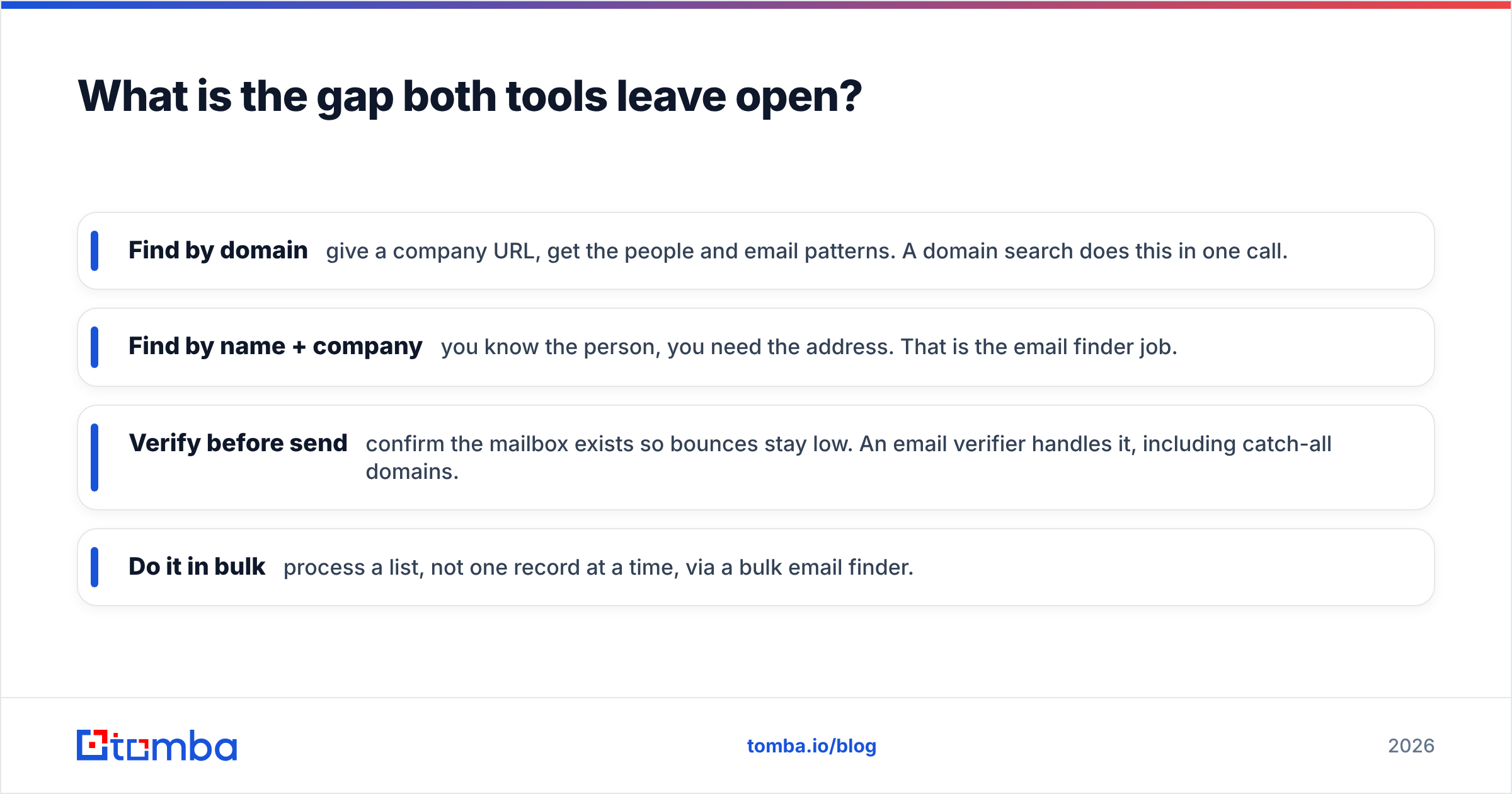
- Find by domain — give a company URL, get the people and email patterns. A domain search does this in one call.
- Find by name + company — you know the person, you need the address. That is the email finder job.
- Verify before send — confirm the mailbox exists so bounces stay low. An email verifier handles it, including catch-all domains.
- Do it in bulk — process a list, not one record at a time, via a bulk email finder.
)
Notice none of these are Clearbit's or FullContact's headline features. Enrichment platforms treat the email as an input. Prospecting tools treat it as the output you are paying for. If your bottleneck is volume of accurate, verified contacts, you are buying the wrong category when you buy enrichment.
When should you actually pick Clearbit or FullContact?#
Pick the heavyweight when the heavyweight problem is real. Be honest about whether it is.
Choose Clearbit (Breeze Intelligence) if:
- You run HubSpot as your system of record and want enrichment to happen automatically inside it.
- You need website-visitor de-anonymization to feed ABM.
- Firmographic and tech-stack data drives your lead scoring.
- A per-seat / credit model inside HubSpot fits your budget.
Choose FullContact if:
- You are unifying fragmented customer data across email, phone, social, and device.
- You operate a CDP, a loyalty program, or an ad-tech pipeline that needs identity resolution.
- Privacy-forward, consented matching is a compliance requirement.
- Net-new sales prospecting is not the job you are buying for.
Choose a dedicated email finder + verifier if:
- Your core need is generating and verifying outbound contact lists.
- You want transparent, self-serve pricing without an annual minimum.
- You are a founder, agency, recruiter, or SDR team that values speed over a single-source-of-truth data warehouse.
These are not mutually exclusive. Plenty of teams run HubSpot + Clearbit for CRM hygiene and a focused finder for outbound — because the enrichment platform was never built to do the prospecting job, and the prospecting tool was never meant to be your warehouse.
How accurate is the data, really?#
Accuracy claims from every vendor in this space are self-reported, so treat marketing percentages skeptically and test on your own ICP. The honest framing: accuracy is segment-specific. Clearbit is strong on funded US/EU tech firmographics and weaker on SMBs, non-tech verticals, and non-Western regions. FullContact's accuracy is a function of how much identity signal you feed it — rich inputs resolve well, thin inputs less so.
For email specifically, the only number that matters is your bounce rate after send. An enrichment platform that appends a plausible-but-stale email still costs you sender reputation when it bounces. That is why a verification step — ideally SMTP-level, with catch-all verifier handling for tricky domains — belongs in the pipeline regardless of which enrichment vendor you choose. Run a small paid pilot, measure bounce and connect rates on real sends, and let your own numbers decide.
Clearbit vs FullContact: the verdict#
If you must pick one of the two, the tiebreaker is your existing stack, not a feature checklist:
- On HubSpot, doing ABM and CRM enrichment → Clearbit / Breeze Intelligence. It is the path of least resistance and the data is genuinely good in its sweet spot.
- Unifying scattered customer identities across channels → FullContact. Nothing else in this comparison does identity resolution as cleanly.
But if you came here because you need more verified contacts to email this quarter, neither tool is the answer — they enrich and resolve; they do not prospect. The category you actually want is an email finder with a built-in verifier and honest pricing.
Where Tomba fits#
Tomba is built for the job the enrichment giants skip: finding and verifying B2B email addresses at scale, without an annual contract. Start free with 25 searches a month, then move to Starter at $49/mo — no sales call, no five-figure minimum. Use the Tomba Email Finder to turn a name and company into a verified address, run a domain search to map every reachable contact at a target account, and pair it with the email verifier so your bounce rate stays low and your sender reputation intact. If your real bottleneck is outbound volume — not a data warehouse — that is where Tomba beats both Clearbit and FullContact on cost, speed, and focus. See full pricing and put it against your own ICP today.
// get started
Find, verify and enrich your first contacts today
Start on the free plan with 25 searches a month, then scale when your team is ready.
Free plan · No credit card required · GDPR & CCPA
// about the author