Clearbit vs Hunter 2026: Which B2B Data Tool Wins?
Clearbit enriches accounts; Hunter finds emails. We break down accuracy, pricing, and use cases so you pick the right B2B data tool in 2026 — plus a cheaper alternative.
Clearbit and Hunter get lumped together as "B2B data tools," but they solve different problems. Clearbit enriches accounts and visitors with firmographic data. Hunter finds and verifies professional email addresses by domain. Picking between them without knowing that difference is how teams overpay for one and under-use the other.
This guide compares Clearbit vs Hunter on what actually matters in 2026: data accuracy, pricing, coverage, integrations, and the jobs each tool is built for. By the end you'll know which one belongs in your stack — and where a leaner option like Tomba fits if you mostly need verified emails without enterprise pricing.
TL;DR#
- Clearbit (now Breeze Intelligence inside HubSpot) is an enrichment and intent platform — best for inbound, form shortening, and account scoring, priced for mid-market and enterprise.
- Hunter is a domain-based email finder and verifier — best for outbound prospecting teams that need contact emails fast and cheap.
- They overlap less than you'd think: Clearbit answers "who is this company/visitor?", Hunter answers "what's this person's email?".
- On raw email finding, accuracy and price per verified contact matter most — and that's where dedicated finders win.
- If your core need is verified B2B emails at a sane price, Tomba's email finder starts at $49/mo and covers domain search, verification, and enrichment in one place.
What is Clearbit?#
Clearbit is a B2B data enrichment platform. You feed it an email or a domain, and it returns a company profile: industry, headcount, revenue range, tech stack, location, and social handles, plus person-level attributes like role and seniority. Since the HubSpot acquisition it ships as Breeze Intelligence, tightly wired into HubSpot CRM and marketing workflows.
Its signature features are real-time enrichment (auto-filling CRM records), reveal (de-anonymizing website visitors by company), and form shortening (asking for an email, then enriching the rest). It's an inbound and revenue operations tool more than a prospecting list builder.
What Clearbit is not great at: handing you a verified personal email for a named individual at scale. That's a finder's job.
What is Hunter?#
Hunter (hunter.io) is one of the most recognized email finders on the market. Give it a domain and it returns the email addresses associated with it, the most likely pattern (like {first}.{last}@), confidence scores, and sources. It also bundles an email verifier, a Campaigns module for cold outreach, and a Chrome extension.
Hunter is built for sales prospecting and outbound teams. Where Clearbit tells you about the company, Hunter gets you the contact you actually email. Its data leans on public web crawling plus pattern inference, which makes it fast and broad but means you should always verify before sending.

Clearbit vs Hunter: how do they compare?#
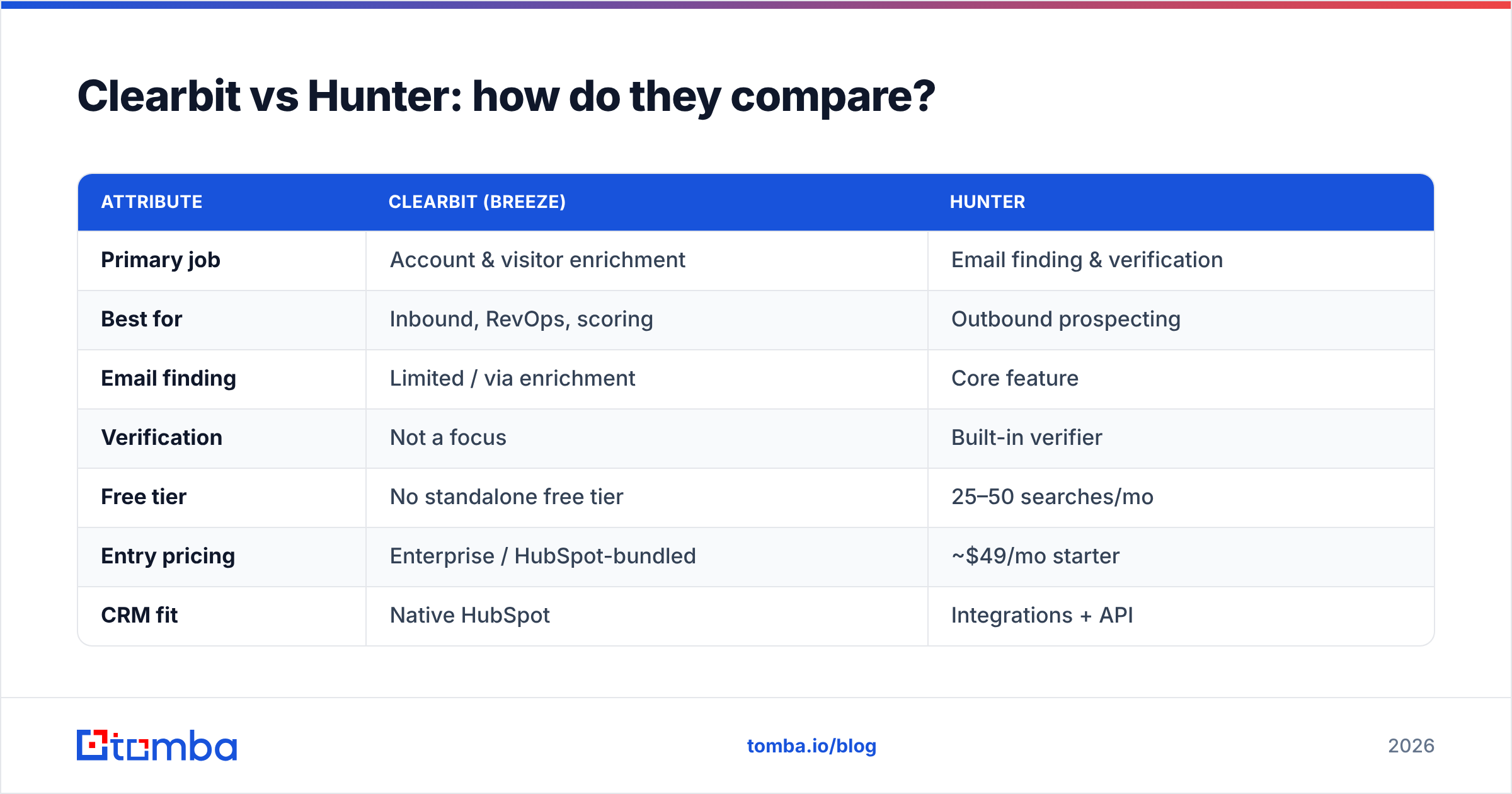
Here's the head-to-head on the attributes that drive a buying decision.
| Attribute | Clearbit (Breeze) | Hunter |
|---|---|---|
| Primary job | Account & visitor enrichment | Email finding & verification |
| Best for | Inbound, RevOps, scoring | Outbound prospecting |
| Email finding | Limited / via enrichment | Core feature |
| Verification | Not a focus | Built-in verifier |
| Free tier | No standalone free tier | 25–50 searches/mo |
| Entry pricing | Enterprise / HubSpot-bundled | ~$49/mo starter |
| CRM fit | Native HubSpot | Integrations + API |
| Data approach | Firmographic + intent | Crawl + pattern inference |
The pattern is clear: these tools are complements more often than competitors. A mature go-to-market stack might run Clearbit for inbound enrichment and a finder for outbound contact discovery. A smaller team rarely needs both — they need the one that matches their motion.

Which one is more accurate?#
Accuracy depends on the question you're asking. For firmographic data — company size, industry, tech stack — Clearbit is strong because that's its specialty and the data changes slowly. For a specific person's email, accuracy comes down to how fresh the finder's index is and whether it verifies in real time.
No email tool is 100% accurate, and anyone claiming otherwise is selling. The honest metric is deliverable rate: of the emails you pull, how many land without bouncing. That's why a verification step is non-negotiable regardless of which finder you choose. Run pulled addresses through an email verifier and quarantine catch-all domains with a catch-all verifier before you load them into a sequence.
Three things separate accurate finders from noisy ones:
- Real-time SMTP verification — checking the mailbox exists at request time, not against a stale cache.
- Source transparency — showing where an email was found so you can judge confidence.
- Catch-all handling — flagging domains that accept all mail instead of falsely marking them "valid."
If you're evaluating on accuracy alone, test each tool on the same 100 domains and measure bounce rate after send. Marketing claims don't survive contact with your own list.
How do pricing and value compare?#
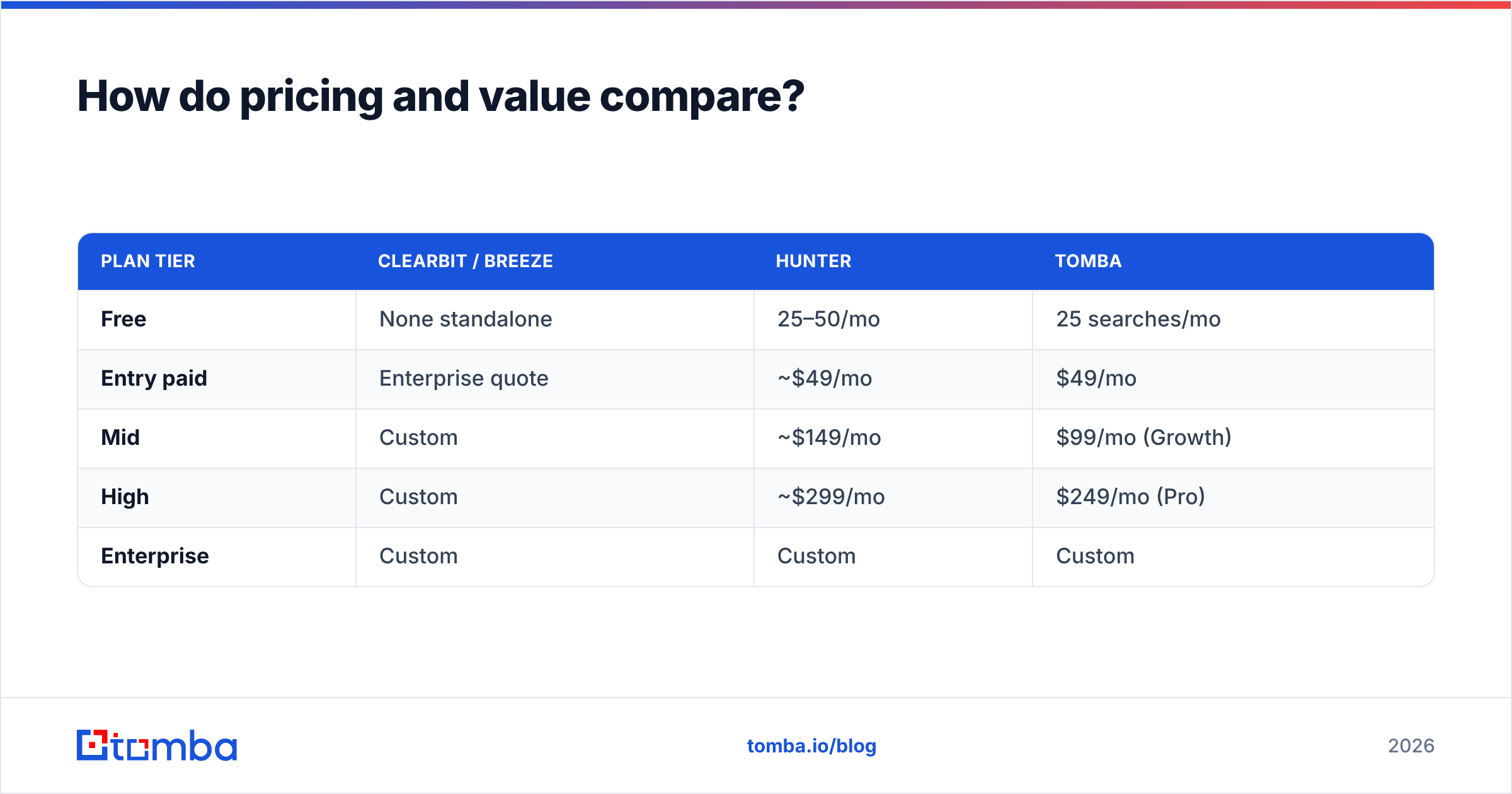
Clearbit no longer publishes simple self-serve tiers — pricing runs through HubSpot and skews enterprise, often four figures monthly once you add reveal and intent. Hunter is transparent and affordable, with a free tier and paid plans that scale by searches and verifications.
| Plan tier | Clearbit / Breeze | Hunter | Tomba |
|---|---|---|---|
| Free | None standalone | 25–50/mo | 25 searches/mo |
| Entry paid | Enterprise quote | ~$49/mo | $49/mo |
| Mid | Custom | ~$149/mo | $99/mo (Growth) |
| High | Custom | ~$299/mo | $249/mo (Pro) |
| Enterprise | Custom | Custom | Custom |
For teams that mainly need verified emails, paying enterprise enrichment prices is overkill. That's the gap dedicated finders fill. See full Tomba pricing for the per-credit math — the Growth plan at $99/mo lands well under comparable Hunter and Clearbit spend for the same email volume.

When should you pick Clearbit?#
Choose Clearbit (Breeze Intelligence) when:
- You live in HubSpot. Native enrichment that auto-fills CRM records is the strongest argument for it.
- Inbound is your engine. Form shortening and visitor reveal turn anonymous traffic into scored accounts.
- You need firmographic + intent data to power lead routing and lead scoring, not just emails.
- Budget isn't the constraint. Enterprise pricing buys depth and HubSpot-native plumbing.
If your motion is "capture demand, enrich it, route it," Clearbit earns its seat. If your motion is "build a list and email it," it's the wrong tool.
When should you pick Hunter?#
Choose Hunter when:
- Outbound is your motion. You need contact emails by domain, fast.
- You want transparent, low-commitment pricing with a real free tier to test.
- You run light campaigns and like having a basic sequencer (Campaigns) in the same app.
- You're an SMB or solo operator who doesn't need enterprise enrichment.
Hunter's weakness is depth of company data and bulk economics at high volume. For heavy list building, compare cost per verified contact against alternatives before committing.
Is there a better alternative to both?#
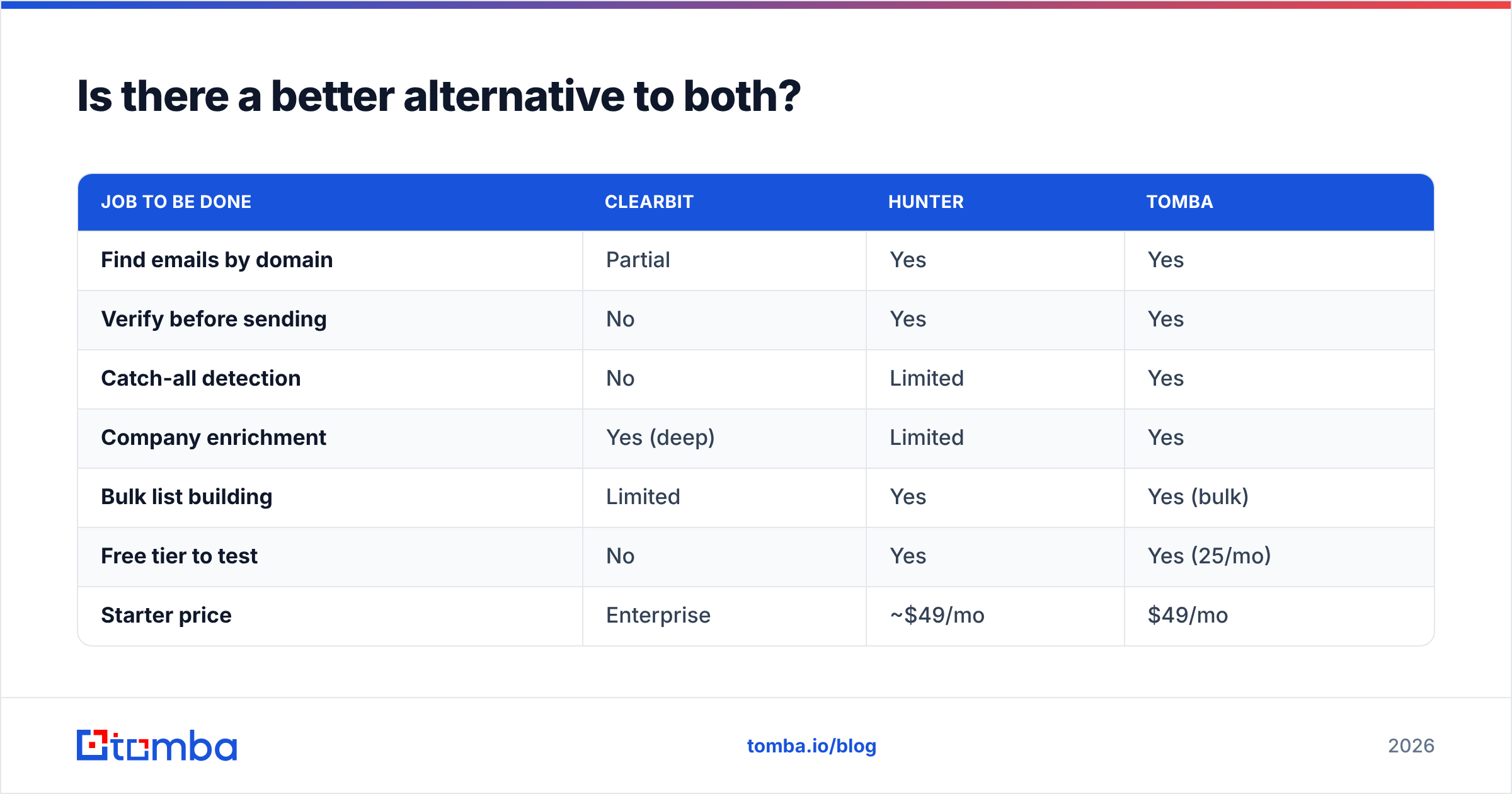
If your real need is verified emails plus light enrichment — without enterprise pricing or a HubSpot lock-in — a dedicated finder usually wins on price-per-contact. Tomba sits in this slot: it does domain search, email finding, real-time verification, catch-all checks, phone finding, and data enrichment under one roof.
| Job to be done | Clearbit | Hunter | Tomba |
|---|---|---|---|
| Find emails by domain | Partial | Yes | Yes |
| Verify before sending | No | Yes | Yes |
| Catch-all detection | No | Limited | Yes |
| Company enrichment | Yes (deep) | Limited | Yes |
| Bulk list building | Limited | Yes | Yes (bulk) |
| Free tier to test | No | Yes | Yes (25/mo) |
| Starter price | Enterprise | ~$49/mo | $49/mo |
Tomba isn't trying to replace HubSpot-native enrichment — Clearbit owns that. It's the better pick when the job is "get me accurate, verified B2B emails at a fair price," which is most outbound teams. You can also work directly inside your tools with the Tomba Chrome extension, the Google Sheets add-on, or the email finder API.

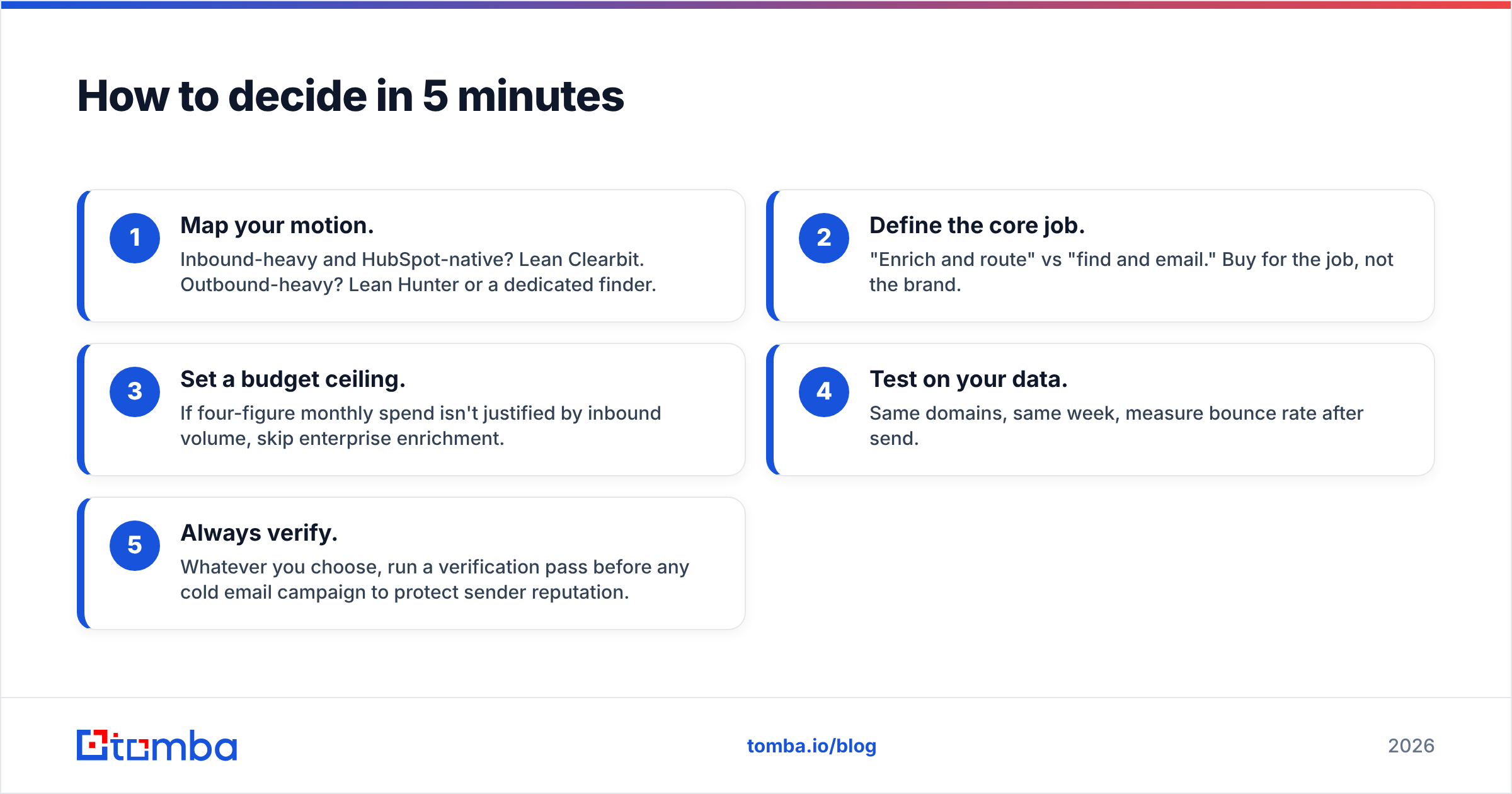
How to decide in 5 minutes#
Run this quick test:
- Map your motion. Inbound-heavy and HubSpot-native? Lean Clearbit. Outbound-heavy? Lean Hunter or a dedicated finder.
- Define the core job. "Enrich and route" vs "find and email." Buy for the job, not the brand.
- Set a budget ceiling. If four-figure monthly spend isn't justified by inbound volume, skip enterprise enrichment.
- Test on your data. Same domains, same week, measure bounce rate after send.
- Always verify. Whatever you choose, run a verification pass before any cold email campaign to protect sender reputation.
For deeper background on vendor capabilities, Clearbit's positioning is documented on HubSpot's site and Hunter's features on hunter.io. Cross-checking buyer reviews on G2 is worth ten minutes before any purchase.
The verdict#
Clearbit and Hunter aren't really rivals — they're built for opposite ends of the funnel. Clearbit enriches and scores inbound demand inside HubSpot; Hunter finds and verifies the emails outbound teams need to reach people. Pick Clearbit if you're inbound-led with budget; pick Hunter if you're outbound-led and price-sensitive.
But if your honest need is "accurate, verified B2B emails without enterprise pricing," neither is the obvious answer. That's the gap Tomba's Email Finder is built for — domain search, real-time verification, catch-all detection, and enrichment in one platform, starting free with 25 searches a month and $49/mo when you scale. Start with the free tier, test it on your own domains, and let bounce rate decide.
// get started
Find, verify and enrich your first contacts today
Start on the free plan with 25 searches a month, then scale when your team is ready.
Free plan · No credit card required · GDPR & CCPA
// about the author