Clearbit vs ZoomInfo 2026: Pricing, Data & Best Alternative
Clearbit and ZoomInfo dominate B2B data, but both price for the enterprise. Here's how they really compare on accuracy, coverage, and cost in 2026, and when a leaner tool wins.
Choosing between Clearbit and ZoomInfo usually comes down to one question your finance team will ask before your SDRs ever touch the data: what are you actually paying for, and does the accuracy justify the contract? Both are heavyweight B2B data platforms, but they solve slightly different problems, and they bill very differently for the privilege.
This breakdown compares Clearbit vs ZoomInfo on data accuracy, coverage, pricing, integrations, and real-world fit, then shows where a focused tool can cover the same ground for a fraction of the spend.
TL;DR — Clearbit vs ZoomInfo at a glance#
- ZoomInfo is the broadest contact-and-company database with direct dials and intent data, but it's expensive, sold on annual contracts, and aggressive on upsells.
- Clearbit (now Clearbit by HubSpot) is enrichment-first and developer-friendly, ideal for filling in records you already have rather than sourcing net-new lists.
- Pricing is the dividing line: ZoomInfo routinely starts around five figures a year; Clearbit is usage-based and tighter to the HubSpot ecosystem.
- Accuracy is close but not identical — ZoomInfo wins on phone/direct-dial depth, Clearbit wins on real-time firmographic and technographic enrichment.
- If your core need is verified work emails by domain or name, a specialized email finder like Tomba delivers comparable contact accuracy starting at $49/mo instead of a $15K+ annual commitment.
What is Clearbit and what is it best at?#
Clearbit is a data enrichment platform that takes a partial record — an email, a domain, or an IP address — and returns a fuller profile: company size, industry, revenue range, tech stack, role, seniority, and social handles. Since being acquired by HubSpot, it has leaned hard into native HubSpot enrichment and form shortening (auto-filling fields so prospects type less).
Where Clearbit shines is real-time, programmatic enrichment. Its API is clean, its data enrichment model is well-documented, and developers can wire it into signup flows, lead-routing logic, and scoring models without much friction. It's the tool you reach for when you already have leads and want them enriched the moment they hit your CRM.
What Clearbit is not great at is bulk net-new prospecting. It doesn't hand you a searchable database of 100M+ contacts to build lists from scratch the way ZoomInfo does. You bring the records; Clearbit makes them richer.
)
What is ZoomInfo and what is it best at?#
ZoomInfo is the closest thing the market has to an everything-database. It combines a massive contact and company directory with direct-dial phone numbers, org charts, buying-intent signals (via its Bombora partnership and its own web data), and workflow tooling for sales and marketing teams.
ZoomInfo's strength is discovery and reach. You can filter by title, geography, headcount, technology, funding stage, and intent topic, then export verified contacts including mobile numbers — the kind of direct dials that are hard to source anywhere else at scale. For outbound teams that live and die by connect rates, that phone depth is the headline feature.
The trade-offs are cost and commitment. ZoomInfo sells annual contracts, gates premium features (intent, direct dials, integrations) behind higher tiers, and is known for firm renewals. It's a platform decision, not a line item.
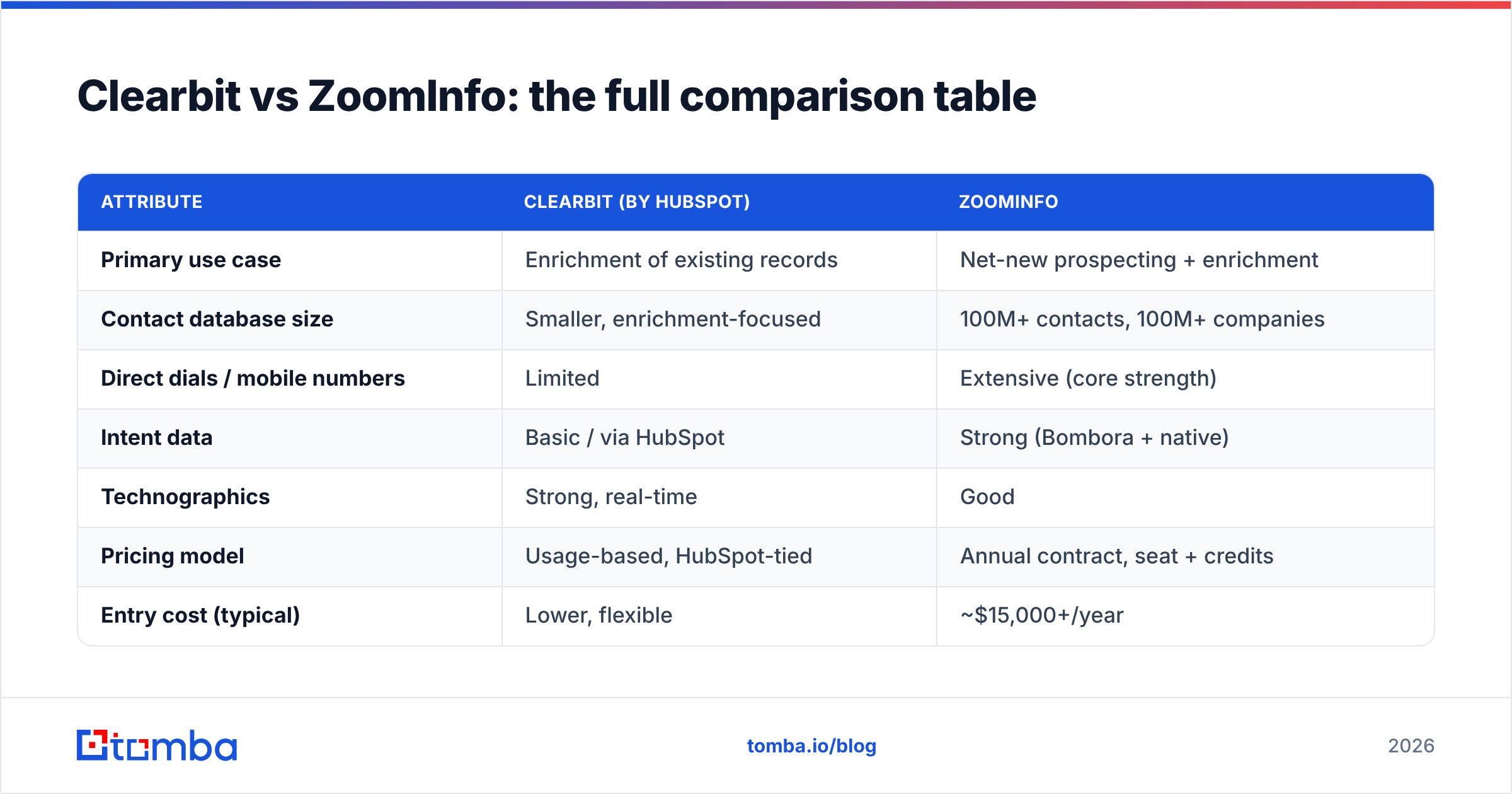
Clearbit vs ZoomInfo: the full comparison table#
Here's how the two stack up on the attributes that actually drive a buying decision.
| Attribute | Clearbit (by HubSpot) | ZoomInfo |
|---|---|---|
| Primary use case | Enrichment of existing records | Net-new prospecting + enrichment |
| Contact database size | Smaller, enrichment-focused | 100M+ contacts, 100M+ companies |
| Direct dials / mobile numbers | Limited | Extensive (core strength) |
| Intent data | Basic / via HubSpot | Strong (Bombora + native) |
| Technographics | Strong, real-time | Good |
| Pricing model | Usage-based, HubSpot-tied | Annual contract, seat + credits |
| Entry cost (typical) | Lower, flexible | ~$15,000+/year |
| Best for | Product-led + RevOps teams | Enterprise outbound sales |
| API quality | Excellent, developer-first | Good, more enterprise-oriented |
| Contract flexibility | Higher | Low (annual lock-in) |
A few rows deserve unpacking. The "entry cost" gap is the single most cited reason teams churn off ZoomInfo — published reseller and review data on G2 consistently put real ZoomInfo spend in the five-figure range once direct dials and intent are included. Clearbit's usage-based model is gentler on a starting budget, but it assumes you're already invested in HubSpot.
Is ZoomInfo more accurate than Clearbit?#
Short answer: it depends on the field. ZoomInfo is generally more accurate on phone numbers and direct dials, which is where it invests heavily in human research and verification. Clearbit is typically fresher on firmographic and technographic data because it enriches in real time from live web signals rather than periodic database refreshes.
For work email accuracy, the two are close, and this is the field most cold-outbound teams care about most. Neither platform was built primarily as an email-verification engine, which is why many teams pair them with a dedicated email verifier to catch bounces before a send. A list that's 95% accurate at the firmographic level can still tank your sender reputation if 8% of the emails bounce.
The practical takeaway: if your motion is phone-heavy enterprise outbound, ZoomInfo's accuracy advantage is real and worth paying for. If your motion is email-first and you mostly need to enrich and reach known accounts, Clearbit's freshness plus a verification layer gets you there for less.
How do Clearbit and ZoomInfo handle pricing?#
This is where the two diverge most sharply, and where buyers get surprised.
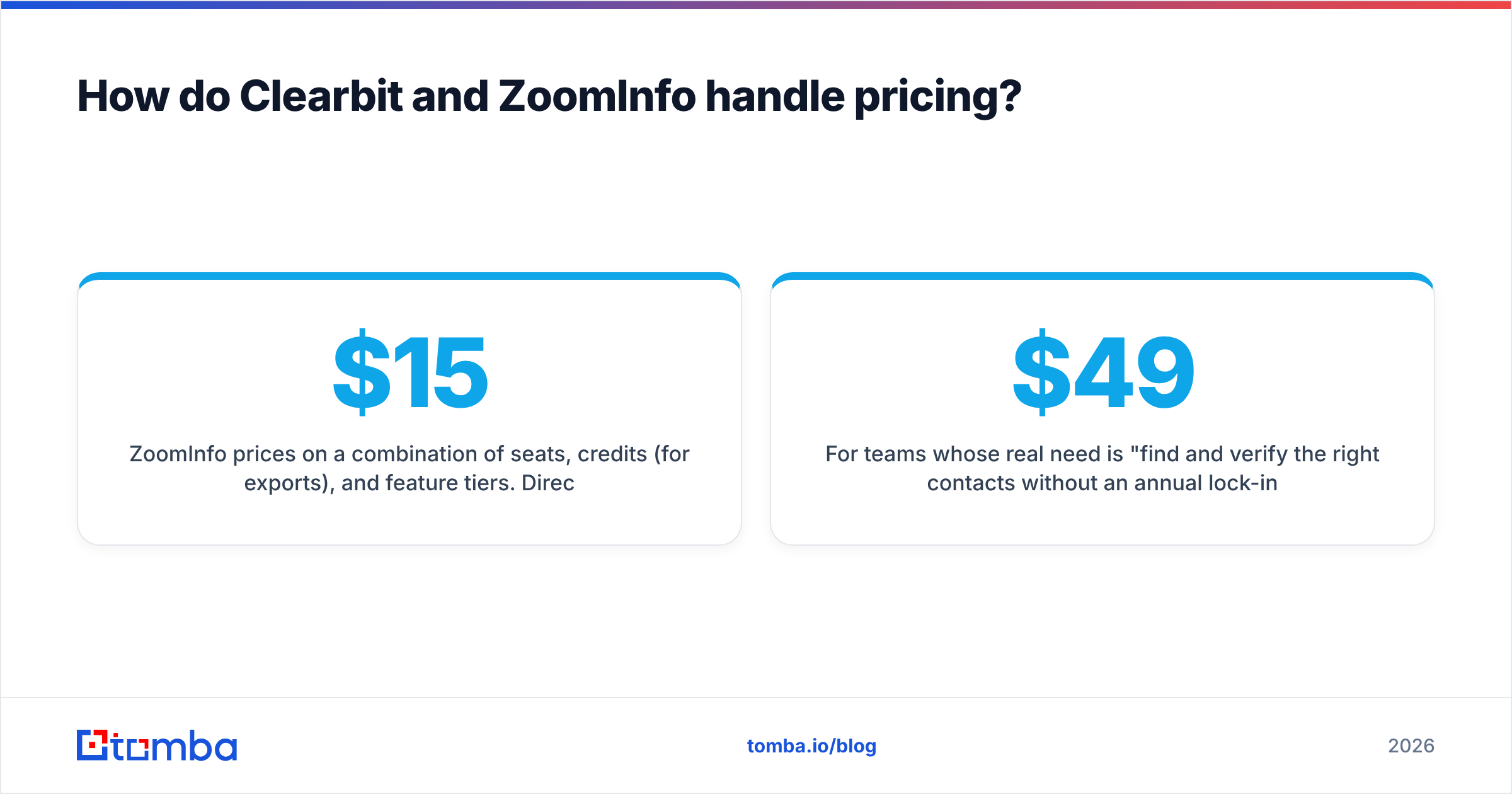
ZoomInfo prices on a combination of seats, credits (for exports), and feature tiers. Direct dials, intent data, and many integrations sit in higher packages. Contracts are annual, and entry points commonly land at or above $15,000/year for a small team. There's no meaningful free tier — trials are sales-gated.
Clearbit uses usage-based pricing tied to enrichment volume and is increasingly bundled with HubSpot plans. That makes it more approachable to start, but your costs scale with volume and your leverage is strongest if you're already a HubSpot customer.
For teams whose real need is "find and verify the right contacts without an annual lock-in," neither model is ideal. That's the gap a focused tool fills — and it's worth comparing transparent Tomba pricing (Free for 25 searches/mo, Starter $49/mo, Growth $99/mo, Pro $249/mo) against a sales-gated enterprise quote before you sign anything.
)
When should you pick Clearbit over ZoomInfo?#
Choose Clearbit when:
- You live in HubSpot. Native enrichment and form shortening are tangibly better when the data lands directly in HubSpot fields.
- Your motion is product-led or inbound. You're enriching signups and inbound leads in real time, not building cold lists.
- You have engineering resources. Clearbit's API rewards teams that can wire enrichment into routing, scoring, and onboarding flows.
- You want flexible, usage-based costs rather than a fixed annual commitment.
Choose ZoomInfo when:
- Phone is your channel. Direct dials and mobile numbers at scale are its defining advantage.
- You need net-new discovery across a huge, filterable database, not just enrichment of records you already own.
- Intent data drives your plays and you want it integrated rather than stitched together.
- You're an enterprise team with the budget and the volume to justify a platform contract.
What's the best Clearbit and ZoomInfo alternative in 2026?#
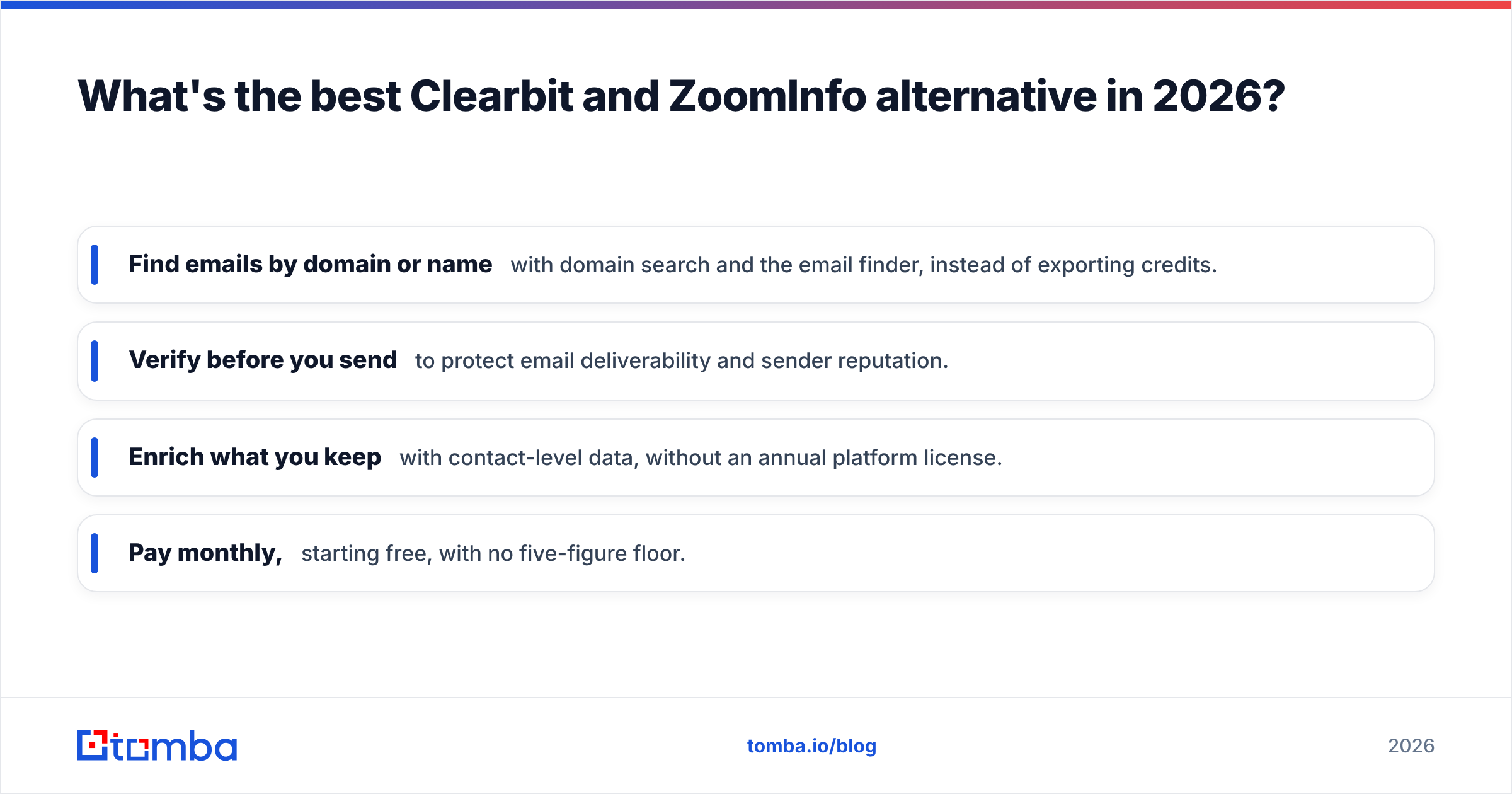
If the comparison above keeps leading you back to one core job — get accurate, verified business emails for the people you want to reach — you may be over-buying. Full data platforms bundle org charts, intent, and dialers you might never use, and you pay for all of it.
A specialized email-finding stack covers the highest-value slice of what Clearbit and ZoomInfo do, at a fraction of the cost:
- Find emails by domain or name with domain search and the email finder, instead of exporting credits.
- Verify before you send to protect email deliverability and sender reputation.
- Enrich what you keep with contact-level data, without an annual platform license.
- Pay monthly, starting free, with no five-figure floor.
This is exactly why teams evaluating a leaner stack look at a Clearbit alternative before committing — the question isn't "Clearbit vs ZoomInfo," it's "do I need a full platform at all, or just reliable contacts I can act on?"
A reasonable 2026 stack for most outbound and growth teams: use a focused email-finder + verifier for sourcing and hygiene, layer enrichment where you genuinely need firmographics, and only escalate to a ZoomInfo-class contract if direct dials and intent become non-negotiable. You can always trade up; you rarely get to trade down mid-contract.
Clearbit vs ZoomInfo: the verdict#
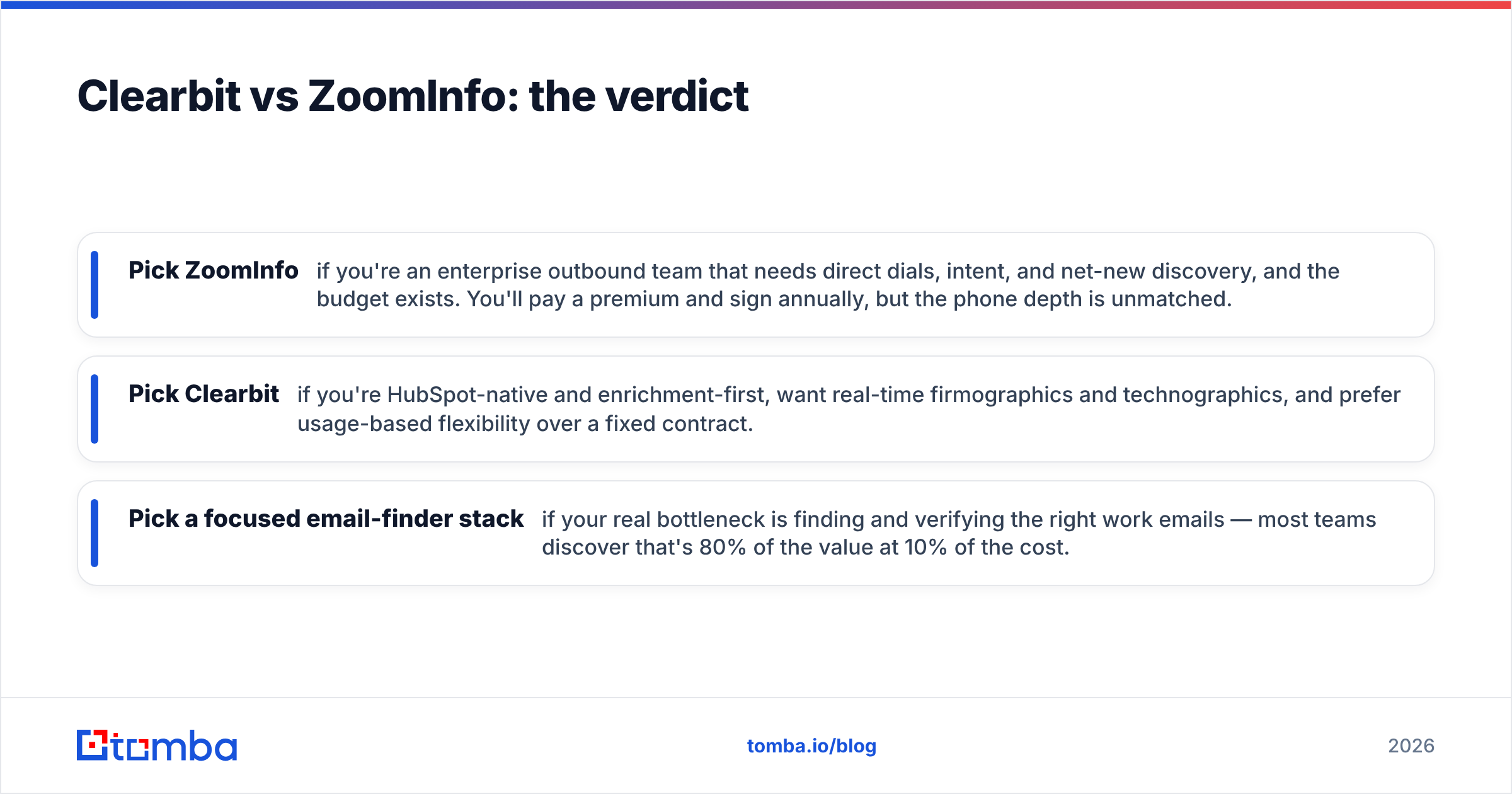
- Pick ZoomInfo if you're an enterprise outbound team that needs direct dials, intent, and net-new discovery, and the budget exists. You'll pay a premium and sign annually, but the phone depth is unmatched.
- Pick Clearbit if you're HubSpot-native and enrichment-first, want real-time firmographics and technographics, and prefer usage-based flexibility over a fixed contract.
- Pick a focused email-finder stack if your real bottleneck is finding and verifying the right work emails — most teams discover that's 80% of the value at 10% of the cost.
Both Clearbit and ZoomInfo are genuinely strong at what they were built for. The mistake is buying a platform when you needed a precision tool. Map your actual workflow — discovery vs enrichment, email vs phone, monthly vs annual — and the right pick gets obvious fast. You can review each vendor's own positioning directly at clearbit.com and zoominfo.com before you decide.
Start finding verified emails today#
If your real goal is reaching the right people, not licensing a data warehouse, start with the job that moves pipeline. Tomba's Email Finder locates professional email addresses by domain, name, or company, verifies them so they don't bounce, and starts free with 25 searches a month — Starter is $49/mo when you're ready to scale. Test it against your current list, measure the bounce rate and connect rate, and let the numbers decide whether you ever need a five-figure contract at all.
// get started
Find, verify and enrich your first contacts today
Start on the free plan with 25 searches a month, then scale when your team is ready.
Free plan · No credit card required · GDPR & CCPA
// about the author