ClearlyIP Alternatives in 2026: Top 7 VoIP Picks Ranked
ClearlyIP is solid for SIP trunking and devices, but it is not the only option. Here are the 7 best ClearlyIP alternatives in 2026, compared on price, features, and fit for sales teams.
ClearlyIP Alternatives in 2026: Top 7 VoIP Picks Ranked
ClearlyIP earned its reputation in the FreePBX and SIP world — solid hardware, honest SIP trunking, and serious emergency-911 features. But "good at telecom plumbing" is not the same as "the right fit for your sales team." If you are shopping around, you are probably weighing price, cloud PBX flexibility, integrations, and how easily your reps can actually dial prospects.
This guide ranks seven real ClearlyIP alternatives, shows where each one wins, and then covers the part most VoIP comparisons skip: a phone system is only as good as the contact data you pour into it.
TL;DR#
- ClearlyIP is strongest for SIP trunking, FreePBX-based deployments, and Kari's Law / E911 compliance — but it is device- and PBX-centric, not a turnkey sales phone system.
- The best all-round ClearlyIP alternatives in 2026 are RingCentral, 8x8, Nextiva, Dialpad, Twilio, Vonage, and Telnyx.
- Pick by job: cloud PBX (RingCentral, Nextiva), AI calling (Dialpad), developer/CPaaS (Twilio, Telnyx), budget SIP (Vonage).
- A dialer is worthless without accurate numbers. Pair any provider with verified B2B phone data so reps reach humans, not dead lines.
- Use Tomba's phone finder and phone validator to feed clean numbers into whichever platform you choose.
What is ClearlyIP and who is it for?#
ClearlyIP is a telecom vendor that grew out of the open-source FreePBX ecosystem. Its lineup spans SIP trunking, VoIP desk phones and ATAs, hosted PBX, and a heavy focus on emergency calling — automatic location, Kari's Law alerting, and Ray Baum's Act compliance. You can read more about their stack on the official ClearlyIP site.
In plain terms: ClearlyIP is the company you call when you want to run your own phone infrastructure correctly. It assumes someone on your team knows what a SIP trunk is. That is a strength for IT-led telecom shops and a weakness for a 12-person sales team that just wants reps dialing by lunch.
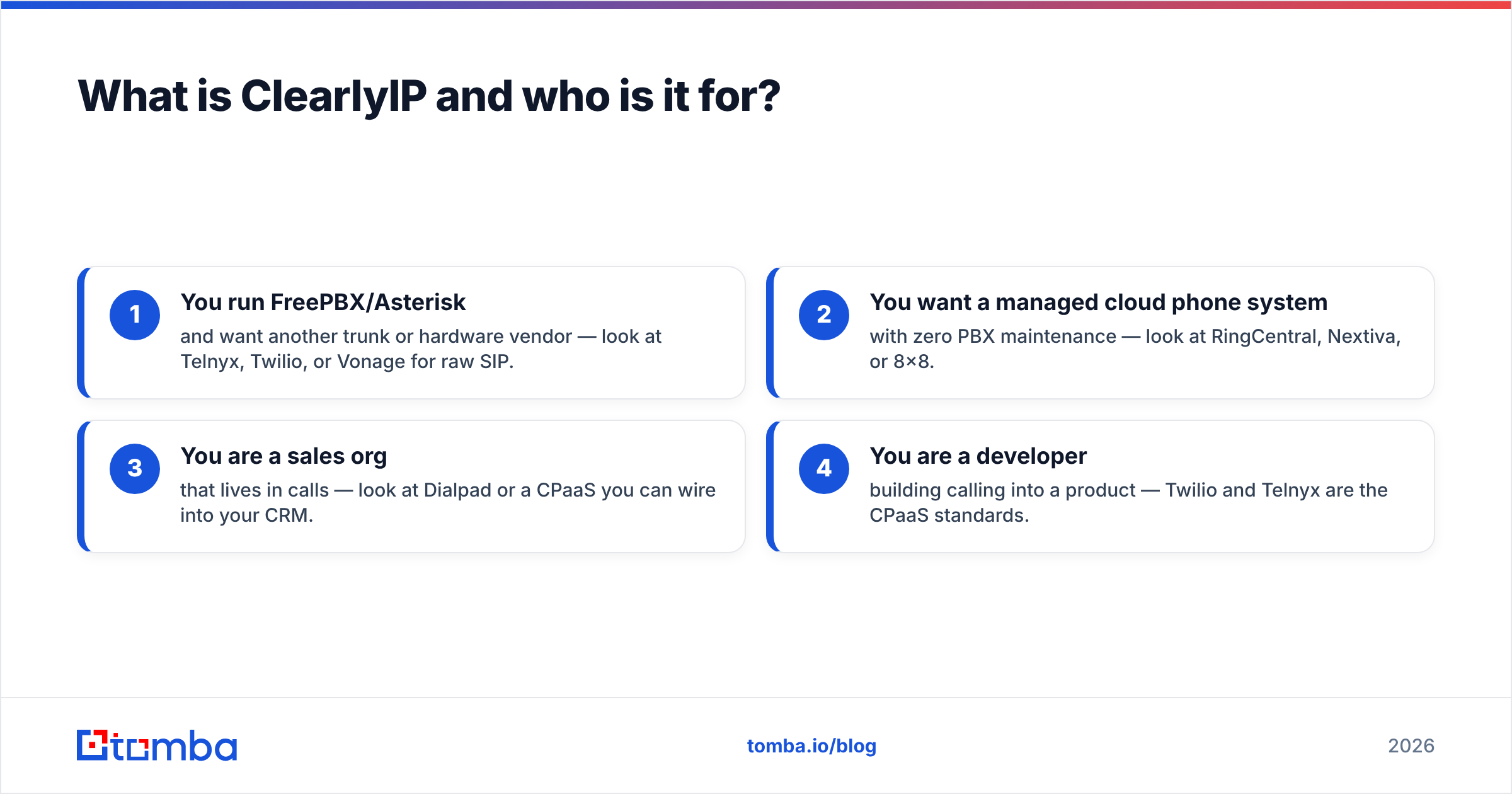
So "alternative" means different things depending on who you are:
- You run FreePBX/Asterisk and want another trunk or hardware vendor — look at Telnyx, Twilio, or Vonage for raw SIP.
- You want a managed cloud phone system with zero PBX maintenance — look at RingCentral, Nextiva, or 8x8.
- You are a sales org that lives in calls — look at Dialpad or a CPaaS you can wire into your CRM.
- You are a developer building calling into a product — Twilio and Telnyx are the CPaaS standards.
What are the best ClearlyIP alternatives in 2026?#
Here is the short list, with the one-line reason each makes the cut.
- RingCentral — the safe enterprise default for full UCaaS (calls, video, SMS, contact center).
- 8x8 — strong global coverage and contact-center features bundled in.
- Nextiva — small-business friendly cloud PBX with a clean admin and good support.
- Dialpad — AI-native calling with live transcription and coaching, built for sales.
- Twilio — the developer CPaaS standard; programmable voice and SMS via API.
- Vonage — flexible business communications plus a robust API arm.
- Telnyx — modern, low-cost programmable SIP and elastic trunking with its own network.
You can sanity-check current ratings for any of these on G2 before you commit.
How do the top ClearlyIP alternatives compare?#
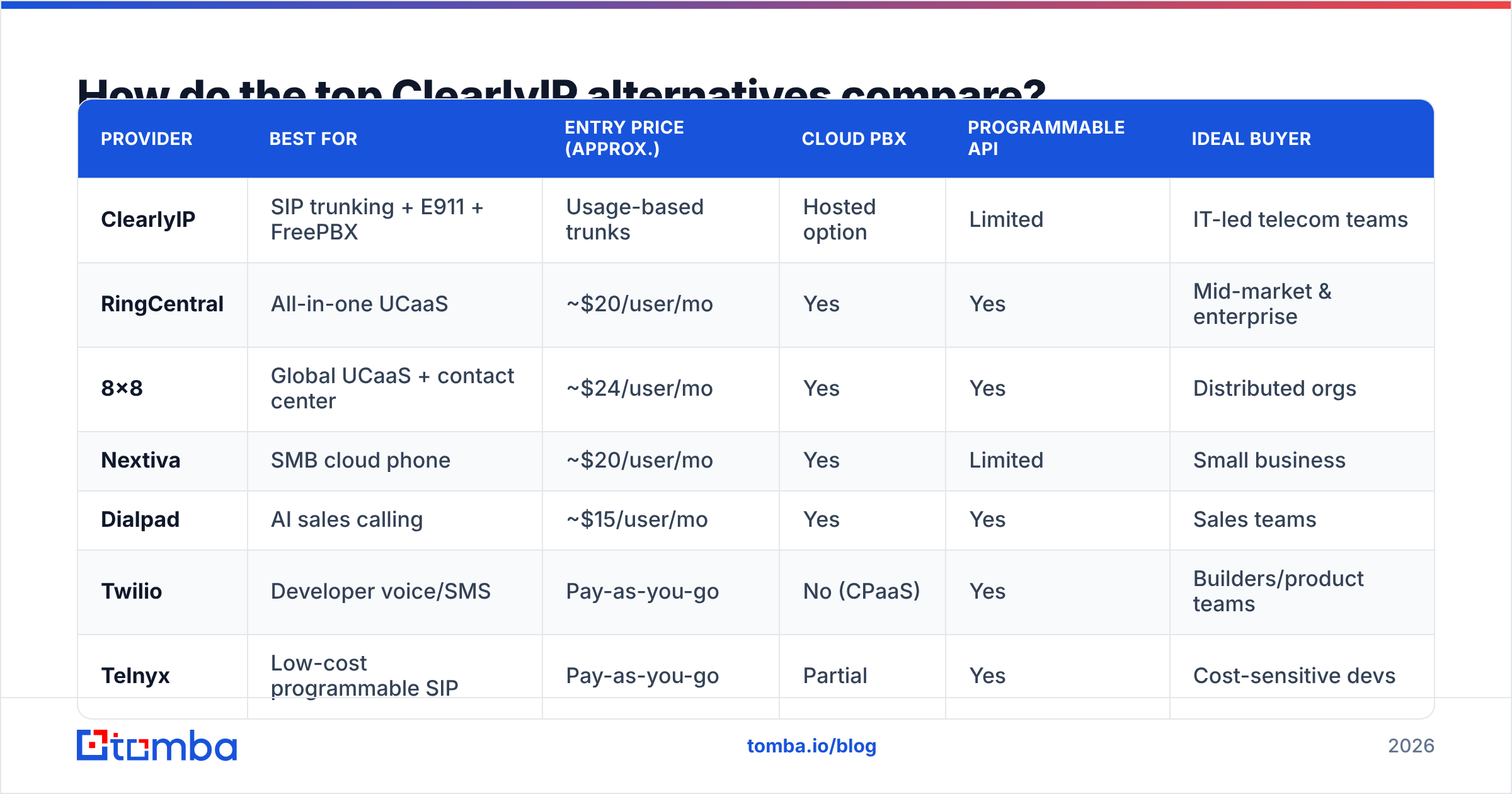
The table below maps each option to the job it does best, an approximate entry price, and the buyer it suits. Pricing for VoIP shifts constantly and depends on seats, contract, and usage — treat these as directional and confirm with each vendor.
| Provider | Best for | Entry price (approx.) | Cloud PBX | Programmable API | Ideal buyer |
|---|---|---|---|---|---|
| ClearlyIP | SIP trunking + E911 + FreePBX | Usage-based trunks | Hosted option | Limited | IT-led telecom teams |
| RingCentral | All-in-one UCaaS | ~$20/user/mo | Yes | Yes | Mid-market & enterprise |
| 8x8 | Global UCaaS + contact center | ~$24/user/mo | Yes | Yes | Distributed orgs |
| Nextiva | SMB cloud phone | ~$20/user/mo | Yes | Limited | Small business |
| Dialpad | AI sales calling | ~$15/user/mo | Yes | Yes | Sales teams |
| Twilio | Developer voice/SMS | Pay-as-you-go | No (CPaaS) | Yes | Builders/product teams |
| Telnyx | Low-cost programmable SIP | Pay-as-you-go | Partial | Yes | Cost-sensitive devs |
A few honest caveats:
- RingCentral and 8x8 are heavier and pricier, but you get a real contact center, analytics, and SLAs. If you have 50+ seats, that overhead pays off.
- Nextiva is the gentlest migration off a legacy PBX for a small team — predictable per-seat pricing, friendly setup.
- Dialpad is the only one on this list built primarily around the sales call itself — real-time transcription, sentiment, and call coaching. If reps make 60 dials a day, that matters more than trunk pricing.
- Twilio and Telnyx are not phone systems; they are building blocks. Choose them only if you have engineering to assemble the experience. Telnyx tends to undercut Twilio on per-minute cost because it runs its own network.
Is a CPaaS like Twilio better than ClearlyIP?#
It depends on whether you are buying a phone system or building one. ClearlyIP gives you trunks, hardware, and PBX expertise off the shelf. A CPaaS like Twilio gives you APIs and expects you to build the dialer, the routing, and the UI yourself.
For a sales leader, the practical question is: do you have developers? If yes, a CPaaS plus your CRM can become a tailored calling machine. If no, a managed UCaaS like RingCentral or a sales-first tool like Dialpad will get you live in days, not quarters.
ClearlyIP still wins on one axis that newer cloud players treat as an afterthought: emergency calling compliance. If you operate physical offices in the US and need bulletproof E911, Kari's Law, and Ray Baum's Act handling, ClearlyIP's depth there is a genuine reason to keep them, even if you add another tool for outbound sales.
What should you actually evaluate before switching?#
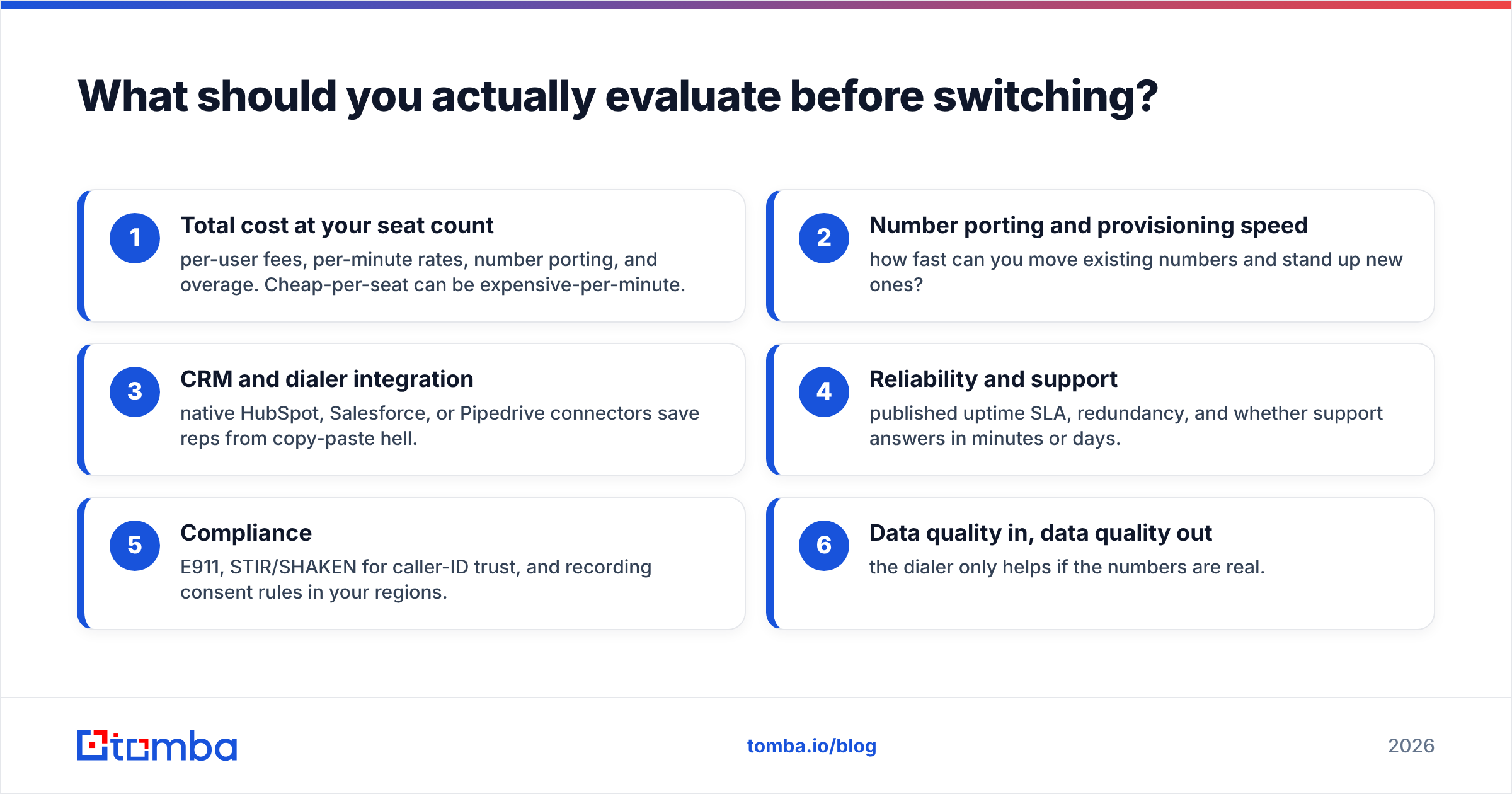
Do not pick on sticker price alone. Score each ClearlyIP alternative against the criteria that bite you six months in:
- Total cost at your seat count — per-user fees, per-minute rates, number porting, and overage. Cheap-per-seat can be expensive-per-minute.
- Number porting and provisioning speed — how fast can you move existing numbers and stand up new ones?
- CRM and dialer integration — native HubSpot, Salesforce, or Pipedrive connectors save reps from copy-paste hell.
- Reliability and support — published uptime SLA, redundancy, and whether support answers in minutes or days.
- Compliance — E911, STIR/SHAKEN for caller-ID trust, and recording consent rules in your regions.
- Data quality in, data quality out — the dialer only helps if the numbers are real.
That last point is where most teams quietly lose money — and it has nothing to do with which VoIP logo you chose.
Why does contact data decide your phone system ROI?#
Your VoIP provider is the pipe. Your contact list is the water. A pristine RingCentral or Dialpad setup still fails if half your numbers are wrong, disconnected, or pointing at the wrong person. Industry research consistently shows B2B data decaying around 30% per year as people change roles and companies — so a list that was clean last spring is leaking by now.
That decay shows up as wasted dials, low connect rates, and reps burning hours on dead lines instead of conversations. No amount of AI transcription fixes a number that never rings a human.

This is where an email-and-phone data layer sits in front of your VoIP stack. Before a number hits the dialer, you want to know it is current and tied to the right decision-maker. Two practical moves:
- Enrich and find the direct numbers and emails for your target accounts, instead of relying on stale CRM exports. A dedicated phone finder pulls B2B numbers from name + company.
- Validate before you dial so reps are not handed disconnected lines. A phone validator checks line status and formatting up front.
Where the numbers come from matters as much as the tool. Tomba documents its data sources rather than treating provenance as a black box — useful when compliance or accuracy questions come up.
How does Tomba fit alongside a VoIP provider?#
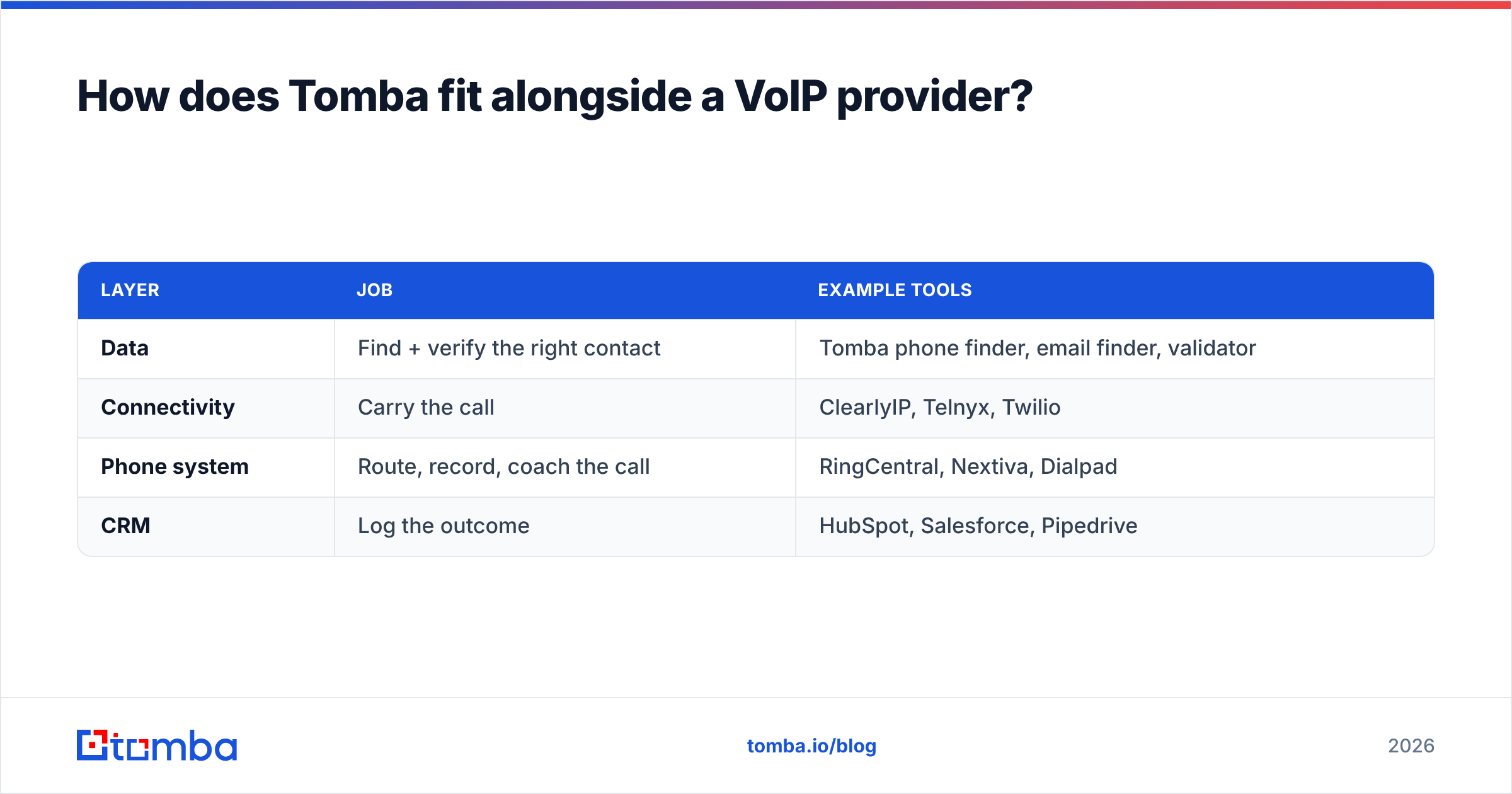
Tomba is not a VoIP company and is not trying to replace ClearlyIP, RingCentral, or Dialpad. It sits one step earlier in the workflow: finding and verifying the contact so your phone system has something accurate to call.
| Layer | Job | Example tools |
|---|---|---|
| Data | Find + verify the right contact | Tomba phone finder, email finder, validator |
| Connectivity | Carry the call | ClearlyIP, Telnyx, Twilio |
| Phone system | Route, record, coach the call | RingCentral, Nextiva, Dialpad |
| CRM | Log the outcome | HubSpot, Salesforce, Pipedrive |
In practice, a sales team might keep ClearlyIP for trunking and compliance, run Dialpad for the rep experience, and use Tomba to source and validate every number that enters the dialer. Each layer does one job well. For exact plan costs on the data layer, the public Tomba pricing page lists a free tier (25 searches/mo), Starter at $49/mo, Growth at $99/mo, and Pro at $249/mo.
Which ClearlyIP alternative should you choose?#
Decide by your primary job-to-be-done:
- You want a no-fuss managed phone system: RingCentral or Nextiva. Nextiva if you are a small team, RingCentral if you need contact-center muscle.
- You are a sales-first org: Dialpad, for AI transcription and coaching on every call.
- You are building calling into software: Twilio if you want the biggest ecosystem, Telnyx if you want lower per-minute cost.
- You are deep in FreePBX and value compliance: keep ClearlyIP for the trunks and E911, and bolt on a data layer plus a sales dialer.
- You operate globally: 8x8 for coverage and bundled contact center.
There is no single "best" — there is best-for-your-stack. The winners are the teams that match the connectivity layer to their technical reality and stop treating contact data as an afterthought.
The bottom line#
ClearlyIP is a strong telecom vendor, especially for SIP trunking and emergency-calling compliance. But if it is mismatched to how your team actually sells, the alternatives above each beat it for a specific job — managed cloud phones, AI sales calling, or programmable CPaaS.
Whichever pipe you choose, feed it clean numbers. Start free with Tomba's phone finder and email finder to source and verify the direct contacts your dialer needs — so every call your new VoIP system places actually reaches a decision-maker, not a dead line. Spin up a free account, pull 25 contacts on the house, and see your connect rate move before you commit a dollar to per-seat fees.
Ready to find emails that actually work?
Join 150,000+ professionals who stopped guessing and started sending. Free credits on signup — no credit card required.
Get the Tomba newsletter
Practical outbound tactics and product updates — once every two weeks.
About the author