Clearout vs RocketReach 2026: Which Email Finder Wins?
Clearout vs RocketReach compared on accuracy, pricing, data coverage, and verification — plus where a leaner alternative beats both on cost per valid contact.
Choosing between Clearout and RocketReach comes down to one question: do you need a verification-first engine that scrubs lists clean, or a discovery-first database that surfaces emails and phone numbers at scale? They are built for different jobs, and picking the wrong one wastes budget on credits you never use.
This guide breaks down the clearout vs rocketreach decision on accuracy, pricing, data coverage, verification, and integrations — then shows where a leaner alternative beats both on cost per valid contact.
TL;DR — Clearout vs RocketReach at a glance#
- Clearout is verification-first: best for cleaning large lists, catch-all detection, and bulk email validation before a send.
- RocketReach is discovery-first: a large contact database with emails and direct-dial phone numbers, strong for finding net-new prospects.
- Pricing models differ sharply — Clearout charges per verification credit, RocketReach sells monthly lookup tiers that reset (and expire).
- Neither is the cheapest path to a verified email — a finder-plus-verifier built on one credit, like Tomba Email Finder, often lands more valid contacts per dollar.
- Pick by job: clean an existing list → Clearout; build a phone-heavy prospect list → RocketReach; find-and-verify in one flow → read the alternatives section.
What is Clearout?#
Clearout is an email verification and email finding platform aimed at teams that already have lists and need them clean. Its core strength is the verifier: real-time SMTP checks, syntax and domain validation, catch-all detection, role-account flagging, and spam-trap screening. You upload a CSV, Clearout scores each address as valid, invalid, catch-all, or unknown, and you export the safe segment.
It also offers an email finder that builds addresses from a name and domain, plus a Chrome extension and an API. But discovery is the secondary act — Clearout's reputation is built on validation accuracy and reducing bounce rates before you hit send. If your problem is "my list bounces," Clearout is squarely in its lane.
What is RocketReach?#
RocketReach is a contact-data platform built around a large B2B database — the company markets hundreds of millions of professional profiles. You search by person, company, or role, and RocketReach returns work emails, personal emails, and direct-dial or mobile phone numbers. It leans into prospecting: browser extension for LinkedIn, bulk lookups, list building, and CRM pushes.
Where Clearout assumes you bring the data, RocketReach assumes you need to find it. Its phone-number coverage is a genuine differentiator for sales teams that cold call, and its database depth helps when you're prospecting into accounts where you have nothing but a company name.
)
Clearout vs RocketReach: the core comparison#
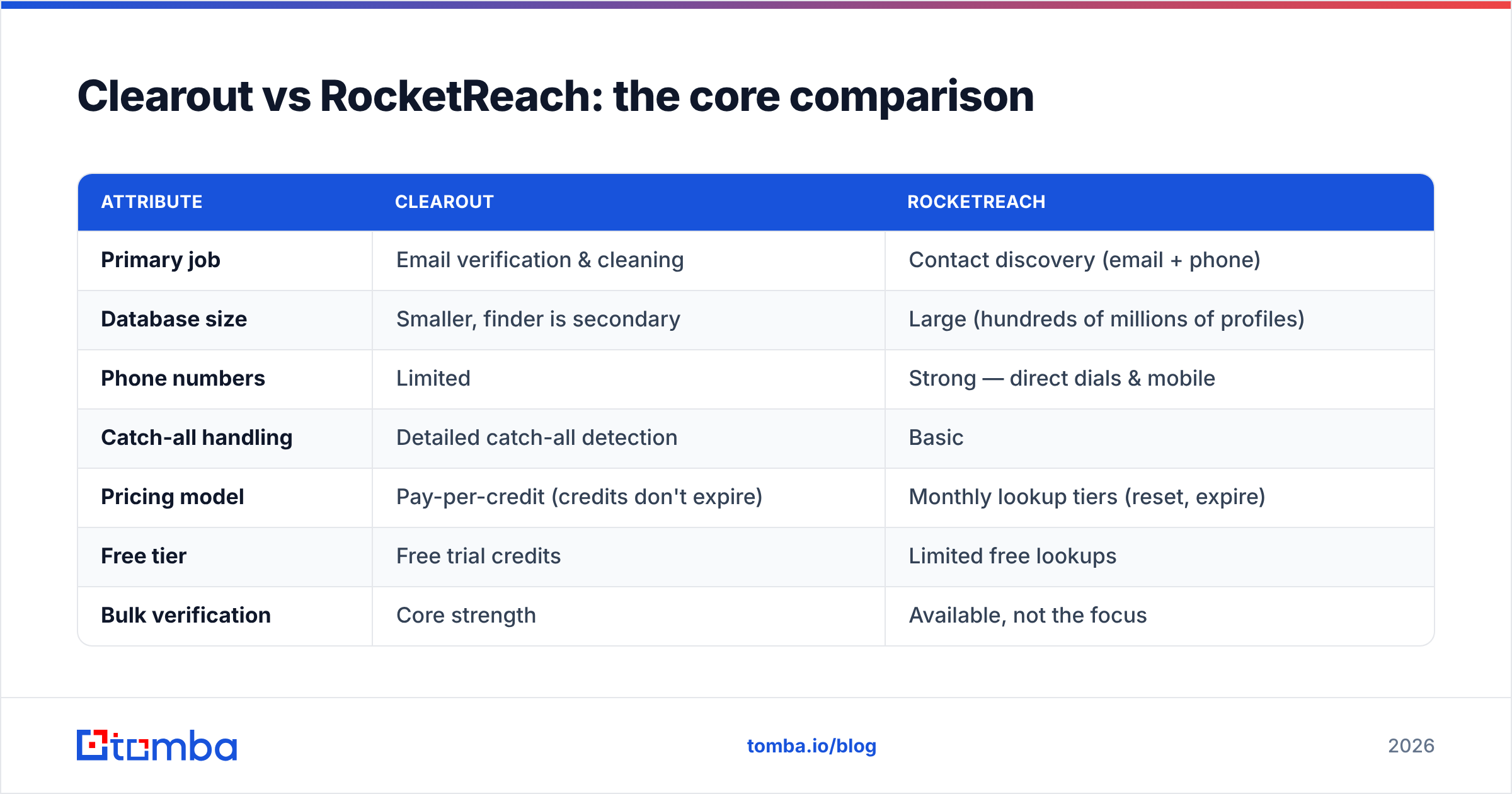
Here is the head-to-head on the attributes that actually change your results and your bill.
| Attribute | Clearout | RocketReach |
|---|---|---|
| Primary job | Email verification & cleaning | Contact discovery (email + phone) |
| Database size | Smaller, finder is secondary | Large (hundreds of millions of profiles) |
| Phone numbers | Limited | Strong — direct dials & mobile |
| Catch-all handling | Detailed catch-all detection | Basic |
| Pricing model | Pay-per-credit (credits don't expire) | Monthly lookup tiers (reset, expire) |
| Free tier | Free trial credits | Limited free lookups |
| Bulk verification | Core strength | Available, not the focus |
| Best for | List cleaning, deliverability | Prospecting, phone outreach |
The pattern is clear: these tools overlap on paper but solve different bottlenecks. Choosing well means naming your bottleneck first.
Which tool is more accurate?#
Accuracy means two different things here, so judge each tool on the job it was built for.
For verification accuracy — does this address actually exist and accept mail — Clearout is the stronger pick. Its SMTP validation, catch-all logic, and spam-trap screening are the product, not a feature, and that focus shows up in lower post-send bounce rates. If your KPI is protecting email deliverability and sender reputation, verification depth is what matters.
For discovery accuracy — can the tool find a correct contact you didn't already have — RocketReach's database depth wins on raw coverage, especially for phone numbers. The trade-off is that big databases carry stale records, so a meaningful share of returned emails still need a second verification pass before you trust them.

That second pass is the hidden cost most buyers miss. A tool that finds an email but can't confirm it forces you to buy verification separately — which is exactly why a combined find-and-verify emails workflow often beats either single-purpose tool on real cost per valid contact.
How does pricing compare?#
Pricing is where the clearout vs rocketreach choice gets sharp, because the two billing models reward opposite behavior.
Clearout sells credits. You buy a pack, spend one credit per verification, and unused credits generally don't expire. That suits spiky, project-based work — clean a 50,000-row list this month, do nothing next month, and you haven't lost anything.
RocketReach sells monthly subscription tiers with a fixed number of lookups that reset each cycle. Unused lookups typically expire. That suits steady, high-volume prospecting where you'll use the allotment every month — but it punishes inconsistent usage, because you pay whether you look anyone up or not.
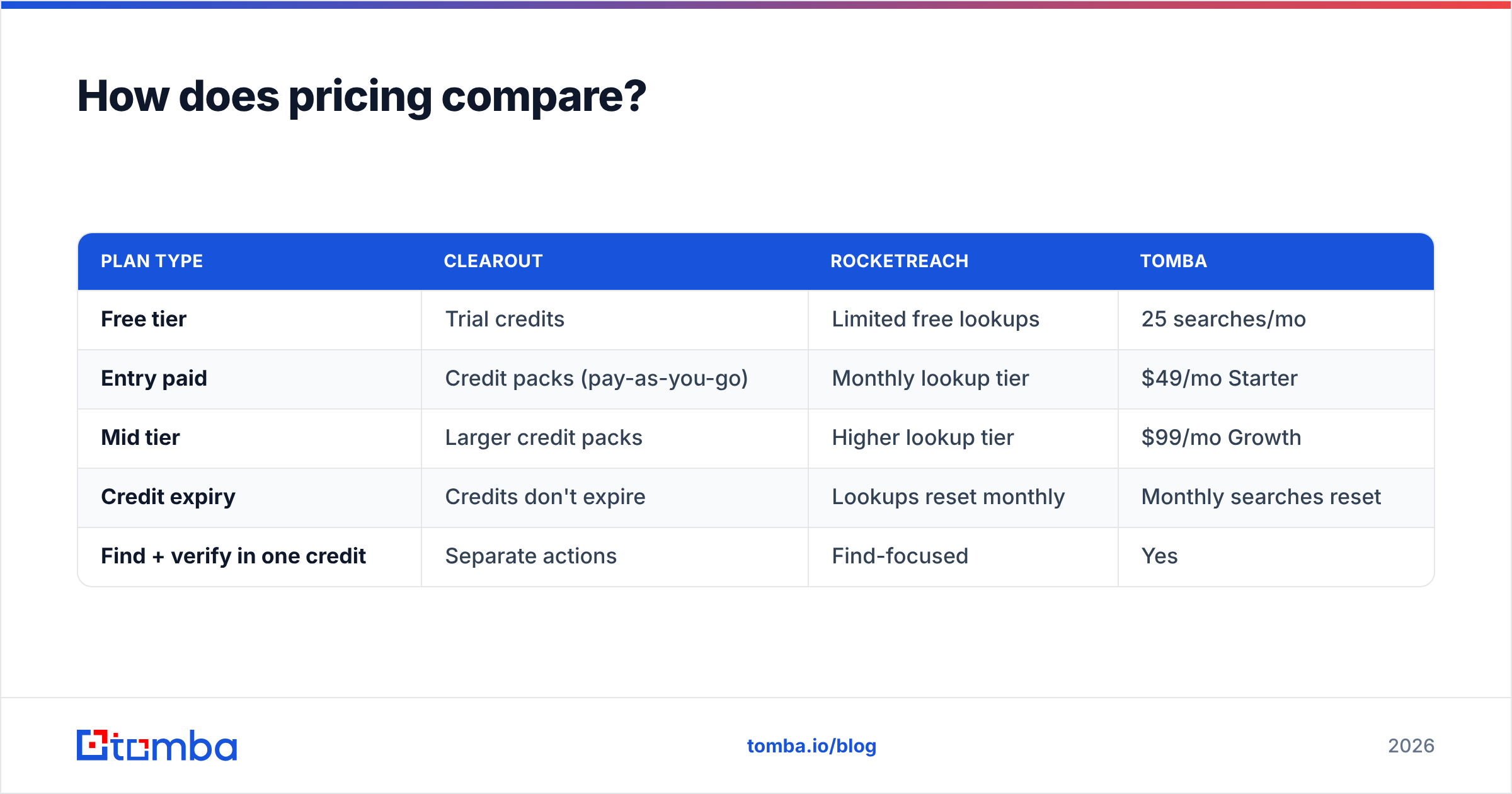
| Plan type | Clearout | RocketReach | Tomba |
|---|---|---|---|
| Free tier | Trial credits | Limited free lookups | 25 searches/mo |
| Entry paid | Credit packs (pay-as-you-go) | Monthly lookup tier | $49/mo Starter |
| Mid tier | Larger credit packs | Higher lookup tier | $99/mo Growth |
| Credit expiry | Credits don't expire | Lookups reset monthly | Monthly searches reset |
| Find + verify in one credit | Separate actions | Find-focused | Yes |
Before you commit, model your actual monthly volume against each model. Bursty users overpay on subscriptions; steady users overpay on credits they rush to use. Compare the math against transparent Tomba pricing so you have a third reference point rather than only the two extremes.
Clearout vs RocketReach: pros and cons#
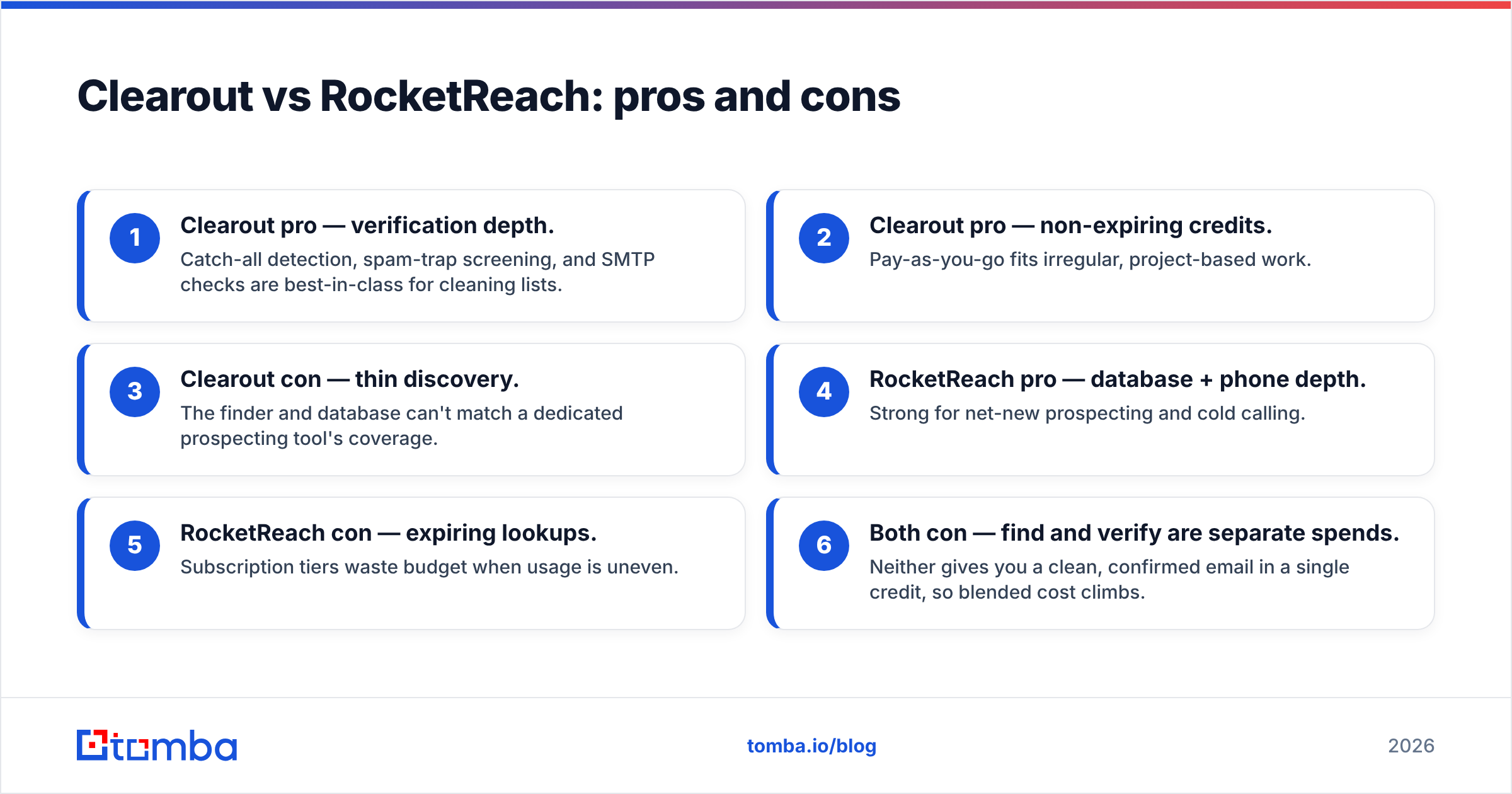
Use this to sanity-check your shortlist before a trial.
- Clearout pro — verification depth. Catch-all detection, spam-trap screening, and SMTP checks are best-in-class for cleaning lists.
- Clearout pro — non-expiring credits. Pay-as-you-go fits irregular, project-based work.
- Clearout con — thin discovery. The finder and database can't match a dedicated prospecting tool's coverage.
- RocketReach pro — database + phone depth. Strong for net-new prospecting and cold calling.
- RocketReach con — expiring lookups. Subscription tiers waste budget when usage is uneven.
- Both con — find and verify are separate spends. Neither gives you a clean, confirmed email in a single credit, so blended cost climbs.
)
Where does a combined finder fit — Tomba as an alternative?#
Tomba sits in the gap between these two tools: it finds emails and verifies them inside one workflow, so you don't stitch a discovery tool to a separate validator. That's the practical answer to the cost problem above — one platform, one credit logic, a confirmed result.
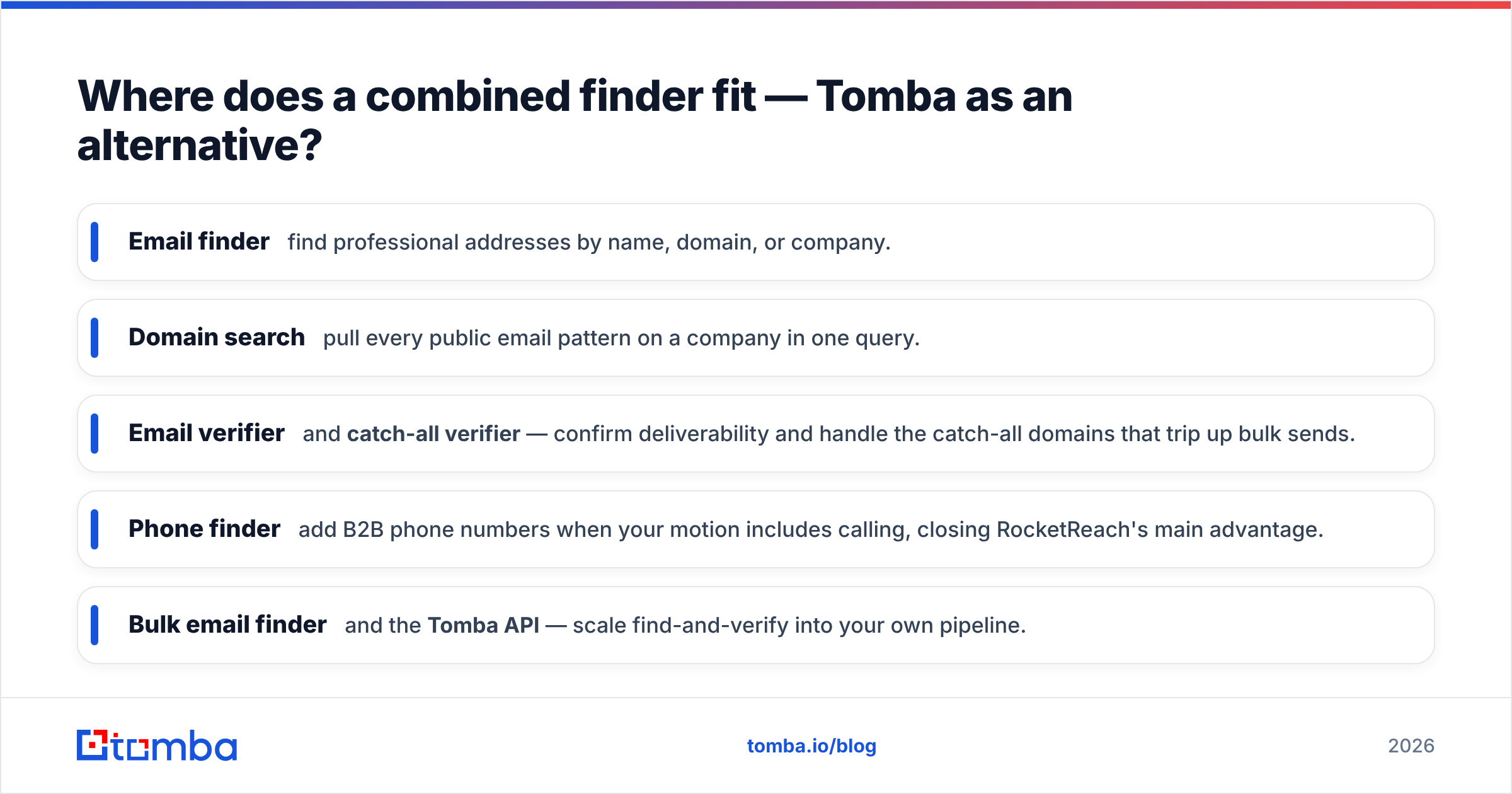
The toolkit covers the full prospecting motion:
- Email finder — find professional addresses by name, domain, or company.
- Domain search — pull every public email pattern on a company in one query.
- Email verifier and catch-all verifier — confirm deliverability and handle the catch-all domains that trip up bulk sends.
- Phone finder — add B2B phone numbers when your motion includes calling, closing RocketReach's main advantage.
- Bulk email finder and the Tomba API — scale find-and-verify into your own pipeline.

For teams already evaluating the category, Tomba publishes direct head-to-heads — including a RocketReach alternative and a Clearout alternative — so you can compare claims against your own seed list rather than marketing copy.
How do they handle integrations and workflow?#
All three plug into a modern stack, but the depth differs by where each tool focuses.
RocketReach leans on its browser extension and CRM pushes to support a prospect-on-LinkedIn, send-to-CRM motion. Clearout integrates with email service providers and marketing platforms so verification runs inside your send workflow. Tomba spreads across the workflow with native connectors — HubSpot, Salesforce, Google Sheets, and a Chrome extension — plus a Zapier integration for the long tail.
A quick gut-check: if your reps live in LinkedIn, weight the extension experience. If your ops team runs enrichment in batches, weight the API and bulk tools. If marketing owns deliverability, weight the verifier's place in your ESP flow. The right integration story is the one that matches who actually clicks the buttons.
How to choose between Clearout, RocketReach, and Tomba#
Match the tool to your bottleneck, not to the longest feature list.
- Choose Clearout when you already have lists and your only problem is bounce rate and deliverability. It's the cleanest single-purpose verifier of the three.
- Choose RocketReach when discovery is the bottleneck and phone numbers matter — high-volume, steady prospecting where you'll burn the monthly lookups every cycle.
- Choose Tomba when you want find-and-verify in one flow, irregular usage that punishes subscription waste, or a transparent per-search cost — without buying two tools to do one job.
Run the same 50-contact test list through all three free tiers before paying. Measure valid-email rate, phone coverage if you call, and total cost to reach a confirmed contact. The winner on that single metric is the one to buy — your seed list beats any vendor's accuracy claim, including the ones in this post.
The bottom line#
Clearout and RocketReach are both good at the narrow job they were built for — Clearout verifies, RocketReach discovers — but most teams need both halves, and buying them separately inflates your cost per valid contact. If you want one tool that finds the email, confirms it's deliverable, and adds a phone number when you need to call, start free with the Tomba Email Finder: 25 searches a month at no cost, then scale on a plan that resets predictably instead of expiring on you. Test it against your own list this week and let the valid-contact math decide.
// get started
Find, verify and enrich your first contacts today
Start on the free plan with 25 searches a month, then scale when your team is ready.
Free plan · No credit card required · GDPR & CCPA
// about the author