Click to Open Rate: Benchmarks, Formula & Fixes for 2026
Your open rate lies. Click to open rate doesn't. Here's how to calculate CTOR, what counts as good in 2026, and the levers that actually move it.
TL;DR
- Click to open rate (CTOR) = unique clicks ÷ unique opens × 100. It tells you how persuasive your email content is once someone actually opens it.
- Unlike open rate, CTOR is far harder to inflate — which matters now that Apple Mail Privacy Protection has wrecked open-rate accuracy.
- A "good" CTOR in 2026 sits roughly between 10% and 20%, depending on industry and email type.
- The biggest CTOR killers are weak calls to action, bloated copy, broken or buried links, and sending to people who never wanted the email.
- Clean lists and accurate targeting lift CTOR before you touch a single word of copy — that's where data quality earns its keep.
What is click to open rate (CTOR)?#
Click to open rate is the percentage of people who clicked a link after opening your email. Think of it like a restaurant: open rate measures how many people walked through the door, but CTOR measures how many actually ordered something off the menu. A packed dining room with no orders means your menu — your email content — isn't doing its job.
Technically, CTOR isolates the performance of everything inside the email: the copy, the offer, the layout, the call to action, and the links. It strips out the subject line and sender reputation, which mostly drive the open. That makes it one of the cleanest signals of message quality you can track.
This metric matters more in 2026 than it did five years ago. Apple's Mail Privacy Protection (MPP) pre-loads images and fires open pixels whether or not a human ever read the email, which means raw open rates are inflated and unreliable. Clicks still require a real action. So CTOR — anchored to clicks — has quietly become the engagement number serious teams trust.

How do you calculate click to open rate?#
The formula is short:
CTOR = (Unique Clicks ÷ Unique Opens) × 100
Use unique counts, not total. If one person clicks three links, that's one unique click, not three. Counting totals will flatter your numbers and hide the truth.
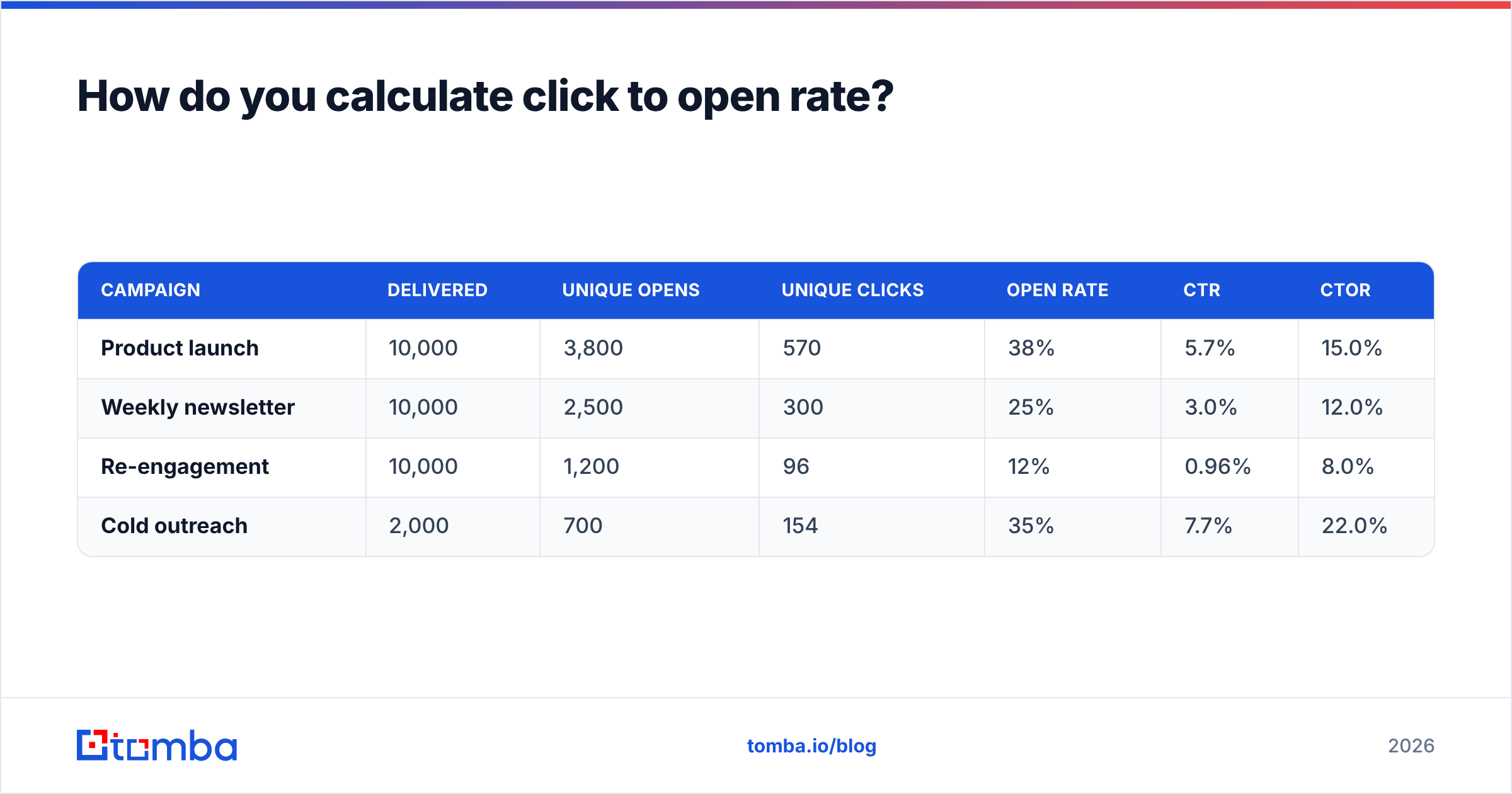
Here's a worked example with four campaigns so you can see how CTOR diverges from the more common click-through rate (CTR), which divides by emails delivered rather than opened:
| Campaign | Delivered | Unique Opens | Unique Clicks | Open Rate | CTR | CTOR |
|---|---|---|---|---|---|---|
| Product launch | 10,000 | 3,800 | 570 | 38% | 5.7% | 15.0% |
| Weekly newsletter | 10,000 | 2,500 | 300 | 25% | 3.0% | 12.0% |
| Re-engagement | 10,000 | 1,200 | 96 | 12% | 0.96% | 8.0% |
| Cold outreach | 2,000 | 700 | 154 | 35% | 7.7% | 22.0% |
Notice the re-engagement campaign: a low open rate and a low CTOR tell you the problem is bigger than the subject line — the audience is cold and the content isn't landing. The cold outreach campaign has a modest CTR but a strong CTOR, meaning the few who opened were genuinely interested. CTOR gives you that nuance; CTR alone hides it.
What is a good click to open rate in 2026?#
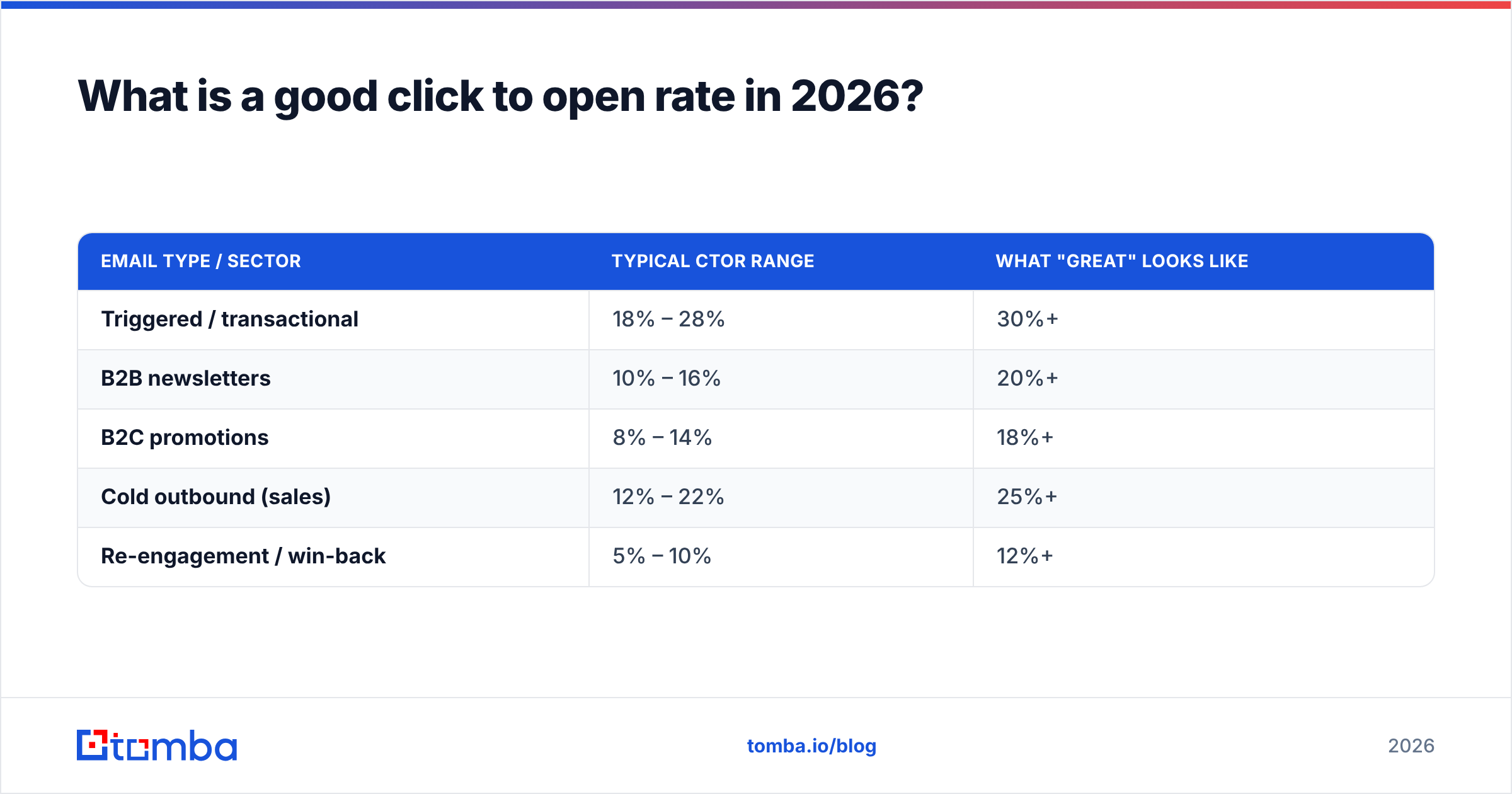
A good CTOR generally falls between 10% and 20%, but the honest answer is "it depends on your industry and email type." Transactional and triggered emails routinely beat broadcast newsletters. B2B tends to run tighter than B2C. Here's a practical reference range pulled from how the major benchmark reports trend:
| Email type / sector | Typical CTOR range | What "great" looks like |
|---|---|---|
| Triggered / transactional | 18% – 28% | 30%+ |
| B2B newsletters | 10% – 16% | 20%+ |
| B2C promotions | 8% – 14% | 18%+ |
| Cold outbound (sales) | 12% – 22% | 25%+ |
| Re-engagement / win-back | 5% – 10% | 12%+ |
Treat external numbers as a compass, not a verdict. Mailchimp's email benchmark data and HubSpot's marketing statistics are useful for orientation, but your own trailing 90-day average is the benchmark that actually counts. If your CTOR is climbing month over month, you're winning — regardless of what an industry chart says.
One caveat: because MPP inflates opens, your denominator may be artificially high, which drags reported CTOR down. If you serve a lot of Apple Mail users, your "true" CTOR is likely higher than your dashboard shows. Segment by mail client when you can.
Why is click to open rate better than open rate?#
CTOR is harder to fake and closer to revenue. Here's the breakdown:
- It survives privacy changes. Open rate counts a pixel load; CTOR counts a deliberate click. Bots, prefetching, and MPP all corrupt the former and barely touch the latter.
- It measures content, not just packaging. A clever subject line can win an open from someone who immediately regrets it. CTOR only rewards emails that deliver on the promise.
- It predicts downstream action. Clicks correlate with site visits, demos, and purchases far better than opens do. A click is a micro-conversion.
- It exposes list-quality problems fast. If your CTOR craters, you're often emailing the wrong people — stale contacts, role accounts, or addresses that should never have been on the list.
That last point is where many teams get blindsided. You can write the best email of your career, but if 30% of your list is invalid or mistargeted, your CTOR will sag and you'll blame the copy. This is why list hygiene and accurate contact data sit upstream of every content decision. Running addresses through an email verifier before a send keeps your opens and clicks anchored to real humans, and protecting your email deliverability ensures the email reaches the inbox in the first place.

How do you improve your click to open rate?#
CTOR improves when you make the inside of the email easier to act on. Work these levers in order of impact:
- Sharpen one primary call to action. Most low-CTOR emails bury the ask or stack five competing buttons. Pick one main action, make it a button, and put it above the fold. Secondary links can stay, but the hierarchy must be obvious.
- Match the body to the subject's promise. If the subject says "Your Q3 report is ready," the very first line and the button should lead straight to that report. Mismatch between subject and content is the fastest way to lose a click.
- Cut the copy. Long preambles tank CTOR. Lead with the value, not your throat-clearing intro. Aim for scannable: short paragraphs, one idea each, bolded anchor phrases.
- Make links unmissable and unbroken. Test every link before sending. A 404 or a link hidden in gray body text is a click you'll never get back. Buttons beat text links for primary actions.
- Segment and personalize. A relevant offer to a tight segment will out-click a generic blast every time. Send the renewal nudge only to people approaching renewal.
- Time it for the reader, not your calendar. Engagement windows vary by audience; test send times and let the data, not habit, decide.
A practical sequence: fix targeting and list quality first, then the CTA, then the copy, then timing. Reordering this wastes effort — polishing copy for an audience that shouldn't be receiving the email is rearranging deck chairs.
How does data quality affect click to open rate?#
Data quality is the silent multiplier on every CTOR number you'll ever report. Garbage contacts inflate your denominator, trigger spam complaints, and pull your sender reputation down — which then suppresses inbox placement and starts a doom loop.
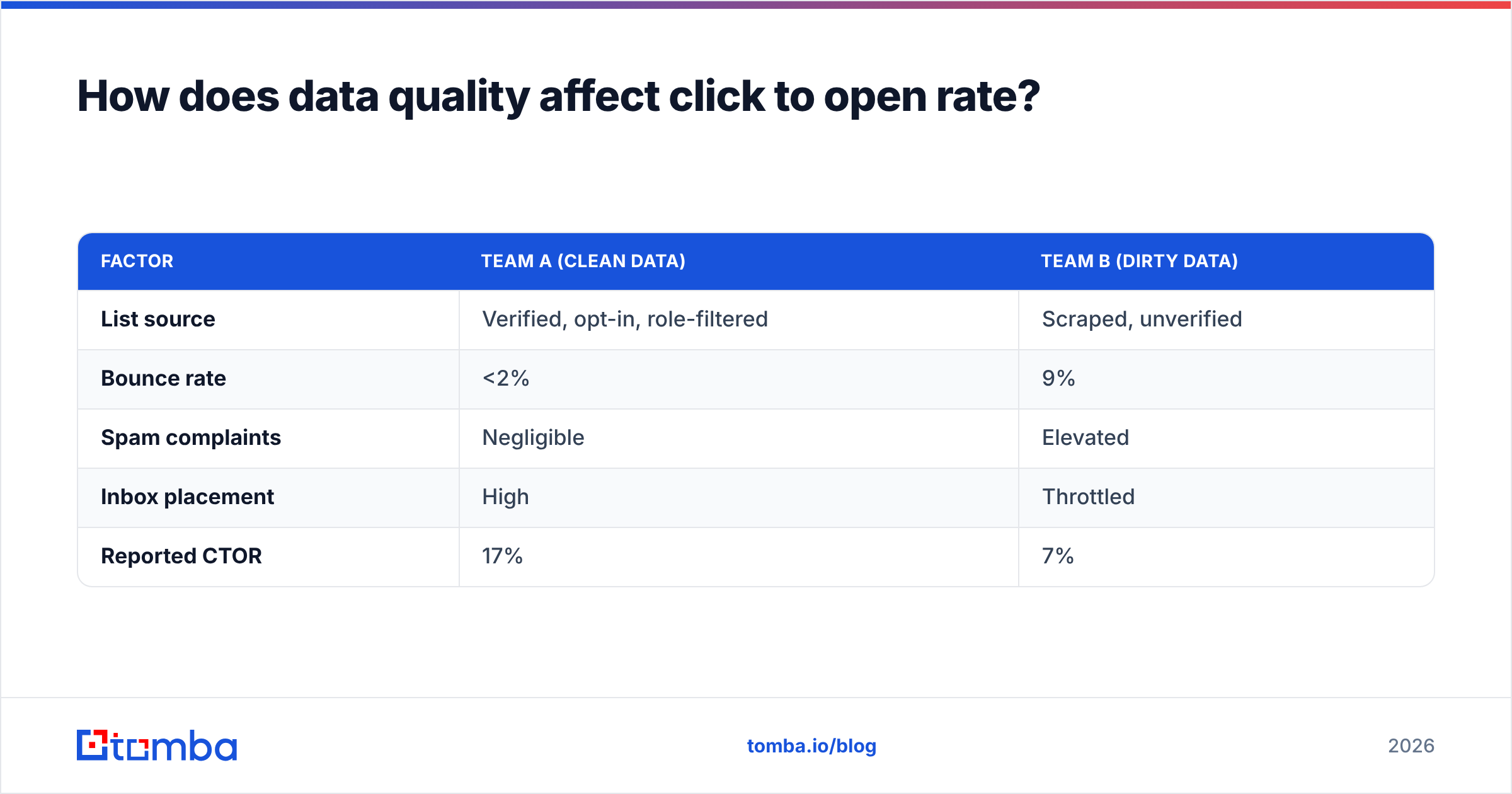
Consider two teams sending the identical email:
| Factor | Team A (clean data) | Team B (dirty data) |
|---|---|---|
| List source | Verified, opt-in, role-filtered | Scraped, unverified |
| Bounce rate | <2% | 9% |
| Spam complaints | Negligible | Elevated |
| Inbox placement | High | Throttled |
| Reported CTOR | 17% | 7% |
Same words. Less than half the CTOR. The difference is entirely upstream — who got the email and whether the address was real. This is why prospecting accuracy is a CTOR strategy, not just a sales one. When you build a list with verified, correctly-targeted contacts using an email finder, you're stacking the deck before the first email goes out. Pair that with monitoring your response rate over time and you get a feedback loop that compounds: better data → better engagement → better reputation → better placement → better engagement again.
For sales teams running cold outbound, this is doubly true. A cold list with even 15% bad addresses will hammer your CTOR and your domain reputation in the same week. Verify before you send, every time.
What mistakes drag click to open rate down?#
The usual suspects, ranked by how often they quietly sabotage campaigns:
- Counting total clicks instead of unique clicks — flatters the number, hides the problem.
- One email, five asks — competing CTAs split attention and clicks collapse.
- Ignoring mobile rendering — if buttons are tiny or links overlap on a phone, you lose the majority of your audience who reads on mobile.
- Sending to unsegmented lists — generic relevance produces generic CTOR.
- Never cleaning the list — dead and invalid addresses drag every metric down and risk blacklisting.
- Comparing yourself to the wrong benchmark — a B2C promo CTOR judged against transactional email standards looks like failure when it's actually fine.
Avoid those six and you'll outperform most senders without writing a single clever line of copy.
Frequently asked questions#
Is click to open rate the same as click-through rate? No. Click-through rate (CTR) divides unique clicks by emails delivered; CTOR divides unique clicks by emails opened. CTR measures overall reach-to-click; CTOR isolates content performance among people who opened.
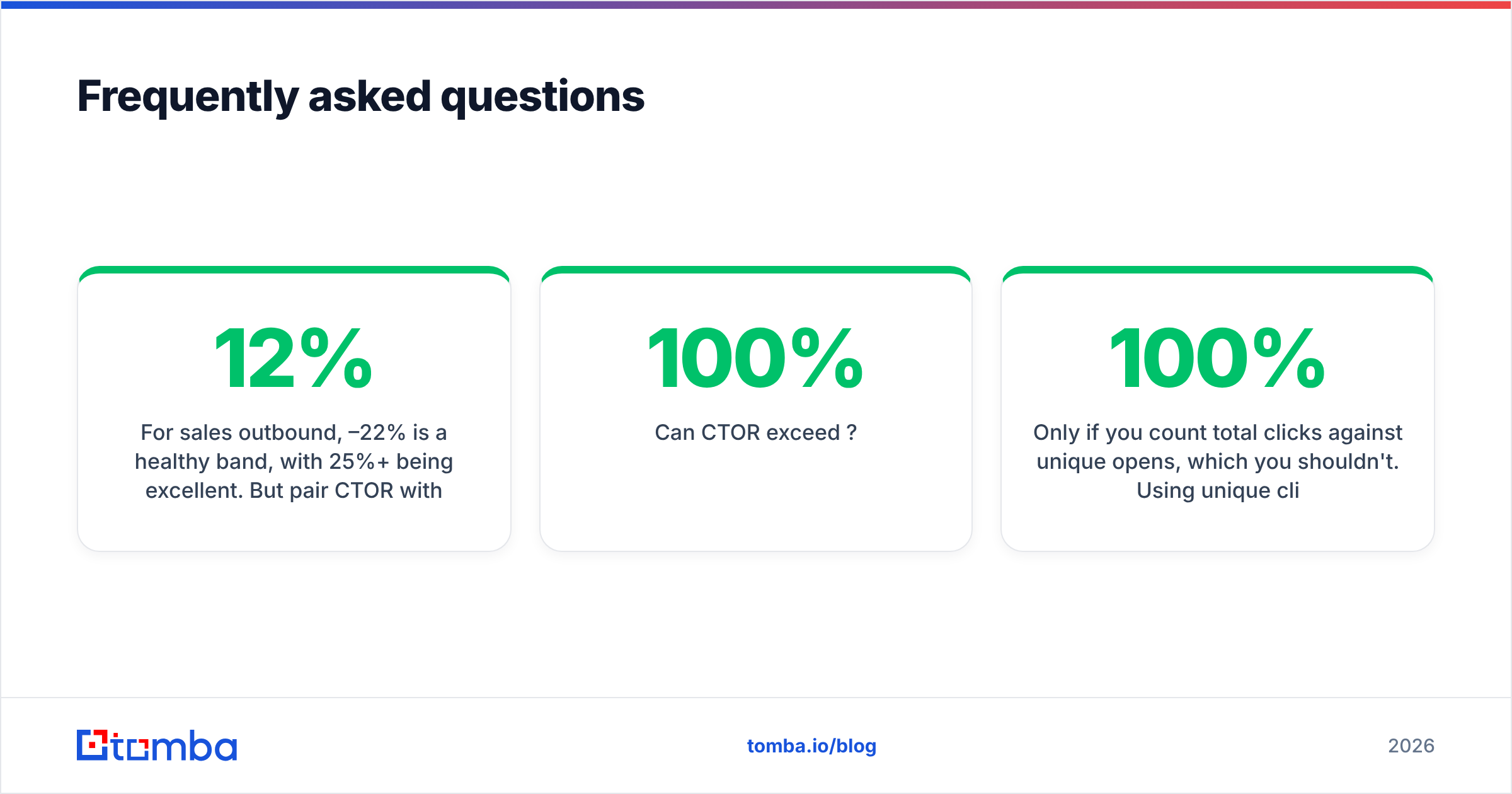
What's a realistic CTOR target for cold email? For sales outbound, 12%–22% is a healthy band, with 25%+ being excellent. But pair CTOR with reply rate — a click without a conversation is only half the goal in cold outreach.
Can CTOR exceed 100%? Only if you count total clicks against unique opens, which you shouldn't. Using unique clicks ÷ unique opens, CTOR caps at 100%.
Does Apple Mail Privacy Protection affect CTOR? Indirectly. MPP inflates opens, which inflates your denominator and can understate your reported CTOR. Segment by mail client to see a truer picture.
Put accurate data behind every click#
CTOR rewards two things: emails worth clicking, and lists worth emailing. You control the copy — but the contacts are where most teams quietly lose. Start every campaign with verified, correctly-targeted prospects from the Tomba Email Finder, confirm each address is deliverable, and you'll watch your click to open rate climb before you've rewritten a single CTA. Clean data isn't a nice-to-have; it's the cheapest CTOR upgrade you'll ever make. Check the Tomba pricing plans — including a free tier with 25 searches a month — and build your next list on a foundation that clicks.
// get started
Find, verify and enrich your first contacts today
Start on the free plan with 25 searches a month, then scale when your team is ready.
Free plan · No credit card required · GDPR & CCPA
// about the author