Click to Open Ratio (CTOR): The 2026 Benchmark Guide
Open rate tells you the subject line worked. Click to open ratio tells you the email did. Here is how to measure CTOR, what counts as good in 2026, and how to lift it.
TL;DR
- Click to open ratio (CTOR) measures how many people who opened your email actually clicked a link inside it. Formula: unique clicks ÷ unique opens × 100.
- CTOR isolates the quality of your email content — copy, offer, layout, CTA — while click-through rate (CTR) is muddied by your subject line and deliverability.
- A "good" click to open ratio in 2026 sits roughly between 10% and 20% for most B2B and ecommerce sends, though it swings hard by industry.
- Apple Mail Privacy Protection inflates opens with bot-driven pre-fetches, so raw CTOR is now noisier than it was five years ago — segment by engaged openers to keep it honest.
- The fastest CTOR gains come from a single clear CTA, tighter segmentation, and sending to verified, real inboxes instead of stale lists.
What is the click to open ratio?#
The click to open ratio is the percentage of people who opened your email and then clicked at least one link inside it. Think of it like a retail store: open rate is how many people walked through the door, and CTOR is how many of those visitors actually picked something off the shelf. A crowded store with empty checkouts is a content problem, not a foot-traffic problem — and CTOR is the metric that exposes it.
That distinction matters because open rate and click-through rate each answer a different question. Open rate grades your subject line and sender reputation. CTOR grades everything that happens after the open: the headline, the body copy, the offer, the design, and the call to action. When you want to know whether the email itself earned the click, CTOR is the number you watch.
How do you calculate click to open ratio?#
The formula is simple and worth memorizing:
CTOR = (Unique Clicks ÷ Unique Opens) × 100
Always use unique clicks and unique opens, not totals. If one subscriber opens an email three times and clicks twice, that's one open and one click for this calculation. Counting raw totals inflates the number and makes campaign-to-campaign comparison meaningless.
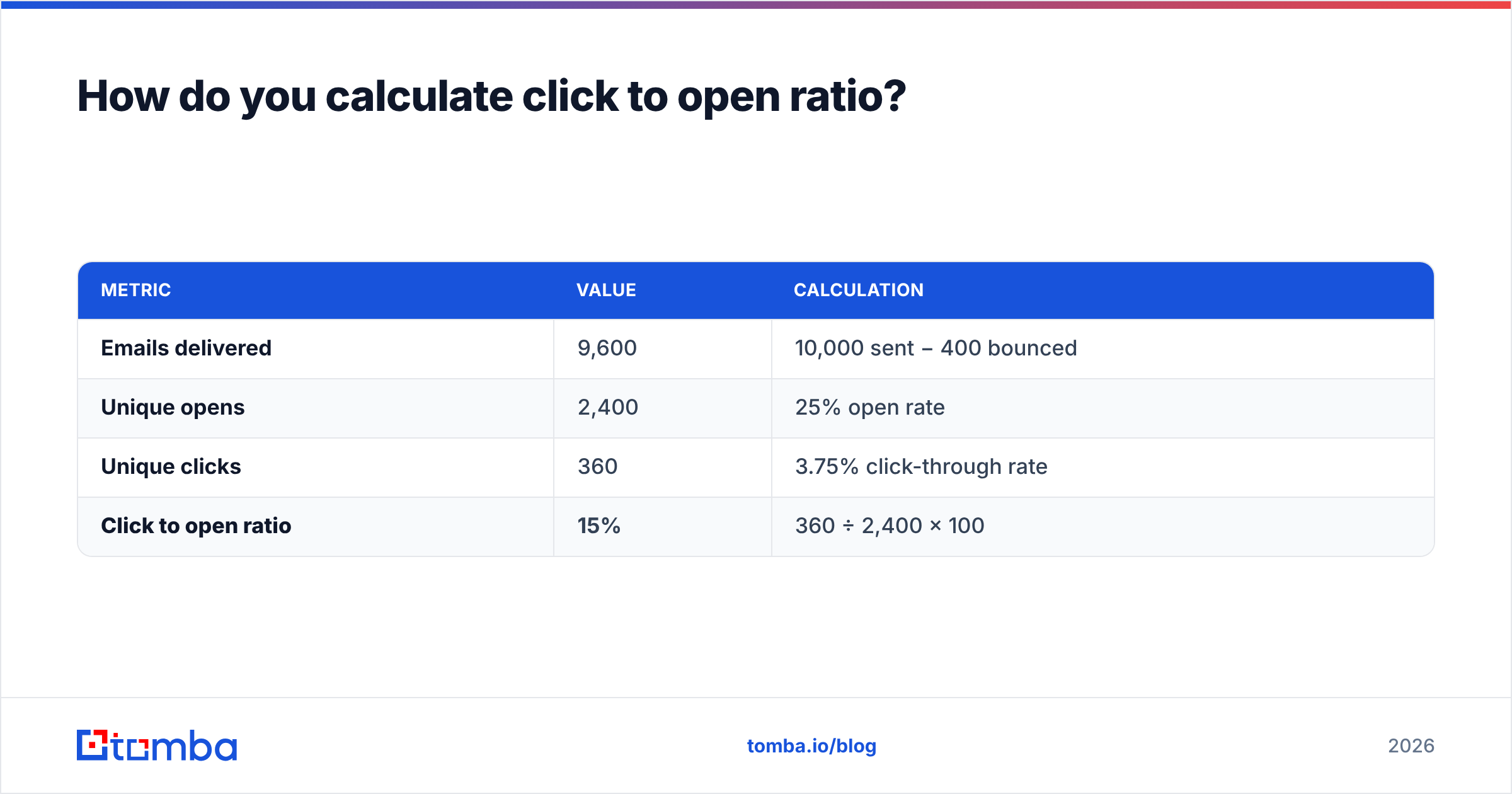
Here's a worked example. Say you send a campaign to 10,000 verified contacts:
| Metric | Value | Calculation |
|---|---|---|
| Emails delivered | 9,600 | 10,000 sent − 400 bounced |
| Unique opens | 2,400 | 25% open rate |
| Unique clicks | 360 | 3.75% click-through rate |
| Click to open ratio | 15% | 360 ÷ 2,400 × 100 |
Notice that the click-through rate (clicks ÷ delivered) is 3.75%, but the click to open ratio is 15%. Same campaign, very different story. The CTR looks modest, but the CTOR tells you that one in seven openers engaged — a strong signal that the content resonated with the people who actually saw it.
Why does CTOR matter more than open rate?#
CTOR matters more because it survives the metrics that broke open rate. Since Apple rolled out Mail Privacy Protection (MPP), a large share of "opens" are now bot pre-fetches rather than human eyeballs. Gmail and Yahoo apply similar caching. The result: open rate is inflated and unreliable, and any metric built on top of it inherits that noise.
CTOR is partially insulated because clicks still require a deliberate human action — a bot rarely clicks through to your pricing page. So while MPP can pad your denominator (opens), the numerator (clicks) stays comparatively clean. That makes CTOR one of the more trustworthy engagement signals left, as long as you're aware of the inflation.
Three reasons CTOR earns its place in your reporting:
- It isolates content performance. Strip away the subject line and deliverability, and CTOR is a near-pure read on whether your message and offer landed.
- It is comparable across campaigns. Because it normalizes for audience size and open volume, you can benchmark a 5,000-person newsletter against a 50,000-person promo fairly.
- It flags list-quality decay early. A sliding CTOR on consistent creative often means your engaged segment is shrinking — a cue to clean your list before deliverability suffers.
For the deeper mechanics of why inbox placement feeds into every one of these numbers, see the fundamentals of email deliverability and how sender reputation shapes who ever sees your send in the first place.
What is a good click to open ratio in 2026?#
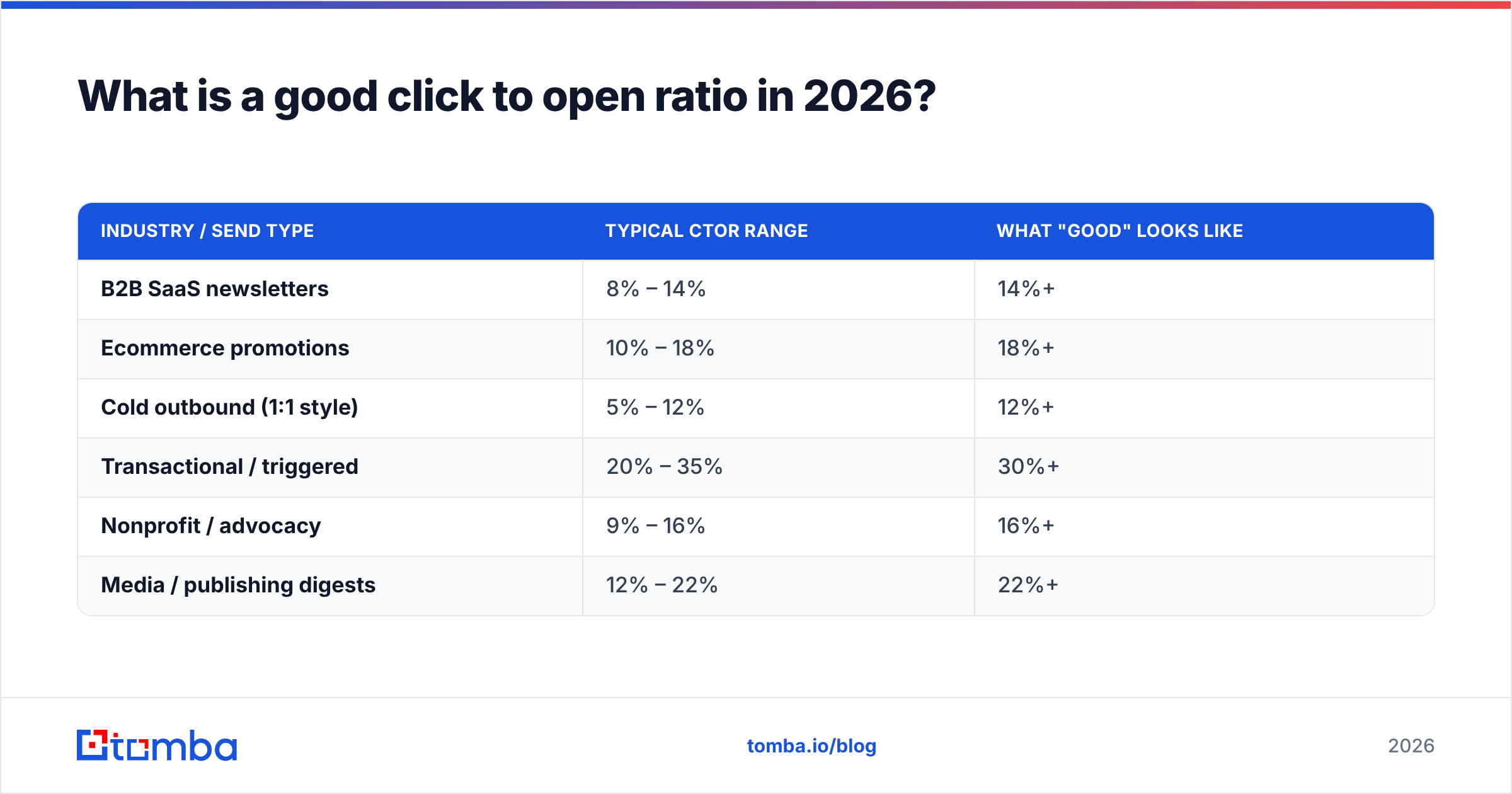
A good click to open ratio in 2026 generally falls between 10% and 20%, but the honest answer is "it depends on your industry, list, and send type." Transactional and triggered emails routinely clear 20–30% because the recipient is expecting them. Cold outbound and large promotional blasts often sit in the high single digits. Context is everything.
Use this table as a directional benchmark, not gospel — your own historical median is the only baseline that truly matters:
| Industry / send type | Typical CTOR range | What "good" looks like |
|---|---|---|
| B2B SaaS newsletters | 8% – 14% | 14%+ |
| Ecommerce promotions | 10% – 18% | 18%+ |
| Cold outbound (1:1 style) | 5% – 12% | 12%+ |
| Transactional / triggered | 20% – 35% | 30%+ |
| Nonprofit / advocacy | 9% – 16% | 16%+ |
| Media / publishing digests | 12% – 22% | 22%+ |
If your numbers sit below these ranges, don't panic — and don't chase the table. Chase your trend line. A campaign that moves your own CTOR from 9% to 12% is worth more than matching some external average, because it reflects a real improvement in how your audience responds to your content. For broader context on how leading teams set engagement targets, the annual benchmark reports from HubSpot and review aggregators like G2 are useful sanity checks.
How is CTOR different from click-through rate?#
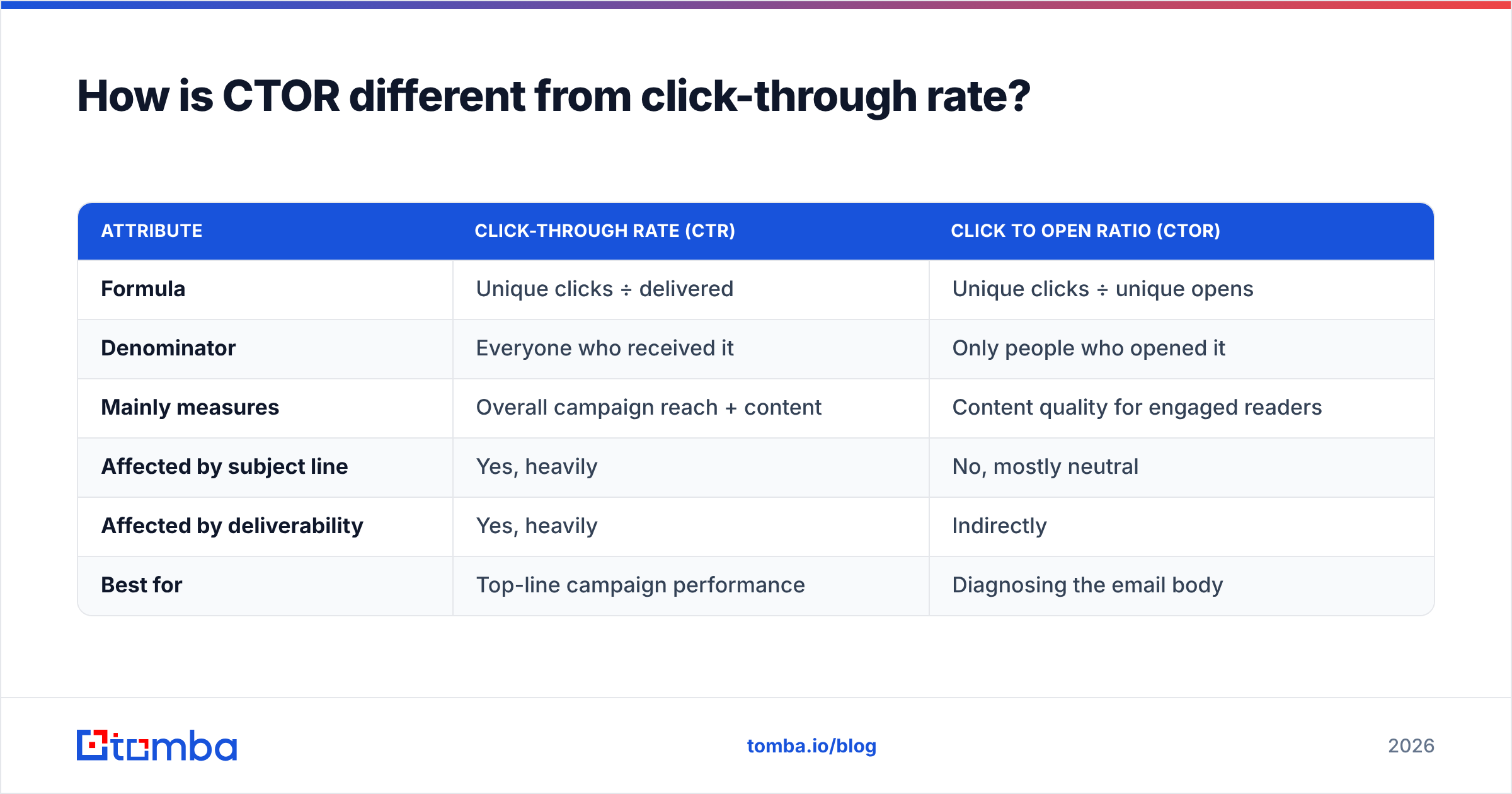
CTOR and CTR look similar but answer different questions, and confusing them leads to bad decisions. Here is the clean comparison:
| Attribute | Click-Through Rate (CTR) | Click to Open Ratio (CTOR) |
|---|---|---|
| Formula | Unique clicks ÷ delivered | Unique clicks ÷ unique opens |
| Denominator | Everyone who received it | Only people who opened it |
| Mainly measures | Overall campaign reach + content | Content quality for engaged readers |
| Affected by subject line | Yes, heavily | No, mostly neutral |
| Affected by deliverability | Yes, heavily | Indirectly |
| Best for | Top-line campaign performance | Diagnosing the email body |
Here's the practical takeaway. If your CTR is low but your CTOR is healthy, your content is fine — your problem is getting people to open (better subject lines, better sending reputation, cleaner list). If both CTR and CTOR are low, the email body itself is the bottleneck. Reading the two metrics together turns vague "this campaign underperformed" into a specific, fixable diagnosis.
How do you improve your click to open ratio?#
Improving CTOR comes down to making the opened email easier to act on. Below are the levers that move the number most, ordered roughly by impact.
1. Use one primary call to action. Emails that ask for three things get clicks on none of them. Pick the single most valuable action, make it a button, and repeat it once near the bottom. Secondary links can live in the email, but the eye should land on one obvious next step. If you need a starting point, Tomba's free cold email templates are structured around a single CTA.
2. Match the body to the subject-line promise. A subject line that promises a discount and a body that buries it is a CTOR killer. The fastest readers scan; if the payoff isn't visible in the first screen, they close. Keep the headline and the first sentence aligned with whatever earned the open.
3. Segment harder. A relevant email to 2,000 people will out-click a generic email to 20,000 every time. Segment by behavior, lifecycle stage, or persona, and write to that slice specifically. This is where engagement metrics and list hygiene meet.
4. Send to real, verified inboxes. This is the underrated one. If 15% of your "opens" are MPP bots or your list is full of stale, role-based, or invalid addresses, your CTOR is distorted before you write a single word. Running your list through an email verifier and re-checking risky catch-all domains keeps your denominator honest, so the CTOR you report reflects actual humans.
5. Optimize for mobile and dark mode. Most B2C and a growing share of B2B opens happen on phones. Single-column layouts, tappable buttons (44px minimum), and dark-mode-safe images prevent the "opened, squinted, closed" pattern that silently tanks CTOR.
6. Tighten the copy. Shorter sentences, scannable structure, and concrete value beat clever fluff. Lead with the benefit, not the backstory.

The order matters: even brilliant copy can't rescue a list full of fake addresses, which is why data quality sits underneath every other tactic. You can write the best email of your career, but if a third of the inbox addresses never belonged to a buying human, your CTOR will lie to you about what's working.
How does data quality affect your click to open ratio?#
Data quality affects CTOR because the metric is a ratio, and both halves of that ratio depend on reaching real people. Bad data corrupts the denominator with bot opens and the numerator by sending engaged-looking signals from addresses that will never convert. Garbage in, misleading ratio out.
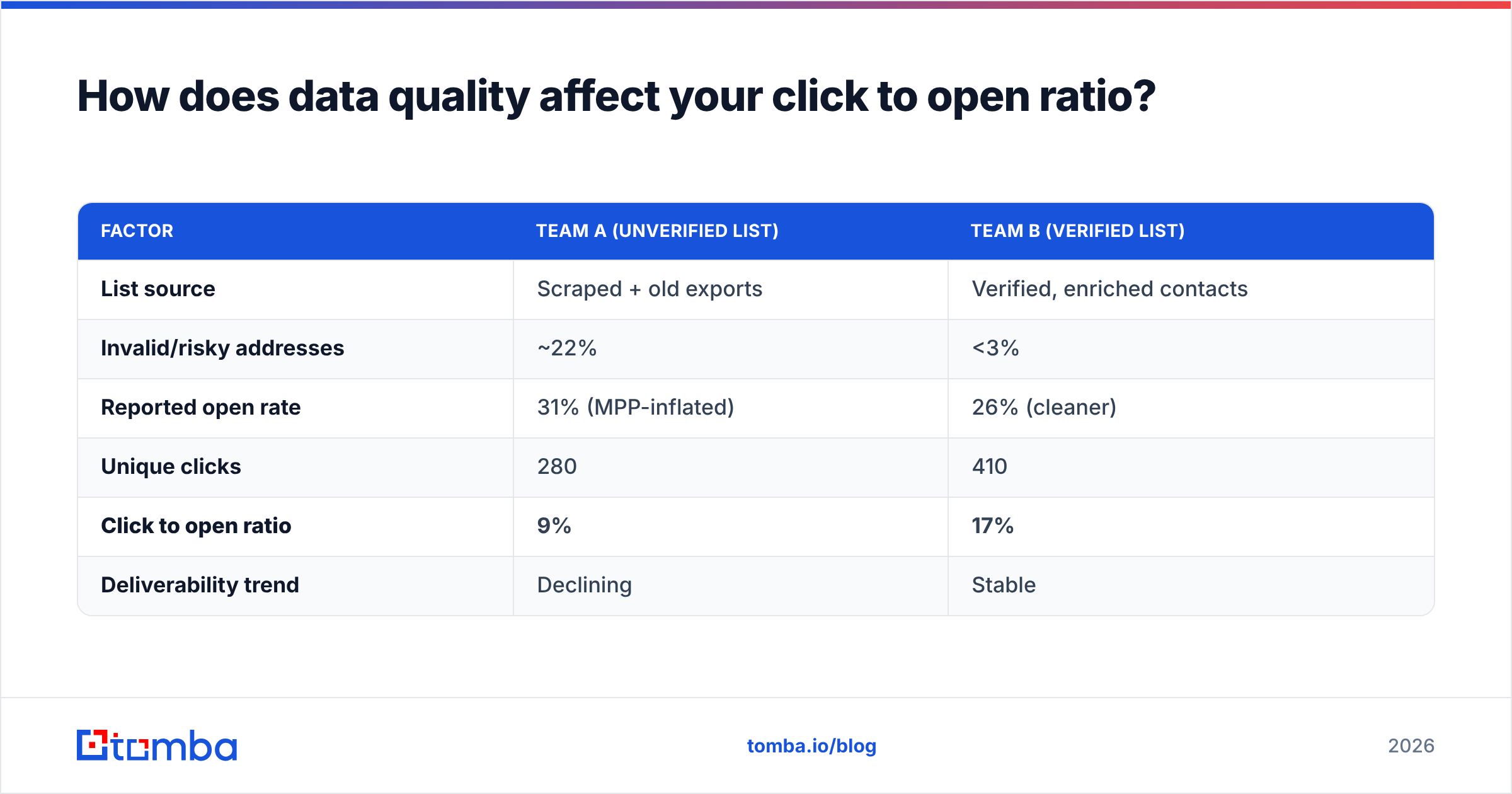
Consider two teams sending the identical campaign:
| Factor | Team A (unverified list) | Team B (verified list) |
|---|---|---|
| List source | Scraped + old exports | Verified, enriched contacts |
| Invalid/risky addresses | ~22% | <3% |
| Reported open rate | 31% (MPP-inflated) | 26% (cleaner) |
| Unique clicks | 280 | 410 |
| Click to open ratio | 9% | 17% |
| Deliverability trend | Declining | Stable |
Team A's higher open rate looks better on a dashboard, but it's noise. Team B's verified list produces a far stronger CTOR and protects long-term inbox placement. The lesson: stop optimizing the email before you've fixed the list under it. Sourcing contacts from a reliable B2B database and verifying them before send is the foundation that makes every copy tweak measurable.
This is also why pairing a finder with a verifier is standard practice for outbound teams — you find the right person, confirm the address is live, then write to them. Skipping the middle step is how good copy ends up with a 6% CTOR and nobody knows why.
How often should you track CTOR?#
Track CTOR per campaign and review the trend monthly. A single campaign's CTOR is a data point; the rolling trend is the signal. Watch for these patterns:
- Steady decline on consistent creative → list fatigue or decaying data. Time to clean and re-engage.
- Sudden drop on a new template → the design or CTA change backfired. Roll back and A/B test.
- High open rate, falling CTOR → you're winning the subject-line game but losing the content game.
- Low open rate, high CTOR → your content is great; fix deliverability and subject lines to get more people in the door.
Pair CTOR with one downstream metric — replies, demos booked, or revenue — so you never optimize clicks that don't convert. A 20% CTOR that produces no pipeline is a vanity number wearing a nice outfit.
Frequently asked questions#
What is the difference between CTOR and CTR? CTR divides clicks by everyone who received the email; CTOR divides clicks by only those who opened it. CTOR isolates content quality, while CTR reflects overall campaign reach.
Is a 25% click to open ratio good? Yes — 25% is strong for almost any send type and excellent for newsletters or promotions. Transactional emails can exceed it, but for marketing campaigns, 25% signals highly relevant content.
Does Apple Mail Privacy Protection affect CTOR? It inflates the open denominator with bot pre-fetches, which can artificially lower your CTOR. Segmenting reports to genuinely engaged openers, and keeping your list verified, reduces the distortion.
Can I improve CTOR without changing my copy? Yes. Cleaning your list, tightening segmentation, and fixing mobile rendering all lift CTOR before you touch a single word, because they change who opens and how the email displays.
Where Tomba fits#
Your click to open ratio is only as trustworthy as the inboxes behind it. Before you spend another sprint A/B testing buttons, make sure you're measuring real humans: use the Tomba Email Finder to source verified professional addresses by name, company, or domain, then confirm they're live before you send. Clean data gives you a CTOR you can actually act on — and a list that protects your deliverability for the long haul. Start free with 25 searches a month, or check Tomba pricing when you're ready to scale to bulk lead generation.
Ready to find emails that actually work?
Join 150,000+ professionals who stopped guessing and started sending. Free credits on signup — no credit card required.
Get the Tomba newsletter
Practical outbound tactics and product updates — once every two weeks.
About the author