Clickagy Pricing, Reviews, Pros and Cons: 2026 Guide
Clickagy was a leading audience-intelligence and intent-data platform before ZoomInfo acquired it. Here's the real pricing, honest reviews, pros and cons, and the alternatives worth your budget in 2026.
If you searched for "Clickagy pricing reviews pros and cons," you probably want one of two things: a license to its audience-intelligence data, or a sober read on whether the platform still exists and what to use instead. This post answers both.
TL;DR — Clickagy at a glance#
- Clickagy was an audience-intelligence and intent-data platform, not a standalone tool you can sign up for in 2026 — ZoomInfo acquired it in 2020 and folded the technology into ZoomInfo Intent.
- Pricing was always custom/enterprise (annual contracts, no public self-serve tier), which is the single biggest complaint in legacy reviews.
- Pros: strong real-time intent signals, large keyword-level behavioral graph, useful for programmatic audience targeting.
- Cons: opaque pricing, enterprise-only contracts, steep learning curve, and now no independent product to buy.
- In 2026 the practical question is "what replaces Clickagy?" — and the answer depends on whether you need raw intent, contact data, or both. We compare the realistic options below.
What was Clickagy and does it still exist?#
Clickagy was a B2B audience-intelligence company that built intent data from billions of online behavioral signals — and as an independent product, it no longer exists. ZoomInfo acquired Clickagy in 2020 and absorbed its "Streaming Intent" technology into the ZoomInfo platform. You can read the basics on ZoomInfo's own site, which now markets the intent capability under its own brand.
Think of Clickagy like a specialty ingredient supplier that got bought by a large grocery chain. The ingredient still ships — but only inside the chain's own packaged meals, not on its own shelf. That single fact reframes every "Clickagy pricing" search: you are really evaluating a discontinued standalone product and choosing a modern replacement.
Clickagy's core idea was simple and still relevant. It tracked anonymized web behavior — the pages people read, the keywords they engaged with, the topics they researched — and turned that into "intent" scores telling you which companies were in-market for a product like yours. That signal is valuable. The question is whether you want it bundled into a six-figure enterprise suite or assembled from leaner, more transparent tools.
What was Clickagy's pricing?#
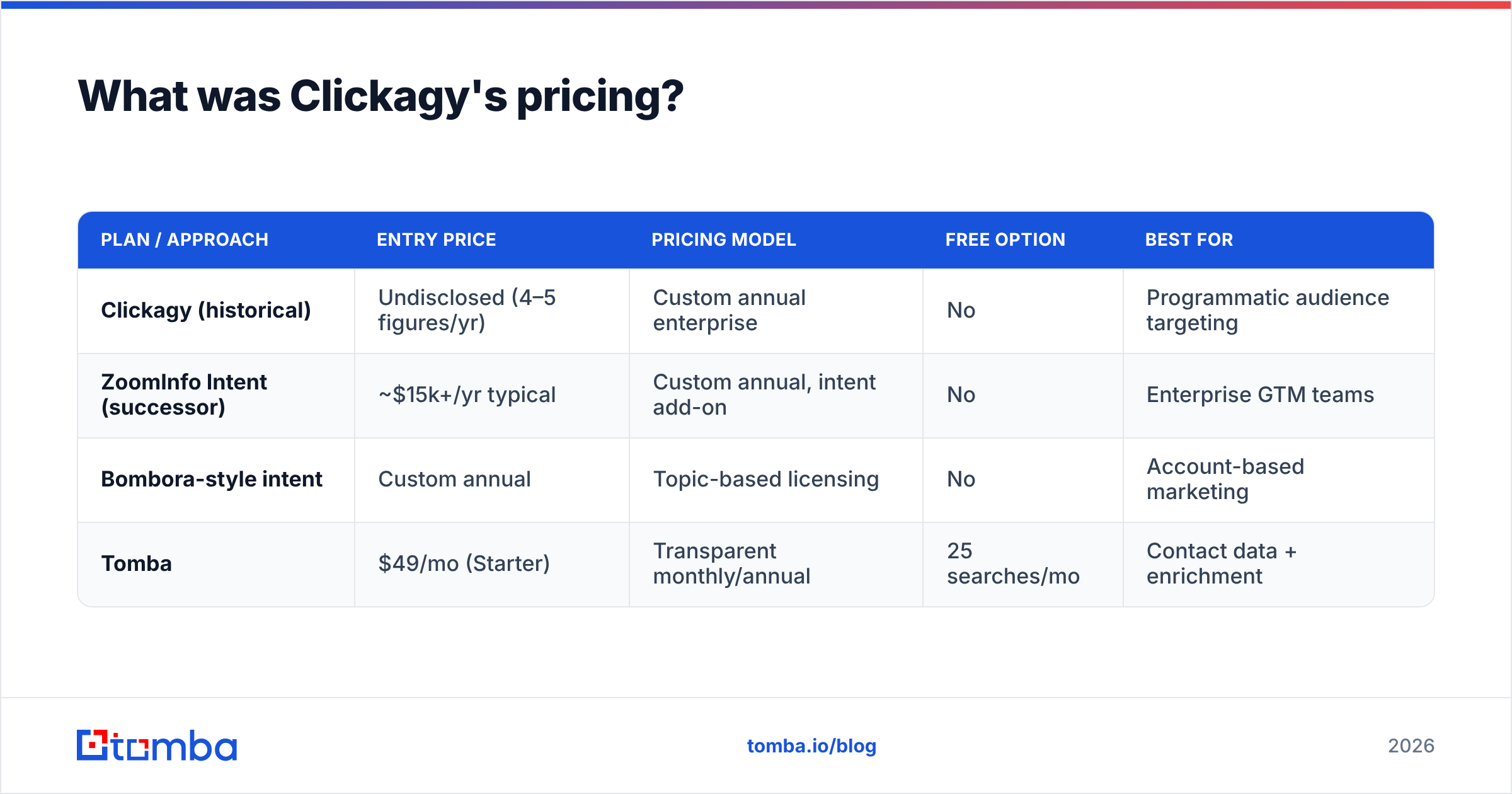
Clickagy never published self-serve pricing — every deal was a custom annual enterprise contract negotiated through sales. That was normal for intent-data vendors of its era, but it makes a clean price comparison impossible. Based on legacy reviews and the broader intent-data market, deals typically started in the high four figures per year and climbed into five and six figures for programmatic data licensing and audience activation.
Here is how that opaque model compares to the more transparent stack you can assemble today. Use this as a structured reference for what you actually pay for:
| Plan / Approach | Entry price | Pricing model | Free option | Best for |
|---|---|---|---|---|
| Clickagy (historical) | Undisclosed (4–5 figures/yr) | Custom annual enterprise | No | Programmatic audience targeting |
| ZoomInfo Intent (successor) | ~$15k+/yr typical | Custom annual, intent add-on | No | Enterprise GTM teams |
| Bombora-style intent | Custom annual | Topic-based licensing | No | Account-based marketing |
| Tomba | $49/mo (Starter) | Transparent monthly/annual | 25 searches/mo | Contact data + enrichment |
The pattern is obvious: legacy intent vendors hide price behind a sales call, while modern lead-data tools publish it. You can see exactly what a plan costs on the Tomba pricing page before you ever talk to anyone — a difference that matters when you are comparing budgets quarter to quarter.
A few honest notes on what drove Clickagy's cost:
- Data volume. You paid for access to a large behavioral graph, not seats.
- Activation rights. Licensing audiences for programmatic ad targeting cost more than basic scoring.
- Contract length. Annual commitments were standard; monthly billing was not an option.
- Integration scope. Pushing intent into your DSP, CRM, or marketing automation added services cost.
- Account coverage. Broader industry and geographic coverage increased the price.
What did reviews say — the real pros and cons?#
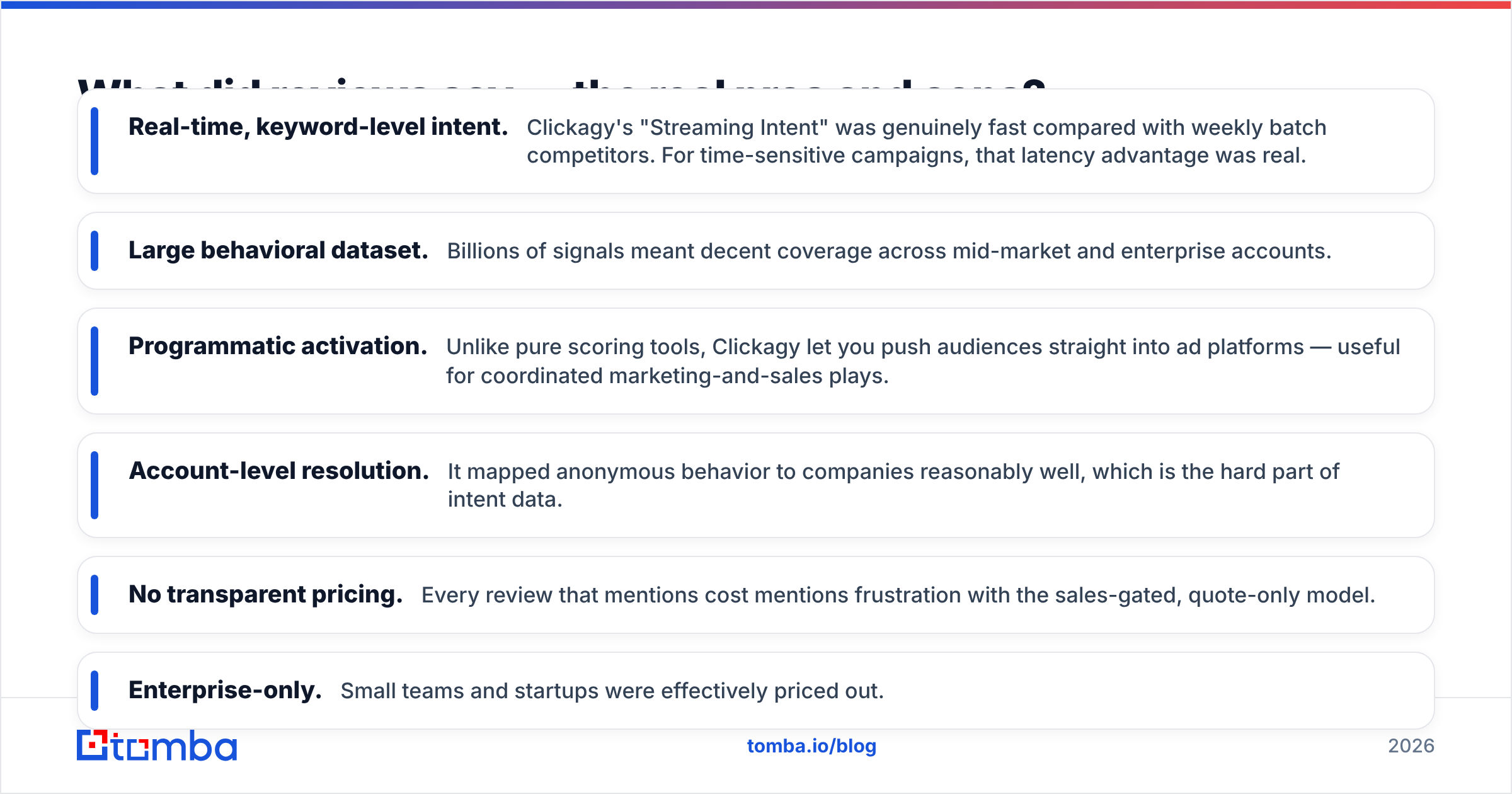
Reviewers praised Clickagy's signal quality and disliked its opacity and enterprise-only footprint. Aggregated impressions from sites like G2 and the wider intent-data category tell a consistent story. Here is the balanced version.
Pros#
- Real-time, keyword-level intent. Clickagy's "Streaming Intent" was genuinely fast compared with weekly batch competitors. For time-sensitive campaigns, that latency advantage was real.
- Large behavioral dataset. Billions of signals meant decent coverage across mid-market and enterprise accounts.
- Programmatic activation. Unlike pure scoring tools, Clickagy let you push audiences straight into ad platforms — useful for coordinated marketing-and-sales plays.
- Account-level resolution. It mapped anonymous behavior to companies reasonably well, which is the hard part of intent data.
Cons#
- No transparent pricing. Every review that mentions cost mentions frustration with the sales-gated, quote-only model.
- Enterprise-only. Small teams and startups were effectively priced out.
- Learning curve. Getting value required someone who understood intent modeling and audience activation — not a plug-and-play tool.
- Vendor risk, realized. The acquisition is the ultimate con: customers who standardized on Clickagy had to migrate to ZoomInfo or rebuild their stack.
That last point is the lesson. Betting your pipeline on a single opaque vendor is fragile. A revenue operations team that diversifies its data sources weathers an acquisition far better than one that didn't.
Is intent data alone enough in 2026?#
No — intent tells you who is interested, but you still need verified contact data to act on it, and that gap is where most Clickagy-style stacks fell short. An intent score that says "Acme Corp is researching your category" is worthless if you can't reach the right person at Acme with a deliverable email.
That is the core distinction worth understanding:
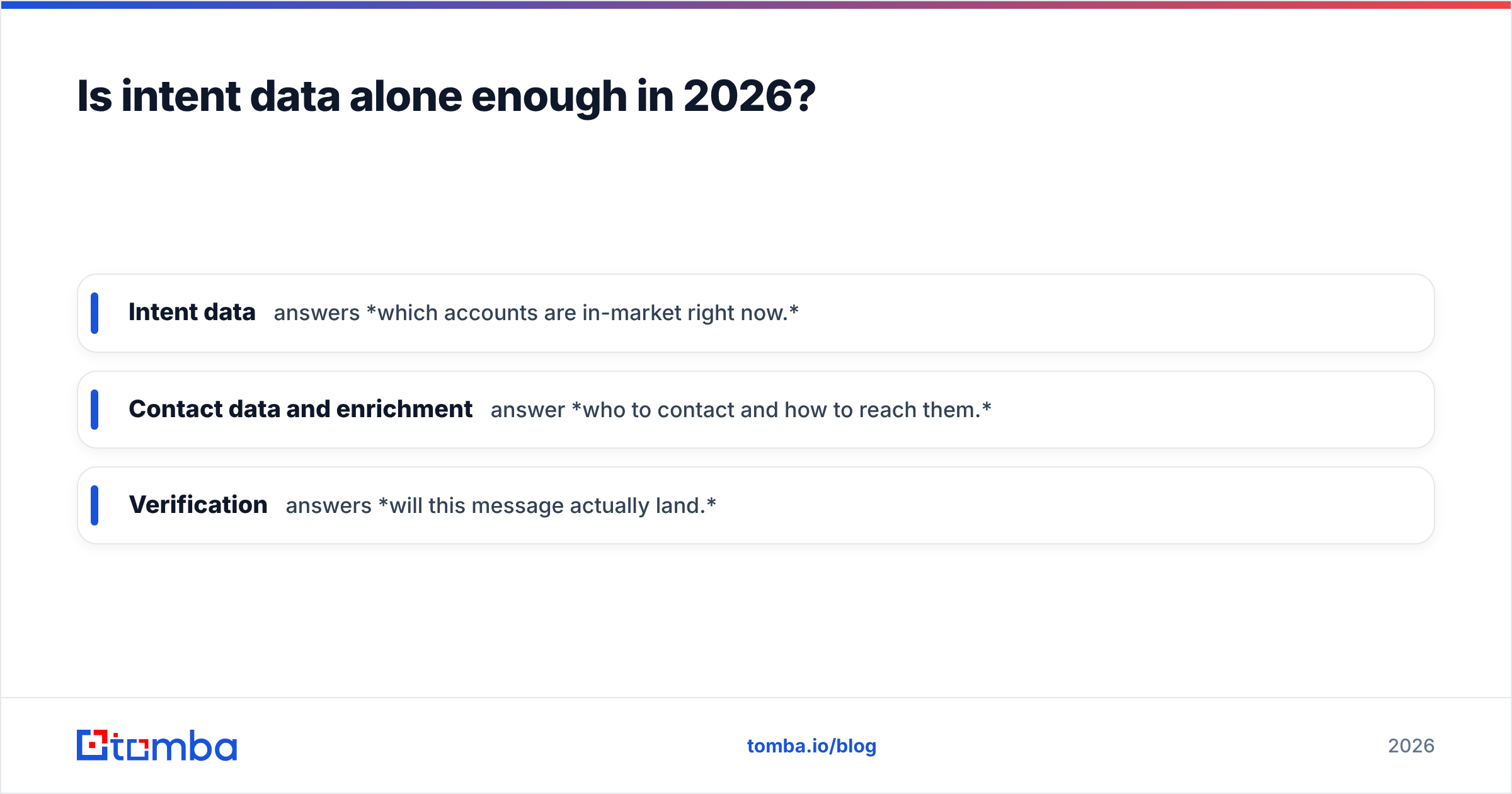
- Intent data answers which accounts are in-market right now.
- Contact data and enrichment answer who to contact and how to reach them.
- Verification answers will this message actually land.
Clickagy did the first job well and left the other two to you. In practice, teams paired it with a separate contact-data provider — which is exactly the architecture you should replicate today, just with transparent, swappable tools. You can handle the "who and how" side with an email finder for discovery, data enrichment to fill in firmographics and roles, and an email verifier so your intent-triggered outreach doesn't bounce.
There's also a self-serve way to capture intent on your own properties. If your goal was Clickagy's "who's researching me" signal, a website visitor reveal tool identifies the companies hitting your site — first-party intent you fully own, with no annual licensing commitment.
What are the best Clickagy alternatives in 2026?#
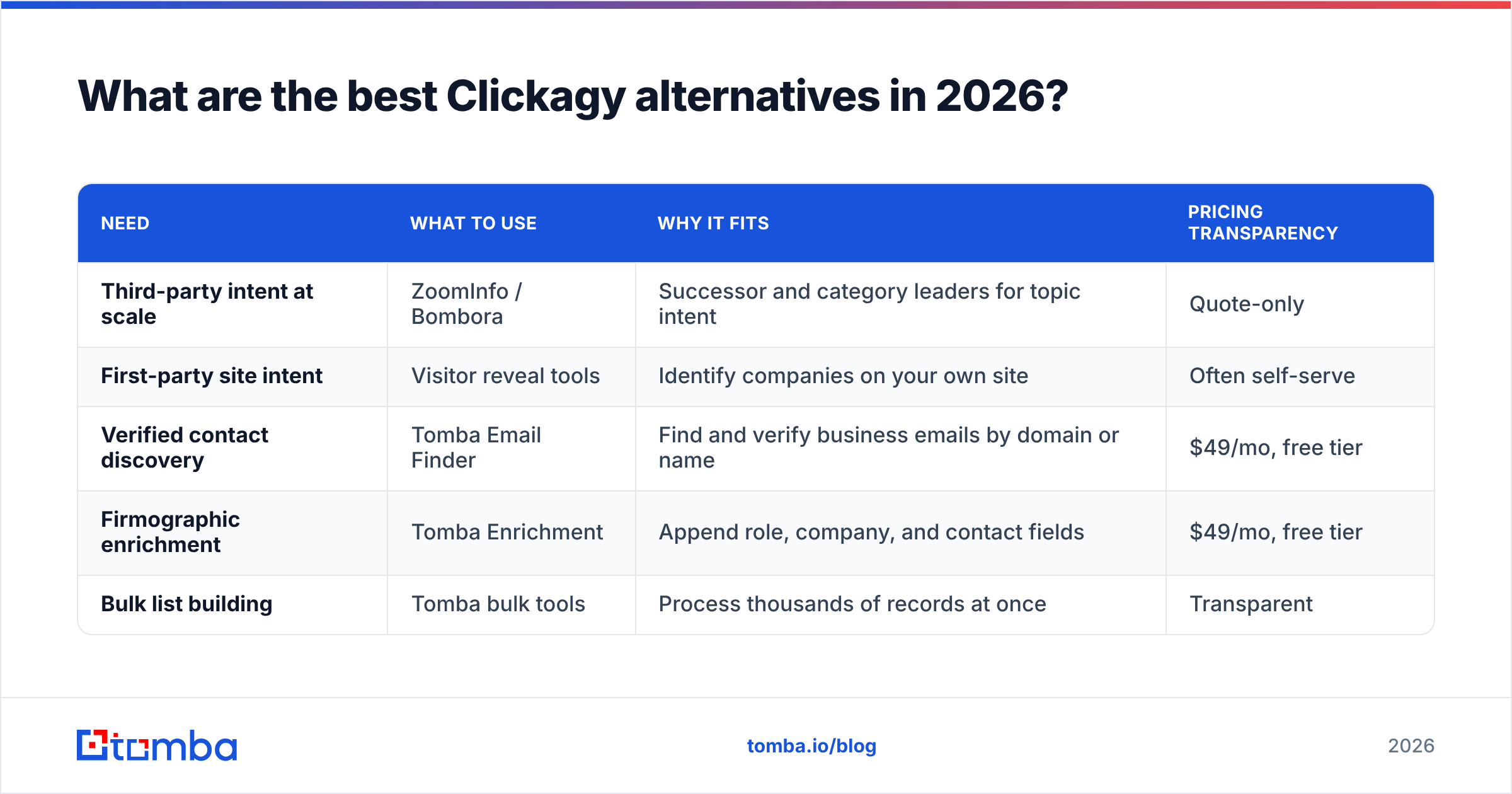
The right replacement depends on which job you're hiring it for — raw third-party intent, first-party visitor intent, or contact data and enrichment. Most teams need a combination, and the good news is the modern versions are cheaper and far more transparent than a single enterprise suite.
| Need | What to use | Why it fits | Pricing transparency |
|---|---|---|---|
| Third-party intent at scale | ZoomInfo / Bombora | Successor and category leaders for topic intent | Quote-only |
| First-party site intent | Visitor reveal tools | Identify companies on your own site | Often self-serve |
| Verified contact discovery | Tomba Email Finder | Find and verify business emails by domain or name | $49/mo, free tier |
| Firmographic enrichment | Tomba Enrichment | Append role, company, and contact fields | $49/mo, free tier |
| Bulk list building | Tomba bulk tools | Process thousands of records at once | Transparent |
A realistic 2026 stack looks like this: use a visitor-reveal or topic-intent source to surface in-market accounts, then run those companies through a bulk email finder and enrichment step to get reachable, verified contacts. You replace one opaque six-figure contract with two or three transparent tools you can swap independently — and you keep control if any single vendor gets acquired.
If you mainly cared about Clickagy for prospecting rather than ad targeting, the contact-data layer is where your budget should go. Intent narrows the list; verified emails and accurate enrichment are what actually turn that list into booked meetings. Tools like Tomba publish exactly where the data comes from, which is the kind of transparency the old intent-vendor model never offered.
How should you choose, practically?#
Match the tool to your team size, budget visibility, and whether you run ads or outbound — don't buy "intent data" as an abstraction. Three quick profiles:
- Enterprise GTM team with budget for programmatic ads: ZoomInfo Intent (Clickagy's actual successor) or Bombora is the closest like-for-like. Expect quote-only pricing and annual commitments.
- Mid-market team focused on sales outreach: Skip heavy third-party intent. Pair first-party visitor reveal with a transparent contact-data tool for discovery, enrichment, and verification.
- Startup or lean team: Start with a free tier, build verified lists, and add intent later only when you've proven the motion. Paying enterprise rates for intent before you have a working outbound process is the classic Clickagy-era mistake.
Whatever you pick, insist on three things Clickagy reviews wished they'd had: published pricing, monthly flexibility, and the ability to swap any single component without rebuilding your stack.
The bottom line on Clickagy in 2026#
Clickagy was a strong intent-data platform with one fatal practical flaw for today's buyer: you can't actually buy it anymore. Its technology lives on inside ZoomInfo, its pricing was always opaque, and its enterprise-only model put it out of reach for most teams. The pros — fast, keyword-level intent — were real. The cons — no transparent pricing, vendor lock-in, and an acquisition that forced migrations — are exactly the risks a modern, modular stack avoids.
If your real goal was reaching the right people at in-market accounts, start with the contact layer. The Tomba Email Finder lets you find and verify professional email addresses by domain, name, or company — with transparent Tomba plans starting free and at $49/mo, no sales call required. Pair it with enrichment and verification, layer intent on top when you're ready, and you'll have a 2026 stack that no acquisition can pull out from under you. Try the email finder and build your first verified list today.
Ready to find emails that actually work?
Join 150,000+ professionals who stopped guessing and started sending. Free credits on signup — no credit card required.
Get the Tomba newsletter
Practical outbound tactics and product updates — once every two weeks.
About the author