Clickback vs Apollo.io 2026: Full B2B Platform Comparison
Clickback sends compliant cold B2B email; Apollo.io is a database-plus-engagement engine. Here's which one fits your 2026 outbound stack — and where both leave gaps.
Choosing between Clickback and Apollo.io is really a choice between two different jobs: sending compliant cold email to cold lists, or building and working a prospect database from scratch. They overlap just enough to confuse buyers, and differ enough that picking the wrong one wastes a quarter.
This guide breaks down what each platform actually does, how pricing compares, where the data quality gaps hide, and how to decide based on your motion rather than the marketing.
TL;DR: Clickback vs Apollo.io in 30 seconds#
- Clickback is a B2B cold-email sending platform built around compliance (CASL/CAN-SPAM) and emailing purchased or cold lists you already own. It does not include a contact database.
- Apollo.io is an all-in-one sales intelligence + engagement platform: a 270M+ contact database, email finder, sequences, dialer, and CRM-lite in one subscription.
- Pricing: Apollo has a usable free tier and scales from roughly $49/user/mo; Clickback is contact-volume priced and quoted higher, aimed at marketing teams sending at scale.
- The shared weakness: both rely on data that decays fast, and bounce rates wreck deliverability. A dedicated finder and email verifier layer fixes that.
- Pick Clickback if you have lists and need compliant volume sending; pick Apollo.io if you need to find people and run multi-step sequences.
What is Clickback and who is it for?#
Clickback is a Canadian B2B email lead-generation platform. Its flagship product, Clickback MAIL, is built for one thing most email tools forbid: sending to cold contacts — lists you bought, scraped, or collected without a prior opt-in — without torching your sending reputation.
Most mainstream ESPs (Mailchimp, HubSpot, Constant Contact) will suspend you for uploading a cold list. Clickback positions itself as the compliant exception, with built-in CASL and CAN-SPAM handling, dedicated IP infrastructure, and list-cleaning that strips known complainers and traps before send. It also offers Clickback WEB, a website-visitor identification product that reveals anonymous traffic at the company level.
Clickback is a fit for marketing teams running top-of-funnel volume — think 50,000-contact sends to net-new B2B audiences, where the goal is to warm a cold list into MQLs. It is not a prospecting database and not a rep-by-rep sales engagement tool. You bring the list; Clickback sends it safely.
What is Apollo.io and who is it for?#
Apollo.io is a sales intelligence and engagement platform that bundles a massive contact database with the tools to act on it. You search the database by title, industry, headcount, technology, and intent signals, then push contacts straight into email sequences, a built-in dialer, or your CRM.
The pitch is consolidation: instead of paying for ZoomInfo and Outreach and a separate email finder, you get a database, email finder, verifier, sequencer, and basic CRM in one seat. Apollo claims 270M+ contacts and 60M+ companies, and its Chrome extension surfaces contact data while you browse LinkedIn.
Apollo is a fit for SDR teams and founders doing outbound from zero — people who need to discover who to contact before they can email anyone. It is account-based, rep-seat priced, and built around the sequence as the unit of work. You can read the full feature set on Apollo's own site, but the short version: it is the opposite of Clickback. Apollo finds and works individuals; Clickback blasts lists you already hold.
)
How do Clickback and Apollo.io compare at a glance?#
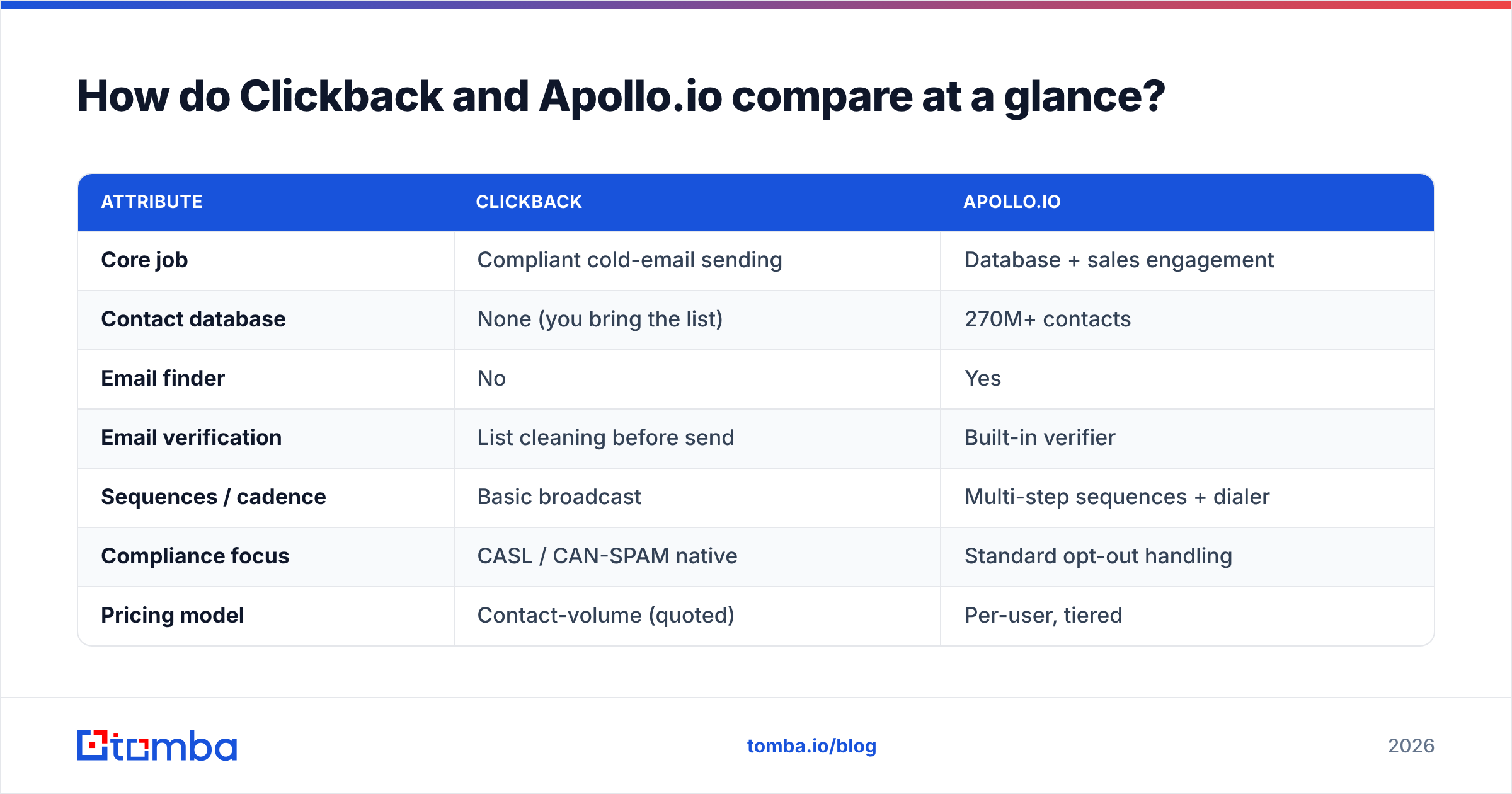
The cleanest way to see the difference is side by side. These are different categories of tool that buyers keep cross-shopping, so the table maps them on the same axes.
| Attribute | Clickback | Apollo.io |
|---|---|---|
| Core job | Compliant cold-email sending | Database + sales engagement |
| Contact database | None (you bring the list) | 270M+ contacts |
| Email finder | No | Yes |
| Email verification | List cleaning before send | Built-in verifier |
| Sequences / cadence | Basic broadcast | Multi-step sequences + dialer |
| Compliance focus | CASL / CAN-SPAM native | Standard opt-out handling |
| Pricing model | Contact-volume (quoted) | Per-user, tiered |
| Free tier | No | Yes (limited credits) |
| Best for | Marketing teams, list sends | SDRs, founders, outbound from zero |
| CRM | No (integrates out) | Lite CRM included |
The takeaway: if your problem is "I have 40,000 cold contacts and nowhere safe to send them," Clickback wins by default. If your problem is "I don't know who to email yet," Apollo wins by default. They only truly compete in the narrow middle where a team has some list but also wants to expand it.
Is Apollo.io better than Clickback on pricing?#
Pricing is where the two diverge most, because they sell to different buyers.
Apollo.io uses transparent, per-user tiers. There is a free plan with limited monthly credits, then paid tiers that start around $49/user/mo (Basic) and climb to roughly $79–$119/user/mo (Professional/Organization) when billed annually. Credits govern how many email and phone reveals you get. This model rewards small teams and self-serve buyers — you can start free and expand seat by seat.
Clickback does not publish flat pricing. It is quoted based on the number of contacts you send to per month, which suits marketing teams running large, infrequent campaigns rather than reps sending 50 emails a day. Expect a higher entry point than Apollo, because you are paying for managed deliverability infrastructure and compliance, not a database.
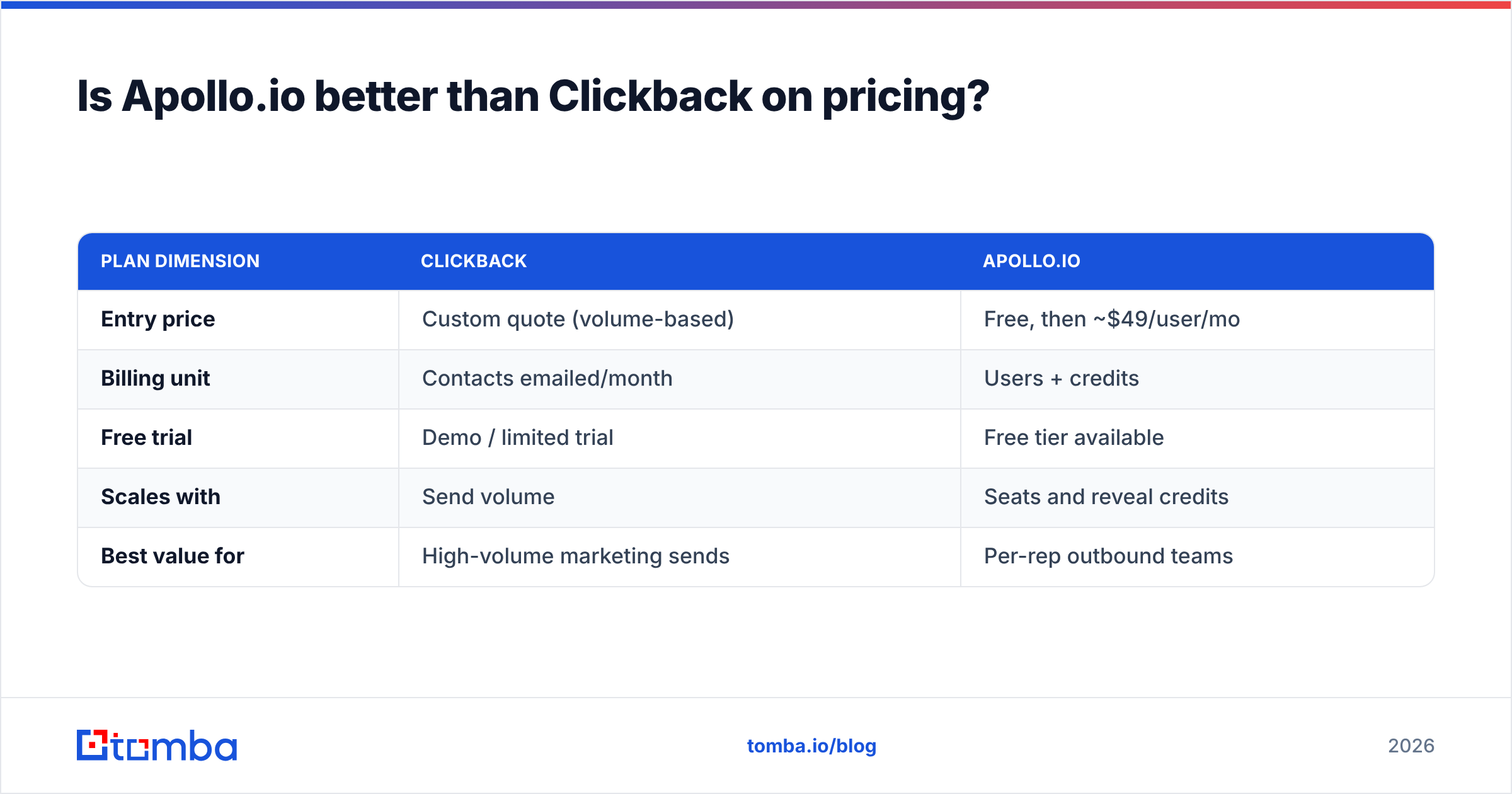
| Plan dimension | Clickback | Apollo.io |
|---|---|---|
| Entry price | Custom quote (volume-based) | Free, then ~$49/user/mo |
| Billing unit | Contacts emailed/month | Users + credits |
| Free trial | Demo / limited trial | Free tier available |
| Scales with | Send volume | Seats and reveal credits |
| Best value for | High-volume marketing sends | Per-rep outbound teams |
Neither price tag tells you the real cost, though. The hidden cost in both tools is wasted sends to dead addresses — and that is a data problem, not a pricing one.
Where do both Clickback and Apollo.io fall short?#
Both platforms inherit the same structural weakness: contact data goes stale fast. People change jobs every 2–3 years, companies rebrand domains, and role-based inboxes get retired. Industry estimates put B2B data decay at roughly 22–30% per year, and you can confirm the pattern on review sites like G2, where data accuracy is the most common complaint against every database vendor — Apollo included.
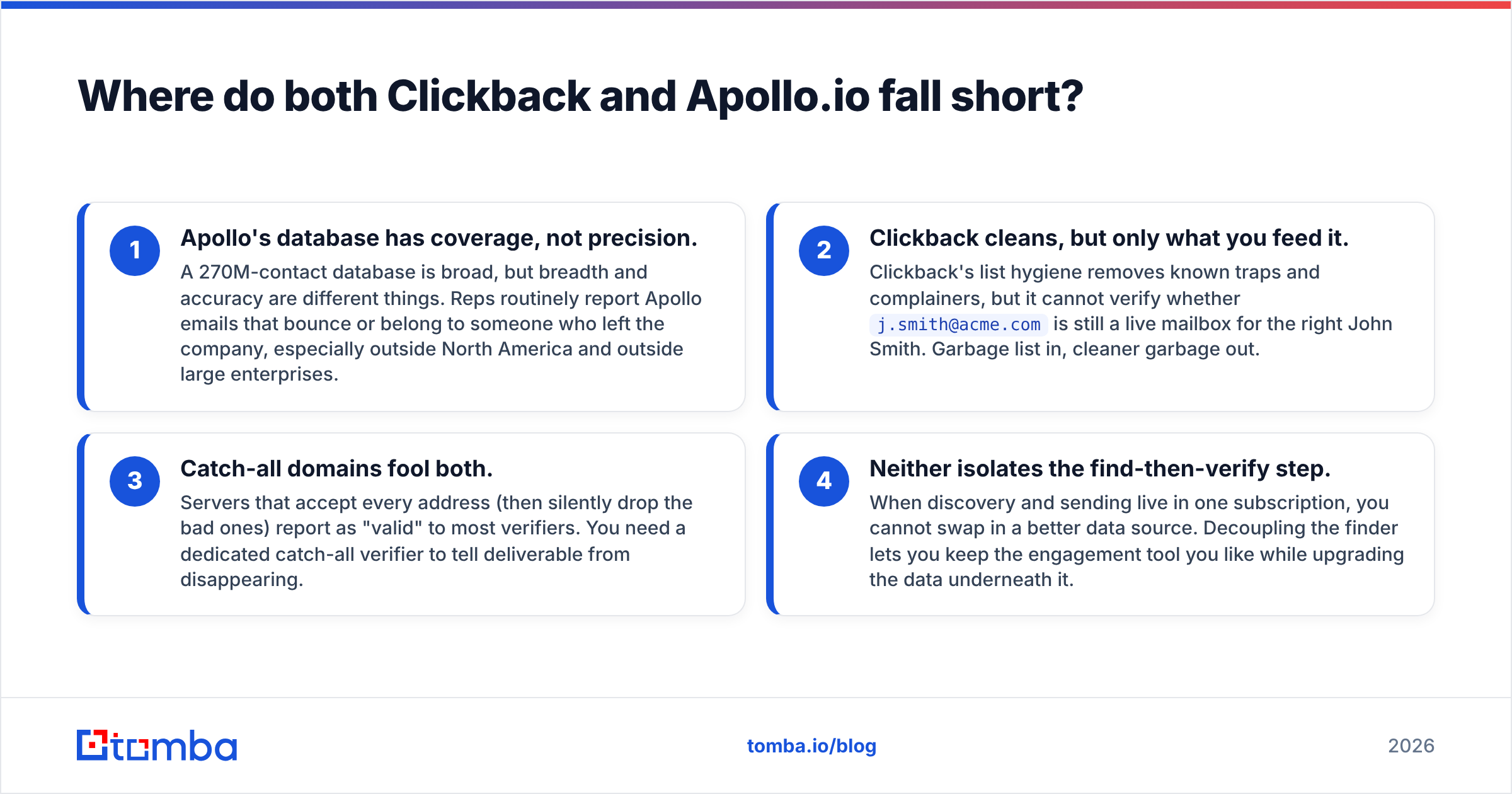
Here is how the gap shows up in each tool:
- Apollo's database has coverage, not precision. A 270M-contact database is broad, but breadth and accuracy are different things. Reps routinely report Apollo emails that bounce or belong to someone who left the company, especially outside North America and outside large enterprises.
- Clickback cleans, but only what you feed it. Clickback's list hygiene removes known traps and complainers, but it cannot verify whether
j.smith@acme.comis still a live mailbox for the right John Smith. Garbage list in, cleaner garbage out. - Catch-all domains fool both. Servers that accept every address (then silently drop the bad ones) report as "valid" to most verifiers. You need a dedicated catch-all verifier to tell deliverable from disappearing.
- Neither isolates the find-then-verify step. When discovery and sending live in one subscription, you cannot swap in a better data source. Decoupling the finder lets you keep the engagement tool you like while upgrading the data underneath it.
The fix is to treat data quality as its own layer. Find emails with a tool built specifically for accuracy, verify them before they ever hit a sequence or a Clickback send, and only then push them into whichever engagement platform you chose.
)
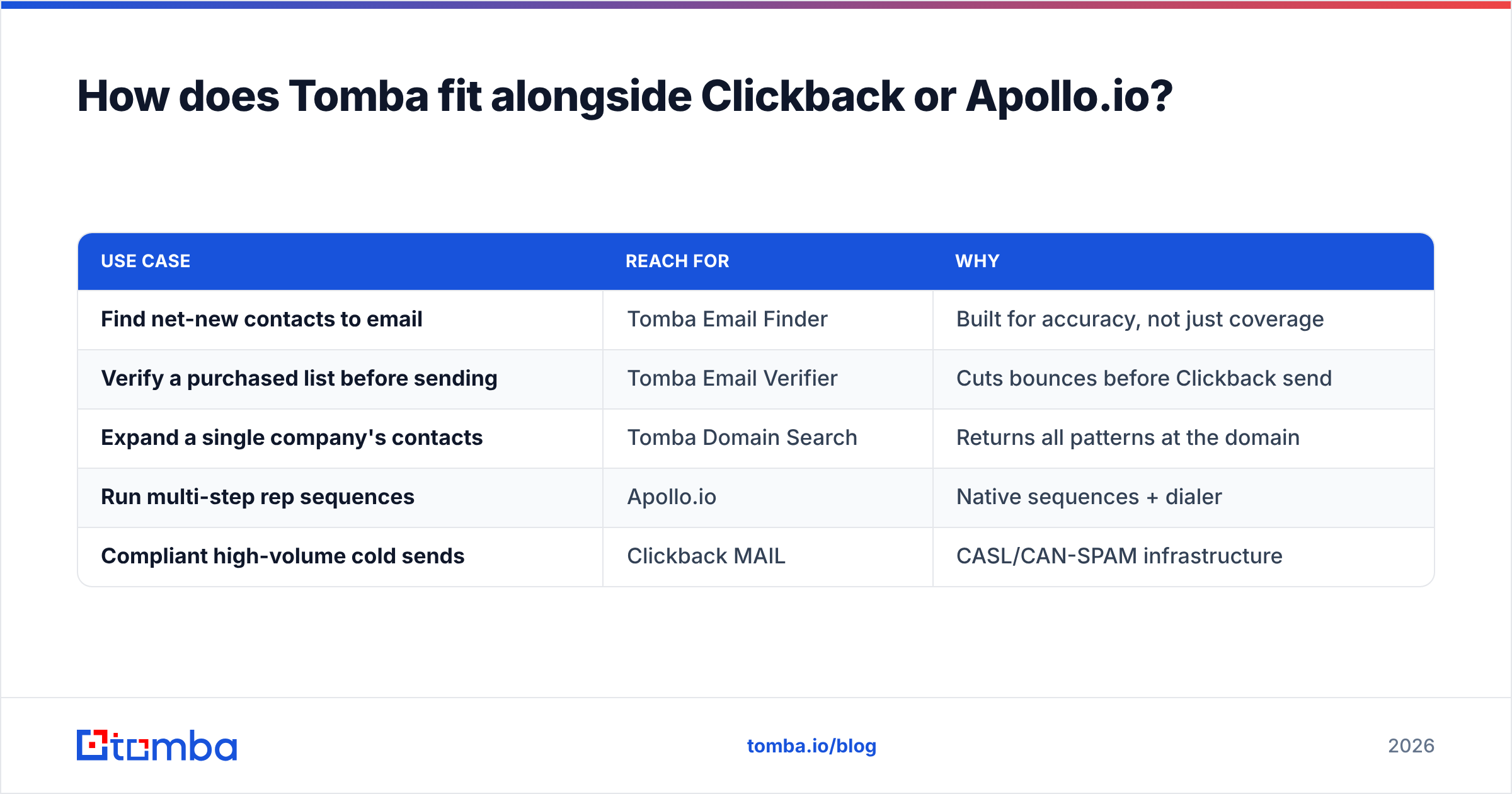
How does Tomba fit alongside Clickback or Apollo.io?#
Tomba is the data layer, not a third engagement platform — which is exactly why it pairs cleanly with either tool instead of replacing them.
Where Apollo gives you a fixed database and Clickback gives you a sending pipe, Tomba focuses on the one job both do unevenly: returning a correct, deliverable email address for a specific person or company. You can run a domain search to pull every known address pattern at a target company, find individual contacts by name, then verify the whole batch before it costs you a send. For list-heavy Clickback workflows, the bulk email finder cleans and enriches a CSV before you upload it.
| Use case | Reach for | Why |
|---|---|---|
| Find net-new contacts to email | Tomba Email Finder | Built for accuracy, not just coverage |
| Verify a purchased list before sending | Tomba Email Verifier | Cuts bounces before Clickback send |
| Expand a single company's contacts | Tomba Domain Search | Returns all patterns at the domain |
| Run multi-step rep sequences | Apollo.io | Native sequences + dialer |
| Compliant high-volume cold sends | Clickback MAIL | CASL/CAN-SPAM infrastructure |
The point is not "drop Apollo or Clickback." It is that your outcome depends on the address being right, and a focused finder-plus-verifier consistently beats the bundled data inside an all-in-one suite. See where the data comes from on Tomba's data sources page and how plans scale on Tomba pricing.
Which should you choose for 2026 outbound?#
Decide by your bottleneck, not by feature counts.
Choose Clickback if your team already has cold B2B lists — events, partnerships, purchased data — and the blocker is sending to them without getting blacklisted. Clickback's compliance posture and managed infrastructure are genuinely hard to replicate with a generic ESP, and that is worth paying for if volume is your game. Verify the list first, though; Clickback's hygiene is not a substitute for true mailbox verification.
Choose Apollo.io if you are starting from zero and need to discover who to contact, then run them through sequences and calls in one place. The free tier lets you validate the workflow before committing, and consolidation saves money versus stitching together four tools. Just don't assume every reveal is accurate — spot-check and verify before high-stakes sends.
Choose neither as your data layer. Whichever engagement path you pick, the addresses still need to be correct. That is the part you should not outsource to a bundled, decaying database. Run discovery and verification through a tool built for it, and let Clickback or Apollo do what each does best.
A simple decision rule: if you can't name the people on your list, you have an Apollo (or Tomba finder) problem. If you can name them but can't safely email them, you have a Clickback problem. If your bounce rate is creeping past 3%, you have a verification problem — and that one is true no matter which platform you signed up for.
The bottom line#
Clickback and Apollo.io are not really rivals; they are different stages of the same funnel. Clickback is the compliant pipe for cold lists you own. Apollo is the database-and-sequence engine for outbound you build from scratch. Cross-shop them only if you sit in the narrow overlap, and even then, the deciding factor is data quality — the thing both tools treat as secondary.
Whatever you run on top, start with addresses you can trust. Spin up the Tomba Email Finder free tier (25 searches/month), find and verify your next list, and feed clean data into Apollo or Clickback so your sends actually land. Better data in means more replies out — and far fewer bounces eating your sender reputation.
// get started
Find, verify and enrich your first contacts today
Start on the free plan with 25 searches a month, then scale when your team is ready.
Free plan · No credit card required · GDPR & CCPA
// about the author