Clickback vs Generect 2026: B2B Lead Gen Tools Compared
Clickback sends compliant cold email to purchased B2B lists; Generect builds fresh contact data from LinkedIn. Here's how the two stack up in 2026—and where a dedicated email finder beats both.
Clickback vs Generect: Which B2B Lead Gen Tool Should You Use in 2026?
Clickback and Generect get lumped together as "B2B lead generation" tools, but they solve different halves of the same problem. One sends email to cold lists you already own. The other builds the contact data in the first place. Choosing between them—or realizing you need neither—comes down to where your outbound actually breaks.
TL;DR#
- Clickback is a cold-email sending platform built to legally market to purchased or non–opted-in B2B lists, with built-in validation and a visitor-tracking add-on.
- Generect is a B2B data engine that pulls fresh contact and company records (heavily LinkedIn-sourced) through an app and API, including lookalike-audience building.
- They are not direct competitors: Clickback is the sending layer, Generect is the data layer. Many teams would technically need both.
- Both stumble on the same thing—email accuracy and deliverability—which is exactly where a dedicated email finder and verifier earns its keep.
- If your real bottleneck is "I can't reach verified, current decision-maker emails," a tool like the Tomba Email Finder often replaces the messy middle of either workflow.
What is Clickback?#
Clickback is an email lead-generation platform designed around an uncomfortable reality of B2B: most of the contacts you want to reach never opted in. Clickback's pitch is that it lets you email cold, purchased, or third-party B2B lists in a way that stays inside CAN-SPAM and similar frameworks, then warms those contacts until they become marketable leads you can hand to sales or push into your CRM.
The product splits into two pieces. Clickback MAIL is the sending engine—list upload, built-in email validation, deliverability handling, and reporting on opens and clicks. Clickback WEB is a website-visitor identification tool that tells you which companies browsed your site so you can follow up. The company has run this model for years and aims squarely at marketers who buy lists and need a compliant way to activate them.
What Clickback is not: a data provider. You bring the list. If your list is stale or full of guessed addresses, Clickback's validation catches some of it, but it can't manufacture accurate contacts you never had.
)
What is Generect?#
Generect is the opposite end of the pipeline. It's a B2B data platform that generates contact and company records on demand, leaning heavily on LinkedIn as a source. Instead of uploading a list, you describe an audience—titles, industries, company size, geography—and Generect returns matching people with enriched fields. It also offers lookalike-audience building (feed it your best customers, get more like them) and an API so engineering teams can wire the data directly into their own systems.
Generect's strength is freshness and targeting. Because records are pulled in near real time rather than served from a stale warehouse, the data tends to reflect current roles and companies better than a database that was scraped 18 months ago. The trade-off: Generect hands you raw contacts, not a sending mechanism. You still need an email platform, a sequencer, or a CRM to actually do outreach—and you still need to trust that the emails attached to those LinkedIn profiles are deliverable.
You can read more about the model on the Generect site, but the short version is: Generect fills the top of the funnel; it does not run the outreach.
Clickback vs Generect: how do they actually compare?#
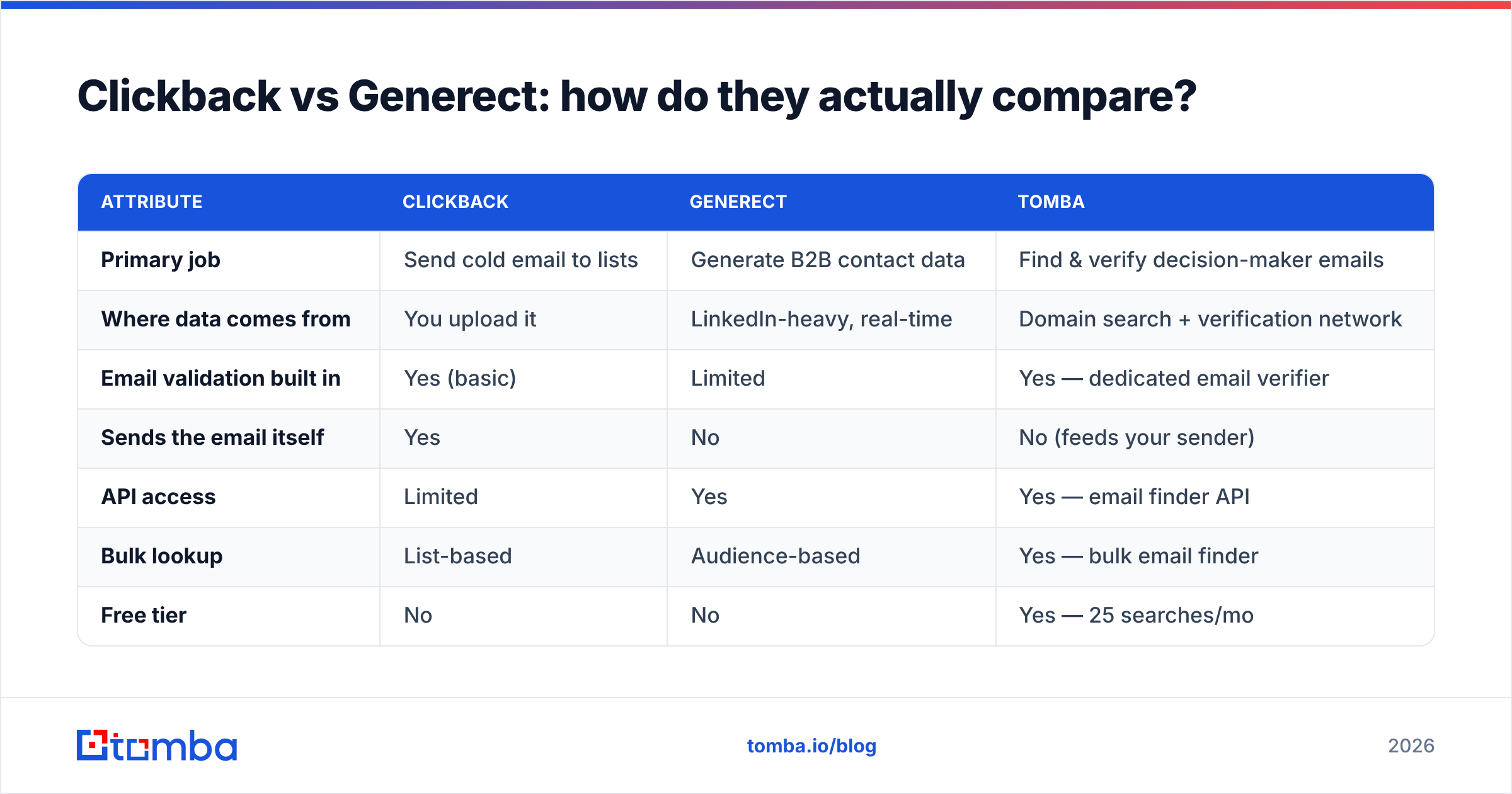
Here's the honest framing—these tools sit at different stages, so a feature-by-feature table is really a "what does each one own" table.
| Attribute | Clickback | Generect | Tomba |
|---|---|---|---|
| Primary job | Send cold email to lists | Generate B2B contact data | Find & verify decision-maker emails |
| Where data comes from | You upload it | LinkedIn-heavy, real-time | Domain search + verification network |
| Email validation built in | Yes (basic) | Limited | Yes — dedicated email verifier |
| Sends the email itself | Yes | No | No (feeds your sender) |
| API access | Limited | Yes | Yes — email finder API |
| Bulk lookup | List-based | Audience-based | Yes — bulk email finder |
| Free tier | No | No | Yes — 25 searches/mo |
| Best fit | Activating purchased lists | Building net-new audiences | Verified emails before you send |
The pattern is clear: Clickback assumes you have data and need to send. Generect assumes you need data and will send elsewhere. Neither one is optimized for the single most failure-prone step—confirming an email address is real and current before it burns your sender reputation.
Is Clickback better than Generect?#
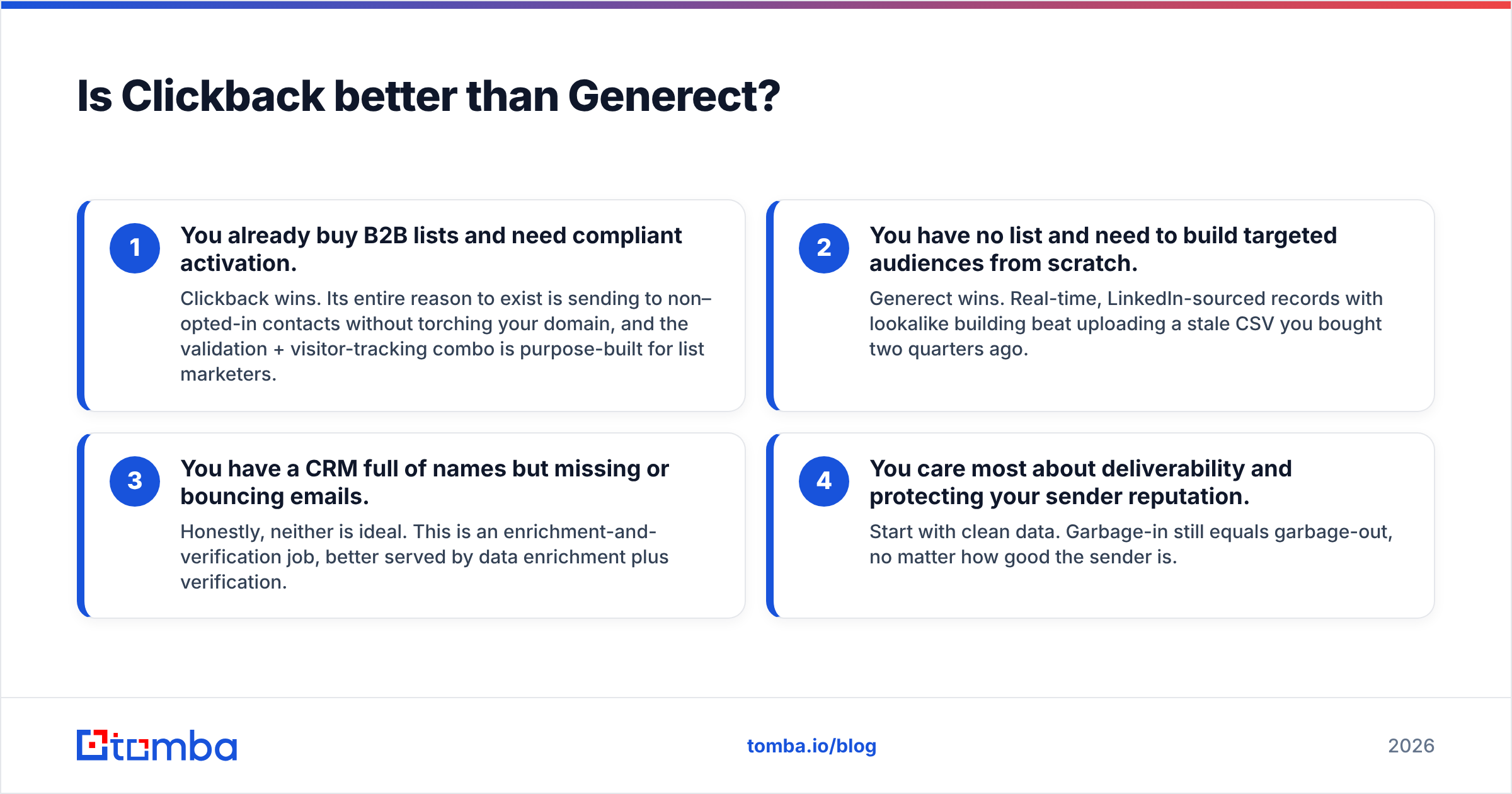
Neither is "better"—they answer different questions. Use this decision split:
- You already buy B2B lists and need compliant activation. Clickback wins. Its entire reason to exist is sending to non–opted-in contacts without torching your domain, and the validation + visitor-tracking combo is purpose-built for list marketers.
- You have no list and need to build targeted audiences from scratch. Generect wins. Real-time, LinkedIn-sourced records with lookalike building beat uploading a stale CSV you bought two quarters ago.
- You have a CRM full of names but missing or bouncing emails. Honestly, neither is ideal. This is an enrichment-and-verification job, better served by data enrichment plus verification.
- You care most about deliverability and protecting your sender reputation. Start with clean data. Garbage-in still equals garbage-out, no matter how good the sender is.
The reason teams end up frustrated with either tool is that they expect it to cover the whole pipeline. Clickback can't fix a bad list it didn't build. Generect can't guarantee deliverability on emails it didn't send. The gap between them—accurate, verified, ready-to-send contacts—is where most outbound campaigns quietly fail.
)
Why does data accuracy decide both?#
Because every downstream metric you care about—open rate, reply rate, response rate, and your domain's standing with mailbox providers—is a function of the addresses you feed in. Send to 1,000 contacts where 18% bounce, and providers like Google and Microsoft start treating you as a spammer regardless of how clever your copy is.
Clickback's built-in validation helps, but it validates the list you give it; it can't improve a list that was guessed from email-permutation patterns. Generect's data is fresher than a static database, but "fresh from LinkedIn" doesn't always mean "this person's work email is X and it accepts mail." Catch-all domains, role-based aliases, and recently changed jobs all slip through.
This is why a verification layer matters more than the sender or the data source. A dedicated email verifier does SMTP-level checking, catch-all detection via a catch-all verifier, and flags risky addresses before they hit your sequence. Industry reviews on G2 consistently show that the teams with the best deliverability aren't the ones with the fanciest sending tools—they're the ones obsessive about list hygiene.
If you want the mechanics of why bounces wreck campaigns, the glossary entry on email deliverability lays it out without the jargon.
How does Tomba fit between them?#
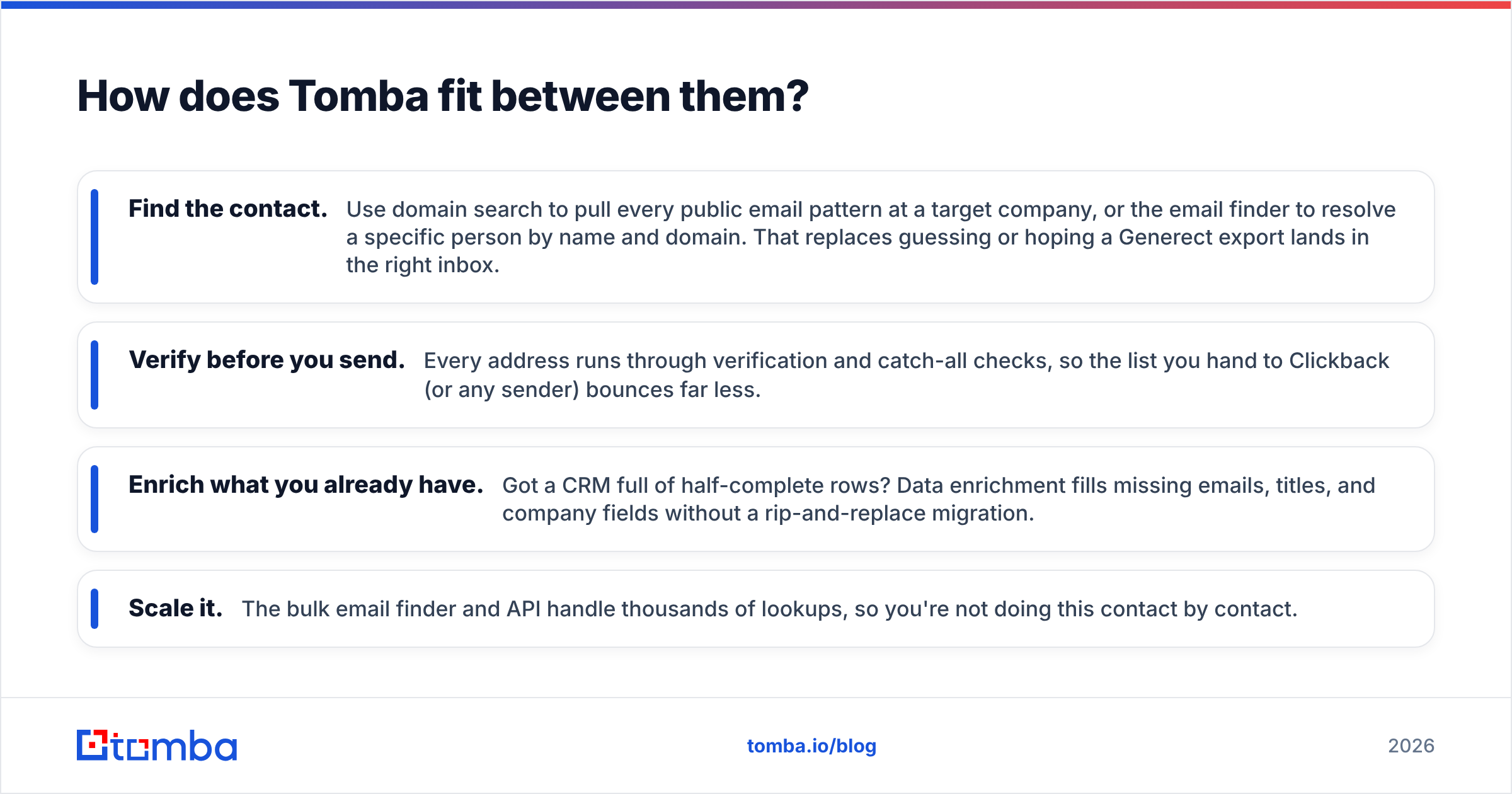
Tomba covers the part both tools leave thin: turning a name and a company into a verified, deliverable email, then keeping that data clean at scale.
- Find the contact. Use domain search to pull every public email pattern at a target company, or the email finder to resolve a specific person by name and domain. That replaces guessing or hoping a Generect export lands in the right inbox.
- Verify before you send. Every address runs through verification and catch-all checks, so the list you hand to Clickback (or any sender) bounces far less.
- Enrich what you already have. Got a CRM full of half-complete rows? Data enrichment fills missing emails, titles, and company fields without a rip-and-replace migration.
- Scale it. The bulk email finder and API handle thousands of lookups, so you're not doing this contact by contact.
Think of it like building a house. Generect delivers the lumber, Clickback is the crew that nails it together—but Tomba is the inspector who makes sure the lumber isn't rotten before anyone builds on it. Skip that step and the whole structure (your campaign) leans.
What does each tool cost?#
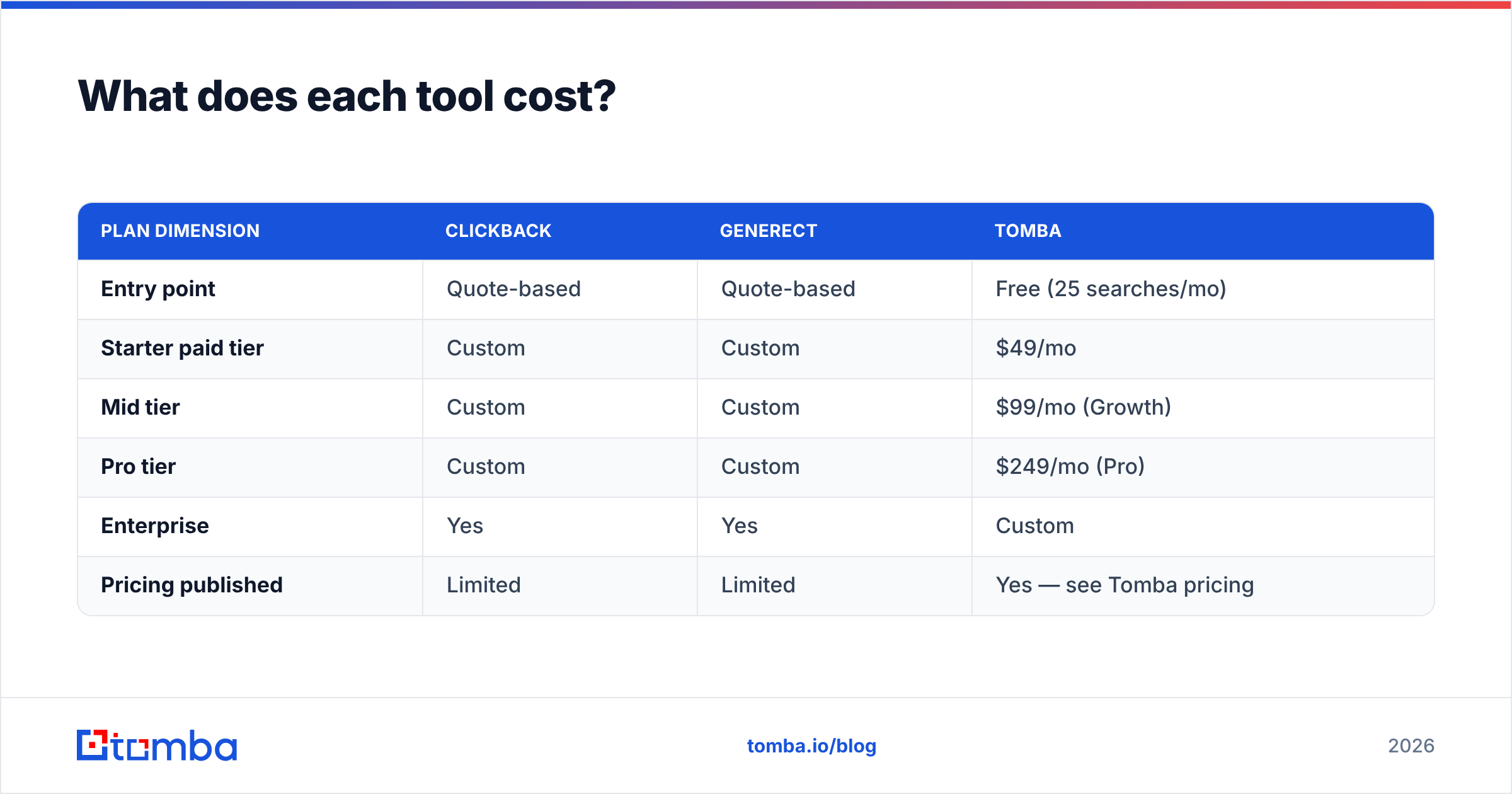
Pricing transparency differs a lot here, so treat exact figures with care and confirm on each vendor's site.
| Plan dimension | Clickback | Generect | Tomba |
|---|---|---|---|
| Entry point | Quote-based | Quote-based | Free (25 searches/mo) |
| Starter paid tier | Custom | Custom | $49/mo |
| Mid tier | Custom | Custom | $99/mo (Growth) |
| Pro tier | Custom | Custom | $249/mo (Pro) |
| Enterprise | Yes | Yes | Custom |
| Pricing published | Limited | Limited | Yes — see Tomba pricing |
Both Clickback and Generect lean toward "contact us for a quote," which is common for list-marketing and data platforms but makes side-by-side budgeting harder. Tomba publishes flat tiers—Free, Starter at $49/mo, Growth at $99/mo, Pro at $249/mo, and custom Enterprise—so you can size a plan without a sales call. For a fuller breakdown, the Tomba plans page lists credits per tier.
Which should you choose?#
Match the tool to your actual gap, not the category label:
- Choose Clickback if you regularly purchase B2B lists and your problem is sending to them compliantly at scale. It's the most specialized option for that exact job, and the visitor-tracking add-on is a genuine bonus for list marketers.
- Choose Generect if you're starting from zero and need to build fresh, well-targeted audiences—especially if your team can consume data through an API and you value LinkedIn-sourced recency.
- Choose a finder + verifier like Tomba if the breakdown is in the middle: you have targets but not their verified emails, or your bounce rate is quietly killing deliverability. In practice this is the most common bottleneck, and fixing it makes whatever sender you choose perform better.
The smartest stacks often combine roles rather than betting on one box: source or import contacts, verify every address, then send. The verification step is the cheap insurance that protects everything you spend on data and sending.
The bottom line#
Clickback and Generect aren't really rivals—they're neighbors on a pipeline, one sending and one sourcing, with a deliverability-shaped gap running right between them. Whichever you pick, the campaign still lives or dies on whether the emails are real, current, and safe to send.
That's the part to lock down first. Start free with the Tomba Email Finder—find decision-maker emails by name or domain, verify them before they ever touch your sequence, and feed clean, deliverable contacts into Clickback, Generect, or whatever sender you already run. Your bounce rate, your sender reputation, and your reply rate will all thank you. Spin up 25 free searches and see the difference clean data makes before you commit a dollar to either platform.
Ready to find emails that actually work?
Join 150,000+ professionals who stopped guessing and started sending. Free credits on signup — no credit card required.
Get the Tomba newsletter
Practical outbound tactics and product updates — once every two weeks.
About the author