Clickback vs Kipplo 2026: Which B2B Email Tool Wins?
Clickback vs Kipplo, broken down for 2026: pricing, deliverability, compliance, and the one variable both tools depend on but neither fully solves — clean contact data.
Choosing between Clickback and Kipplo usually comes down to one question that neither vendor puts on its homepage: how good is the data you're feeding the machine? Both platforms promise to send cold email at scale to B2B prospects, and both can do it. But a sending tool only amplifies what you give it. Point a clean, verified list at either one and you'll see results. Point a stale, scraped list at either one and you'll burn a domain.
This is a working comparison for 2026 — pricing, deliverability, compliance posture, and where each tool actually fits. No marketing gloss, no pretending one is perfect.
TL;DR — Clickback vs Kipplo in 30 seconds#
- Clickback is a long-running, compliance-heavy B2B email lead generation platform built around emailing cold, purchased, or opt-out-only lists in North America. It leans into the legal gray area of cold B2B email and gives you guardrails for it.
- Kipplo is a leaner, more modern cold-email and sales-engagement tool aimed at SMBs and agencies that want multi-inbox sending, sequences, and warmup without enterprise pricing.
- Pricing: Kipplo is generally cheaper and more transparent at the low end; Clickback is a heavier platform with custom, contact-volume-based pricing.
- The shared weakness: both depend entirely on list quality. Neither replaces a real email-finding and verification layer — that's where a tool like Tomba comes in.
- Pick Clickback if compliance and emailing acquired lists at scale is your core motion. Pick Kipplo if you want lightweight multi-inbox cold outreach with sequences and a smaller budget.
What is Clickback?#
Clickback is a B2B email lead generation software that has been around far longer than most of today's cold-email startups. Its pitch is specific: send email to cold B2B contacts — including purchased or third-party lists — while staying inside the lines of CAN-SPAM and CASL. The platform includes list cleaning, suppression management, and engagement tracking designed to turn cold contacts into "warm" leads you can hand to sales.
What makes Clickback distinct is that it embraces a use case most modern tools quietly avoid: emailing people who never opted in. That's legal in the United States under CAN-SPAM if you follow the rules (accurate headers, real physical address, working unsubscribe), and Clickback's whole architecture is built to keep you compliant while doing it. The trade-off is that this is a heavier, more expensive, more enterprise-flavored product.
What is Kipplo?#
Kipplo is a newer cold-email and sales-engagement platform aimed at founders, SMB sales teams, and agencies. The core feature set is what you'd expect from the modern category: connect multiple sending inboxes, rotate sends across them, run multi-step sequences with conditional follow-ups, and warm up domains to protect deliverability.
Kipplo's positioning is "do cold outreach properly without paying enterprise prices." It assumes you already have permission-based or carefully sourced lists and that you want to spread volume across many inboxes to keep any single domain healthy. It's lighter to learn, faster to launch, and priced for teams that don't have a six-figure outbound budget.
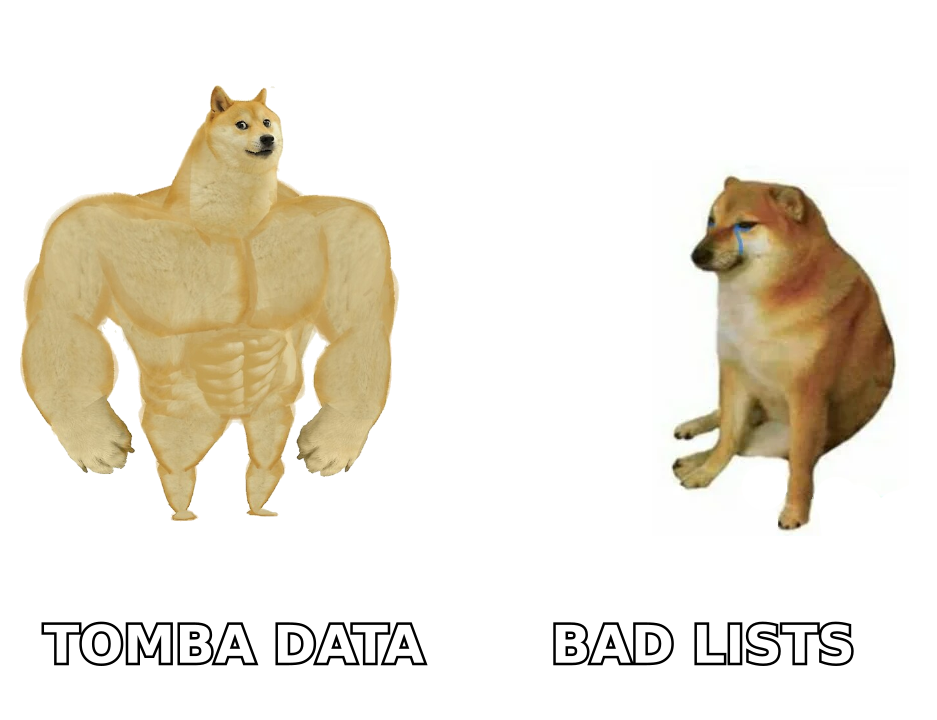
What actually separates these two tools?#
Strip away the branding and the real differences fall into a few buckets. Here's the structured breakdown to anchor on before the pricing table:
- Core use case — Clickback is built for emailing cold/acquired B2B lists with compliance scaffolding; Kipplo is built for sequenced outreach across many inboxes.
- Sending model — Clickback sends through its own managed infrastructure tuned for cold volume; Kipplo connects your inboxes (Google/Microsoft/SMTP) and rotates them.
- Compliance depth — Clickback invests heavily in CAN-SPAM/CASL tooling, suppression, and physical-address handling; Kipplo gives you the basics and expects you to know the rules.
- Buyer profile — Clickback targets mid-market and enterprise lead-gen teams; Kipplo targets SMBs, solo founders, and agencies running client campaigns.
- Price ceiling and floor — Kipplo wins on entry price and transparency; Clickback wins on managed scale but costs more and quotes custom.
- Data responsibility — neither tool finds or verifies contacts for you at a serious level, so both push the data-quality problem back onto you.
That last point is the one that quietly decides whether either tool works. We'll come back to it.
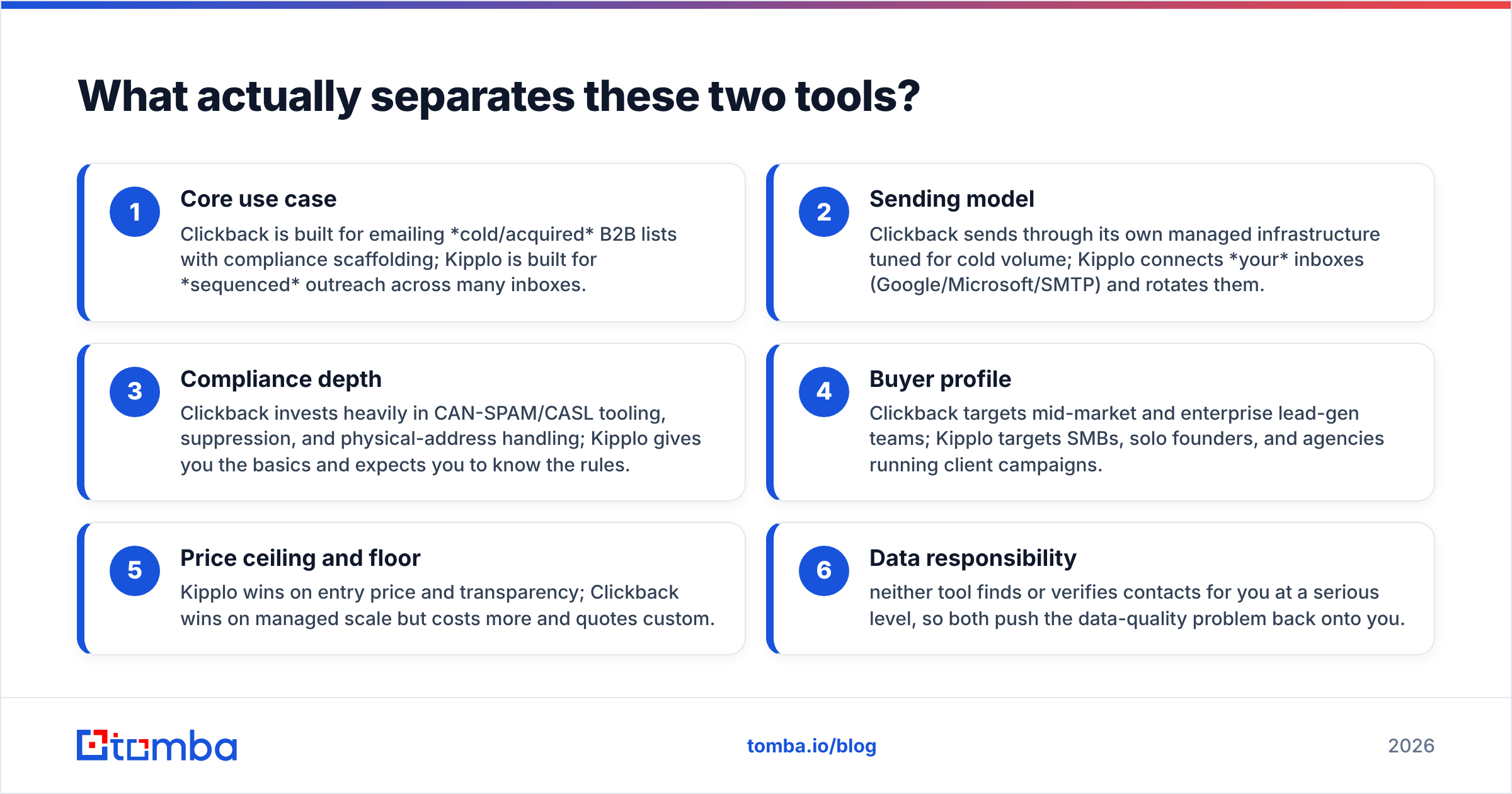
How do Clickback and Kipplo compare on features and pricing?#
Pricing for both moves over time and Clickback in particular quotes based on contact volume, so treat the numbers below as directional rather than a locked quote. Always confirm current pricing on each vendor's site before you commit.
| Attribute | Clickback | Kipplo |
|---|---|---|
| Primary use case | Cold/acquired B2B list email at scale | Multi-inbox cold email sequences |
| Sending infrastructure | Managed, built for cold volume | Your connected inboxes (Google/MS/SMTP) |
| Multi-inbox rotation | Limited / not the core model | Yes — core feature |
| Sequences & follow-ups | Campaign-based | Yes — conditional multi-step |
| Built-in warmup | Add-on / managed deliverability | Yes, included on most plans |
| Compliance tooling (CAN-SPAM/CASL) | Deep, a headline feature | Basic |
| List cleaning / suppression | Strong | Basic |
| Entry price | Custom, higher floor | Low, transparent tiers |
| Best fit | Mid-market & enterprise lead gen | SMBs, founders, agencies |
| Email finding / verification | Not a real finder | Not a real finder |
The pattern is clear. Clickback is the heavyweight built for one specialized, compliance-sensitive motion. Kipplo is the nimble generalist for teams that want sequences and inbox rotation without the enterprise contract. Neither is "better" in the abstract — they're built for different buyers.
Is Clickback better than Kipplo for deliverability?#
Deliverability depends less on which of these two tools you pick and more on what you send and to whom. That said, the two take genuinely different approaches.
Clickback runs managed sending infrastructure tuned specifically for cold, high-volume B2B email, with deliverability monitoring baked in. If your motion is "email 50,000 acquired contacts a month," that managed approach is designed to absorb the reputation risk that comes with cold volume.
Kipplo takes the modern inbox-rotation route: connect many low-volume inboxes, warm them up, and spread sends so no single domain gets hammered. This is the dominant cold-email playbook in 2026 because it mirrors how a human would send and keeps per-inbox volume under provider thresholds.
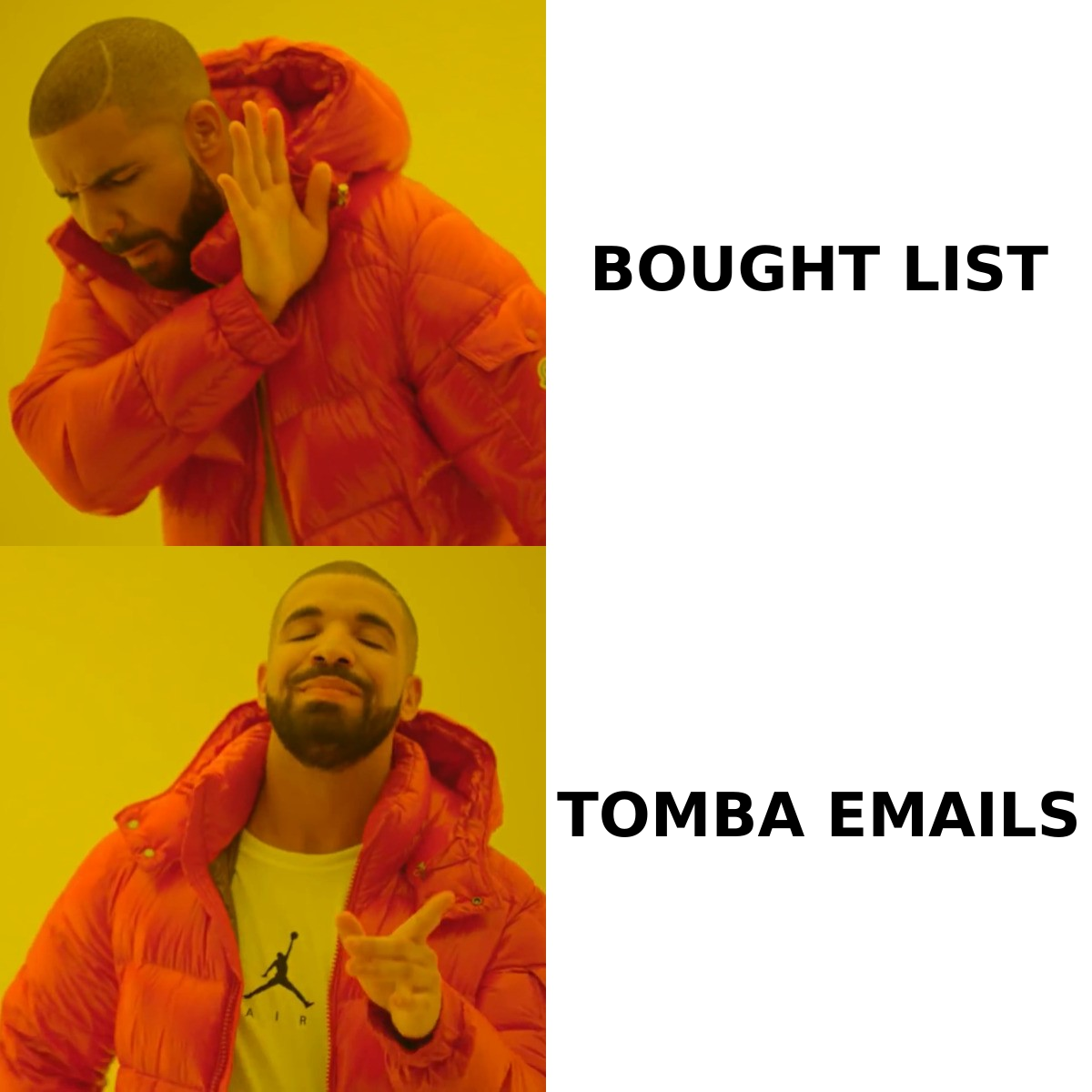
But here's what neither vendor will tell you loudly enough: the single biggest deliverability killer isn't your sending tool — it's invalid addresses. Every hard bounce signals to mailbox providers that you don't know your audience, and that tanks your sender reputation fast. You can have flawless warmup and perfect rotation and still land in spam if 15% of your list bounces. Clean the list first, then worry about the sending engine.
What about compliance — CAN-SPAM, CASL, and GDPR?#
This is Clickback's clearest advantage. If your business model genuinely involves emailing cold or acquired B2B lists in North America, Clickback's compliance scaffolding — suppression lists, header accuracy, unsubscribe handling, physical-address inclusion — is purpose-built for that risk. It exists precisely because this use case is legally delicate.
Kipplo handles the basics (unsubscribe links, the standard footer requirements) but assumes you're sending to lists you've sourced responsibly. It's not trying to be a compliance platform.
A few hard rules either way, because no tool removes your legal responsibility:
- United States (CAN-SPAM): cold B2B email is allowed with accurate headers, a valid physical address, and a working opt-out you honor promptly.
- Canada (CASL): much stricter — you generally need consent or a documented existing business relationship. Clickback's tooling leans into this market.
- EU/UK (GDPR): consent and legitimate-interest rules make scraped or purchased lists risky. Document your lawful basis before sending.
If you operate primarily in the EU, neither tool magically makes a purchased list compliant. Sourcing matters more than sending.
Which tool should you pick?#
Match the tool to your actual motion, not to the flashier feature list.
Choose Clickback if:
- Emailing cold or acquired B2B lists is a core, deliberate part of your strategy.
- You need serious compliance tooling and suppression management.
- You're mid-market or enterprise and can absorb custom, volume-based pricing.
- You want managed sending infrastructure rather than juggling your own inboxes.
Choose Kipplo if:
- You want modern multi-inbox cold outreach with sequences and warmup.
- You're an SMB, founder, or agency running campaigns on a tighter budget.
- You already source your own permission-based or carefully built lists.
- You value transparent, low entry pricing over enterprise muscle.
Notice that both recommendations assume one thing: that the list you load is accurate. That assumption is doing a lot of work.
The variable both tools depend on: list quality#
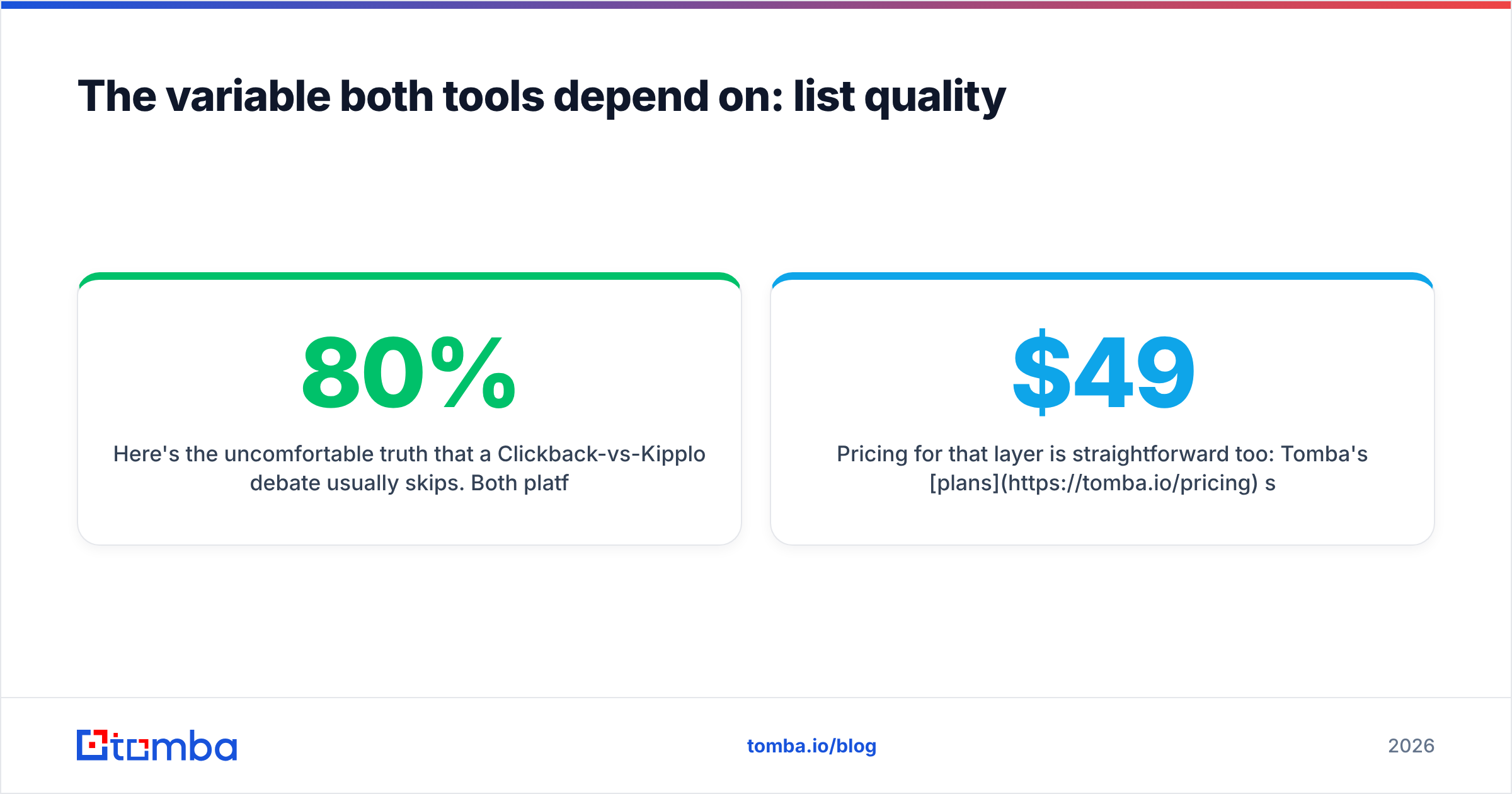
Here's the uncomfortable truth that a Clickback-vs-Kipplo debate usually skips. Both platforms are senders. Neither is a serious data source. The contacts you load determine 80% of your outcome, and a bad list will sink either tool no matter how good its warmup or compliance features are.
Consider what a dirty list does to each platform:
- Bounce rate spikes — invalid addresses trigger hard bounces that destroy domain reputation.
- Spam traps — recycled or scraped addresses can include traps that get your domain blocklisted.
- Wasted volume — every send to a dead address is a credit and a sending slot you don't get back.
- Compliance exposure — emailing the wrong person at a defunct company is exactly the kind of mistake regulators and recipients punish.
This is why a real find-and-verify layer sits upstream of both Clickback and Kipplo, not inside them. Before any contact enters a campaign, you want a confirmed, current, deliverable address tied to the right person and company.
That's the gap Tomba fills. Use the email finder to source professional addresses by domain, name, or company, then run them through the email verifier to strip out bounces and risky catch-alls before they ever touch your sending tool. The result is a list that protects your email deliverability instead of eroding it — and that improvement applies whether you end up on Clickback, Kipplo, or anything else.
Pricing for that layer is straightforward too: Tomba's plans start with a free tier of 25 searches per month, then Starter at $49/mo, Growth at $99/mo, and Pro at $249/mo, so you can verify before you scale.
Clickback vs Kipplo vs a clean-data workflow#
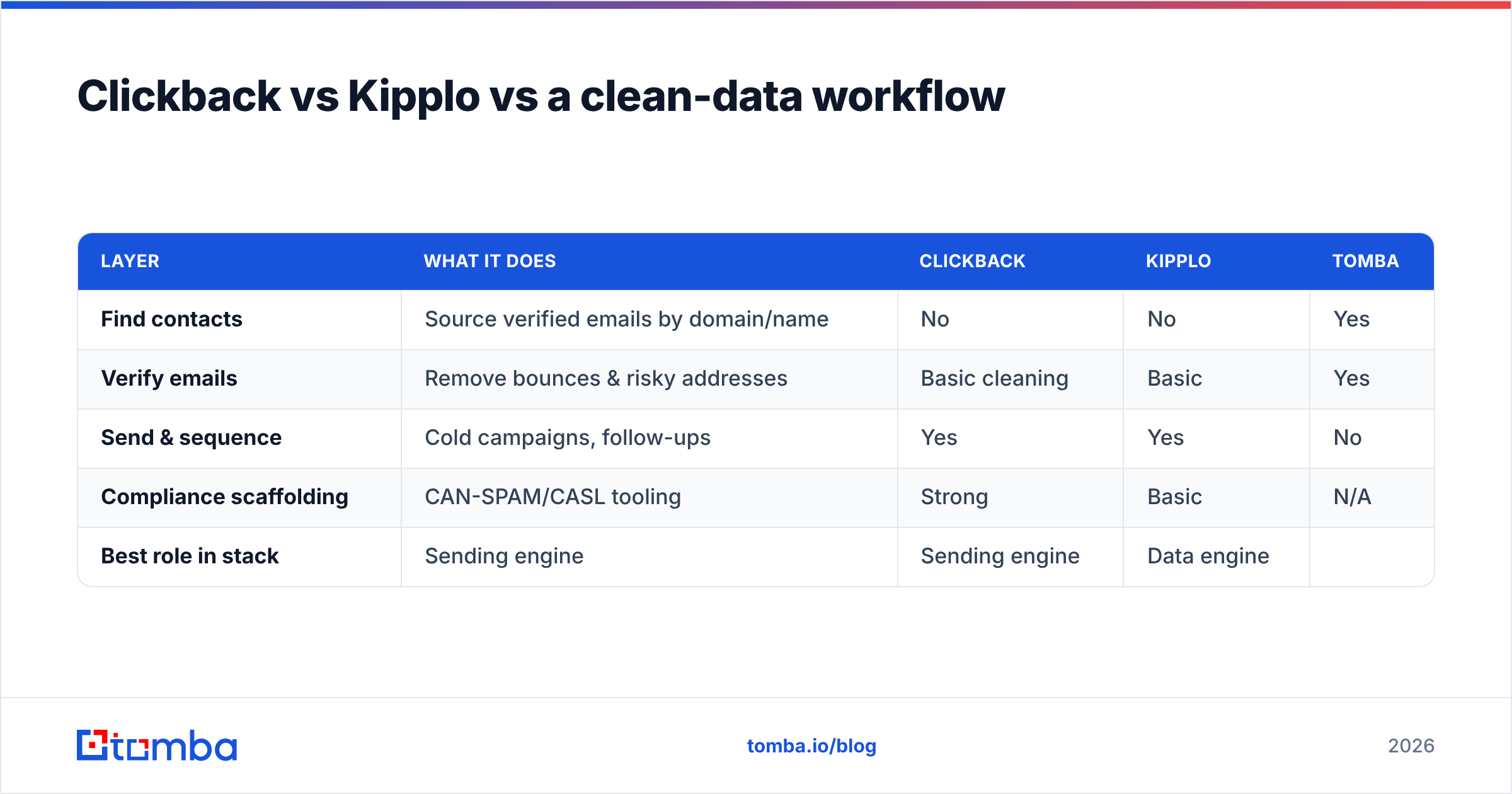
Think of it as a relay, not a single runner. The sending platform is the last leg. The data layer is the first — and if the first leg drops the baton, the race is already lost.
| Layer | What it does | Clickback | Kipplo | Tomba |
|---|---|---|---|---|
| Find contacts | Source verified emails by domain/name | No | No | Yes |
| Verify emails | Remove bounces & risky addresses | Basic cleaning | Basic | Yes |
| Send & sequence | Cold campaigns, follow-ups | Yes | Yes | No |
| Compliance scaffolding | CAN-SPAM/CASL tooling | Strong | Basic | N/A |
| Best role in stack | Sending engine | Sending engine | Data engine |
The smartest setup for most teams isn't Clickback or Kipplo. It's a clean-data tool feeding whichever sender matches your motion. The sender you pick is a preference; clean data is a prerequisite.
Frequently asked questions#
Is Clickback or Kipplo cheaper? Kipplo generally has a lower, more transparent entry price, making it friendlier for SMBs and agencies. Clickback quotes custom pricing based on contact volume and sits at a higher floor because it's a heavier, compliance-focused platform.
Can I email a purchased list with these tools? Clickback is explicitly designed for emailing cold and acquired B2B lists under CAN-SPAM/CASL guardrails. Kipplo can technically send to any list you load, but it offers far less compliance scaffolding and assumes you've sourced contacts responsibly. In both cases, the legal responsibility is yours — and a purchased list is only as safe as it is clean and verified.
Do Clickback or Kipplo find email addresses for me? Not in any serious way. Both are sending platforms, not contact-discovery tools. To build an accurate list, you need a dedicated email finder and verifier upstream — that's the role Tomba plays.
Which should I choose for cold outreach in 2026? If compliance-heavy, high-volume emailing of acquired lists is your core motion, Clickback. If you want modern multi-inbox sequences on a tighter budget, Kipplo. Either way, verify your list first.
The bottom line#
Clickback and Kipplo solve the same surface problem — getting cold email out the door — for two different buyers. Clickback is the compliance-forward heavyweight for teams that deliberately email acquired B2B lists at scale. Kipplo is the lightweight, multi-inbox sequencer for SMBs and agencies that want results without an enterprise contract. Pick by motion and budget, and you won't go wrong.
But before you debate features, fix the input. A sending tool only amplifies the list you feed it, and the fastest way to waste money on either platform is to load addresses you never verified. Start by building a clean, current, deliverable list with the Tomba Email Finder — find the right contacts, verify them, and only then hand them to Clickback or Kipplo. Get the data right, and whichever sender you choose will perform far better than its marketing page ever promised.
// get started
Find, verify and enrich your first contacts today
Start on the free plan with 25 searches a month, then scale when your team is ready.
Free plan · No credit card required · GDPR & CCPA
// about the author