Clickback vs LeadEngineAI 2026: B2B Lead Gen Compared
Clickback vs LeadEngineAI in 2026: pricing, data quality, compliance, and deliverability compared so you can pick the right B2B lead-gen engine — and the data layer that actually feeds it.
Clickback vs LeadEngineAI: Which B2B Lead Engine Wins in 2026?
You are choosing between two very different bets. Clickback is a mature, compliance-first email lead-generation platform built around sending cold email to purchased or third-party B2B lists. LeadEngineAI is a newer, AI-led prospecting tool that promises automated list-building, intent signals, and message generation in one workflow. Both want to fill your pipeline. Neither will save you if the underlying contact data is wrong.
This is a neutral breakdown of how the two compare on data quality, deliverability, compliance, pricing, and fit — plus where a dedicated data layer like Tomba changes the math for either one.
TL;DR#
- Clickback is the safer pick for regulated, high-volume cold email to cold B2B lists — strong compliance tooling, built-in verification, and a long track record.
- LeadEngineAI is the faster pick for small teams that want AI to build lists, score intent, and draft copy without stitching five tools together.
- Neither tool is a true email-finder. Both lean on imported or scraped data, and accuracy varies wildly by region and seniority.
- Deliverability lives or dies on list hygiene. Whichever platform you choose, verify contacts before the first send or you will burn your sending domain.
- The smart stack pairs a lead engine with a precise data source — use a email finder and email verifier to feed clean, accurate contacts into either platform.
What is Clickback?#
Clickback is a Canadian B2B email lead-generation platform focused on one hard problem: sending cold email to people who have not opted in, legally and at scale. Its flagship product, Clickback MAIL, is built for outbound campaigns to cold, third-party, or purchased lists — the kind of sending that gets most marketing platforms (Mailchimp, HubSpot, Constant Contact) to suspend your account.
The platform bundles list verification, spam-word checking, and compliance guardrails for CAN-SPAM and CASL. The pitch is straightforward: send cold email without torching your reputation or your legal standing. It is aimed at mid-market and enterprise marketing teams that already have lists and need a sanctioned way to mail them.
What Clickback is not: a database. You bring the contacts. The platform cleans and sends them, but it does not find net-new people for you the way a prospecting tool does.
What is LeadEngineAI?#
LeadEngineAI sits in the newer category of AI-first prospecting tools. The promise is end-to-end automation: describe your ideal customer, and the engine assembles a target list, enriches it with firmographic and intent data, scores accounts, and drafts personalized outreach — often with a one-click handoff to a sending sequence.
This category exploded after 2024 as AI made list-building and copy generation cheap. The appeal is obvious for lean teams: instead of paying for a data tool, a verification tool, a sequencer, and a copywriter, you get a single subscription that does a passable version of all four.
The tradeoff is depth. AI-assembled lists are only as good as the sources the model can reach, and "intent" claims are notoriously hard to audit. You trade control and transparency for speed.
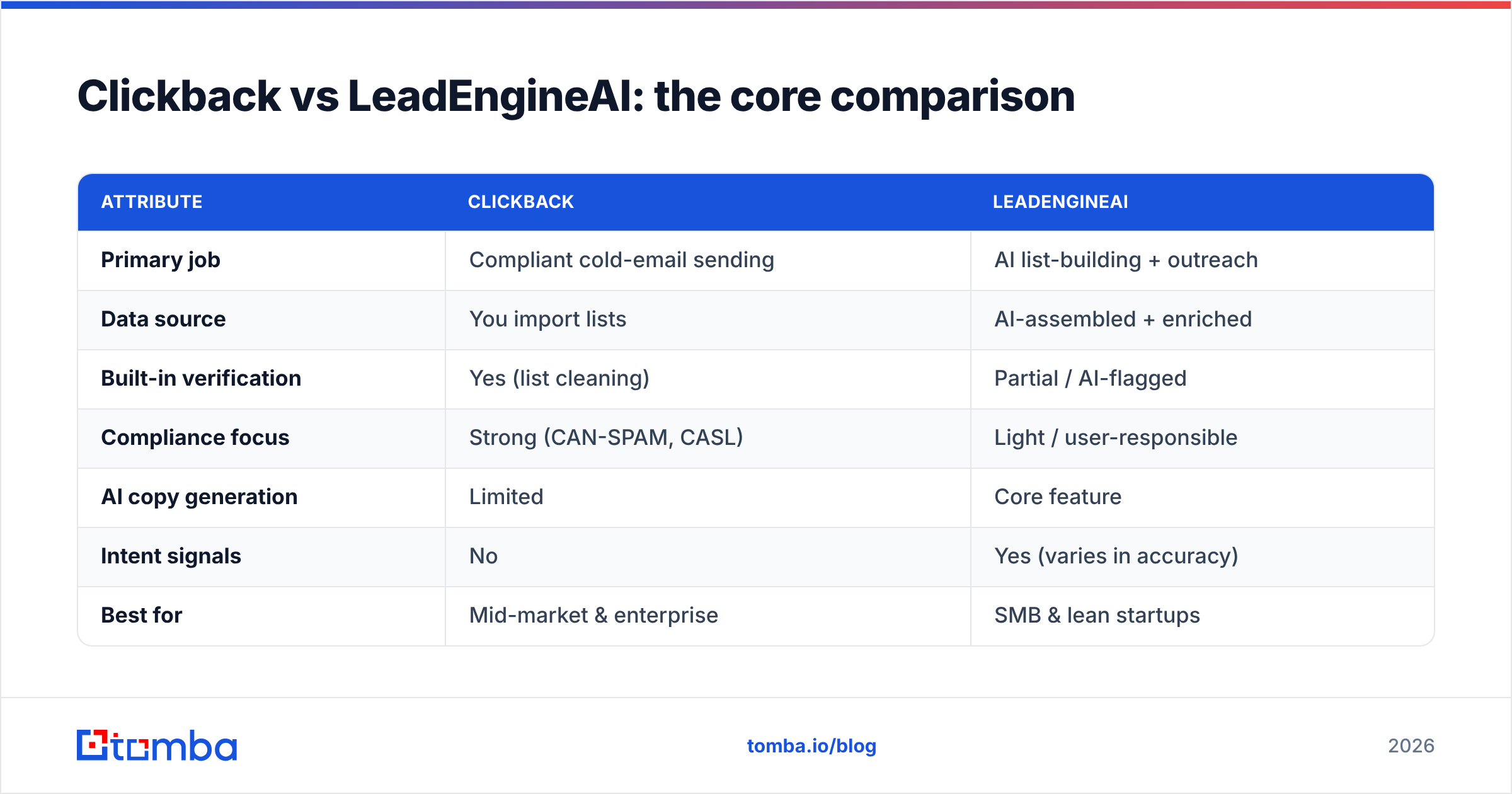
Clickback vs LeadEngineAI: the core comparison#
Here is the honest side-by-side. Treat AI-tool numbers as directional — newer vendors move fast and publish less.
| Attribute | Clickback | LeadEngineAI |
|---|---|---|
| Primary job | Compliant cold-email sending | AI list-building + outreach |
| Data source | You import lists | AI-assembled + enriched |
| Built-in verification | Yes (list cleaning) | Partial / AI-flagged |
| Compliance focus | Strong (CAN-SPAM, CASL) | Light / user-responsible |
| AI copy generation | Limited | Core feature |
| Intent signals | No | Yes (varies in accuracy) |
| Best for | Mid-market & enterprise | SMB & lean startups |
| Typical pricing | Mid-to-high, volume-based | Lower, seat-based |
| Learning curve | Moderate | Low |
The pattern: Clickback is the disciplined sender, LeadEngineAI is the fast assembler. Your choice depends on whether your bottleneck is sending safely or finding people quickly.
Which one has better data quality?#
Neither tool is a data company first, and that is the most important thing to understand before you buy.
Clickback verifies the lists you upload, which catches dead addresses and obvious traps — but it cannot improve the accuracy of bad source data. Garbage in, cleaned garbage out. If you bought a stale list, verification reduces the bounce rate but does not give you the right person at the current company.
LeadEngineAI generates lists from its own sources plus third-party enrichment. The quality varies sharply by segment. North American mid-market contacts tend to be decent; EMEA, APAC, SMB, and senior-executive records get thin and stale fast. AI "confidence scores" sound reassuring but rarely come with a transparent methodology you can audit.
This is exactly why teams that care about results decouple the data layer from the sending layer. A focused domain search returns every public email pattern at a target company, and an independent verifier confirms each address before it ever touches a campaign. When you control data quality upstream, the choice between Clickback and LeadEngineAI becomes a workflow decision instead of a gamble.
How do they compare on deliverability and compliance?#
Deliverability is where these two products diverge most.
Clickback was built for the hardest deliverability scenario in B2B: cold mail to unengaged recipients. It actively manages sending infrastructure, throttles volume, and screens content for spam triggers. If your strategy depends on legally mailing cold lists at volume, this is its entire reason to exist. The platform also leans hard into compliance — CASL in particular is unforgiving, and Clickback's guardrails exist because the penalties are real.
LeadEngineAI generally hands you a sequence and assumes you have warmed your domain and sorted your own SPF, DKIM, and DMARC. That is fine for low-volume, highly targeted outreach, but it puts the deliverability burden on you. If you point an AI-assembled list at a fresh domain and hit send, you will land in spam — fast.
Two rules apply no matter which tool wins your evaluation:
- Authenticate your domain. A correct SPF record, DKIM, and DMARC are non-negotiable in 2026 after the Google and Yahoo bulk-sender requirements.
- Protect your sender reputation. Clean lists, gradual ramp-up, and tight monitoring of complaint rates keep your domain out of trouble. Read up on email deliverability before you scale volume on either platform.
For an authoritative baseline on cold-email rules, the Federal Trade Commission's CAN-SPAM guidance is the document both vendors design against.
What does each one cost?#
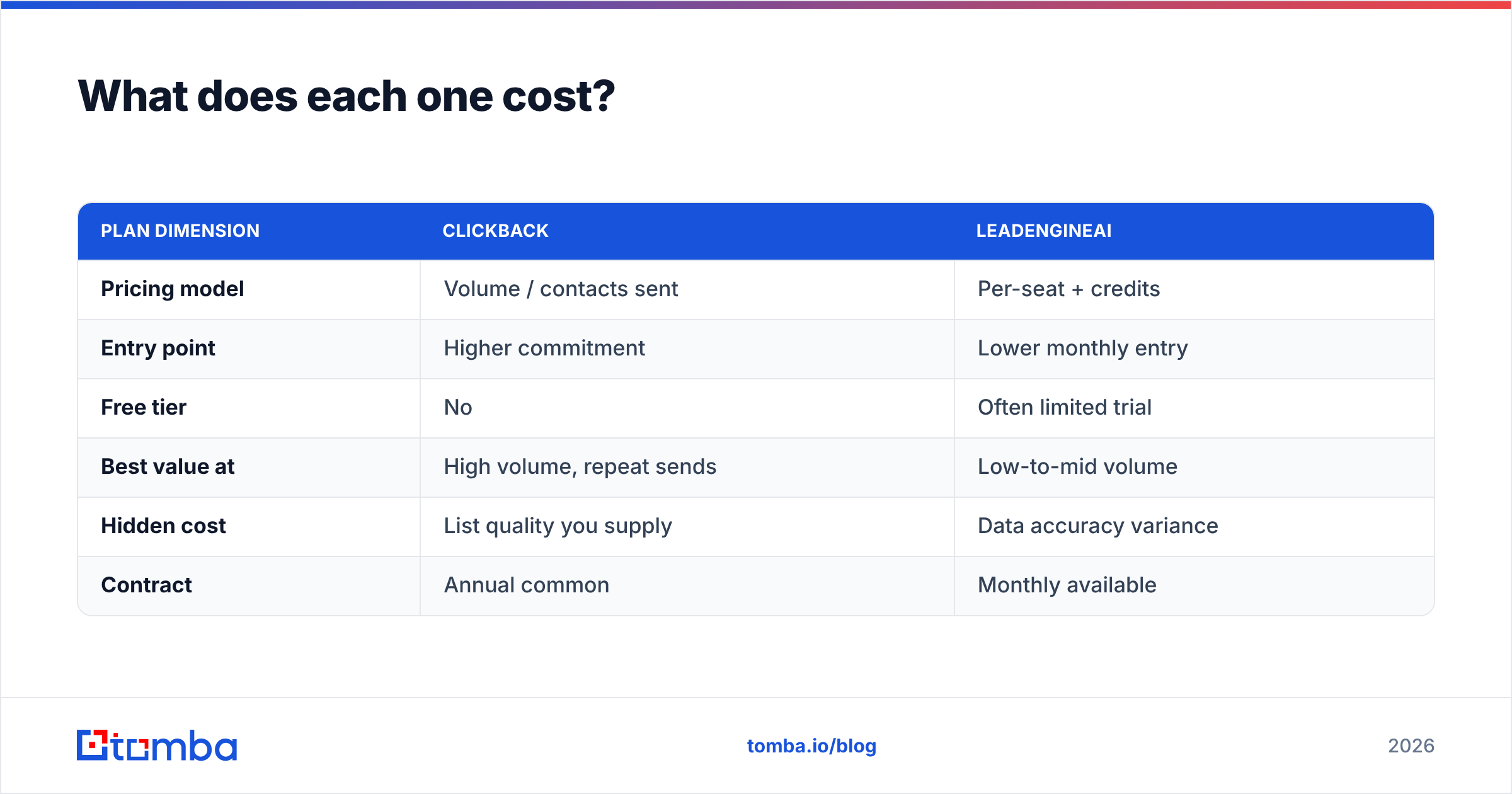
Pricing is where intent and budget collide. Exact numbers shift, so confirm on each vendor's current pricing page — but the shape of each model is stable.
| Plan dimension | Clickback | LeadEngineAI |
|---|---|---|
| Pricing model | Volume / contacts sent | Per-seat + credits |
| Entry point | Higher commitment | Lower monthly entry |
| Free tier | No | Often limited trial |
| Best value at | High volume, repeat sends | Low-to-mid volume |
| Hidden cost | List quality you supply | Data accuracy variance |
| Contract | Annual common | Monthly available |
Clickback is a considered purchase: you commit because cold mailing at volume is your channel. LeadEngineAI is an easy yes for a founder or a two-person SDR team that wants to test outbound this quarter without a procurement cycle.
One cost that hides in both: re-buying data you already paid for because it bounced. Every bounced send is wasted spend plus reputation damage. Running contacts through a bulk email finder and verifier before import is cheap insurance against the most expensive failure mode in outbound. For reference, compare against transparent, usage-based Tomba pricing when you model total cost of ownership — data plus sending, not sending alone.
Which should you choose?#
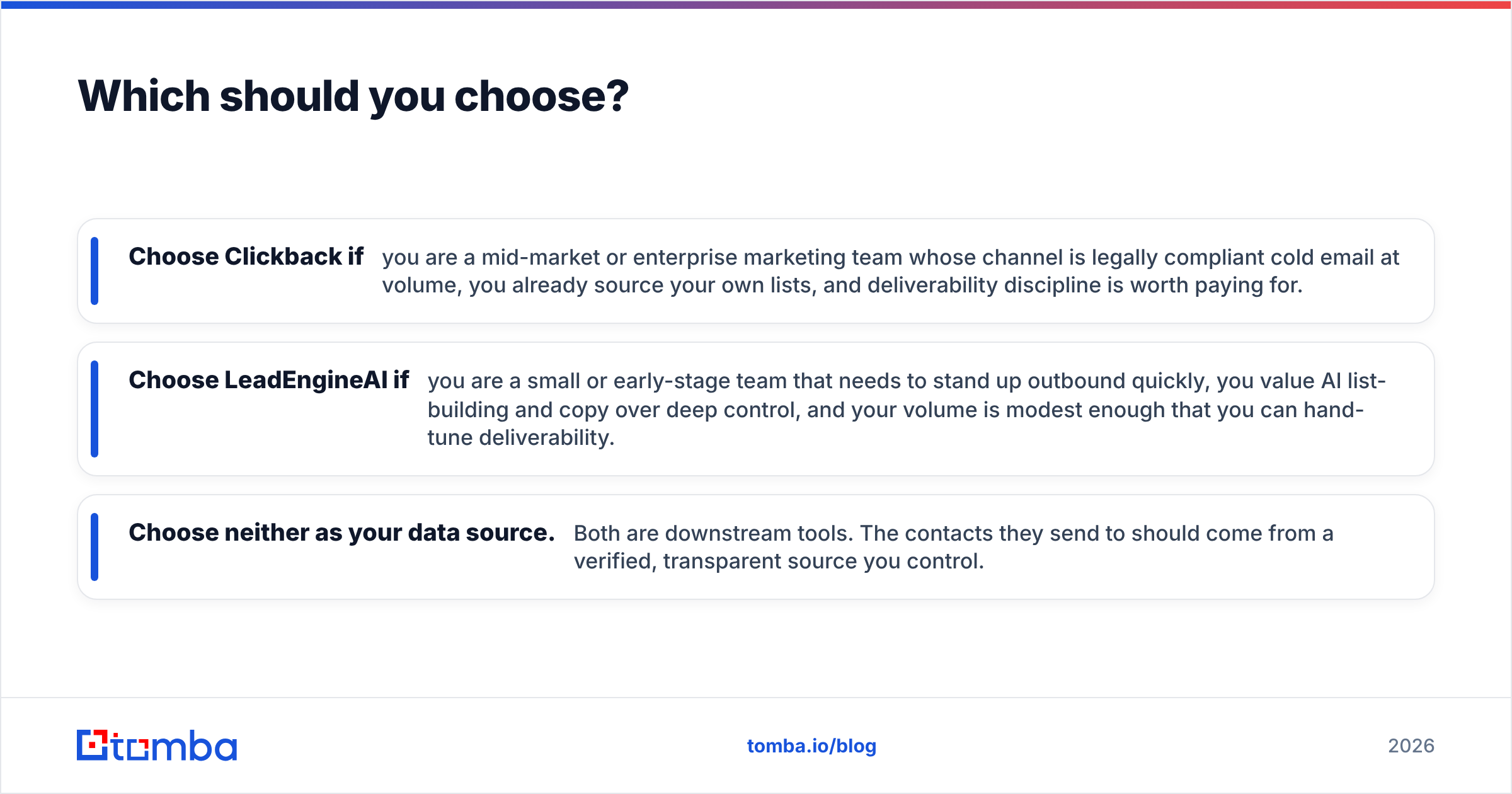
Match the tool to your actual constraint.
- Choose Clickback if you are a mid-market or enterprise marketing team whose channel is legally compliant cold email at volume, you already source your own lists, and deliverability discipline is worth paying for.
- Choose LeadEngineAI if you are a small or early-stage team that needs to stand up outbound quickly, you value AI list-building and copy over deep control, and your volume is modest enough that you can hand-tune deliverability.
- Choose neither as your data source. Both are downstream tools. The contacts they send to should come from a verified, transparent source you control.
A useful gut check: if your biggest risk is getting sued or suspended, Clickback's compliance posture earns its price. If your biggest risk is never launching, LeadEngineAI's speed wins. If your biggest risk is bouncing into spam — and for most teams it is — the answer is a clean data layer underneath whichever sender you pick.
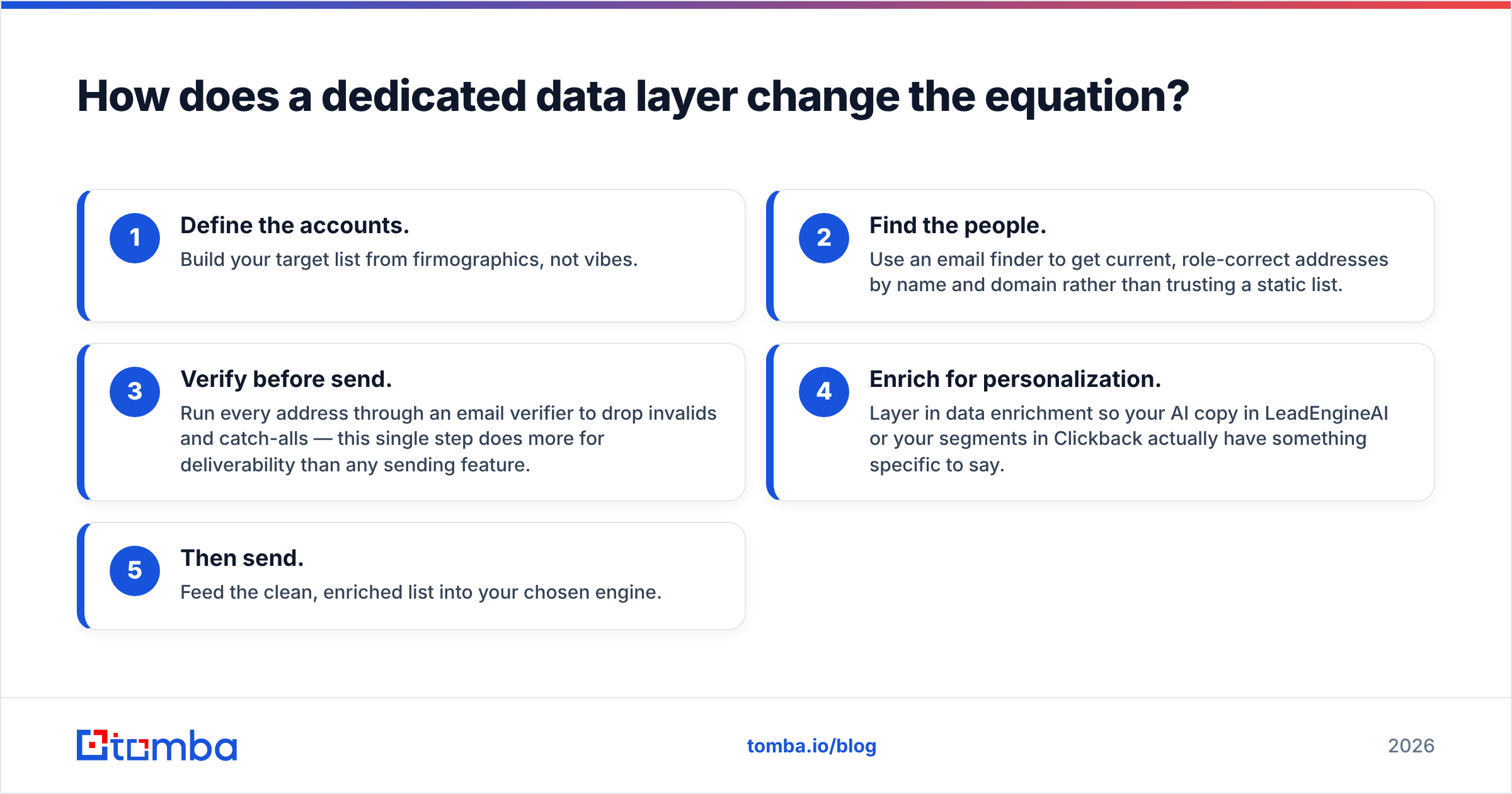
How does a dedicated data layer change the equation?#
This is the part most comparison posts skip. Clickback and LeadEngineAI are sending and assembly engines; they are not where accurate B2B contact data originates. When you separate "find and verify the contact" from "send the campaign," every metric improves.
Here is the workflow that consistently beats a single-vendor approach:
- Define the accounts. Build your target list from firmographics, not vibes.
- Find the people. Use an email finder to get current, role-correct addresses by name and domain rather than trusting a static list.
- Verify before send. Run every address through an email verifier to drop invalids and catch-alls — this single step does more for deliverability than any sending feature.
- Enrich for personalization. Layer in data enrichment so your AI copy in LeadEngineAI or your segments in Clickback actually have something specific to say.
- Then send. Feed the clean, enriched list into your chosen engine.
Decoupling data from delivery means you can switch senders without re-buying contacts, and you never let a tool's weakest layer (its data) drag down its strongest (its sending). It is the same reason serious teams pair a CRM with a dedicated data and intelligence source instead of trusting whatever shipped in the box.
For independent perspective on where each platform stands, vendor-neutral review sites like G2 and Capterra collect real-user feedback on both categories — read the deliverability and data-accuracy comments specifically, since those are the line items that decide outbound success.
Frequently asked questions#
Is Clickback or LeadEngineAI better for cold email? Clickback is purpose-built for compliant cold email to cold lists at volume, with stronger deliverability infrastructure. LeadEngineAI is better when you need AI to build the list and draft the copy, at lower volume.
Does LeadEngineAI replace a data provider? Not reliably. Its AI-assembled data quality varies by region and seniority. For accuracy you can audit, pair it with a dedicated email finder and verifier.
Will either tool keep me out of spam? No tool guarantees the inbox. Domain authentication (SPF, DKIM, DMARC), list verification, and gradual volume ramp matter more than platform choice.
Can I use Tomba with both? Yes. Tomba is a data layer, not a sender — find and verify contacts, then export or integrate them into Clickback, LeadEngineAI, or any sequencer.
The bottom line#
Clickback wins on compliance and high-volume sending discipline. LeadEngineAI wins on speed and AI-assisted assembly for lean teams. But the variable that actually decides your results — contact accuracy — sits outside both products.
Before you commit to either engine, fix the data. Start with the Tomba Email Finder to pull current, role-correct B2B emails by name or domain, verify them, and feed a clean list into whichever platform you choose. Clean data in, real replies out — that is the part no sending tool can do for you. Try Tomba's free tier (25 searches a month) and see how much your bounce rate drops before your next campaign goes out.
// get started
Find, verify and enrich your first contacts today
Start on the free plan with 25 searches a month, then scale when your team is ready.
Free plan · No credit card required · GDPR & CCPA
// about the author