Clickback vs Salesbot 2026: Which B2B Lead Tool Wins?
Clickback pushes cold email to purchased B2B lists. Salesbot automates inbound chat conversations. Here's a neutral 2026 breakdown of which fits your funnel — and where clean data matters more than either.
TL;DR
- Clickback is B2B cold-email software built to email purchased or third-party contact lists at scale, plus a website-visitor-tracking add-on (Clickback WEB).
- Salesbot is an AI-driven conversational assistant that qualifies and converts inbound website traffic through chat — a different stage of the funnel entirely.
- They are not true substitutes: Clickback fills the top of an outbound pipeline, Salesbot captures and routes demand that's already on your site.
- Both live or die on data quality. Clickback's deliverability collapses on a dirty list; Salesbot's routing is only as good as the lead data it enriches against.
- If your real problem is sourcing accurate, verified contacts before either tool runs, a dedicated email finder and email verifier do more for ROI than picking between these two.
Most "Clickback vs Salesbot" searches start from a wrong assumption: that these are competing products. They aren't. One is an outbound email engine; the other is an inbound chat layer. The useful question isn't "which is better" — it's "which problem am I actually trying to solve, and what does each tool require to work?" This guide answers both, in plain terms.
What is Clickback?#
Clickback is a Canadian B2B software company whose flagship product, Clickback MAIL, is purpose-built for cold email to cold lists — including purchased, rented, or scraped contact data that most mainstream ESPs (Mailchimp, HubSpot, Constant Contact) explicitly ban. That single design choice defines the entire product.
Because sending to non-opted-in lists wrecks deliverability and sender reputation, Clickback wraps the workflow in compliance tooling: list hygiene, suppression management, CAN-SPAM/CASL-aligned footers, and dedicated sending infrastructure that isolates your reputation from other senders. Its second product, Clickback WEB, identifies anonymous companies visiting your site so sales can follow up.
In short, Clickback's promise is: "Upload a cold B2B list, and we'll get more of it into inboxes without torching your domain." Whether you should email purchased lists is a separate strategic and legal question — but that's the niche Clickback owns.
)
What is Salesbot?#
Salesbot refers to AI-powered conversational sales assistants — chatbots that engage visitors already on your website, answer product questions, qualify leads with branching logic, book meetings, and hand warm conversations to reps. The term is used generically (and is also the name of HubSpot's native chatbot inside its CRM), so the category is broader than a single vendor.
The core job is inbound conversion: turn passive traffic into booked calls or captured contacts without a human watching the chat widget 24/7. Modern versions layer in large-language-model responses, CRM lookups, and lead-scoring so the bot can personalize replies and route high-intent visitors instantly.
Salesbot's promise is the inverse of Clickback's: "You already have traffic — let's stop losing it." It does nothing to generate that traffic or fill a cold pipeline. If nobody's visiting your site, a chatbot has no one to talk to.
How do Clickback and Salesbot differ?#
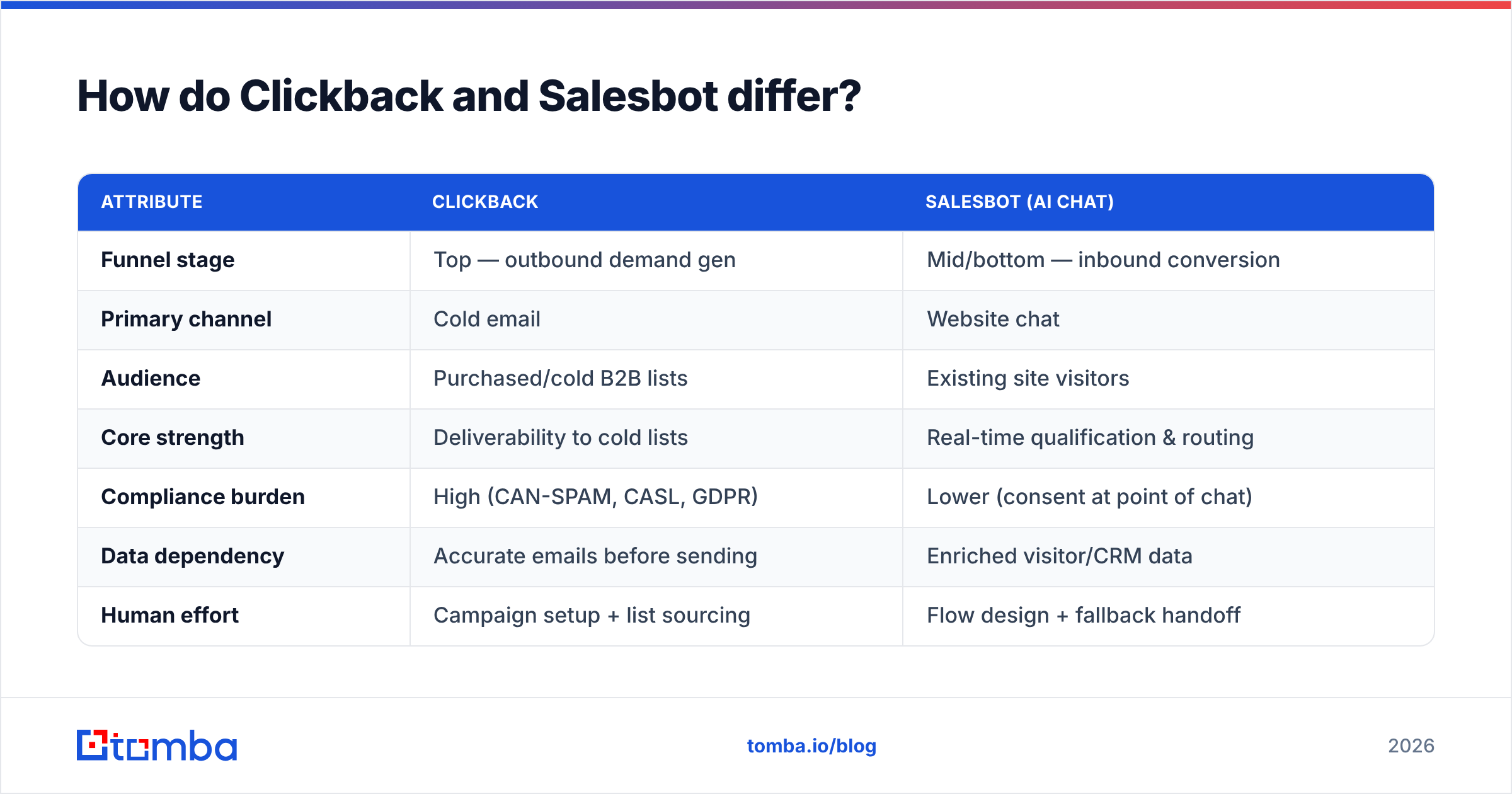
Here's the structural breakdown across the attributes that actually change your buying decision:
| Attribute | Clickback | Salesbot (AI chat) |
|---|---|---|
| Funnel stage | Top — outbound demand gen | Mid/bottom — inbound conversion |
| Primary channel | Cold email | Website chat |
| Audience | Purchased/cold B2B lists | Existing site visitors |
| Core strength | Deliverability to cold lists | Real-time qualification & routing |
| Compliance burden | High (CAN-SPAM, CASL, GDPR) | Lower (consent at point of chat) |
| Data dependency | Accurate emails before sending | Enriched visitor/CRM data |
| Human effort | Campaign setup + list sourcing | Flow design + fallback handoff |
| Typical buyer | Outbound SDR / demand-gen team | Marketing / web conversion team |
The pattern is clear: Clickback creates conversations that don't exist yet; Salesbot improves conversations that already started. A mature B2B motion often runs both — Clickback (or any outbound tool) drives traffic and replies, while a chatbot catches the visitors that outreach sends back to the site.
Which one fits your use case?#
Decide by your bottleneck, not by feature lists.
- You have no pipeline and need volume. Clickback's lane. You're buying lists and want them to land in inboxes. But understand the trade-off: cold-list emailing carries real reputation and legal risk, and quality varies wildly by data vendor.
- You have traffic but weak conversion. Salesbot's lane. Visitors arrive and leave without converting; a chatbot recovers some of that intent and books meetings around the clock.
- You have lists but bad data. Neither tool fixes this — and both will amplify the problem. Clean and verify emails first, or Clickback bounces and Salesbot routes garbage into your CRM.
- You want personalization at scale. Salesbot personalizes live; Clickback personalizes via merge fields. Both need enriched fields to work — which is a data enrichment job upstream.
- You're compliance-sensitive (EU, regulated industries). Salesbot is generally safer because consent happens at the moment of chat. Cold-list email under GDPR is a minefield; tread carefully with Clickback regardless of its compliance features.
If you can only fund one tool this quarter, choose the one that unblocks your current bottleneck — adding a chatbot to an empty funnel, or blasting cold email to a site that already converts well, both waste money.
How much do Clickback and Salesbot cost?#
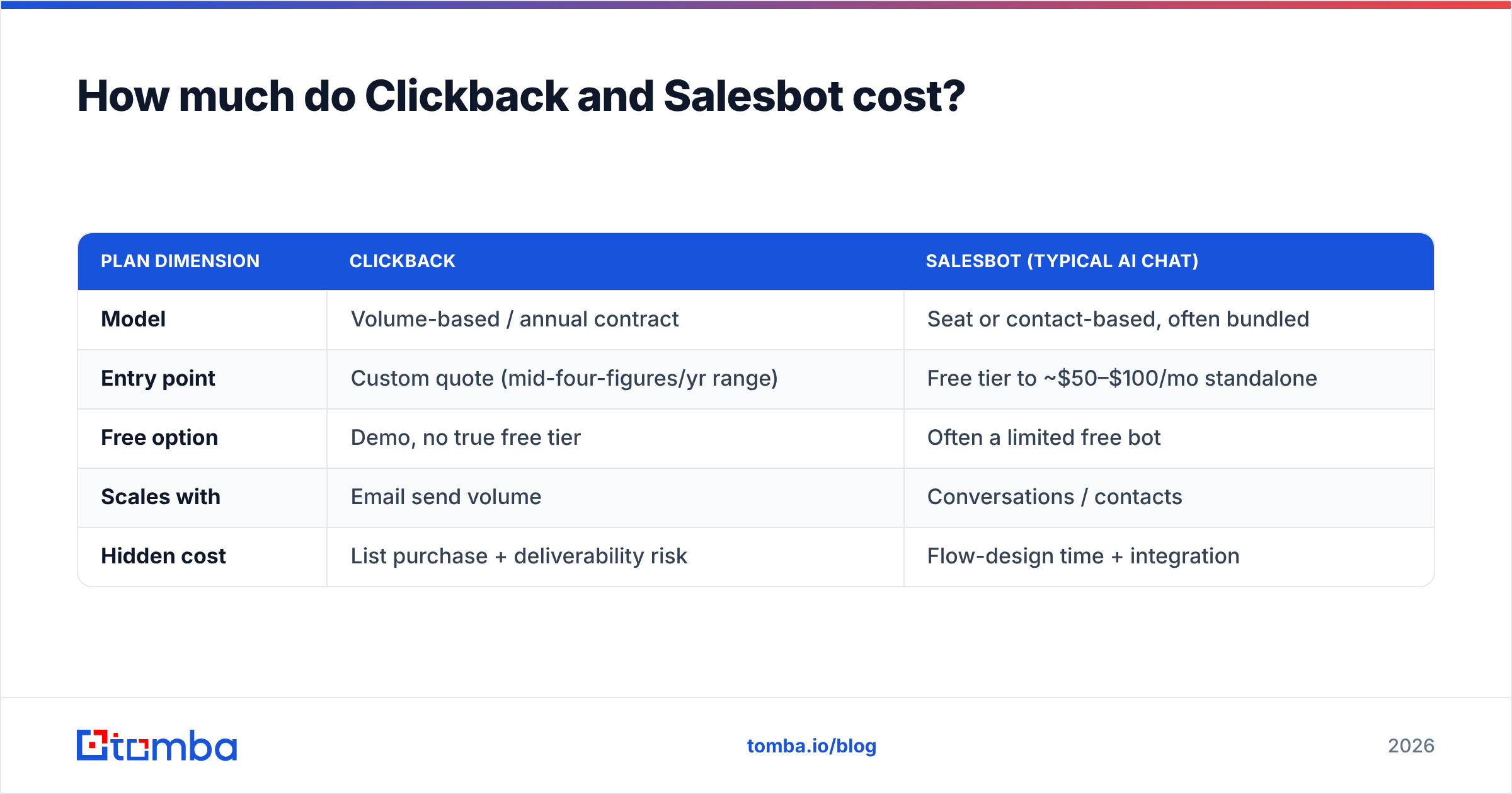
Pricing for both is quote-driven and tier-dependent, so treat the figures below as directional rather than fixed. Clickback prices by email send volume and contracts; Salesbot pricing depends heavily on which vendor you pick (HubSpot's is bundled into Marketing/Sales Hub tiers, standalone AI chatbots range widely).
| Plan dimension | Clickback | Salesbot (typical AI chat) |
|---|---|---|
| Model | Volume-based / annual contract | Seat or contact-based, often bundled |
| Entry point | Custom quote (mid-four-figures/yr range) | Free tier to ~$50–$100/mo standalone |
| Free option | Demo, no true free tier | Often a limited free bot |
| Scales with | Email send volume | Conversations / contacts |
| Hidden cost | List purchase + deliverability risk | Flow-design time + integration |
The hidden cost line matters most. Clickback's sticker price excludes the contact lists you must buy and the reputation risk you absorb. Salesbot's excludes the design and integration hours needed to make a bot that doesn't frustrate visitors. For honest budgeting, add those to the quote.
)
Why does data quality decide both tools?#
Because every dollar you spend on Clickback or Salesbot is leveraged — for better or worse — by the contact data underneath it.
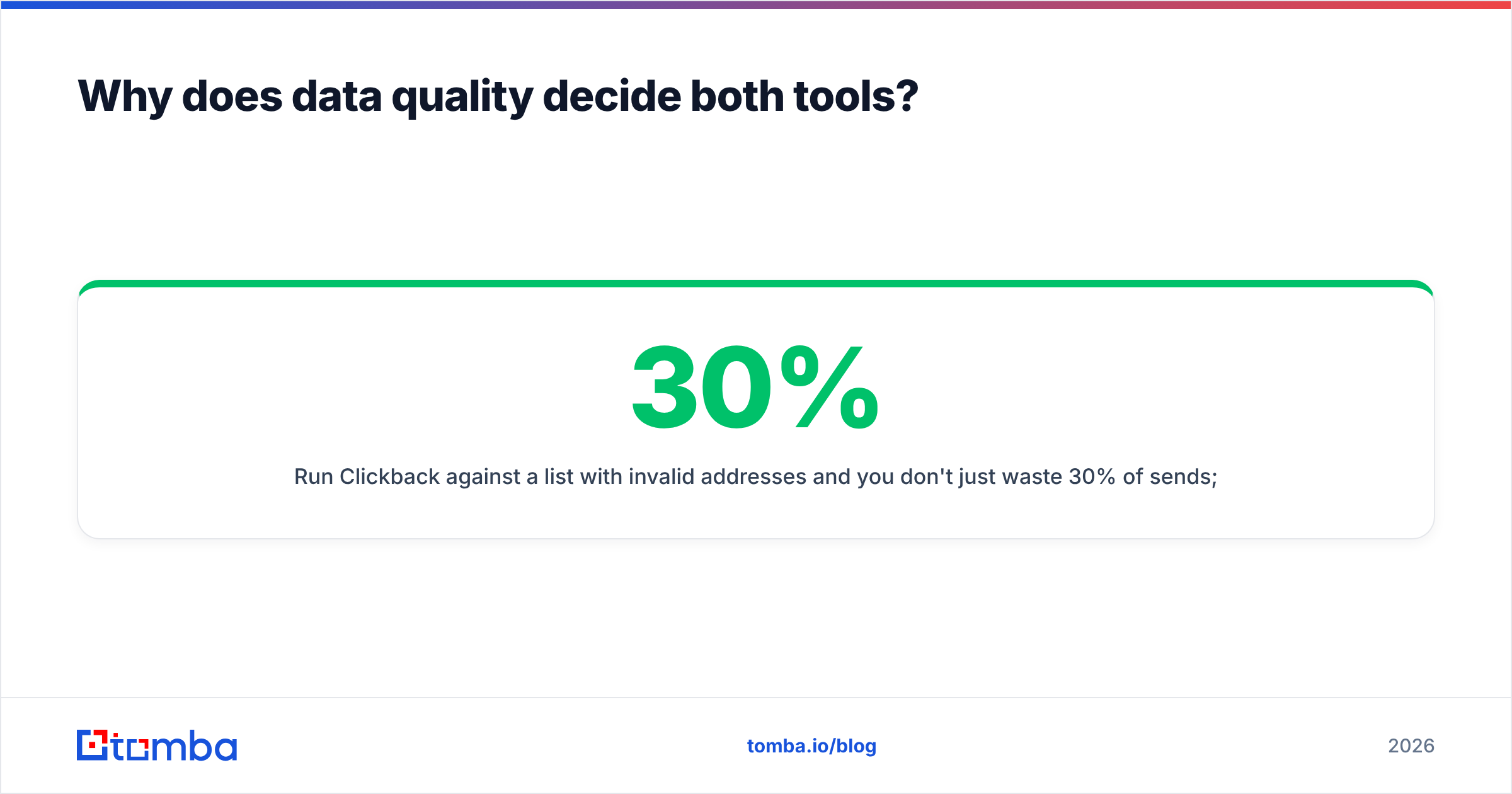
Run Clickback against a list with 30% invalid addresses and you don't just waste 30% of sends; you trigger spam traps, hard bounces, and a sender reputation hit that drags down the valid 70% too. Deliverability is non-linear: a dirty list poisons the whole campaign. That's why teams that take cold email seriously verify before sending and source from accurate providers in the first place.
Salesbot has the same dependency, just hidden. When a known visitor lands and your bot personalizes off CRM data, stale or wrong records make it greet "Sarah from Acme" who left two years ago — instantly breaking trust. Enrichment and verification keep the bot's intelligence honest.
This is where a focused data layer beats bolting more features onto either platform. Tools like Tomba sit upstream of both: find the right contacts, confirm they're real, and enrich them before a single email sends or a single chat fires. According to vendor-neutral review sites like G2, data accuracy is the single most cited differentiator in this category — ahead of price or UI.
Should you use a third tool instead?#
Often, yes — at least alongside. The unglamorous truth is that most "which sending tool" debates are downstream of a data problem the sending tool can't fix.
Before committing to Clickback's cold-list model or a Salesbot deployment, ask:
- Do I actually have verified, accurate contacts? If not, sourcing them is the higher-ROI move. A purpose-built email finder plus cold email templates gets you a clean, opt-in-friendlier outbound motion without inheriting the deliverability baggage of bulk purchased lists.
- Am I enriching for personalization? Both tools reward enriched fields. Doing that once, centrally, beats paying each platform to do it partially.
- What's my compliance posture? If you're EU-facing or risk-averse, building targeted, verified outreach lists is safer than the rent-a-list model Clickback is optimized for.
None of this means Clickback or Salesbot is wrong — it means the order of operations is data first, tooling second.
Clickback vs Salesbot: the verdict#
There's no single winner because they don't play the same sport.
- Choose Clickback if your strategy genuinely relies on emailing cold, purchased B2B lists and you accept the compliance and reputation trade-offs that come with it.
- Choose Salesbot if you have meaningful website traffic and your gap is converting it — real-time qualification and 24/7 booking is where a chatbot earns its keep.
- Choose both if you run a full-funnel motion and want outbound to feed a site that converts harder.
- Fix your data first in every scenario, because both tools multiply whatever quality you feed them — positive or negative.
For most B2B teams the honest sequence is: build an accurate, verified contact base, then layer outbound and inbound tooling on top. Whichever way the Clickback vs Salesbot decision goes, it's the data underneath that determines whether either tool returns a profit.
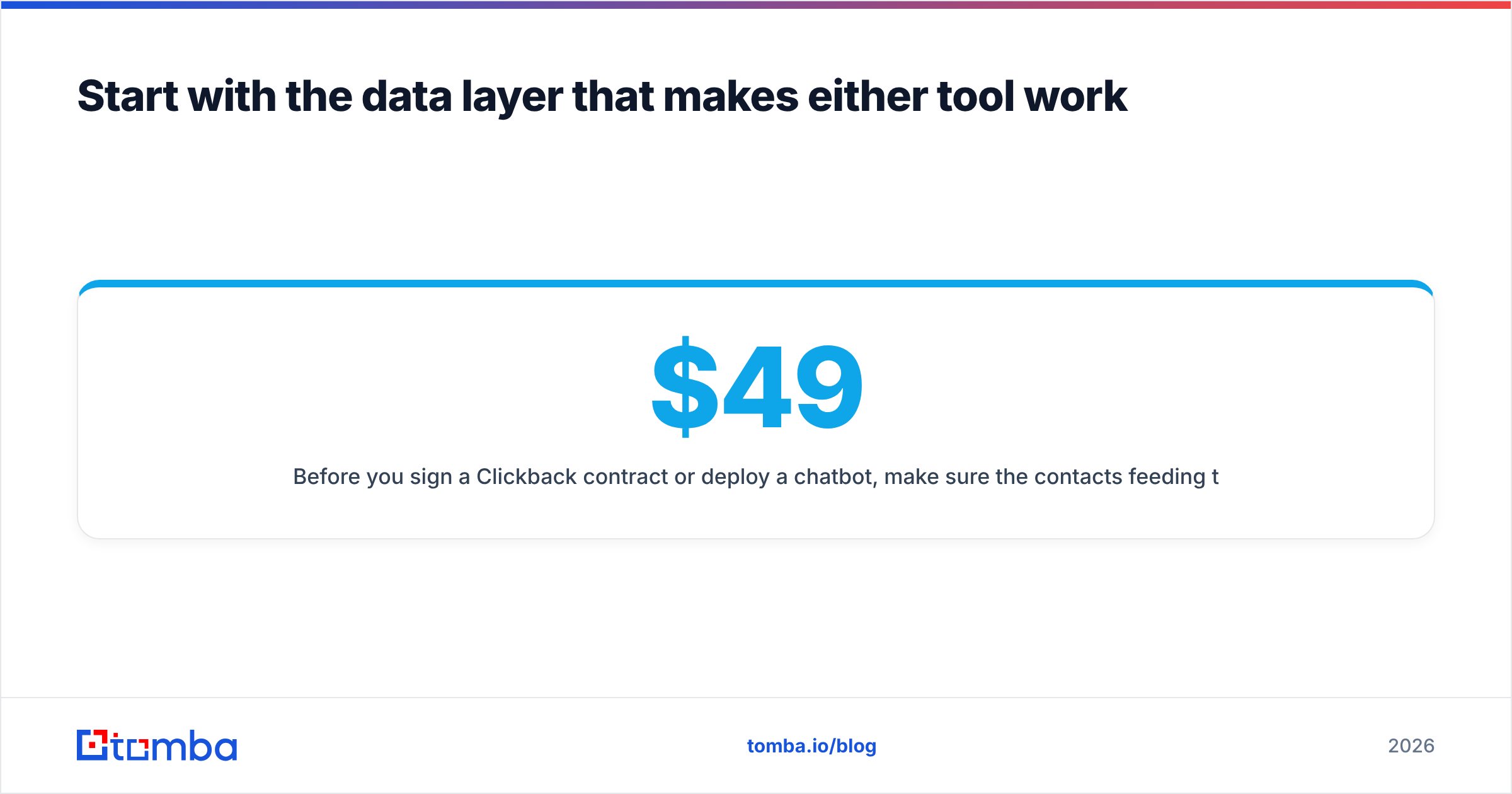
Start with the data layer that makes either tool work#
Before you sign a Clickback contract or deploy a chatbot, make sure the contacts feeding them are real. Tomba's Email Finder locates verified professional email addresses by name, company, or domain — with a free tier (25 searches/month) and paid plans from $49/mo Starter to $99/mo Growth and $249/mo Pro, so you can validate the approach before scaling. Pair it with the built-in verifier to scrub lists before they ever hit a sending platform, and you'll get more from Clickback, Salesbot, or whatever stack you choose next. See full Tomba pricing to match a plan to your volume.
// get started
Find, verify and enrich your first contacts today
Start on the free plan with 25 searches a month, then scale when your team is ready.
Free plan · No credit card required · GDPR & CCPA
// about the author