Clickback vs SalesIntel 2026: Full B2B Tool Comparison
Clickback sends cold B2B email at scale; SalesIntel sells human-verified contact data. Here's which one fits your pipeline in 2026 — and where a cheaper stack beats both.
Clickback and SalesIntel get lumped together in "B2B lead gen" shortlists, but they solve different halves of the same problem. Pick the wrong one and you either pay for a sending engine with no good data to feed it, or buy a premium database you have no compliant way to email. This guide separates the two so you can spend on the gap you actually have.
TL;DR — Clickback vs SalesIntel at a glance#
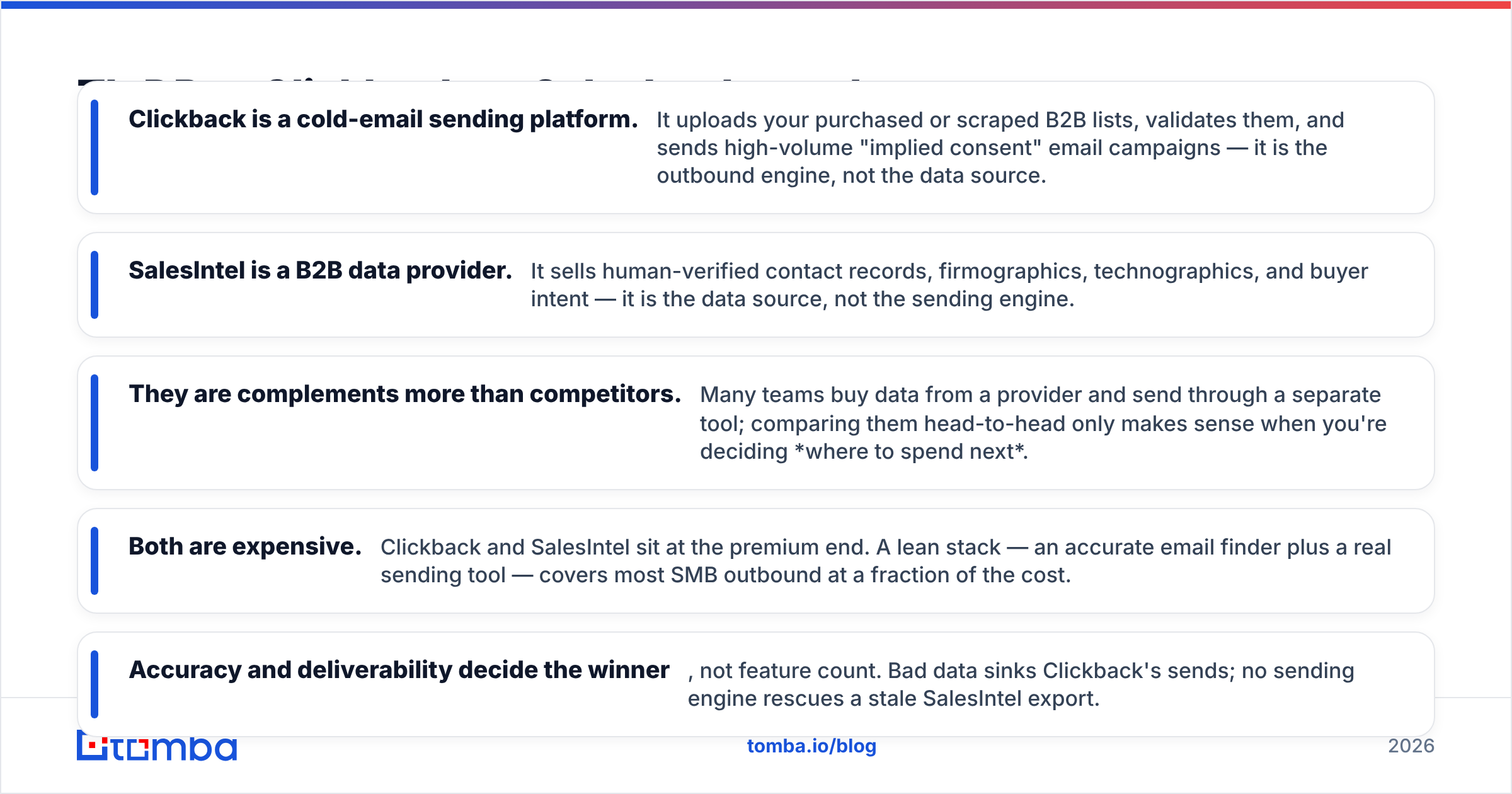
- Clickback is a cold-email sending platform. It uploads your purchased or scraped B2B lists, validates them, and sends high-volume "implied consent" email campaigns — it is the outbound engine, not the data source.
- SalesIntel is a B2B data provider. It sells human-verified contact records, firmographics, technographics, and buyer intent — it is the data source, not the sending engine.
- They are complements more than competitors. Many teams buy data from a provider and send through a separate tool; comparing them head-to-head only makes sense when you're deciding where to spend next.
- Both are expensive. Clickback and SalesIntel sit at the premium end. A lean stack — an accurate email finder plus a real sending tool — covers most SMB outbound at a fraction of the cost.
- Accuracy and deliverability decide the winner, not feature count. Bad data sinks Clickback's sends; no sending engine rescues a stale SalesIntel export.
What is Clickback?#
Clickback is B2B email lead-generation software built around one idea: emailing cold, purchased, or third-party lists under an "implied consent" / legitimate-interest model rather than the explicit opt-in that mainstream ESPs like Mailchimp require. Most consumer email tools will suspend you for uploading a bought list. Clickback is engineered specifically for that use case, with list hygiene, validation, and reputation controls baked in so cold sends don't immediately torch your domain.
The platform's core loop: import a list, run it through Clickback's validation and spam-trap removal, then send through their managed sending infrastructure with tracking on opens, clicks, and engagement. The pitch is volume outreach to people you have no prior relationship with — turning a static list into "marketing-qualified" leads you can hand to sales.
What Clickback is not: a database. You bring the contacts. If your list is garbage, Clickback cleans some of it and surfaces the rest, but it cannot invent accurate emails you don't have. That's the seam where a dedicated finder and email verifier matter.
What is SalesIntel?#
SalesIntel is a B2B contact and company data platform. Its differentiator is human verification — a research team re-verifies records on a rolling cycle (the marketing claim is re-verification roughly every 90 days), aiming for higher accuracy than purely algorithmic databases. On top of raw contacts, SalesIntel layers firmographics, technographics, and buyer-intent signals so you can prioritize accounts that are actively researching your category.
You use SalesIntel to build a list: filter by title, industry, company size, tech stack, or intent topic, then export contacts (name, work email, direct dial, LinkedIn) into your CRM or sequencer. It competes with Apollo, ZoomInfo, Lusha, and Cognism — data-first tools where the contact record is the product.
What SalesIntel is not: a sending platform. It won't run your campaigns, manage sender reputation, or warm your inboxes. You take the data elsewhere to actually email it. For more on how data freshness is sourced and maintained, see how data accuracy is built and re-checked over time.
Is Clickback better than SalesIntel?#
Wrong question — they're on opposite sides of the funnel. The right question is which gap is bleeding your pipeline: do you have good contacts but no compliant way to send to cold lists (buy Clickback), or do you have a sending setup but weak, stale, or thin data (buy SalesIntel)?
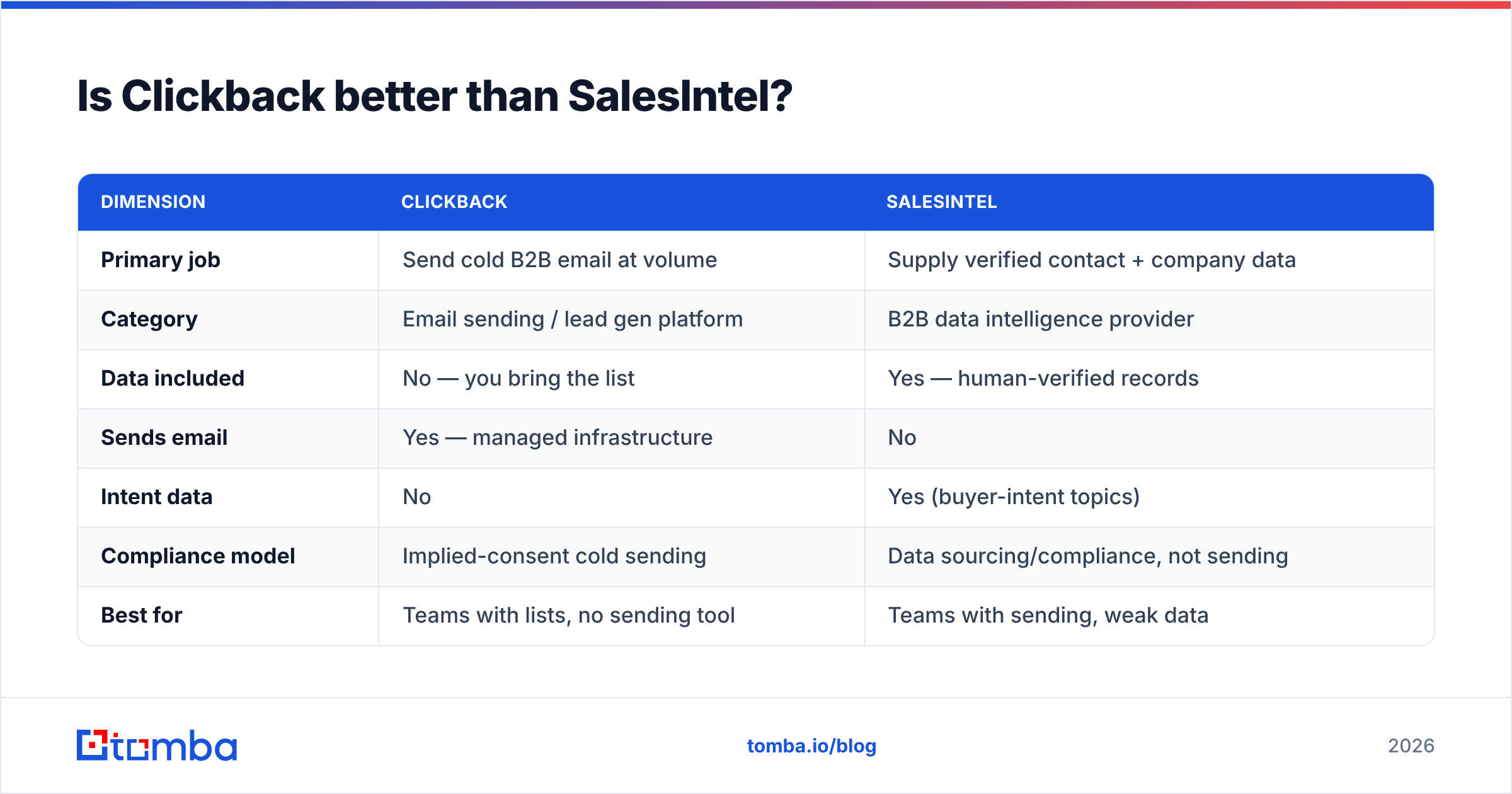
Here's the head-to-head on the dimensions that actually differ:
| Dimension | Clickback | SalesIntel |
|---|---|---|
| Primary job | Send cold B2B email at volume | Supply verified contact + company data |
| Category | Email sending / lead gen platform | B2B data intelligence provider |
| Data included | No — you bring the list | Yes — human-verified records |
| Sends email | Yes — managed infrastructure | No |
| Intent data | No | Yes (buyer-intent topics) |
| Compliance model | Implied-consent cold sending | Data sourcing/compliance, not sending |
| Best for | Teams with lists, no sending tool | Teams with sending, weak data |
| Entry cost | High (managed plans) | High (per-seat + credits) |
| Free tier | No | No |
If you only remember one row: Clickback moves email, SalesIntel moves data. A team with both a good list and a sequencer needs neither.
How do they compare on data accuracy?#
Accuracy is where the comparison gets practical, because both tools live or die on it — just in different ways.
SalesIntel competes on accuracy. Human re-verification is its whole reason to charge a premium over algorithm-only databases. When it works, you get a higher share of deliverable direct emails and working dials than a typical scraped database. The trade-off is coverage and price: human-verified records are more expensive and the verified universe is smaller than a "we have 250M contacts" claim from a bulk vendor.
Clickback's accuracy story is downstream. It validates the list you upload — removing spam traps, syntax errors, and known-bad addresses — but it can't upgrade a list that's merely stale. An address that was valid eight months ago and now bounces will often pass syntax validation and still fail on send. That's why teams pair any cold-send tool with a real-time email verification pass and a catch-all verifier before a campaign, not just the platform's built-in cleaning.
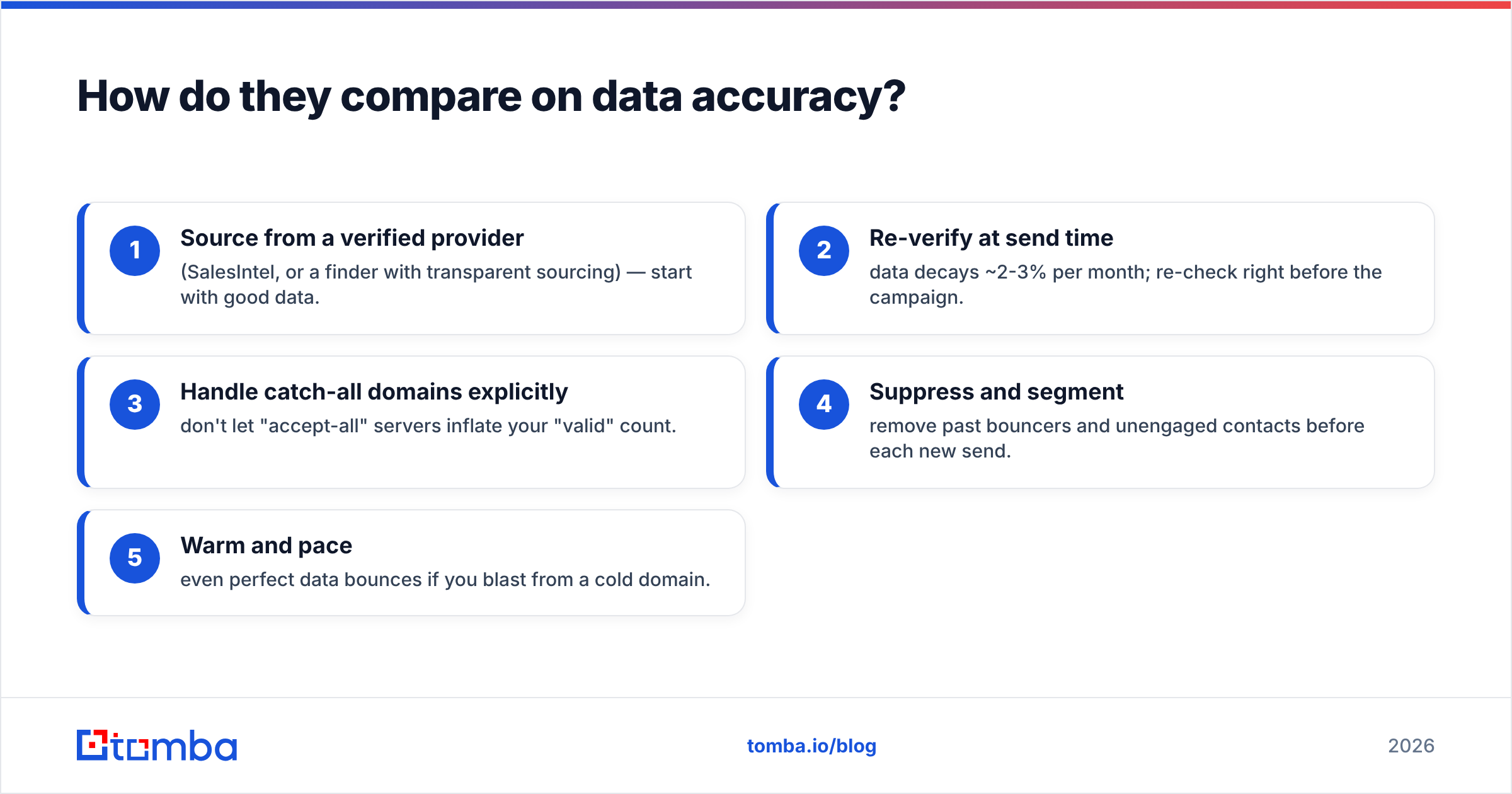
The accuracy hierarchy most teams land on, cheapest mistake to most expensive:
- Source from a verified provider (SalesIntel, or a finder with transparent sourcing) — start with good data.
- Re-verify at send time — data decays ~2-3% per month; re-check right before the campaign.
- Handle catch-all domains explicitly — don't let "accept-all" servers inflate your "valid" count.
- Suppress and segment — remove past bouncers and unengaged contacts before each new send.
- Warm and pace — even perfect data bounces if you blast from a cold domain.
Steps 1-3 are data problems (SalesIntel's turf plus a verifier); steps 4-5 are sending problems (Clickback's turf). Neither tool covers the whole chain alone.
What about deliverability and compliance?#
This is the part buyers underestimate. Clickback's implied-consent model is legal in some jurisdictions and risky in others — Canada's CASL and the EU's GDPR are far stricter than the US CAN-SPAM regime, and "legitimate interest" is a defensible basis, not a blanket permission slip. Clickback gives you the tooling to send to cold lists; it does not make every cold send compliant in every country. That's your legal call, not the vendor's.
On raw deliverability, the engine matters less than the inputs. Sender reputation, SPF/DKIM/DMARC alignment, send pacing, and list quality drive inbox placement far more than which platform pushes the bytes. SalesIntel improves the list quality input; Clickback manages reputation and pacing. If you bring a clean, verified, well-segmented list, most reputable sending tools will land it. If you bring a rotting list, no platform saves you.
A note on scope: deliverability is its own discipline. Warmup, inbox rotation, and reputation monitoring sit outside both products' core jobs and usually mean a third tool. Don't expect either Clickback or SalesIntel to be your full deliverability stack.
How much do Clickback and SalesIntel cost?#
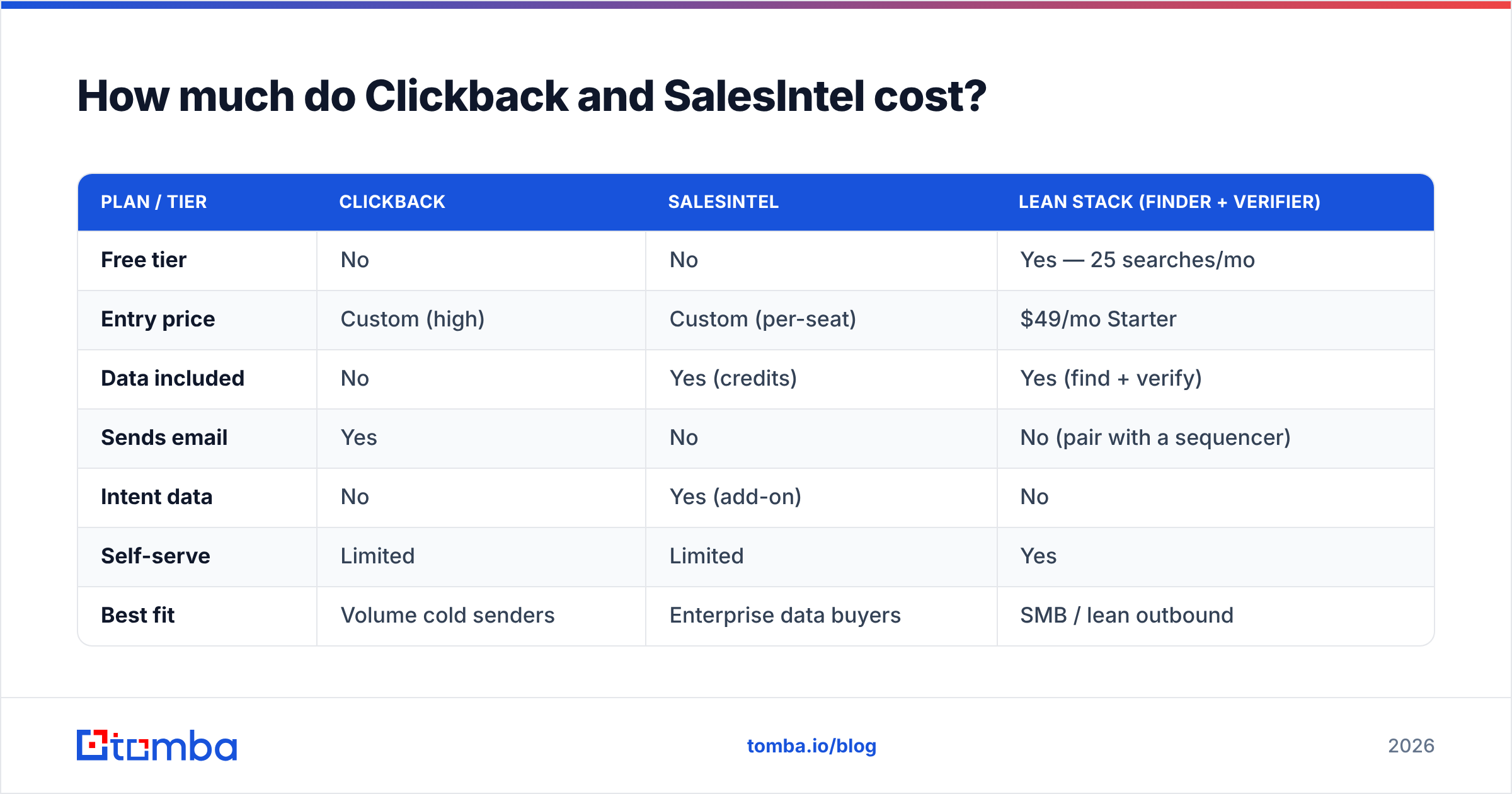
Both quote custom pricing and steer you toward a demo, which is the tell for premium positioning. Clickback prices around send volume and contacts under management; SalesIntel prices per seat plus data credits, with intent data as a pricier add-on. Neither publishes a transparent self-serve tier, and neither offers a free plan — you commit before you've tested data quality on your own ICP.
That opacity is the opening for a leaner stack. Here's the realistic shape of the spend:
| Plan / tier | Clickback | SalesIntel | Lean stack (finder + verifier) |
|---|---|---|---|
| Free tier | No | No | Yes — 25 searches/mo |
| Entry price | Custom (high) | Custom (per-seat) | $49/mo Starter |
| Data included | No | Yes (credits) | Yes (find + verify) |
| Sends email | Yes | No | No (pair with a sequencer) |
| Intent data | No | Yes (add-on) | No |
| Self-serve | Limited | Limited | Yes |
| Best fit | Volume cold senders | Enterprise data buyers | SMB / lean outbound |
For most SMB and mid-market teams, the math favors building rather than buying the all-in-one. A precise email finder plus verification covers the data half at a published price — see Tomba pricing: Free (25 searches/mo), Starter $49/mo, Growth $99/mo, Pro $249/mo — and you route sending through a tool you already trust. You only need SalesIntel-grade intent data or Clickback-grade managed sending once volume and budget justify them.
When should you pick each one?#
Pick Clickback if: you already have large purchased or third-party B2B lists, you operate in jurisdictions where implied-consent sending is defensible, and you need a platform purpose-built to send cold without getting your main domain suspended. You're buying a sending engine — bring your own data.
Pick SalesIntel if: your bottleneck is data quality and account prioritization, you sell into the enterprise where direct dials and intent signals shorten cycles, and you have the budget for human-verified records. You're buying data — bring your own sending.
Pick a lean build-it stack if: you're SMB or mid-market, you want to find and verify contacts on demand without a six-figure commitment, and your sending volume doesn't yet need managed cold-email infrastructure. Start with an accurate finder, layer data enrichment when you need firmographics, and add the heavy platforms only when scale forces the issue.
The most common real-world setup isn't "Clickback or SalesIntel" at all — it's a finder for contacts, a verifier for hygiene, and one sequencer for sends. You graft on a premium data or sending platform only at the seam where the lean stack actually breaks.
Which tools do they actually compete with?#
Naming the real competitive sets clarifies the choice. SalesIntel competes with data platforms — ZoomInfo, Apollo, Lusha, Cognism, and Clearbit — where you can compare coverage and accuracy directly; independent reviews on G2 are useful for seeing which provider wins on your segment. Clickback competes with cold-email and lead-gen senders, where the differentiator is the implied-consent model rather than the opt-in model most ESPs enforce. You can confirm each vendor's own positioning on the Clickback and SalesIntel sites before a demo.
Cross-shopping tip: if you're evaluating SalesIntel mainly for contact discovery, benchmark its hit rate against a pure finder on a sample of your target accounts first. Often the gap that justifies the premium is intent data, not raw email coverage — and if you don't act on intent today, you're paying for a feature you won't use.
The bottom line#
Clickback and SalesIntel aren't really rivals — they're two halves of an outbound machine. SalesIntel fills the top of the funnel with verified data; Clickback pushes that data out as cold email at volume. Buy the one that matches your actual gap, and don't pay for the half you already have.
Before you commit to either premium platform, test whether a leaner data layer closes your gap. Tomba's Email Finder finds and structures professional emails by domain, name, or company, with verification built in — start free with 25 searches a month, scale to Starter at $49/mo, and feed clean, deliverable contacts into whatever sending tool you already run. Prove the data quality on your own ICP first; upgrade to Clickback's sending engine or SalesIntel's intent data only when scale genuinely demands it.
Ready to find emails that actually work?
Join 150,000+ professionals who stopped guessing and started sending. Free credits on signup — no credit card required.
Get the Tomba newsletter
Practical outbound tactics and product updates — once every two weeks.
About the author