Clickbait Email Subject Lines: Do They Work in 2026?
Clickbait email subject lines spike opens then tank replies and deliverability. Here's what actually works in 2026 — and the honest hooks that beat the bait.
Clickbait Email Subject Lines: Do They Work in 2026?
Clickbait email subject lines are the sugar rush of cold outreach: a fast spike, then a crash. They can lift opens for a single send, but they quietly burn the things that actually drive pipeline — replies, sender reputation, and trust. This guide breaks down where the line sits between a sharp hook and a deceptive one, what the data says, and the honest formulas that outperform bait over a full quarter.
TL;DR
- Clickbait subject lines (fake "Re:", false urgency, misleading promises) can raise open rates short-term but reliably lower reply rates and increase spam complaints.
- In 2026, inbox providers weigh engagement and complaints heavily — a high open / low reply pattern is a deliverability red flag, not a win.
- "Curiosity" and "clickbait" are not the same thing. Curiosity withholds; clickbait deceives. One earns the next email, the other poisons it.
- The highest-performing cold subject lines in 2026 are short (3–6 words), specific, and lowercase-casual — not hyped.
- Clean targeting beats clever baiting: verified, well-segmented lists move open and reply rates more than any subject-line trick.
What counts as a clickbait email subject line?#
A clickbait email subject line is one that manufactures a gap between what the reader expects and what the email delivers. The open is bought with a promise the body can't honor.
Think of it like a movie trailer that shows the only three good scenes. You buy the ticket, then sit through two hours of disappointment — and you remember the studio that tricked you. Email works the same way, except the "studio" is your sending domain, and the audience can report you to the inbox police with one click.
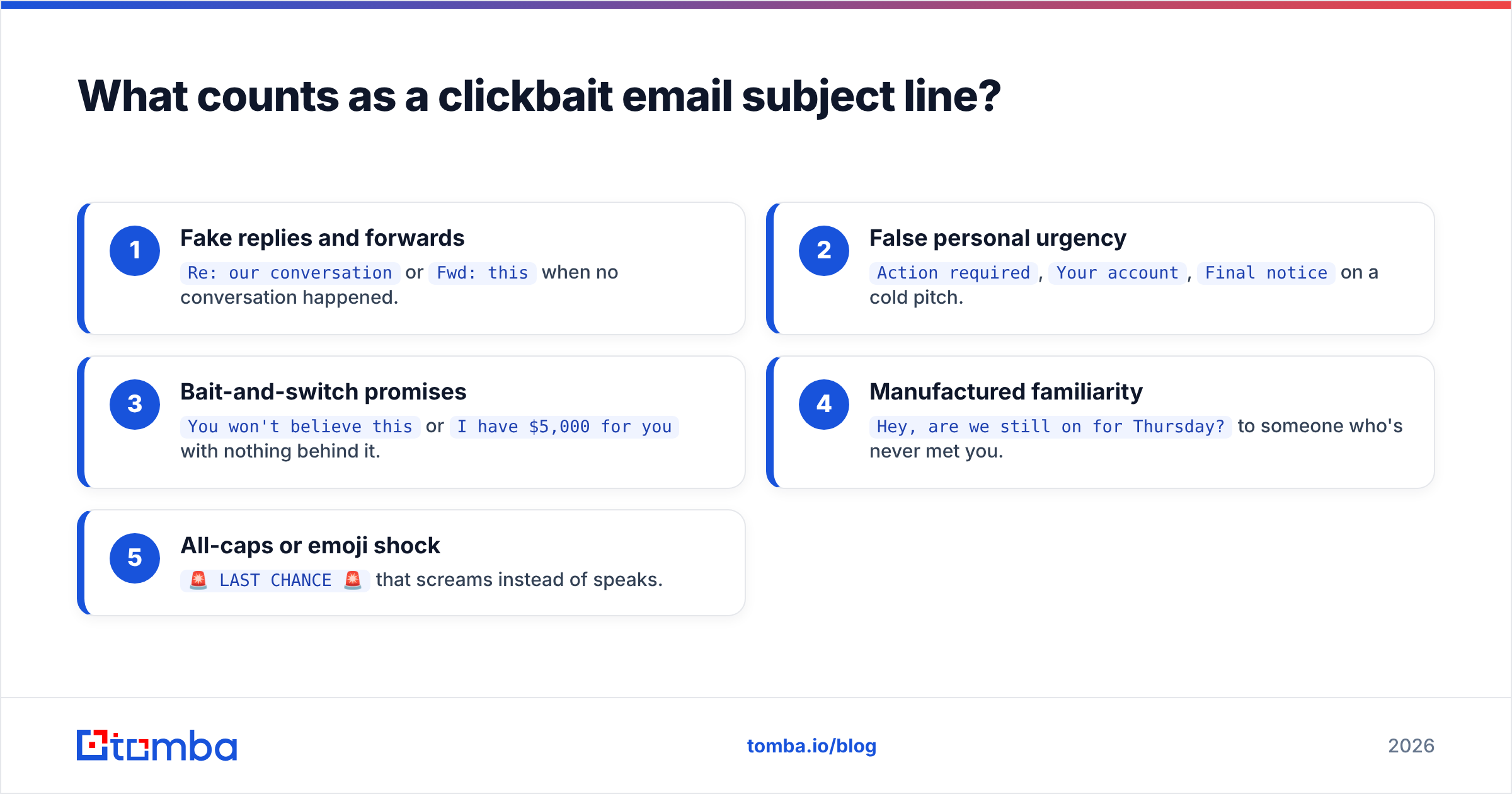
Common clickbait patterns:
- Fake replies and forwards —
Re: our conversationorFwd: thiswhen no conversation happened. - False personal urgency —
Action required,Your account,Final noticeon a cold pitch. - Bait-and-switch promises —
You won't believe thisorI have $5,000 for youwith nothing behind it. - Manufactured familiarity —
Hey, are we still on for Thursday?to someone who's never met you. - All-caps or emoji shock —
🚨 LAST CHANCE 🚨that screams instead of speaks.
The tell is simple: if the subject line would feel like a betrayal the moment someone opens the email, it's clickbait. If it accurately previews real value, it's just a good hook.

Do clickbait subject lines actually increase open rates?#
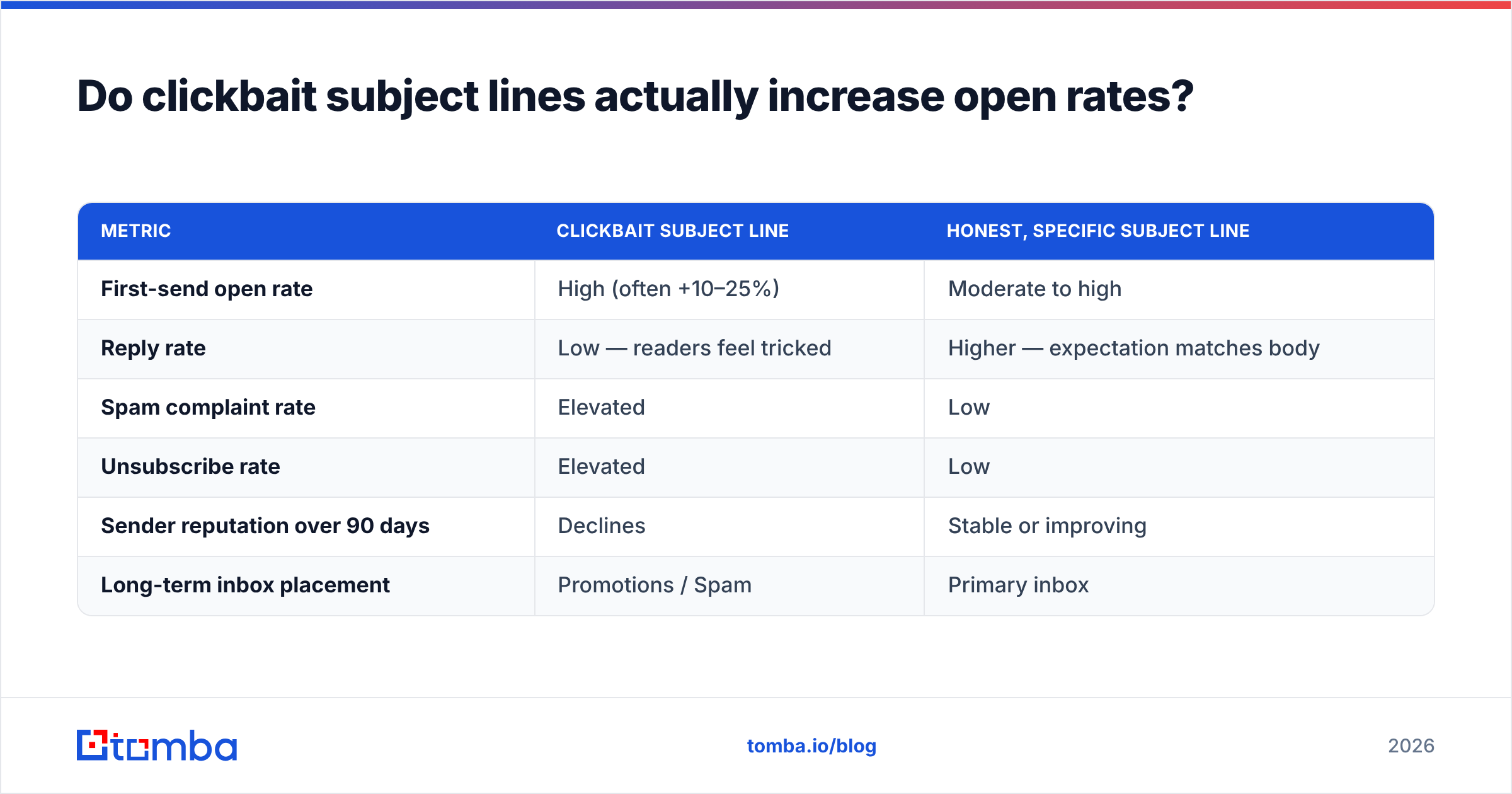
Yes — for exactly one send, and at a cost that compounds. Clickbait can lift opens by exploiting reflexes (the brain reacts to Re: before it reads it), but the lift is borrowed against future deliverability.
Here's the mechanism. Open rate is a vanity metric in isolation. What inbox providers like Gmail and Outlook actually track is the full engagement signature: opens, replies, archives, deletes-without-reading, and spam complaints. A subject line that wins the open but loses the reader produces the worst possible signature — high open, zero reply, rising complaints. That pattern tells the provider your mail is unwanted, and your next campaign lands in Promotions or Spam.
This is why a clean list and good email deliverability matter more than any single subject line. You can't trick your way past an algorithm that's measuring whether humans want your mail.
| Metric | Clickbait subject line | Honest, specific subject line |
|---|---|---|
| First-send open rate | High (often +10–25%) | Moderate to high |
| Reply rate | Low — readers feel tricked | Higher — expectation matches body |
| Spam complaint rate | Elevated | Low |
| Unsubscribe rate | Elevated | Low |
| Sender reputation over 90 days | Declines | Stable or improving |
| Long-term inbox placement | Promotions / Spam | Primary inbox |
The honest version may lose the opening sprint. It wins the quarter — and the quarter is what funds your salary.
Is there a difference between curiosity and clickbait?#
There's a wide one, and it's the most important distinction in this entire topic. Curiosity withholds information the reader genuinely wants; clickbait fabricates information that isn't there.
A curiosity subject line is like a good book jacket — it tells you enough to want chapter one, and chapter one delivers. A clickbait subject line is a blank book with a thrilling cover. Same first impression, opposite aftertaste.
Curiosity (earns the open honestly):
quick question about your Q3 hiringidea for {{company}}'s onboarding flowthe metric most {{role}}s miss
Clickbait (deceives to steal the open):
Re: your refund(there is no refund)we need to talk(you've never spoken)you've been selected(they haven't)
The curiosity lines create a small, true information gap that the body closes. The clickbait lines create a gap the body can't close, so the reader's reward for opening is irritation. Over thousands of sends, irritation is a deliverability liability.
What does clickbait cost you in 2026?#
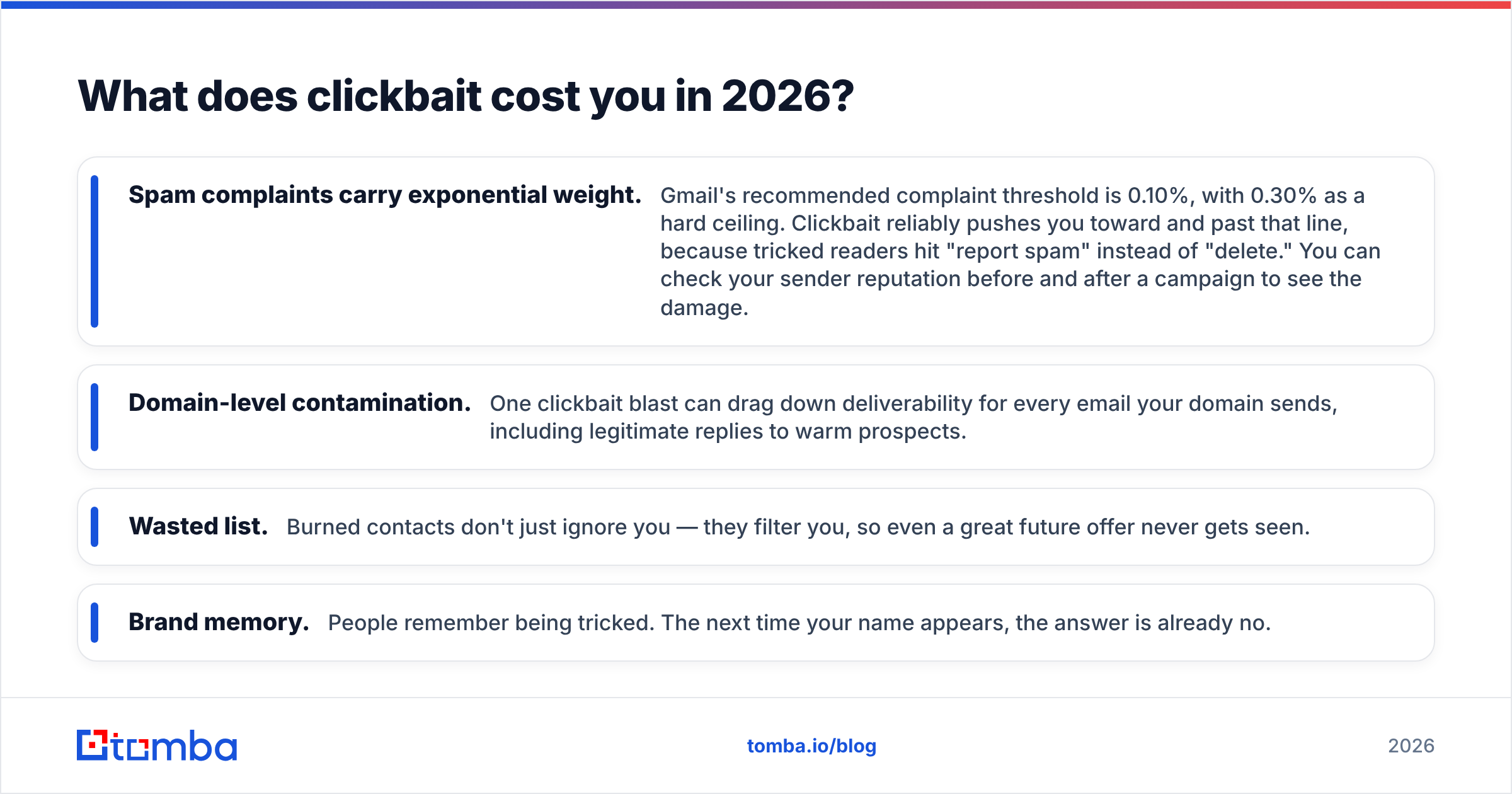
It costs you the asset that makes email work at all: your sender reputation. In 2026, that reputation is scored across domain, IP, and even individual mailbox engagement, and it's unforgiving of the open-high / reply-low pattern that clickbait produces.
The hidden costs stack up:
- Spam complaints carry exponential weight. Gmail's recommended complaint threshold is 0.10%, with 0.30% as a hard ceiling. Clickbait reliably pushes you toward and past that line, because tricked readers hit "report spam" instead of "delete." You can check your sender reputation before and after a campaign to see the damage.
- Domain-level contamination. One clickbait blast can drag down deliverability for every email your domain sends, including legitimate replies to warm prospects.
- Wasted list. Burned contacts don't just ignore you — they filter you, so even a great future offer never gets seen.
- Brand memory. People remember being tricked. The next time your name appears, the answer is already no.
Google and Yahoo's 2024 bulk-sender requirements made one-click unsubscribe and complaint-rate ceilings mandatory, and enforcement has only tightened since. You can read the current rules straight from Google's Postmaster guidelines. Clickbait is a strategy built for an inbox that stopped existing years ago.

What subject-line styles actually win in 2026?#
Short, specific, and human. The best-performing cold subject lines in 2026 read like something a busy colleague would type with their thumbs — not a billboard.
The patterns that consistently beat clickbait:
- The lowercase question —
quick question about {{company}}— feels personal, not promotional. - The specific observation —
noticed {{company}} is hiring 3 SDRs— proves you did homework. - The 3-word teaser —
idea for {{first_name}}— low friction, genuine curiosity. - The relevant outcome —
cut {{role}} onboarding time 40%— promises a real, deliverable result. - The mutual connection —
{{mutual_name}} suggested I reach out— only if true.
Notice what's missing: no caps, no emojis, no fake urgency, no Re:. These lines win because they set an expectation the email body actually meets, which produces the reply-positive engagement signature inbox providers reward.
If you want a head start, Tomba's free subject line generator and subject line tester score your hooks for spam triggers and clarity before you send — so you catch a clickbait reflex before it costs you the domain.
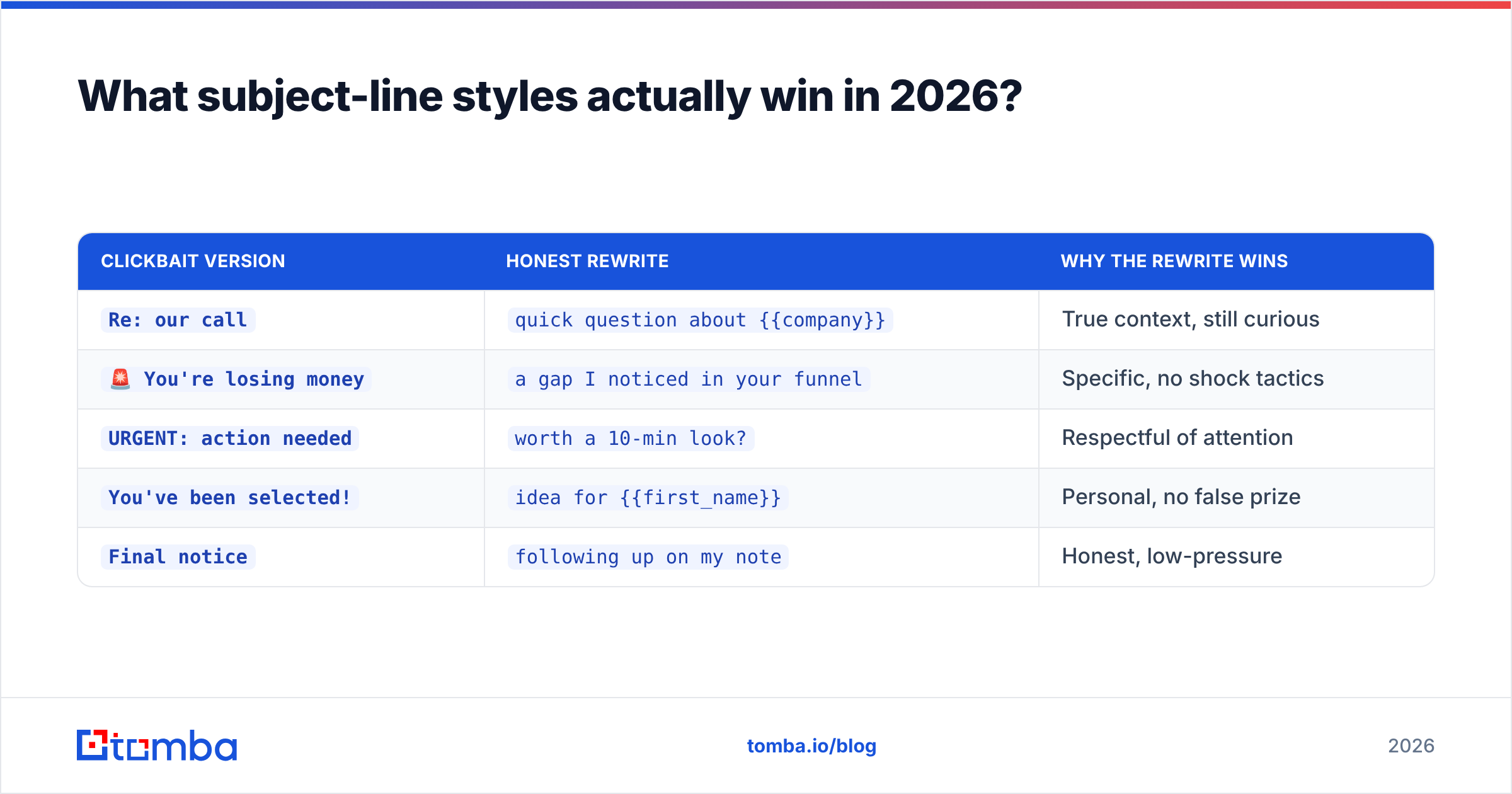
A quick before/after#
| Clickbait version | Honest rewrite | Why the rewrite wins |
|---|---|---|
Re: our call |
quick question about {{company}} |
True context, still curious |
🚨 You're losing money |
a gap I noticed in your funnel |
Specific, no shock tactics |
URGENT: action needed |
worth a 10-min look? |
Respectful of attention |
You've been selected! |
idea for {{first_name}} |
Personal, no false prize |
Final notice |
following up on my note |
Honest, low-pressure |
How do you write hooks that open without baiting?#
Start from the body and work backward. Write the email's real value first, then compress its single most relevant promise into the subject line. If you can't summarize the body honestly in six words, the problem is the offer, not the subject line.
A practical framework:
- Lead with relevance, not hype. Reference something true and specific about them — a hire, a launch, a stat. Generic flattery reads as bulk; specifics read as research.
- Match casing to context. Lowercase reads as a one-to-one note; Title Case reads as a campaign. For cold outreach, casual usually wins.
- Keep it under 7 words. Most opens happen on mobile, where long subject lines truncate mid-thought.
- Pass it through a spam check. Run the line through a spam checker to catch trigger words before the filter does.
- Test honestly. A/B test two truthful hooks against each other, not truth against clickbait. The goal is the best honest line, not the best trick.
For ready-made starting points, Tomba's library of cold email templates pairs proven subject lines with bodies that deliver on them — so the promise and the payoff stay in sync.
Doesn't great targeting matter more than the subject line?#
It matters more than every subject-line trick combined. The single biggest lever on open and reply rates isn't word choice — it's whether the right person, at the right company, with a real reason to care, received the email at a valid address.
A perfectly honest subject line sent to a stale, unverified list still underperforms, because half the sends bounce and tank your reputation before anyone reads a word. A modest subject line sent to a tightly segmented, verified list outperforms it every time. Clickbait is what people reach for when their targeting is weak — it's a symptom, not a strategy.
This is where your prospecting stack earns its keep:
- Find the right contacts with a domain search to pull the actual decision-makers at a target account, instead of spraying a generic inbox.
- Verify before you send so your hard-won honest subject line doesn't bounce off a dead address and drag your domain down.
- Enrich for relevance with data enrichment so your "specific observation" subject lines are backed by real, current data — the homework that makes honest hooks land.
When targeting is tight, you don't need to bait anyone. The relevance does the opening for you.
What about subject lines for newsletters and warm lists?#
The same rule holds, with a small adjustment: warm audiences forgive playfulness but punish deception faster, because they expected better from you. A subscriber who opted in has a higher trust baseline — and a steeper fall when you abuse it.
For warm and newsletter sends:
- Clever is fine; deceptive is not. A pun or a wink works when the body rewards it.
- Consistency builds open rates. Subscribers who recognize your sender name and trust your subject lines open on autopilot. Clickbait resets that trust to zero.
- Watch the unsubscribe-after-open rate. If people open and immediately leave, your subject promised something the issue didn't deliver.
- Segment by engagement. Send your best material to your most engaged readers; let cold subscribers sunset rather than baiting them back.
Trust is the only renewable resource in email. Clickbait spends it; honesty compounds it.
The verdict: do clickbait email subject lines work?#
For one send, sometimes. For a business, no. Clickbait email subject lines optimize the one metric that doesn't pay you — the open — while degrading the ones that do: replies, reputation, and trust. In 2026's engagement-weighted inboxes, that trade is worse than ever.
The winning move isn't a cleverer trick. It's a sharper hook pointed at a better-targeted list, with a body that delivers exactly what the subject line promised. Honest, specific, and short beats hyped, vague, and deceptive across every metric that touches revenue.
Before you obsess over the perfect six words, make sure those words are reaching real, verified decision-makers who have a reason to reply. Start with the Tomba Email Finder to build a clean, accurate list of the right contacts — then your honest subject lines have someone worth opening them. You can compare Tomba plans from the free tier (25 searches/month) up to Starter at $49/month when you're ready to scale. Great targeting plus honest copy is the only "trick" that keeps working.
// get started
Find, verify and enrich your first contacts today
Start on the free plan with 25 searches a month, then scale when your team is ready.
Free plan · No credit card required · GDPR & CCPA
// about the author