Top 7 ClickPoint Software Alternatives for Sales Teams (2026)
ClickPoint is solid lead distribution software, but it is not the only option. Here are 7 ClickPoint software alternatives compared on price, routing, and data quality for 2026.
Top 7 ClickPoint Software Alternatives for Sales Teams in 2026
ClickPoint (formerly known for SalesExec and LeadManager) does one job well: it captures inbound leads, scores them, and routes them to the right rep fast. But "fast routing" is only half the battle. If the contact data behind those leads is stale, or the pricing model doesn't fit your team, you end up paying for speed you can't use. That's why most teams evaluating ClickPoint end up shortlisting alternatives at the same time.
This guide compares seven of the strongest ClickPoint software alternatives for 2026 — across lead distribution, sales engagement, CRM-native routing, and the data layer that feeds all of them.
TL;DR#
- ClickPoint's strength is rules-based lead distribution and speed-to-lead; its weakness is that it assumes your contact data is already clean and complete.
- Best all-in-one CRM alternative: HubSpot or Salesforce if you want routing inside the system of record.
- Best sales-engagement alternative: Salesloft or Outreach for sequence-heavy outbound teams.
- Best lead-routing specialist: LeanData or Chili Piper for complex assignment logic.
- The piece everyone forgets: lead routing is worthless without accurate emails and phone numbers — that's where a data layer like Tomba Email Finder earns its place next to whichever tool you pick.
What does ClickPoint software actually do?#
ClickPoint is a lead management and sales acceleration platform. It pulls leads from web forms, paid ads, and integrations, then applies routing rules — round-robin, shark-tank, geography, product line — to push each lead to a rep within seconds. It layers in a power dialer, local presence, and click-to-call so reps can work leads while intent is hot.
In plain terms: ClickPoint is the traffic controller at a busy airport. It doesn't fly the planes (your reps do) and it doesn't fuel them (your data does) — it just decides which runway each one uses and how quickly. That's genuinely useful, especially for high-volume inbound teams in insurance, mortgage, home services, and education.
The gap shows up at the edges. ClickPoint assumes a lead arrives with a working phone number and a reachable email. When that assumption breaks — and on inbound web traffic it breaks often — fast routing just delivers a dead contact faster. So the right comparison isn't only "which tool routes best," but "which stack routes and keeps the underlying data alive."

Why look for a ClickPoint alternative at all?#
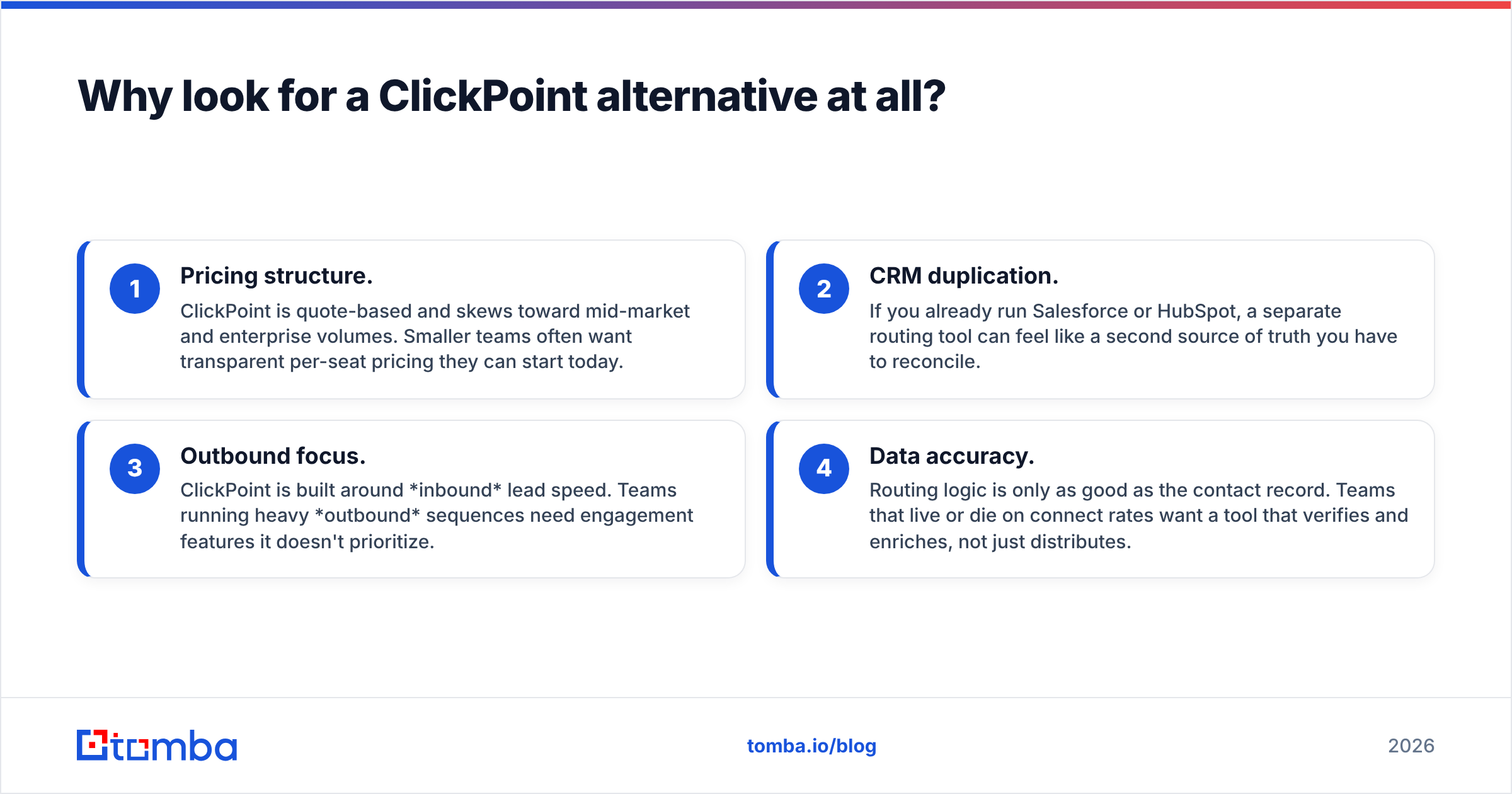
Four reasons come up repeatedly when teams shop around:
- Pricing structure. ClickPoint is quote-based and skews toward mid-market and enterprise volumes. Smaller teams often want transparent per-seat pricing they can start today.
- CRM duplication. If you already run Salesforce or HubSpot, a separate routing tool can feel like a second source of truth you have to reconcile.
- Outbound focus. ClickPoint is built around inbound lead speed. Teams running heavy outbound sequences need engagement features it doesn't prioritize.
- Data accuracy. Routing logic is only as good as the contact record. Teams that live or die on connect rates want a tool that verifies and enriches, not just distributes.
If one or more of those match your situation, the alternatives below are worth a serious look.
What are the best ClickPoint software alternatives in 2026?#
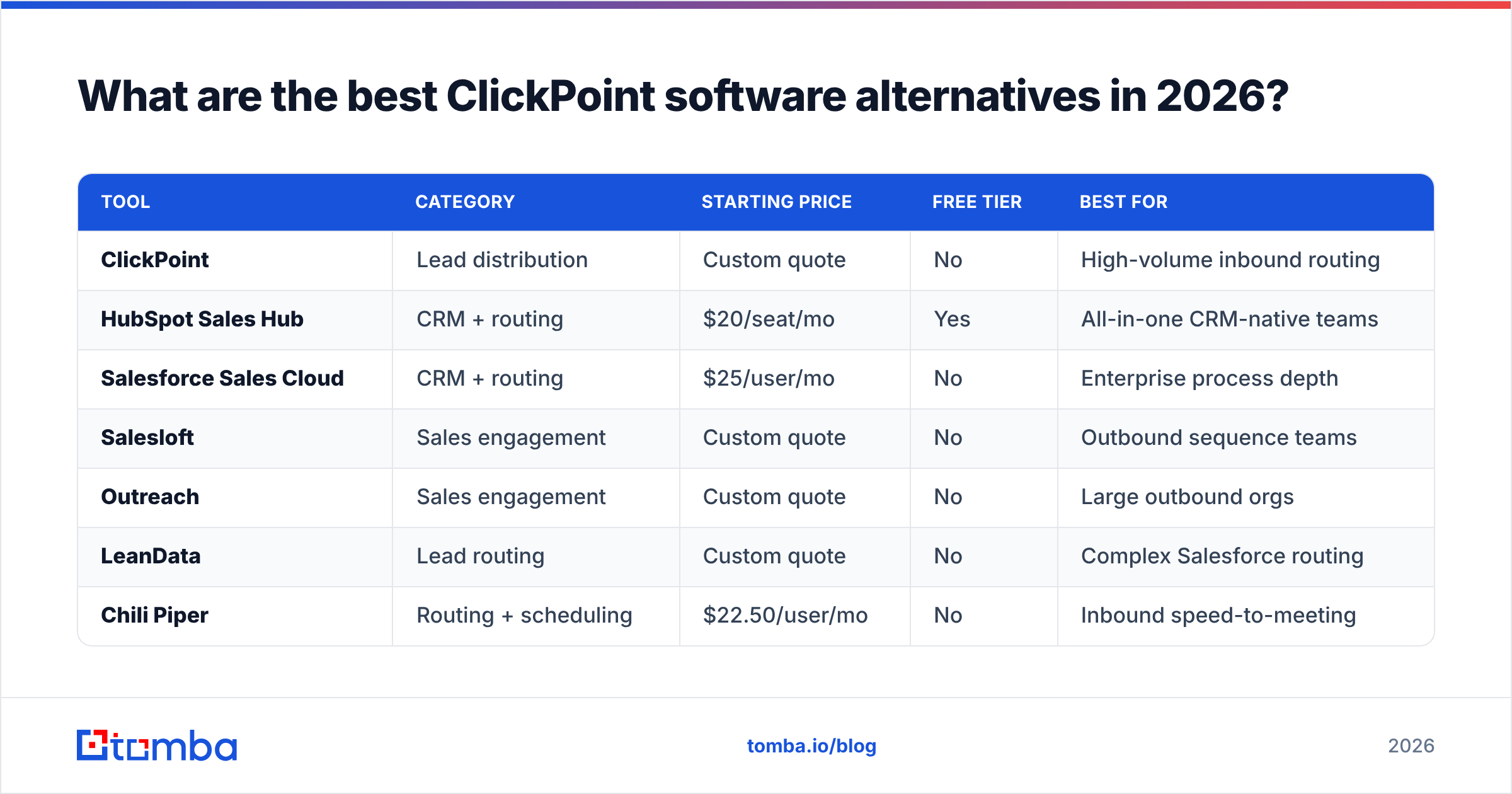
Here's the side-by-side. "Best for" is the deciding column — most of these tools win in one lane and lose in another.
| Tool | Category | Starting price | Free tier | Best for |
|---|---|---|---|---|
| ClickPoint | Lead distribution | Custom quote | No | High-volume inbound routing |
| HubSpot Sales Hub | CRM + routing | $20/seat/mo | Yes | All-in-one CRM-native teams |
| Salesforce Sales Cloud | CRM + routing | $25/user/mo | No | Enterprise process depth |
| Salesloft | Sales engagement | Custom quote | No | Outbound sequence teams |
| Outreach | Sales engagement | Custom quote | No | Large outbound orgs |
| LeanData | Lead routing | Custom quote | No | Complex Salesforce routing |
| Chili Piper | Routing + scheduling | $22.50/user/mo | No | Inbound speed-to-meeting |
| Tomba | Data + enrichment layer | $49/mo | Yes (25 searches) | Feeding accurate data to any of the above |
A note on that last row: Tomba isn't a routing engine and won't replace ClickPoint's distribution logic. It sits underneath whichever tool you choose, supplying verified emails, phone numbers, and enrichment so the routing actually reaches a human. More on that below.
1. HubSpot Sales Hub — best all-in-one alternative#
If your objection to ClickPoint is "I don't want a second system," HubSpot is the obvious answer. Routing, scoring, sequences, and reporting all live in the CRM. Workflow-based assignment covers round-robin and rule-based distribution, and the free tier lets you start before you commit. The trade-off: HubSpot's routing is less specialized than ClickPoint's for very high inbound volumes. See the HubSpot Sales Hub overview for current feature tiers.
2. Salesforce Sales Cloud — best for enterprise depth#
Salesforce wins on configurability. Between native assignment rules, Flow, and the AppExchange, you can model almost any routing scenario. That power is also the catch — it needs admin time ClickPoint doesn't. If you're already on Salesforce, pairing it with a Salesforce integration for enrichment closes the data gap before routing even runs.
3. Salesloft — best for outbound sequences#
ClickPoint is inbound-first. Salesloft flips that: it's a sales-engagement platform built for cadences, multi-touch sequences, and rep productivity on outbound. If your motion is "build a list, work it across email and calls," Salesloft (or its peer below) is a better fit than a pure distribution tool.
4. Outreach — best for large outbound orgs#
Outreach plays in the same lane as Salesloft, tuned for bigger teams that want deal-stage automation, forecasting, and AI-assisted sequencing layered on top of engagement. It's heavier and pricier, but for 50+ rep outbound orgs the depth pays off.
5. LeanData — best routing specialist#
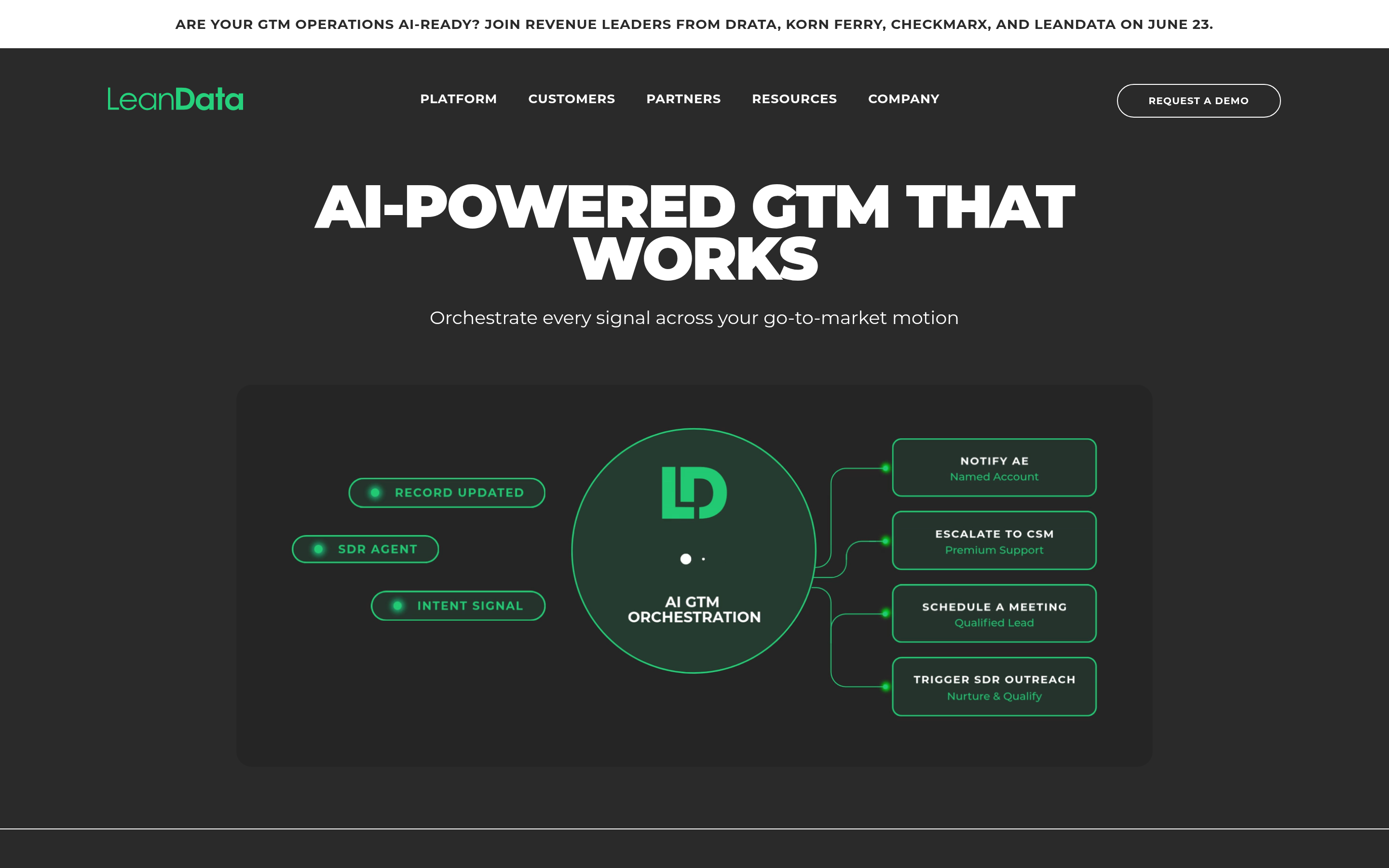
If you love ClickPoint's routing but want it inside Salesforce, LeanData is the specialist. Its visual flow builder handles matching, account-based routing, and complex assignment trees that go beyond round-robin. It does one thing — routing — and does it deeply.
6. Chili Piper — best for speed-to-meeting#
Chili Piper compresses the gap between "lead submits a form" and "meeting on the calendar." Instant qualification, routing, and booking happen on the form itself. For inbound demo-request flows, it often beats ClickPoint on conversion because it removes the back-and-forth scheduling step entirely.
7. Tomba — the data layer every option needs#
Here's the part the other six comparisons skip. Whatever you route with, the contact record has to be real. Tomba is the email finder and enrichment layer that verifies addresses, finds direct phone numbers, and fills missing firmographics before a lead hits your routing rules. Bad data is the silent tax on every CRM and dialer — fixing it upstream lifts connect rates across whatever stack you run.
How do the routing-focused tools compare on logic?#
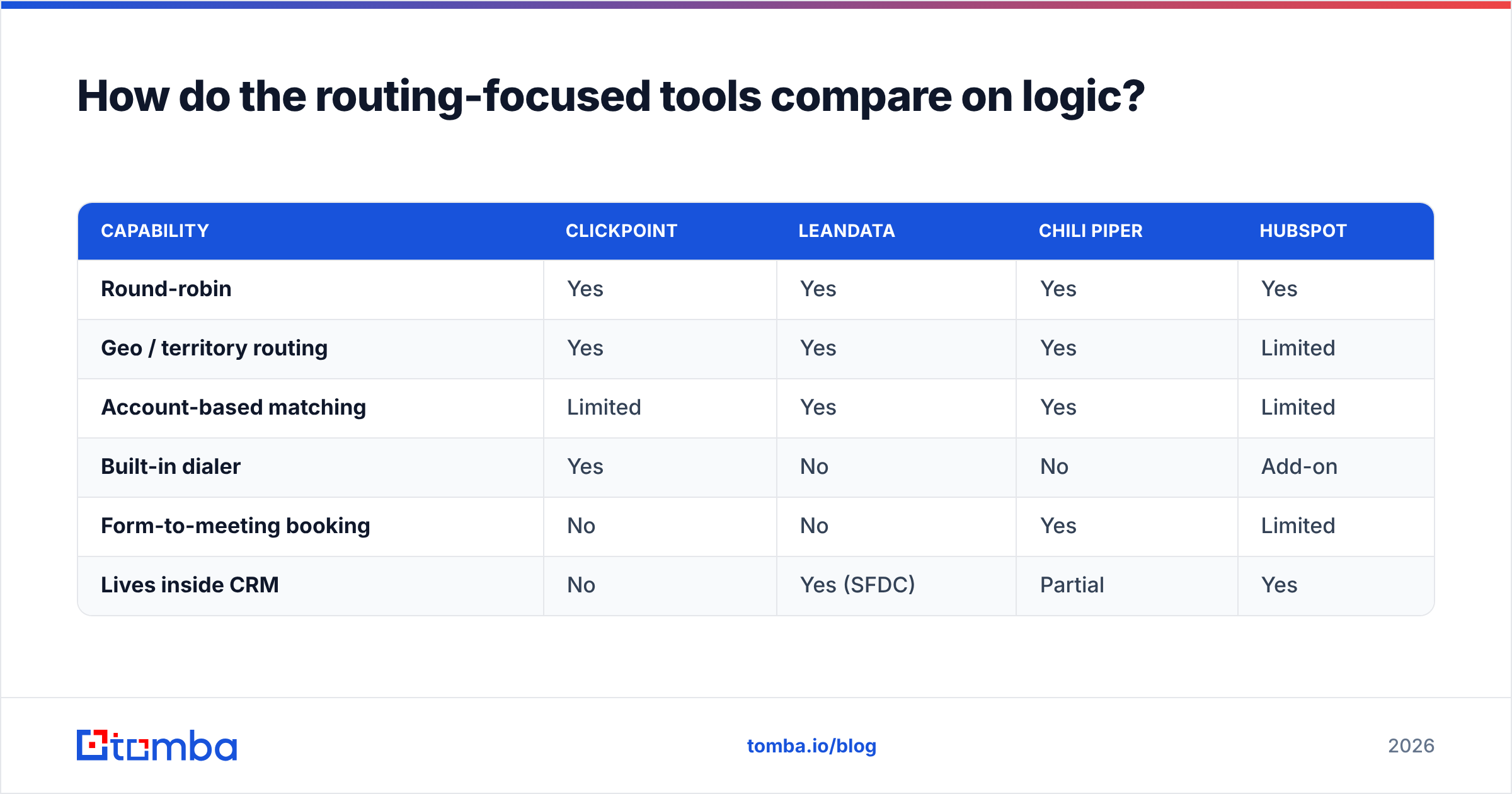
If routing is the reason you're shopping, narrow to these three plus ClickPoint:
| Capability | ClickPoint | LeanData | Chili Piper | HubSpot |
|---|---|---|---|---|
| Round-robin | Yes | Yes | Yes | Yes |
| Geo / territory routing | Yes | Yes | Yes | Limited |
| Account-based matching | Limited | Yes | Yes | Limited |
| Built-in dialer | Yes | No | No | Add-on |
| Form-to-meeting booking | No | No | Yes | Limited |
| Lives inside CRM | No | Yes (SFDC) | Partial | Yes |
The pattern: ClickPoint owns the dialer + distribution combo, LeanData owns complex CRM routing, Chili Piper owns inbound booking, and HubSpot owns all-in-one simplicity. Pick the lane that matches your bottleneck.

Isn't the real problem data quality, not routing?#
Usually, yes. Most teams blame their routing tool for low connect rates when the actual culprit is the record being routed. According to vendor benchmarks and reviews aggregated on G2, B2B contact data decays roughly 2–3% per month as people change jobs — so a list that was 90% accurate in January is meaningfully worse by summer.
This is the structural weakness in any pure distribution tool, ClickPoint included: it routes whatever it's given. If the email bounces or the phone number is disconnected, the fastest routing engine on earth just wasted a rep's first dial.
A data layer fixes the input side:
- Verify before routing. Run inbound emails through an email verifier so dead addresses never reach a sequence.
- Find the missing piece. When a form gives you a name and company but no direct line, domain search and a phone finder fill the gap.
- Enrich for scoring. Append title, company size, and industry so your routing rules actually have fields to route on.
Do that, and every tool downstream — ClickPoint or any alternative — performs better without changing a single routing rule.
How much do ClickPoint alternatives cost?#
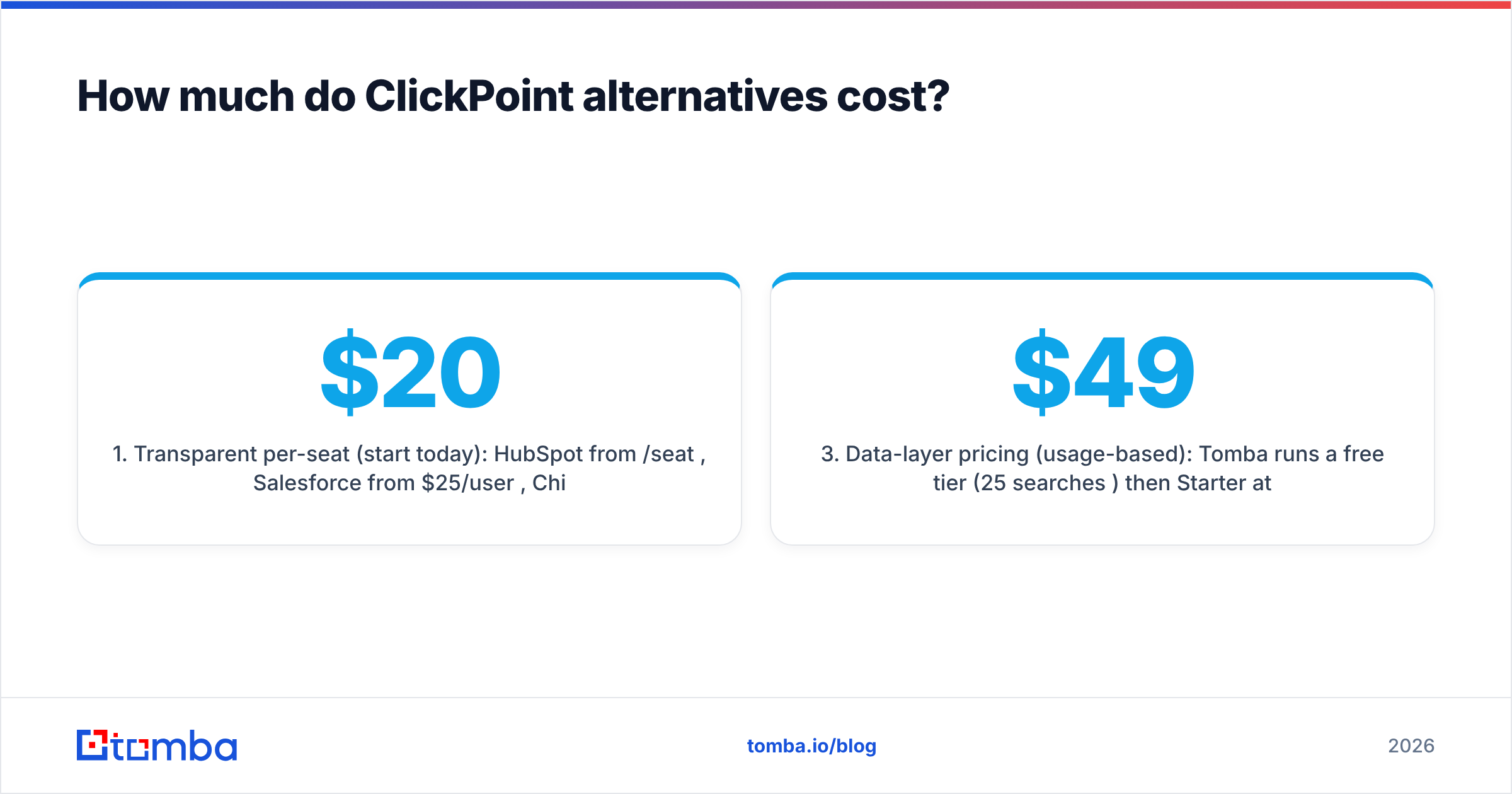
Pricing splits into three buckets:
- Transparent per-seat (start today): HubSpot from $20/seat/mo, Salesforce from $25/user/mo, Chili Piper from $22.50/user/mo. Good for teams that want to swipe a card and go.
- Quote-based (sales call required): ClickPoint, Salesloft, Outreach, and LeanData all gate pricing behind a demo. Expect mid-market-and-up minimums.
- Data-layer pricing (usage-based): Tomba runs a free tier (25 searches/mo) then Starter at $49/mo, Growth at $99/mo, and Pro at $249/mo. Because it's not per-seat, the whole team shares the credit pool. Full Tomba pricing is public — no demo wall.
The honest takeaway: if budget predictability matters, the transparent-pricing tools (and a public-priced data layer) save you a procurement cycle. If you need deep enterprise routing, the quote-based specialists earn their cost.
Which ClickPoint alternative should you choose?#
Match the tool to your actual bottleneck:
- "I want routing inside my CRM." → HubSpot (simple) or Salesforce (deep).
- "My motion is outbound sequences." → Salesloft (mid-market) or Outreach (enterprise).
- "My routing logic is genuinely complex." → LeanData on Salesforce.
- "I lose deals at the scheduling step." → Chili Piper.
- "My connect rates are bad no matter what I route with." → Fix the data first with Tomba, then keep the routing tool you already have.
For a lot of teams the answer is "and," not "or." Keep ClickPoint or adopt one of these alternatives for distribution — and add a data layer so the leads being distributed are real. You can compare the broader landscape of tools on Capterra's lead management category or against ClickPoint's own product pages before committing.
The bottom line#
ClickPoint is a capable lead-distribution and dialing platform, and several alternatives — HubSpot, Salesforce, Salesloft, Outreach, LeanData, Chili Piper — beat it in specific lanes depending on whether your priority is CRM-native simplicity, outbound depth, routing complexity, or speed-to-meeting. Choose by bottleneck, not by feature-count.
But before you migrate anything, audit the data underneath. Routing speed amplifies whatever quality you feed it — fast routing of bad records just loses deals faster.
Start with the data layer. Tomba's Email Finder verifies addresses, finds direct phone numbers, and enriches incoming leads before they ever hit your routing rules — and you can test it free with 25 searches a month, no demo required. Plug it into whichever ClickPoint alternative you pick, and watch your connect rates climb without touching a single routing rule.
// get started
Find, verify and enrich your first contacts today
Start on the free plan with 25 searches a month, then scale when your team is ready.
Free plan · No credit card required · GDPR & CCPA
// about the author