Client Funnel: How to Build a B2B Sales Funnel in 2026
A client funnel turns cold strangers into paying customers in predictable stages. Here's how to map, measure, and fix every stage in 2026.
TL;DR
- A client funnel is the staged path a stranger takes to become a paying client: awareness, interest, consideration, intent, and purchase — plus the retention loop that turns one deal into many.
- Most funnels don't fail at the bottom; they leak at the top because the contact data feeding them is wrong, stale, or unverified.
- You can't fix what you don't measure: track conversion rate, drop-off, and velocity at every stage, not just total leads and closed deals.
- Tooling matters at three points — sourcing accurate contacts, scoring and routing them, and following up before they go cold.
- Start small: instrument one funnel, find the single biggest leak, and fix that before adding more channels.
What is a client funnel?#
A client funnel is the map of how a stranger becomes a customer, broken into stages you can measure and improve one at a time. Think of it like a water filtration system: raw water (cold prospects) enters at the top, passes through progressively finer filters (qualification steps), and clean water (paying clients) comes out the bottom. If a filter clogs, you see exactly where the flow stops.
The classic shape is wide at the top and narrow at the bottom because you lose people at every step — and that's normal. The goal isn't to keep everyone; it's to lose the wrong people early and cheaply while moving the right people through faster.
A typical B2B client funnel has five stages:
- Awareness — the prospect learns you exist (content, ads, cold outreach, referrals).
- Interest — they engage: open an email, read a post, attend a webinar.
- Consideration — they actively compare you against alternatives.
- Intent — they request a demo, a quote, or a trial.
- Purchase — they sign and pay.
Most teams bolt a sixth stage on the end — retention and expansion — because in B2B the first contract is rarely where the money is. Renewals, upsells, and referrals usually dwarf the initial deal value.
Why do most client funnels leak at the top?#
Bad data at the top of the funnel quietly destroys everything downstream. You can write perfect copy, build a slick demo, and train a great closer — but if 30% of the email addresses you're sending to bounce or belong to people who left the company, your funnel was broken before the first touch.
Here's the chain reaction: a bounced email hurts your sender reputation, which lands your good emails in spam, which drops open rates, which starves every stage below it. One leak at the top becomes five leaks by the bottom. This is why email deliverability and accurate sourcing are funnel problems, not just inbox problems.
The fix is unglamorous: verify before you send. Run new contacts through an email verifier to drop invalid and risky addresses, and confirm tricky domains with a catch-all verifier before you commit them to a sequence. A list that's 95% deliverable doesn't just protect your reputation — it makes every conversion rate below it look better, because you're no longer dividing by ghosts.
What are the stages of a client funnel?#
Each stage has a job, a metric, and a typical failure mode. Treat them as separate machines, not one blurry pipe.
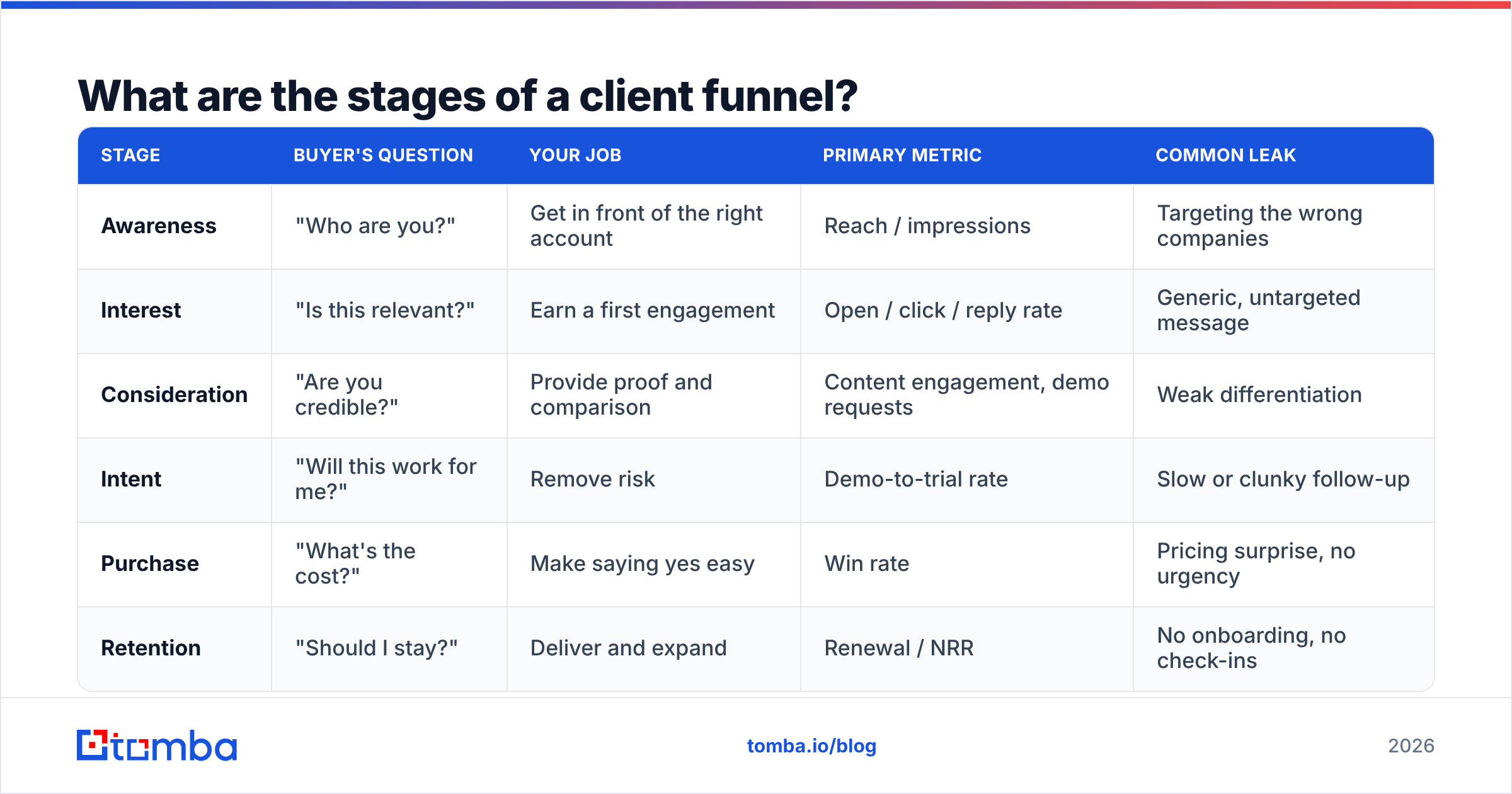
| Stage | Buyer's question | Your job | Primary metric | Common leak |
|---|---|---|---|---|
| Awareness | "Who are you?" | Get in front of the right account | Reach / impressions | Targeting the wrong companies |
| Interest | "Is this relevant?" | Earn a first engagement | Open / click / reply rate | Generic, untargeted message |
| Consideration | "Are you credible?" | Provide proof and comparison | Content engagement, demo requests | Weak differentiation |
| Intent | "Will this work for me?" | Remove risk | Demo-to-trial rate | Slow or clunky follow-up |
| Purchase | "What's the cost?" | Make saying yes easy | Win rate | Pricing surprise, no urgency |
| Retention | "Should I stay?" | Deliver and expand | Renewal / NRR | No onboarding, no check-ins |
Notice that the metric changes at every stage. A team that only watches "leads in" and "deals closed" is flying blind in the middle, where most deals actually die. If your demo-to-trial rate is 60% but your trial-to-purchase rate is 8%, no amount of top-of-funnel spend will save you — you have a closing problem, not a traffic problem.
How do you measure a client funnel?#
Measure three things at every stage: conversion rate, drop-off, and velocity. Together they tell you where you're losing people and how fast the survivors move.
- Conversion rate is the percentage who move from one stage to the next. Low conversion = a quality or messaging problem at that step.
- Drop-off is the absolute number you lose. A 50% conversion rate sounds bad until you realize the stage only had 6 people in it — fix the stage with 600.
- Velocity is how long people sit in a stage. Deals that stall in "consideration" for 90 days rarely close; they just haven't admitted it yet.
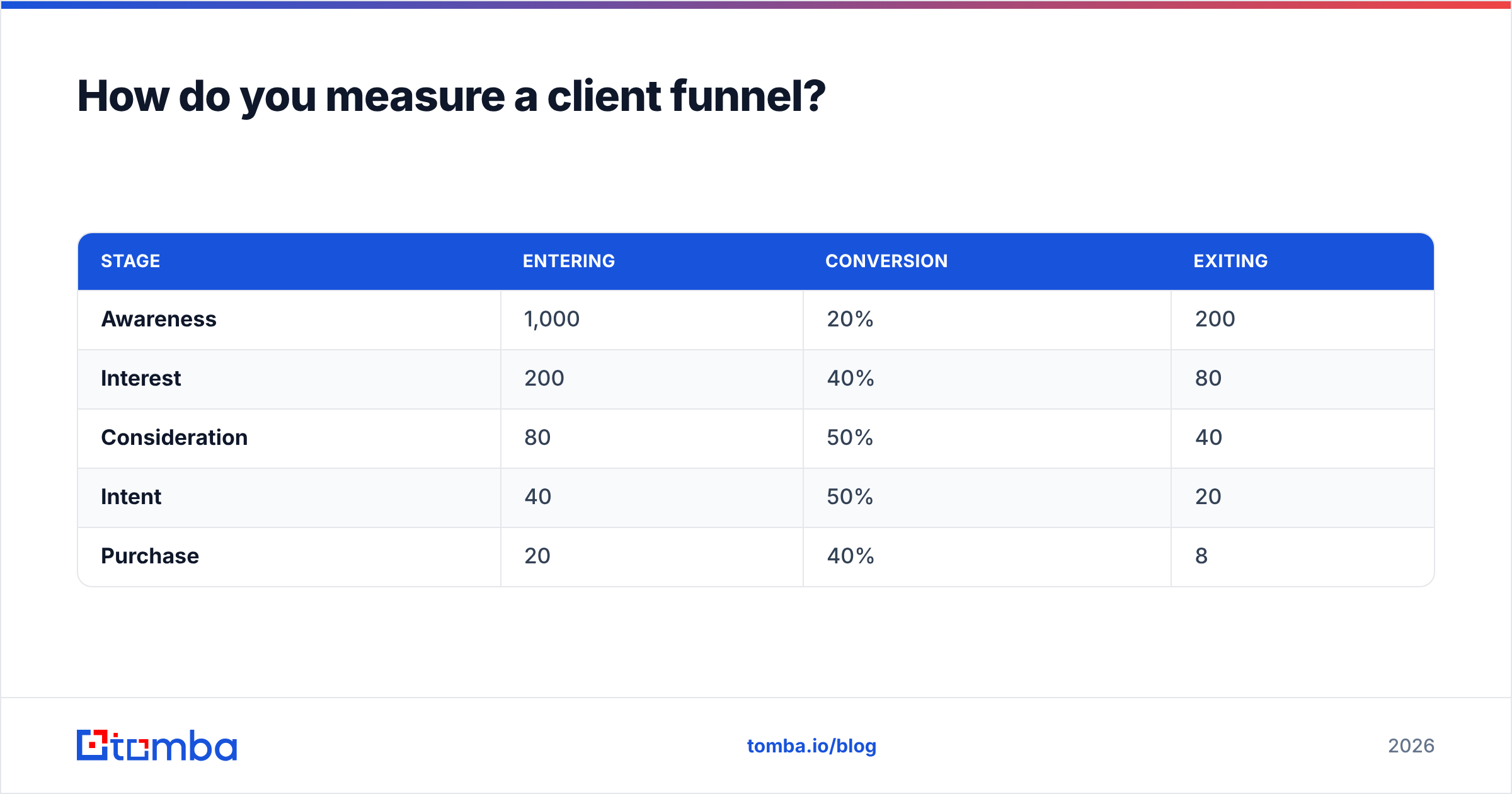
A simple worked example. Say 1,000 prospects enter awareness:
| Stage | Entering | Conversion | Exiting |
|---|---|---|---|
| Awareness | 1,000 | 20% | 200 |
| Interest | 200 | 40% | 80 |
| Consideration | 80 | 50% | 40 |
| Intent | 40 | 50% | 20 |
| Purchase | 20 | 40% | 8 |
Eight clients from a thousand prospects is a 0.8% end-to-end rate — and that's healthy for cold B2B outbound. The lesson: small percentage gains compound. Lift awareness-to-interest from 20% to 25% and you don't get 5% more clients, you get 25% more, because the gain multiplies through every stage below it.
To make these numbers trustworthy, your CRM has to define each stage the same way every time. "Qualified" should mean one specific, written thing — not whatever the rep felt that day.
Which tools fix which part of the funnel?#
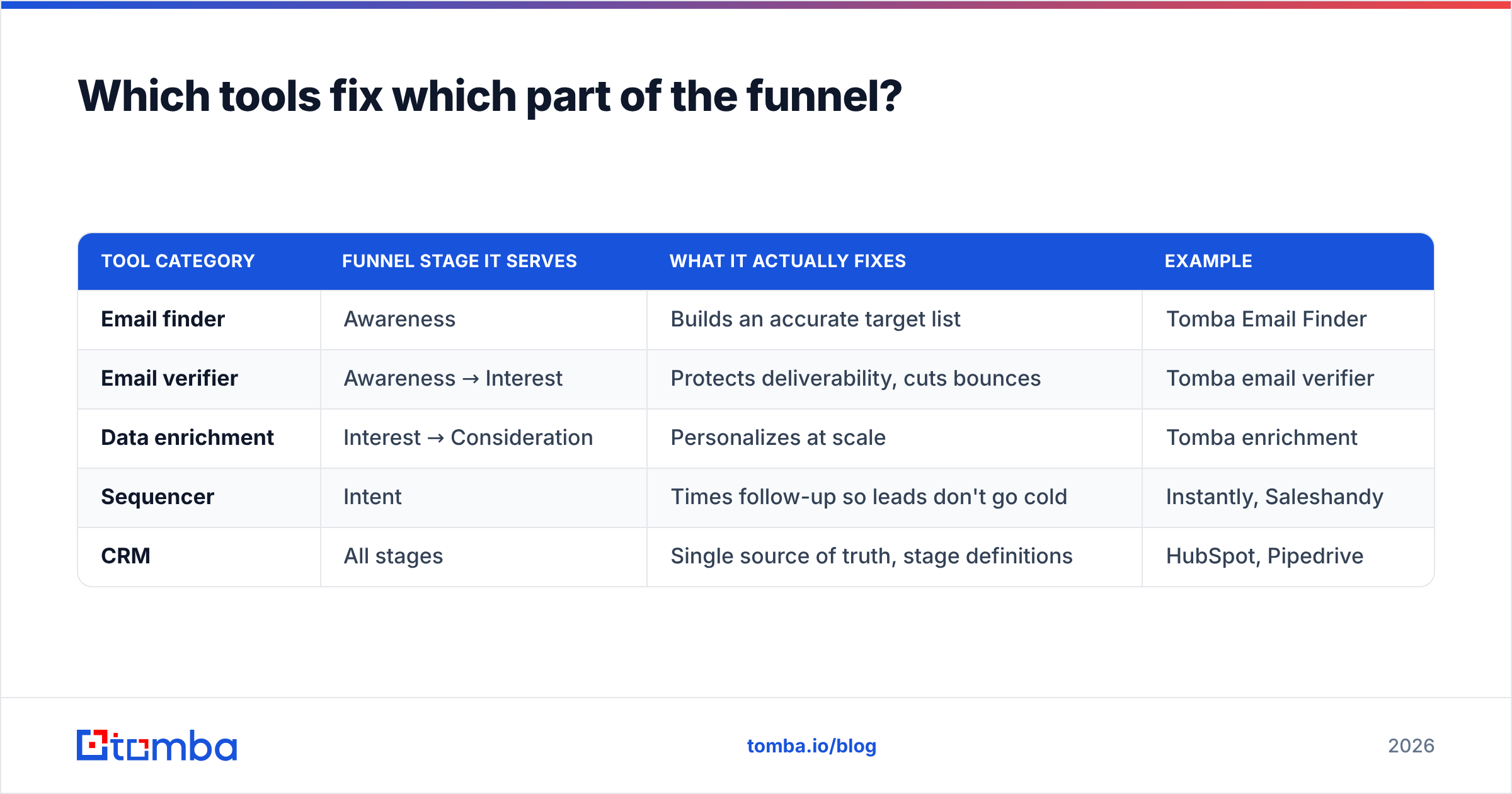
Different funnel leaks need different tools. Buying one "all-in-one" platform rarely fixes a specific leak better than a focused tool aimed at it. Here's how the main categories map to funnel stages.
| Tool category | Funnel stage it serves | What it actually fixes | Example |
|---|---|---|---|
| Email finder | Awareness | Builds an accurate target list | Tomba Email Finder |
| Email verifier | Awareness → Interest | Protects deliverability, cuts bounces | Tomba email verifier |
| Data enrichment | Interest → Consideration | Personalizes at scale | Tomba enrichment |
| Sequencer | Intent | Times follow-up so leads don't go cold | Instantly, Saleshandy |
| CRM | All stages | Single source of truth, stage definitions | HubSpot, Pipedrive |
The biggest mistake is buying a sequencer before you've fixed sourcing. A sequencer just sends more emails to a bad list, faster. Fix the inputs first: source accurate contacts with an email finder, verify them, enrich them, then automate the follow-up. For teams running outbound at volume, a bulk email finder plus verification on the same platform removes the messy CSV hand-offs between tools.
How do you build a client funnel step by step?#
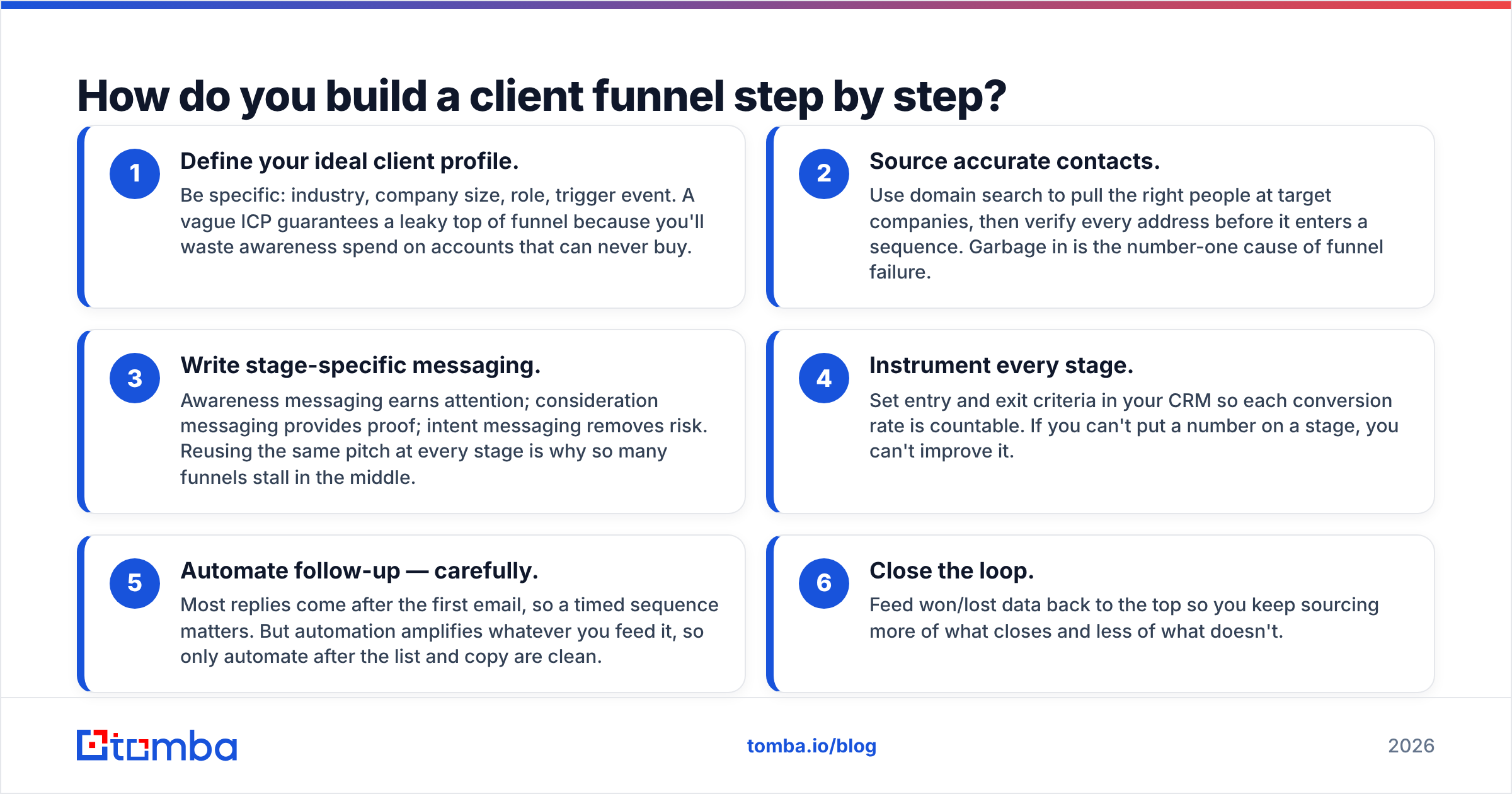
Build the funnel backward from the client you want, then instrument it forward.
- Define your ideal client profile. Be specific: industry, company size, role, trigger event. A vague ICP guarantees a leaky top of funnel because you'll waste awareness spend on accounts that can never buy.
- Source accurate contacts. Use domain search to pull the right people at target companies, then verify every address before it enters a sequence. Garbage in is the number-one cause of funnel failure.
- Write stage-specific messaging. Awareness messaging earns attention; consideration messaging provides proof; intent messaging removes risk. Reusing the same pitch at every stage is why so many funnels stall in the middle.
- Instrument every stage. Set entry and exit criteria in your CRM so each conversion rate is countable. If you can't put a number on a stage, you can't improve it.
- Automate follow-up — carefully. Most replies come after the first email, so a timed sequence matters. But automation amplifies whatever you feed it, so only automate after the list and copy are clean.
- Close the loop. Feed won/lost data back to the top so you keep sourcing more of what closes and less of what doesn't.
The order matters. Teams that start at step 5 (automation) and never do steps 1–2 (ICP and clean data) get a fast, efficient machine for losing money.
How is a client funnel different from a sales pipeline?#
A funnel measures conversion rates across a population; a pipeline tracks individual deals. They're two views of the same reality, and you need both.
The funnel answers strategic questions: "What percentage of demos become clients?" "Where do we lose the most people?" It's about the system. The pipeline answers tactical questions: "Will Acme Corp close this quarter?" "Which deals need a nudge today?" It's about specific opportunities.
Use the funnel to decide where to invest — if consideration-to-intent is your worst stage, that's where new content or a better demo goes. Use the pipeline to run the daily work of moving named deals forward. A team obsessed with pipeline but blind to funnel will keep pushing deals through a stage that statistically can't convert, instead of fixing the stage. If your team also runs phone outreach, pull verified B2B phone numbers into the same record so the pipeline view shows every channel you've touched a deal with.
What does a healthy client funnel look like in 2026?#
A healthy 2026 funnel is narrow at the entry, not just at the exit — meaning you spend effort qualifying before outreach, not after. The old model sprayed thousands of generic emails and let the funnel do the filtering. That model is dead: inbox providers punish volume-without-relevance harder every year, and buyers ignore anything that isn't specific to them.
The modern shape:
- Tighter targeting up front. Fewer, better-fit accounts beat a huge cold list. Quality of entry sets the ceiling on everything below.
- Verified, enriched data as a baseline, not a nice-to-have. Personalization at scale is impossible without clean enrichment.
- Multi-channel touch — email, phone, and LinkedIn working from one contact record instead of three disconnected tools.
- Fast, measured follow-up so intent-stage leads don't cool off while you're deciding what to send.
Industry analysts like Gartner and review platforms like G2 consistently show that data quality and follow-up speed — not channel choice — separate the funnels that convert from the ones that leak. The tooling is secondary to getting those two fundamentals right.
If you want to benchmark your own numbers, compare your stage conversion rates against your last four quarters before chasing industry averages. Your own trend line is the most honest benchmark you have, and it tells you whether last quarter's changes actually moved the needle.
Common client funnel mistakes to avoid#
- Optimizing the bottom while the top leaks. Closing tactics can't save a funnel fed by bad data.
- One message for every stage. Awareness and intent buyers have different questions; answer them differently.
- No stage definitions. If "qualified" means different things to different reps, your funnel math is fiction.
- Automating too early. A sequencer multiplies the quality of your list — including when that quality is zero.
- Ignoring retention. The cheapest client to win is the one you already have; funnels that stop at "purchase" leave the real revenue on the table.
Build the top of your funnel on data you can trust#
Your funnel can only convert the people who actually enter it — and they can only enter if you reach them. Before you spend another dollar on copy, ads, or a sequencer, fix the input: source accurate, verified contacts at the companies that match your ICP.
That's exactly what the Tomba Email Finder does — find professional email addresses by name, company, or domain, verify them, and push clean records straight into your sequence or CRM. Start free with 25 searches a month, and scale up through the Starter plan at $49/mo when your funnel is humming. See full Tomba pricing for every tier. A funnel built on data you can trust is a funnel that compounds — fix the top, and every stage below it gets easier.
Ready to find emails that actually work?
Join 150,000+ professionals who stopped guessing and started sending. Free credits on signup — no credit card required.
Get the Tomba newsletter
Practical outbound tactics and product updates — once every two weeks.
About the author