Client Outreach Email Template: 9 Examples That Convert in 2026
A client outreach email template only works if it's personalized, short, and sent to a verified address. Here are 9 copy-paste templates plus the framework behind them.
TL;DR
- A client outreach email template is a reusable skeleton — you still personalize the first line, the offer, and the ask for every prospect.
- The four-part structure that wins in 2026: a relevant hook, one sentence of proof, a single low-friction ask, and a clean signature.
- Templates fail for two reasons: they read like a mail-merge, or they land in spam because the address was never verified.
- Below are 9 copy-paste templates for cold intros, warm re-engagement, referrals, follow-ups, and breakups — plus when to use each.
- Verify every address before you hit send. A perfect template to a bouncing inbox is wasted effort.
What is a client outreach email template?#
A client outreach email template is a pre-written email structure you reuse to start conversations with potential clients — but it is not a script you blast unchanged. Think of it like a chef's mise en place: the ingredients and the order are prepped, but you still cook each dish to the order in front of you. The template handles the 70% that stays constant (structure, tone, signature, CTA logic) so you can spend your energy on the 30% that actually drives replies: the personalized opener and the specific reason you're reaching out to this person.
The distinction matters because buyers in 2026 can smell a mass blast instantly. According to HubSpot's sales research, personalized, relevant outreach consistently outperforms generic volume. A good template makes personalization faster, not optional.

What makes a client outreach email actually get a reply?#
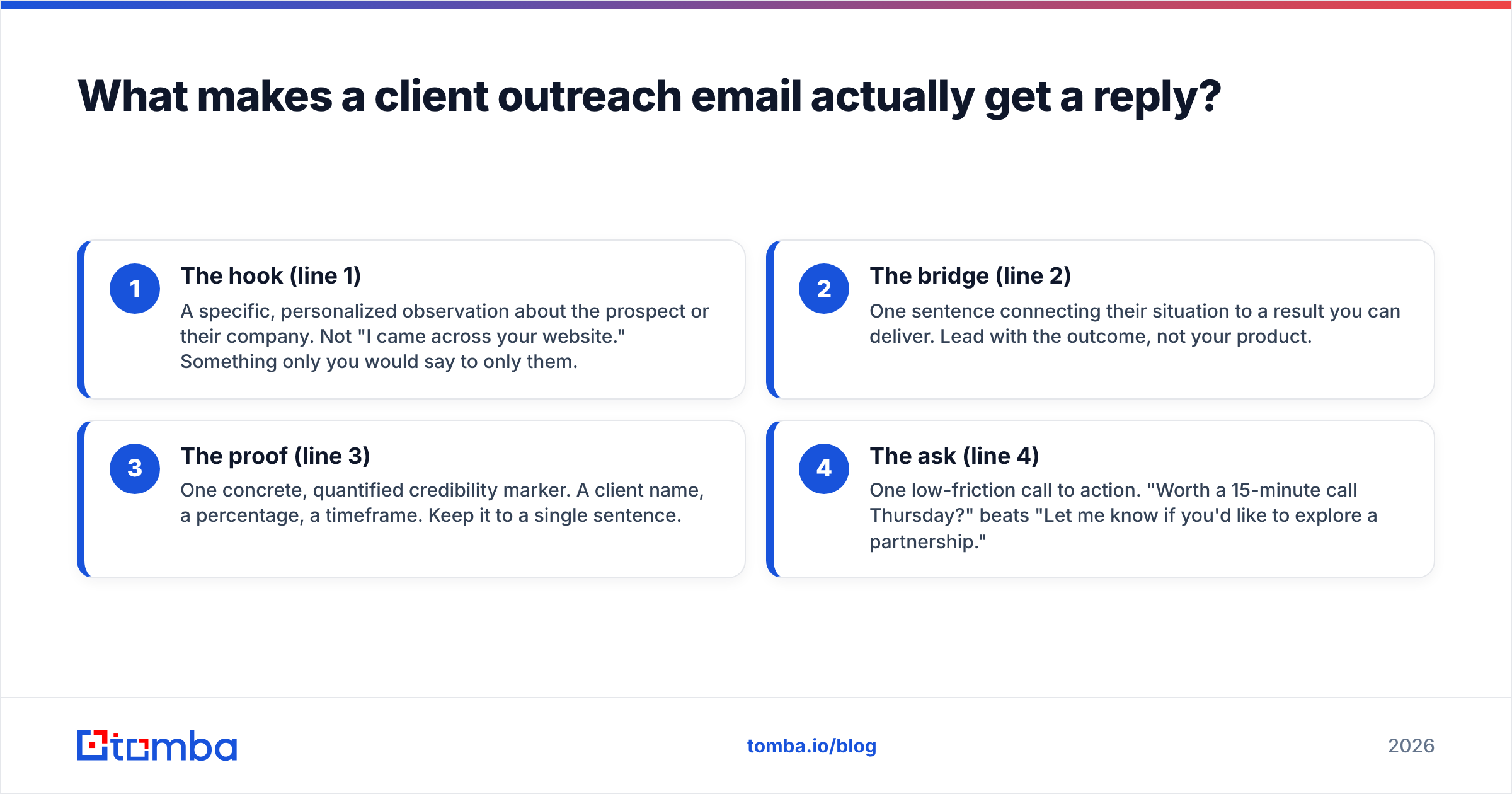
Most outreach emails die for predictable reasons. Here's the anatomy of one that doesn't, broken into the four parts every template below follows:
- The hook (line 1) — A specific, personalized observation about the prospect or their company. Not "I came across your website." Something only you would say to only them.
- The bridge (line 2) — One sentence connecting their situation to a result you can deliver. Lead with the outcome, not your product.
- The proof (line 3) — One concrete, quantified credibility marker. A client name, a percentage, a timeframe. Keep it to a single sentence.
- The ask (line 4) — One low-friction call to action. "Worth a 15-minute call Thursday?" beats "Let me know if you'd like to explore a partnership."
If your draft has two asks, three paragraphs of backstory, or a hook that could be pasted into any inbox, cut until only the four parts remain. Short emails win because they respect the reader's time.
How is a cold outreach template different from a warm one?#
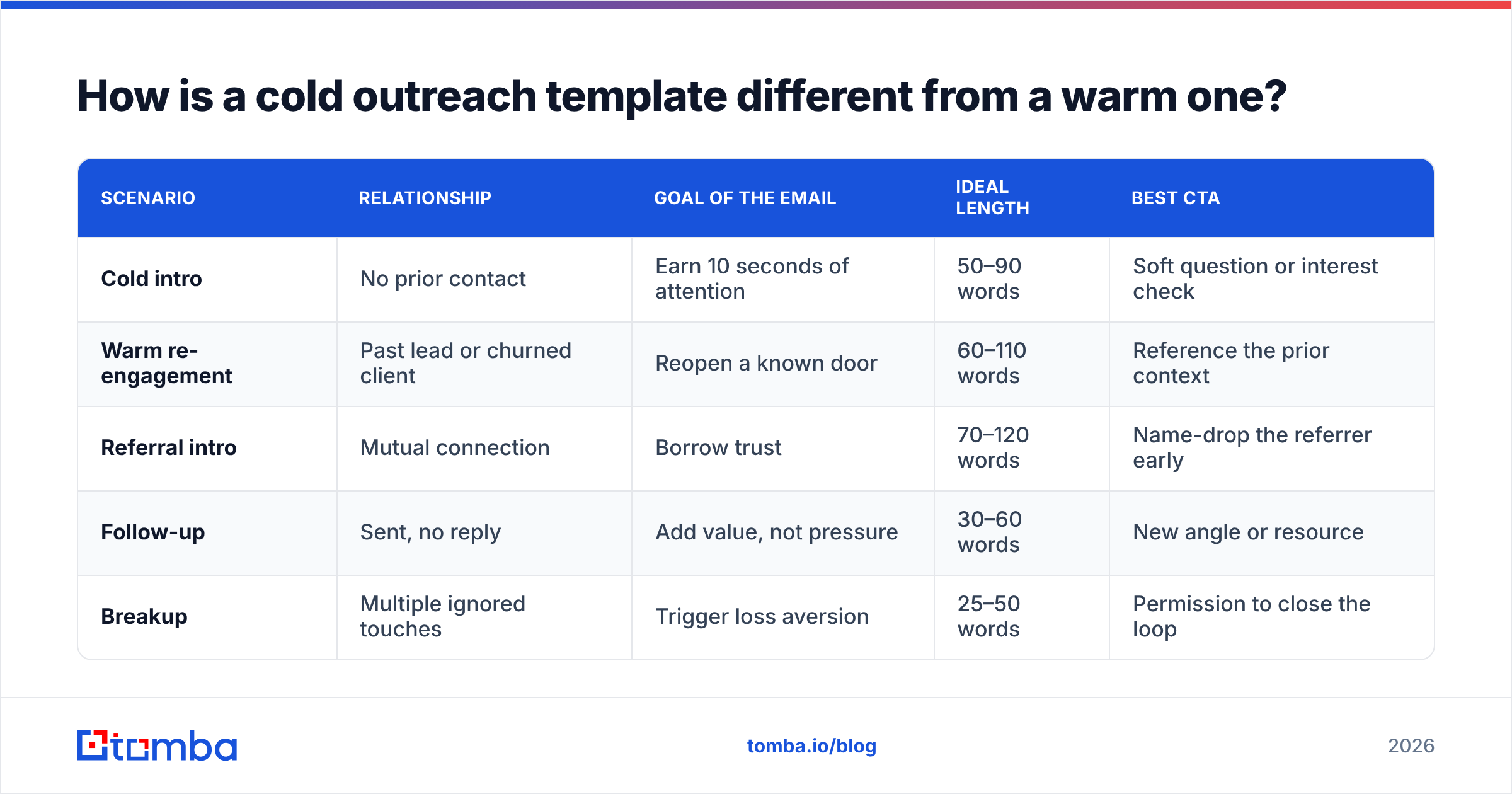
The biggest mistake reps make is using the same energy for a stranger and a lapsed contact. Match the template to the relationship.
| Scenario | Relationship | Goal of the email | Ideal length | Best CTA |
|---|---|---|---|---|
| Cold intro | No prior contact | Earn 10 seconds of attention | 50–90 words | Soft question or interest check |
| Warm re-engagement | Past lead or churned client | Reopen a known door | 60–110 words | Reference the prior context |
| Referral intro | Mutual connection | Borrow trust | 70–120 words | Name-drop the referrer early |
| Follow-up | Sent, no reply | Add value, not pressure | 30–60 words | New angle or resource |
| Breakup | Multiple ignored touches | Trigger loss aversion | 25–50 words | Permission to close the loop |
Notice the cold template is short and curious, while the referral can run longer because the borrowed trust earns you more attention. Pick the row, then grab the matching template below.
What are the best client outreach email templates for 2026?#
Copy these, swap the brackets, and personalize line one every time.
1. The cold intro (problem-first)#
Subject: quick question about [specific process at their company]
Hi [First name],
Noticed [Company] just [specific trigger — hired, launched, expanded]. Teams hitting that stage usually struggle to [specific problem] without adding headcount.
We helped [similar company] cut that workload by [X%] in [timeframe].
Worth a 15-minute look next week?
[Your name]
2. The cold intro (compliment-first)#
Subject: loved [specific thing they published]
Hi [First name],
Your [post / talk / product update] on [topic] was sharp — especially the point about [detail].
It's exactly why I think [your solution outcome] would land well for [Company]. We do this for [client type] every day.
Open to me sending over a two-line breakdown?
[Your name]
3. The referral intro#
Subject: [Referrer name] suggested I reach out
Hi [First name],
[Referrer name] mentioned you're the right person to talk to about [topic]. We recently helped them [result], and they thought it'd be relevant for you too.
Happy to share what worked. Does a short call Thursday or Friday suit you?
[Your name]
4. The warm re-engagement#
Subject: picking this back up
Hi [First name],
We spoke back in [month] about [topic], and the timing wasn't right. Since then we've [new development relevant to them].
Curious whether [their original goal] is back on your radar for this quarter?
[Your name]
5. The value-add follow-up#
Subject: thought of you
Hi [First name],
No pitch — just sharing [resource / benchmark / template] that maps directly to [their challenge].
If it's useful, I'm glad to walk through how [similar company] applied it.
[Your name]
6. The breakup email#
Subject: should I close your file?
Hi [First name],
I've reached out a few times about [topic] without connecting — totally understand priorities shift.
If now isn't the moment, I'll stop here. Just reply "later" and I'll check back next quarter.
[Your name]
These six cover most pipelines, but a template is only as good as the subject line that gets it opened. If you're stuck, a subject line generator can spin out variations to A/B test before you commit.
How do you personalize a template without spending an hour per email?#
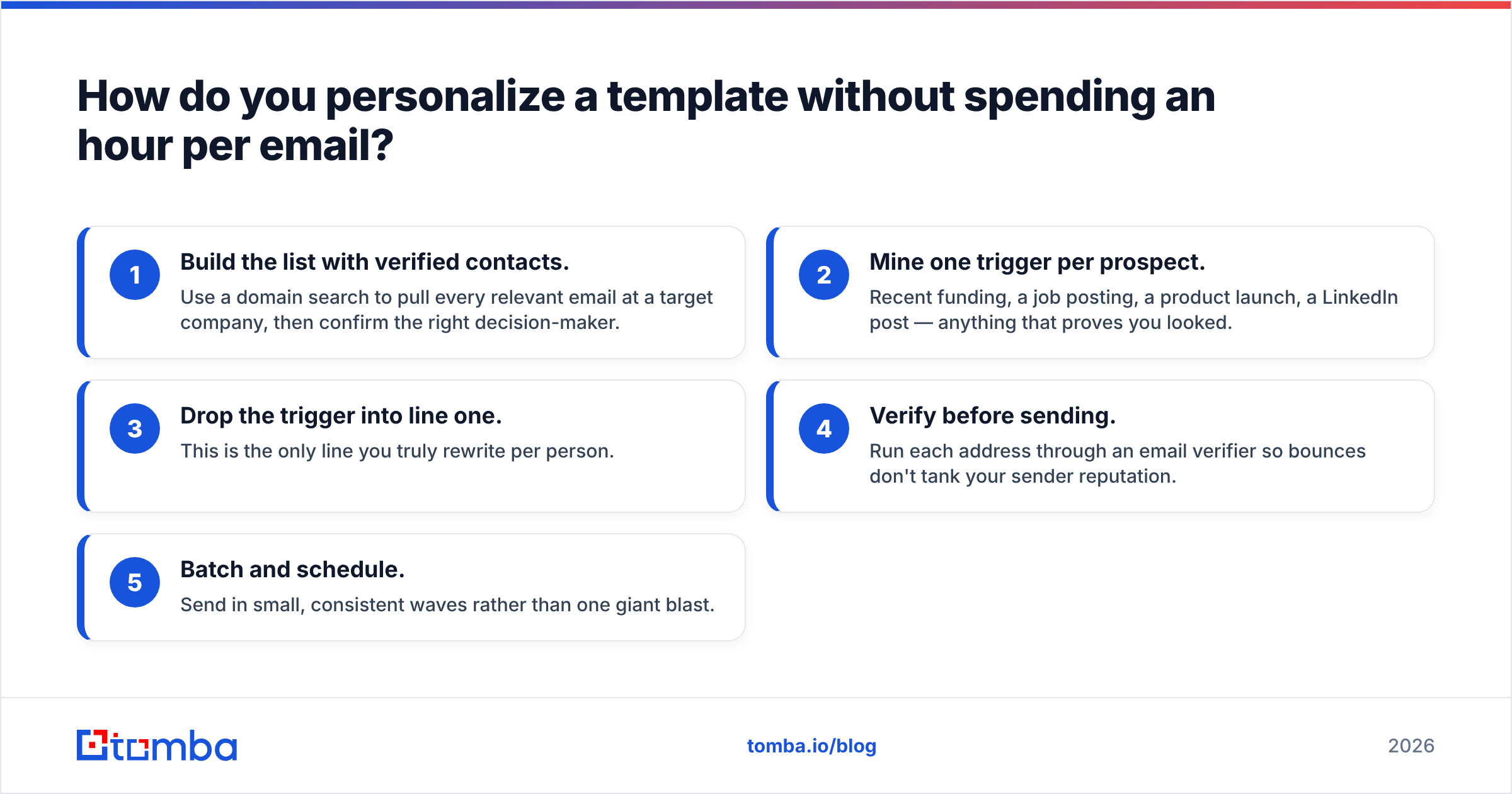
Personalization at scale is a research problem, not a writing problem. The writing is already done — the template handles it. What takes time is finding the specific hook for line one. Solve the research, and you can personalize 30 emails in the time it used to take to write 5.
Here's a repeatable workflow:
- Build the list with verified contacts. Use a domain search to pull every relevant email at a target company, then confirm the right decision-maker.
- Mine one trigger per prospect. Recent funding, a job posting, a product launch, a LinkedIn post — anything that proves you looked.
- Drop the trigger into line one. This is the only line you truly rewrite per person.
- Verify before sending. Run each address through an email verifier so bounces don't tank your sender reputation.
- Batch and schedule. Send in small, consistent waves rather than one giant blast.
That fourth step is non-negotiable. You can write the best client outreach email template in the world, but if 20% of your list bounces, mailbox providers start routing you to spam — and your good emails to real prospects suffer for it.
Which outreach tools and templates fit your stage?#
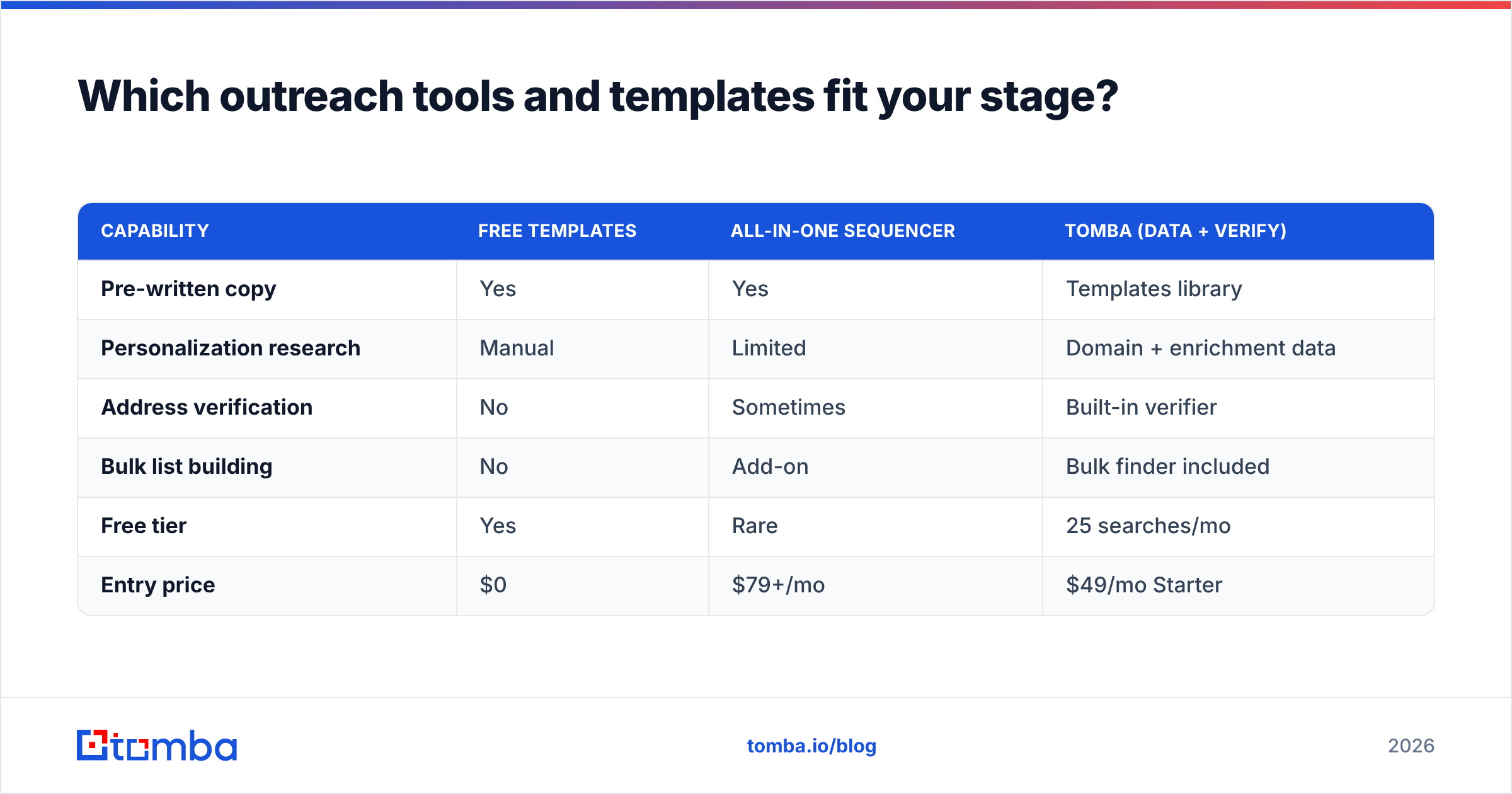
Templates, sending tools, and data tools solve different jobs. Here's how the pieces compare so you don't overbuy.
| Capability | Free templates | All-in-one sequencer | Tomba (data + verify) |
|---|---|---|---|
| Pre-written copy | Yes | Yes | Templates library |
| Personalization research | Manual | Limited | Domain + enrichment data |
| Address verification | No | Sometimes | Built-in verifier |
| Bulk list building | No | Add-on | Bulk finder included |
| Free tier | Yes | Rare | 25 searches/mo |
| Entry price | $0 | $79+/mo | $49/mo Starter |
Free templates are a fine starting point — and you can grab a ready-made set from the email templates library without paying anything. But once volume grows, the bottleneck shifts from writing to finding and verifying the right people. That's where pairing a template with accurate data pays for itself. You can review the full Tomba pricing to see where your volume lands.
For a broader market view, G2's outreach software category and the analyst coverage from Gartner are useful for comparing sequencing platforms — though most of them assume you already have clean, verified contact data feeding the top of the funnel.
How many follow-ups should a sequence have?#
Three to five touches, spaced across two to three weeks, is the sweet spot for client outreach. One email almost never lands — most replies come from the second and third touch, when persistence signals you're serious without being a nuisance.
A simple, proven cadence:
- Day 1 — Template 1 or 2 (the cold intro)
- Day 3 — Template 5 (value-add follow-up, new angle)
- Day 7 — Short bump referencing the first email
- Day 12 — Template 5 again with a different resource
- Day 18 — Template 6 (the breakup)
Change the angle each time. Reps who just resend "bumping this to the top of your inbox" train prospects to ignore them. Reps who bring a new, relevant reason to reply earn the meeting. And every send in that cadence still depends on a deliverable, verified address — which is why list hygiene sits underneath everything else.
What mistakes kill outreach templates the fastest?#
- No personalized first line. If line one could go to anyone, it goes to the trash.
- Two asks. "Book a call or reply or check our site" splits attention. One ask.
- Pitching features instead of outcomes. Buyers care about their result, not your spec sheet.
- Skipping verification. Bounces wreck your sender reputation and quietly kill future deliverability.
- Walls of text. If it doesn't fit on a phone screen without scrolling, it's too long.
- Generic subject lines. "Touching base" and "Partnership opportunity" are open-rate killers.
Avoid those six and you're already ahead of most senders competing for the same inbox.
Start sending outreach that actually lands#
The best client outreach email template in the world only works if it reaches a real, verified inbox. Before you send your next campaign, build your list and confirm every address with the Tomba Email Finder — find professional emails by name, company, or domain, then verify them in the same workflow so your carefully written templates reach humans instead of bouncing into a spam folder. Pair clean data with the four-part structure above, and your reply rate stops being a guessing game.
// get started
Find, verify and enrich your first contacts today
Start on the free plan with 25 searches a month, then scale when your team is ready.
Free plan · No credit card required · GDPR & CCPA
// about the author