Clodura.ai vs Coldlytics 2026: Which B2B Tool Wins?
Clodura.ai is an all-in-one sales intelligence platform; Coldlytics is a done-for-you list service. Here's which one fits your outbound motion in 2026 — and where a leaner data layer beats both.
Clodura.ai vs Coldlytics: Which B2B Prospecting Tool Should You Pay For in 2026?
You're choosing between two very different bets. This Cloduraai vs Coldlytics comparison makes the choice simple. Clodura.ai sells you a self-serve sales intelligence platform. You get a 600M+ contact database, sequences, and an email finder in one login. Coldlytics sells you something else: a human research team that builds custom prospect lists to order. The goal is the same — more booked meetings. The philosophies are opposite. This guide shows where each tool earns its price, where it quietly costs you, and the leaner data layer that can replace either.
TL;DR#
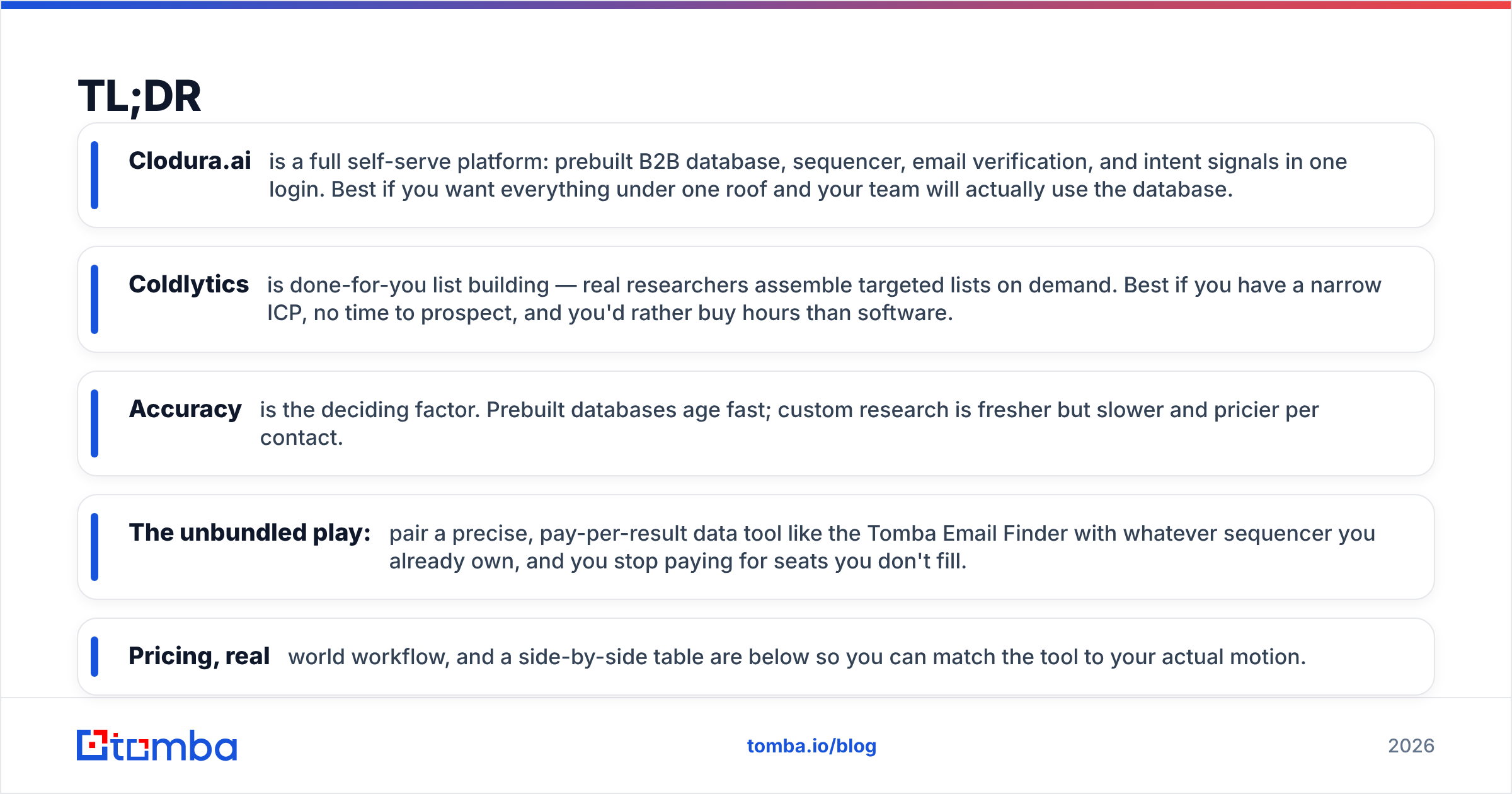
- Clodura.ai is a full self-serve platform: prebuilt B2B database, sequencer, email verification, and intent signals in one login. Best if you want everything under one roof and your team will actually use the database.
- Coldlytics is done-for-you list building — real researchers assemble targeted lists on demand. Best if you have a narrow ICP, no time to prospect, and you'd rather buy hours than software.
- Accuracy is the deciding factor. Prebuilt databases age fast; custom research is fresher but slower and pricier per contact.
- The unbundled play: pair a precise, pay-per-result data tool like the Tomba Email Finder with whatever sequencer you already own, and you stop paying for seats you don't fill.
- Pricing, real-world workflow, and a side-by-side table are below so you can match the tool to your actual motion.
What is Clodura.ai?#
Clodura.ai is an all-in-one sales prospecting platform. It is built around a large prebuilt contact database. The company advertises 600M+ B2B contacts and 18M+ companies. It also adds org charts, technographics, and buyer-intent signals. You search by filters like industry, title, geography, and tech stack. Then you pull contacts into lists, verify emails, and run sequences without leaving the app.
Think of it like a warehouse club for sales data. You pay an annual membership, walk the aisles, and grab what you need. The value is breadth and convenience: one tool covers find, verify, and send. The catch is the same as any warehouse. A lot of what's on the shelf is generic, and freshness varies by aisle. Before you commit, read how a prebuilt B2B database is assembled and where the data comes from.

Clodura's strength is the buyer who wants self-serve volume. Think SDRs who run high-activity outbound. They need to refill lists weekly without filing a request and waiting.
What is Coldlytics?#
Coldlytics is not software you log into. It's a managed research service. You define your ideal customer profile. Then a team of human researchers hand-builds a list of matching prospects with verified contact data. They deliver it to you, often within a few business days. You're buying labor and precision, not a database subscription.
Here's the analogy. Clodura.ai is a grocery store. Coldlytics is a personal shopper who buys only what's on your list and checks every expiration date. Take a tight niche like "VP of Facilities at hospitals with 200+ beds in Texas." A personal shopper beats wandering a warehouse. The warehouse's filters get you only so close before you prune hundreds of near-misses by hand.
The trade-off is clear. You wait for delivery, you pay for human hours, and you can't pull 5,000 more contacts at midnight. Coldlytics shines on quality-over-quantity, narrow-ICP campaigns. It strains when you need volume fast or want to iterate hourly.
Cloduraai vs Coldlytics: the core comparison#
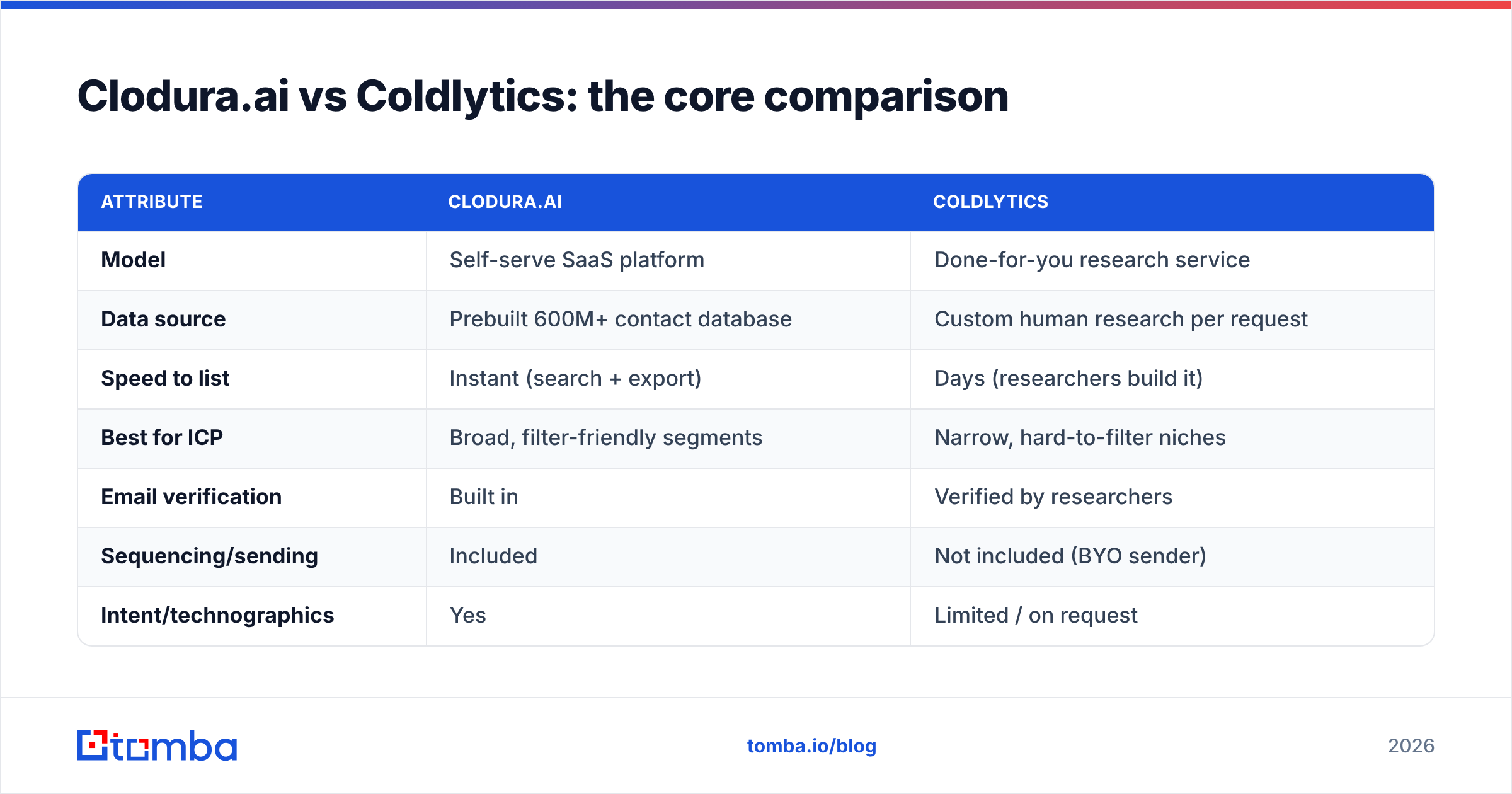
Here's the head-to-head on the attributes that actually change your pipeline.
| Attribute | Clodura.ai | Coldlytics |
|---|---|---|
| Model | Self-serve SaaS platform | Done-for-you research service |
| Data source | Prebuilt 600M+ contact database | Custom human research per request |
| Speed to list | Instant (search + export) | Days (researchers build it) |
| Best for ICP | Broad, filter-friendly segments | Narrow, hard-to-filter niches |
| Email verification | Built in | Verified by researchers |
| Sequencing/sending | Included | Not included (BYO sender) |
| Intent/technographics | Yes | Limited / on request |
| Pricing model | Annual seat subscription | Per-list / hourly research |
| Volume flexibility | High (self-serve) | Capped by team capacity |
| Freshness | Varies by record age | High (built fresh) |
The pattern is clear. Clodura.ai optimizes for breadth and speed. Coldlytics optimizes for precision and freshness. Neither is "better" in the abstract. They're built for different buyers.
Is Clodura.ai better than Coldlytics?#
It depends on three questions, in this order:
How specific is your ICP? Can you describe your buyer with standard filters like title, industry, headcount, location, and tech stack? Then Clodura's self-serve search gets you there in minutes. Does your ICP need human judgment, like non-standard titles or signals no database tags? Then Coldlytics' researchers out-target the filters every time.
Do you need volume or precision? High-velocity outbound burns through thousands of contacts a month. That favors a self-serve database. A founder-led or ABM motion sends 50 hyper-relevant emails a week. That favors custom research.
Will your team actually use the platform? Here's a common failure with all-in-one tools. You pay for a 600M-record database and a sequencer. Then your two reps use 4% of it. Seat-based annual contracts punish under-utilization. If you won't max it out, a managed service or an unbundled stack looks a lot better.
How accurate is the data, really?#
Accuracy is where these tools live or die. It's the number you should pressure-test hardest. Prebuilt databases like Clodura's are enormous, but size and freshness are in tension. A record collected 14 months ago may show a contact who has since changed jobs. B2B data decays roughly 2–3% per month. Vendors quote high accuracy figures. Verify them against your own sample before you trust the dashboard.
Coldlytics counters this by building lists fresh at request time. That structurally improves accuracy, because there's no shelf for data to age on. The cost is throughput. Human verification doesn't scale to instant 10,000-row pulls.
This is where an unbundled, verification-first data layer earns its place. Rather than trust any database's age, you re-verify at the moment of send. Run contacts through a dedicated email verifier to strip catch-alls and dead addresses. Then enrich the gaps with a data enrichment pass. The result is fresher than a stale export and faster than a research queue. For neutral benchmarks, G2's data quality category is a useful reference before you sign anything.
What does each one cost?#
Pricing is the least transparent part of this comparison, so treat published numbers as starting points and confirm directly.
- Clodura.ai runs on annual seat-based subscriptions. There's a free tier for trial usage, plus paid plans that scale by credits, seats, and features. Check the current breakdown on Clodura's official pricing page. The meaningful cost is per active seat per year, not the headline monthly figure.
- Coldlytics prices by research output, like list size and complexity, rather than seats. You pay for verified contacts delivered. That makes per-contact cost higher but eliminates shelfware.
The hidden line item with both is contacts you pay for but never email. A seat you under-use or a list segment you discard is pure waste. That's the case for paying per result.
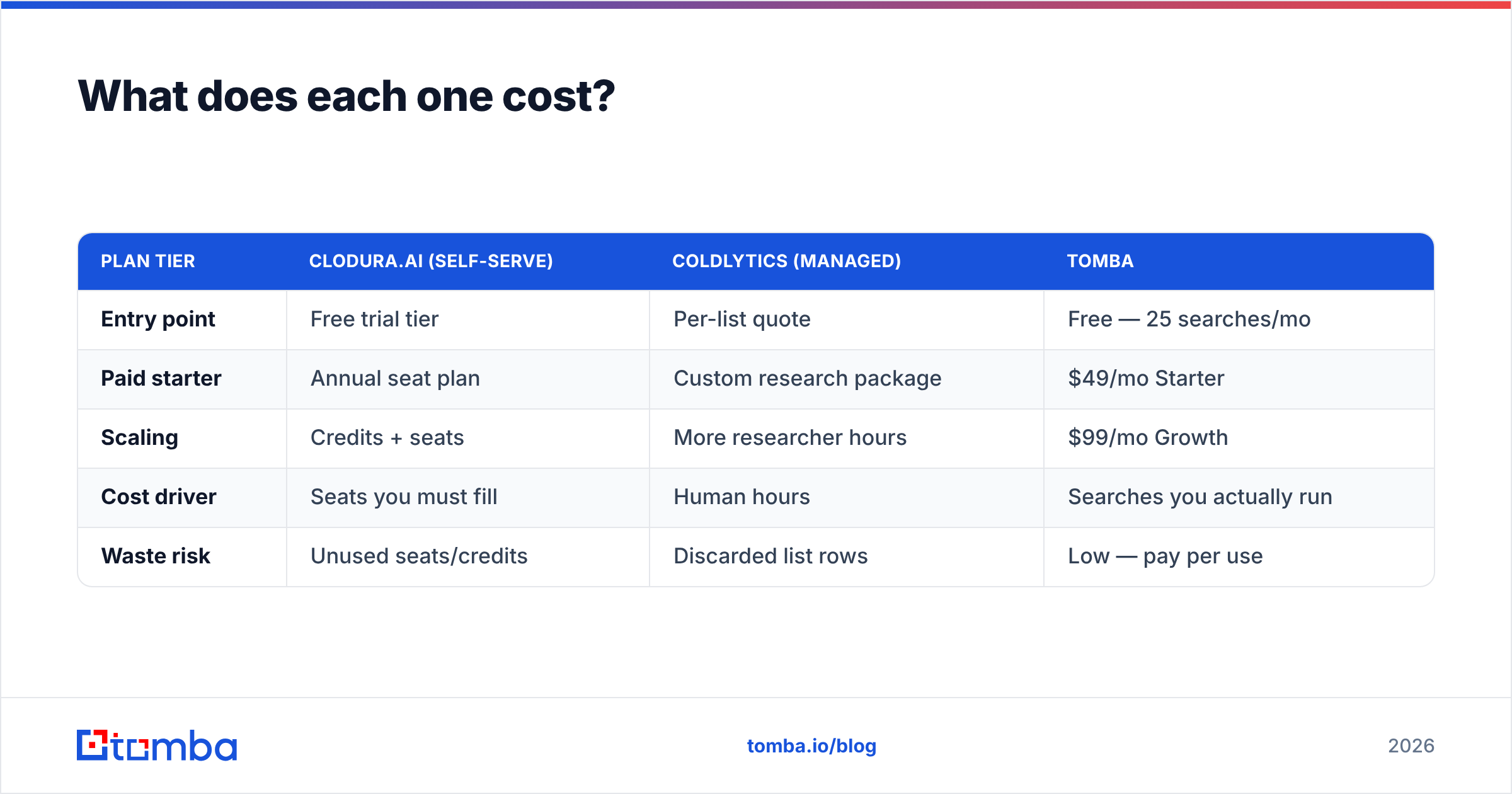
| Plan tier | Clodura.ai (self-serve) | Coldlytics (managed) | Tomba |
|---|---|---|---|
| Entry point | Free trial tier | Per-list quote | Free — 25 searches/mo |
| Paid starter | Annual seat plan | Custom research package | $49/mo Starter |
| Scaling | Credits + seats | More researcher hours | $99/mo Growth |
| Cost driver | Seats you must fill | Human hours | Searches you actually run |
| Waste risk | Unused seats/credits | Discarded list rows | Low — pay per use |
See full Tomba pricing for the exact credit math. The point isn't that Tomba is the cheapest sticker. It's that you pay for searches you run, not seats you hope to fill.
When should you pick the unbundled stack instead?#
Pick it when you're paying for a platform's breadth but using a sliver of it. The all-in-one pitch bundles database, sequencer, intent, and verification in one login. That's convenient. But convenience you don't use is just cost.
The lean alternative is three composable pieces:
- Find — resolve a name and company to a verified work email with the Tomba Email Finder. Or pull every address at a target company with domain search.
- Verify — run the list through an email verifier so you protect your sender reputation and your bounce rate.
- Scale — when you need volume, the bulk email finder and the Tomba API handle thousands of lookups programmatically. Integrations push results straight into HubSpot, Pipedrive, or Sheets.
You keep your existing sequencer and CRM. You don't sign a per-seat annual contract. You pay only for the data you pull. For a narrow ICP you still hand-build the target list, which is the Coldlytics strength. But you find and verify the contacts yourself at a fraction of the cost.
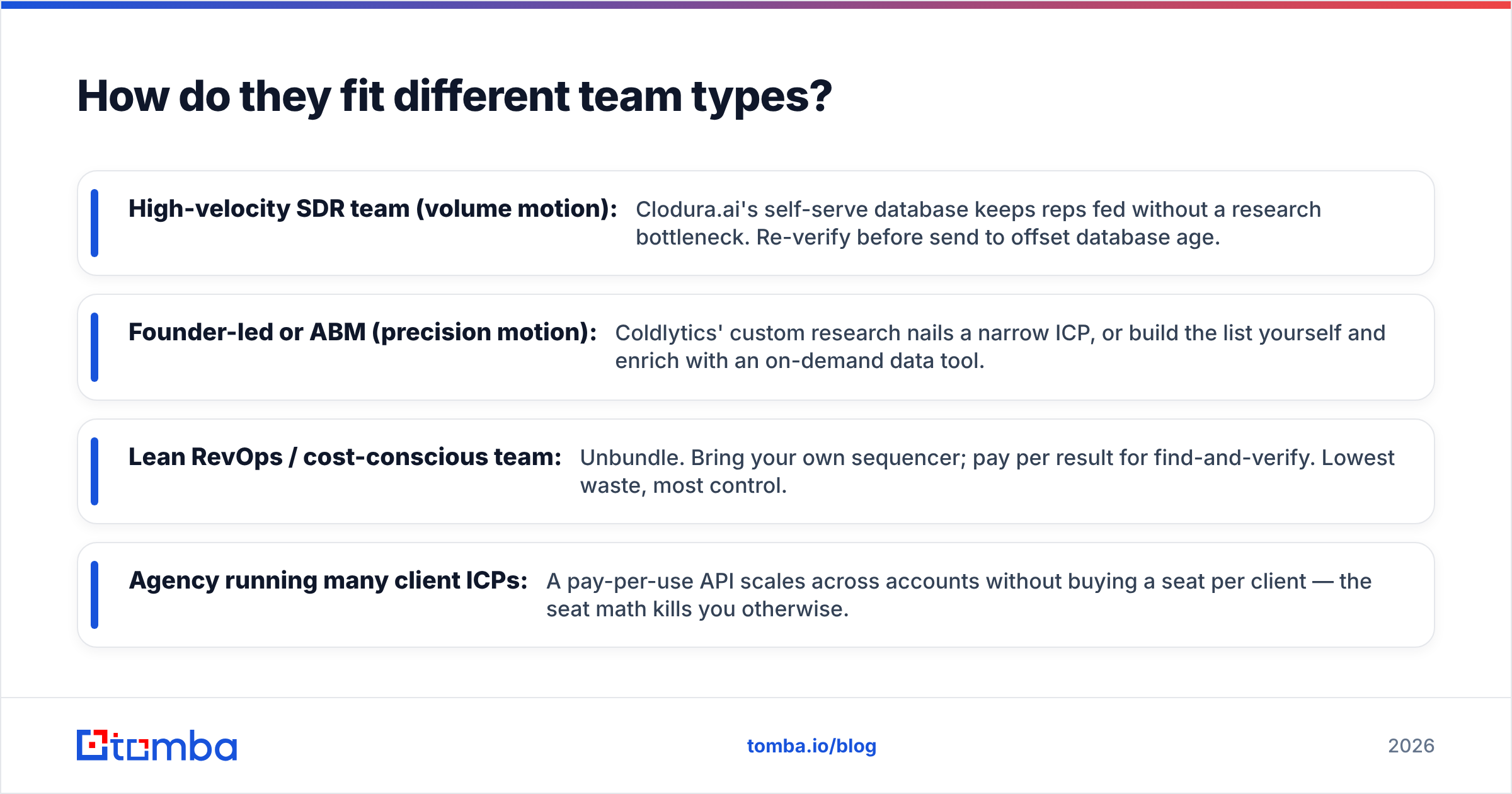
How do they fit different team types?#
- High-velocity SDR team (volume motion): Clodura.ai's self-serve database keeps reps fed without a research bottleneck. Re-verify before send to offset database age.
- Founder-led or ABM (precision motion): Coldlytics' custom research nails a narrow ICP, or build the list yourself and enrich with an on-demand data tool.
- Lean RevOps / cost-conscious team: Unbundle. Bring your own sequencer; pay per result for find-and-verify. Lowest waste, most control.
- Agency running many client ICPs: A pay-per-use API scales across accounts without buying a seat per client — the seat math kills you otherwise.
Match the tool to the motion, not the marketing. The most expensive mistake is buying a broad platform for a precision job, or queuing custom research for a volume job.
What about deliverability — does the tool even matter?#
Yes, but indirectly. No database or research team fixes a cold domain or a missing SPF record. Whatever you pick, the email lands only if your sending setup is healthy. That means an authenticated domain, a warmed inbox, and a clean list. The cleanest contact data still bounces if your sender reputation is shot.
So the data tool's deliverability job is narrow but critical: don't hand you addresses that bounce. That's a verification problem. It's why a verify step belongs in every stack, no matter where the contacts came from. That holds for a fresh Coldlytics list, a Clodura export, or a Tomba lookup. Verify at send time, every time.
Final verdict: which should you buy?#
The Cloduraai vs Coldlytics call comes down to fit. Buy Clodura.ai if you want one self-serve platform, your ICP is filter-friendly, and your team has the volume to use a big database and sequencer. Buy Coldlytics if your ICP is narrow, freshness beats instant volume, and you'd rather pay humans to research than learn another tool.
But before you commit, audit how much of the platform you'll really use. If the honest answer is "the find-and-verify part, mostly," you're overpaying for bundled features. So unbundle. Keep your sequencer, drop the seat contract, and run find-and-verify on a pay-per-result data layer.
Start free with the Tomba Email Finder. You get 25 searches a month at no cost, then $49/mo when you scale. Add the email verifier and API only when you need them. You get fresh, verified contacts and the economics of paying for exactly what you use. No betting a year's budget on seats you might never fill.
// get started
Find, verify and enrich your first contacts today
Start on the free plan with 25 searches a month, then scale when your team is ready.
Free plan · No credit card required · GDPR & CCPA
// about the author