Clodura.ai vs Coresignal 2026: B2B Data Platforms Compared
Clodura.ai is an all-in-one prospecting suite; Coresignal is a raw B2B data API. Here's which one fits your GTM stack in 2026 — and where a focused tool beats both.
Clodura.ai vs Coresignal: Which B2B Data Platform Wins in 2026?
You're comparing Clodura.ai vs Coresignal because both promise to fuel your outbound engine with B2B data — but they solve the problem from opposite ends. One hands you a finished prospecting cockpit. The other hands you raw data pipes and expects your engineers to build the cockpit themselves.
This guide breaks down where each one earns its keep, where each one leaves you stranded, and when a focused, pay-for-what-you-use tool beats paying for a platform you'll half-use.
TL;DR#
- Clodura.ai is an all-in-one sales prospecting suite: a contact database, email finder, cadence/sequencing, and buyer-intent signals bundled into one UI. Best for SDR teams that want to log in and start sending.
- Coresignal is a data-as-a-service provider. It sells firmographic, employee, and job-posting datasets via API and flat files. Best for data engineers, RevOps, and product teams building their own enrichment layer.
- They rarely compete head-to-head: Clodura.ai is a destination, Coresignal is an ingredient.
- Both carry platform-sized price tags and minimums. If you mainly need accurate, verified emails on demand, a focused tool like the Tomba Email Finder covers that slice for a fraction of the commitment.
- Pick by who's doing the work: a sales rep (Clodura.ai), an engineer (Coresignal), or a closer who just needs the email (Tomba).
What is Clodura.ai?#
Clodura.ai is a sales-prospecting platform aimed at SDRs and small-to-mid sales teams. Think of it as a Swiss Army knife: a B2B contact database, an email finder and verifier, an email-sequencing tool, and buyer-intent and technographic signals, all stitched into one dashboard. You search for a company or persona, build a list, verify contacts, and launch a cadence without leaving the app.
The pitch is consolidation. Instead of paying for a database tool, a data enrichment tool, and a sequencer separately, you get them under one login. For a lean team that doesn't want to integrate five vendors, that bundling is the entire value proposition.
The trade-off is the classic all-in-one tax: each module is decent, none is best-in-class. The database is smaller than the giants, the sequencer is lighter than a dedicated outreach platform, and you're locked into their data quality whether it's strong in your vertical or not.
What is Coresignal?#
Coresignal is a B2B data vendor, not an app you "use" in the sales sense. It aggregates public web data — company profiles, employee records, job postings, technographics — and delivers it through APIs, datasets, and flat-file deliveries. There's no cadence builder, no inbox, no SDR-facing UI to speak of.
That's the point. Coresignal is built for engineers and data teams who want to pipe fresh B2B data into their own systems: a custom CRM enrichment job, a lead-scoring model, an investment-research database, or a product feature. If you're building, Coresignal is plumbing. If you're selling, it's overkill until someone wires it up for you.
Coresignal competes with the Clearbit alternatives and data-API crowd, not with prospecting suites. Its strength is breadth and freshness at scale; its requirement is technical resources to actually consume it.
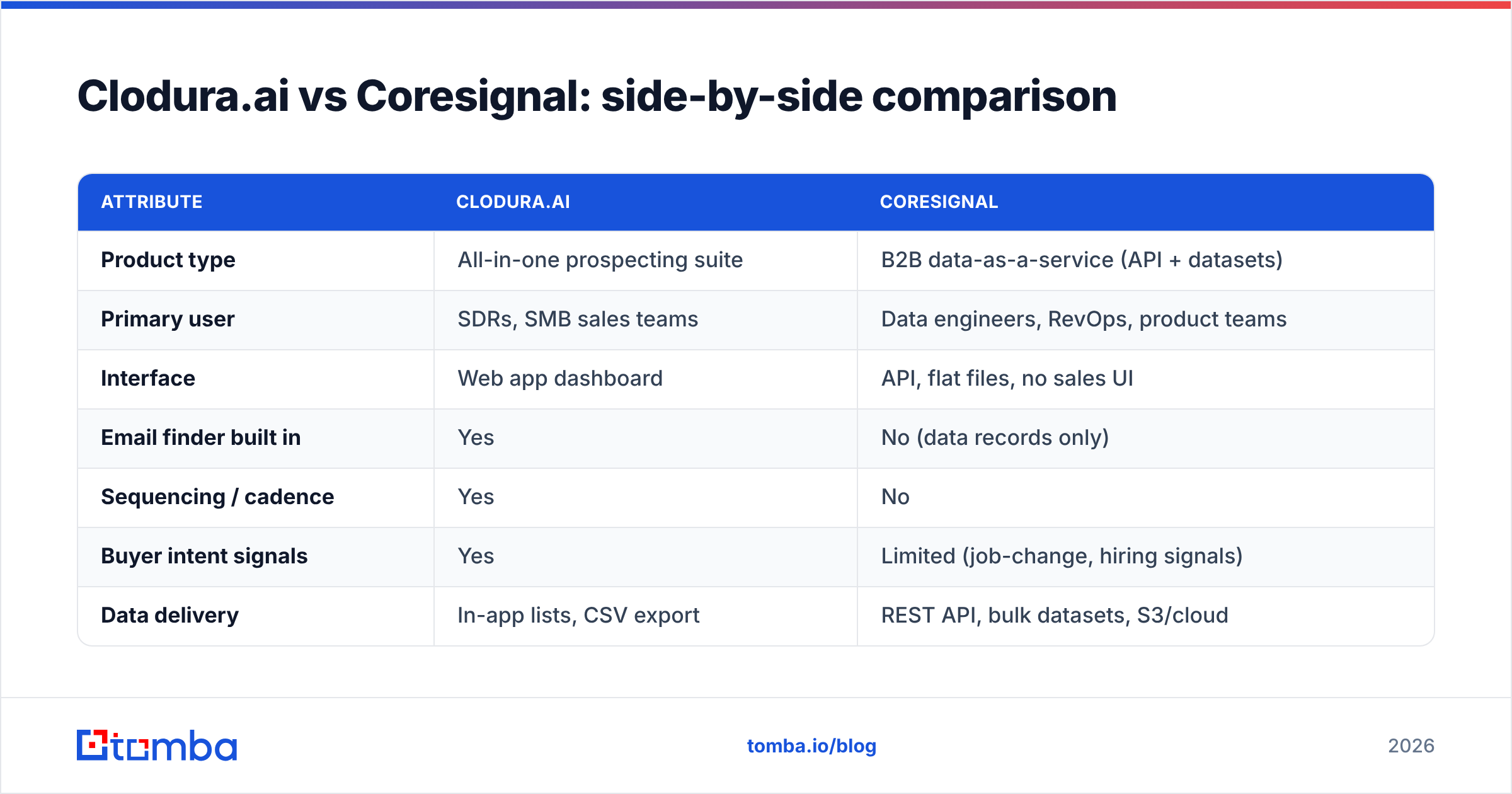
Clodura.ai vs Coresignal: side-by-side comparison#
Here's the core distinction in one view. Read it as "who is this for and what do they get," not "which scores higher" — they're built for different buyers.
| Attribute | Clodura.ai | Coresignal |
|---|---|---|
| Product type | All-in-one prospecting suite | B2B data-as-a-service (API + datasets) |
| Primary user | SDRs, SMB sales teams | Data engineers, RevOps, product teams |
| Interface | Web app dashboard | API, flat files, no sales UI |
| Email finder built in | Yes | No (data records only) |
| Sequencing / cadence | Yes | No |
| Buyer intent signals | Yes | Limited (job-change, hiring signals) |
| Data delivery | In-app lists, CSV export | REST API, bulk datasets, S3/cloud |
| Typical entry price | ~$33–$99/user/mo tiers | Custom; data plans often $1,000+/mo |
| Best for | Launch outbound today, no eng | Build your own enrichment at scale |
| Worst fit | Teams needing raw data at scale | Reps who just want to send email |
The pattern is obvious once you see it: Clodura.ai sells you a finished workflow; Coresignal sells you the raw material. Choosing between them is really choosing whether your team consumes data through a UI or through code.
How do they compare on data accuracy and freshness?#
Data quality is where the comparison gets honest, because both platforms live or die on it — and both have the same weakness.
Clodura.ai maintains its own contact database with built-in verification. Accuracy is solid in tech and mid-market segments but thins out in niche verticals, non-US regions, and smaller companies. Because it's a bundled database, you can't easily swap in a better source when coverage is weak — you take what's there.
Coresignal wins on scale and freshness for firmographic and employee data, refreshing large datasets frequently. But raw aggregated data isn't the same as verified, deliverable contact data. A record can be accurate about a person's job and still carry a stale or guessed email. Coresignal gives you the haystack; turning it into deliverable contacts is your job.
This is the gap a dedicated verifier closes. Whatever your primary source, running contacts through an email verifier before you send protects your sender reputation and keeps bounce rates low. Neither platform removes the need to verify at the point of send — and on catch-all domains, a catch-all verifier is the difference between a confident send and a coin flip.
Pricing: what do Clodura.ai and Coresignal actually cost?#
Neither vendor makes pricing fully transparent, and both push you toward sales conversations for serious volume. Here's the realistic shape of it.
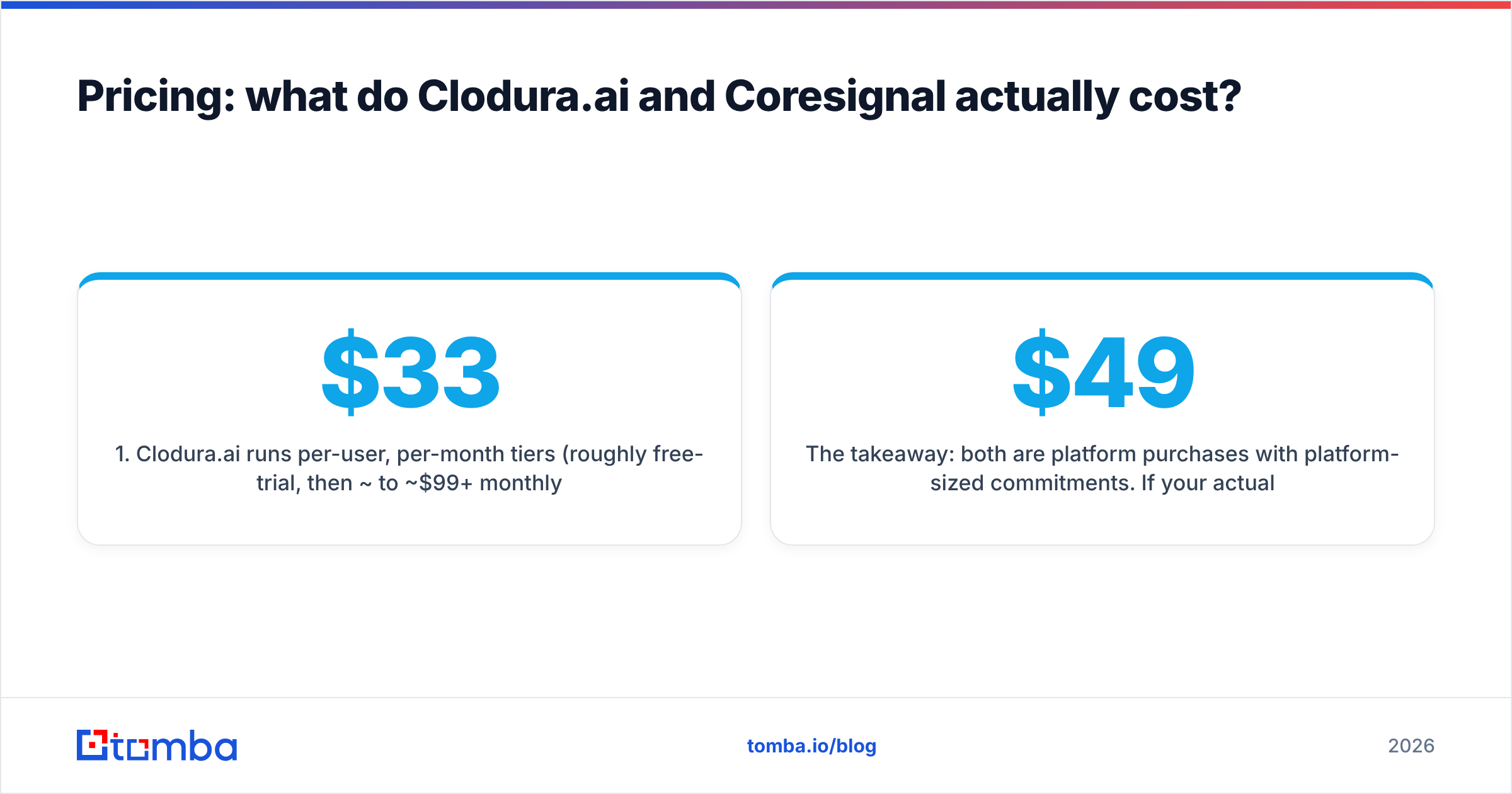
- Clodura.ai runs per-user, per-month tiers (roughly free-trial, then ~$33 to ~$99+ per user monthly depending on credits and features). Costs scale with seats and credit consumption, so a 5-rep team adds up fast.
- Coresignal prices by data volume and access type — API calls, records, or dataset subscriptions. Real usage commonly lands in the four-figures-per-month range, with annual commitments for the better rates.
- Hidden cost on Coresignal: engineering time. Budget for the developer who builds and maintains the integration, not just the license.
- Hidden cost on Clodura.ai: unused modules. If you already own a sequencer or CRM, you're paying for overlap.
The takeaway: both are platform purchases with platform-sized commitments. If your actual need is "find and verify emails for the prospects I already know about," you're overbuying. A focused tool with usage-based Tomba pricing — Free at 25 searches/mo, Starter at $49/mo, Growth at $99/mo — covers that job without a seat-based or four-figure floor.
When should you choose each tool?#
Match the tool to who's doing the work and what they're building.
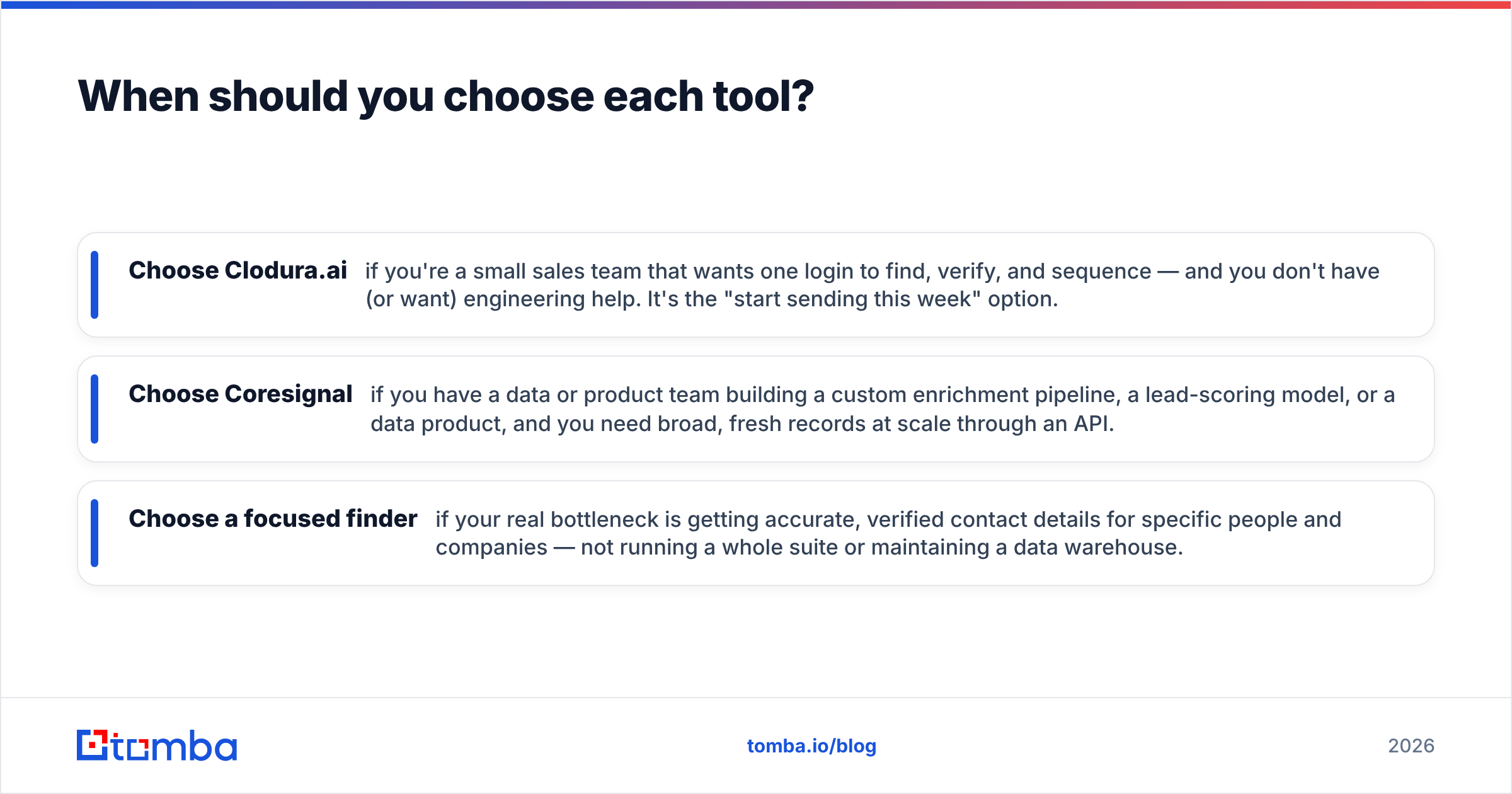
- Choose Clodura.ai if you're a small sales team that wants one login to find, verify, and sequence — and you don't have (or want) engineering help. It's the "start sending this week" option.
- Choose Coresignal if you have a data or product team building a custom enrichment pipeline, a lead-scoring model, or a data product, and you need broad, fresh records at scale through an API.
- Choose a focused finder if your real bottleneck is getting accurate, verified contact details for specific people and companies — not running a whole suite or maintaining a data warehouse.
A common reality: companies buy the big platform, use 30% of it, and still bolt on a dedicated email finder because the bundled one underperforms in their vertical. Mapping your actual workflow first saves you from paying for the other 70%.
How does Tomba fit into this comparison?#
Tomba isn't trying to be either of these — and that's the advantage. Where Clodura.ai bundles everything and Coresignal makes you build everything, Tomba does the contact-data job precisely and charges only for it.
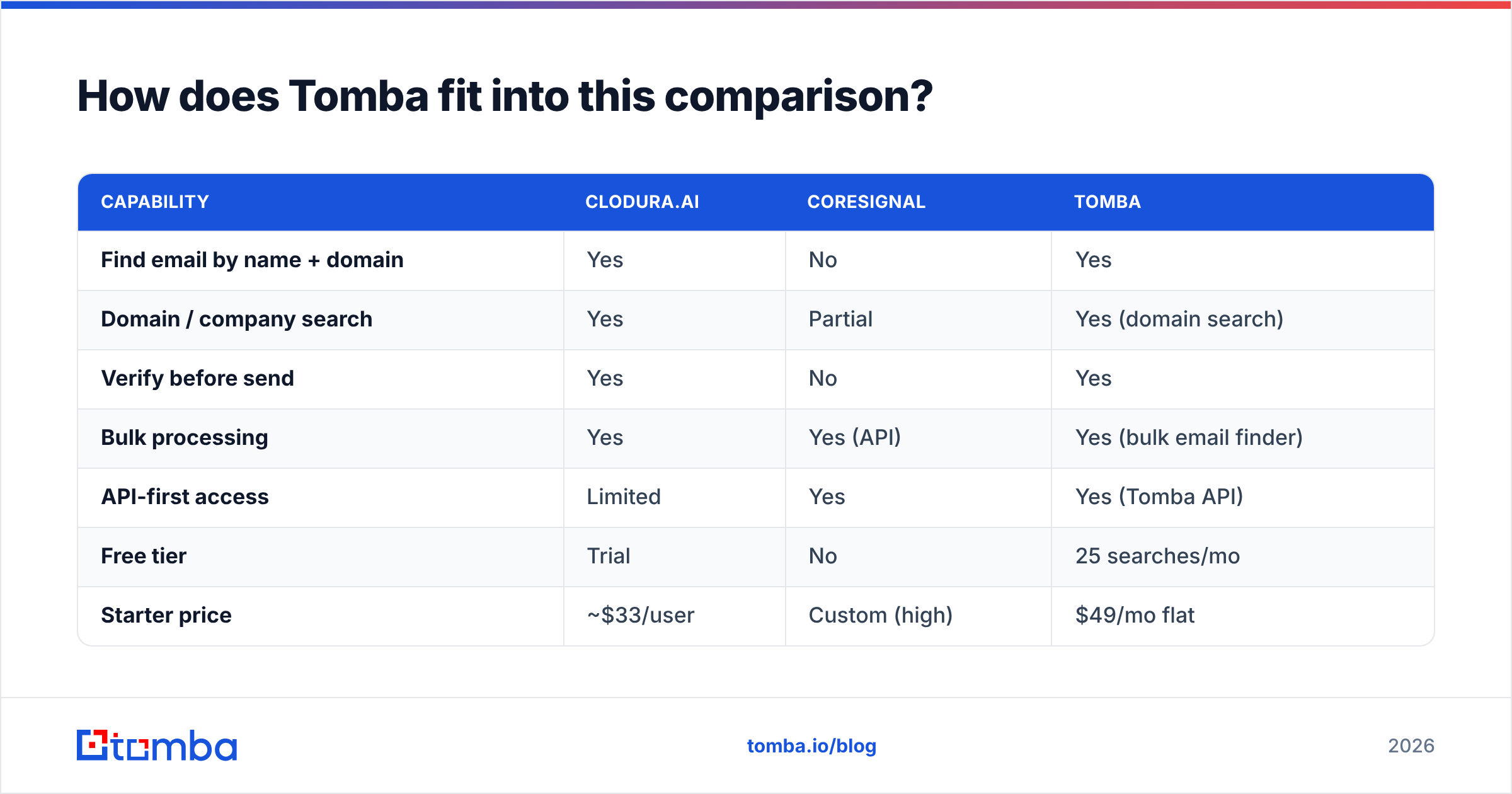
| Capability | Clodura.ai | Coresignal | Tomba |
|---|---|---|---|
| Find email by name + domain | Yes | No | Yes |
| Domain / company search | Yes | Partial | Yes (domain search) |
| Verify before send | Yes | No | Yes |
| Bulk processing | Yes | Yes (API) | Yes (bulk email finder) |
| API-first access | Limited | Yes | Yes (Tomba API) |
| Free tier | Trial | No | 25 searches/mo |
| Starter price | ~$33/user | Custom (high) | $49/mo flat |
If your stack already has a sequencer and a CRM, you don't need Clodura.ai's bundle — you need its data layer done well. If you don't have an engineering team, you can't realistically consume Coresignal — but you can call a clean email-finder API or use a Chrome extension the same day. Tomba slots into the gap both platforms leave: accurate, verified contact data, by UI or API, without a platform commitment.
It also plays nicely with the rest of your stack through native integrations — push verified contacts straight into HubSpot, Salesforce, or your sequencer instead of exporting CSVs by hand.
Frequently asked questions#
Is Clodura.ai a direct competitor to Coresignal? Not really. Clodura.ai is a sales-facing prospecting app; Coresignal is a developer-facing data provider. A team might even use Coresignal data inside a product and Clodura.ai for outbound. They overlap on "B2B data" but serve different buyers.
Which one has better email accuracy? Clodura.ai delivers verified, send-ready emails out of the box; Coresignal delivers data records that still need verification before you trust deliverability. For pure email accuracy at the point of send, a dedicated finder-plus-verifier workflow beats both.
Can I just use Coresignal's data for cold email? Only if you have the engineering resources to ingest, clean, and verify it. Raw aggregated records aren't deliverability-checked, so sending against them unverified risks high bounce rates and damaged sender reputation.
What's the cheapest way to get verified emails without a platform contract? A usage-based email finder. Tomba's free tier covers 25 searches monthly, and paid plans start at $49/mo flat — no per-seat pricing and no four-figure data minimums.
The bottom line#
Clodura.ai vs Coresignal is a choice between a finished workflow and raw building blocks. Clodura.ai wins for hands-off SDR teams; Coresignal wins for data engineers building at scale. Neither is the cheap, focused answer if all you truly need is accurate, verified contact data on demand.
For that job, start with the Tomba Email Finder. Find professional emails by domain, name, or company, verify them before you send, and access everything through a clean API or browser extension — with a free tier to test coverage in your vertical before you spend a dollar. Skip the platform tax; pay for the data you actually use.
Sources: Clodura.ai, Coresignal, G2
// get started
Find, verify and enrich your first contacts today
Start on the free plan with 25 searches a month, then scale when your team is ready.
Free plan · No credit card required · GDPR & CCPA
// about the author