Clodura.AI vs Crustdata: 2026 B2B Data Tool Comparison
Clodura.AI bundles prospecting and sequencing; Crustdata sells real-time data via API. See which B2B data engine fits your 2026 GTM stack — and where a focused finder beats both.
Clodura.AI vs Crustdata: Which B2B Data Engine Wins in 2026?
Picking between Clodura.AI and Crustdata is really a question about how you want to consume B2B data. One hands you a full prospecting cockpit. The other hands you a firehose of fresh data through an API and tells you to build. Neither is wrong — but choosing the wrong one for your team burns budget and stalls pipeline.
This breakdown compares both on data freshness, coverage, workflow, and price, then shows where a focused email-finding layer beats paying platform prices for contact discovery you only need in bulk.
TL;DR — The Fast Answer#
- Clodura.AI is an all-in-one sales prospecting platform: a 600M+ contact database, buyer intent, sequencing, and email verification bundled into one UI. Best for SDR teams who want everything in one login.
- Crustdata is a real-time data API and dataset company. It sells live company and people signals (headcount, funding, job changes) for engineering and RevOps teams who build their own tooling.
- Data freshness is Crustdata's headline strength; workflow breadth is Clodura's.
- Both are heavier and pricier than teams who only need accurate, verified contact emails at scale.
- If your real job is finding and verifying outreach-ready emails by domain, a dedicated email finder like Tomba covers that for a fraction of platform pricing.
What Is Clodura.AI?#
Clodura.AI is a sales intelligence and prospecting platform aimed at outbound teams. Think of it as a Swiss Army knife: the database, the intent signals, the sequencer, and the verifier all live behind one login, so an SDR rarely has to leave the tool to run a campaign.
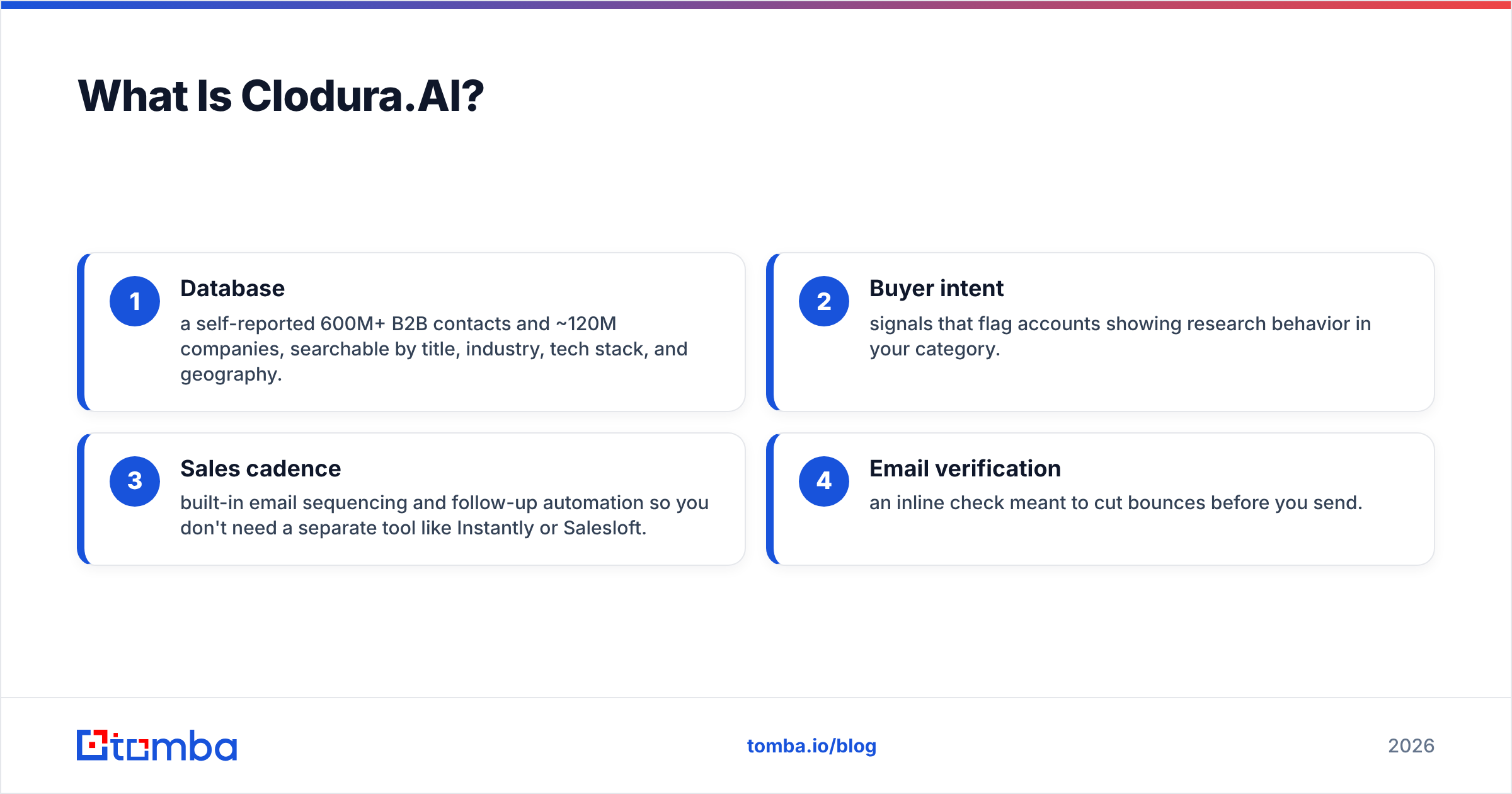
Its pitch centers on four pillars:
- Database — a self-reported 600M+ B2B contacts and ~120M companies, searchable by title, industry, tech stack, and geography.
- Buyer intent — signals that flag accounts showing research behavior in your category.
- Sales cadence — built-in email sequencing and follow-up automation so you don't need a separate tool like Instantly or Salesloft.
- Email verification — an inline check meant to cut bounces before you send.
The value is consolidation. For a small SDR team, one subscription replacing three tools is a real budget story. The tradeoff: bundled tools are rarely best-in-class at every job, and you pay for modules you may not touch.

What Is Crustdata?#
Crustdata is a real-time B2B data company that delivers data primarily through an API and flat datasets — not a polished click-around UI. It's built for people who write code or live in a data warehouse.
Where Clodura sells a workflow, Crustdata sells signals: company headcount trends, hiring velocity, funding events, web traffic, executive job changes, and people-level enrichment. The differentiator they lean on hardest is freshness — data refreshed on short cycles rather than quarterly, so a job change or layoff shows up days after it happens, not months.
That makes Crustdata a natural fit for:
- RevOps and data teams piping enrichment into Salesforce or HubSpot programmatically.
- Product teams building competitive-intelligence or sourcing features on top of live company data.
- Investors and analysts tracking growth signals across thousands of companies.
The cost of that power is build effort. There's no SDR-friendly cockpit; someone has to wire the API into your stack and maintain it.
Clodura.AI vs Crustdata: Side-by-Side Comparison#
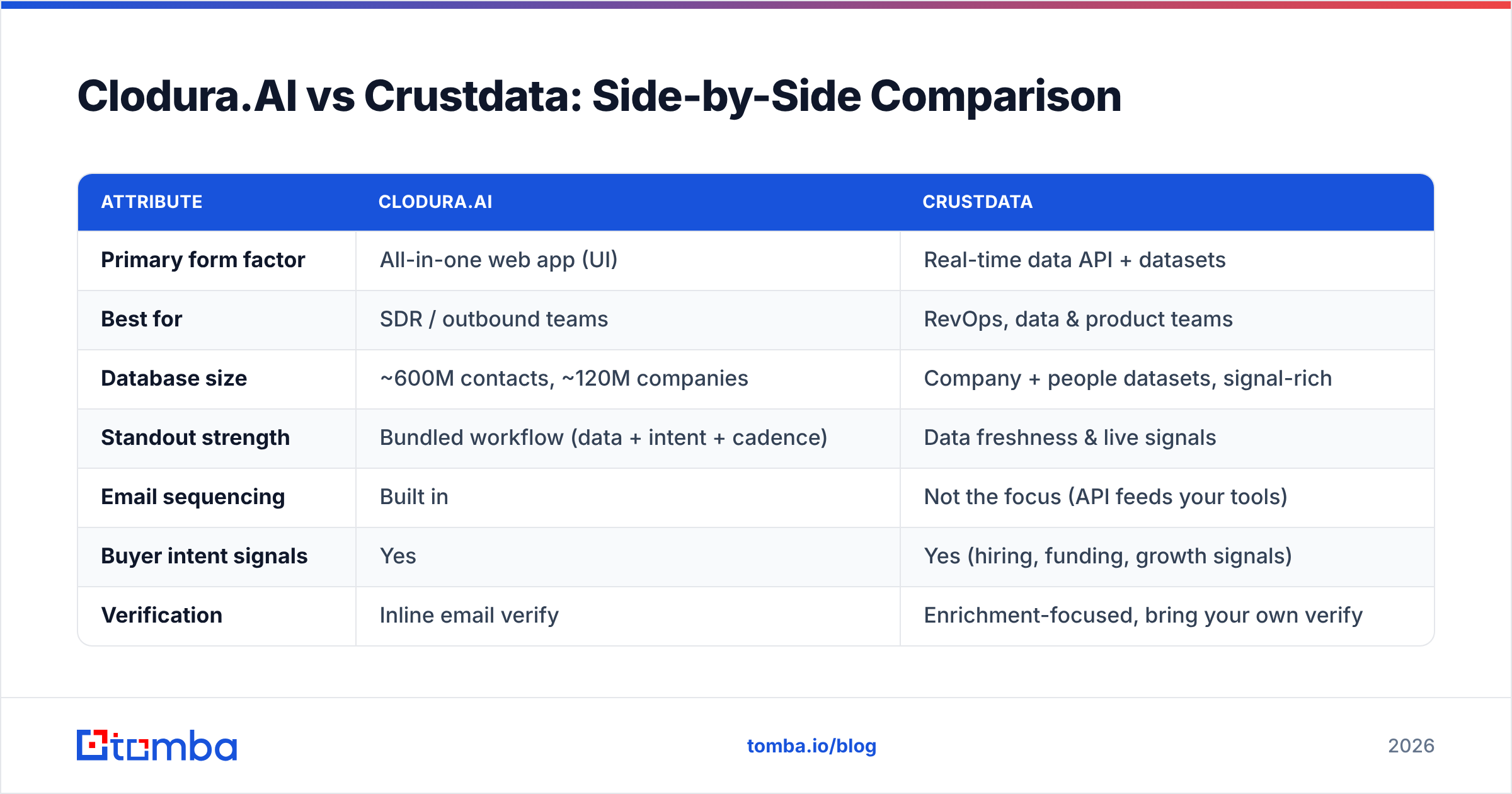
Here's the core comparison across the attributes that actually change a buying decision. (Pricing reflects publicly listed entry points as of 2026; both vendors quote custom enterprise tiers, so confirm current numbers directly.)
| Attribute | Clodura.AI | Crustdata |
|---|---|---|
| Primary form factor | All-in-one web app (UI) | Real-time data API + datasets |
| Best for | SDR / outbound teams | RevOps, data & product teams |
| Database size | ~600M contacts, ~120M companies | Company + people datasets, signal-rich |
| Standout strength | Bundled workflow (data + intent + cadence) | Data freshness & live signals |
| Email sequencing | Built in | Not the focus (API feeds your tools) |
| Buyer intent signals | Yes | Yes (hiring, funding, growth signals) |
| Verification | Inline email verify | Enrichment-focused, bring your own verify |
| Entry pricing | Free tier + paid plans (~$39–$99/user range) | Custom / usage-based, quote-driven |
| Learning curve | Low (point-and-click) | Higher (engineering required) |
| Weakness | Modules vary in depth | No turnkey SDR cockpit |
The pattern is clear: Clodura optimizes for the person running campaigns; Crustdata optimizes for the team building systems. Your org chart, more than your industry, should drive the pick.
Which Has Fresher, More Accurate Data?#
Crustdata wins on freshness; both lose ground to a dedicated verifier on email accuracy. Those are two different claims, so separate them.
Freshness is about how recently a record was refreshed. Crustdata's entire positioning is built on short refresh cycles, which matters most for time-sensitive signals — a VP changing jobs, a company doubling headcount, a fresh funding round. If your motion triggers off events, stale data isn't just annoying, it's wrong. Clodura's database is large and broadly maintained, but bundled databases historically refresh on slower cadences than a freshness-first vendor.
Accuracy of the email itself is a separate problem. A record can be perfectly fresh (the person really does work there) and still carry a guessed email that bounces. Bundled platforms verify inline, but verification quality varies, and catch-all domains routinely slip through and torch your sender reputation.
This is the gap a specialized layer fills. Running discovered contacts through a dedicated email verifier — and a real catch-all verifier for risky domains — protects deliverability in a way a bundled "verify" toggle rarely matches. According to G2 category reviews, deliverability complaints are the single most common knock against all-in-one prospecting suites, precisely because verification is an afterthought rather than the core product.
When Should You Choose Clodura.AI?#
Choose Clodura.AI when your bottleneck is workflow, not data engineering. The strongest fits:
- You run a small-to-mid SDR team and want one tool instead of stitching a database, a verifier, and a sequencer together.
- Your reps are not technical and need a point-and-click interface, not an API token.
- You value consolidated billing and a single vendor relationship over best-of-breed depth.
- Intent-based outbound is your motion and you want signals living next to your contact list.
The honest caveat: when you bundle, you accept "good enough" on each module. If email deliverability or data freshness is mission-critical, you'll likely bolt on a specialist anyway — which erodes the all-in-one savings.
When Should You Choose Crustdata?#
Choose Crustdata when data is an input to a system you're building, not a list a human scrolls through. Strong signals you're in this camp:
- You have engineering or RevOps resources that can consume an API and maintain the integration.
- Your use case is event-driven — triggering plays off job changes, funding, or hiring spikes.
- You're enriching a CRM or warehouse programmatically rather than working out of a prospecting UI.
- Freshness is non-negotiable and you'd rather build the last mile yourself than accept a vendor's UI opinions.
The caveat here is the mirror image of Clodura's: Crustdata gives you raw power and expects you to supply the workflow. If you don't have someone to build and own the pipeline, that power sits unused.
Where Does a Dedicated Email Finder Fit?#
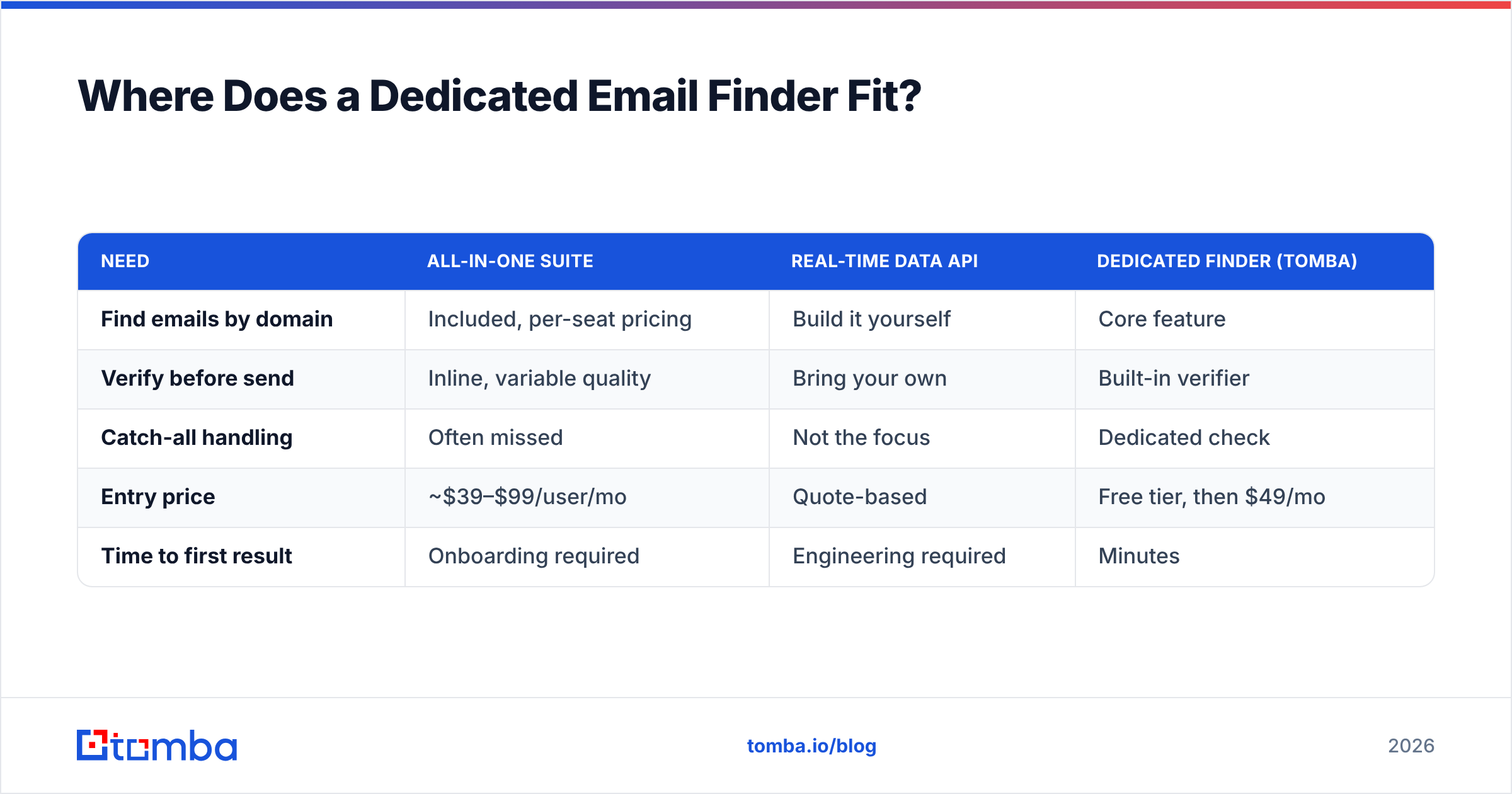
Both platforms treat contact email as one feature among many. For a large share of teams, that one feature is the whole job — and paying platform prices for it is overkill.
If your day-to-day is "I have a list of companies and names, get me verified emails I can actually send to," a focused tool is faster and cheaper:
- Domain-level discovery — pull every reachable contact at a target company with domain search, no full-suite subscription required.
- Bulk runs — process thousands of rows through a bulk email finder instead of paying per-seat platform fees.
- API-first — wire discovery and verification directly into your stack with the Tomba API, the same build-it-yourself ethos Crustdata buyers prefer, but scoped to the email problem.
Here's how the cost framing compares for a team whose primary need is verified contact emails:
| Need | All-in-one suite | Real-time data API | Dedicated finder (Tomba) |
|---|---|---|---|
| Find emails by domain | Included, per-seat pricing | Build it yourself | Core feature |
| Verify before send | Inline, variable quality | Bring your own | Built-in verifier |
| Catch-all handling | Often missed | Not the focus | Dedicated check |
| Entry price | ~$39–$99/user/mo | Quote-based | Free tier, then $49/mo |
| Time to first result | Onboarding required | Engineering required | Minutes |
Tomba's pricing starts free with 25 searches per month, then $49/mo (Starter), $99/mo (Growth), and $249/mo (Pro) — billed by usage, not per seat. For teams where contact discovery is the actual deliverable, that's a different order of cost than a multi-module platform license.
This isn't an argument that Tomba replaces Clodura or Crustdata for every job. If you need buyer intent dashboards or live funding signals, you need those products. But if you've been justifying a full suite mostly to get emails, a finder plus verifier covers it for less.
Clodura.AI vs Crustdata: Pros and Cons#
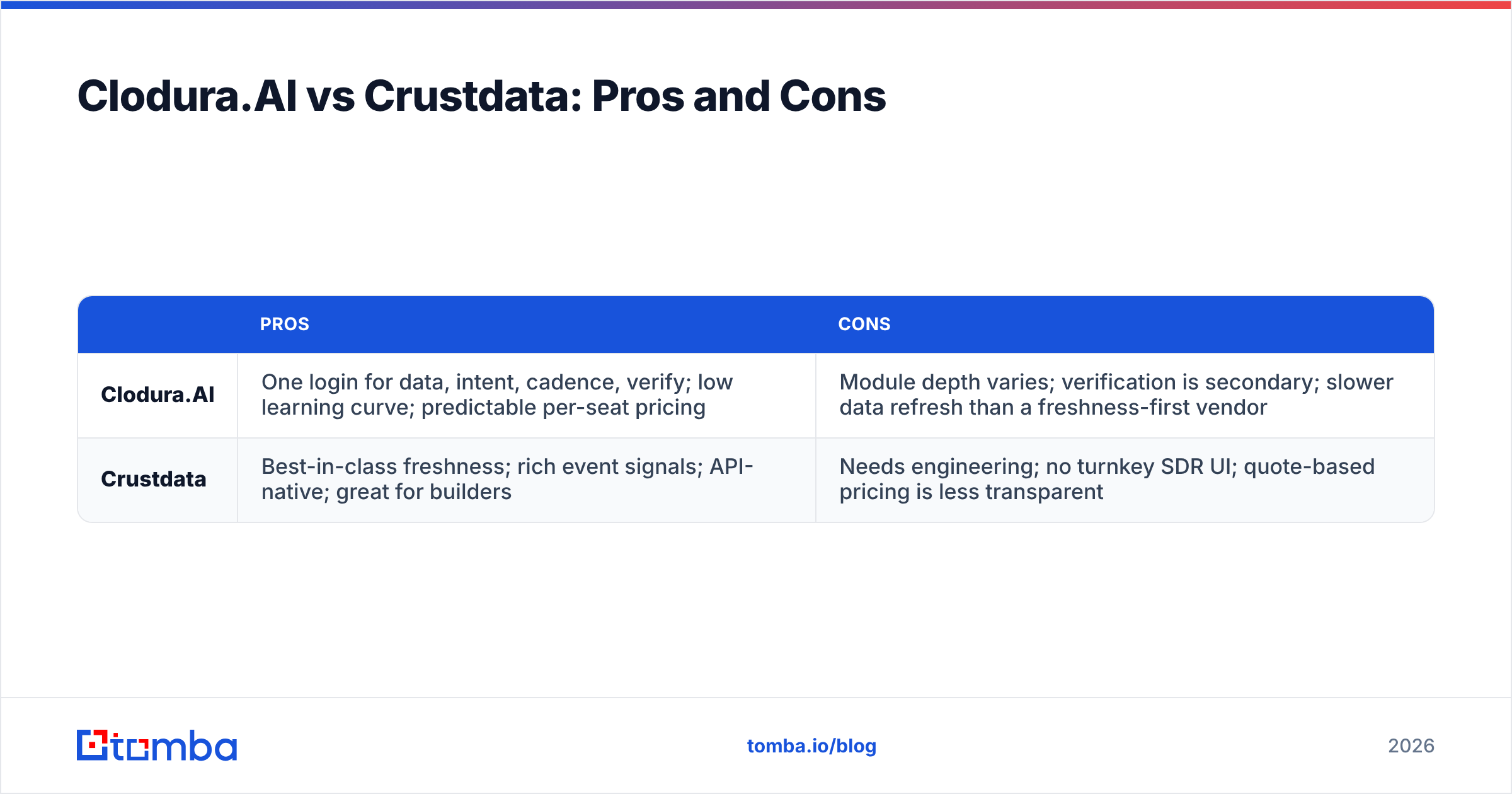
| Pros | Cons | |
|---|---|---|
| Clodura.AI | One login for data, intent, cadence, verify; low learning curve; predictable per-seat pricing | Module depth varies; verification is secondary; slower data refresh than a freshness-first vendor |
| Crustdata | Best-in-class freshness; rich event signals; API-native; great for builders | Needs engineering; no turnkey SDR UI; quote-based pricing is less transparent |
How Do You Actually Decide?#
Run your decision through three questions, in order:
- Who consumes the data — a rep or a system? Rep → Clodura. System → Crustdata.
- Is your motion event-driven or list-driven? Event-driven (job changes, funding) leans Crustdata. Steady list-building leans Clodura.
- Is your real need verified emails at scale? If yes, neither suite is the cheapest path — a dedicated finder + email verification wins on cost and deliverability.
Most teams discover their honest answer to question three is "yes, mostly," and that they were about to overpay for two features inside a ten-feature platform. For background on why verification quality drives outbound results, HubSpot's research on email deliverability is a useful neutral reference — bounce rate, not database size, is what kills sender reputation.
The Bottom Line#
Clodura.AI and Crustdata solve different shapes of the same problem. Clodura packages B2B data into a ready-to-run SDR workflow; Crustdata delivers fresher data as an API for teams who build. Pick Clodura for hands-on reps and consolidated tooling. Pick Crustdata for engineering-led, signal-driven enrichment.
But before you sign either contract, be honest about what you're buying it for. If 80% of the value you expect is "find me accurate, send-ready emails," you can get that faster and cheaper with a focused tool.
Start free with the Tomba Email Finder — 25 searches a month at no cost, verified results, domain search, and an API that drops straight into your stack. Find the emails first, then decide whether you actually need the rest of the platform. Most teams find they don't.
// get started
Find, verify and enrich your first contacts today
Start on the free plan with 25 searches a month, then scale when your team is ready.
Free plan · No credit card required · GDPR & CCPA
// about the author