CloduraAI vs DealSignal 2026: B2B Sales Data Compared
CloduraAI and DealSignal both promise clean B2B contact data, but they price, source, and verify it very differently. Here's the honest 2026 breakdown.
When you weigh CloduraAI vs DealSignal, it comes down to one question. Do you want an all-in-one outbound platform with a built-in database? Or a managed data service that hand-builds lists to your spec? Both sit in the B2B sales intelligence category. Both sell "accurate contact data." And both quote very different numbers depending on volume. This guide breaks down where each one earns its price in 2026. It also shows where a focused email-finding layer like Tomba does the same job for far less.
TL;DR — CloduraAI vs DealSignal at a glance#
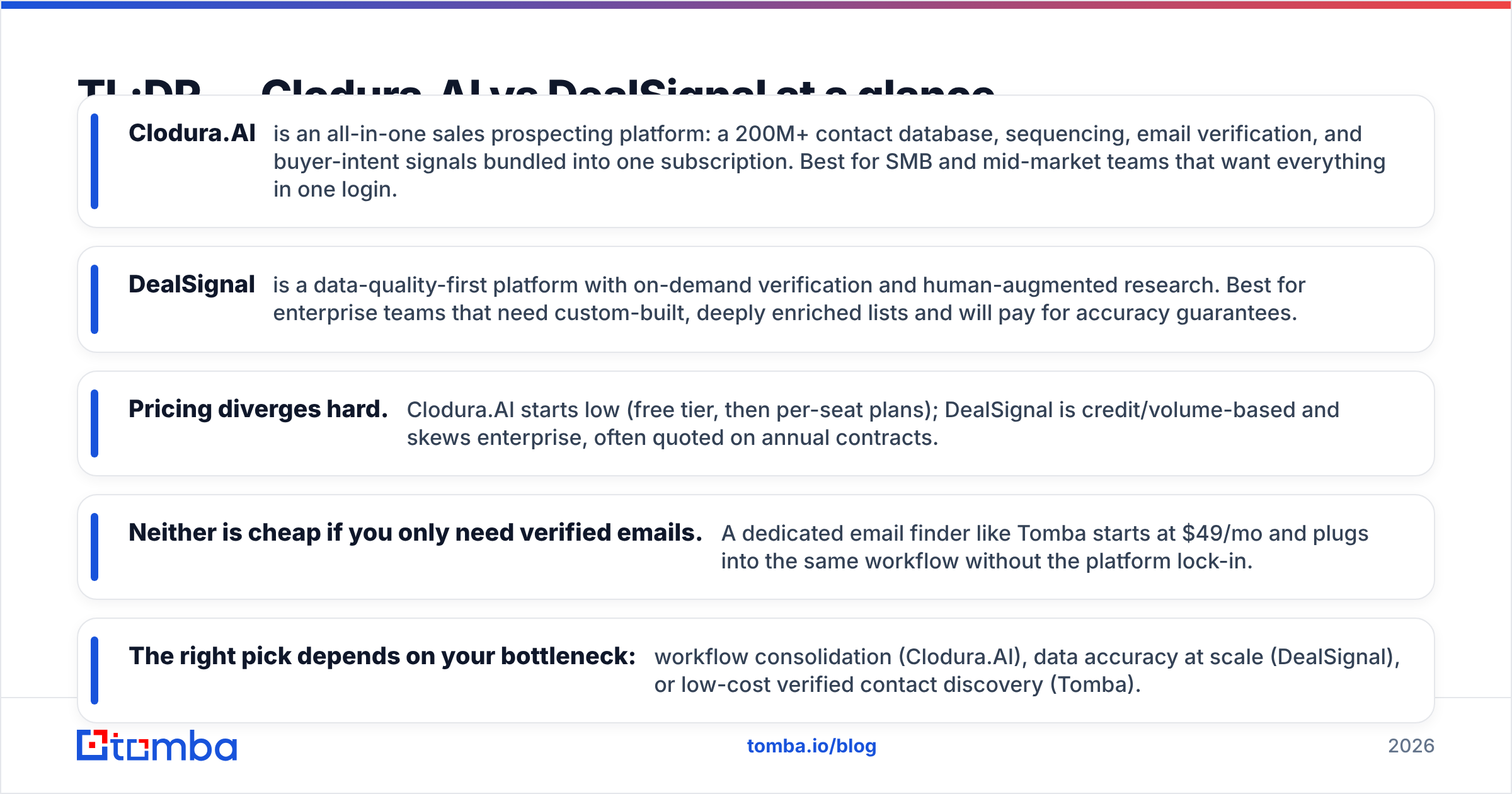
- CloduraAI is an all-in-one sales prospecting platform. You get a 200M+ contact database, sequencing, email verification, and buyer-intent signals in one subscription. It fits SMB and mid-market teams that want everything in one login.
- DealSignal is a data-quality-first platform. It uses on-demand verification and human-augmented research. It fits enterprise teams that need custom-built, deeply enriched lists and will pay for accuracy guarantees.
- Pricing diverges hard. CloduraAI starts low (free tier, then per-seat plans). DealSignal is credit-based, skews enterprise, and is often quoted on annual contracts.
- Neither is cheap if you only need verified emails. A dedicated email finder like Tomba starts at $49/mo. It plugs into the same workflow without the platform lock-in.
- The right pick depends on your bottleneck: workflow consolidation (CloduraAI), data accuracy at scale (DealSignal), or low-cost verified contact discovery (Tomba).
What is CloduraAI?#
CloduraAI is a sales prospecting platform built around its own contact database. That database holds roughly 200 million B2B contacts and 18 million companies, by the vendor's numbers. The pitch is consolidation. Instead of paying for a data tool, a sequencer, and a verifier separately, you get them in one place. You get a database, email sequencing, a built-in verifier, direct dials, org charts, and buyer-intent signals under one subscription.
Think of it like a grocery store with its own kitchen. You can buy the raw ingredients (contacts) and walk out. Or you can use the prepared-meals counter (sequences, cadences) without leaving the building. That bundling is the main appeal for smaller teams. They don't want to stitch five tools together.
The trade-off is depth. All-in-one platforms tend to be good enough at many things rather than excellent at one. CloduraAI's database is broad. But reps often supplement it for hard-to-reach contacts, and its sequencing is lighter than dedicated tools like Outreach or Salesloft.
What is DealSignal?#
DealSignal is a B2B data platform that leads with accuracy, not breadth. Its model mixes machine-driven aggregation with on-demand verification. When you request contacts, it re-verifies emails, phone numbers, and job titles at the moment of delivery. It does not serve whatever was last cached. DealSignal also offers human-augmented research for hard targets. It publishes accuracy guarantees, commonly cited around 97%+ for delivered records.
If CloduraAI is the grocery store, DealSignal is the specialty butcher who cuts to order. You give them the persona, geography, and firmographics. They assemble and freshly verify the list. That helps enterprise demand-gen teams running large, compliance-sensitive campaigns. For those teams, a 20% bounce rate is a real cost.
The catch is price and motion. DealSignal is built for volume buyers and annual commitments. Say a two-rep startup needs 300 verified emails this week. DealSignal is overkill, both in cost and in the procurement cycle it takes to start.
CloduraAI vs DealSignal: how do they compare?#
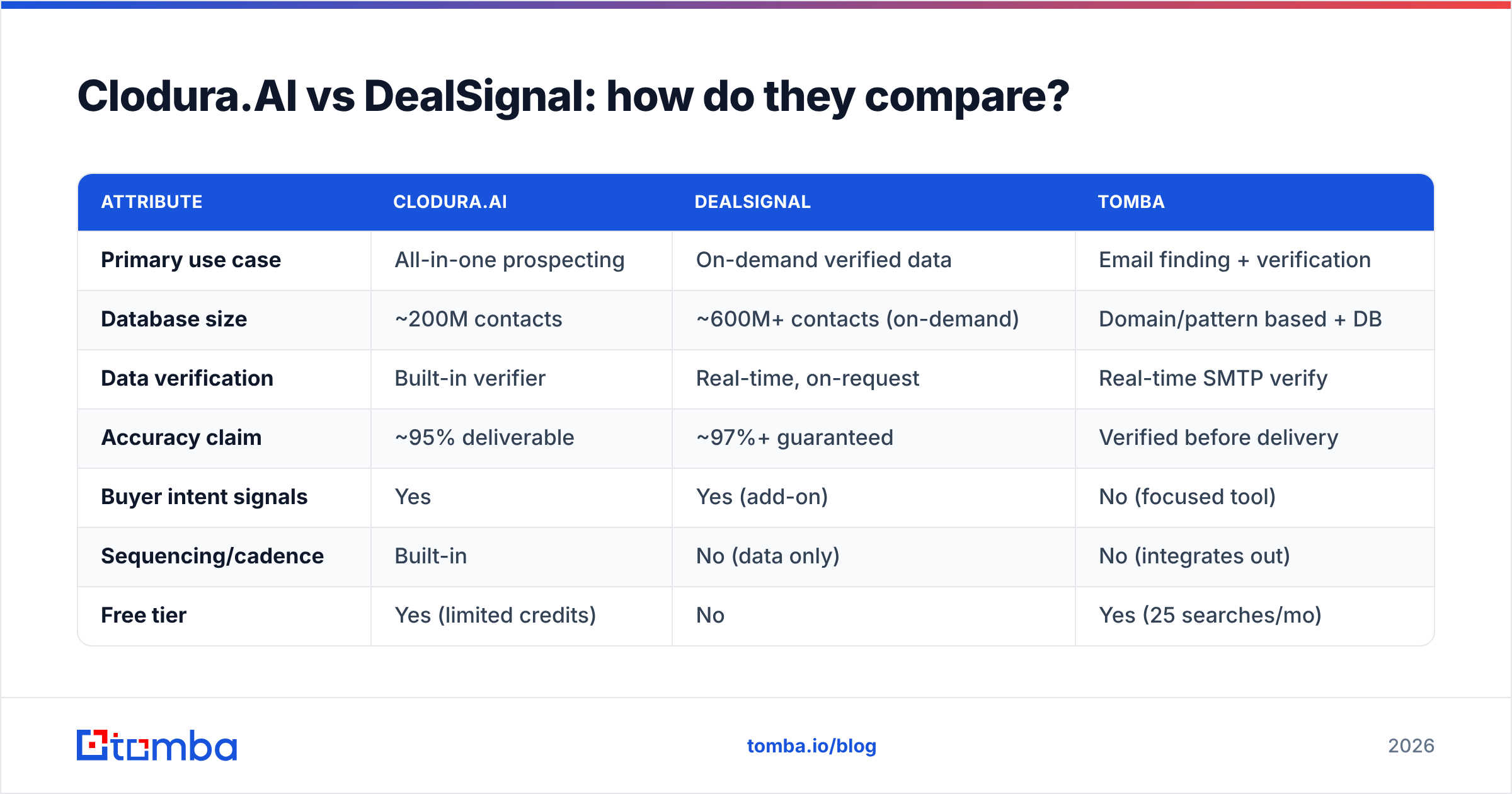
Here's the core feature-and-pricing comparison. The numbers reflect publicly listed plans and typical vendor quotes as of 2026. Enterprise pricing is negotiated, so treat the DealSignal column as directional.
| Attribute | CloduraAI | DealSignal | Tomba |
|---|---|---|---|
| Primary use case | All-in-one prospecting | On-demand verified data | Email finding + verification |
| Database size | ~200M contacts | ~600M+ contacts (on-demand) | Domain/pattern based + DB |
| Data verification | Built-in verifier | Real-time, on-request | Real-time SMTP verify |
| Accuracy claim | ~95% deliverable | ~97%+ guaranteed | Verified before delivery |
| Buyer intent signals | Yes | Yes (add-on) | No (focused tool) |
| Sequencing/cadence | Built-in | No (data only) | No (integrates out) |
| Free tier | Yes (limited credits) | No | Yes (25 searches/mo) |
| Entry price | ~$33–$99/seat/mo | Credit-based, enterprise | $49/mo Starter |
| Best for | SMB / mid-market | Enterprise demand gen | Lean teams, devs, agencies |
| API access | Limited | Yes | Full email finder API |
A few honest takeaways from the table:
- CloduraAI wins on bundling. Want database + sequencer + verifier in one bill? It's the cleaner buy.
- DealSignal wins on guaranteed accuracy and scale. Its on-demand re-verification genuinely cuts bounce risk on big lists.
- Both lose on focus pricing. Maybe you just need to find and verify the right email for one person at one company. Then you're paying for a lot of surface area you won't use.
- Intent data is table stakes now. Both include it. But intent without clean contact data is just noise.
Which one has better data accuracy?#
DealSignal has the edge on paper. The reason is architectural, not marketing. Re-verifying a record at the moment of request beats serving one that was verified six months ago. B2B data decays at roughly 2–3% per month as people change jobs. So a static database is always aging out from the day it's built. DealSignal's on-demand model is built to fight that decay.
CloduraAI's built-in verifier is solid for a bundled feature. But it verifies against its own database snapshot. That works for warm, recently updated records. It is weaker for long-tail contacts.
Still, "accuracy" is the wrong battle to fight on a credit-card budget. The most cost-effective play is simple. Find candidate emails from the source — the company's domain and naming pattern — and SMTP-verify them in real time. That's what a dedicated email verifier does. It's why many teams pair a cheap finder with their platform of choice. They skip paying enterprise rates for verification alone. You can also catch tricky accept-all domains with a catch-all verifier instead of guessing.
For more on where contact data comes from and why freshness matters, G2's sales intelligence software category is a useful neutral reference. Use it to compare vendor claims side by side.
Which one is better for cold email and deliverability?#
CloduraAI, if you want the sending built in. It includes sequencing and an email verifier. So you can build a list and start cadences without leaving the tool. For a small team, that's a real time-saver.
But "deliverability" is a separate discipline from "data." Neither platform replaces good email deliverability hygiene. That means warmup, SPF/DKIM/DMARC, and list cleaning. A verified list reduces hard bounces, which protects your sender reputation. But you still need the sending fundamentals right. If your bounce rate creeps over 2–3%, mailbox providers throttle you. It won't matter which database the addresses came from.
DealSignal is data-only — there's no sending layer. So you'd pair it with a sequencer like Instantly, Smartlead, or Outreach. That's more tools. But it lets you pick a best-in-class sender instead of an adequate bundled one.
The lean alternative is simple. Use Tomba's domain search to pull every verified address at a target company. Push them to your sequencer via the HubSpot integration or Zapier. Keep your deliverability tooling separate. You get clean data and a free choice of sender, with no platform premium for a verifier you'll use once per contact.
Which one is better value?#
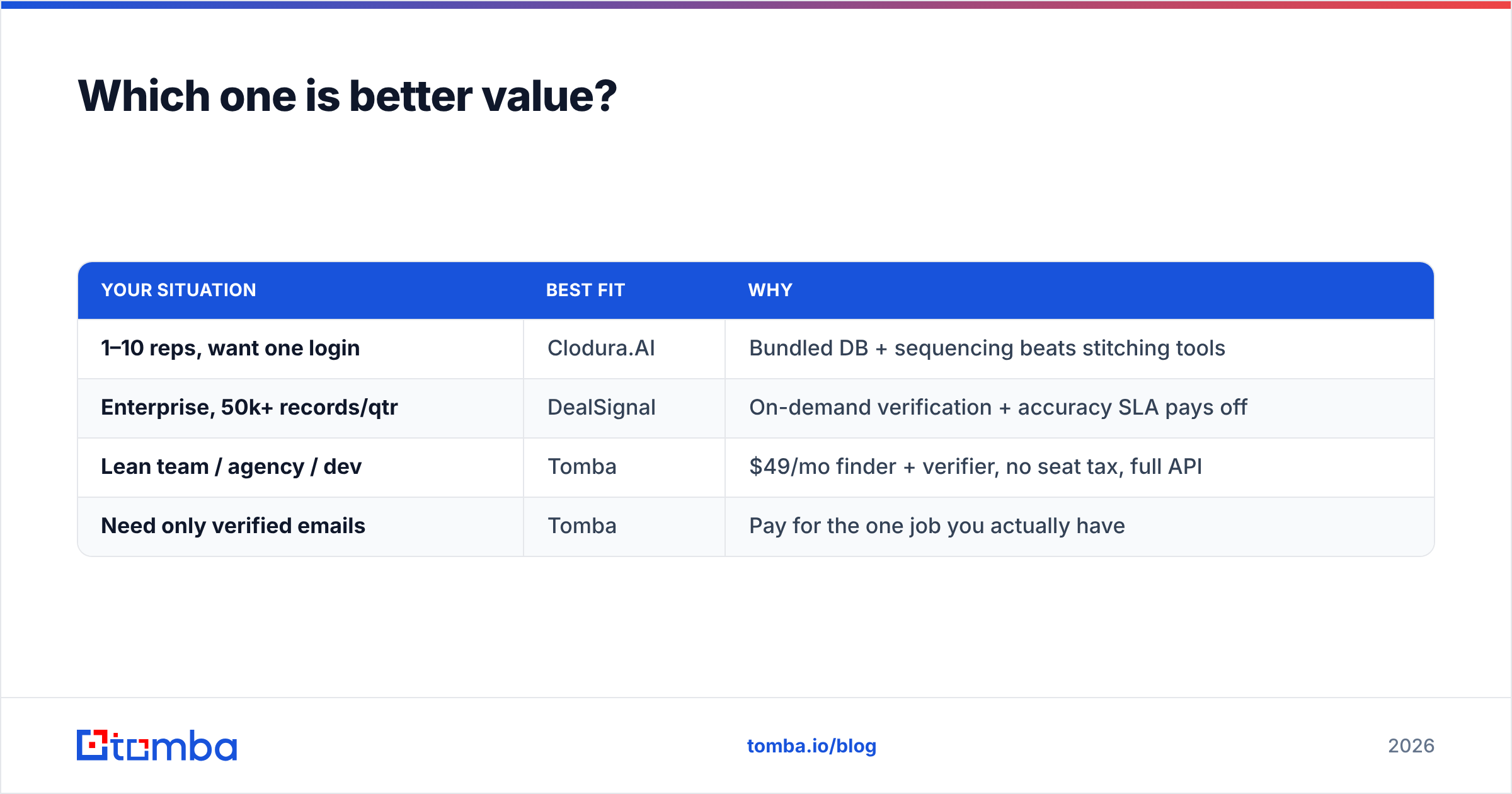
It depends on your volume and motion. Here are three honest scenarios:
| Your situation | Best fit | Why |
|---|---|---|
| 1–10 reps, want one login | CloduraAI | Bundled DB + sequencing beats stitching tools |
| Enterprise, 50k+ records/qtr | DealSignal | On-demand verification + accuracy SLA pays off |
| Lean team / agency / dev | Tomba | $49/mo finder + verifier, no seat tax, full API |
| Need only verified emails | Tomba | Pay for the one job you actually have |
Platform tools earn their keep when you use the full surface area — intent, sequencing, org charts, dials. Are you buying a $99/seat platform to do basic email finding and verification? Then you're overpaying. Tomba's pricing starts at $49/mo for the Starter plan. It includes a free tier of 25 searches, so you can test accuracy before you commit. There's also a bulk email finder for list-building runs. There's no per-seat tax. That matters when an agency needs the same data across a whole pod.
For a deeper look at how buyers evaluate these platforms, two sources help. Forrester's research on B2B data providers and the buyer reviews on Capterra are both worth scanning before you sign anything annual.
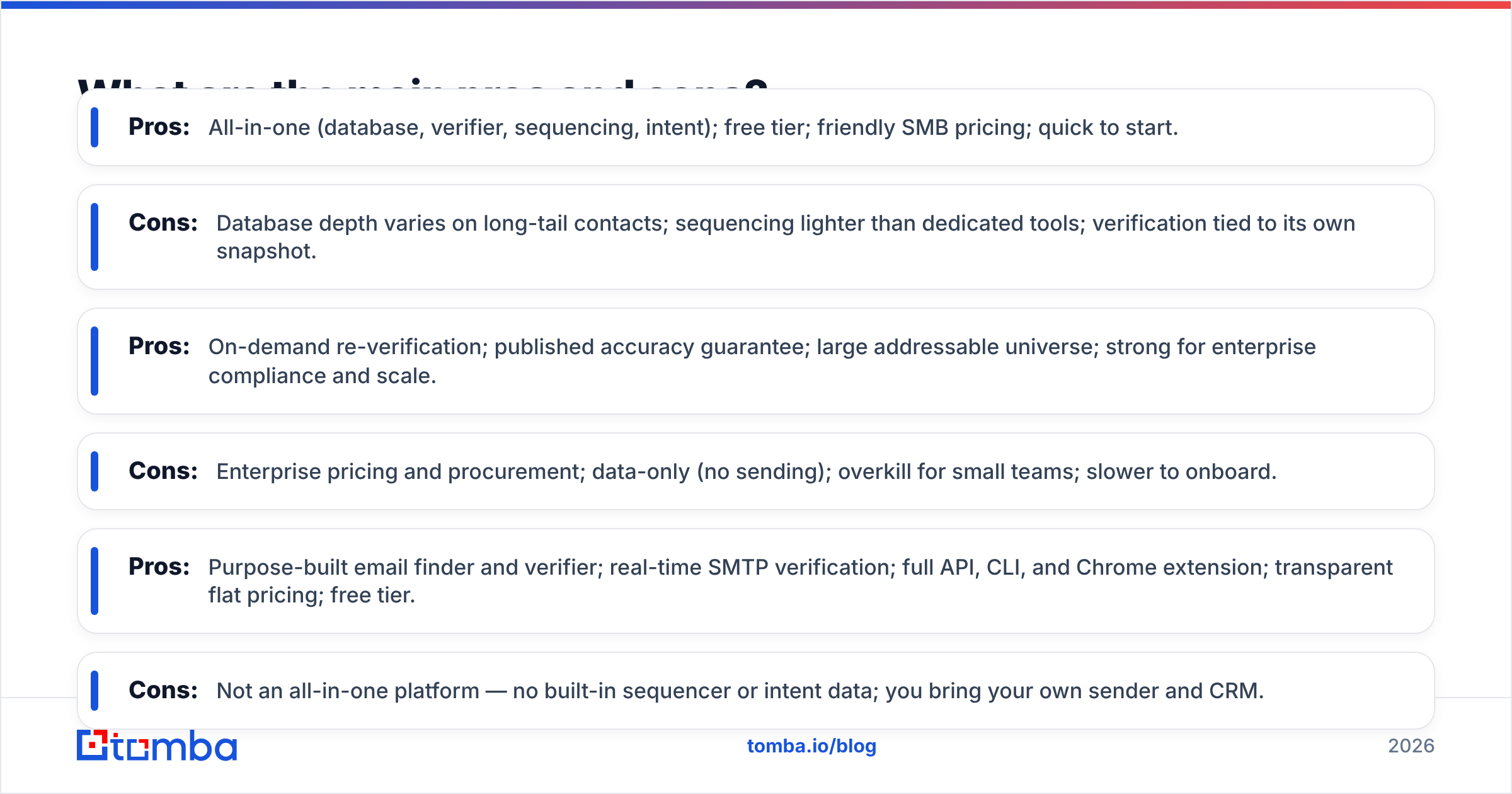
What are the main pros and cons?#
CloduraAI
- Pros: All-in-one (database, verifier, sequencing, intent); free tier; friendly SMB pricing; quick to start.
- Cons: Database depth varies on long-tail contacts; sequencing is lighter than dedicated tools; verification is tied to its own snapshot.
DealSignal
- Pros: On-demand re-verification; published accuracy guarantee; large addressable universe; strong for enterprise compliance and scale.
- Cons: Enterprise pricing and procurement; data-only (no sending); overkill for small teams; slower to onboard.
Where Tomba fits
- Pros: Purpose-built email finder and verifier; real-time SMTP verification; full API, CLI, and Chrome extension; transparent flat pricing; free tier.
- Cons: Not an all-in-one platform — no built-in sequencer or intent data; you bring your own sender and CRM.
That last "con" is the point. Tomba does one layer extremely well and integrates out. It doesn't lock you into a suite. If you already have a CRM and a sequencer, that's a feature, not a gap.
How should you choose between CloduraAI and DealSignal?#
Work backward from your real bottleneck:
- If the bottleneck is tool sprawl — too many subscriptions, too much manual hand-off — CloduraAI's bundle is the rational consolidation play.
- If the bottleneck is bounce rates and bad data at scale — and you have an enterprise budget — DealSignal's on-demand verification solves it directly.
- If the bottleneck is "I can't reliably find verified emails without overpaying" — neither platform is the efficient answer. A focused finder is.
Many teams land on a practical hybrid. Keep your existing CRM and sequencer. Use Tomba for verified contact discovery, with data enrichment to fill in titles and company fields. Then graduate to a full platform only when intent data and org charts become a daily need. You stop paying for capability you don't use yet. And you keep your data layer swappable.
The bottom line#
CloduraAI and DealSignal are both legitimate choices. They just solve different problems. CloduraAI is the consolidation play for SMB and mid-market teams that want everything in one place. DealSignal is the accuracy-and-scale play for enterprises that treat data quality as a line item worth guaranteeing. Pick based on your pain — workflow sprawl or data decay — not on which marketing page sounds shinier.
But strip the comparison down to what most teams do every day. You find the right person, get their verified email, and move on. You don't need an enterprise suite to do that well. Start with Tomba's Email Finder: real-time verification, a free tier of 25 searches to test accuracy yourself, and Starter pricing at $49/mo with no per-seat fees. Find and verify the contacts you need, plug them into whatever stack you already run, and pay for the platform layer only when you genuinely outgrow the basics.
// get started
Find, verify and enrich your first contacts today
Start on the free plan with 25 searches a month, then scale when your team is ready.
Free plan · No credit card required · GDPR & CCPA
// about the author