Clodura.ai vs DeBounce: Which B2B Email Tool Wins in 2026?
Clodura.ai bundles prospecting data; DeBounce verifies lists. We compare features, pricing, accuracy, and where Tomba beats both in 2026.
You are comparing two tools that do not do the same job. Fix that before you spend a dollar. The real Clodura.ai vs DeBounce question is simple: do you need to find contacts, or clean them?
TL;DR
- Clodura.ai is a B2B sales intelligence and prospecting platform — it gives you a contact database, email finding, and outreach sequencing in one place.
- DeBounce is a focused email verification service — it cleans lists you already have and does almost nothing else.
- Pitting them head to head only makes sense if your real question is "do I need data, or do I need to clean data?" — they solve opposite ends of the pipeline.
- On accuracy and price-per-verification, DeBounce is competitive; on database depth, Clodura.ai is the heavier tool but costs more.
- If you want find + verify in one workflow without stitching two vendors together, Tomba covers both jobs at a lower entry price ($49/mo Starter).
What is Clodura.ai?#
Clodura.ai is an all-in-one sales intelligence platform. Think of it as a prospecting cockpit: a B2B contact database (the company claims hundreds of millions of contacts), an email finder, direct-dial discovery, buyer-intent signals, and a built-in sequencer for cold outreach. The pitch is that a rep can build a list, find verified emails, and start a campaign without leaving the tool.
That breadth is the selling point and the catch. You pay for the whole suite even if you only use the email finder. For teams that want one subscription to replace three, that math works. For someone who already runs HubSpot or Salesforce and just needs accurate contact data, a lot of Clodura.ai's surface area goes unused.
Clodura.ai leans on its database plus a verification layer, so the emails it hands you are meant to be campaign-ready. In practice, database tools age — contacts change jobs, domains migrate — so a verification step still matters before you hit send.
What is DeBounce?#
DeBounce is a dedicated email verification service. You upload a list, it checks each address through syntax validation, MX record lookups, SMTP probing, and catch-all and disposable-domain detection, then hands back a clean list sorted into deliverable, risky, and invalid.
DeBounce does not find emails. It has no prospecting database, no sequencer, no intent data. It is a scalpel, not a Swiss Army knife. That focus is a feature: pay-as-you-go pricing, a generous accuracy claim, and a fast bulk pipeline make it a popular choice for teams that already have lists and just need them scrubbed before a send.
If you are weighing dedicated verifiers, it is worth seeing how a DeBounce alternative stacks up — verification accuracy varies more between vendors than the marketing pages admit.
)
Clodura.ai vs DeBounce: what's the core difference?#
The cleanest way to see it: one tool creates your list, the other cleans it. Here is the practical split.
- Primary job — Clodura.ai finds and enriches contacts; DeBounce validates existing addresses.
- Where it sits in your pipeline — Clodura.ai at the top (prospect discovery); DeBounce at the bottom (pre-send hygiene).
- What you bring to it — Clodura.ai needs only a target profile; DeBounce needs a list you already own.
- What replaces it — Clodura.ai competes with Apollo, ZoomInfo, and Cognism; DeBounce competes with ZeroBounce, NeverBounce, and Bouncer.
- Buyer — Clodura.ai is bought by SDR teams building pipeline; DeBounce is bought by email marketers and ops protecting sender reputation.
So "Clodura.ai vs DeBounce" is really a question about which problem is bleeding you money right now. If your reps can't find contacts, a verifier won't help. If your bounce rate is wrecking email deliverability, a database won't help either.
How do they compare on features and pricing?#
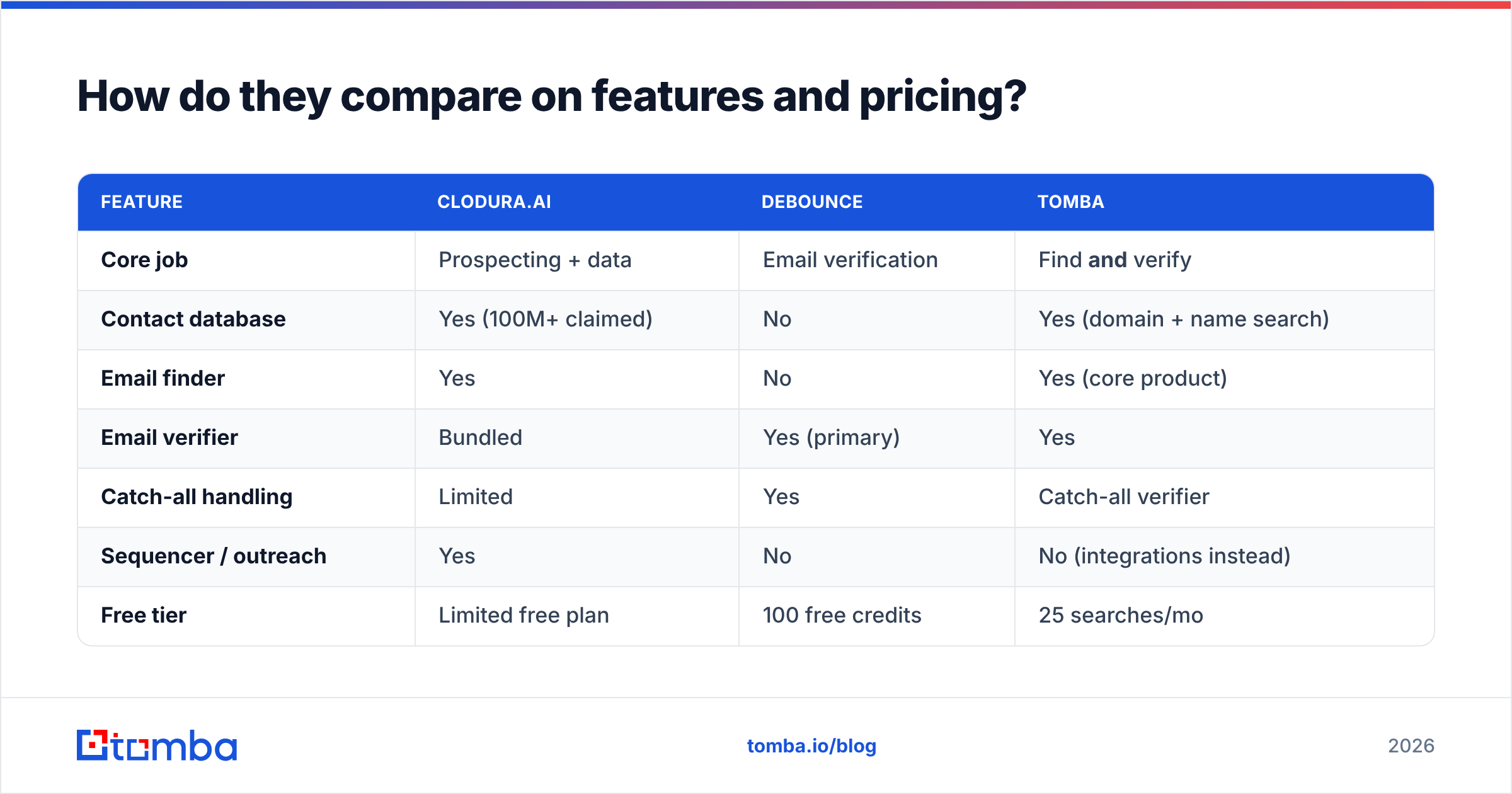
| Feature | Clodura.ai | DeBounce | Tomba |
|---|---|---|---|
| Core job | Prospecting + data | Email verification | Find and verify |
| Contact database | Yes (100M+ claimed) | No | Yes (domain + name search) |
| Email finder | Yes | No | Yes (core product) |
| Email verifier | Bundled | Yes (primary) | Yes |
| Catch-all handling | Limited | Yes | Catch-all verifier |
| Sequencer / outreach | Yes | No | No (integrations instead) |
| Free tier | Limited free plan | 100 free credits | 25 searches/mo |
| Entry paid price | ~$33–$99/mo (annual) | Pay-as-you-go from ~$10 | $49/mo Starter |
| Best for | Full-funnel SDR teams | List cleaning only | Accurate find + verify |
| API access | Yes | Yes | Tomba API |
A few honest notes on this table. DeBounce's pay-as-you-go model is cheap if you verify occasionally — you buy credits and they don't expire fast. Clodura.ai's entry pricing looks low on annual billing, but the useful tiers (more credits, intent data, more sequences) climb quickly, which is normal for database platforms.
They are hard to compare on price because you are buying different units. DeBounce sells verifications. Clodura.ai sells access to data plus seats. One is a per-email cost; the other is a platform subscription. Don't let a side-by-side number trick you into thinking you're comparing like for like.
Which one is more accurate?#
Accuracy means two different things here, so answer the right version of the question.
For verification accuracy — does an address actually exist and accept mail — DeBounce is the relevant tool, and it performs well against its peers. The variable that trips up every verifier is the catch-all domain, where the server accepts all mail whether or not the mailbox exists. No verifier is perfect on catch-alls. The better ones flag them as "risky" instead of guessing "valid." Treat any vendor claiming 99%+ on catch-alls with suspicion.
For data accuracy — is the contact still at the company, and is the email pattern right — Clodura.ai is the relevant tool, and database freshness is its real battleground. Contacts decay roughly 2–3% per month as people change jobs. A list you pulled six months ago is already stale. That is exactly why even a database tool needs a verification pass before send.
This is where a find-and-verify tool earns its keep: it verifies at the moment of discovery, so you're not chaining a six-month-old database export through a separate scrubber and hoping. For a closer look at where the underlying records come from, Tomba documents its data sources openly.

When should you pick Clodura.ai?#
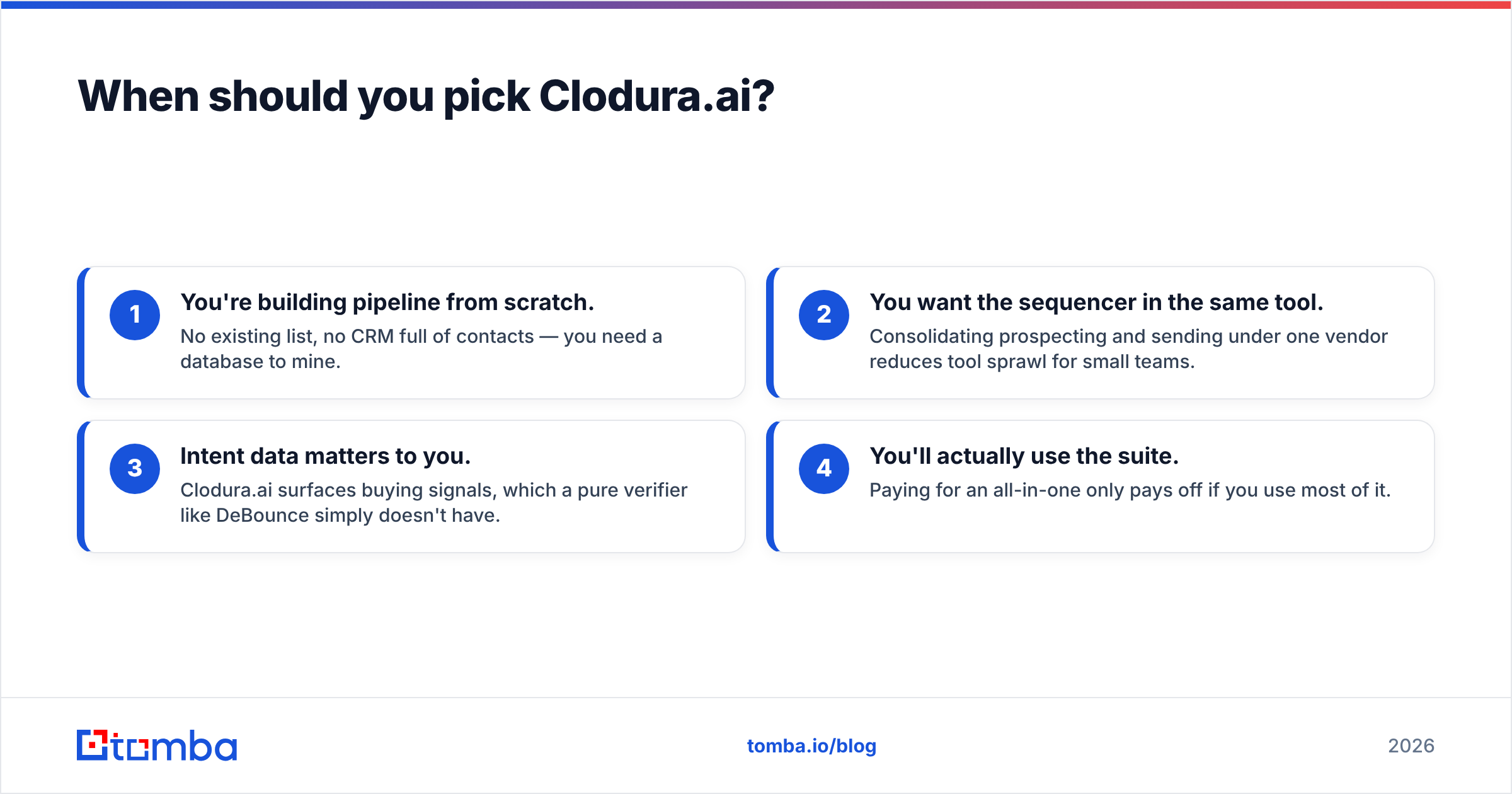
Pick Clodura.ai when your bottleneck is finding people, not cleaning a list, and you want one platform to run discovery through outreach.
It's a reasonable fit if:
- You're building pipeline from scratch. No existing list, no CRM full of contacts — you need a database to mine.
- You want the sequencer in the same tool. Consolidating prospecting and sending under one vendor reduces tool sprawl for small teams.
- Intent data matters to you. Clodura.ai surfaces buying signals, which a pure verifier like DeBounce simply doesn't have.
- You'll actually use the suite. Paying for an all-in-one only pays off if you use most of it.
Skip it if you already own a strong CRM and outreach stack and just need accurate emails. In that case the platform overlap is wasted spend, and a focused email finder plus a verifier covers the gap for less.
When should you pick DeBounce?#
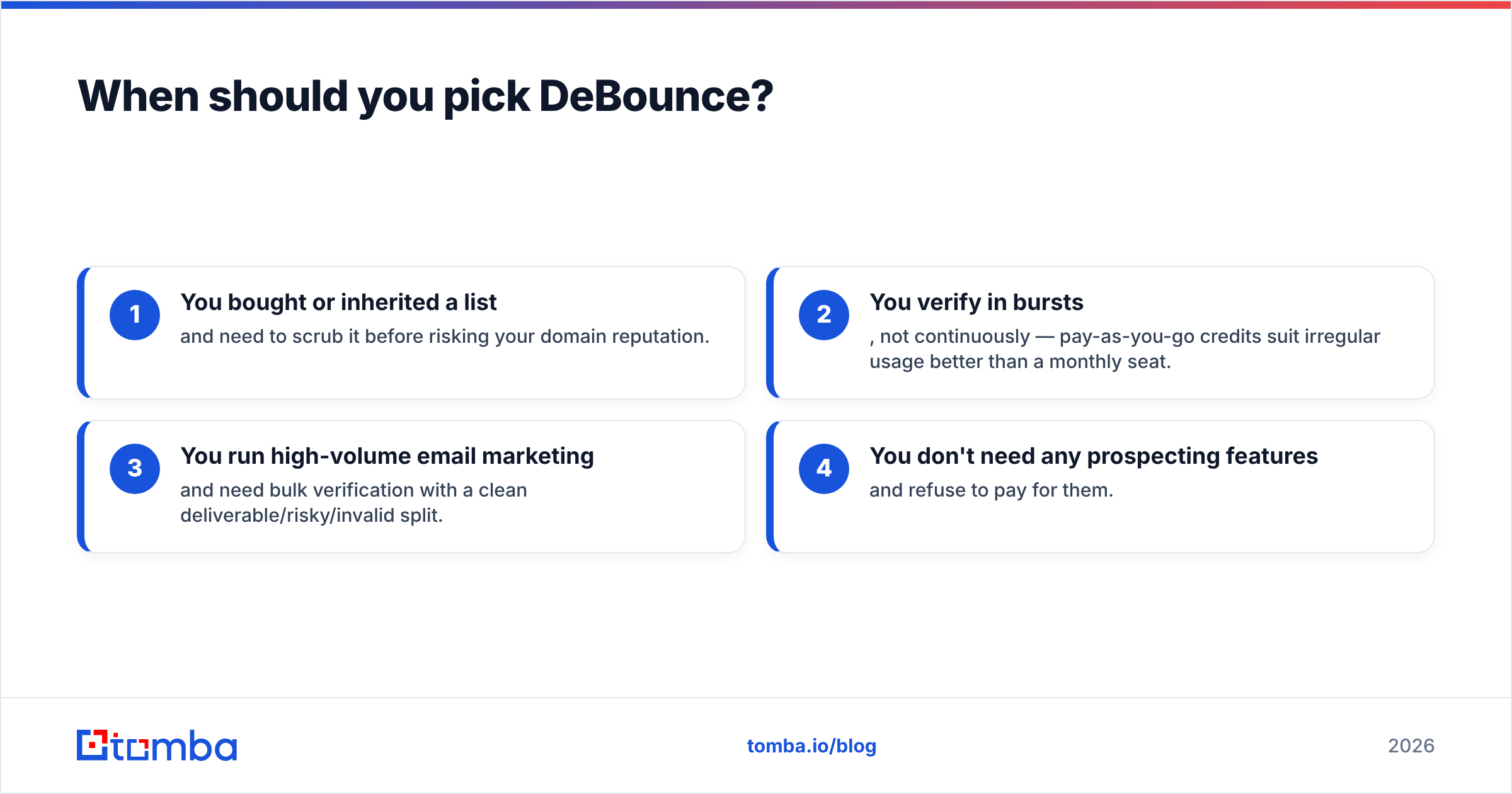
Pick DeBounce when you already have lists and your only job is hygiene before a send.
It shines if:
- You bought or inherited a list and need to scrub it before risking your domain reputation.
- You verify in bursts, not continuously — pay-as-you-go credits suit irregular usage better than a monthly seat.
- You run high-volume email marketing and need bulk verification with a clean deliverable/risky/invalid split.
- You don't need any prospecting features and refuse to pay for them.
DeBounce's weakness is the obvious one: it's a single-purpose tool. The moment you need to find a contact, you're opening another tab and another invoice. For ongoing outbound, that two-vendor stitch adds friction and cost.
)
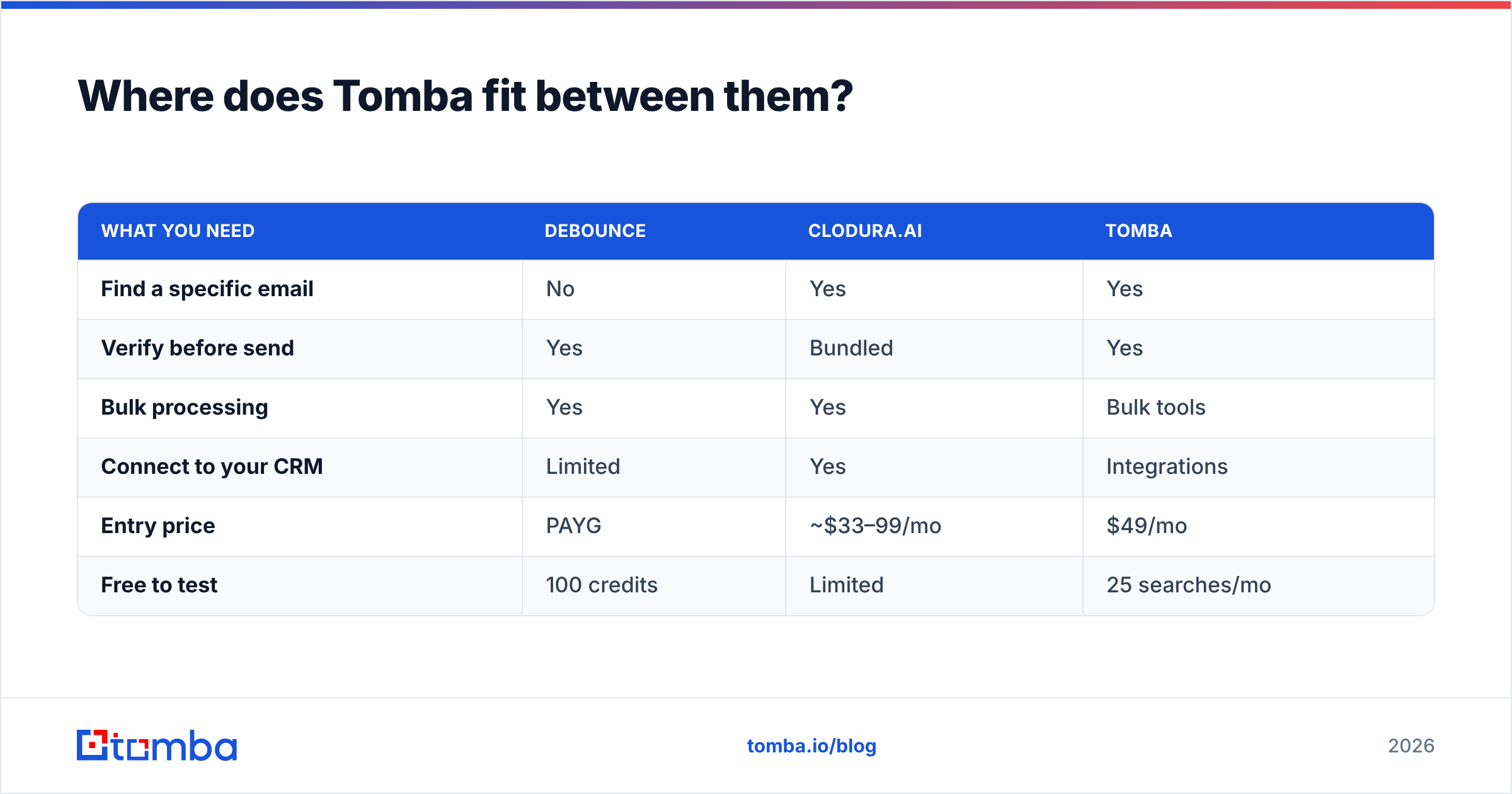
Where does Tomba fit between them?#
Tomba sits exactly on the seam these two tools leave open: it both finds and verifies, so you don't run two subscriptions to cover one workflow.
The practical workflow looks like this. You use domain search to pull every public email pattern at a target company, the email finder to resolve a specific person's address, and the built-in email verifier to confirm deliverability before the address ever reaches your sequencer. Catch-all domains — the thing that breaks naive verification — get routed through a dedicated catch-all verifier instead of a coin-flip "valid" guess.
| What you need | DeBounce | Clodura.ai | Tomba |
|---|---|---|---|
| Find a specific email | No | Yes | Yes |
| Verify before send | Yes | Bundled | Yes |
| Bulk processing | Yes | Yes | Bulk tools |
| Connect to your CRM | Limited | Yes | Integrations |
| Entry price | PAYG | ~$33–99/mo | $49/mo |
| Free to test | 100 credits | Limited | 25 searches/mo |
The cost story is straightforward. Tomba's pricing runs Free (25 searches/mo), Starter $49/mo, Growth $99/mo, Pro $249/mo, and Enterprise custom. That Starter tier replaces the need for a separate finder and a separate verifier — the two-vendor combo you'd assemble from a Clodura.ai-style finder plus DeBounce-style cleaning. You get find-and-verify in one pass, and you connect it to wherever you actually work via the Tomba API, Chrome extension, or native CRM integrations.
To be fair about the tradeoff: Tomba is not a full sales-intelligence suite. It doesn't ship a sequencer or buyer-intent feed the way Clodura.ai does. If you specifically want outreach automation and intent signals bundled in, Clodura.ai's broader platform is the closer match. But if your job is getting accurate, verified B2B emails into a stack you already run, the all-in-one finder-plus-verifier is the leaner buy.

How to decide in 2026#
Run your situation through three questions:
- Do I have a list, or do I need to build one? No list → you need a finder or a database (Clodura.ai or Tomba). Have a list → you need a verifier (DeBounce or Tomba).
- Will I use a full prospecting suite? Yes, including sequencing and intent → Clodura.ai. No, I just need data into my existing stack → Tomba or a focused verifier.
- Do I want one tool or two? One tool for find + verify → Tomba. Two best-of-breed tools and the budget to run both → Clodura.ai for finding, DeBounce for cleaning.
Most teams that start by comparing Clodura.ai and DeBounce discover they were really asking "do I have to buy both?" The answer is no — not if a single find-and-verify tool covers the workflow. You can check this yourself: independent reviews on G2 and Capterra break down each tool by use case, and both DeBounce and Clodura.ai publish their own feature docs at debounce.io and clodura.ai.
Whatever you pick, verify before you send. Bounce rate is the fastest way to torch your domain, and no database is fresh enough to skip the check.
The bottom line#
The Clodura.ai vs DeBounce debate misses the point: they aren't rivals — they're two halves of the same pipeline. Clodura.ai finds; DeBounce cleans. If you genuinely need a full sales-intelligence suite with sequencing and intent, Clodura.ai is the platform to evaluate. If you only ever clean lists, DeBounce is a sharp, cheap scalpel.
But if you're like most B2B teams — you need accurate emails found and verified, dropped straight into the CRM and outreach tools you already use — running two vendors is overkill. Start with the Tomba Email Finder: find professional emails by domain, name, or company, verify them in the same flow, and skip the two-subscription stitch. The free tier gives you 25 searches a month to test it against your real targets before you commit a dollar.
// get started
Find, verify and enrich your first contacts today
Start on the free plan with 25 searches a month, then scale when your team is ready.
Free plan · No credit card required · GDPR & CCPA
// about the author