Cloduraai vs Definitive Healthcare: 2026 Data Tool Guide
Clodura.ai and Definitive Healthcare solve different B2B data problems. Here's an honest 2026 breakdown of pricing, coverage, and which one fits your pipeline.
Cloduraai vs Definitive Healthcare: Which B2B Data Tool Wins in 2026?
TL;DR
- Clodura.ai is a horizontal sales-intelligence and prospecting platform: contact data, intent signals, and sequencing across most industries.
- Definitive Healthcare is a vertical specialist — deep commercial intelligence on hospitals, physicians, payers, and life-sciences accounts. Nothing else comes close in that niche.
- They rarely compete head-to-head. You pick Definitive Healthcare when healthcare is your market; you pick Clodura.ai when you sell broadly across verticals.
- Both are platform-priced (annual contracts, seats, sometimes five figures). Neither is a cheap, pay-as-you-go contact source.
- If your real need is accurate, verifiable email and phone data to feed outbound — not a whole platform — a focused tool like Tomba covers that for a fraction of the cost.
If you searched "cloduraai vs definitive healthcare," you're probably comparing two tools that aren't actually substitutes. This guide fixes that framing first, then gives you a concrete decision table, pricing reality, and where a lighter data layer beats both.
What is Clodura.ai?#
Clodura.ai is an all-in-one sales prospecting platform. Think of it as a Swiss Army knife for outbound: a B2B contact database, buyer-intent signals, a built-in email sequencer, and technographic data bundled into one subscription.
The pitch is breadth. You search by industry, title, geography, or technology stack, pull verified-ish contacts, and push them straight into cadences without leaving the tool. For a small or mid-market team that doesn't want to stitch together five vendors, that consolidation is the main draw.
Where Clodura.ai gets thinner is depth in any single vertical. Its database spans hundreds of millions of contacts across every sector, which means coverage is wide but not specialized. If you sell to dentists, ambulatory surgery centers, or specific payer networks, a generalist database will miss the granular firmographics that a vertical tool tracks natively.
You can read more about how horizontal databases are assembled on Tomba's data sources page — the same sourcing tradeoffs apply to any all-in-one platform.
What is Definitive Healthcare?#
Definitive Healthcare is the opposite bet: go narrow, go deep. It is a healthcare commercial-intelligence platform built entirely around providers, payers, and life-sciences organizations.
Instead of generic firmographics, it tracks claims data, procedure volumes, technology installs at the facility level, physician affiliations, referral patterns, and reimbursement trends. If you sell medical devices, diagnostics, healthcare IT, or pharma services, that depth is the product. You're not just getting a contact — you're getting the clinical and financial context around the account.
That specialization is also its boundary. Outside healthcare, Definitive Healthcare has essentially nothing to offer. There's no point evaluating it for selling marketing SaaS to retailers. Its value is entirely a function of whether your buyers wear lab coats.
You can see the company's own positioning on the Definitive Healthcare site, which leans hard into claims-driven intelligence rather than generic prospecting.

Cloduraai vs Definitive Healthcare: how do they actually compare?#
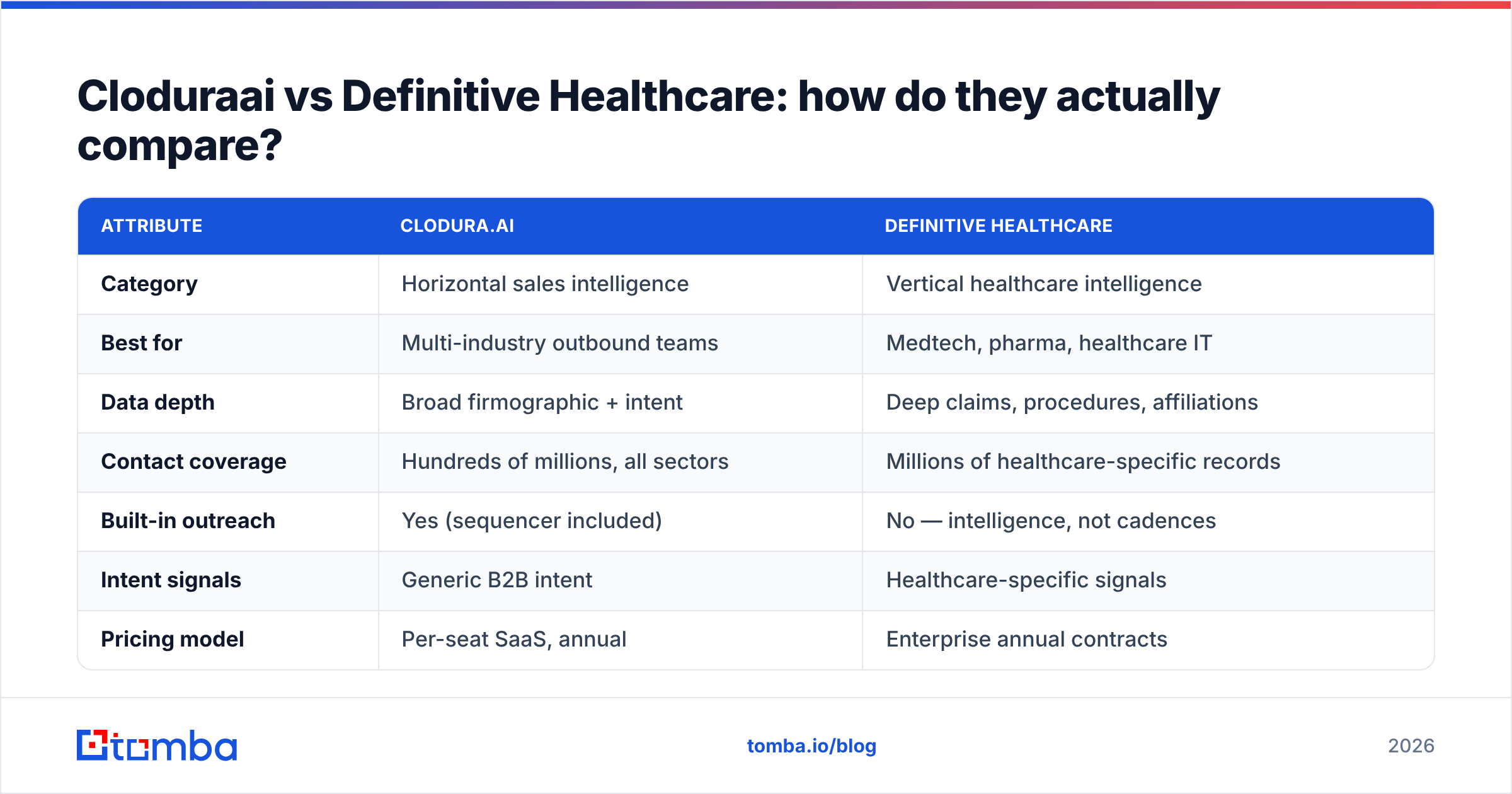
Here's the core comparison most "cloduraai vs definitive healthcare" searches are missing — they're optimized for different jobs.
| Attribute | Clodura.ai | Definitive Healthcare |
|---|---|---|
| Category | Horizontal sales intelligence | Vertical healthcare intelligence |
| Best for | Multi-industry outbound teams | Medtech, pharma, healthcare IT |
| Data depth | Broad firmographic + intent | Deep claims, procedures, affiliations |
| Contact coverage | Hundreds of millions, all sectors | Millions of healthcare-specific records |
| Built-in outreach | Yes (sequencer included) | No — intelligence, not cadences |
| Intent signals | Generic B2B intent | Healthcare-specific signals |
| Pricing model | Per-seat SaaS, annual | Enterprise annual contracts |
| Typical entry cost | Low-to-mid four figures/yr | Mid-to-high four/five figures/yr |
| Free trial | Limited free tier/trial | Demo-gated, no self-serve free tier |
| Learning curve | Moderate | Steep — built for analysts |
The pattern is clear. Clodura.ai competes with tools like Apollo and Lusha; Definitive Healthcare competes with other healthcare data specialists. Comparing them directly is like comparing a general hardware store to a specialist electrical-parts distributor — useful only once you know which job you're doing.
Five questions that decide it for you#
- Is healthcare your primary or only market? If yes, Definitive Healthcare's depth justifies the price. If healthcare is just one of several verticals, you'll overpay for coverage you won't use.
- Do you need claims and procedure data? Only Definitive Healthcare tracks facility-level clinical and reimbursement signals. Clodura.ai does not pretend to.
- Do you want outreach built in? Clodura.ai ships a sequencer; Definitive Healthcare expects you to export into your own stack.
- Who's the user? Clodura.ai is built for reps. Definitive Healthcare is built for analysts and strategic account planners.
- What's your budget shape? Predictable per-seat (Clodura.ai) versus negotiated enterprise contract (Definitive Healthcare).
How accurate is the data on each platform?#
Accuracy splits along the same vertical/horizontal line, and it matters more than the feature lists suggest.
Definitive Healthcare's accuracy advantage is contextual. Because it's sourced from claims, licensing records, and facility filings, its healthcare firmographics are exceptionally current and specific. A physician's affiliation or a hospital's imaging-equipment install is the kind of detail generalist databases simply don't carry.
Clodura.ai trades that depth for reach. Its records are aggregated and machine-verified across every industry, so individual email and direct-dial accuracy varies by region and seniority — the same reality every horizontal database lives with. Independent reviews on G2 consistently show generalist B2B databases landing in the 80–95% range on email validity, with phone numbers lagging.
That gap is exactly why many teams verify before they send, regardless of which platform sourced the contact. Running any exported list through a dedicated email verifier catches stale and catch-all addresses before they wreck your sender reputation — a step neither platform fully replaces.
What does each one cost in 2026?#
Neither tool is cheap, and neither publishes fully transparent enterprise pricing — so treat these as directional.
Clodura.ai uses a per-seat SaaS model with free, mid, and enterprise tiers. Real spend climbs once you add credits for bulk exports and unlock intent data. It's the more accessible of the two for a small team, but the "all-in-one" bundle means you pay for modules (sequencing, intent) even if you only wanted the database.
Definitive Healthcare is sold the way enterprise data is usually sold: annual contracts, demo-gated, negotiated by use case and seat count. Expect mid-four to five figures per year. The cost is rational if healthcare revenue depends on the intelligence — and hard to justify otherwise.
The hidden cost in both cases is platform lock-in. You're buying a database and the workflow wrapped around it. When your real bottleneck is just "I need correct emails and phone numbers for these accounts," that bundle is overkill.
Is there a leaner alternative to both?#
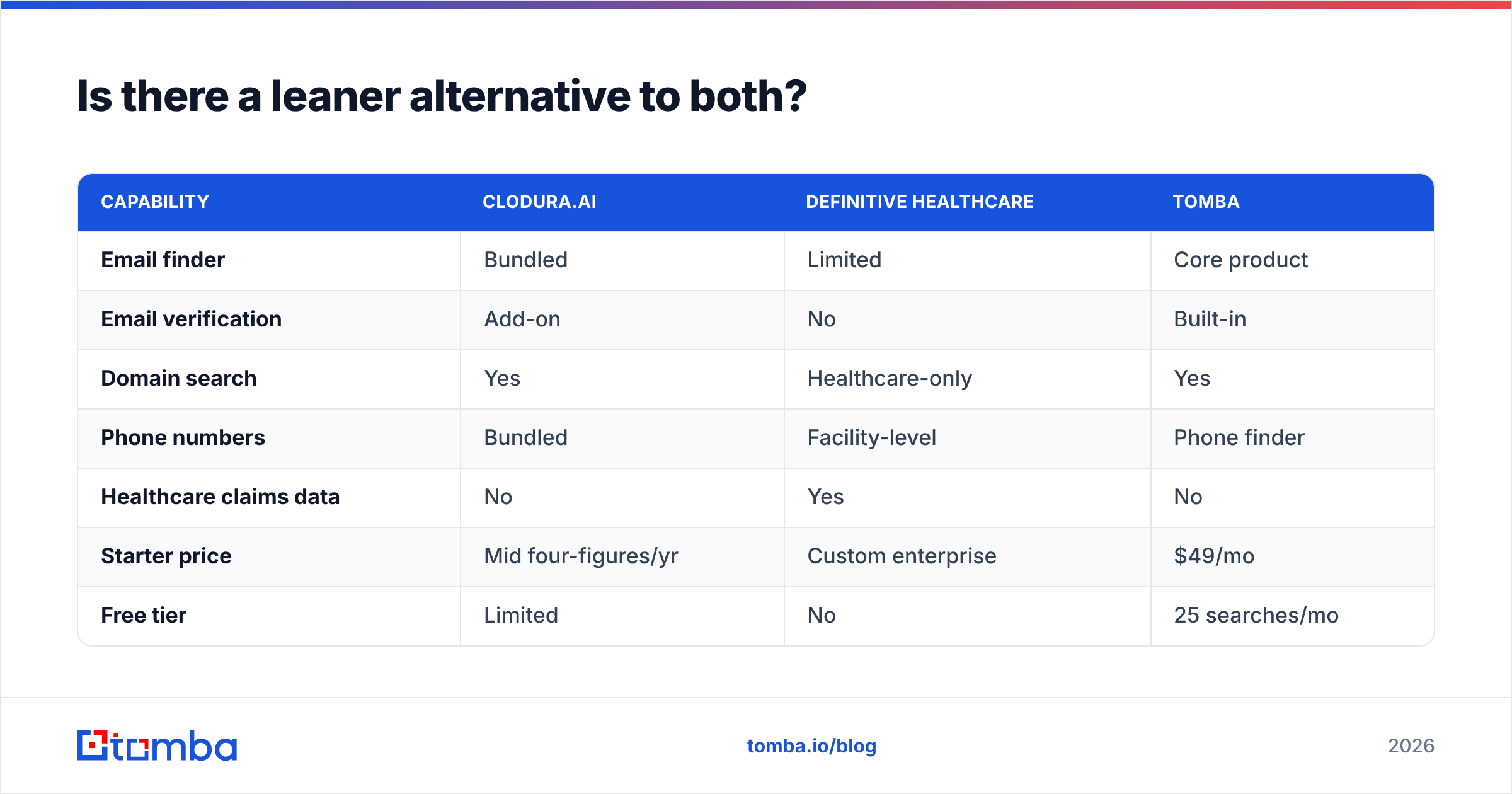
Yes — if your bottleneck is contact data, not a whole sales OS. Many teams discover that 80% of the value they wanted from Clodura.ai or Definitive Healthcare was simply getting accurate emails and phone numbers for known accounts. That's a narrower, cheaper problem.
This is where a focused tool like Tomba fits. Instead of licensing an entire intelligence platform, you find and verify exactly the contacts you need, pay-as-you-grow, and keep the rest of your stack (CRM, sequencer, enrichment) however you like.
| Capability | Clodura.ai | Definitive Healthcare | Tomba |
|---|---|---|---|
| Email finder | Bundled | Limited | Core product |
| Email verification | Add-on | No | Built-in |
| Domain search | Yes | Healthcare-only | Yes |
| Phone numbers | Bundled | Facility-level | Phone finder |
| Healthcare claims data | No | Yes | No |
| Starter price | Mid four-figures/yr | Custom enterprise | $49/mo |
| Free tier | Limited | No | 25 searches/mo |
| API access | Yes | Limited | Full REST API |
With Tomba you can run a domain search to pull every public email pattern at a target company, find an individual contact with the email finder, then enrich the record with data enrichment to fill in title, company, and social profiles. Pricing is published and predictable — see the full Tomba pricing page: a free tier with 25 searches a month, Starter at $49/mo, Growth at $99/mo, and Pro at $249/mo.
The honest caveat: Tomba does not replace Definitive Healthcare's claims data. If you genuinely need procedure volumes and referral patterns, no email finder substitutes for that. But if you were eyeing these platforms mainly to reach people, a contact layer plus your existing tools is dramatically cheaper.
Which should you choose?#
Here's the decision in one paragraph each.
Choose Definitive Healthcare if healthcare is your market and you need clinical, claims, and facility intelligence to plan accounts. Nothing horizontal matches its depth, and the price is defensible when device, diagnostics, or pharma deals hang on knowing procedure volumes and affiliations.
Choose Clodura.ai if you sell across multiple industries and want one subscription that handles database, intent, and outreach. It's the pragmatic consolidation play for SMB and mid-market teams that don't want to manage five vendors.
Choose a focused data tool like Tomba if your actual need is accurate, verifiable contact data to feed an outbound motion you already run. You skip the platform tax, keep your stack flexible, and verify every address before it ships — which protects email deliverability far better than trusting any database's "verified" badge at face value.
Most teams overbuy. They license a heavyweight intelligence platform when the gap was simply correct emails and phone numbers. Map your need to the narrowest tool that solves it, and you'll spend less while sending cleaner lists.
The bottom line#
Clodura.ai and Definitive Healthcare aren't really rivals — one goes wide, the other goes deep into healthcare. Decide your vertical, decide whether you need claims data or just contacts, and the choice almost makes itself.
If your honest answer is "I mostly need verified emails and phone numbers, not a platform," start lean. Tomba's email finder gives you accurate, deliverability-checked contacts with a free tier to test on, a $49/mo Starter plan, and a full Tomba API when you're ready to automate. Find the right people, verify before you send, and let your CRM and sequencer handle the rest — without a five-figure annual contract.
// get started
Find, verify and enrich your first contacts today
Start on the free plan with 25 searches a month, then scale when your team is ready.
Free plan · No credit card required · GDPR & CCPA
// about the author