Cloudura.ai vs Ditlead 2026: Which Sales Tool Wins?
Cloudura.ai and Ditlead both promise to run your cold outreach on autopilot — but they win on very different jobs. Here's the honest 2026 breakdown of features, pricing, deliverability, and which one fits your team.
Choosing between Cloudura.ai and Ditlead usually comes down to one question: do you need an all-in-one prospecting engine, or a lean cold-email sender that just works? Both tools live in the same crowded "sales engagement" category, both automate multichannel outreach, and both will happily charge you monthly. But they're built around different bets — and picking the wrong one quietly taxes every campaign you run afterward.
This is a neutral, hands-on comparison written for revenue teams who actually have to hit a number. No vendor spin, no "both are great, it depends" cop-out. By the end you'll know which platform fits your motion, where each one cuts corners, and the one thing both tools assume you've already solved.
TL;DR — Cloudura.ai vs Ditlead at a glance#
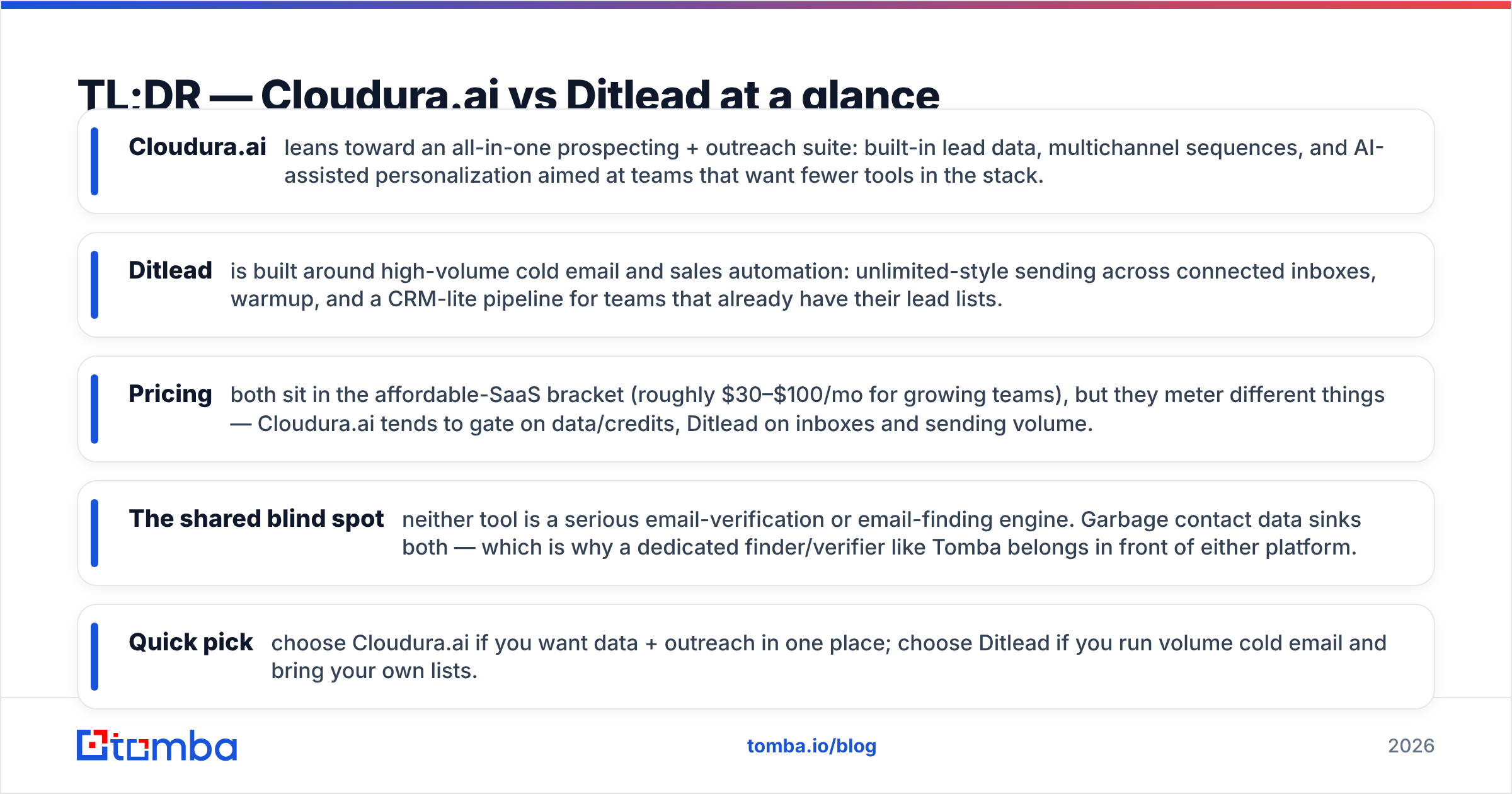
- Cloudura.ai leans toward an all-in-one prospecting + outreach suite: built-in lead data, multichannel sequences, and AI-assisted personalization aimed at teams that want fewer tools in the stack.
- Ditlead is built around high-volume cold email and sales automation: unlimited-style sending across connected inboxes, warmup, and a CRM-lite pipeline for teams that already have their lead lists.
- Pricing: both sit in the affordable-SaaS bracket (roughly $30–$100/mo for growing teams), but they meter different things — Cloudura.ai tends to gate on data/credits, Ditlead on inboxes and sending volume.
- The shared blind spot: neither tool is a serious email-verification or email-finding engine. Garbage contact data sinks both — which is why a dedicated finder/verifier like Tomba belongs in front of either platform.
- Quick pick: choose Cloudura.ai if you want data + outreach in one place; choose Ditlead if you run volume cold email and bring your own lists.
What is Cloudura.ai?#
Cloudura.ai positions itself as an AI-powered sales prospecting and outreach platform. The pitch is consolidation: instead of stitching together a data provider, a sequencer, and a personalization tool, you get lead discovery, multichannel sequences (email plus other touchpoints), and AI copy assistance inside one dashboard.
That all-in-one framing is the product's whole personality. For a small team that doesn't want to manage five subscriptions and five logins, having contact data and the sending engine under one roof is genuinely convenient. The trade-off — and there's always a trade-off — is that bundled data is usually broader than it is deep. A platform that does everything rarely matches a specialist on any single axis, and contact accuracy is the axis that hurts most when it slips.
If your team's bottleneck is "we don't have anyone to email yet," Cloudura.ai's discovery-plus-outreach loop is the more natural starting point.
What is Ditlead?#
Ditlead is a sales engagement and cold-email platform built for volume. Its center of gravity is the sending engine: connect multiple mailboxes, rotate sends across them, warm them up, and push sequences at scale — with a lightweight CRM/pipeline layer so you can track replies and deals without bolting on a separate system.
Ditlead's design assumes you already have lead lists, or you'll source them elsewhere. It's the kind of tool that appeals to agencies and outbound-heavy teams running many inboxes across many domains. The strength is throughput and inbox management; the implied homework is that you've handled targeting and data quality before the contacts ever reach the sequencer.
Think of it this way: Cloudura.ai is closer to "find people and email them," while Ditlead is closer to "email a lot of people, reliably." The overlap is real, but the emphasis is different.

Cloudura.ai vs Ditlead: the core feature comparison#
Here's the head-to-head on the attributes that actually change your results. Treat the pricing row as a directional range — both vendors adjust plans frequently, so confirm current numbers on their official pages before you buy.
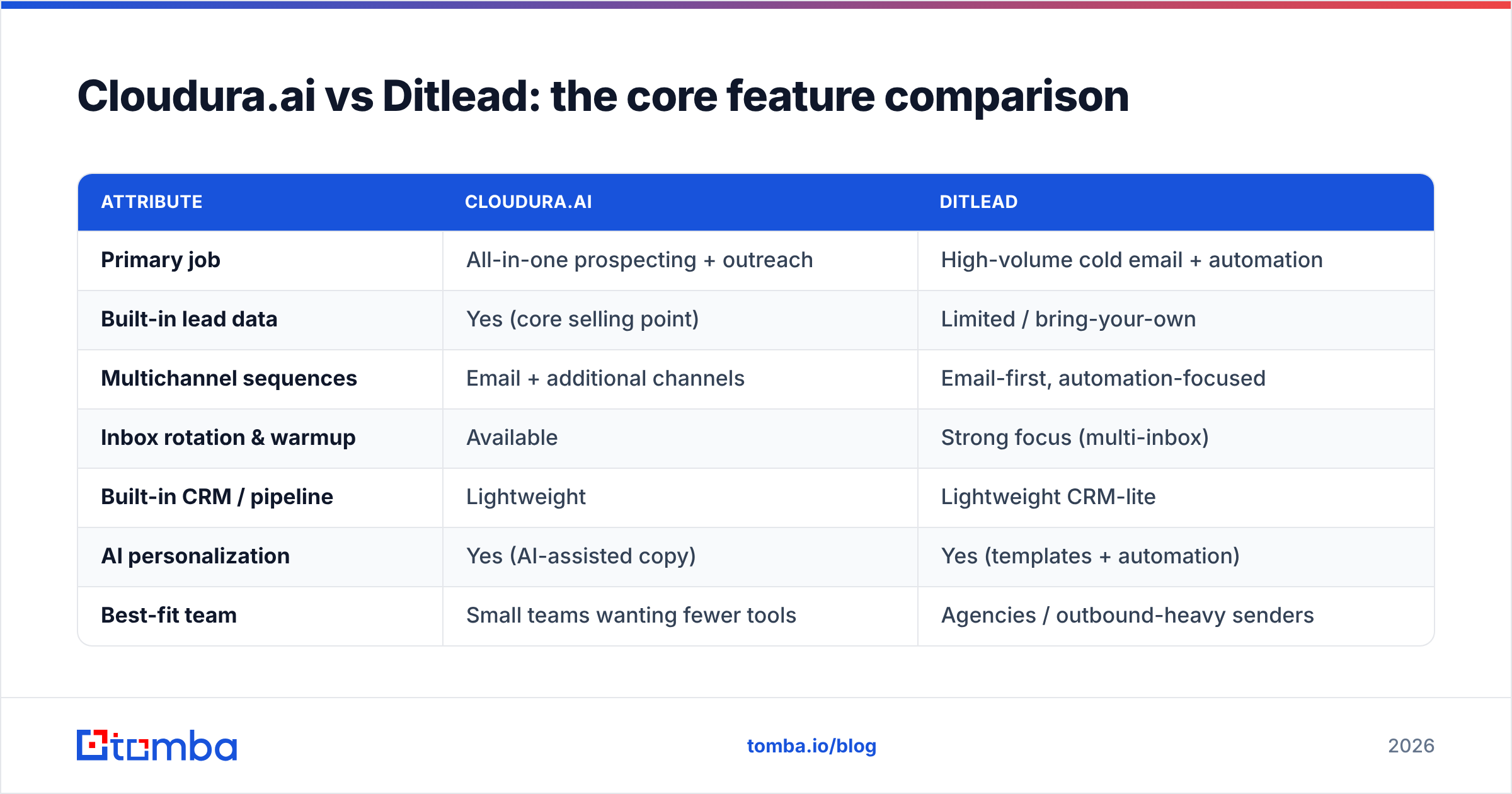
| Attribute | Cloudura.ai | Ditlead |
|---|---|---|
| Primary job | All-in-one prospecting + outreach | High-volume cold email + automation |
| Built-in lead data | Yes (core selling point) | Limited / bring-your-own |
| Multichannel sequences | Email + additional channels | Email-first, automation-focused |
| Inbox rotation & warmup | Available | Strong focus (multi-inbox) |
| Built-in CRM / pipeline | Lightweight | Lightweight CRM-lite |
| AI personalization | Yes (AI-assisted copy) | Yes (templates + automation) |
| Best-fit team | Small teams wanting fewer tools | Agencies / outbound-heavy senders |
| Typical entry pricing | ~$30–$60/mo range | ~$30–$50/mo range |
| Data/email verification | Not a dedicated verifier | Not a dedicated verifier |
A few honest takeaways from the table:
- Cloudura.ai wins on consolidation. If you value one bill and one login over best-in-class anything, the bundled data is the differentiator.
- Ditlead wins on sending scale. Multi-inbox rotation and warmup are where it invests, which matters if you're sending thousands of emails a week.
- Neither wins on data hygiene. Both treat verification as "good enough," and "good enough" is exactly what tanks deliverability over time.
- Pricing is close enough to be a tiebreaker, not a deciding factor. Pick on workflow fit first; the $10–$20 monthly delta won't matter once a campaign is working.
Which tool has better deliverability?#
Deliverability is decided mostly by what you do before you press send, and both tools give you only part of the picture. Ditlead's multi-inbox rotation and warmup are a real advantage for high-volume senders — spreading sends across mailboxes and domains is a legitimate way to protect sender reputation. Cloudura.ai supports healthy sending too, but its emphasis is broader, so the inbox-management depth is shallower.
But here's the part the marketing pages skip: warmup and rotation can't save a list full of invalid addresses. Every hard bounce is a direct hit to your domain reputation, and once mailbox providers start throttling you, no amount of sequence optimization buys it back quickly. The single highest-leverage move for deliverability isn't a feature in either tool — it's verifying your list before it ever enters the sequencer. Run addresses through a dedicated email verifier and catch-all checks first, and both platforms perform dramatically better.
If you want to go deeper on the fundamentals here, Google's own Postmaster Tools and the general concept of email deliverability are worth understanding before you scale either tool.

How do Cloudura.ai and Ditlead handle data quality?#
This is the section that should change how you read every other feature. Both platforms are outreach tools, not data tools — and that distinction is everything.
Cloudura.ai includes built-in lead data, which sounds like it solves the problem. In practice, bundled databases from outreach-first vendors tend to be wider than they are accurate; coverage looks impressive in a demo, but the bounce rate at scale tells the real story. Ditlead mostly expects you to bring your own list, which is honest — but it means the burden of quality falls entirely on you.
In both cases you end up needing a real verification layer. A purpose-built finder-and-verifier does three things neither platform does well:
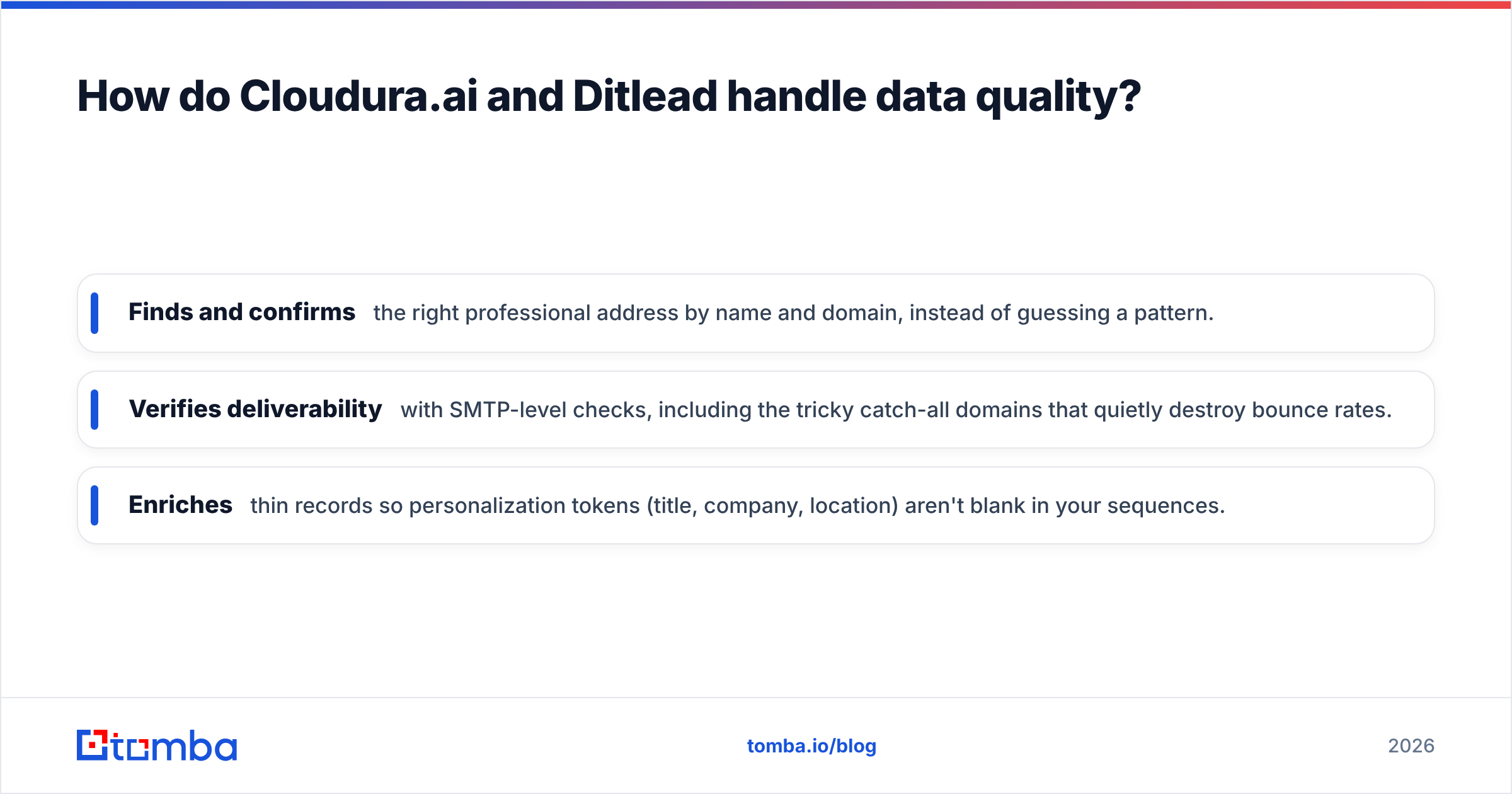
- Finds and confirms the right professional address by name and domain, instead of guessing a pattern.
- Verifies deliverability with SMTP-level checks, including the tricky catch-all domains that quietly destroy bounce rates.
- Enriches thin records so personalization tokens (title, company, location) aren't blank in your sequences.
This is the gap Tomba's data tooling is built to fill. You don't replace Cloudura.ai or Ditlead with it — you put it in front of them so the sequencer is firing at real, reachable humans. For teams sourcing at scale, a bulk email finder plus verification step is the difference between a 2% bounce rate and a 15% one.
Cloudura.ai vs Ditlead: pricing and value#
Both tools target budget-conscious teams, which is refreshing in a category where seats can run $100+/user. The nuance is what each one meters.
Cloudura.ai typically gates value behind data credits and feature tiers — fair, because the data is part of what you're paying for. Ditlead tends to meter on connected inboxes and sending capacity, which aligns with its volume identity. That means the "cheaper" option flips depending on your motion:
- Low list volume, need data → Cloudura.ai's bundled credits can be the better deal.
- High send volume, own your lists → Ditlead's inbox-based pricing usually scales more economically.
Compare both against the cost of bounced campaigns and burned domains, and the math gets clearer: the most expensive line item in cold outreach isn't the software — it's the deliverability you lose to bad data. A modest add-on for verification frequently pays for itself in a single avoided domain blacklisting. For reference on how the broader category prices, browse independent reviews on G2 before committing.
Which should you choose: Cloudura.ai or Ditlead?#
Here's the decision framed by job-to-be-done rather than feature counts.
Choose Cloudura.ai if:
- You're a small team or solo founder who wants prospecting data and outreach in one subscription.
- You don't yet have lead lists and want discovery built in.
- You value fewer tools over maximum depth in any single one.
Choose Ditlead if:
- You run high-volume cold email across multiple inboxes and domains.
- You're an agency or outbound team that already sources lists.
- Inbox rotation, warmup, and sending reliability are your top priorities.
Choose neither as your data source — for either path:
- If your bounce rate is creeping up, the problem is upstream of the sequencer.
- If personalization tokens render blank, your records are too thin.
- If you're guessing email patterns by hand, you're leaving reply rate on the table.
Both platforms are reasonable choices for their respective jobs. The mistake isn't picking the "wrong" one — it's assuming either tool's built-in data is enough to skip a real verification step. It isn't.
What both tools assume you've already solved#
The uncomfortable truth running under this entire comparison: outreach platforms are downstream of data. Cloudura.ai, Ditlead, and every competitor in the space optimize the delivery of your message. None of them seriously optimize who receives it or whether the address is real. That's by design — it's a different product category — but it's also where most cold-outreach programs actually fail.
If you fix targeting and verification first, both tools look great. If you don't, both tools look broken, and you'll churn from one to the next blaming the software. The pattern is so common it's almost a law: teams blame the sequencer for problems the data created. Strong data accuracy upstream makes whatever sequencer you choose look like a genius.
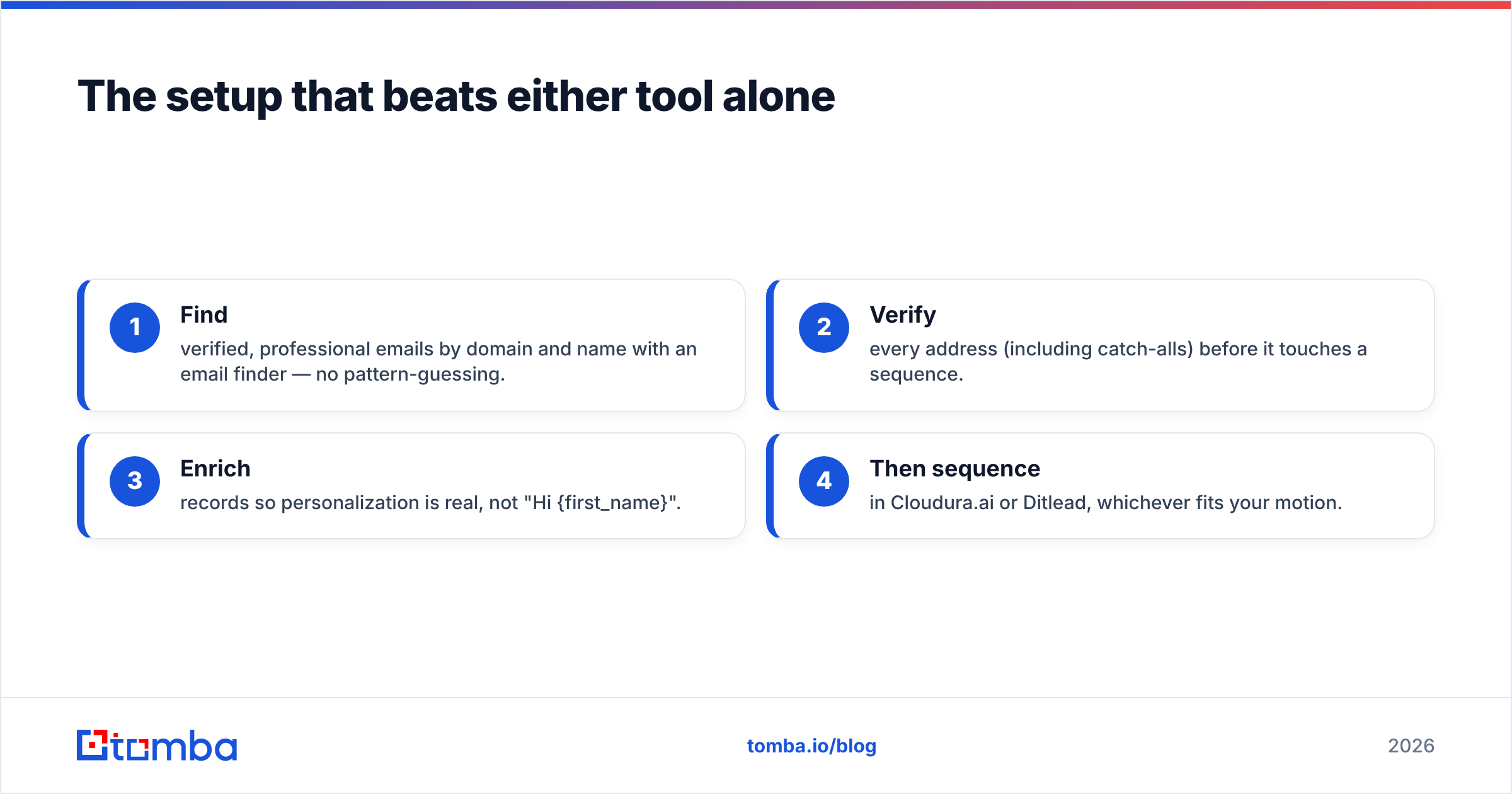
The setup that beats either tool alone#
Here's the stack that consistently outperforms "just buy Cloudura.ai" or "just buy Ditlead":
- Find verified, professional emails by domain and name with an email finder — no pattern-guessing.
- Verify every address (including catch-alls) before it touches a sequence.
- Enrich records so personalization is real, not "Hi {first_name}".
- Then sequence in Cloudura.ai or Ditlead, whichever fits your motion.
Steps 1–3 are where reply rates are won or lost, and they happen before either platform enters the picture. The sequencer is the last 20% of the work that gets 80% of the blame.
Final verdict#
Cloudura.ai vs Ditlead isn't a clean winner-takes-all — it's a fit question. Cloudura.ai is the better pick for teams that want data and outreach consolidated into one affordable tool. Ditlead is the better pick for volume senders and agencies who already own their lists and need rock-solid multi-inbox sending. Pick the one whose default job matches yours, and don't overthink the small pricing gap.
Just don't let either platform's bundled or assumed data become your single source of truth. Both perform far better with a clean, verified list feeding them — and that's the part neither tool is built to handle.
Start where the results actually come from. Before you commit to a sequencer, run your target accounts through the Tomba Email Finder to pull verified, professional addresses by name and domain, then verify them in bulk. Whether you land on Cloudura.ai, Ditlead, or something else entirely, you'll send to real people, protect your domain, and finally see the reply rates the outreach tools promised. Try it free — 25 searches a month, no card required — and see your bounce rate drop on the very next campaign.
// get started
Find, verify and enrich your first contacts today
Start on the free plan with 25 searches a month, then scale when your team is ready.
Free plan · No credit card required · GDPR & CCPA
// about the author