Clodura.ai vs Enrichley 2026: Which B2B Data Tool Wins?
A neutral, feature-by-feature breakdown of Clodura.ai vs Enrichley in 2026 — pricing, data accuracy, enrichment depth, and where a dedicated email finder beats both.
Choosing between Clodura.ai and Enrichley usually comes down to one question that neither vendor's homepage answers cleanly: do you need an all-in-one prospecting suite, or a focused enrichment engine that feeds the tools you already run? This breakdown puts both side by side on the attributes that actually move pipeline — database size, email accuracy, enrichment depth, pricing, and fit — and is honest about where a dedicated email finder beats either one.
TL;DR — Clodura.ai vs Enrichley at a glance#
- Clodura.ai is a full sales-intelligence suite: a built-in B2B database, buyer-intent signals, sequences, and an email finder/verifier bundled into one seat-based platform.
- Enrichley is a leaner enrichment-first tool aimed at filling gaps in records you already own — think CRM cleanup, list appending, and waterfall enrichment rather than net-new prospecting.
- Pick Clodura.ai if you want one login for sourcing, intent, and outreach and can absorb per-seat pricing.
- Pick Enrichley if you already have a list and just need accurate fields appended without buying a second outreach suite.
- Pick a dedicated tool like Tomba if email accuracy and pay-for-what-you-use pricing matter more than a bundled all-in-one — it starts at $49/mo and verifies as it finds.
What is Clodura.ai?#
Clodura.ai is a B2B sales-intelligence platform built around its own contact database (the vendor advertises hundreds of millions of contacts and company records). The pitch is consolidation: you search for accounts, pull verified contacts, layer on buyer-intent and technographic signals, then launch email sequences without leaving the tool. It competes with the broad all-in-one category — Apollo, Lusha, ZoomInfo — rather than with single-purpose utilities.
That breadth is the selling point and the catch. You get sequencing, intent, and a database in one subscription, but you pay seat-based prices whether or not every rep uses every module. For a team that lives inside one platform, that's efficient. For a team that already owns an outreach stack, you're paying twice for features you won't touch.
What is Enrichley?#
Enrichley is an enrichment-first platform. Instead of leading with prospecting, it leads with the records you already have: upload a messy list or connect a CRM, and it appends or corrects fields — job titles, company data, emails, phone numbers, and firmographics. Many enrichment tools in this tier also run a "waterfall" model, querying multiple data sources in sequence so a field that one provider misses gets filled by the next.
The strength is focus. Enrichley does not try to be your sequencer or your intent platform; it tries to make your existing data complete and current. If your problem is "40% of my CRM contacts are missing a direct email," that's the problem Enrichley is shaped to solve. If your problem is "I have no list yet," it's the wrong starting point.
How do Clodura.ai and Enrichley compare on features and pricing?#
Here's the core comparison. Treat the pricing as directional — both vendors change tiers and gate features behind annual plans — and always confirm on the official pages before you buy.
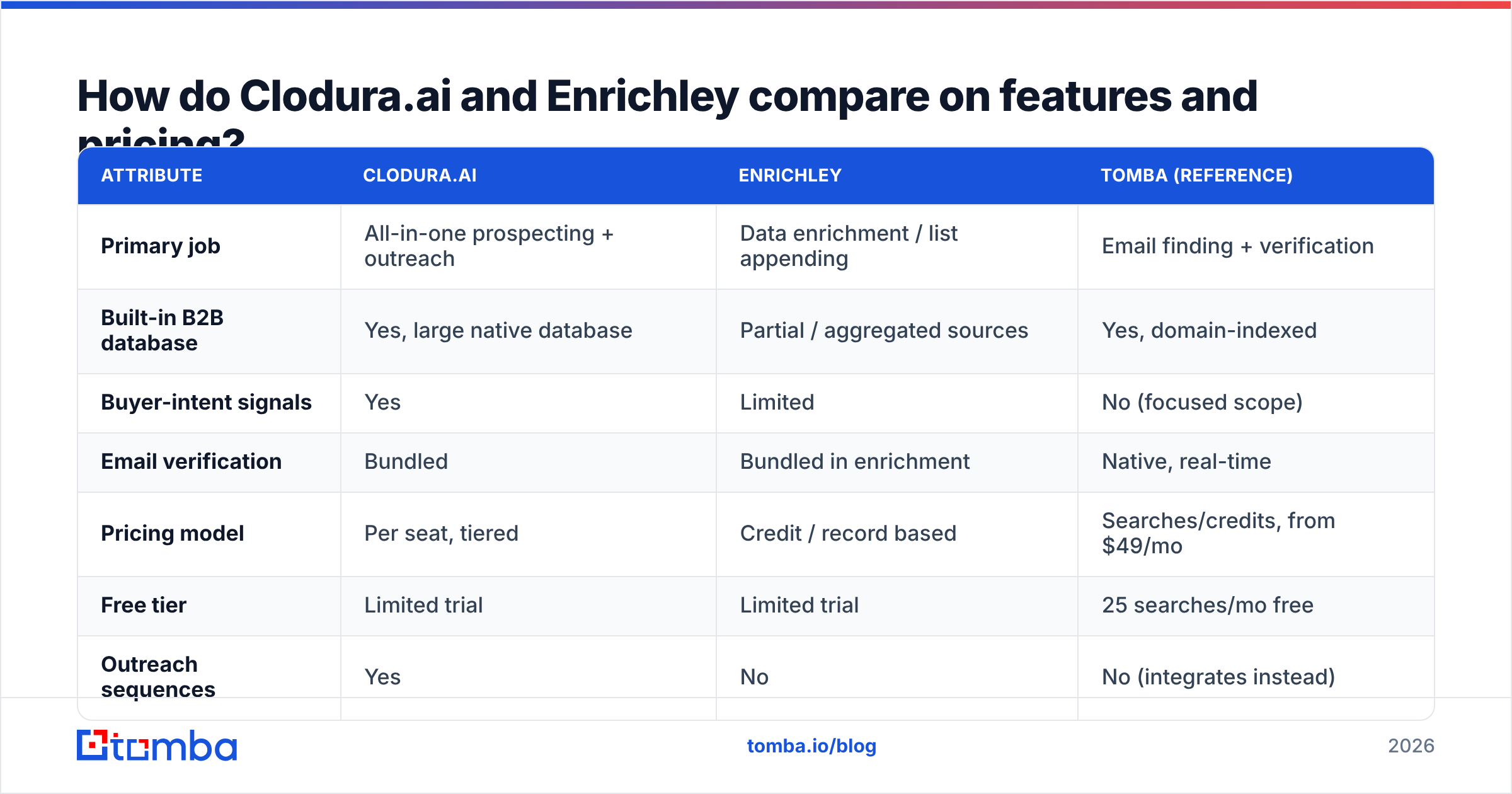
| Attribute | Clodura.ai | Enrichley | Tomba (reference) |
|---|---|---|---|
| Primary job | All-in-one prospecting + outreach | Data enrichment / list appending | Email finding + verification |
| Built-in B2B database | Yes, large native database | Partial / aggregated sources | Yes, domain-indexed |
| Buyer-intent signals | Yes | Limited | No (focused scope) |
| Email verification | Bundled | Bundled in enrichment | Native, real-time |
| Pricing model | Per seat, tiered | Credit / record based | Searches/credits, from $49/mo |
| Free tier | Limited trial | Limited trial | 25 searches/mo free |
| Outreach sequences | Yes | No | No (integrates instead) |
| Best for | Teams wanting one suite | Teams cleaning existing data | Accuracy-first sourcing |
The pattern is clear: Clodura.ai is wide, Enrichley is deep on one job, and a focused email finder optimizes a third axis — cost-per-valid-contact — that neither all-in-one prioritizes.
When should you pick a suite over an enrichment tool?#
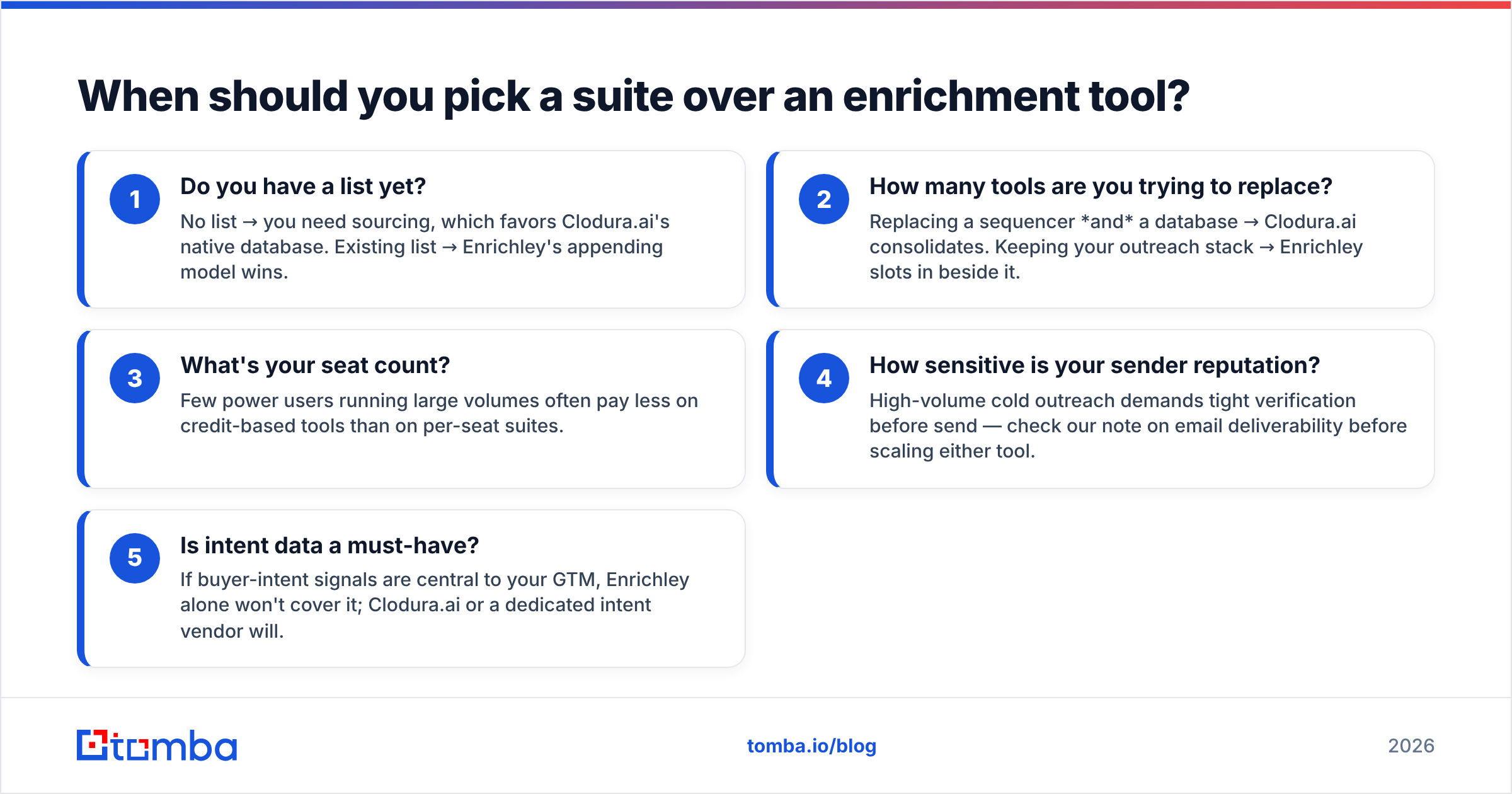
Use these five tests to decide where Clodura.ai and Enrichley actually fit your motion:
- Do you have a list yet? No list → you need sourcing, which favors Clodura.ai's native database. Existing list → Enrichley's appending model wins.
- How many tools are you trying to replace? Replacing a sequencer and a database → Clodura.ai consolidates. Keeping your outreach stack → Enrichley slots in beside it.
- What's your seat count? Few power users running large volumes often pay less on credit-based tools than on per-seat suites.
- How sensitive is your sender reputation? High-volume cold outreach demands tight verification before send — check our note on email deliverability before scaling either tool.
- Is intent data a must-have? If buyer-intent signals are central to your GTM, Enrichley alone won't cover it; Clodura.ai or a dedicated intent vendor will.
If you answered "I just need accurate emails I can trust," that's a signal you may not need either suite — only the part both bundle and neither perfects.
How accurate is the data in Clodura.ai vs Enrichley?#
Accuracy is where bundled platforms tend to underperform specialists, because verification is one module among many rather than the whole product. Independent reviews on G2 consistently show that all-in-one suites trade some email accuracy for breadth, while focused finders publish and defend a single headline number.

Two practical accuracy rules apply no matter which tool you choose:
- Catch-all domains inflate "found" rates. A platform can return an address that exists on a catch-all server but never reaches a human. Always run results through a catch-all verifier before you treat a "found" email as deliverable.
- Verify at send time, not source time. Data decays roughly 2–3% per month as people change jobs. A contact Clodura.ai or Enrichley validated 90 days ago may already bounce, so re-verify with an email verifier before each campaign.
The honest takeaway: both tools will find emails, but neither makes verification its core promise. If a 2% bounce rate would tank your domain reputation, treat the bundled verifier as a first pass and a dedicated verifier as the gatekeeper.
Which tool fits which buyer?#
- Clodura.ai fits the consolidating team. You're tired of stitching a database, an enrichment tool, and a sequencer together, and you'd rather pay one bill and train reps on one UI. The cost is per-seat pricing and accuracy that's "good enough" rather than best-in-class.
- Enrichley fits the data-hygiene team. You already run outreach somewhere you like, and your real pain is incomplete CRM records. Bolt Enrichley onto the side, append the missing fields, and keep your stack.
- A dedicated finder fits the accuracy-first team. You measure success in cost-per-valid-contact and bounce rate, and you'd rather pipe clean data into the tools you already trust than rent another suite.
Can you replace both with a focused stack?#
Often, yes — and for less. A lot of teams reach for an all-in-one because buying three tools sounds like three problems, but a focused stack frequently costs less and bounces less. The recipe:
- Source with a finder. Use a domain search to pull every public address pattern at a target company, or a name+domain lookup for individual prospects.
- Verify before send. Run the list through real-time verification so catch-alls and stale addresses never reach your sequencer.
- Enrich only what you'll use. Append firmographics with data enrichment on the records that survive verification — not the whole raw list.
- Keep your outreach tool. Send from whatever sequencer your team already knows; the finder feeds it through native integrations or the API.
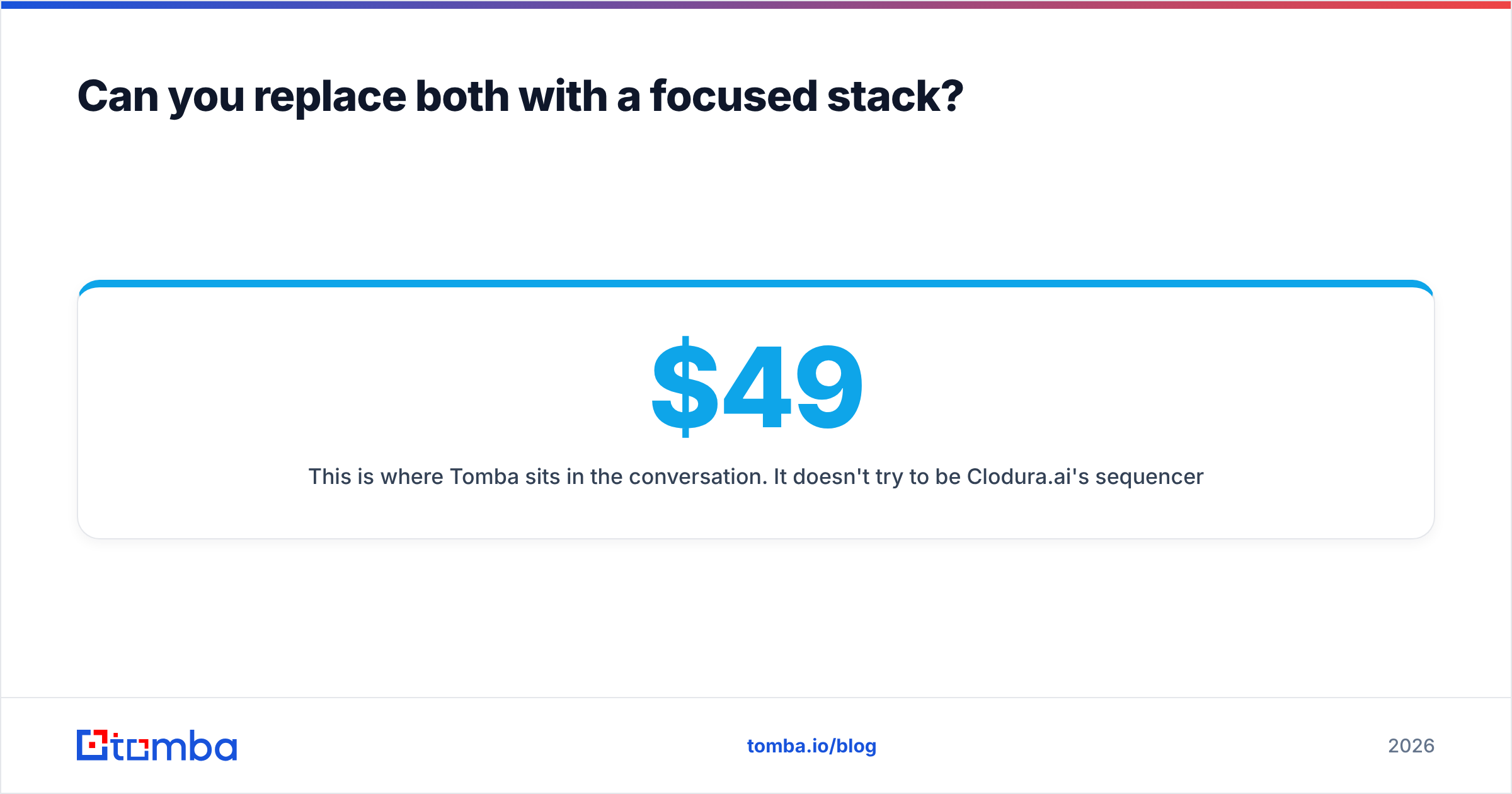
This is where Tomba sits in the conversation. It doesn't try to be Clodura.ai's sequencer or Enrichley's full enrichment suite. It does the one thing both bundle — finding and verifying professional emails — and does it with transparent, usage-based pricing instead of per-seat lock-in. You can see the full breakdown on the Tomba pricing page, but the short version: a Free tier with 25 searches/mo, Starter at $49/mo, Growth at $99/mo, and Pro at $249/mo.

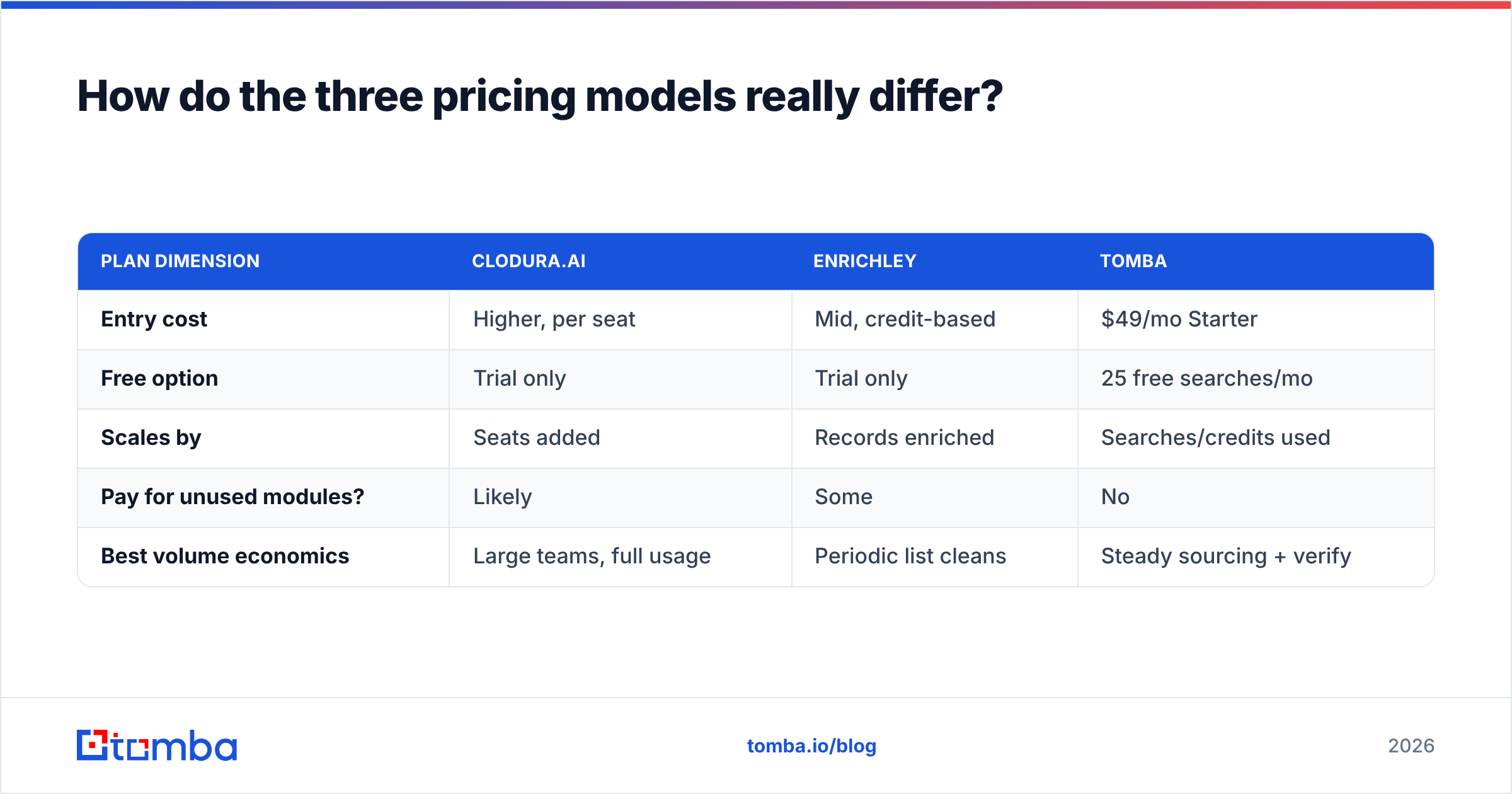
How do the three pricing models really differ?#
| Plan dimension | Clodura.ai | Enrichley | Tomba |
|---|---|---|---|
| Entry cost | Higher, per seat | Mid, credit-based | $49/mo Starter |
| Free option | Trial only | Trial only | 25 free searches/mo |
| Scales by | Seats added | Records enriched | Searches/credits used |
| Pay for unused modules? | Likely | Some | No |
| Best volume economics | Large teams, full usage | Periodic list cleans | Steady sourcing + verify |
The differences matter most at the edges. A 12-rep team that uses every Clodura.ai module gets real value from consolidation. A two-person team running heavy outbound usually wins on credit- or search-based pricing, because they're not paying for ten seats' worth of database access they'll never open. Map the model to your headcount and usage before the feature list seduces you.
What about phone numbers and multichannel?#
Both Clodura.ai and Enrichley surface phone data alongside emails, and multichannel (email + call + LinkedIn) is increasingly table stakes. If dialing is core to your motion, confirm the direct-dial hit rate specifically — switchboard numbers are easy to populate and nearly useless to an SDR. For teams that want to add phone coverage without committing to a full suite, a standalone phone finder plus a phone validator gives you the same channel without the seat tax. The principle repeats across every category: the bundle is convenient, the specialist is accurate, and you should buy convenience only where accuracy isn't the bottleneck.
Frequently asked questions#
Is Clodura.ai better than Enrichley? Neither is universally better — they solve different jobs. Clodura.ai is the better pick when you need net-new prospecting plus outreach in one place. Enrichley wins when you already have a list and only need fields appended. Match the tool to whether your problem is "no data" or "incomplete data."
Can Enrichley find net-new contacts? Its strength is enrichment and appending, not large-scale net-new sourcing. If you need to build a list from scratch, you'll lean on Clodura.ai's native database or a dedicated finder instead.
Which has better email accuracy? Both bundle verification, but neither makes it the core product. For accuracy-critical sending, validate results through an independent verifier before each campaign regardless of which platform sourced the address.
Is there a cheaper way to get the same emails? Frequently, yes. A focused finder priced by usage — like Tomba from $49/mo — covers the find-and-verify job both suites bundle, often at a lower cost-per-valid-contact than per-seat pricing.
The bottom line#
Clodura.ai and Enrichley win in different lanes: Clodura.ai for teams consolidating sourcing, intent, and outreach into one suite; Enrichley for teams whose only real gap is incomplete records. But if your scorecard is deliverability and cost-per-valid-contact, the part both bundle — finding and verifying professional emails — is exactly the part a focused tool does best.
That's the case for trying the Tomba Email Finder before you commit to a full suite. Find emails by name, domain, or company, verify them in real time, and pipe clean contacts into the outreach tools you already run — on a Free tier of 25 searches/mo, scaling to $49/mo when you're ready. Source accurate data first; pay for the extra modules only when you actually need them.
// get started
Find, verify and enrich your first contacts today
Start on the free plan with 25 searches a month, then scale when your team is ready.
Free plan · No credit card required · GDPR & CCPA
// about the author