Cloduraai vs Exellius (2026): Which B2B Data Tool Wins?
A neutral, hands-on breakdown of Cloduraai vs Exellius for 2026 — data accuracy, pricing, coverage, and where a focused email finder like Tomba fits better.
Choosing between Cloduraai and Exellius usually comes down to one question your CFO will eventually ask: are you paying for data you can actually email, or for a dashboard full of contacts that bounce? Both platforms promise B2B contact data, intent signals, and prospecting automation. They get there in very different ways, and neither is the obvious winner for every team.
This is a neutral teardown. Where Tomba does a job better — verified email finding at a fraction of the seat cost — we say so. Where Clodura.AI or Exellius genuinely lead, we say that too.
TL;DR — Cloduraai vs Exellius at a glance#
- Clodura.AI is a broad sales-intelligence suite: a large built-in database, org charts, intent data, and a built-in sequencer. Best for teams that want one platform to find and email prospects.
- Exellius leans toward managed, service-heavy lead generation and account research — stronger when you want done-for-you lists and human-curated targeting than a self-serve data tap.
- Pricing model differs sharply: Clodura.AI sells seat-based SaaS tiers with credit caps; Exellius is more quote-driven and service-weighted, so costs scale with scope, not seats.
- Data accuracy is the real battleground. Big databases age fast. If your core need is finding and verifying emails, a focused tool like Tomba often out-delivers a do-everything suite on bounce rate and cost-per-valid-contact.
- Verdict: pick Clodura.AI for self-serve all-in-one, Exellius for managed targeting, and bolt on Tomba as the verification layer either way.
What is Clodura.AI?#
Clodura.AI is a B2B sales-intelligence platform built around a large contact-and-company database (the vendor advertises hundreds of millions of contacts), enriched with org charts, technographics, and buyer-intent signals. On top of the data sits an outreach engine — email sequencing, cadence tracking, and basic deliverability tooling — so reps can prospect and send from the same screen.
The pitch is consolidation: instead of stitching a data vendor to a sequencer to a verifier, you rent one stack. That's genuinely useful for a small team that doesn't want five logins. The trade-off is the classic all-in-one tax — you pay for modules you may not use, and any single module (the verifier, the sequencer) is rarely best-in-class.
You can sanity-check the live feature set and user reviews on G2 or the official Clodura.AI site before committing.
What is Exellius?#
Exellius positions closer to managed B2B lead generation and account intelligence than to a pure self-serve database. The emphasis is on curated targeting — building account and contact lists around your ICP, often with a heavier human/service component layered on the technology.
That changes who it fits. If you have a defined territory, a narrow ICP, and you'd rather receive a vetted list than run searches yourself, a service-weighted model removes operational load. If you want to log in at 9am and pull 500 verified emails for a campaign you invented at 8:55am, a managed model feels slow and opaque by comparison.
Because Exellius is less of a flat-rate SaaS product, expect a discovery call and a scoped quote rather than a public pricing page. Confirm current capabilities and terms directly with the vendor and cross-reference listings on Capterra.
Cloduraai vs Exellius: how do they compare on features and price?#
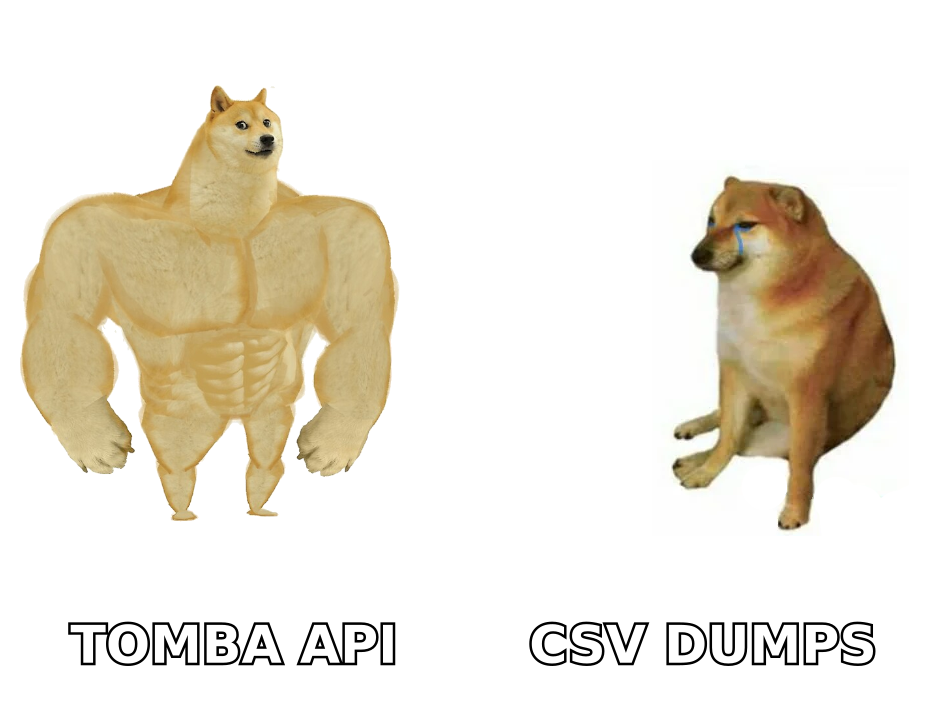
Here's the head-to-head. Treat the pricing as directional — Clodura.AI publishes seat tiers, while Exellius is quote-driven, so the right comparison is cost per valid contact, not sticker price.
| Attribute | Clodura.AI | Exellius | Tomba (focused alternative) |
|---|---|---|---|
| Primary model | Self-serve SaaS suite | Managed / service-weighted | Self-serve data API + apps |
| Core strength | All-in-one database + sequencer | Curated ICP targeting | Verified email finding |
| Database size | Hundreds of millions (claimed) | Curated per-engagement | Domain-driven discovery + verification |
| Email verification | Built-in, bundled | Part of list delivery | Dedicated verifier + catch-all checks |
| Intent data | Yes | Yes (research-led) | No (focused on contact accuracy) |
| Pricing transparency | Public seat tiers | Quote-based | Public, usage-based |
| Entry price | Mid-tier SaaS seats | Custom quote | Free tier (25 searches), $49/mo Starter |
| Best for | Small teams wanting one tool | Teams wanting done-for-you lists | Teams that live or die by deliverability |
The pattern is clear: Clodura.AI and Exellius are platforms competing on breadth, while a tool like Tomba competes on a single metric that breadth tends to erode — does the email actually land. You can see Tomba's transparent pricing details instead of booking a call.
Which one has more accurate data?#
Accuracy is where buying decisions should be made, and where marketing slides are least trustworthy. A database advertising "200M+ contacts" tells you about volume, not freshness. People change jobs every few years; a contact captured 18 months ago may be three roles removed from the title you're targeting. The headline count is the easiest number to inflate and the least correlated with campaign results.
The number that matters is bounce rate on your actual send. A 5% hard-bounce rate quietly torches your sender reputation and pushes future mail to spam, so "more contacts" can literally make your outreach worse if those contacts aren't verified at send time.

This is the structural reason a dedicated verifier earns its place even when you already own a suite. Both Clodura.AI and Exellius verify, but verification bundled inside a platform is a feature, not a focus. A standalone email verifier that runs real-time SMTP and catch-all verification checks against your final list is the cheapest insurance you can buy on a cold-email program — re-verify right before you send, not whenever the database last refreshed.
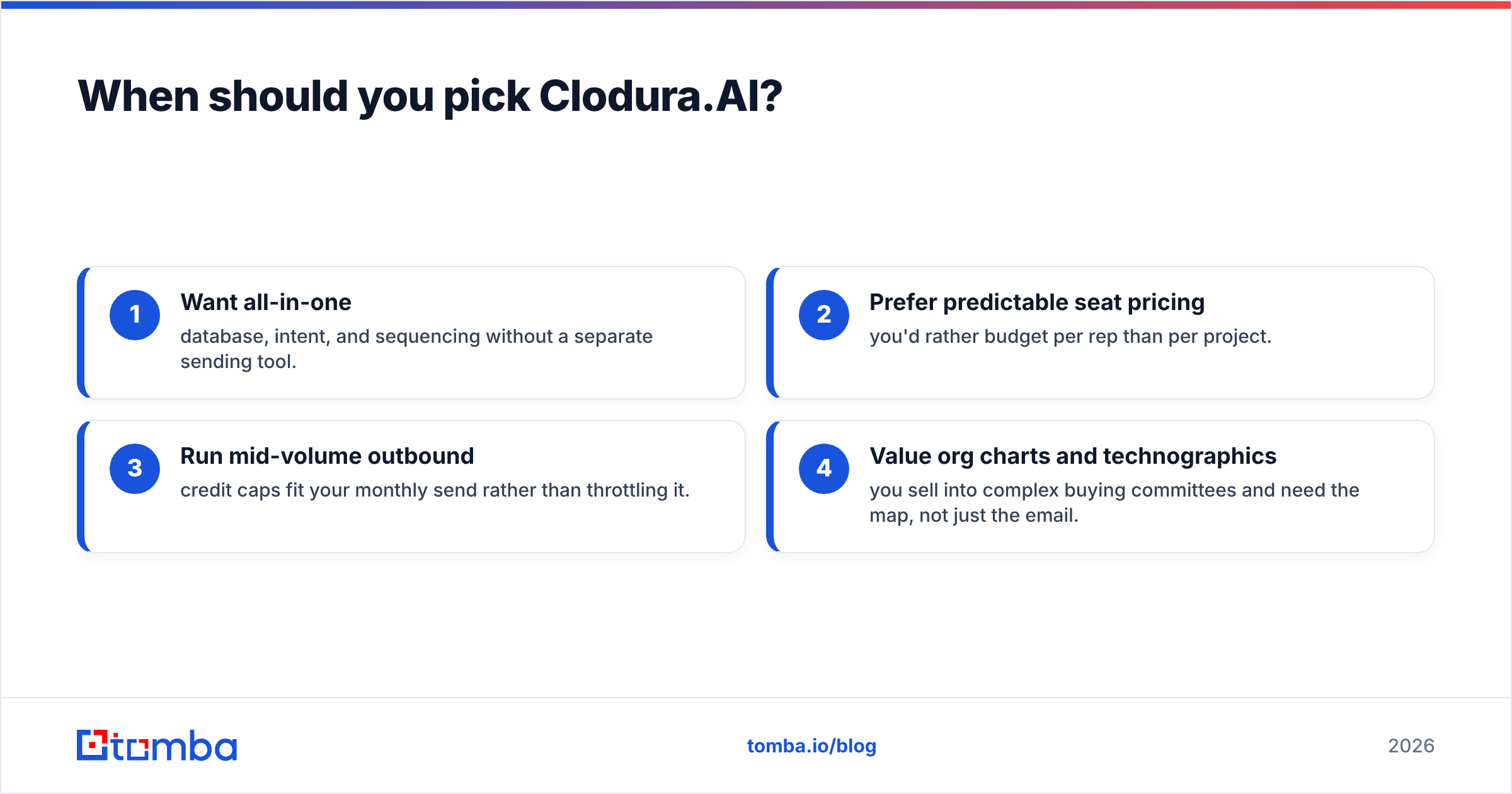
When should you pick Clodura.AI?#
Choose Clodura.AI when you want one self-serve login that covers find-and-send, and your team is small enough that integrating five point tools isn't worth the overhead.
It's a strong fit if you:
- Want all-in-one — database, intent, and sequencing without a separate sending tool.
- Prefer predictable seat pricing — you'd rather budget per rep than per project.
- Run mid-volume outbound — credit caps fit your monthly send rather than throttling it.
- Value org charts and technographics — you sell into complex buying committees and need the map, not just the email.
Where it disappoints: power users routinely note that any single module is "good enough" rather than best. The sequencer isn't Outreach; the data isn't ZoomInfo; the verifier isn't a dedicated tool. That's the all-in-one bargain — convenience now, ceilings later.

When should you pick Exellius?#
Choose Exellius when you'd rather receive a vetted list than build one, and a human-curated ICP is worth paying a premium for.
It fits teams that:
- Lack data ops — no one in-house to run searches, clean lists, and manage credits.
- Sell into a narrow, high-value ICP — precision beats volume, and bad targeting is expensive.
- Want accountability — a scoped engagement with a deliverable, not a seat you have to fully exploit yourself.
The downsides are the mirror image of the upsides: less transparency, slower turnaround than a self-serve tap, and quote-based costs that are harder to benchmark line-by-line. If your motion is fast, experimental, and high-volume, a managed model becomes a bottleneck.
Is there a better alternative for email accuracy?#
Yes — if your bottleneck is finding and verifying business emails rather than buying a full intelligence suite, a focused tool beats a broad one on the metric that pays your bills.
That's the lane Tomba runs in. Instead of renting a giant static database, you point the email finder at a name and domain (or run a full domain search to pull every public address on a company), then verify before you send. The data is generated and checked against live sources, so you're not betting your reputation on a snapshot from last quarter. For account-based work, data enrichment fills in titles, phones, and socials on contacts you already have.
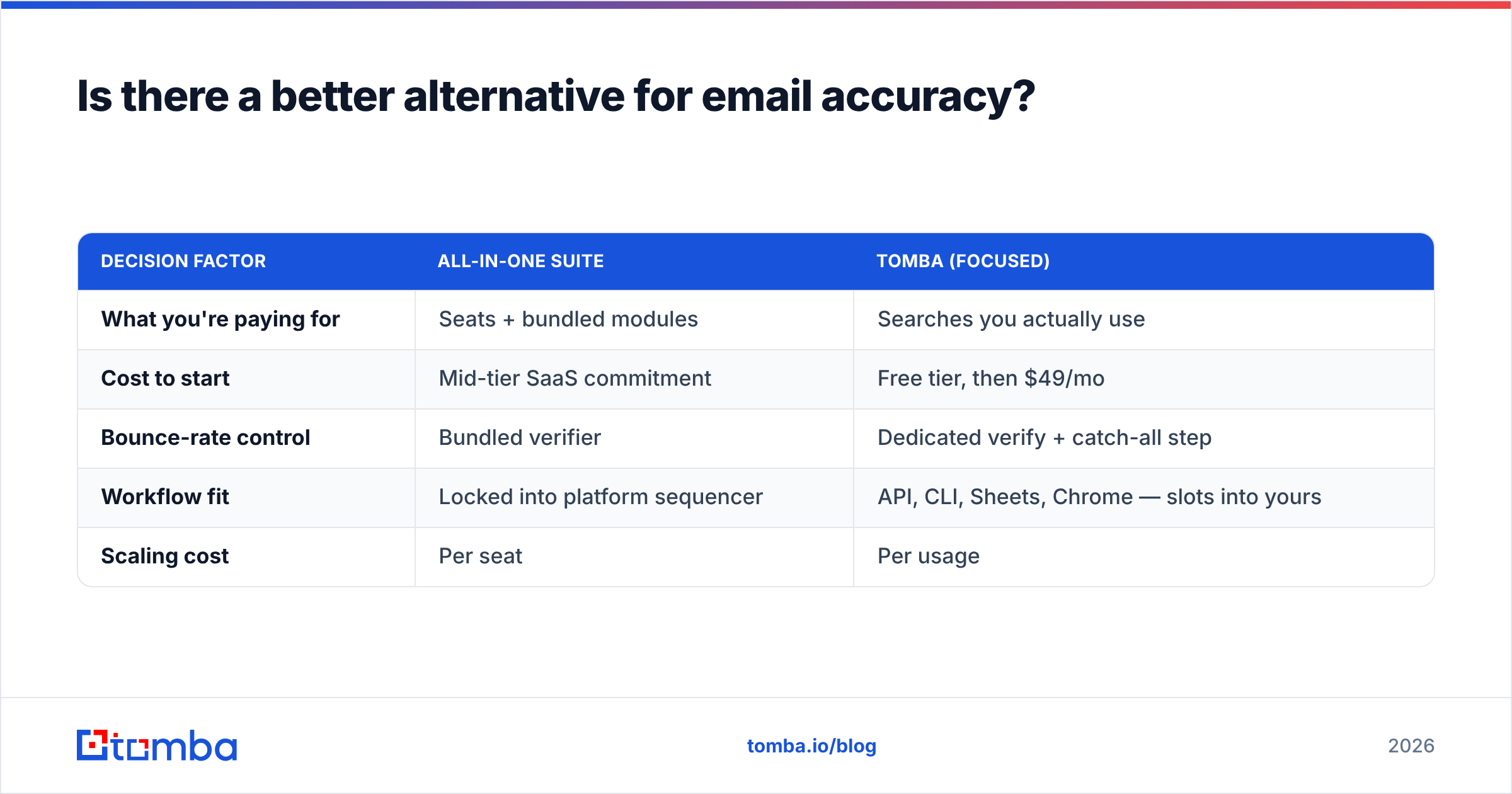
Here's how the focused approach stacks up against the suite model:
| Decision factor | All-in-one suite | Tomba (focused) |
|---|---|---|
| What you're paying for | Seats + bundled modules | Searches you actually use |
| Cost to start | Mid-tier SaaS commitment | Free tier, then $49/mo |
| Bounce-rate control | Bundled verifier | Dedicated verify + catch-all step |
| Workflow fit | Locked into platform sequencer | API, CLI, Sheets, Chrome — slots into yours |
| Scaling cost | Per seat | Per usage |

The honest framing: Tomba is not trying to be Clodura.AI or Exellius. It doesn't sell you a sequencer or a managed service. It does the find-and-verify job and gets out of the way — which is exactly why teams often run it alongside a suite, using the platform for intent and org mapping and Tomba for the clean, send-ready email layer.
How do the pricing models really differ?#
The cleanest way to compare is to ignore sticker price and compute cost per valid contact = (monthly spend) ÷ (contacts that pass verification and don't bounce).
- Clodura.AI charges per seat with credit caps. Your effective cost per valid contact rises if reps under-use credits (you paid for capacity you didn't touch) or if a chunk of the database is stale (you paid for bounces).
- Exellius charges per engagement. Cost per valid contact depends entirely on scope and list quality — potentially excellent for a tight ICP, expensive for broad volume.
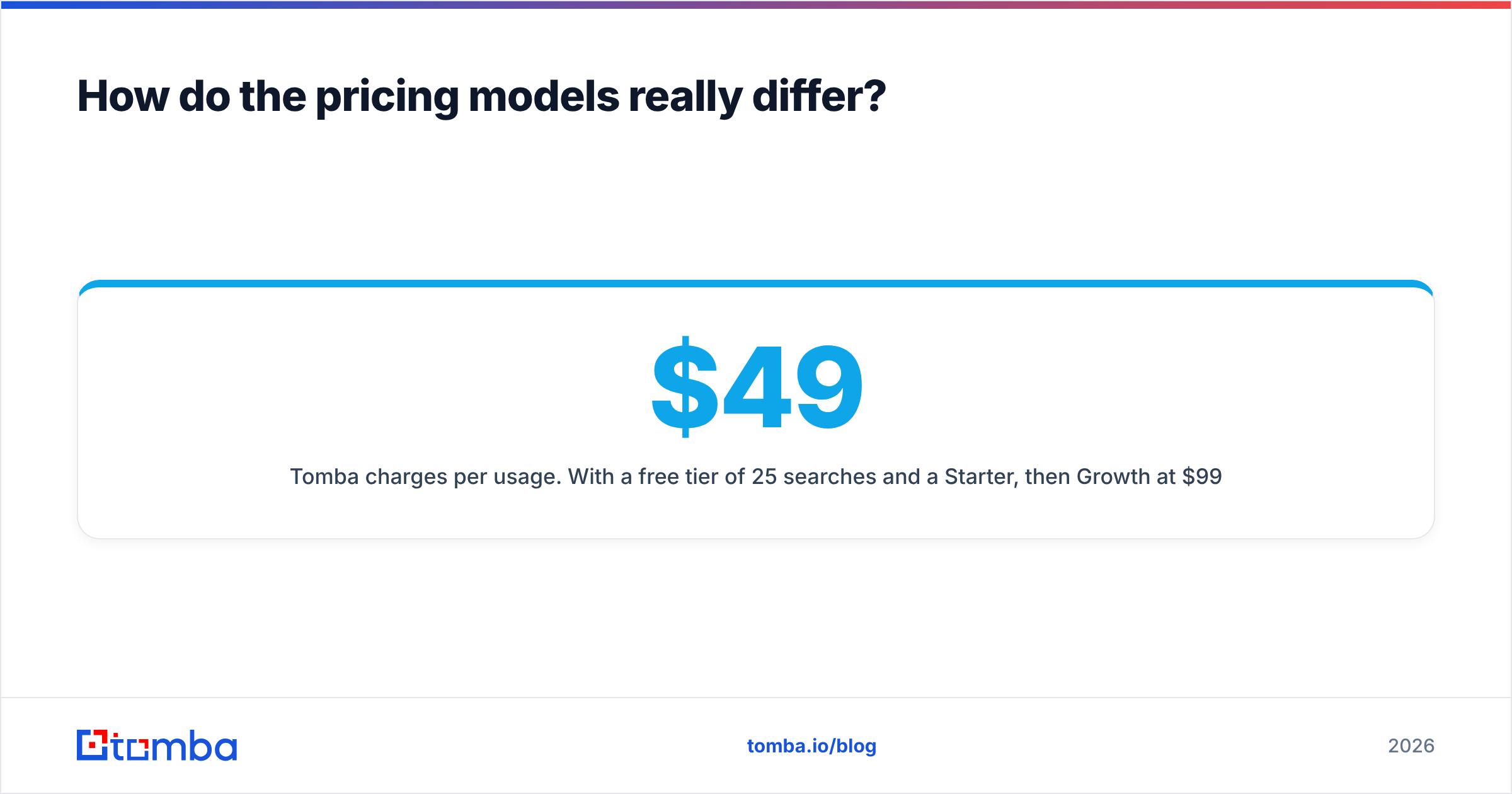
- Tomba charges per usage. With a free tier of 25 searches and a $49/mo Starter, then Growth at $99/mo and Pro at $249/mo, you can model the cost before committing — and you only pay for searches you run.
For a high-volume, self-serve team, usage-based almost always wins on this math. For a low-volume team that wants hand-holding, the managed model can justify its premium. Run your own numbers against your real bounce rate before you sign anything.
Final verdict: Cloduraai vs Exellius#
There's no universal winner — there's a winner for your motion.
- Pick Clodura.AI if you want a single self-serve platform for find-and-send and you value breadth (intent, org charts, sequencing) over best-in-class anything.
- Pick Exellius if you'd rather buy a curated, vetted list than operate a data tool, and your ICP is narrow enough that precision pays for the premium.
- Bolt on Tomba regardless. Whichever suite you choose, deliverability is decided at send time, and a dedicated finder-plus-verifier is the cheapest way to protect it.
The mistake to avoid is treating database size as a proxy for results. It isn't. Valid, verified, send-ready emails are — and that's a narrower, more measurable problem than either platform's homepage suggests.
Get send-ready emails without the suite tax#
If your real goal is more replies and fewer bounces, start where the money is: clean, verified contact data. The Tomba Email Finder finds professional emails by name, domain, or company, then verifies them before they hit your sequencer — so you spend on prospects who exist, not on a dashboard. Try it on the free tier (25 searches, no card), feed the output into Clodura.AI, Exellius, or whatever you already run, and watch your bounce rate drop. That's the layer both suites quietly depend on — own it directly.
// get started
Find, verify and enrich your first contacts today
Start on the free plan with 25 searches a month, then scale when your team is ready.
Free plan · No credit card required · GDPR & CCPA
// about the author