Clodura.ai vs Extruct AI: B2B Data Tools Compared 2026
Clodura.ai vs Extruct AI: one is a full sales-intelligence database, the other an AI research agent. See which fits your B2B data stack in 2026 — and where a dedicated finder beats both.
You are comparing two tools that look similar on a feature grid but solve different problems. Clodura.ai is a sales-intelligence platform built around a static B2B contact database, sequences, and an email finder. Extruct AI is an AI research agent that builds custom company lists by extracting structured data from the live web. Picking the wrong one wastes a quarter of pipeline-building time.
This guide breaks down Clodura.ai vs Extruct AI across data model, accuracy, pricing, and the jobs each one actually does well — plus where a focused email finder earns its place alongside either.
TL;DR#
- Clodura.ai = a prospecting suite: 600M+ contacts, direct dials, email sequences, and basic CRM features in one login. Best for SDR teams that want database + outreach together.
- Extruct AI = an AI agent that researches companies on demand and returns structured tables. Best for RevOps and founders building niche, custom account lists no static database covers.
- They are complements more than rivals: Extruct finds and qualifies accounts; Clodura supplies contacts and sequences.
- Neither is a pure verification engine — both benefit from a dedicated email verifier before you send.
- If your real need is just accurate work emails by domain or name, a specialist tool like Tomba is cheaper and more precise than either platform.
What is Clodura.ai?#
Clodura.ai is an all-in-one sales prospecting platform. Its core is a prebuilt database of B2B companies and contacts — the vendor cites 600M+ verified contacts and 18M+ companies — layered with technographics, org charts, direct-dial numbers, and an email-sequence tool. You search by filters (industry, headcount, title, tech stack), pull a list, then email or call from the same dashboard.
Think of Clodura like a warehouse with shelves already stocked. You walk in, filter the aisles, and load your cart. The data is there before you ask; your job is to query and qualify it. That makes it fast for repeatable, high-volume SDR motions where the total addressable market is broad and well-documented.
The trade-off is the trade-off of every static database: coverage is strongest in well-trodden segments (US SaaS, mid-market tech) and thinner for niche verticals, new companies, or non-English markets. Records also decay — people change jobs roughly every two to three years — so any database list needs verification before send.

What is Extruct AI?#
Extruct AI is a different animal: an AI-powered company research agent. Instead of querying a frozen database, you describe the companies you want ("seed-stage fintechs in the EU using Stripe, founded after 2023"), and Extruct's agents crawl the live web, extract the matching companies, and return a structured, enrichable table. You add columns by asking for them — funding, headcount, specific signals — and the agent fills them.
Extruct is less a warehouse and more a research assistant you can point at the open internet. It shines when the list you need doesn't exist in any off-the-shelf database — emerging categories, long-tail niches, or signal-based account scoring that changes weekly. Because it works from live sources, it can surface companies that static providers haven't indexed yet.
The catch: Extruct is primarily an account-level tool. It excels at finding and enriching companies, not at handing you the verified personal email of the VP of Engineering. For contact-level data — the actual address you email — you still need a finder and verifier downstream.
Clodura.ai vs Extruct AI: how do they compare?#
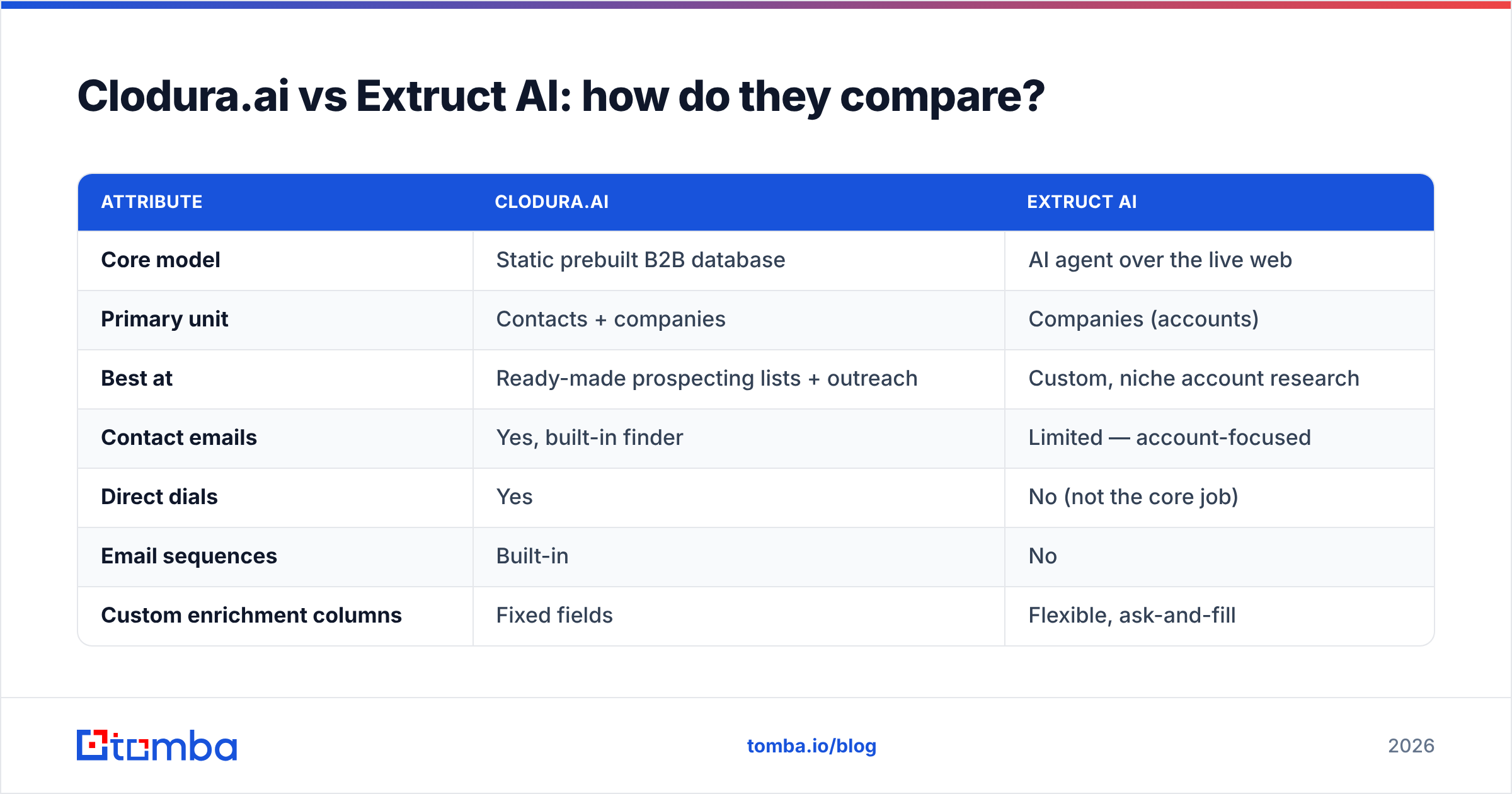
Here is the head-to-head on the attributes that decide which tool fits your workflow.
| Attribute | Clodura.ai | Extruct AI |
|---|---|---|
| Core model | Static prebuilt B2B database | AI agent over the live web |
| Primary unit | Contacts + companies | Companies (accounts) |
| Best at | Ready-made prospecting lists + outreach | Custom, niche account research |
| Contact emails | Yes, built-in finder | Limited — account-focused |
| Direct dials | Yes | No (not the core job) |
| Email sequences | Built-in | No |
| Custom enrichment columns | Fixed fields | Flexible, ask-and-fill |
| Data freshness | Periodic refresh, decays | Live, on-demand |
| Best fit | SDR teams running volume outreach | RevOps, founders, custom lists |
| Learning curve | Moderate (full suite) | Low (describe what you want) |
The pattern is clear once you map it to a job:
- Need contacts and a place to email them today? Clodura.ai is the broader, faster path — database and sequences under one roof.
- Need a company list that no database sells? Extruct AI's agent is built for exactly that long-tail research.
- Need both? Use Extruct to build and score the account list, then enrich contacts with a dedicated finder.
- Need volume dials for a phone motion? Clodura includes direct dials; Extruct doesn't play here — pair it with a phone finder instead.
- Need defensible deliverability before send? Neither is a verification specialist — run lists through an email verifier first.
)
Which has better data accuracy?#
Accuracy depends on what you mean by "accurate," because the two tools measure different things.
Clodura.ai's accuracy is database accuracy: how current and correct its stored records are. Like every static provider — Apollo, ZoomInfo, Lusha — its emails are time-stamped snapshots. A 95% "verified" claim degrades the moment someone changes roles, so real-world hit rate on cold lists is lower than the marketing number. The fix is to re-verify at send time, not to trust the stored flag.
Extruct AI's accuracy is extraction accuracy: did the agent correctly read the live web and return true company attributes? Because it pulls from current sources, its company-level facts (funding, headcount, tech) are often fresher than a database. But AI extraction can misread ambiguous pages, and it generally won't give you a verified personal email — so contact accuracy isn't its strength.
The honest conclusion: for company facts, Extruct's live model is fresher; for ready contacts, Clodura's database is broader; for the email actually landing, neither replaces verification. This is why mature teams treat data sourcing and data verification as separate steps. If you care where numbers come from, scrutinize each vendor's data sources — provenance predicts accuracy more than any headline percentage.
)
Clodura.ai vs Extruct AI pricing: which is better value?#
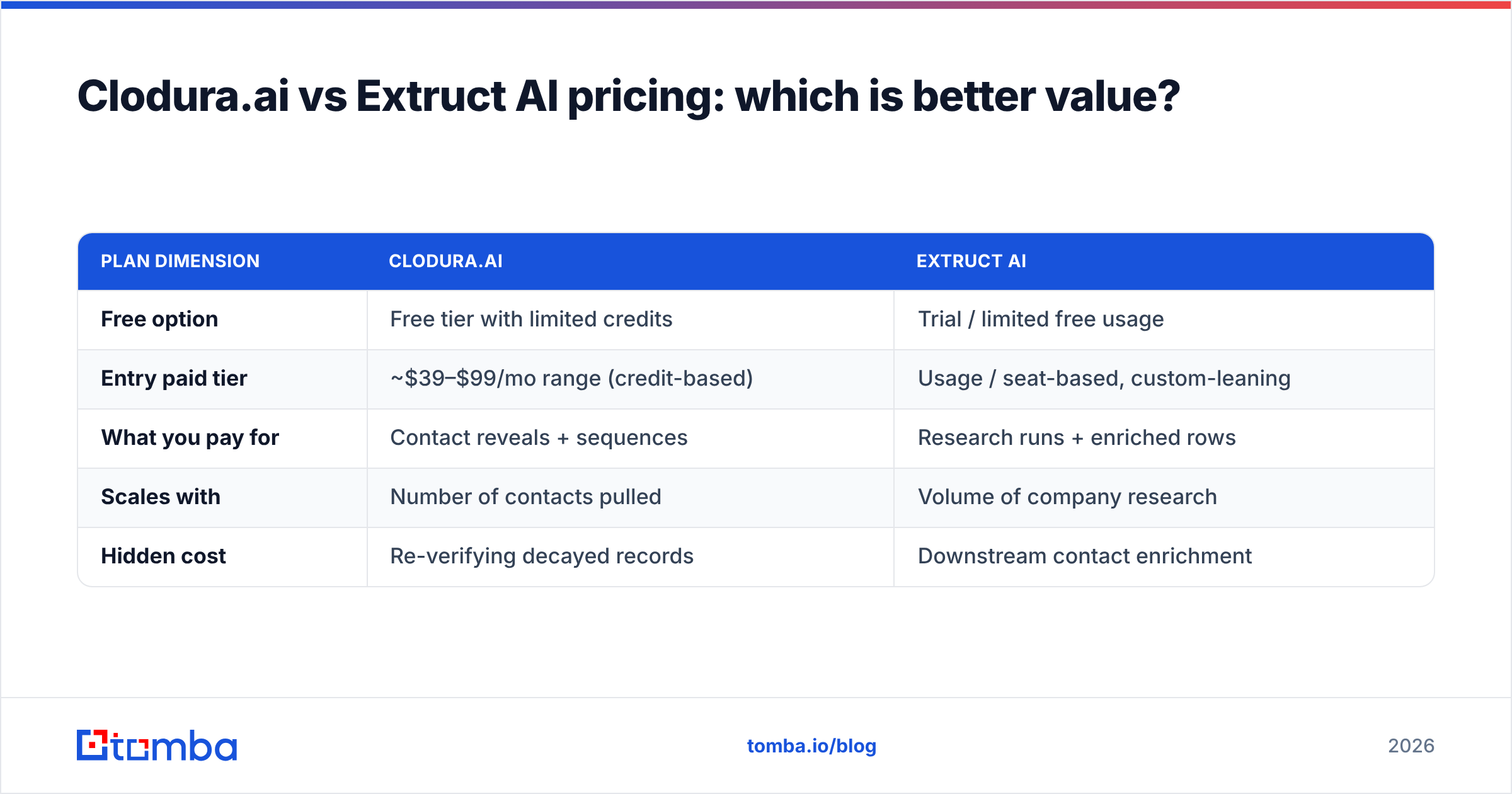
Pricing structures reflect the different models, so compare cost-per-job, not just sticker price.
| Plan dimension | Clodura.ai | Extruct AI |
|---|---|---|
| Free option | Free tier with limited credits | Trial / limited free usage |
| Entry paid tier | ~$39–$99/mo range (credit-based) | Usage / seat-based, custom-leaning |
| What you pay for | Contact reveals + sequences | Research runs + enriched rows |
| Scales with | Number of contacts pulled | Volume of company research |
| Hidden cost | Re-verifying decayed records | Downstream contact enrichment |
Clodura bills around contact credits — you pay to reveal and export contacts, with outreach bundled. Extruct bills around research and enrichment volume — you pay for the agent's work building and filling tables. Always check current numbers on the vendors' own pages, since both iterate plans (clodura.ai, extruct.ai), and read independent reviews on G2 before committing annually.
The value question that actually matters: what is your fully loaded cost per usable, verified contact? A cheap database export that's 30% stale isn't cheap once your domain reputation takes the hit. Budget for verification as a line item regardless of which platform you choose — see typical Tomba pricing for what dedicated finding and verifying costs as a standalone layer.
When should you use each tool?#
Choose Clodura.ai if you:
- Run a volume SDR motion and want database, email, and dialer in one tool.
- Sell into well-documented segments (US/EU tech, mid-market) where database coverage is deep.
- Want sequences and basic CRM-style tracking without buying a separate outreach platform.
- Prefer one login over a stitched-together stack.
Choose Extruct AI if you:
- Need account lists that no static database sells — emerging niches, custom signals.
- Are in RevOps or founder-led sales building TAM/ICP lists from scratch.
- Value live, current company data over a periodically refreshed snapshot.
- Want flexible enrichment columns you can define by asking.
Use both if you build account lists with Extruct and need contacts plus outreach from Clodura — a common stack for teams chasing non-obvious markets.
Where does a dedicated email finder fit?#
Here's the gap both tools share: the verified, personal work email is the weakest link in each. Clodura gives you database emails that decay; Extruct gives you companies but rarely the contact's verified address. In both cases, the last mile — turning a name and domain into an email that actually delivers — is a specialist job.
That's the niche a focused finder fills. With a tool like Tomba you can:
- Turn a company domain into its people via domain search when you only have the website.
- Find a specific person's address with the email finder from name + company.
- Run any exported list through verification so you don't torch your sender reputation.
- Enrich thin records with firmographic data enrichment before they hit your sequence.
Think of it as quality control at the end of the assembly line. Extruct or Clodura sources the raw parts; the finder/verifier inspects and certifies each address before it ships. Teams that skip this step pay for it in bounces, spam folders, and a damaged domain — costs that dwarf the price of verification.
Frequently asked questions#
Is Clodura.ai a direct competitor to Extruct AI? Not really. Clodura is a contact database plus outreach suite; Extruct is an AI agent for custom company research. They overlap on "finding companies" but diverge on everything downstream — contacts, dials, and sequences live in Clodura, while bespoke list-building lives in Extruct.
Which is better for a small SDR team? Clodura.ai, usually — it bundles the database, emails, and dialer an SDR needs day one. Add Extruct later if you start chasing niche segments the database doesn't cover.
Do I still need an email verifier with these tools? Yes. Database emails decay and AI-extracted contacts are unverified by default. Run lists through an email verifier before any send to protect deliverability.
Can I use Extruct AI to find personal email addresses? It's built for account-level research, not verified personal emails. Pair it with a dedicated finder for the contact layer.
The bottom line#
In the Clodura.ai vs Extruct AI decision, pick by the shape of your problem: Clodura.ai for a ready-made database with built-in outreach, Extruct AI for AI-driven research into lists no database sells. They're complements as often as competitors — and neither one removes your need to verify the actual email before you hit send.
Whichever platform sources your accounts, certify the contacts before they enter a sequence. Start free with the Tomba Email Finder — find work emails by name, company, or domain, verify them in bulk, and feed clean, deliverable data into Clodura, Extruct, or whatever stack you run. Accurate contacts are the difference between pipeline and bounce.
// get started
Find, verify and enrich your first contacts today
Start on the free plan with 25 searches a month, then scale when your team is ready.
Free plan · No credit card required · GDPR & CCPA
// about the author