Clodura.AI vs FINTRX 2026: B2B Data Platforms Compared
Clodura.AI is a broad B2B sales-intelligence engine; FINTRX is a niche private-wealth database. Here is which one fits your pipeline in 2026 — and where a verified email layer beats both.
Clodura.AI vs FINTRX: Which B2B Data Platform Should You Buy in 2026?
Two tools, two completely different jobs. People keep pitting Clodura.AI vs FINTRX as if they're interchangeable — they aren't. One is a horizontal sales-intelligence and prospecting engine built for SDR teams across every industry. The other is a deep, vertical database for the private-wealth and alternative-investment world. Picking the wrong one wastes a year of budget.
This guide breaks down exactly what each platform does, where the data comes from, what you pay, and — the part most reviews skip — what to do when the contact data either tool hands you is stale by the time it reaches your inbox.
TL;DR#
- Clodura.AI is a broad B2B sales-intelligence platform: company + contact database, intent signals, sequences, and an email/dialer layer for general outbound teams.
- FINTRX is a specialized private-capital dataset — family offices, RIAs, wealth managers, and alternative-investment allocators. It is the wrong tool for generic SaaS prospecting and the right tool for capital-raising.
- Pick Clodura.AI if you sell horizontally and want one platform for list-building + outreach. Pick FINTRX if your entire ICP lives inside private wealth.
- Neither is an accuracy guarantee. Both ship contacts that decay ~2–3% per month, so verify every address before you send.
- A dedicated verification layer like Tomba catches the dead addresses both databases miss, protecting your sender reputation.
What is Clodura.AI?#
Clodura.AI is a sales-intelligence and prospecting platform aimed at outbound teams that sell across many industries. Think of it as a Swiss Army knife: a 600M+ contact database, buyer-intent and technographic signals, an email/sequence builder, and a built-in dialer, all under one login. You search by title, geography, technology, or company size, build a list, and push it straight into a cadence.
Its strength is breadth. If your ideal customer profile spans software buyers, manufacturers, healthcare admins, and retail ops, Clodura.AI gives you one surface to find and contact all of them. It competes with the Apollo / Lusha / Seamless tier of all-in-one prospecting tools.
The trade-off with breadth is depth. Horizontal databases stretch their verification budget across hundreds of millions of records, so coverage in any single niche is shallower than a specialist's, and freshness varies by segment.

What is FINTRX?#
FINTRX is a private-wealth intelligence platform. Its whole reason to exist is mapping the family-office, RIA, and alternative-investment ecosystem: who allocates capital, how much, to which strategies, and who the decision-makers are. If you raise a fund, sell to wealth managers, or distribute alternative products, FINTRX is purpose-built for you.
Where Clodura.AI is a mile wide, FINTRX is a mile deep in one vertical. It tracks relationships, mandates, AUM bands, and the connective tissue between allocators and managers — context a horizontal database simply doesn't model. That depth is the product.
The flip side: outside private capital, FINTRX is irrelevant. You cannot use it to prospect a logistics company or a dev-tools startup. It is a scalpel, not a multi-tool.
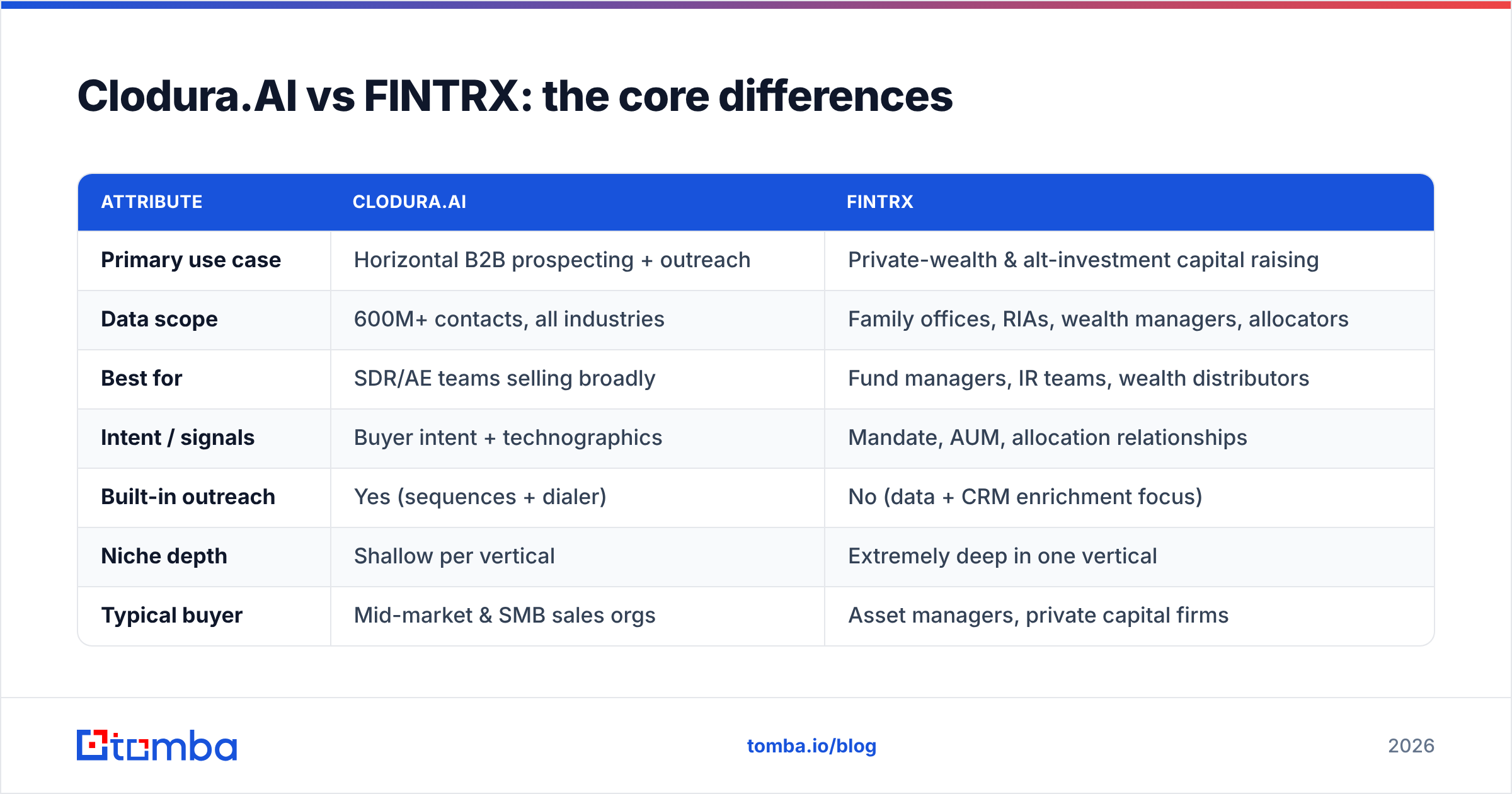
Clodura.AI vs FINTRX: the core differences#
The honest way to compare these two is by job-to-be-done, not by feature checkbox. Here's the side-by-side.
| Attribute | Clodura.AI | FINTRX |
|---|---|---|
| Primary use case | Horizontal B2B prospecting + outreach | Private-wealth & alt-investment capital raising |
| Data scope | 600M+ contacts, all industries | Family offices, RIAs, wealth managers, allocators |
| Best for | SDR/AE teams selling broadly | Fund managers, IR teams, wealth distributors |
| Intent / signals | Buyer intent + technographics | Mandate, AUM, allocation relationships |
| Built-in outreach | Yes (sequences + dialer) | No (data + CRM enrichment focus) |
| Niche depth | Shallow per vertical | Extremely deep in one vertical |
| Typical buyer | Mid-market & SMB sales orgs | Asset managers, private capital firms |
| Pricing model | Per-seat SaaS tiers | Enterprise / custom quote |
The pattern is clear: these tools don't actually overlap much. If you're choosing between them, your industry usually decides for you before pricing does.
Which one fits your team? A 5-point decision guide#
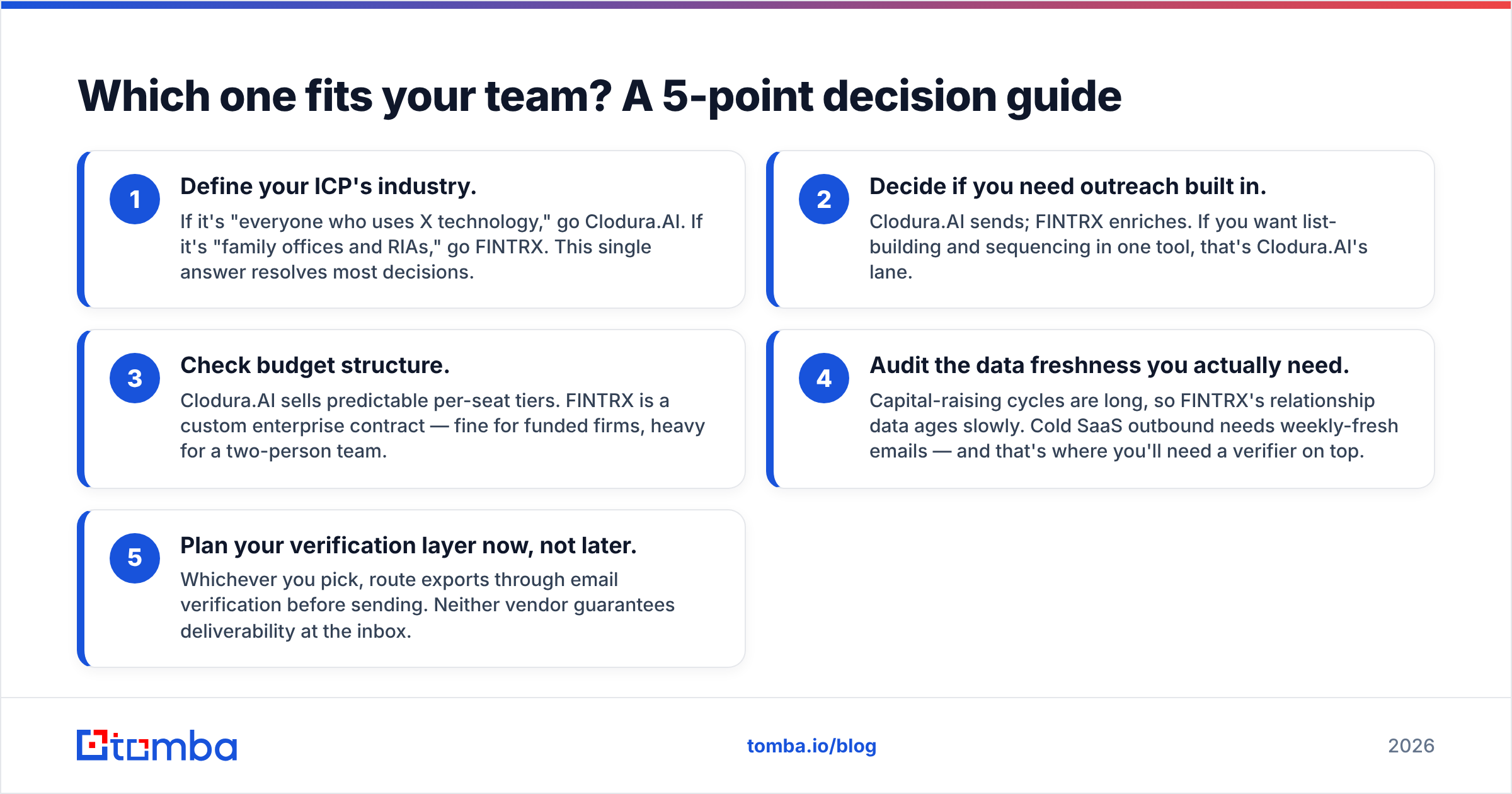
Use this checklist to settle the cloduraai vs fintrx question in five minutes:
- Define your ICP's industry. If it's "everyone who uses X technology," go Clodura.AI. If it's "family offices and RIAs," go FINTRX. This single answer resolves most decisions.
- Decide if you need outreach built in. Clodura.AI sends; FINTRX enriches. If you want list-building and sequencing in one tool, that's Clodura.AI's lane.
- Check budget structure. Clodura.AI sells predictable per-seat tiers. FINTRX is a custom enterprise contract — fine for funded firms, heavy for a two-person team.
- Audit the data freshness you actually need. Capital-raising cycles are long, so FINTRX's relationship data ages slowly. Cold SaaS outbound needs weekly-fresh emails — and that's where you'll need a verifier on top.
- Plan your verification layer now, not later. Whichever you pick, route exports through email verification before sending. Neither vendor guarantees deliverability at the inbox.
Is the contact data accurate enough to send cold?#
Short answer: not without a second check. Both platforms publish high accuracy claims, and both are telling a partial truth. Database accuracy is measured the day a record is collected — but B2B contacts decay fast. People change jobs, companies rebrand, and catch-all domains hide invalid mailboxes. Industry studies from vendors like ZoomInfo and analyst notes on G2 consistently put B2B data decay around 25–30% per year.
That means a list you pulled in January is meaningfully wrong by spring. If you blast it cold, you rack up bounces, which trains spam filters to distrust your domain. One bad send hurts every future campaign.
The fix is a verification step between "export" and "send." A standalone email verifier checks MX records, SMTP responses, and catch-all behavior in real time — catching the dead addresses that a database snapshot can't see. For domains that accept everything, a dedicated catch-all verifier is the only reliable way to separate real mailboxes from black holes.

How does pricing compare?#
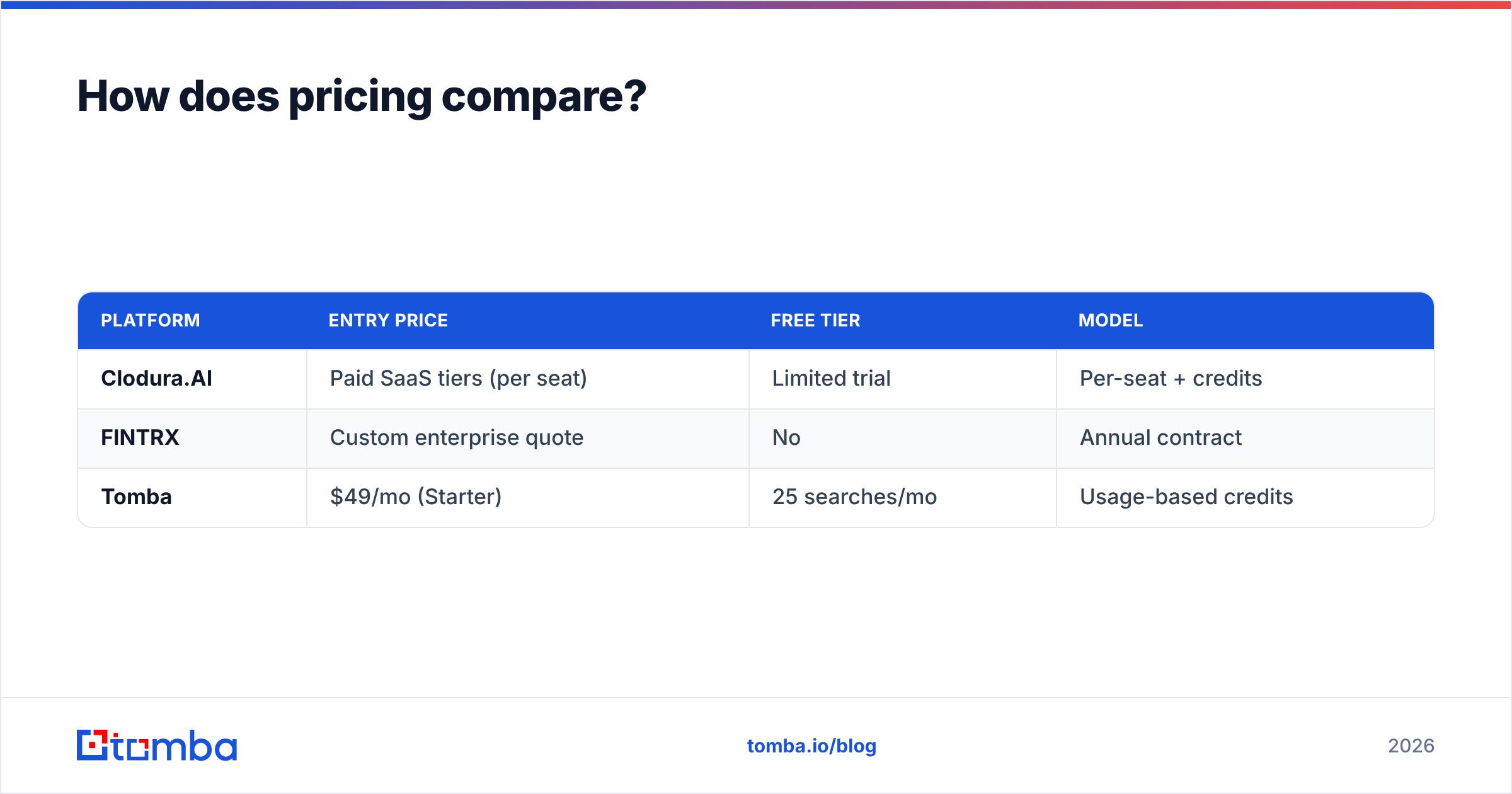
Clodura.AI uses transparent per-seat SaaS tiers (free trial plus paid plans that scale by credits and seats), which makes it easy to start small. FINTRX is enterprise-priced and quote-based — expect a meaningful annual commitment, justified when a single closed allocation is worth six or seven figures.
For comparison, here's how a focused, verification-first stack stacks up on cost predictability:
| Platform | Entry price | Free tier | Model |
|---|---|---|---|
| Clodura.AI | Paid SaaS tiers (per seat) | Limited trial | Per-seat + credits |
| FINTRX | Custom enterprise quote | No | Annual contract |
| Tomba | $49/mo (Starter) | 25 searches/mo | Usage-based credits |
Tomba isn't a like-for-like replacement for either platform — it's the layer you bolt on to make either one safe to send from. You can see the full breakdown on the Tomba pricing page. The Free tier (25 searches/mo) is enough to test data quality before you commit.
Where does a focused email layer beat both?#
Big databases optimize for record count. They want to say "600 million contacts" because that headline sells. But a sales team doesn't email 600 million people — it emails the 500 who match this quarter's ICP, and it needs those 500 to be correct.
That's a different problem, and it's the one a specialist tool solves better:
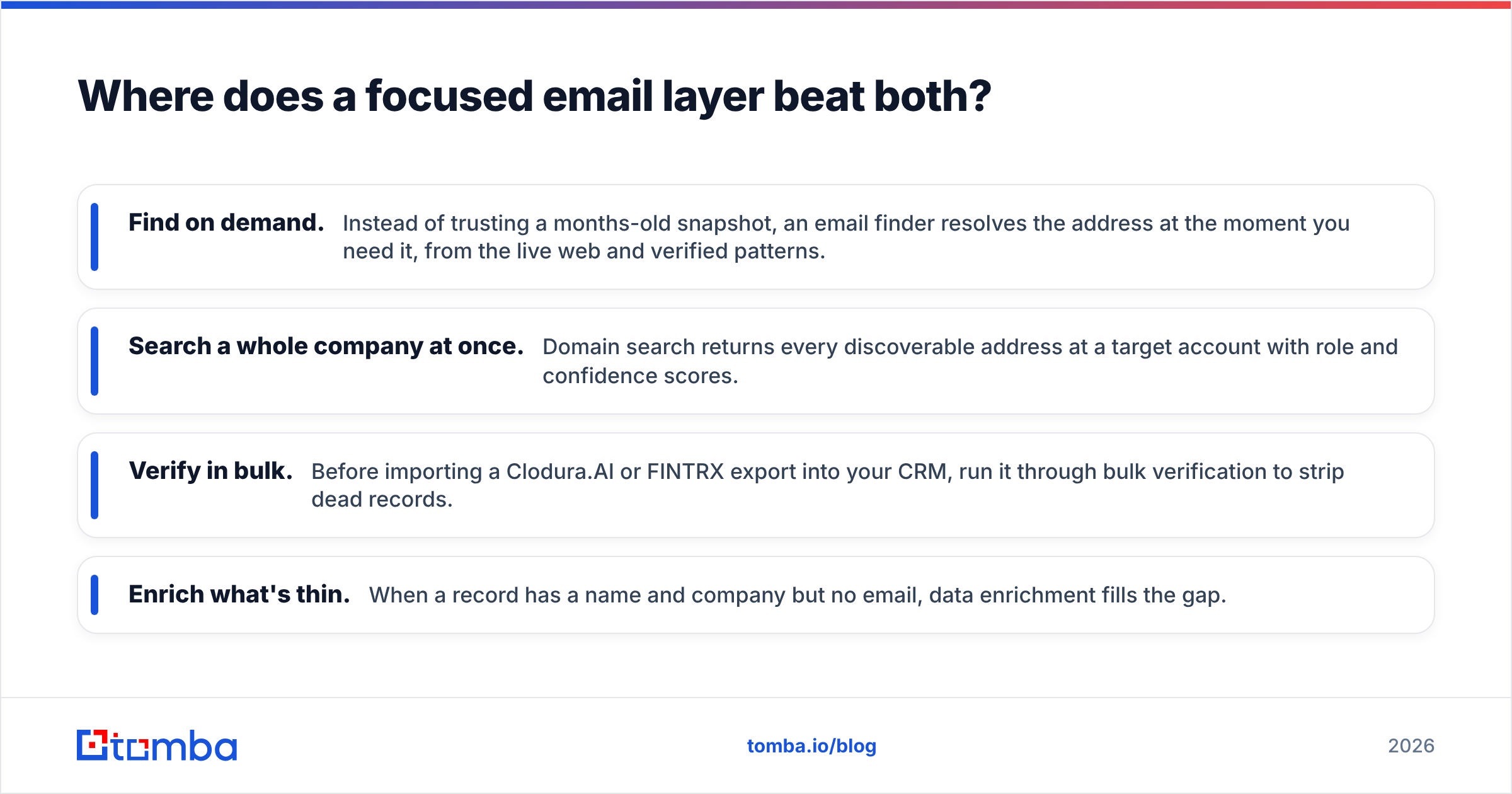
- Find on demand. Instead of trusting a months-old snapshot, an email finder resolves the address at the moment you need it, from the live web and verified patterns.
- Search a whole company at once. Domain search returns every discoverable address at a target account with role and confidence scores.
- Verify in bulk. Before importing a Clodura.AI or FINTRX export into your CRM, run it through bulk verification to strip dead records.
- Enrich what's thin. When a record has a name and company but no email, data enrichment fills the gap.
This is why the smart stack isn't "Clodura.AI or FINTRX or Tomba." It's a broad source for discovery and a focused layer for accuracy. The database tells you who; the verifier tells you whether you can actually reach them.
Common mistakes when choosing between them#
- Treating them as competitors. They serve different markets. Comparing them on raw contact count is meaningless when one is vertical and one is horizontal.
- Skipping verification to "save a step." A few cents of verification per contact is far cheaper than a blacklisted domain. Protect sender reputation first.
- Buying enterprise data for an SMB motion. If you're early-stage and selling broadly, a custom-quote wealth database is overkill. Start narrow and cheap.
- Ignoring catch-all domains. A large share of corporate domains accept all mail. Without a catch-all check, your "valid" list is full of unknowns.
Verdict: which should you choose?#
Choose Clodura.AI if you run a horizontal outbound motion and want one platform to build lists and send sequences. Choose FINTRX if your entire revenue depends on reaching family offices, RIAs, and capital allocators — nothing horizontal will match its depth there.
But understand what you're actually buying in both cases: a starting point, not a finished list. The contact data from either platform decays the moment it leaves their servers. The teams that win at outbound treat database exports as raw material and verify before every send.
Get verified, send-ready contacts with Tomba#
Whatever you decide in the cloduraai vs fintrx debate, the deliverability problem is yours to solve. Tomba's Email Finder and verifier give you fresh, validated addresses on demand — so the contacts you pull from any database actually land in the inbox instead of the spam folder. Start free with 25 searches a month, confirm the data quality yourself, and scale up from the Starter plan at $49/mo only when you're convinced. Your sender reputation will thank you.
Ready to find emails that actually work?
Join 150,000+ professionals who stopped guessing and started sending. Free credits on signup — no credit card required.
Get the Tomba newsletter
Practical outbound tactics and product updates — once every two weeks.
About the author