Clodura.ai vs Gamalogic 2026: Which Sales Data Tool Wins?
Clodura.ai bundles a B2B database with sequences; Gamalogic focuses on email finding and verification. Here's an honest 2026 breakdown of accuracy, pricing, and which one fits your stack.
Choosing between Clodura.ai and Gamalogic comes down to one question: do you want a full prospecting platform with a built-in database and sequencer, or a focused email-finding and verification engine you can plug into the stack you already run? They solve overlapping problems from opposite ends, and picking the wrong one means paying for seats you don't use or stitching together tools you didn't need to.
TL;DR — Clodura.ai vs Gamalogic at a glance#
- Clodura.ai is an all-in-one sales intelligence platform: a B2B contact database, email finder, verification, cadences, and a sales-intelligence layer (org charts, buying signals). Best if you want one login for the whole top-of-funnel.
- Gamalogic is a leaner email finder and email verifier with bulk processing and an API. Best if you already have a CRM and sequencer and just need accurate contact data on demand.
- Accuracy is close on common corporate domains; both struggle with catch-all domains, which is where a dedicated verifier earns its keep.
- Pricing model differs sharply: Clodura.ai sells per-seat platform plans, Gamalogic sells credit packs. Your monthly cost depends entirely on whether you need the platform or just the data.
- If your real bottleneck is email accuracy and deliverability, a specialist like Tomba's email finder often beats both on cost-per-valid-email — more on that below.

What is Clodura.ai?#
Clodura.ai is a B2B sales-intelligence and prospecting platform. Think of it less as a single tool and more as a workbench: you search a database of company and contact records, pull verified emails and direct dials, then push prospects into built-in email sequences without leaving the app. It layers on "sales intelligence" features — organizational charts, technographics, and buying-intent signals — that aim to tell you who to contact and when, not just their email address.
That breadth is the selling point and the catch. You're paying for a platform, so the value only materializes if you use the database, the finder, the verifier, and the cadences together. Teams that adopt one slice of it tend to overpay. You can confirm the current feature scope on the official Clodura.ai site and read unfiltered user notes on G2.
What is Gamalogic?#
Gamalogic is a focused email-finding and verification tool. Its core jobs are simple and well-defined: find a professional email from a name and company or domain, and verify whether an email address is deliverable. It ships bulk processing for list work and an API for developers who want to wire lookups into their own systems.
Because it stays in its lane, Gamalogic is easier to reason about. There's no sequencer to learn, no database seats to justify — you buy credits, run lookups, and move the results into whatever CRM or outreach tool you already trust. The trade-off is that you'll need those other tools; Gamalogic won't run your campaigns for you. Check the current capabilities on the Gamalogic homepage.
How do Clodura.ai and Gamalogic compare on features?#
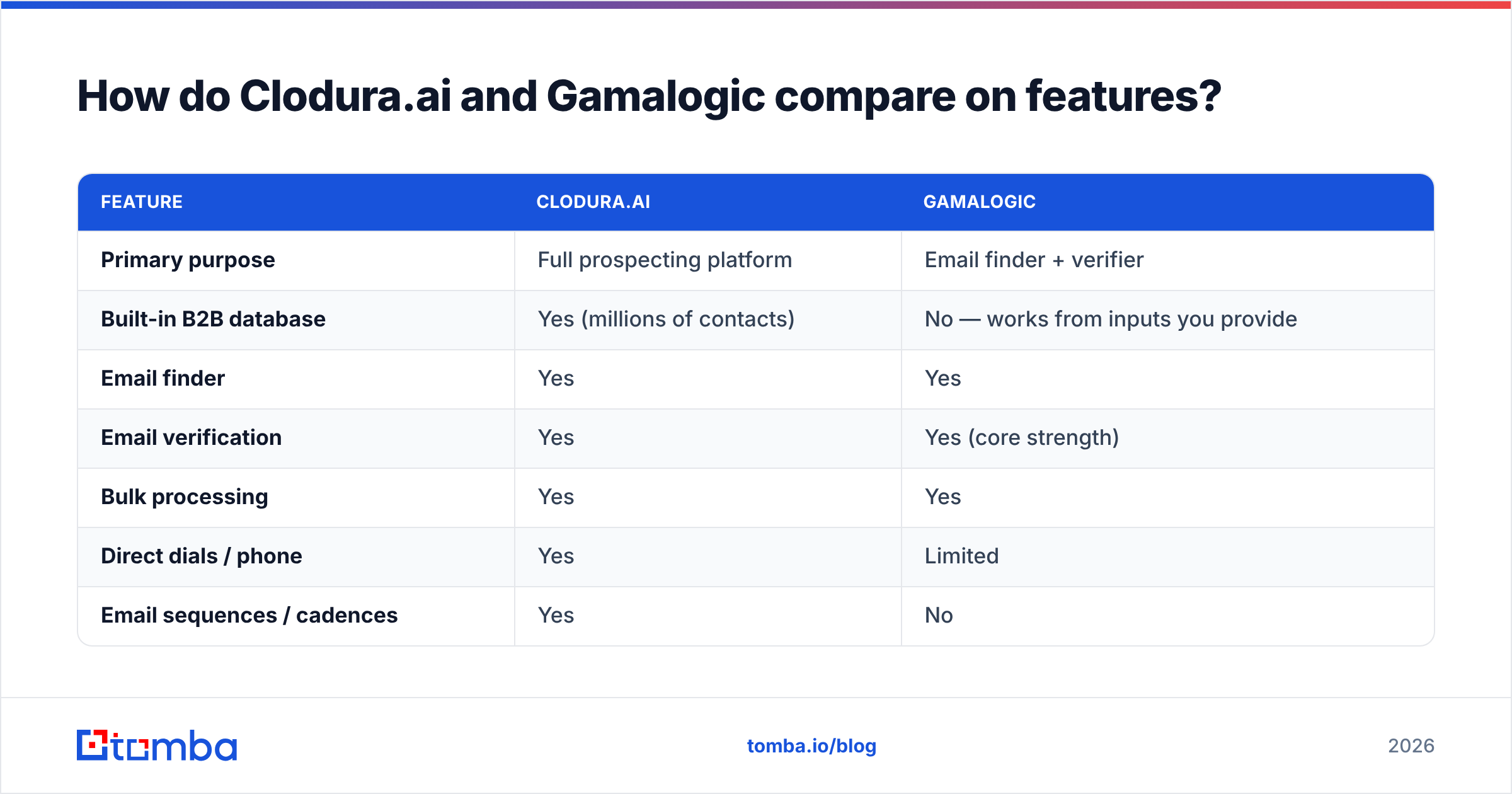
Here's the honest side-by-side. The biggest divide isn't any single feature — it's the shape of the product. Clodura.ai is wide; Gamalogic is deep on a narrow set.
| Feature | Clodura.ai | Gamalogic |
|---|---|---|
| Primary purpose | Full prospecting platform | Email finder + verifier |
| Built-in B2B database | Yes (millions of contacts) | No — works from inputs you provide |
| Email finder | Yes | Yes |
| Email verification | Yes | Yes (core strength) |
| Bulk processing | Yes | Yes |
| Direct dials / phone | Yes | Limited |
| Email sequences / cadences | Yes | No |
| Buying-intent signals | Yes | No |
| API access | Yes | Yes |
| Pricing model | Per-seat platform plans | Credit packs |
| Best fit | Teams wanting one tool for everything | Teams needing data for an existing stack |
The decision logic is straightforward once you see it laid out:
- You have no database and no sequencer — Clodura.ai consolidates the most into one bill.
- You already run a CRM and an outreach tool — Gamalogic adds data without making you re-platform.
- You only care about email accuracy and deliverability — a dedicated finder/verifier (Gamalogic, or a specialist like Tomba) beats a broad platform on cost-per-valid-email.
- You need org charts and intent data to prioritize accounts — that's squarely Clodura.ai territory; Gamalogic doesn't play here.
Which is more accurate at finding and verifying emails?#
Accuracy is where most teams should focus, because a cheap email that bounces costs you far more than a slightly pricier one that lands. On common corporate domains (a single, predictable MX and a clear first.last@ pattern), Clodura.ai and Gamalogic both perform well. The gap shows up on the hard cases: catch-all domains, role-based aliases, and recently changed records.

Catch-all domains accept any address at the SMTP layer, so a basic verifier can't tell a real mailbox from a typo — it just sees "accepted." This is the single biggest source of silent bounces in B2B lists. Gamalogic's verification engine is built to handle this category, and it's the reason a focused verifier often outperforms the verification module bolted onto a broad platform. If catch-all domains make up a meaningful slice of your target accounts, treat verification quality as a primary buying criterion, not a footnote. (Tomba ships a dedicated catch-all verifier for exactly this reason.)
A practical rule: whatever tool you pick for finding, run the output through a strong verifier before you send. Even a 95%-accurate finder leaves a 5% bounce rate that will quietly damage your sender reputation and drag down deliverability across your whole domain. Separating "find" from "verify" — and using the best tool for each — is usually cheaper than trusting one vendor's number for both.
How does pricing compare?#
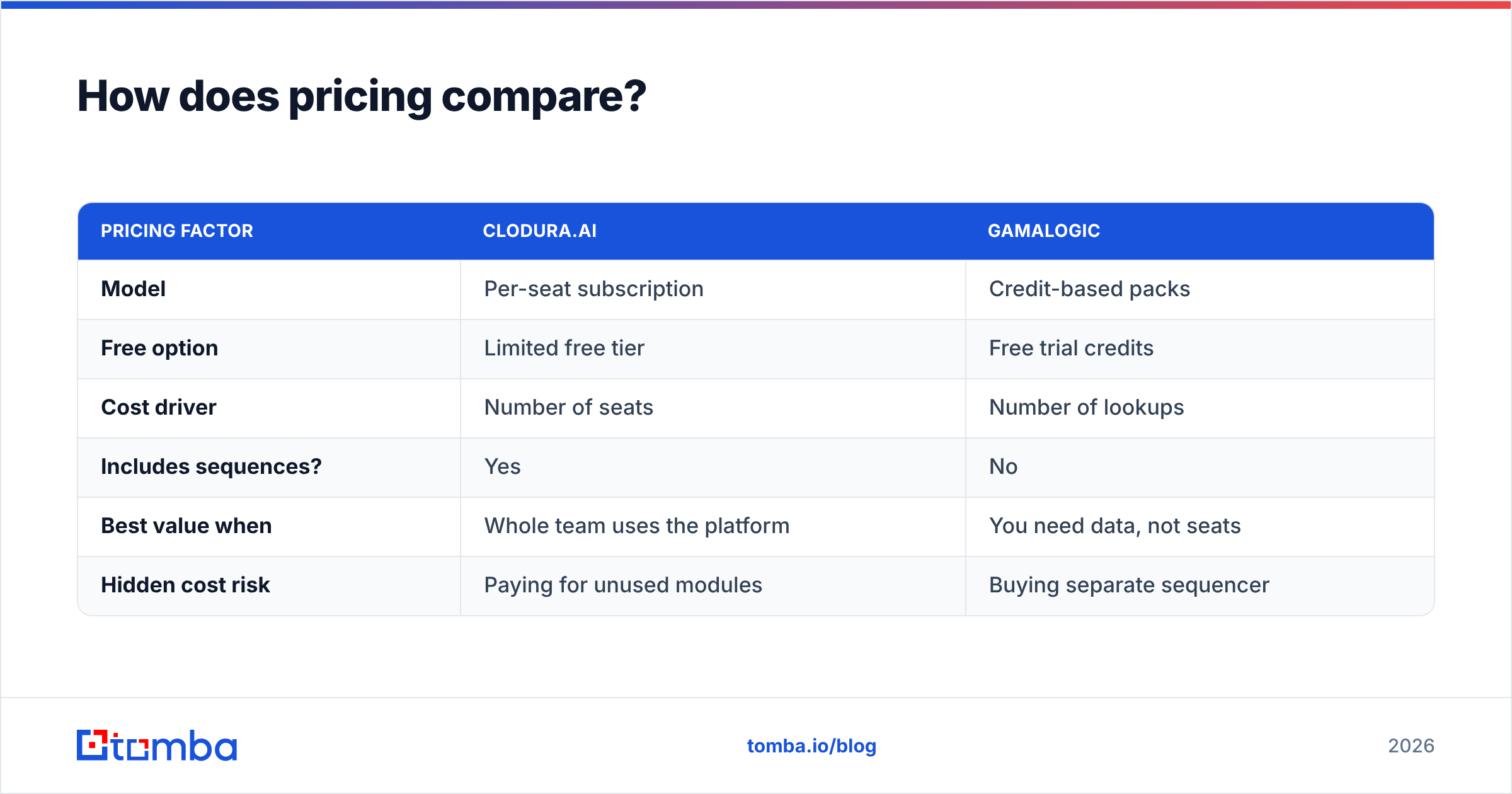
This is where the two diverge most, and where buyers get surprised. Clodura.ai prices like a SaaS platform: per-seat plans that bundle database access, finding, verification, and sequences. Gamalogic prices like a utility: credit packs you draw down as you run lookups. There's no universal "cheaper" answer — it depends on team size and how many of the bundled features you'll actually touch.
| Pricing factor | Clodura.ai | Gamalogic |
|---|---|---|
| Model | Per-seat subscription | Credit-based packs |
| Free option | Limited free tier | Free trial credits |
| Cost driver | Number of seats | Number of lookups |
| Includes sequences? | Yes | No |
| Best value when | Whole team uses the platform | You need data, not seats |
| Hidden cost risk | Paying for unused modules | Buying separate sequencer |
A common mistake: a two-person team buys a multi-seat platform plan because it "has everything," then uses only the email finder. They'd have spent less on credits plus a cheap sequencer. The reverse mistake also happens — a ten-person team buys credit packs and a separate CRM and outreach tool and ends up paying more than a consolidated platform would have cost, plus the integration tax.
For comparison, a specialist email-finder like Tomba runs a transparent tiered model — a free tier with 25 searches per month, then Starter at $49/mo, Growth at $99/mo, and Pro at $249/mo. You can see the full Tomba pricing breakdown if you want a third reference point against either platform. The takeaway isn't "Tomba is cheapest" — it's that you should price the job you actually need done, not the longest feature list.

Is Clodura.ai or Gamalogic better for cold email at scale?#
For high-volume cold outreach, the workflow matters as much as the data. You're going to find contacts, verify them, segment, and feed a sequencer. Clodura.ai keeps all of that under one roof, which reduces context-switching and export/import friction — a real productivity gain if your team lives in the tool daily. Gamalogic gives you clean, verified data and gets out of the way, which is ideal if your sequencer of choice is already dialed in.
The volume question hinges on bulk quality. Both support bulk runs, but at scale your real metric is valid emails per dollar after verification, not raw matches. Run a pilot: pull the same 500-row test list through each, verify the output, and send to a seed inbox to measure actual inbox placement. Vanity match rates lie; bounce rates and inbox placement don't.
If your bulk needs are heavy and finding-centric, it's worth benchmarking a dedicated bulk email finder and email verifier against both — the specialist tooling is frequently tuned harder for throughput and catch-all handling than a platform's general-purpose module. You can also read aggregated buyer sentiment on Capterra to sanity-check vendor claims before you commit.
Which should you choose?#
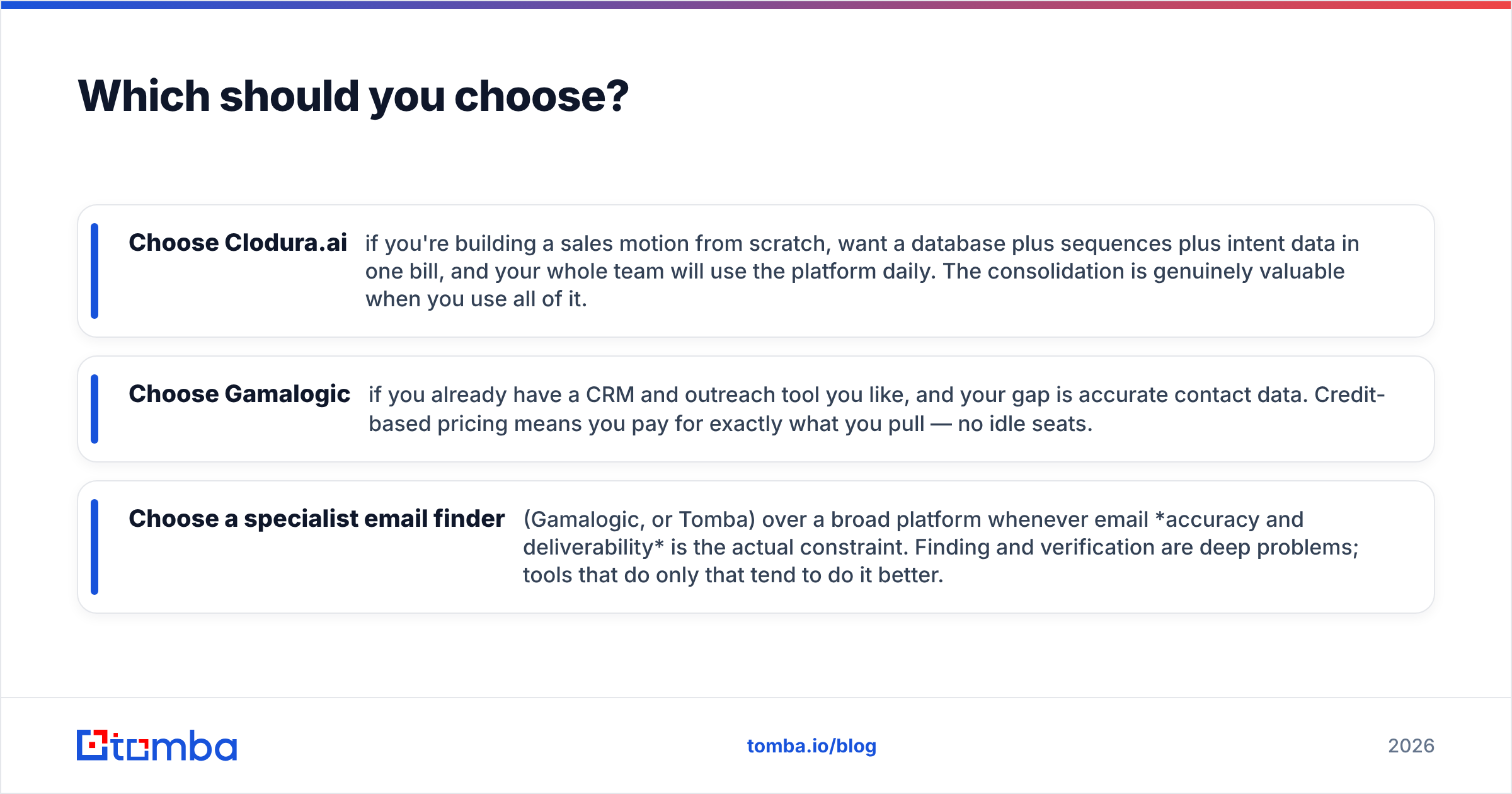
Pick based on what's missing from your stack today, not on feature-count bragging rights.
- Choose Clodura.ai if you're building a sales motion from scratch, want a database plus sequences plus intent data in one bill, and your whole team will use the platform daily. The consolidation is genuinely valuable when you use all of it.
- Choose Gamalogic if you already have a CRM and outreach tool you like, and your gap is accurate contact data. Credit-based pricing means you pay for exactly what you pull — no idle seats.
- Choose a specialist email finder (Gamalogic, or Tomba) over a broad platform whenever email accuracy and deliverability is the actual constraint. Finding and verification are deep problems; tools that do only that tend to do it better.
There's no shame in running two tools. Many high-performing teams pair a focused finder/verifier for clean data with a separate sequencer they already trust — that combination often beats an all-in-one on both quality and cost. The "single platform" pitch is convenient, but convenience and best-in-class accuracy are rarely the same vendor.
How to test before you buy#
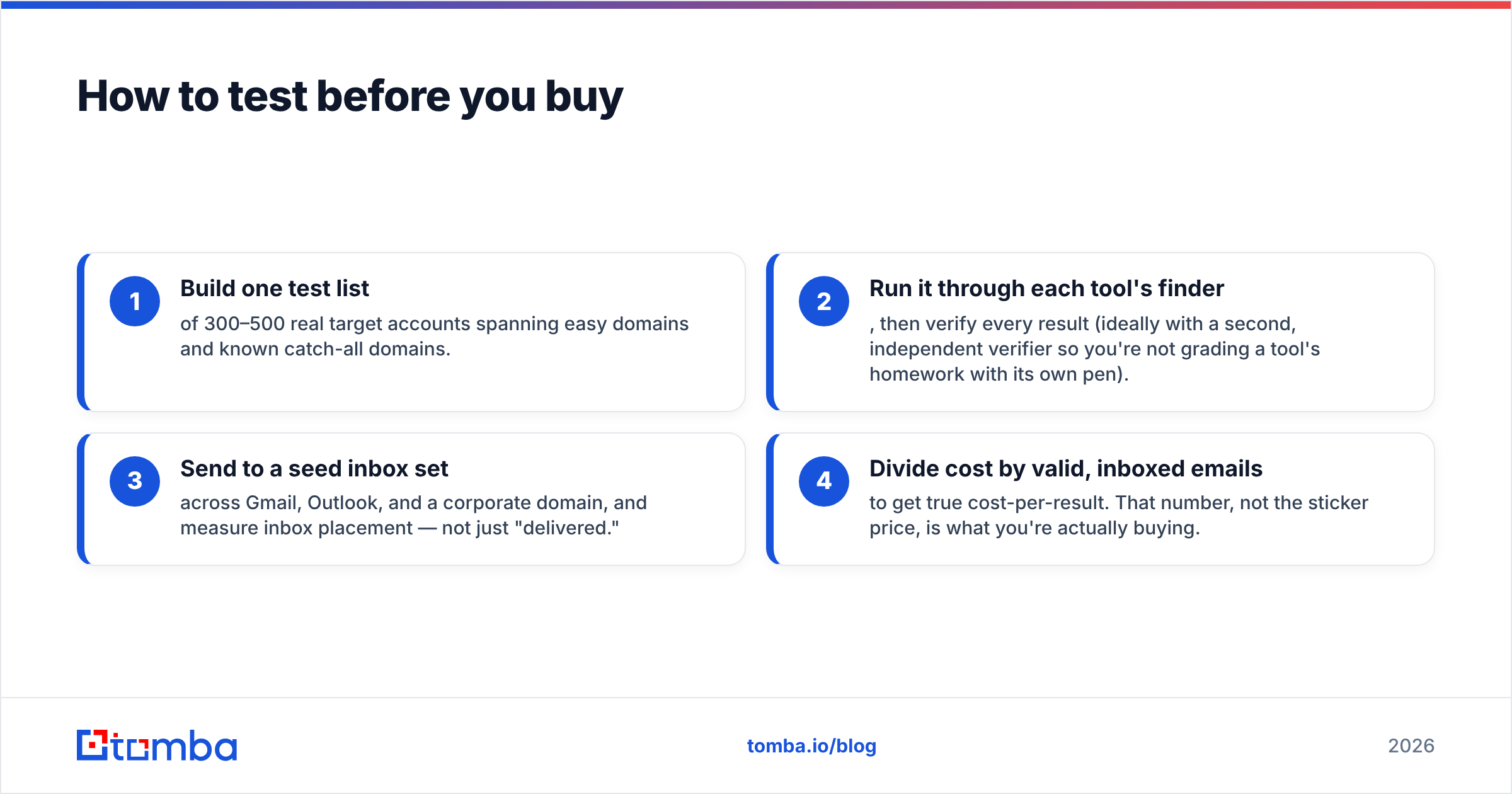
Don't trust marketing match rates. Run a 60-minute bake-off:
- Build one test list of 300–500 real target accounts spanning easy domains and known catch-all domains.
- Run it through each tool's finder, then verify every result (ideally with a second, independent verifier so you're not grading a tool's homework with its own pen).
- Send to a seed inbox set across Gmail, Outlook, and a corporate domain, and measure inbox placement — not just "delivered."
- Divide cost by valid, inboxed emails to get true cost-per-result. That number, not the sticker price, is what you're actually buying.
This protocol cuts through both vendors' best-case claims and tells you which tool wins for your data, which is the only comparison that matters.
The bottom line#
Clodura.ai and Gamalogic aren't really competitors so much as different answers to "what's missing from my pipeline?" Clodura.ai sells you the whole prospecting workbench; Gamalogic sells you precise, verified contact data to drop into the workbench you already own. Decide which gap is real for you, then validate with a live test before you sign anything annual.
And if the gap is accuracy — the thing that quietly decides whether your campaigns land or bounce — start with a tool built for exactly that. Try the Tomba Email Finder free (25 searches a month, no card), pair it with the built-in verifier, and benchmark cost-per-valid-email against both Clodura.ai and Gamalogic on your own list. Let the bounce rate, not the brochure, make the call.
// get started
Find, verify and enrich your first contacts today
Start on the free plan with 25 searches a month, then scale when your team is ready.
Free plan · No credit card required · GDPR & CCPA
// about the author