Clodura.ai vs Gazelle.ai: 2026 B2B Sales Data Compared
Clodura.ai and Gazelle.ai both promise better B2B data, but they solve different problems. Here's how their coverage, pricing, and accuracy stack up in 2026.
TL;DR
- Clodura.ai is a prospecting platform: a B2B contact database with email finding, verification, sequences, and intent signals built for SDRs who need names, emails, and a place to email them from.
- Gazelle.ai is a company-intelligence platform: account-level data, growth predictions, and firmographics aimed at market expansion, economic development, and account targeting — not individual contact outreach.
- They overlap less than the "vs" framing suggests. Pick Clodura.ai if you need contacts to email; pick Gazelle.ai if you need to decide which companies to chase.
- Pricing models differ sharply: Clodura.ai publishes per-seat tiers with a free plan; Gazelle.ai is quote-based and priced for teams and institutions.
- If your real bottleneck is contact data accuracy and cost-per-verified-email, a focused email finder like Tomba often beats paying platform pricing for data you only partly use.
If you searched "Clodura.ai vs Gazelle," you're probably trying to fix one of two problems: I don't have enough contacts to reach or I don't know which accounts are worth my time. Those are different problems, and these two tools sit on opposite sides of them. This post lays out what each does, where they actually compete, and how to avoid overpaying for the half you won't use.
What is Clodura.ai?#
Clodura.ai is an AI-powered sales prospecting platform. Think of it as a contact database with an outreach engine bolted on — the same way a phone book is useless until you can actually dial. It bundles a large B2B contact database (the vendor cites hundreds of millions of contacts), an email finder and verifier, org charts, technographic and intent data, and a built-in email sequencing tool so reps can move from "found a lead" to "sent a sequence" without leaving the app.
The pitch is consolidation: instead of stitching together a data provider, a verifier, and a sending tool, an SDR works inside one platform. For teams that live in outbound, that single-pane workflow is the main draw.
The trade-off is the one every all-in-one makes — you pay for breadth. The database is large but, like every B2B dataset, decays constantly, so verification quality matters more than the headline contact count. Always treat any "600M+ contacts" claim as a starting pool, not a guarantee of reachable people.
What is Gazelle.ai?#
Gazelle.ai is a company-intelligence platform, not a contact-outreach tool. It profiles companies globally — firmographics, financial signals, executive listings, and proprietary AI growth predictions that estimate which companies are likely to expand. Its core users are economic development organizations, market-expansion teams, and enterprise account strategists who need to answer "which companies should we target and where are they growing?"
The analogy: Gazelle.ai is a scouting report, while Clodura.ai is the contact sheet for the players. Gazelle helps you decide who to pursue at the company level; it is far less about handing a rep a verified personal email to send a cold message to this afternoon.
That focus shapes everything. Gazelle.ai leans on company coverage across many countries and on predictive signals rather than on individual email deliverability. If your goal is territory planning, market research, or building a target account list for an ABM motion, that's the value. If your goal is filling an SDR's daily send quota, it's the wrong shape of tool.
Clodura.ai vs Gazelle.ai: how do they compare?#
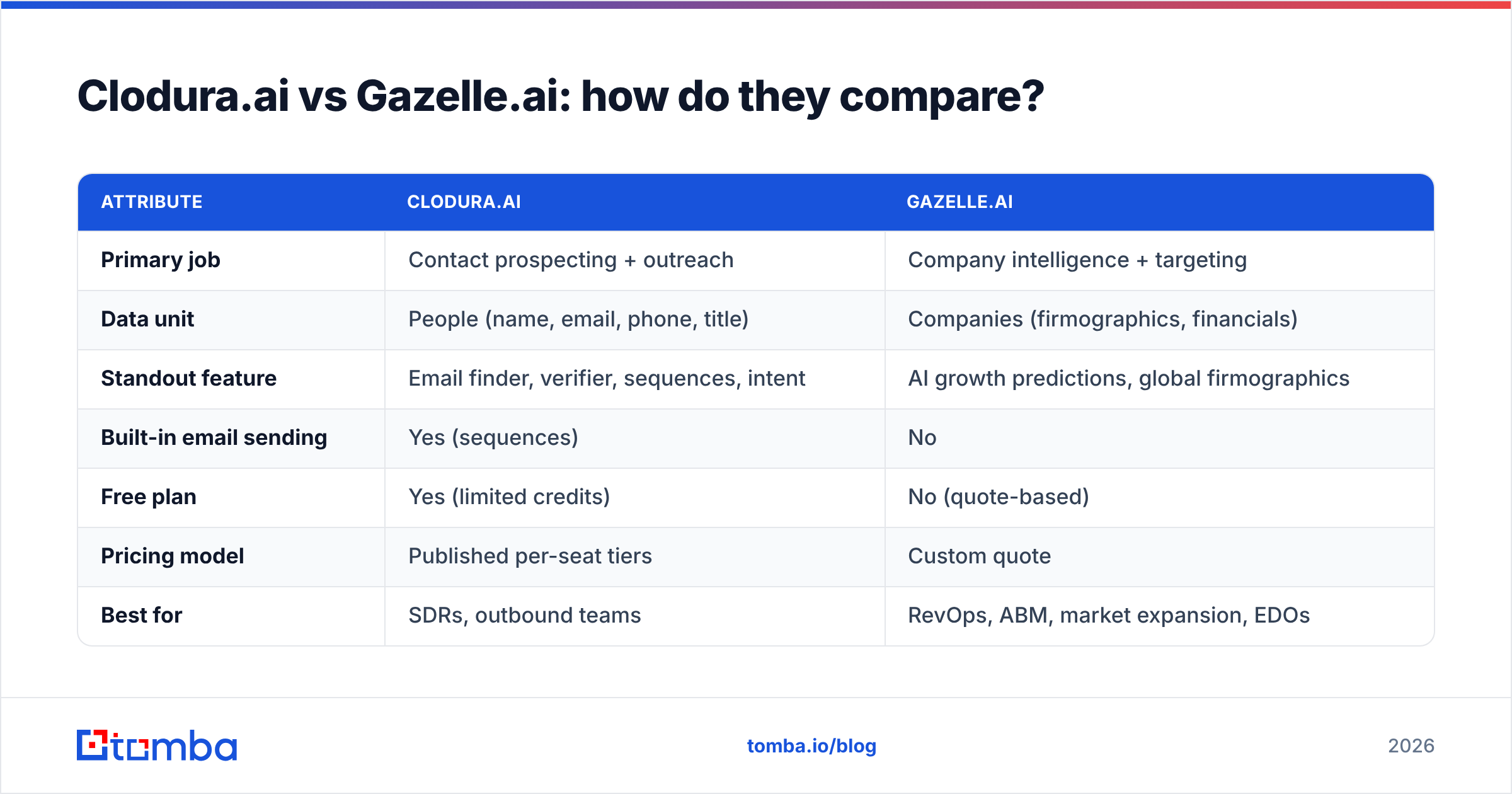
Here's the head-to-head on the attributes that actually drive a buying decision. Pricing figures are approximate and change often — confirm current numbers on each vendor's site before you commit.
| Attribute | Clodura.ai | Gazelle.ai |
|---|---|---|
| Primary job | Contact prospecting + outreach | Company intelligence + targeting |
| Data unit | People (name, email, phone, title) | Companies (firmographics, financials) |
| Standout feature | Email finder, verifier, sequences, intent | AI growth predictions, global firmographics |
| Built-in email sending | Yes (sequences) | No |
| Free plan | Yes (limited credits) | No (quote-based) |
| Pricing model | Published per-seat tiers | Custom quote |
| Best for | SDRs, outbound teams | RevOps, ABM, market expansion, EDOs |
| Geographic strength | Strong US/global B2B contacts | Broad global company coverage |
| Weak spot | Data freshness at scale | Not built for 1:1 contact outreach |
The pattern is clear: these tools rarely belong on the same shortlist unless your buying committee hasn't yet agreed on the problem. A reasonable read of B2B data and intelligence categories on review sites like G2 and Capterra puts Clodura.ai in the sales-intelligence/prospecting bucket and Gazelle.ai in the market/company-intelligence bucket.
Which one is better for cold outreach?#
Clodura.ai, clearly — but with a caveat. If your team needs to find contacts and email them, Gazelle.ai isn't designed for that job, so the comparison is lopsided for outreach.
The caveat is that "find contacts and email them" is two jobs, and bundling them doesn't automatically make either one best-in-class. Outbound performance comes down to three things:
- Coverage — does the tool have the people in your target accounts?
- Accuracy — are the emails real, or will they bounce and burn your domain?
- Sending health — are you warming up and protecting sender reputation?
Clodura.ai addresses all three inside one product, which is convenient. But a bundled verifier is only as good as its catch-all handling and SMTP checks. If even 10–15% of "verified" emails are risky, your bounce rate climbs and email deliverability suffers — and no amount of sequencing automation fixes a poisoned domain.

This is where a specialist often wins. Running candidate emails through a dedicated email verifier — including a real catch-all verifier — before they ever hit your sequence tool protects deliverability regardless of which database surfaced the contact. Coverage and verification don't have to come from the same vendor, and decoupling them usually improves both quality and cost.
Which one is better for account targeting and ABM?#
Gazelle.ai has the edge here. Account-based motions start with a question Clodura.ai doesn't really answer: which companies are worth pursuing right now? Gazelle.ai's growth predictions and financial signals are built to rank and prioritize companies, which is exactly what a RevOps or ABM team needs when it's building a target list.
Clodura.ai has firmographic filters too, so it can build company lists — but its center of gravity is the contact, not the company forecast. For pure "where should we expand / which accounts are heating up" work, Gazelle.ai's predictive layer is the differentiator.
The realistic enterprise pattern is a two-step pipeline:
- Step 1 — pick accounts. Use company-intelligence signals (Gazelle.ai or similar) to choose and prioritize target companies.
- Step 2 — get the people. Use a contact source plus domain search to find the right decision-makers at those companies and verify their emails before outreach.
Notice that Step 2 doesn't require an all-in-one. Once you know the target domains, a focused finder can enumerate the relevant contacts faster and cheaper than re-licensing a second broad platform.
What about pricing and value?#
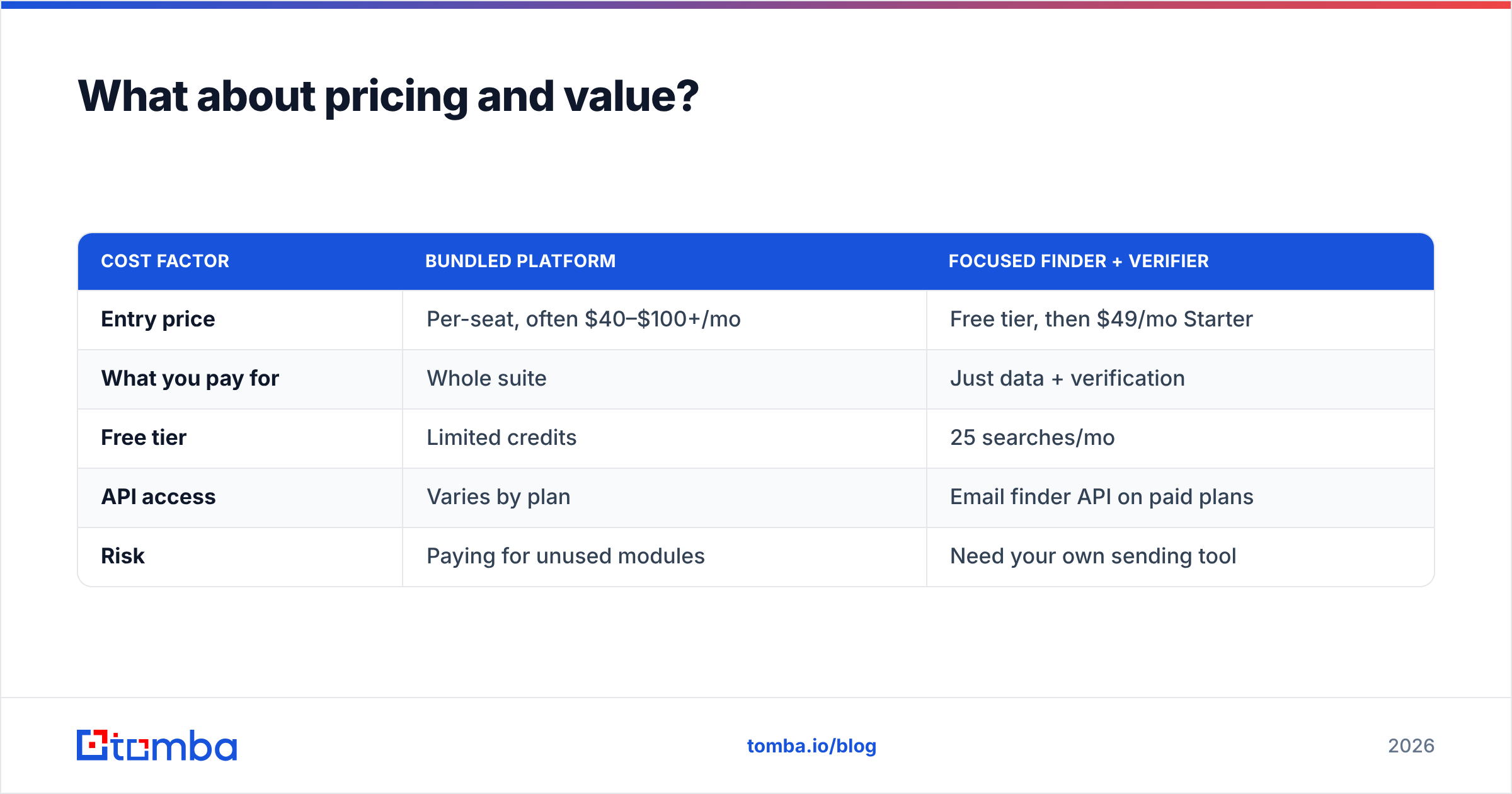
Different models, so compare on cost-per-outcome, not sticker price. Clodura.ai publishes per-seat tiers and offers a free plan with limited credits, which makes it easy to trial. Gazelle.ai is quote-based, which usually signals an enterprise/institutional sales motion with annual commitments.
For per-seat platforms, the trap is paying for an entire bundle when you only consume one slice of it. A rep on a $99/seat plan who mostly needs verified emails is funding a sequencer, an intent feed, and an org-chart module they barely touch. That's where unbundling pays off.
| Cost factor | Bundled platform | Focused finder + verifier |
|---|---|---|
| Entry price | Per-seat, often $40–$100+/mo | Free tier, then $49/mo Starter |
| What you pay for | Whole suite | Just data + verification |
| Free tier | Limited credits | 25 searches/mo |
| API access | Varies by plan | Email finder API on paid plans |
| Risk | Paying for unused modules | Need your own sending tool |
Tomba's pricing is a useful reference point for the unbundled approach: Free (25 searches/mo), Starter $49/mo, Growth $99/mo, Pro $249/mo, and custom Enterprise. If your only real need is "accurate contacts at scale," paying data-and-verification pricing rather than full-suite pricing is often the cheaper path to the same number of replies.
Where does an email finder fit alongside these tools?#
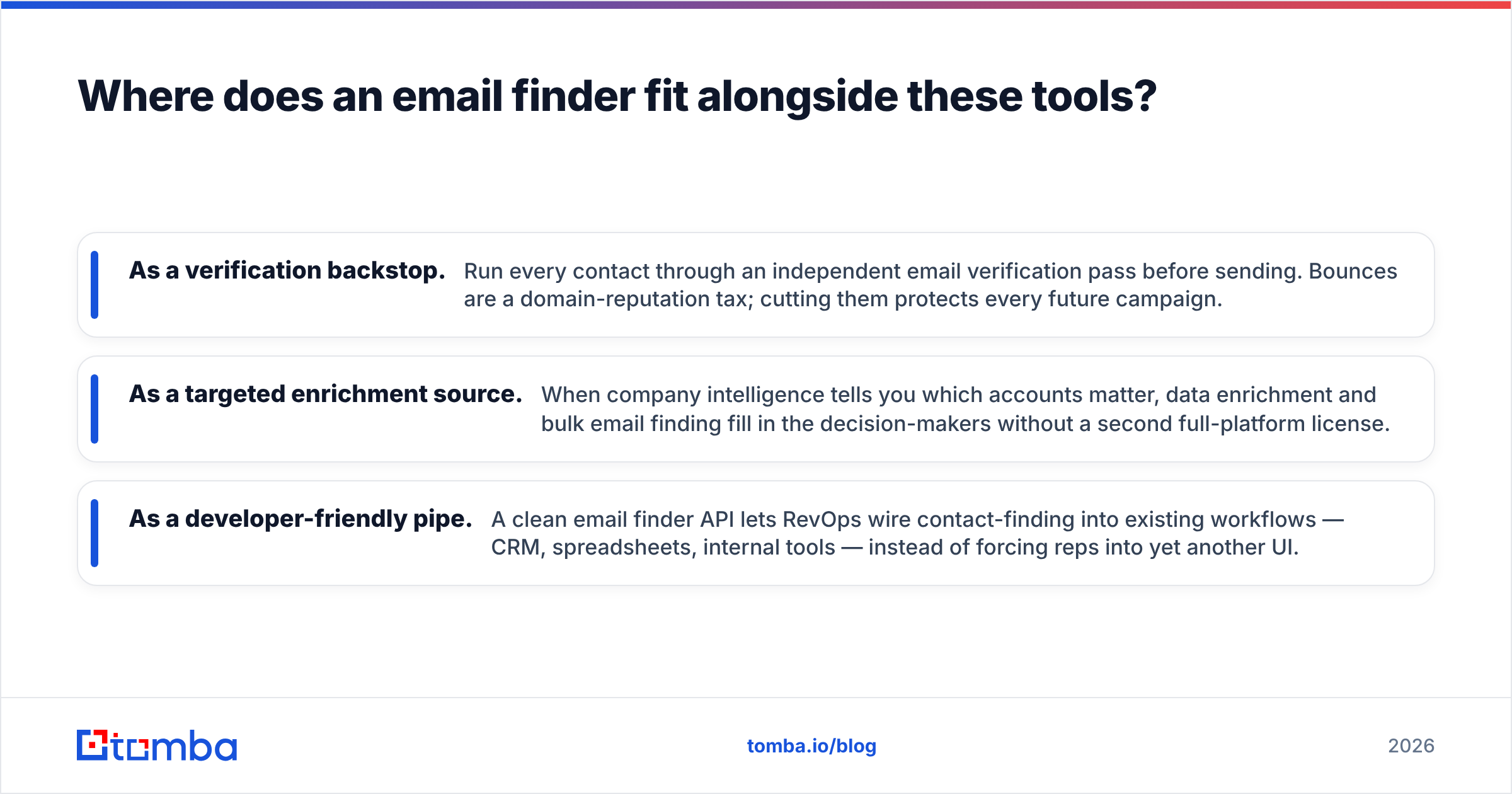
As the accuracy and cost-control layer — and sometimes as the cheaper replacement. Whether you go with Clodura.ai, Gazelle.ai, or both, the contacts you actually email still need to be real. A focused finder slots in three ways:
- As a verification backstop. Run every contact through an independent email verification pass before sending. Bounces are a domain-reputation tax; cutting them protects every future campaign.
- As a targeted enrichment source. When company intelligence tells you which accounts matter, data enrichment and bulk email finding fill in the decision-makers without a second full-platform license.
- As a developer-friendly pipe. A clean email finder API lets RevOps wire contact-finding into existing workflows — CRM, spreadsheets, internal tools — instead of forcing reps into yet another UI.
Tomba covers this layer with an email finder, verifier, domain search, catch-all verification, and enrichment, with public data sourcing you can review on the data sources page. It won't send sequences for you and it won't forecast company growth — but for the part both Clodura.ai and Gazelle.ai users still have to get right (reachable, verified contacts), it's a focused, lower-cost option.
So which should you choose?#
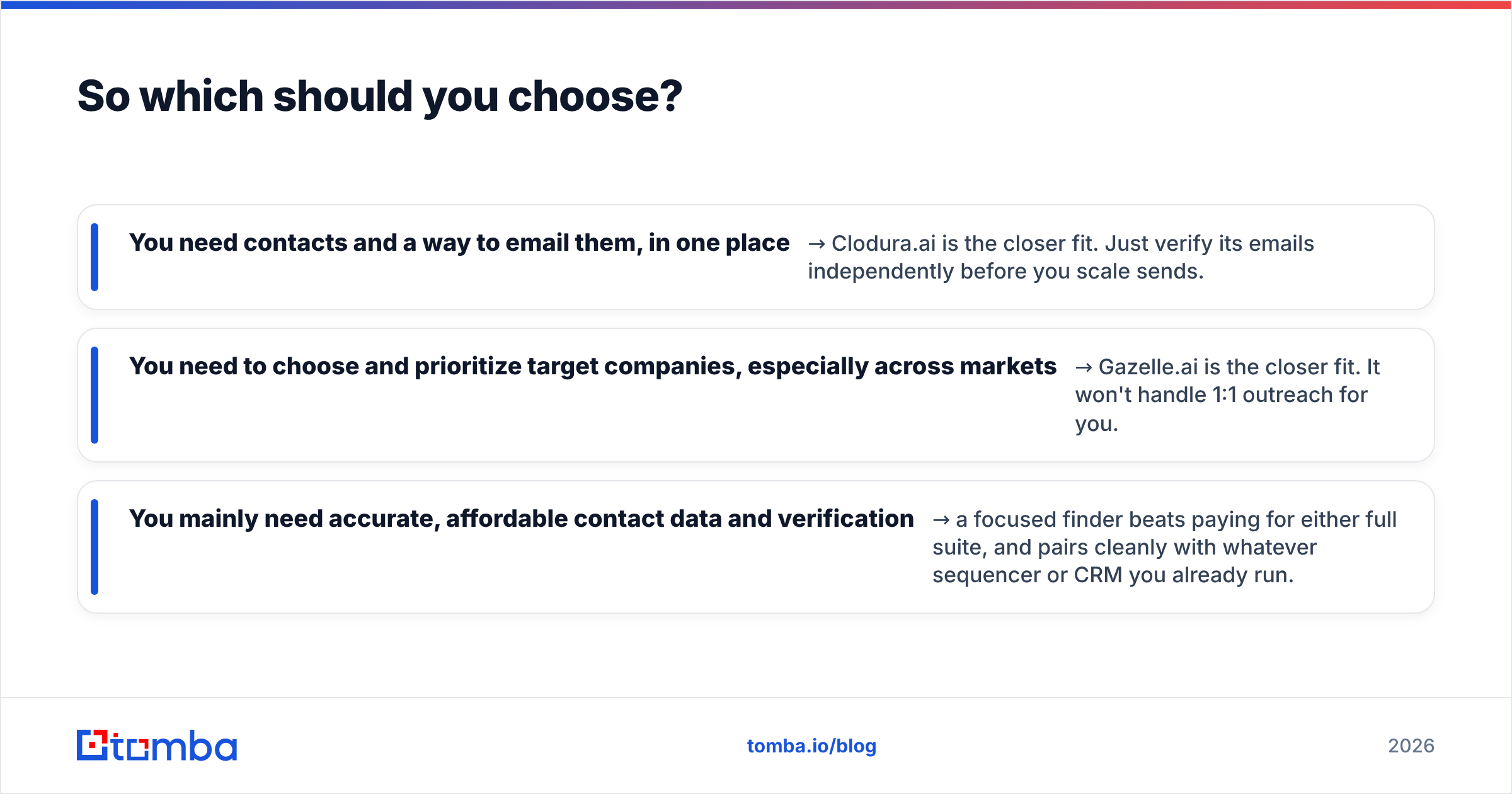
Decide by the problem, not the feature list:
- You need contacts and a way to email them, in one place → Clodura.ai is the closer fit. Just verify its emails independently before you scale sends.
- You need to choose and prioritize target companies, especially across markets → Gazelle.ai is the closer fit. It won't handle 1:1 outreach for you.
- You mainly need accurate, affordable contact data and verification → a focused finder beats paying for either full suite, and pairs cleanly with whatever sequencer or CRM you already run.
Most teams that frame this as "Clodura.ai vs Gazelle" eventually realize they need parts of both: targeting signals from the company-intelligence side, and verified contacts from the prospecting side. You rarely need to buy two whole platforms to get there.
The bottom line#
Clodura.ai and Gazelle.ai aren't really competitors — they're answers to different questions. Clodura.ai fills your outreach with contacts; Gazelle.ai tells you which companies deserve the outreach. The expensive mistake is buying one expecting it to do the other's job, then paying again to fix the gap.
If your bottleneck is the contact layer — finding the right people and making sure their emails actually land — start with a tool built for exactly that. Try the Tomba Email Finder free for 25 searches a month, verify before you send, and feed clean contacts into whichever targeting or sequencing stack you already trust. You'll spend less, bounce less, and keep your sending domain healthy while you figure out the rest of your stack.
Ready to find emails that actually work?
Join 150,000+ professionals who stopped guessing and started sending. Free credits on signup — no credit card required.
Get the Tomba newsletter
Practical outbound tactics and product updates — once every two weeks.
About the author