Cloduraai vs Getemailio: Email Finder Showdown 2026
Clodura.ai bundles a full prospecting suite; GetEmail.io keeps it lean. Here's an honest, side-by-side breakdown of accuracy, pricing, and which fits your stack in 2026.
Cloduraai vs Getemailio: Which Email Finder Wins in 2026?
You have a list of target accounts, a quota, and a budget. The question is narrow: should you run Clodura.ai or GetEmail.io to turn those companies into verified, reachable contacts? This is the honest, feature-by-feature answer — including where a third option quietly beats both.
TL;DR#
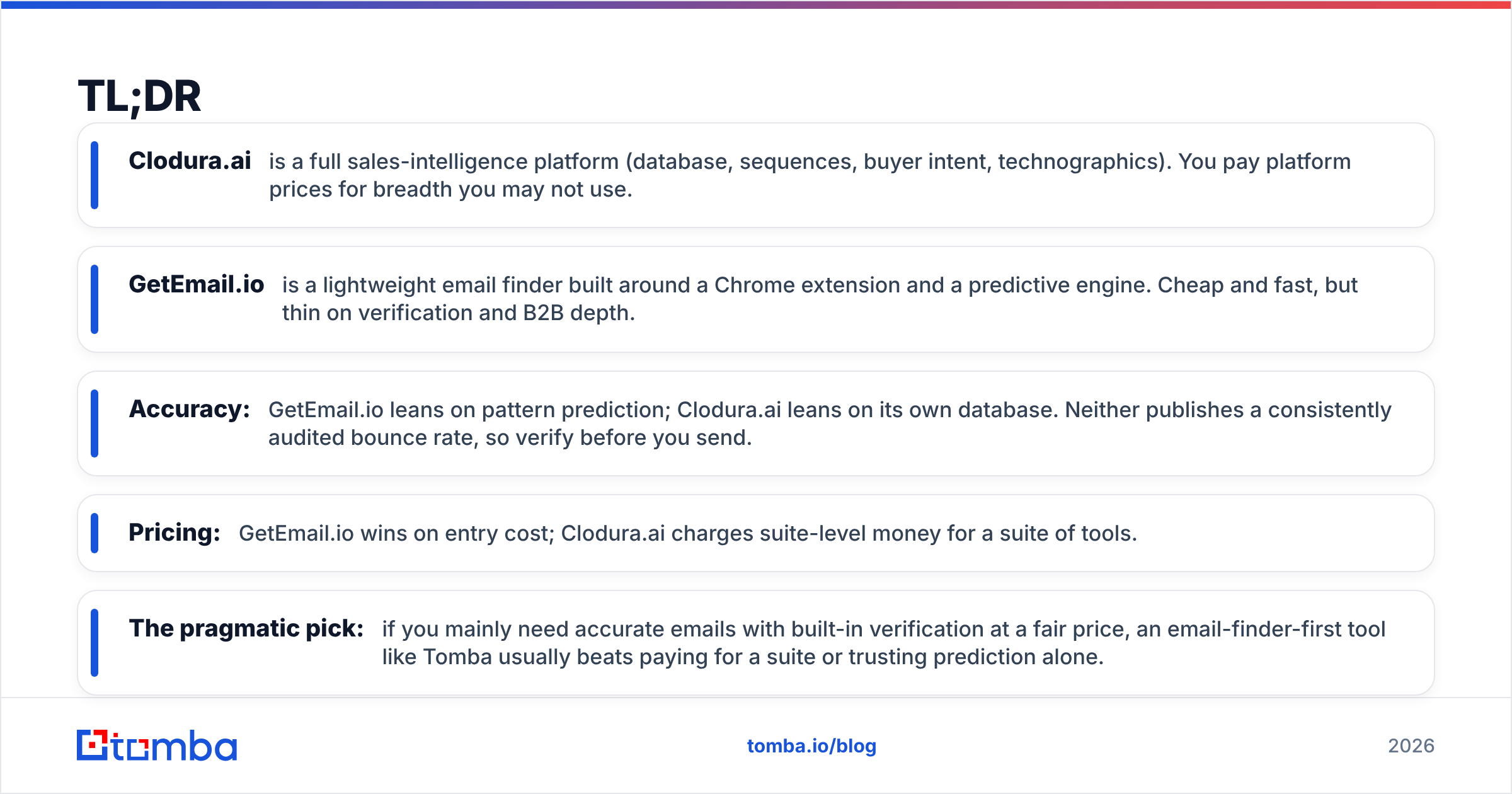
- Clodura.ai is a full sales-intelligence platform (database, sequences, buyer intent, technographics). You pay platform prices for breadth you may not use.
- GetEmail.io is a lightweight email finder built around a Chrome extension and a predictive engine. Cheap and fast, but thin on verification and B2B depth.
- Accuracy: GetEmail.io leans on pattern prediction; Clodura.ai leans on its own database. Neither publishes a consistently audited bounce rate, so verify before you send.
- Pricing: GetEmail.io wins on entry cost; Clodura.ai charges suite-level money for a suite of tools.
- The pragmatic pick: if you mainly need accurate emails with built-in verification at a fair price, an email-finder-first tool like Tomba usually beats paying for a suite or trusting prediction alone.
What is Clodura.ai?#
Clodura.ai is an all-in-one sales prospecting platform aimed at outbound teams that want their data and their outreach in one place. Think of it as a Swiss Army knife: a B2B contact database (it advertises hundreds of millions of contacts), direct dials, buyer-intent signals, technographic filters, and a basic email sequencing engine bolted on top.
That breadth is the selling point and the catch. If your motion needs intent data, org charts, and sequencing inside one login, the bundle saves you stitching tools together. If you just need an email for a known prospect, you are renting a warehouse to store a single box.
You can read Clodura's own positioning on the Clodura.ai homepage, and cross-check user sentiment on G2 before committing — review depth varies a lot by region and use case.
What is GetEmail.io?#
GetEmail.io is a focused email finder. You give it a first name, last name, and company domain; its predictive algorithm (trained on public data and machine-learning pattern matching) returns the most likely address with a confidence indicator. Its calling card is a Chrome extension that surfaces emails while you browse LinkedIn or company sites.
The philosophy is the opposite of Clodura's. GetEmail.io does one job and prices it to move, with a small free tier and credit-based paid plans. The trade-off: it is a finder, not a data platform. Native verification, bulk enrichment, intent, and phone data are limited or absent compared with a full suite. See the GetEmail.io homepage for current credit limits.

How accurate is each one?#
Accuracy is where this comparison actually gets decided, because a cheap wrong email costs more than an expensive right one. A bounce dents your sender reputation, and reputation damage compounds across every future campaign.
The two tools get to an answer differently:
- GetEmail.io — prediction-first. It infers the address from name plus domain patterns and confidence scoring. Fast and broad, but a high "confidence" guess is still a guess until SMTP-verified.
- Clodura.ai — database-first. It returns what is stored in its contact records. Strong when the contact exists and is fresh; weaker when records are stale or the person recently changed roles.
- Both still need a verify step. Neither tool's headline accuracy claim substitutes for checking the inbox actually accepts mail. Catch-all domains, in particular, fool prediction engines routinely.
That last point matters. Run anything you pull through a dedicated email verifier before it touches a sequence, and treat catch-all domains with a real catch-all verifier rather than trusting a confidence percentage.

Cloduraai vs Getemailio: the feature comparison#
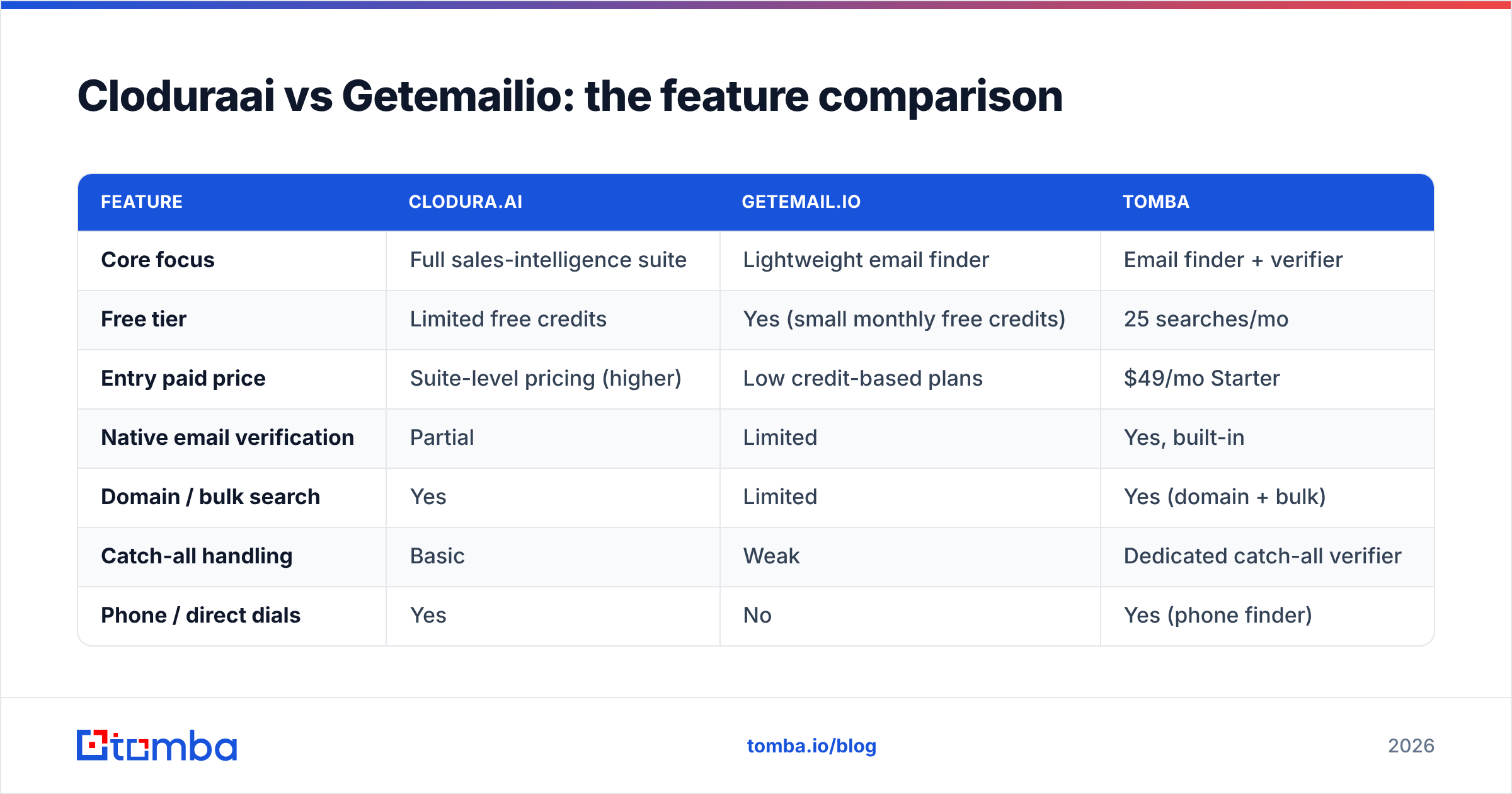
Here is the head-to-head on the attributes that change a buying decision. Tomba is included as the email-finder-first reference point most teams benchmark against.
| Feature | Clodura.ai | GetEmail.io | Tomba |
|---|---|---|---|
| Core focus | Full sales-intelligence suite | Lightweight email finder | Email finder + verifier |
| Free tier | Limited free credits | Yes (small monthly free credits) | 25 searches/mo |
| Entry paid price | Suite-level pricing (higher) | Low credit-based plans | $49/mo Starter |
| Native email verification | Partial | Limited | Yes, built-in |
| Domain / bulk search | Yes | Limited | Yes (domain + bulk) |
| Catch-all handling | Basic | Weak | Dedicated catch-all verifier |
| Phone / direct dials | Yes | No | Yes (phone finder) |
| Buyer intent data | Yes | No | No |
| API access | Yes | Yes | Yes (full REST API) |
| Best for | Teams wanting one platform | Solo / light prospecting | Accuracy-first email sourcing |
The pattern is clear: Clodura wins on breadth, GetEmail wins on simplicity and price-of-entry, and a finder-first tool wins on the specific job of getting a verified address cheaply.
Is Clodura.ai better than GetEmail.io?#
It depends entirely on what you are buying. Let me be direct instead of diplomatic.
Choose Clodura.ai if your team runs full outbound and wants intent signals, technographics, dialer data, and sequencing under one roof — and you will genuinely use those modules. Paying suite prices only makes sense if the suite replaces three other subscriptions. If you adopt Clodura just for its email finder, you are over-buying by a wide margin.
Choose GetEmail.io if you are a solo founder, recruiter, or light prospector who needs a few emails a week, lives in the Chrome extension, and wants the lowest possible cost. The risk is verification: you will likely bolt on a separate email verification tool, which erodes the price advantage.
Neither is "wrong." They sit at opposite ends — maximalist suite versus minimalist finder. The teams that struggle are the ones in the middle: they need reliable, verified emails at volume without paying for a platform they will not fully use.
What about pricing — which is cheaper?#
GetEmail.io is cheaper at the door; Clodura.ai is more expensive but bundles more. The real comparison is cost-per-usable contact, not sticker price.
- GetEmail.io: credit-based, low monthly entry, small free tier. But unverified credits spent on bounces are wasted credits — your effective cost rises with every bad send.
- Clodura.ai: higher monthly commitment justified only if you use the database, intent, and sequencing together. As a standalone finder, the cost-per-email is hard to defend.
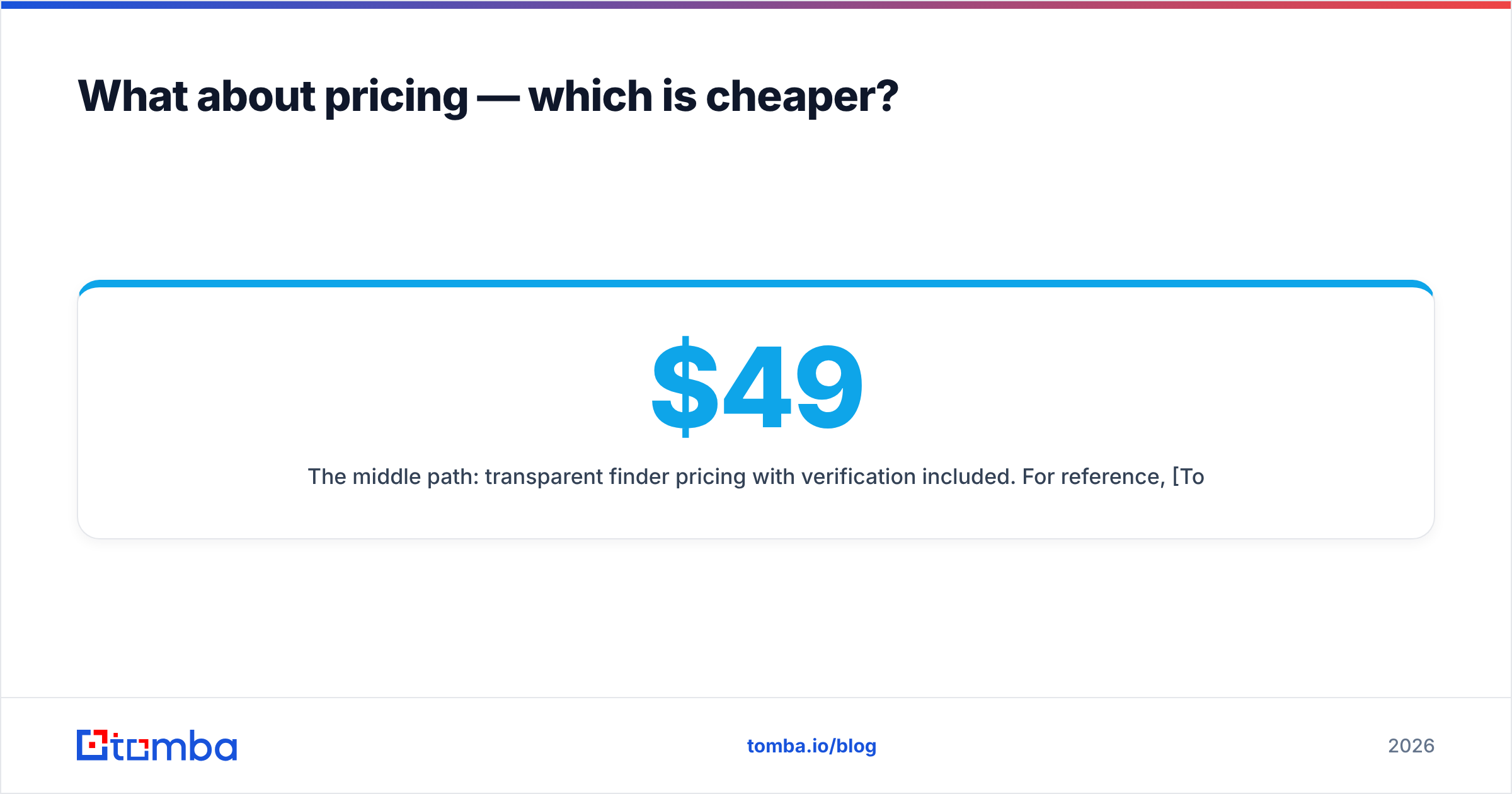
- The middle path: transparent finder pricing with verification included. For reference, Tomba pricing runs a Free tier (25 searches/mo), Starter at $49/mo, Growth at $99/mo, and Pro at $249/mo — verification baked in, so you are not paying twice.
When you model a quarter of outreach, the line item that actually moves is bounce rate, not the headline plan price. A tool that finds and verifies in one pass usually has the lowest true cost.
How do these compare on data depth and workflow?#
Workflow is where suites and finders diverge most.
Clodura.ai keeps you inside one app: filter the database, pull contacts, drop them into a sequence, watch intent. That is powerful when your whole team standardizes on it. The downside is lock-in and a steeper learning curve — you are operating a platform, not a tool.
GetEmail.io is the opposite: it expects to live alongside your CRM and outreach tools, feeding emails in via extension or API. Lighter to adopt, but you assemble the rest of the stack yourself.
If your real need is "find emails by company, in bulk, and push them clean into my CRM," a focused domain search plus bulk email finder workflow tends to beat both — you skip the suite overhead and the prediction-only risk. For LinkedIn-heavy sourcing, a dedicated LinkedIn finder covers the same ground as GetEmail's extension with verification attached.
Which should you actually pick in 2026?#
Here is the decision in three lines:
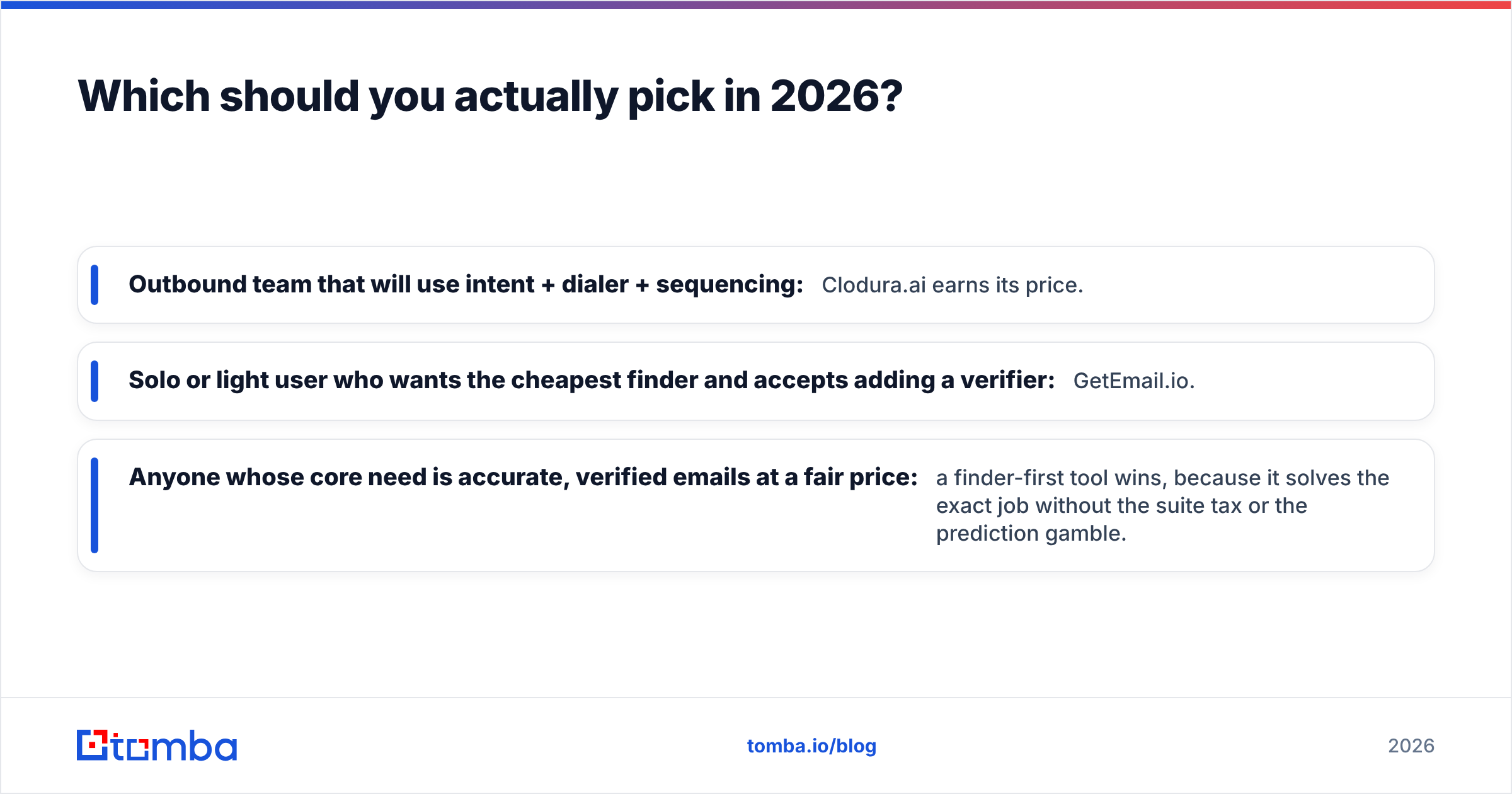
- Outbound team that will use intent + dialer + sequencing: Clodura.ai earns its price.
- Solo or light user who wants the cheapest finder and accepts adding a verifier: GetEmail.io.
- Anyone whose core need is accurate, verified emails at a fair price: a finder-first tool wins, because it solves the exact job without the suite tax or the prediction gamble.
Most readers comparing "Cloduraai vs Getemailio" are in that third bucket. You do not want a platform and you do not want to trust a guess — you want a clean address that lands. That is a narrower, cheaper problem than either vendor is built around.
The bottom line#
Clodura.ai and GetEmail.io are good at different things: Clodura at breadth, GetEmail at simplicity. The mistake is buying either for a job it is not optimized for — paying suite prices for one feature, or trusting prediction without verification.
If your goal is to find professional email addresses by domain, name, or company, verify them in the same workflow, and not overpay for modules you will not touch, start with the Tomba Email Finder. The free tier gives you 25 searches a month to test accuracy on your own list before you spend a cent — the only honest way to settle an accuracy debate is to run your own data through it and count the bounces. Find emails, verify them, and ship your campaign with a clean sender reputation intact.
// get started
Find, verify and enrich your first contacts today
Start on the free plan with 25 searches a month, then scale when your team is ready.
Free plan · No credit card required · GDPR & CCPA
// about the author