Clodura.ai vs Gigasheet: 2026 B2B Data Tool Comparison
Clodura.ai sells sales intelligence; Gigasheet sells a big-data spreadsheet. They look like rivals but solve different problems. Here's which one your team actually needs in 2026 — and the faster, cheaper data layer most pipelines are missing.
You typed "Clodura.ai vs Gigasheet" into a search bar expecting a head-to-head, and you deserve an honest answer: these two tools barely compete. One builds your prospect list. The other helps you wrangle the giant spreadsheet that list lands in. Picking between them as if they were interchangeable is how teams end up paying for two platforms and still missing the one capability that drives replies — clean, verified contact data.
This guide breaks down what each tool actually does, where they overlap, where they don't, and how to assemble a stack that doesn't leak budget.
TL;DR — Clodura.ai vs Gigasheet at a glance#
- Clodura.ai is a B2B sales intelligence platform: a contact database, email finder, sequencing, and intent signals aimed at outbound sales teams.
- Gigasheet is a no-code "big data spreadsheet" — it opens and analyzes million-row CSVs in the browser, the way Excel can't. It is not a lead-gen tool.
- They overlap only at the edges: Clodura generates data; Gigasheet processes data you already have.
- If you need accurate emails to actually run campaigns, neither is built around verification-first accuracy — that's where a focused email finder earns its keep.
- Best 2026 setup for most teams: a precise data source feeding a lightweight analysis layer, not one bloated all-in-one.
What is Clodura.ai?#
Clodura.ai is a sales intelligence and prospecting platform. Its pitch is "find, engage, and close" inside one tool. The core modules are a B2B contact database (the marketing claims tens of millions of direct dials and verified emails), an email-sequencing engine, buyer-intent and technographic signals, and an org-chart view that maps decision-makers inside target accounts.
In practice, teams reach for Clodura when they want a single seat to do account research, pull contacts, and fire a basic cadence without bolting on a separate sequencer. It sits in the same neighborhood as Apollo, Lusha, and ZoomInfo — broad coverage, sales-led workflows, and pricing that climbs as you add seats and credits.
The trade-off with any all-in-one of this type is depth versus breadth. You get a lot of surface area, but each module — the dialer, the database, the sequencer — tends to be "good enough" rather than best-in-class. Data freshness and email accuracy are the usual sticking points, because maintaining a giant database is expensive and decay is relentless: B2B contacts go stale at roughly 25–30% per year as people change jobs.

Wait — ignore that, this isn't an email-finder bake-off. Here's the meme that actually fits:

What is Gigasheet?#
Gigasheet is a spreadsheet built for data that breaks Excel. Upload a CSV with five million rows, and Gigasheet opens it in the browser, lets you filter, group, pivot, dedupe, and join it against other files — no SQL, no warehouse, no crashing your laptop. Think of it as Google Sheets with the row limit removed and a few analyst-grade tools bolted on.
That's a genuinely useful niche. Revenue ops, data, and analytics folks use it to clean exports, merge enrichment files, investigate large datasets, and prep lists before they hit a CRM. It has light enrichment add-ons and integrations, but the heart of the product is analysis and manipulation of data you bring to it.
Critically, Gigasheet does not prospect. It will not find you a CMO's email address from a domain. It assumes you already have the raw data and just need to make sense of it at scale. Comparing it to Clodura is like comparing a fishing boat to a fish market.
Clodura.ai vs Gigasheet: how do they actually compare?#
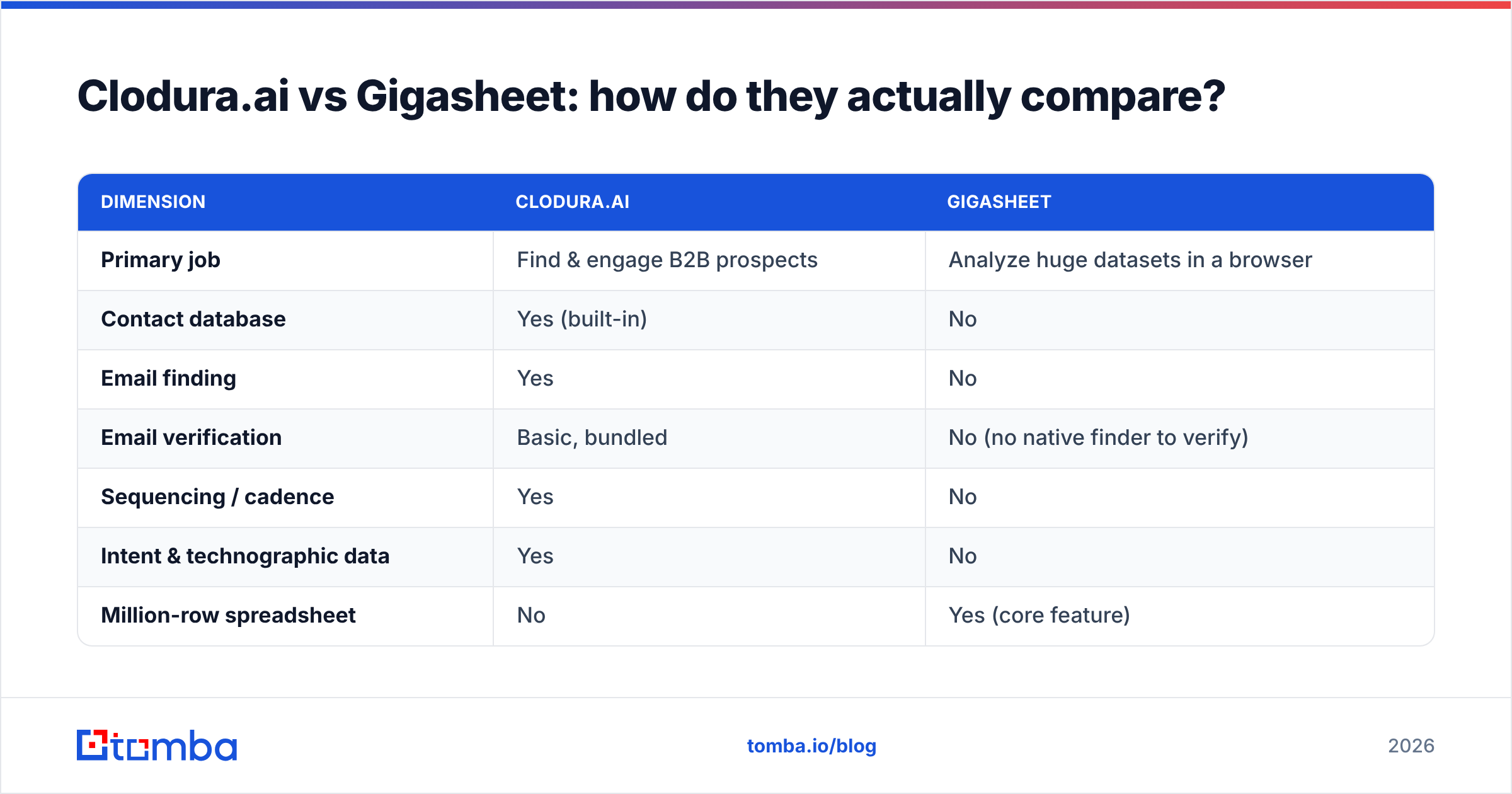
Here's the honest side-by-side. Notice how few rows are true head-to-head — most are "one does this, the other doesn't."
| Dimension | Clodura.ai | Gigasheet |
|---|---|---|
| Primary job | Find & engage B2B prospects | Analyze huge datasets in a browser |
| Contact database | Yes (built-in) | No |
| Email finding | Yes | No |
| Email verification | Basic, bundled | No (no native finder to verify) |
| Sequencing / cadence | Yes | No |
| Intent & technographic data | Yes | No |
| Million-row spreadsheet | No | Yes (core feature) |
| Pivot / dedupe / join at scale | Limited | Yes |
| Best user | SDR / AE / sales leader | RevOps / data analyst |
| Typical entry price | ~$33–$83+/user/mo (annual) | Free tier; paid from ~$95/mo |
The takeaway: they're complements, not competitors. A realistic workflow is "generate a list, then analyze it" — Clodura (or a better data source) on the front end, Gigasheet on the back end. The mistake is buying one expecting it to do the other's job.
Which one should you choose for B2B prospecting?#
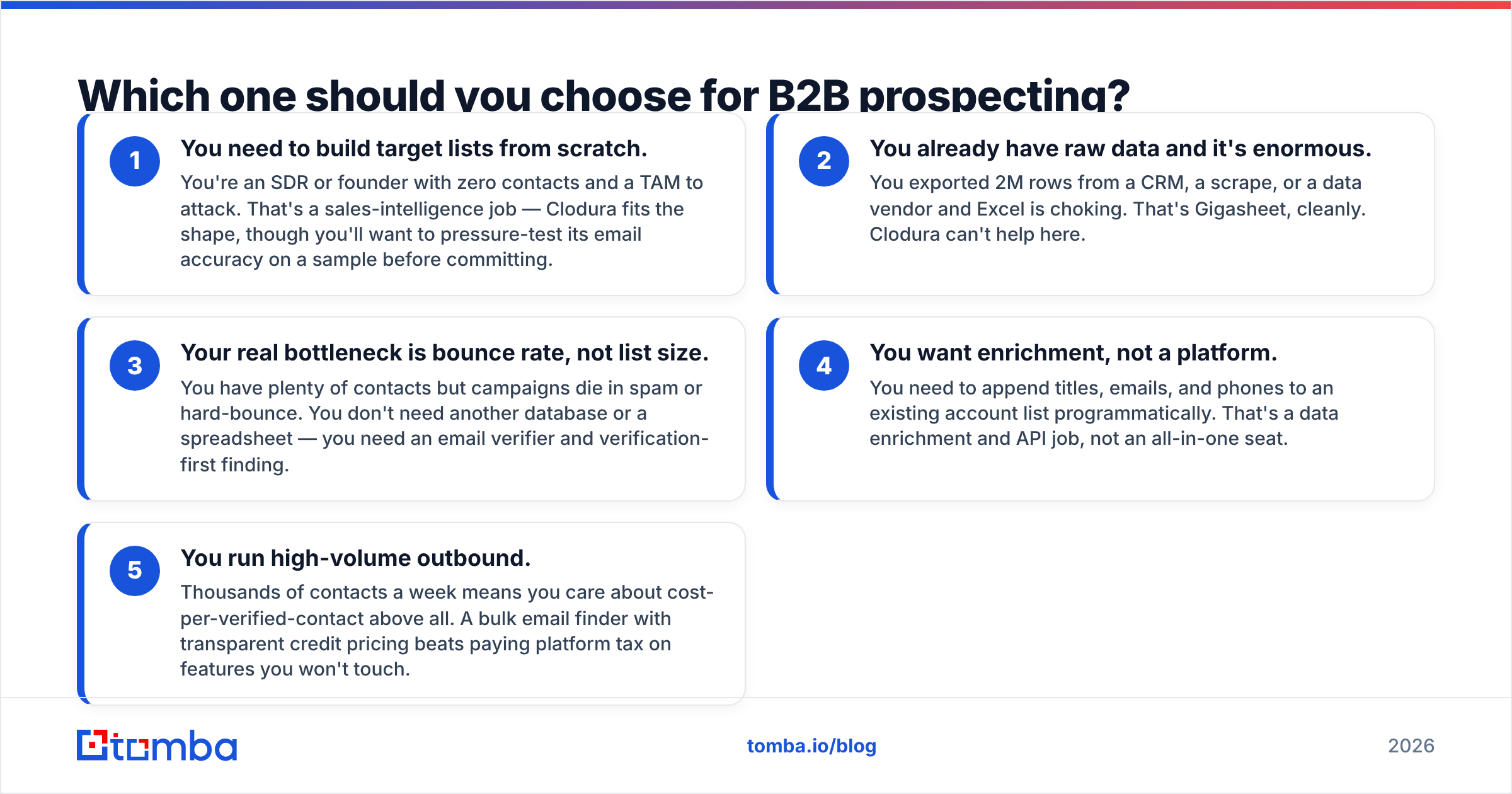
Choose based on the job you're hiring the tool to do. Use this decision list before you swipe a card:
- You need to build target lists from scratch. You're an SDR or founder with zero contacts and a TAM to attack. That's a sales-intelligence job — Clodura fits the shape, though you'll want to pressure-test its email accuracy on a sample before committing.
- You already have raw data and it's enormous. You exported 2M rows from a CRM, a scrape, or a data vendor and Excel is choking. That's Gigasheet, cleanly. Clodura can't help here.
- Your real bottleneck is bounce rate, not list size. You have plenty of contacts but campaigns die in spam or hard-bounce. You don't need another database or a spreadsheet — you need an email verifier and verification-first finding.
- You want enrichment, not a platform. You need to append titles, emails, and phones to an existing account list programmatically. That's a data enrichment and API job, not an all-in-one seat.
- You run high-volume outbound. Thousands of contacts a week means you care about cost-per-verified-contact above all. A bulk email finder with transparent credit pricing beats paying platform tax on features you won't touch.
If your honest answer is "I need accurate, ready-to-send contact data," then the Clodura-vs-Gigasheet framing was the wrong question all along.

Where do both tools leave gaps?#
Every all-in-one and every spreadsheet shares the same blind spot: deliverability is downstream of data accuracy, and neither tool is architected accuracy-first.
Clodura's database is broad, but broad databases inherit decay. When 25–30% of records rot annually, "verified" on the marketing page rarely means "verified this week." Send to stale records and your bounce rate climbs, your domain reputation drops, and inbox placement collapses — a chain reaction that protecting your sender reputation is supposed to prevent. According to a long-running theme in deliverability research, even a few percent of hard bounces can trip spam filters across an entire sending domain.
Gigasheet, meanwhile, makes bad data easier to look at but no more accurate. You can dedupe and pivot a list of invalid emails beautifully; they're still invalid. Garbage at scale is still garbage.
This is the case for a verification-first layer. A dedicated finder validates each address against the live mail server in real time and grades catch-all domains separately, so what reaches your sequencer is what reaches the inbox. Industry reviews on platforms like G2 consistently rank email accuracy and low bounce rates as the features that actually move reply rates — ahead of database size.
How does a focused data layer compare on price?#
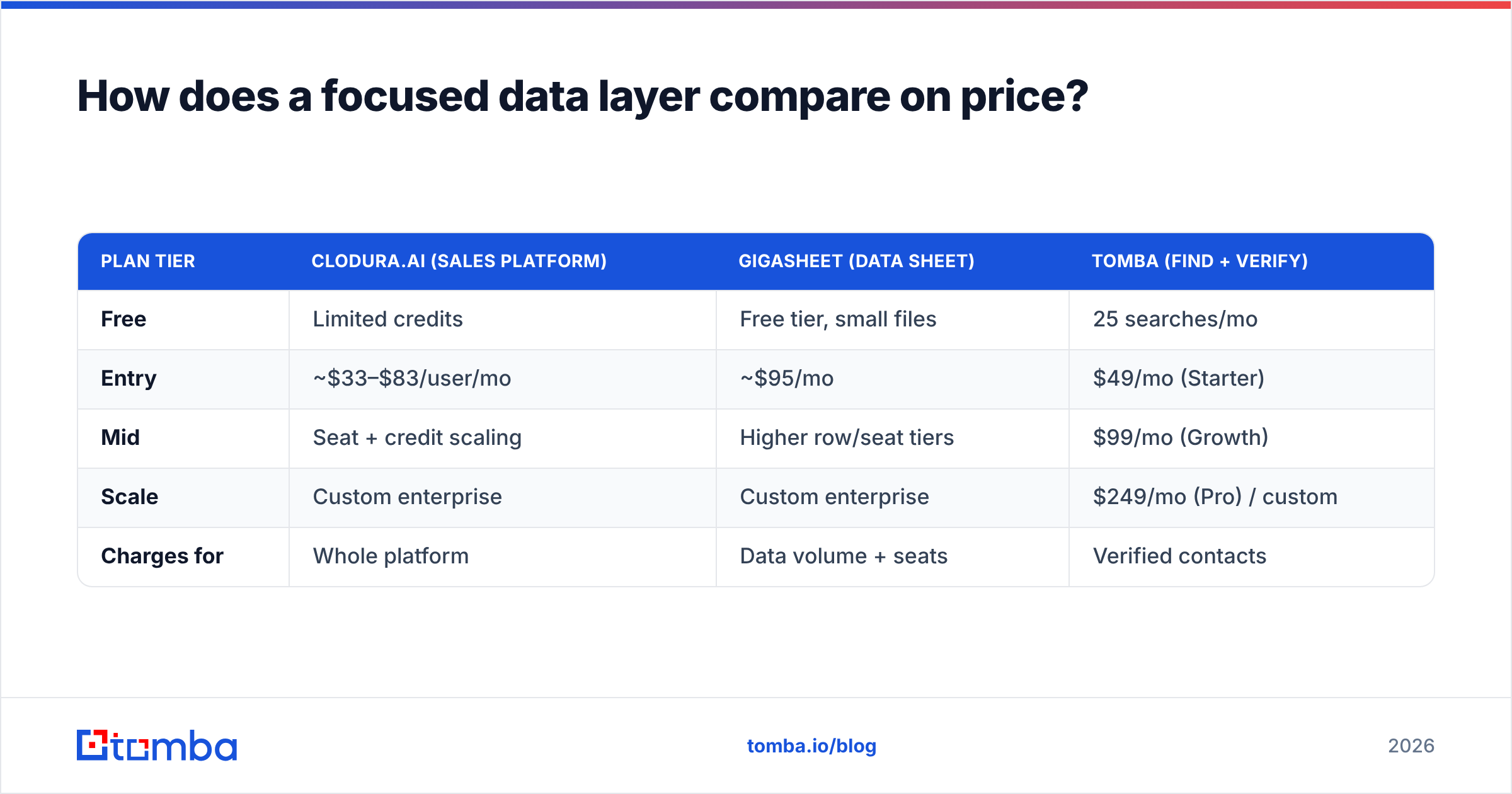
Here's where the all-in-one math stops working. You pay platform pricing for every module — dialer, sequencer, intent — whether you use them or not. A focused finder-plus-verifier charges for the one thing you can't fake: deliverable contacts.
| Plan tier | Clodura.ai (sales platform) | Gigasheet (data sheet) | Tomba (find + verify) |
|---|---|---|---|
| Free | Limited credits | Free tier, small files | 25 searches/mo |
| Entry | ~$33–$83/user/mo | ~$95/mo | $49/mo (Starter) |
| Mid | Seat + credit scaling | Higher row/seat tiers | $99/mo (Growth) |
| Scale | Custom enterprise | Custom enterprise | $249/mo (Pro) / custom |
| Charges for | Whole platform | Data volume + seats | Verified contacts |
You can see the full Tomba pricing breakdown, but the structural point stands: when your KPI is cost-per-verified-contact, paying for sequencing and intent modules you already cover elsewhere is pure overhead. Pricing details aside, the cheapest verified email is the one that doesn't bounce.
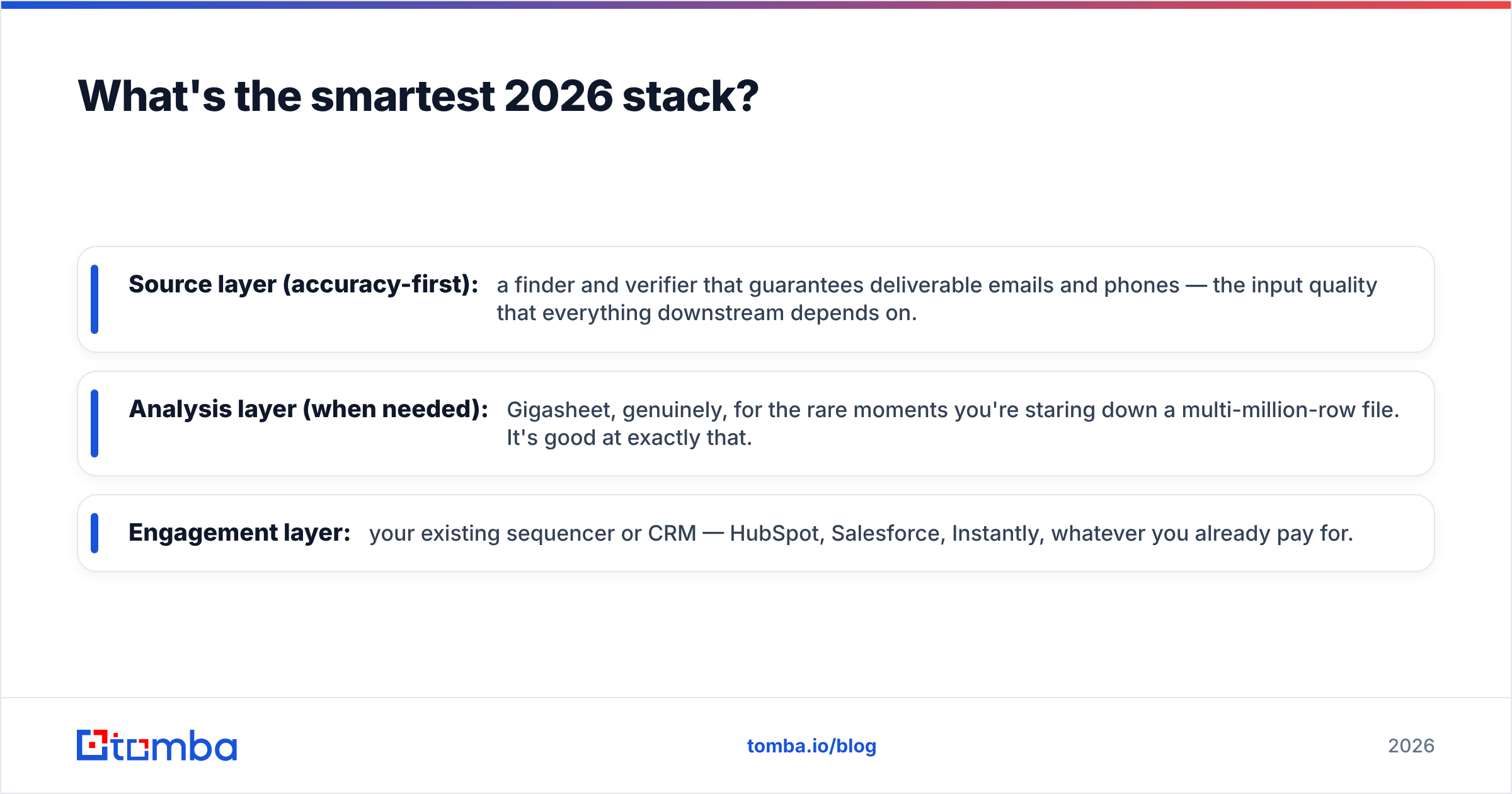
What's the smartest 2026 stack?#
Stop trying to make one tool do everything. The teams with the lowest cost-per-meeting in 2026 run a deliberately layered stack:
- Source layer (accuracy-first): a finder and verifier that guarantees deliverable emails and phones — the input quality that everything downstream depends on.
- Analysis layer (when needed): Gigasheet, genuinely, for the rare moments you're staring down a multi-million-row file. It's good at exactly that.
- Engagement layer: your existing sequencer or CRM — HubSpot, Salesforce, Instantly, whatever you already pay for.
The "source layer" is the one people skimp on and then wonder why their open rates are fine but replies are dead. It's because half their sends never arrive. A programmatic Tomba API call to find-and-verify before a contact enters any sequence is the cheapest deliverability insurance you can buy, and it slots in front of both Clodura-style platforms and Gigasheet-style sheets without ripping anything out.
For reference, you can vet each vendor directly — Clodura.ai and Gigasheet both publish their own feature breakdowns, and they're worth reading with this framing in mind: which job are you actually hiring it for?
Final verdict: Clodura.ai vs Gigasheet#
The verdict is that this isn't a versus. Clodura.ai is a sales-intelligence platform; Gigasheet is a big-data spreadsheet. If you must pick one, pick by the job: prospecting and engaging → Clodura's category; cleaning and analyzing massive files → Gigasheet. Buying either as a stand-in for the other guarantees disappointment.
But the more useful realization is that most teams searching this comparison are really asking "how do I get reliable contact data I can actually send to?" Neither tool is built accuracy-first, and accuracy is what determines whether your outbound works at all.
If clean, verified, ready-to-send contacts are the real goal, start with the layer that everything else depends on. Tomba's email finder finds professional addresses by domain, name, or company and verifies them against the live mail server before they ever touch your sequencer — with a free tier to test accuracy on your own list and plans from $49/mo when you scale. Build your stack on data that arrives, and let Clodura or Gigasheet do their narrow jobs on top of it.
// get started
Find, verify and enrich your first contacts today
Start on the free plan with 25 searches a month, then scale when your team is ready.
Free plan · No credit card required · GDPR & CCPA
// about the author