Clodura.ai vs Global Database 2026: B2B Data Compared
Clodura.ai bundles data with sequencing; Global Database sells deep firmographics. Here's an honest 2026 breakdown of accuracy, coverage, pricing, and the cheaper way to get clean B2B contacts.
Clodura.ai vs Global Database: Which B2B Data Platform Wins in 2026?
Choosing between Clodura.ai vs Global Database comes down to one question: do you want a bundled suite or just clean data? Picking a B2B data vendor is like choosing a grocery supplier for a restaurant. One sells you a fully-stocked walk-in cooler with prep stations attached — that's Clodura.ai. The other delivers crates of sourced, traceable ingredients and lets you cook — that's Global Database. Both feed your pipeline. But they solve different problems, and paying for the wrong one quietly bleeds budget.
This Clodura.ai vs Global Database guide is a neutral, hands-on comparison for 2026. We cover what each tool does, how the data holds up, what they cost, and where a lighter, API-first option beats both on price per verified contact.
TL;DR#
- Clodura.ai is an all-in-one sales intelligence and engagement platform. It bundles a database, sequences, intent signals, and email automation. It fits SMB outbound teams that want one login.
- Global Database is a deep firmographic and financial-data provider. It carries strong company-level detail (filings, credit, technographics). It leans more on company data than on dialer-ready contacts.
- Accuracy is the real battleground. Both inflate "verified" counts. Always re-verify before you send.
- Pricing is opaque on both sides. Expect annual contracts and sales calls, not a public price tag.
- If you mainly need accurate, verified contact data on demand, a focused tool like Tomba often delivers a lower cost-per-good-email than a bundled suite you half-use.
)
What is Clodura.ai?#
Clodura.ai calls itself an AI-powered sales prospecting platform. The pitch is consolidation. Instead of stitching together a data provider, a sequencer, and a verification tool, you get one workspace. Its core modules are a B2B contact database (the company claims hundreds of millions of contacts and direct dials), buyer-intent signals, an email sequencer with deliverability tooling, and a Chrome extension for LinkedIn capture.
The audience is clear. It targets small to mid-size outbound teams that don't want to run a five-tool stack. You search for a persona, build a list, push it into a sequence, and send. You never leave the app. That bundling is the headline benefit. As we'll see, it is also the source of its biggest trade-off.
Where Clodura is strong:
- Workflow consolidation — database and engagement under one roof cut export/import friction.
- Direct dials — it markets a large pool of mobile numbers, useful for cold calling teams.
- Intent data — technographic and buyer-intent signals layered onto the contact records.
- Sequencing built in — you can run cadences without buying a separate Outreach or Salesloft seat.
The caveat: bundled tools are rarely best-in-class at every layer. A sequencer thrown in with a database is usually "good enough," not category-leading. And you pay for it whether you use it or not.
What is Global Database?#
Global Database is a UK-rooted business intelligence provider. It focuses on depth of company data rather than sheer contact volume. Think company financials, credit reports, corporate filings, ownership structures, technographics, and compliance signals across many countries. It reads less like a prospecting list and more like a due-diligence and market-research source.
That makes Global Database a different animal. Say you're enriching accounts for risk scoring, territory planning, or account-based GTM. Then its firmographic and financial depth is genuinely useful. But say you just need 5,000 verified email addresses for a cold email campaign next week. You may find the contact-level layer thinner and the buying process heavier than you'd like.
Where Global Database is strong:
- Company depth — financials, credit, and filings most contact databases don't carry.
- Compliance posture — a strong focus on data sourcing and GDPR-aligned processes, which matters for EU-facing teams.
- Market intelligence — useful for analysts and RevOps, not only SDRs.
How do Clodura.ai and Global Database compare head to head?#
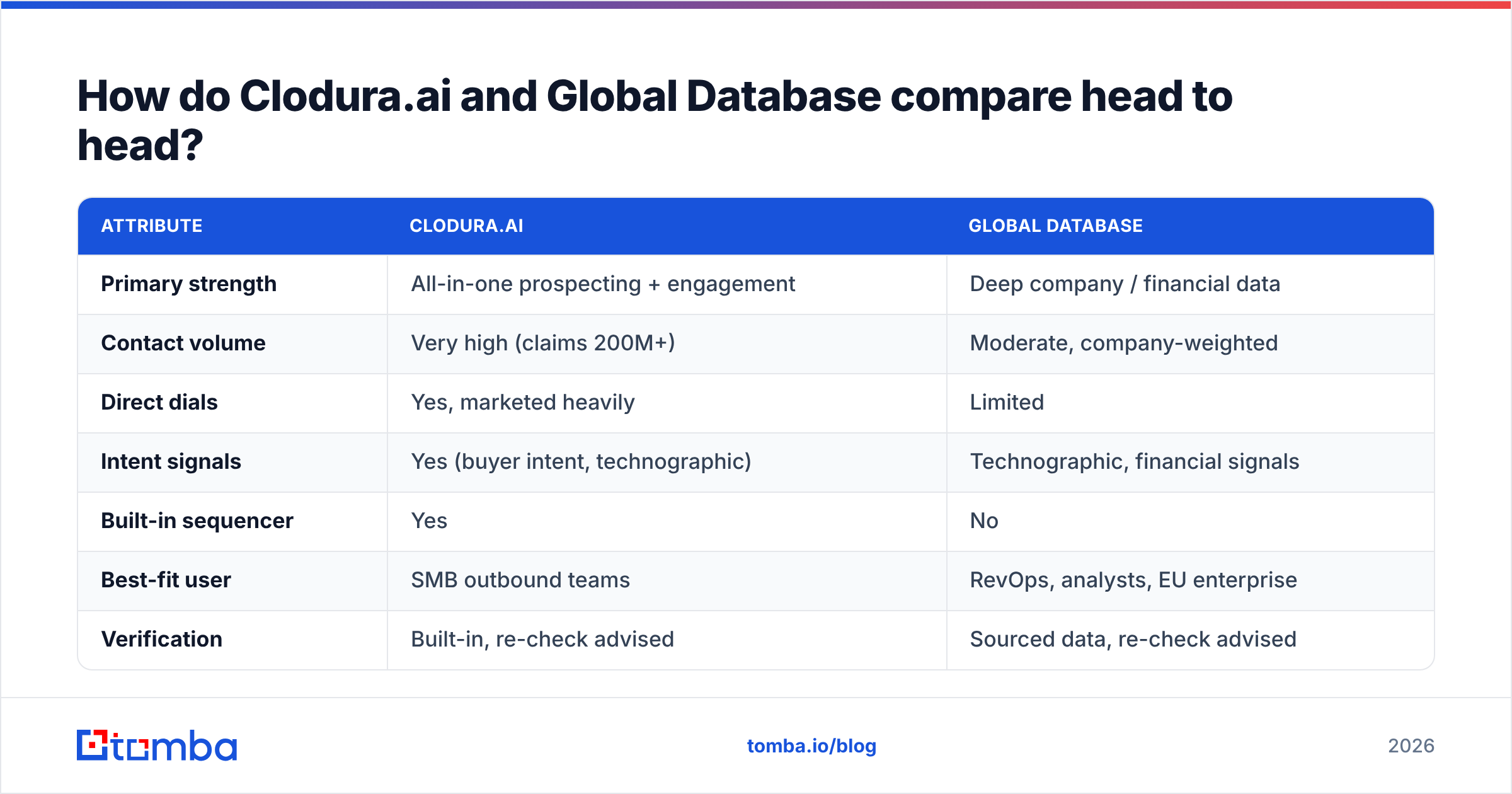
Here's the side-by-side. Treat any vendor-reported "accuracy" number as a marketing figure until you've tested a sample against your own list.
| Attribute | Clodura.ai | Global Database |
|---|---|---|
| Primary strength | All-in-one prospecting + engagement | Deep company / financial data |
| Contact volume | Very high (claims 200M+) | Moderate, company-weighted |
| Direct dials | Yes, marketed heavily | Limited |
| Intent signals | Yes (buyer intent, technographic) | Technographic, financial signals |
| Built-in sequencer | Yes | No |
| Best-fit user | SMB outbound teams | RevOps, analysts, EU enterprise |
| Verification | Built-in, re-check advised | Sourced data, re-check advised |
| Pricing transparency | Low (demo/quote) | Low (demo/quote) |
| Free self-serve trial | Limited | Limited |
| Geographic edge | US-heavy | Strong EU/UK coverage |
The pattern is simple. Clodura optimizes for motion — find and send fast. Global Database optimizes for knowledge — understand the account deeply. Neither is "better" in the abstract. It depends on your bottleneck. Is it the volume of outreach or the quality of account understanding?
Clodura.ai vs Global Database: which has more accurate data?#
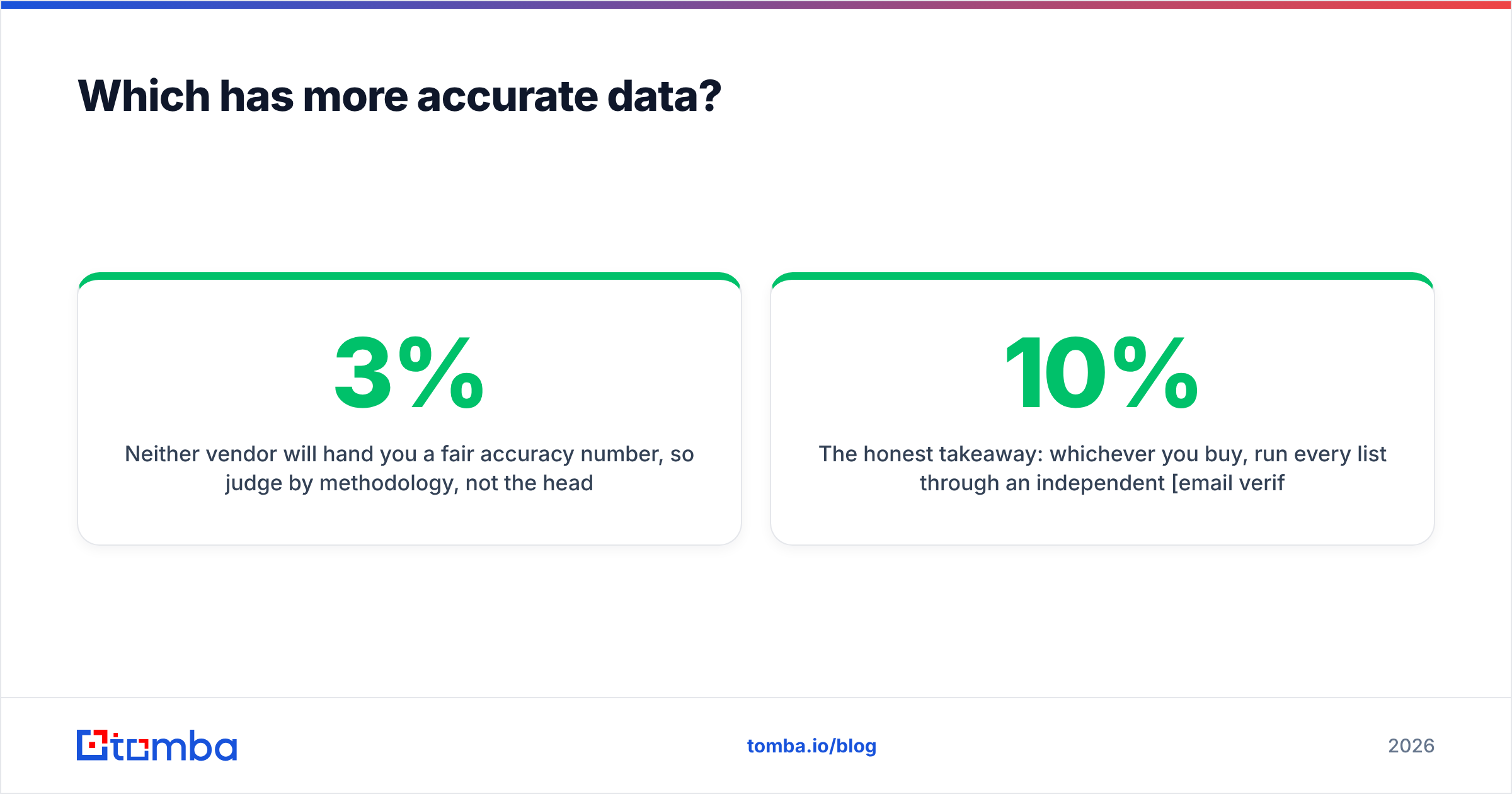
Neither vendor will hand you a fair accuracy number. So judge by methodology, not the headline. Accuracy in B2B data decays fast. Roughly 2-3% of contacts go stale every month as people change jobs. A database that was 95% accurate at collection is much worse a quarter later if it isn't re-verified.
Clodura's edge is that verification sits in the same pipeline that feeds sequences. In theory, contacts get checked closer to send time. Its weakness is the classic bundled-suite problem. The verification engine isn't its core product. So edge cases like catch-all domains and role-based addresses tend to slip through.
Global Database leans on documented sourcing — filings, registries, and partner feeds. That makes company records reliable and auditable. The trade-off is the person-level data. Email and mobile records, the stuff SDRs actually dial and send to, form a smaller, less-refreshed slice of the offering.
The honest takeaway: whichever you buy, run every list through an independent email verifier before you send. A 10% bounce rate will torch your sender reputation, no matter which logo supplied the data.
)
What about pricing and contracts?#
Both platforms keep pricing behind a demo. That's the norm at the enterprise end of B2B data. It's also a real friction point if you're a lean team that wants to test before committing. Expect annual contracts, seat minimums, and credit-based usage caps. The "unlimited" language in sales decks usually has fair-use throttles underneath.
That opacity is exactly where buyers overpay. You commit to a 200M-record suite, use one persona slice, and the cost-per-contact-you-actually-touched balloons. So in any Clodura.ai vs Global Database decision, do the math first. Count the verified contacts you'll realistically export per month, not the headline database size.
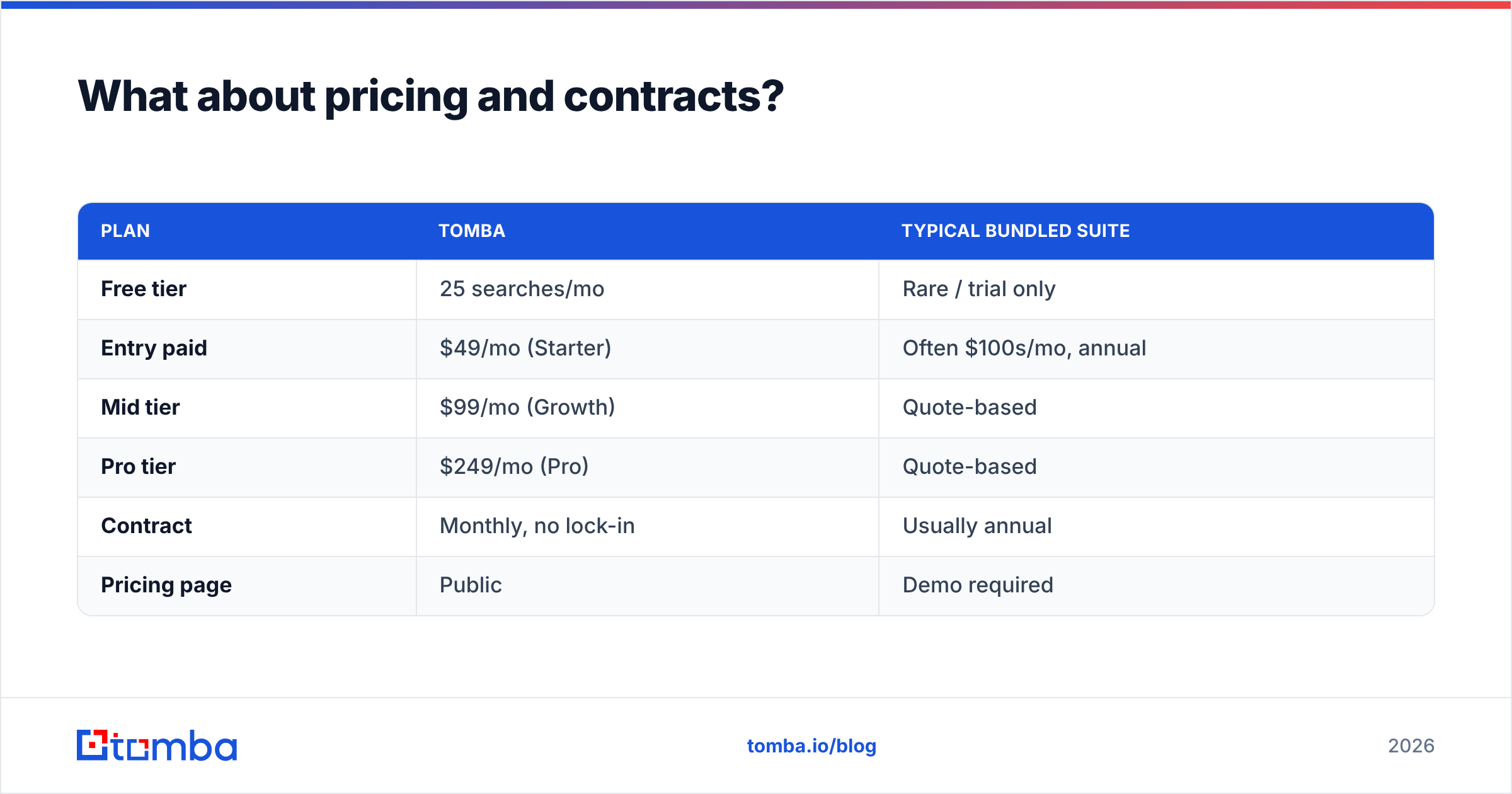
Here's how a focused, transparent-priced tool reframes the cost question:
| Plan | Tomba | Typical bundled suite |
|---|---|---|
| Free tier | 25 searches/mo | Rare / trial only |
| Entry paid | $49/mo (Starter) | Often $100s/mo, annual |
| Mid tier | $99/mo (Growth) | Quote-based |
| Pro tier | $249/mo (Pro) | Quote-based |
| Contract | Monthly, no lock-in | Usually annual |
| Pricing page | Public | Demo required |
You can see full Tomba pricing without a sales call. That's a deliberate contrast to the quote-gated model both Clodura and Global Database use. If you want to validate data quality on a small batch first, self-serve pricing removes the biggest barrier to testing.
Who should choose Clodura.ai?#
Choose Clodura.ai if you're an SMB or mid-market outbound team. It suits teams that want the database and the sending engine in one place. Say your reps currently juggle a data tool, a verifier, and a sequencer. Then the consolidation alone can justify the cost. You get fewer logins, fewer CSV hand-offs, and fewer places for a list to go stale between export and send.
It's also the stronger pick if direct dials and intent signals drive your motion. Teams running a phone-plus-email cadence benefit here. They get mobile numbers and buyer-intent flags attached to the same record they're sequencing.
Where it disappoints: power users who want best-in-class verification, granular deliverability control, or a clean API to pipe data into their own systems. Bundled suites optimize for the in-app workflow, not for being a programmatic data source.
Who should choose Global Database?#
Choose Global Database if your work is account-led, analytical, or compliance-sensitive. Picture RevOps teams scoring accounts on financial health. Picture analysts mapping a market. Picture EU-facing companies that need defensible, well-sourced data. All of them get more from its depth than from a volume-first contact list.
It's the better fit when "understanding the account" matters more than "emailing 10,000 people this month." The financial and filings data is genuinely differentiated. Most prospecting databases simply don't carry it.
Where it disappoints: a classic SDR who just needs verified emails and mobiles at speed. The contact layer is thinner and the buying process heavier than a prospecting-first team usually wants.
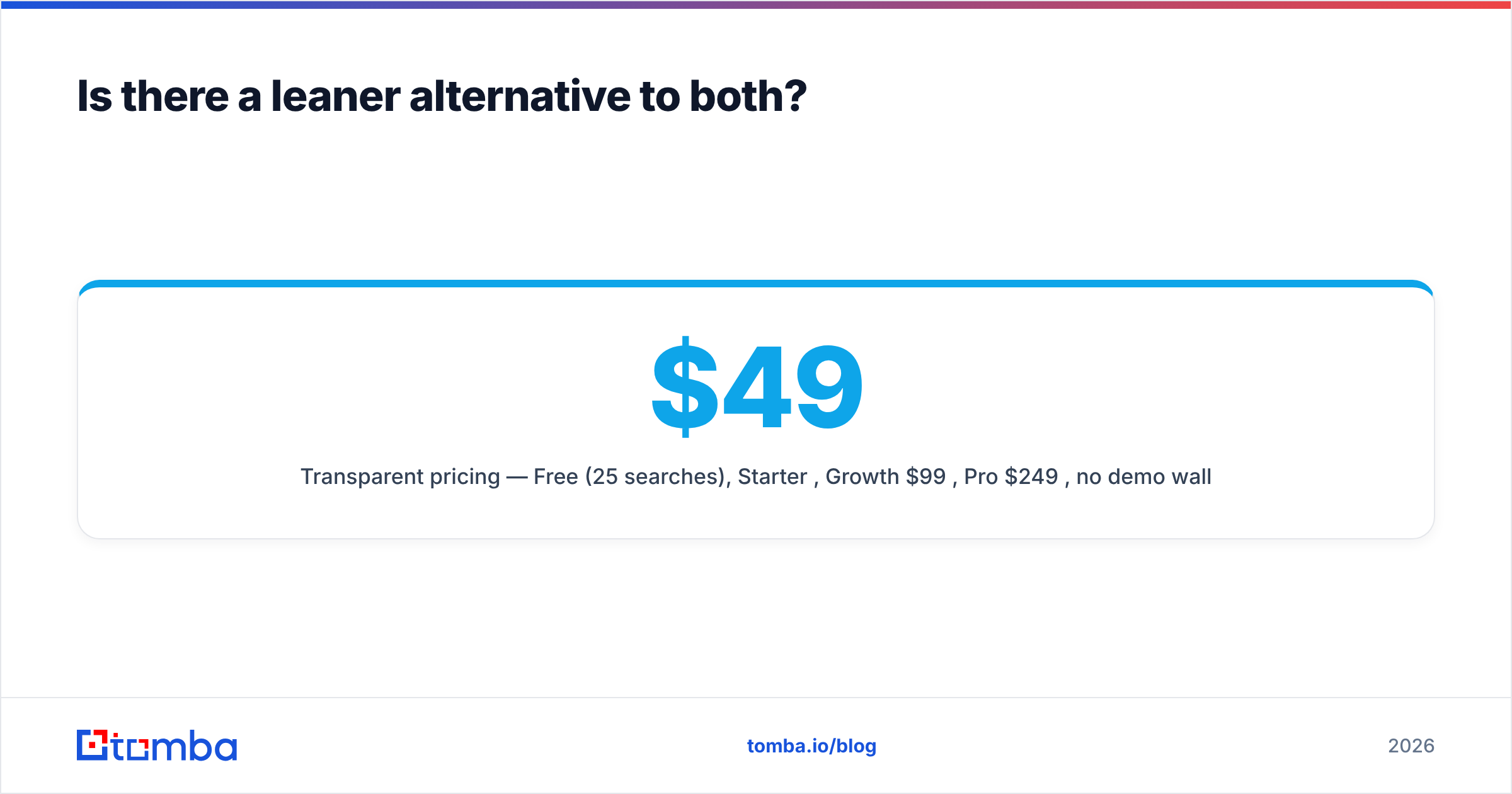
Is there a leaner alternative to both?#
Yes. And it's worth naming the trade-off plainly. Clodura and Global Database are platforms. You adopt a whole ecosystem. But say your real need is accurate contact data on demand. Then a focused email-finding and verification tool gives you the part you use without the parts you don't.
That's where Tomba fits. Instead of a bundled suite, it does the data layer well. You can find email addresses by name or company, search a whole company by domain, verify in bulk, and enrich records. It comes with a public price and a real email finder API for teams that want to build the workflow themselves rather than rent someone else's UI.
How the focused approach stacks up against the bundled model:
- Transparent pricing — Free (25 searches), Starter $49/mo, Growth $99/mo, Pro $249/mo, no demo wall.
- Verification-first — a dedicated verifier and catch-all checking, not an afterthought bolted onto a sequencer.
- API and integrations — drop data straight into your CRM or sequencer of choice instead of being locked into one vendor's sending engine.
- Documented sourcing — see where the data comes from rather than a black-box "200M records" claim.
The point isn't that Tomba replaces a financial-intelligence suite like Global Database. It doesn't carry credit filings. The point is different. A large share of teams buy a heavyweight platform when what they actually needed was clean, verified contacts they could pull on demand.
How to decide in practice#
Run a 30-minute test before any contract. The methodology beats any vendor's accuracy slide:
- Pull a sample. Take 100 known contacts (people you can verify yourself) from your target segment.
- Match against each tool. Check coverage. How many of the 100 does each vendor actually have?
- Verify independently. Run every returned email through a neutral email verification pass and count real bounces, not "valid" flags.
- Price the result. Divide monthly cost by verified, usable contacts. That's your true cost-per-contact.
- Weigh the extras honestly. Will you actually use the sequencer, the intent data, the financial filings? If not, you're subsidizing features for someone else's use case.
Most teams find a gap between "records claimed" and "verified contacts I can use." That gap is where the real cost — and the real decision — lives.
Final verdict#
There's no single winner in Clodura.ai vs Global Database. They aim at different buyers. Clodura wins for SMB outbound teams that want database and sequencing in one motion. Global Database wins for analytical, account-led, and EU-compliance-driven work that needs deep company and financial data. Both hide pricing. Both require independent verification before you send.
Say your core need is simply accurate, verified B2B contacts without adopting a whole ecosystem. Then start lean. Tomba's Email Finder gives you find-and-verify on a public price. It has a free tier to test data quality on your own list before you spend a cent, plus an API to wire it into whatever stack you already run. Try it on 25 free searches this week, measure the cost-per-verified-contact, and let the numbers — not the sales deck — pick your data vendor.
External references: Clodura.ai, Global Database, and verified user reviews on G2 are worth scanning before you commit.
// get started
Find, verify and enrich your first contacts today
Start on the free plan with 25 searches a month, then scale when your team is ready.
Free plan · No credit card required · GDPR & CCPA
// about the author