Cloduraai vs Go4database: Best B2B Data Tool in 2026?
Clodura.ai and Go4database both promise B2B contact data, but they solve different problems. Here's an honest 2026 breakdown of accuracy, pricing, and fit.
Cloduraai vs Go4database: Which B2B Data Tool Wins in 2026?
Picking a B2B data vendor is really a bet on two things: how accurate the records are the day you use them, and how the pricing scales when you actually run volume. Clodura.ai and Go4database sit on opposite ends of that spectrum. One is a sales-intelligence platform with prospecting tooling bolted on; the other is a database seller that hands you lists. This post breaks down where each one earns its keep, and where you'll feel the pain.
TL;DR
- Clodura.ai is a sales intelligence platform: a built-in contact database, intent signals, org charts, and sequencing. Best when you want prospecting and outreach in one login.
- Go4database is a list/data vendor: you buy targeted contact lists by industry, geography, or technology. Best for one-off campaign pulls, not continuous workflows.
- Accuracy and freshness are the real battleground. Static purchased lists decay ~2–2.5% per month; platform-refreshed data with verification holds up better.
- Neither is a pure email-finder — if your core need is finding and verifying a specific person's email on demand, a dedicated tool like the email finder approach usually beats both on cost-per-valid-contact.
- Your decision comes down to workflow (platform vs. file) and verification (live checks vs. trust-the-seller).
What is Clodura.ai?#
Clodura.ai is an AI-powered sales prospecting platform. Think of it less as a spreadsheet you download and more as a workspace you live in. It bundles a B2B contact database (the vendor cites tens of millions of direct dials and verified emails), buyer-intent data, technographic filters, organizational charts, and a basic email-sequencing engine.
The pitch is consolidation: instead of stitching together a data provider, an intent tool, and a sequencer, you do discovery and first-touch outreach in one place. For a small SDR team that doesn't want five subscriptions, that's genuinely appealing.
Where it gets murkier is depth. A do-everything platform rarely wins any single category. The intent data is directional, not surgical. The sequencer works but won't replace a dedicated outreach tool. And like every database vendor, coverage is uneven — strong in some regions and verticals, thin in others. You can read more about how data sourcing affects quality on Tomba's data sources page, which applies to any vendor you evaluate.

What is Go4database?#
Go4database is a B2B data vendor in the classic sense: you tell them the audience you want — say, "IT decision-makers at US manufacturing firms with 200+ employees" — and they deliver a list. Pricing is typically per-list or per-record, and you own the file once it's delivered.
This model has real advantages. It's transactional, so there's no monthly platform fee if you only run campaigns quarterly. The targeting can be granular because a human (or a query) builds the segment for you. And for direct mail, event invites, or a single large email blast, a clean file is sometimes all you need.
The downside is structural. A purchased list is a snapshot. The moment it's delivered, it starts decaying — people change jobs, companies fold, domains migrate. You're also trusting the seller's verification claims, which range from rigorous to "we ran it through a free checker last year." There's no live re-verification at the moment you actually send. That's the core risk with any static list, and it's why running purchased data through an email verifier before sending is non-negotiable.
Cloduraai vs Go4database: How do they compare head to head?#
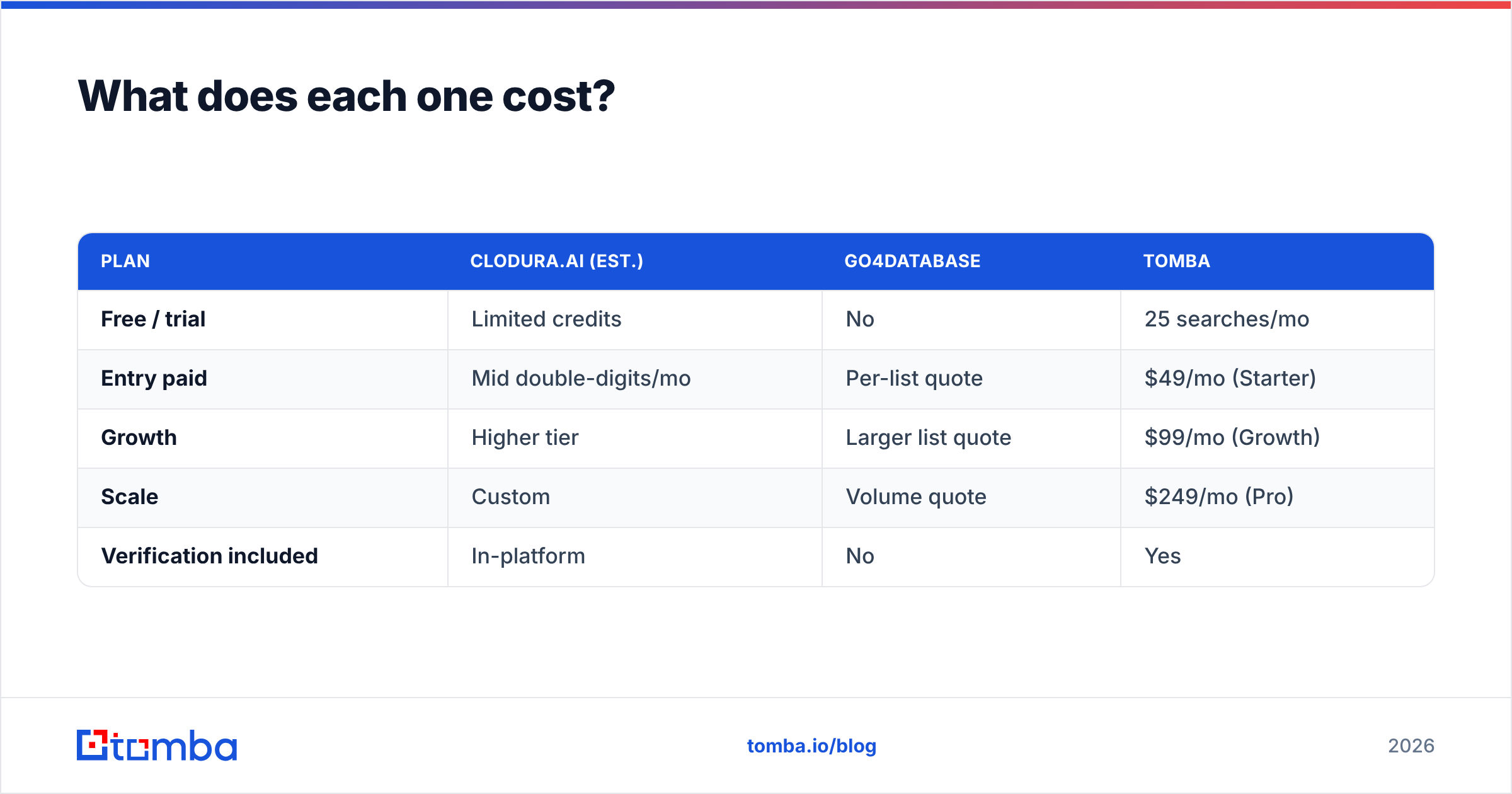
Here's the honest side-by-side. Neither tool is "bad" — they're built for different buyers.
| Attribute | Clodura.ai | Go4database |
|---|---|---|
| Model | SaaS platform (subscription) | List vendor (per-list / per-record) |
| Core strength | Prospecting + intent + sequencing in one | Custom-built targeted lists |
| Data freshness | Continuously refreshed in-platform | Snapshot at delivery; decays over time |
| Verification | In-platform email checks | Seller-claimed; verify before sending |
| Best for | Ongoing SDR workflows | One-off campaign pulls |
| Outreach tooling | Built-in sequencer | None (export only) |
| Intent / technographics | Yes | Limited / varies |
| Learning curve | Moderate (full platform) | Low (you get a file) |
| Pricing transparency | Tiered plans, public-ish | Quote-based, varies by list |
The pattern is clear: Clodura.ai is a workflow, Go4database is a deliverable. If you run outbound every week, a platform pays for itself in saved tool-switching. If you run two big campaigns a year, paying a monthly SaaS fee 12 times to use it twice makes no sense.
Which one is more accurate?#
Accuracy is where most buyers get burned, so let's be specific. According to widely cited B2B data research (HubSpot and others peg contact data decay at roughly 22–30% per year), no static list stays clean. That math hits Go4database harder simply because its model is snapshot-based — a list bought in January is meaningfully worse by June if it's untouched.
Clodura.ai has the architectural advantage here because records are refreshed inside the platform. But "refreshed" doesn't mean "perfect" — platform databases still carry stale rows, especially for smaller companies and non-US regions. The only reliable defense, regardless of vendor, is verifying at the point of use.
This is also why pairing any database with live verification matters. A catch-all domain, for instance, will pass a basic syntax check but bounce or vanish into a black hole. A dedicated catch-all verifier catches what list sellers routinely miss.
What does each one cost?#
Pricing is the least transparent part of this comparison, and you should treat any single number with suspicion — both vendors adjust quotes by volume, region, and contract.
Clodura.ai uses tiered subscriptions. There's typically a free or trial tier with limited credits, then paid plans that scale by the number of contacts you can unlock and which features (intent, sequencing) you get. The trap is credit math: a low headline price can hide a low monthly contact allowance, so your real cost-per-contact may be higher than it looks.
Go4database is quote-based. You pay per list, with price driven by list size and how specific the targeting is. There's no recurring fee, which is a genuine cost advantage for infrequent users — but no live verification either, so budget for a verification pass on top.
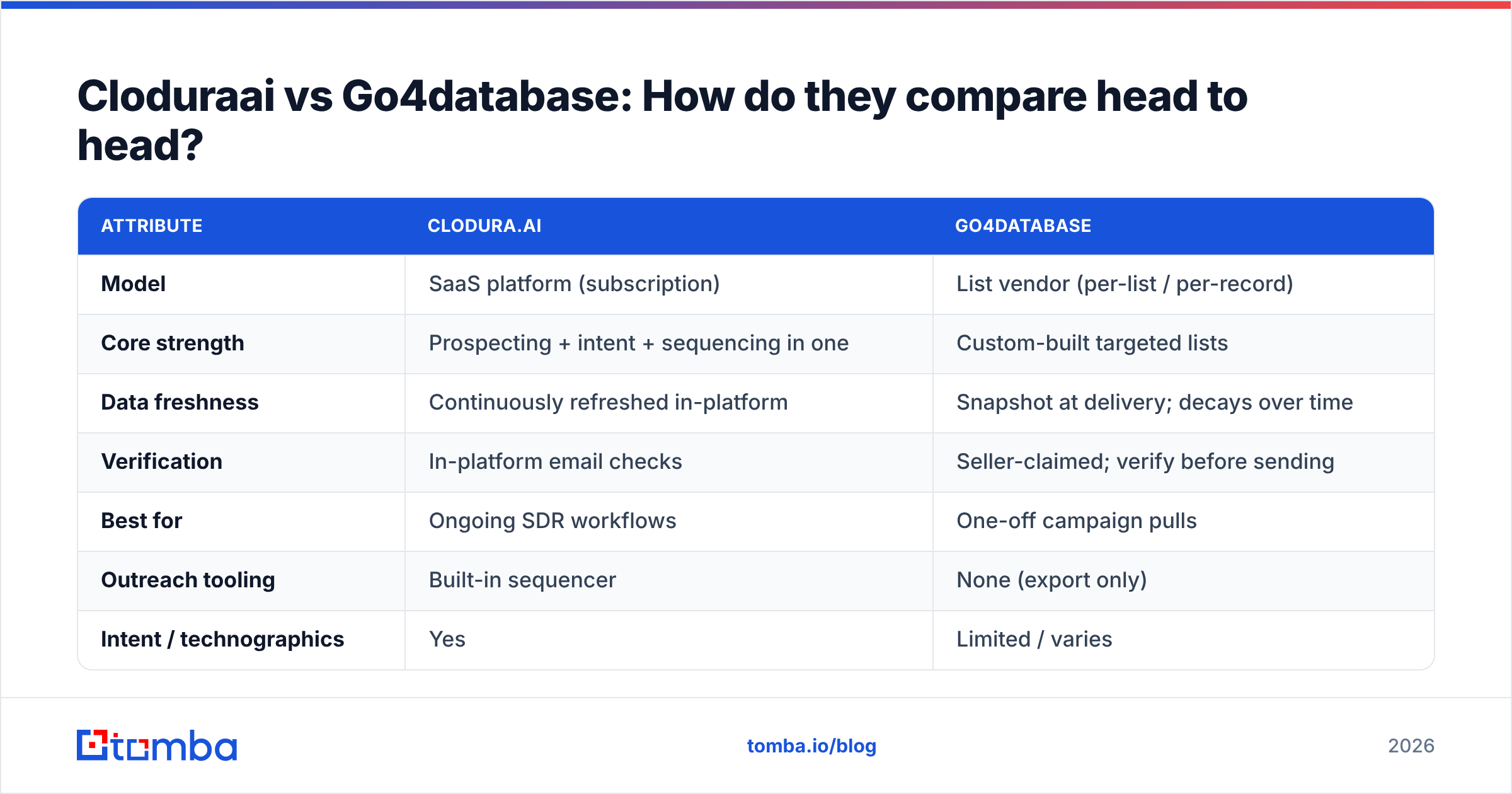
For reference, here's how a usage-based finder/verifier tool prices against both models, since many teams end up combining a database with on-demand lookups:
| Plan | Clodura.ai (est.) | Go4database | Tomba |
|---|---|---|---|
| Free / trial | Limited credits | No | 25 searches/mo |
| Entry paid | Mid double-digits/mo | Per-list quote | $49/mo (Starter) |
| Growth | Higher tier | Larger list quote | $99/mo (Growth) |
| Scale | Custom | Volume quote | $249/mo (Pro) |
| Verification included | In-platform | No | Yes |
Full, current numbers for the usage-based option are on the Tomba pricing page. The point isn't that one is universally cheapest — it's that you should compare cost per valid contact, not cost per row. A cheap list with a 20% bounce rate is more expensive than it looks once you factor in deliverability damage.
Is Clodura.ai better than Go4database?#
It depends entirely on how you work — but here's a decision framework instead of a cop-out answer.
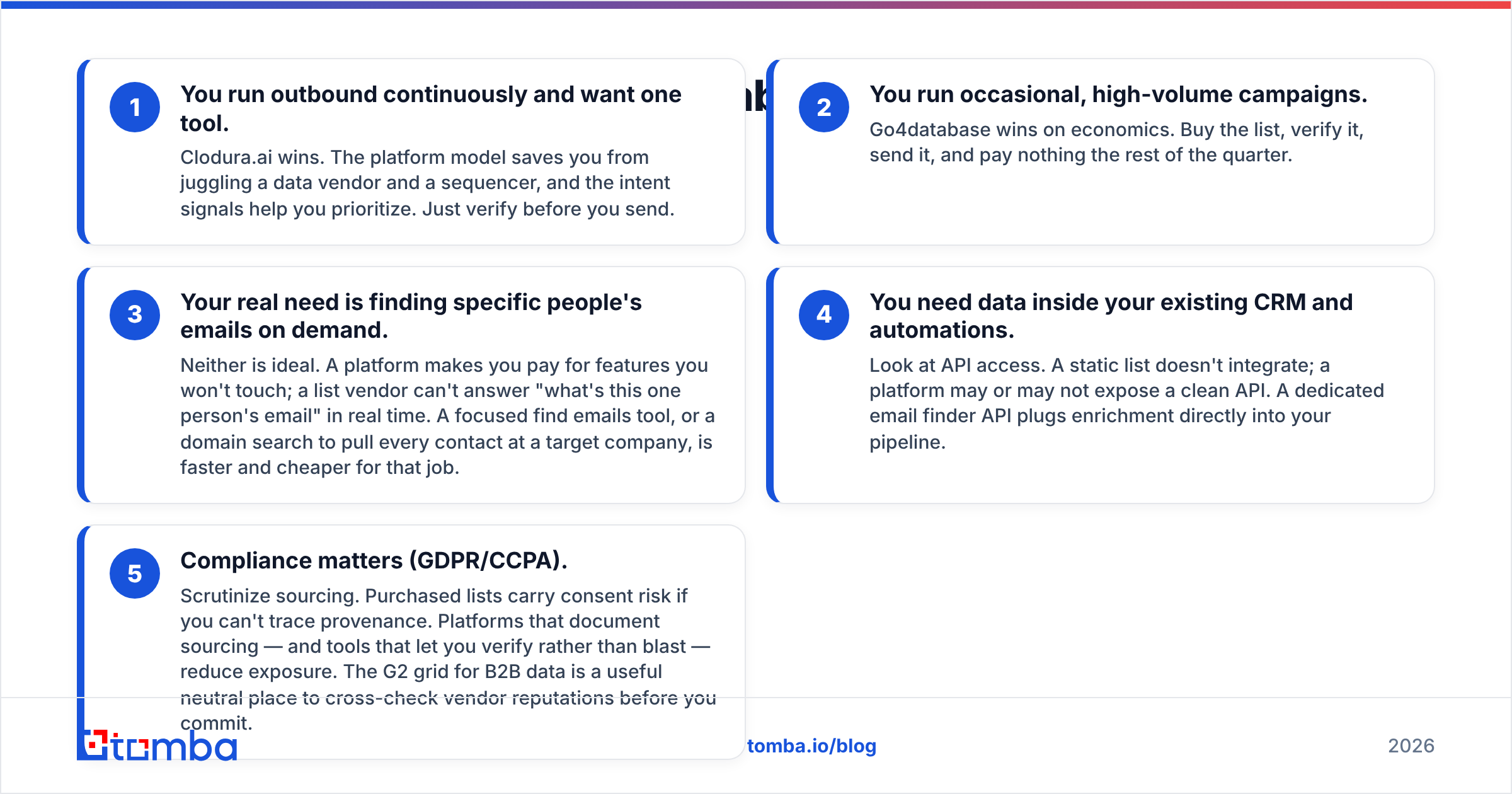
You run outbound continuously and want one tool. Clodura.ai wins. The platform model saves you from juggling a data vendor and a sequencer, and the intent signals help you prioritize. Just verify before you send.
You run occasional, high-volume campaigns. Go4database wins on economics. Buy the list, verify it, send it, and pay nothing the rest of the quarter.
Your real need is finding specific people's emails on demand. Neither is ideal. A platform makes you pay for features you won't touch; a list vendor can't answer "what's this one person's email" in real time. A focused find emails tool, or a domain search to pull every contact at a target company, is faster and cheaper for that job.
You need data inside your existing CRM and automations. Look at API access. A static list doesn't integrate; a platform may or may not expose a clean API. A dedicated email finder API plugs enrichment directly into your pipeline.
Compliance matters (GDPR/CCPA). Scrutinize sourcing. Purchased lists carry consent risk if you can't trace provenance. Platforms that document sourcing — and tools that let you verify rather than blast — reduce exposure. The G2 grid for B2B data is a useful neutral place to cross-check vendor reputations before you commit.
What are the alternatives to both?#
Plenty, and the right answer often isn't "pick one of these two." The B2B data market splits into three rough buckets:
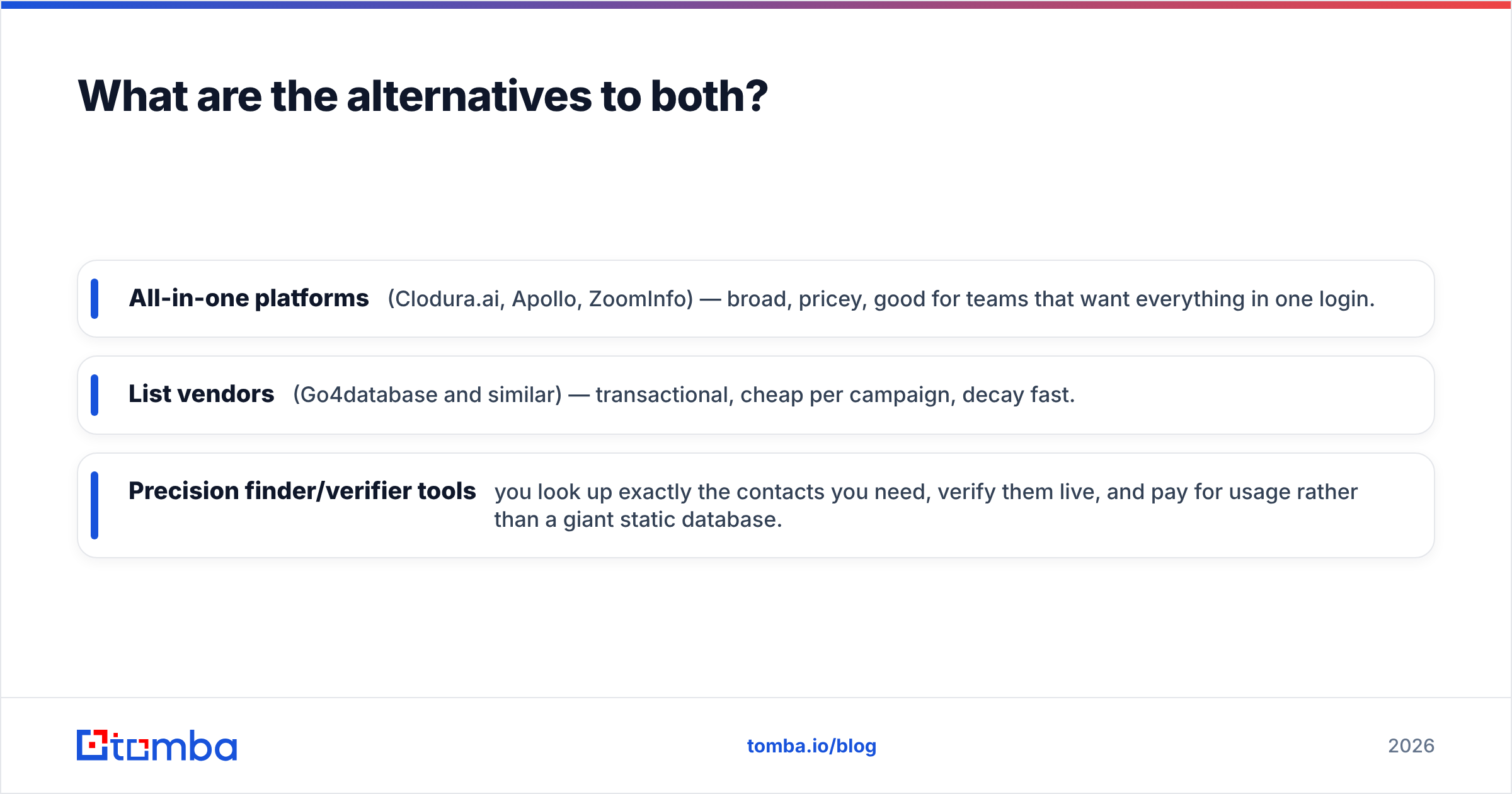
- All-in-one platforms (Clodura.ai, Apollo, ZoomInfo) — broad, pricey, good for teams that want everything in one login.
- List vendors (Go4database and similar) — transactional, cheap per campaign, decay fast.
- Precision finder/verifier tools — you look up exactly the contacts you need, verify them live, and pay for usage rather than a giant static database.
That third category is where a lot of lean teams have moved, because it sidesteps both the "paying for features I don't use" problem and the "my list is already rotting" problem. You can layer it on top of either competitor: use Clodura.ai or a Go4database list for breadth, then run the contacts through verification and fill gaps with targeted lookups. Tools like the bulk email finder handle the gap-filling at scale, and data enrichment tops up missing fields like job title, company size, or phone.
If you're specifically weighing platforms, it's worth reading independent reviews on Capterra rather than vendor landing pages — the gap between marketing copy and verified-buyer reviews is where the real product lives.
How should you actually test them before buying?#
Don't trust any vendor's accuracy claim, including the ones in this article. Run a controlled bake-off:
- Pull the same 200-contact segment from each vendor — same industry, geography, and seniority.
- Verify every record through an independent checker. Measure valid, risky (catch-all), and invalid rates. This single step usually settles the debate faster than any feature comparison.
- Spot-check 20 records by hand against LinkedIn and company sites for title and employer accuracy.
- Send a small real campaign and watch bounce rate and reply rate, not just open rate (opens are unreliable in 2026 thanks to privacy proxies).
- Calculate cost per valid contact, not per row. Divide what you paid by the count that survived verification.
Whoever wins that test wins your budget. Everything else — dashboards, logos, "AI-powered" badges — is secondary to deliverable, verifiable data.
The verdict#
Clodura.ai and Go4database aren't really competitors so much as two different shapes of the same need. Clodura.ai is the better choice if you want a continuous prospecting-to-outreach workflow and you're willing to pay a subscription for consolidation. Go4database is the better choice if you run infrequent, targeted campaigns and want to avoid recurring fees — provided you verify aggressively before you send.
But for most teams in 2026, the smartest play isn't either/or. It's pairing a breadth source with a precision finder-and-verifier so you only pay for contacts you'll actually email, and you verify every one at the moment of use. That keeps your bounce rate low, your sender reputation intact, and your cost-per-valid-contact honest.
If your core job is finding and confirming the right person's email — fast, accurate, and ready to drop into your CRM — start with the Tomba Email Finder. Search by domain, name, or company, get a confidence score on every result, and verify in the same flow. The free tier gives you 25 searches a month to test the accuracy yourself before you spend a cent — which is exactly the kind of proof neither a list vendor nor a locked-in platform makes easy.
// get started
Find, verify and enrich your first contacts today
Start on the free plan with 25 searches a month, then scale when your team is ready.
Free plan · No credit card required · GDPR & CCPA
// about the author