Clodura.ai vs GoCustomer 2026: Which Sales Tool Wins?
Clodura.ai vs GoCustomer compared on data, prospecting, AI outreach, and price — plus where a dedicated email finder beats both for accuracy in 2026.
The Cloduraai vs Gocustomer choice comes down to one question. Do you need a sales-intelligence database to find prospects? Or an AI engine to contact them? The two tools overlap a little. But they solve different halves of the outbound problem. Pick the wrong one, and you pay for features you never open.
This is a neutral breakdown of both platforms in 2026. You'll see what each does well. You'll see where each falls short. We cover how pricing really works. And we explain why your contact data layer matters more than either tool's marketing implies.
TL;DR — Cloduraai vs Gocustomer at a glance#
- Clodura.ai is a B2B sales-intelligence and prospecting platform: a large contact/company database, technographics, org charts, and a built-in email finder plus light sequencing.
- GoCustomer is an AI-first sales-engagement tool focused on personalized email outreach, multichannel cadences, and reply handling — it assumes you already have contacts.
- Pick Clodura.ai if your gap is sourcing leads; pick GoCustomer if your gap is converting a list you already own.
- Neither is a best-in-class data vendor. For verified emails, pairing either with a dedicated email finder consistently lifts deliverability.
- Budget reality: both sit in the mid-market range, but credits, seats, and verification add-ons change the real monthly cost fast.
What is Clodura.ai?#
Clodura.ai is a sales-prospecting platform built around a proprietary B2B database. The pitch is "find your next customer." You search across tens of millions of contacts and companies. You filter by industry, headcount, technology stack, and intent signals. Then you export or sequence the results.
Three features stand out. Org-chart mapping shows the reporting lines inside a target account. Technographic filters find companies that use a specific CRM, cloud, or ad platform. And a bundled email finder and verifier means you can start without a separate data tool. A basic cadence builder also lets you send sequences inside the app.
Think of Clodura.ai as a hardware store. It stocks the raw materials — names, emails, company signals. It also throws in a few basic power tools, so you can start building right away.
Teams do hit friction. Database freshness varies by region — it's stronger in North America and India, thinner elsewhere. The native sequencing works, but it isn't best-in-class. So many users treat Clodura as the data source and push contacts into a dedicated outreach tool.
https://blog-cdn.tomba.io/content/images/2026/06/memes/2026-06-25/cloduraai-vs-gocustomer-meme-1.png
Wait — that's the wrong asset. Here's the meme that fits the data-freshness point:
What is GoCustomer?#
GoCustomer is an AI sales-engagement platform. Its core job is simple. It takes your contact list and runs personalized outreach at scale. It generates tailored email copy. It sequences across email and other channels. And it uses AI to triage and draft replies.
The strength here is the AI personalization layer. Instead of mail-merging {first_name}, it drafts context-aware openers and follow-ups. Then it optimizes send timing and cadence. For teams whose bottleneck is "we have leads but our reply rates are flat," that's the relevant lever. You can read more about how copy quality affects response rate in any outreach motion.
Think of GoCustomer as a high-end espresso machine. It makes excellent output — but only if you supply good beans. It doesn't pretend to be your bean supplier. There's no large prospecting database underneath it.
Where teams hit friction: garbage in, garbage out. If your list is full of unverified or catch-all addresses, GoCustomer's clever copy still bounces. And bounces wreck sender reputation. The platform is also less useful if you don't already have a steady source of fresh contacts.
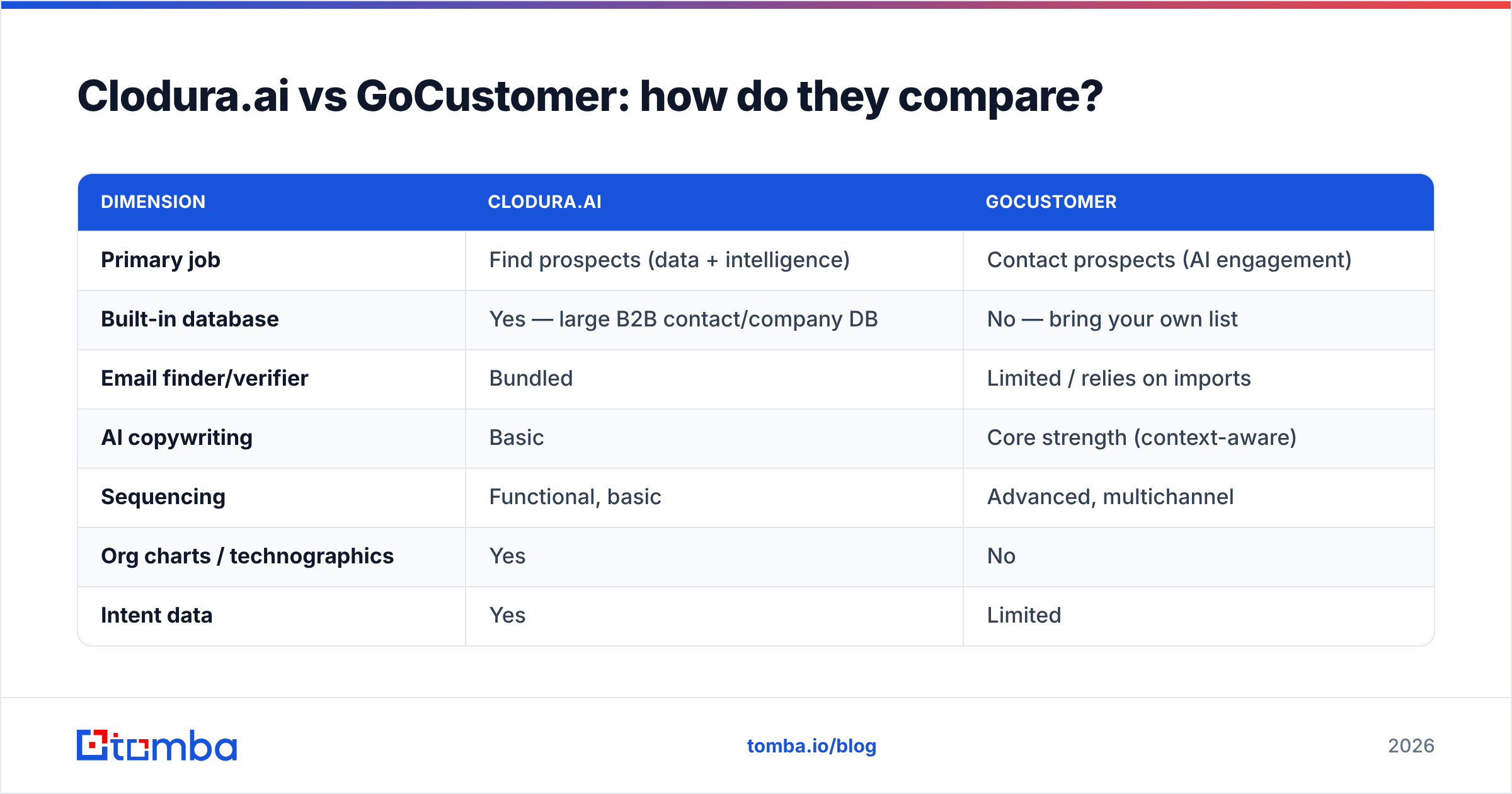
Clodura.ai vs GoCustomer: how do they compare?#
Here's the head-to-head on the dimensions that actually drive a buying decision. Treat exact prices as indicative — both vendors run custom and promotional pricing, so confirm on their sites.
| Dimension | Clodura.ai | GoCustomer |
|---|---|---|
| Primary job | Find prospects (data + intelligence) | Contact prospects (AI engagement) |
| Built-in database | Yes — large B2B contact/company DB | No — bring your own list |
| Email finder/verifier | Bundled | Limited / relies on imports |
| AI copywriting | Basic | Core strength (context-aware) |
| Sequencing | Functional, basic | Advanced, multichannel |
| Org charts / technographics | Yes | No |
| Intent data | Yes | Limited |
| Best for | SDR sourcing, list building | Reply-rate optimization, AE outreach |
| Typical fit | Top of funnel | Middle of funnel |
The pattern is clear. These aren't really competitors — they're neighbors. Clodura.ai owns "who do I contact, and how do I reach them." GoCustomer owns "how do I make that contact convert."
Which one fits your team?#
Use this quick decision framework instead of a feature checklist:
- You have no reliable lead source. Choose Clodura.ai — the database is the whole point, and the bundled finder gets you sending fast.
- You already buy data (or scrape LinkedIn) but reply rates are weak. Choose GoCustomer — its AI personalization is the upgrade you're actually missing.
- You're an SDR-heavy outbound team scaling volume. Lead with Clodura.ai for sourcing, then graduate winning segments into a stronger engagement tool.
- You're an AE team working warm, known accounts. GoCustomer's tailored copy beats a database you don't need.
- You care most about deliverability. Neither alone is enough — verify every address before send (more on that below).
- You're cost-sensitive and early-stage. Start with one layer plus a low-cost finder rather than paying for both platforms at once.
Is Clodura.ai or GoCustomer better for data accuracy?#
Neither platform is a pure-play data accuracy specialist. That's the honest catch with all-in-one sales tools. Clodura.ai maintains its own database, which is convenient. But self-reported accuracy figures deserve skepticism. Coverage is uneven by geography and seniority. And B2B data decays at roughly 2–3% every month as people change jobs. GoCustomer mostly inherits whatever quality your imported list already has.
This matters because deliverability is unforgiving. A 5% bounce rate is enough to get flagged by inbox providers. Once your domain reputation drops, even perfect copy lands in spam. The fix isn't a better cadence. It's clean data at the point of send.
That's where a dedicated layer earns its keep. Run addresses through a standalone email verifier before they enter any sequence. It catches the dead and risky ones that a bundled tool waves through. For fresh contacts beyond either platform's database, use a focused finder with transparent data sources. You get verifiable results rather than a black box.
A simple accuracy-first workflow#
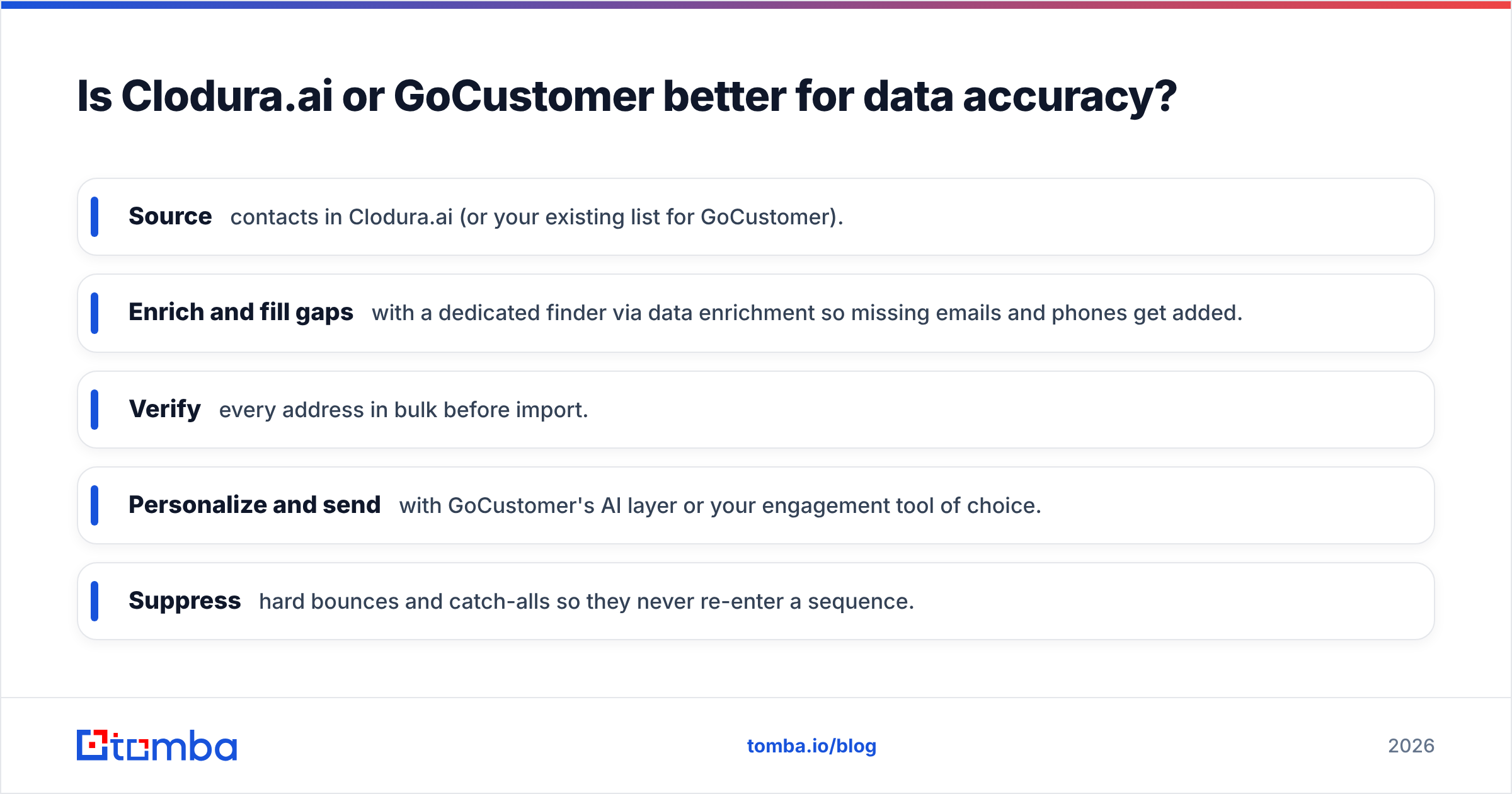
- Source contacts in Clodura.ai (or your existing list for GoCustomer).
- Enrich and fill gaps with a dedicated finder via data enrichment so missing emails and phones get added.
- Verify every address in bulk before import.
- Personalize and send with GoCustomer's AI layer or your engagement tool of choice.
- Suppress hard bounces and catch-alls so they never re-enter a sequence.
This four-step chain typically does more for results than swapping one platform for another. It attacks the real failure point — the data, not the tooling.
How does pricing compare?#
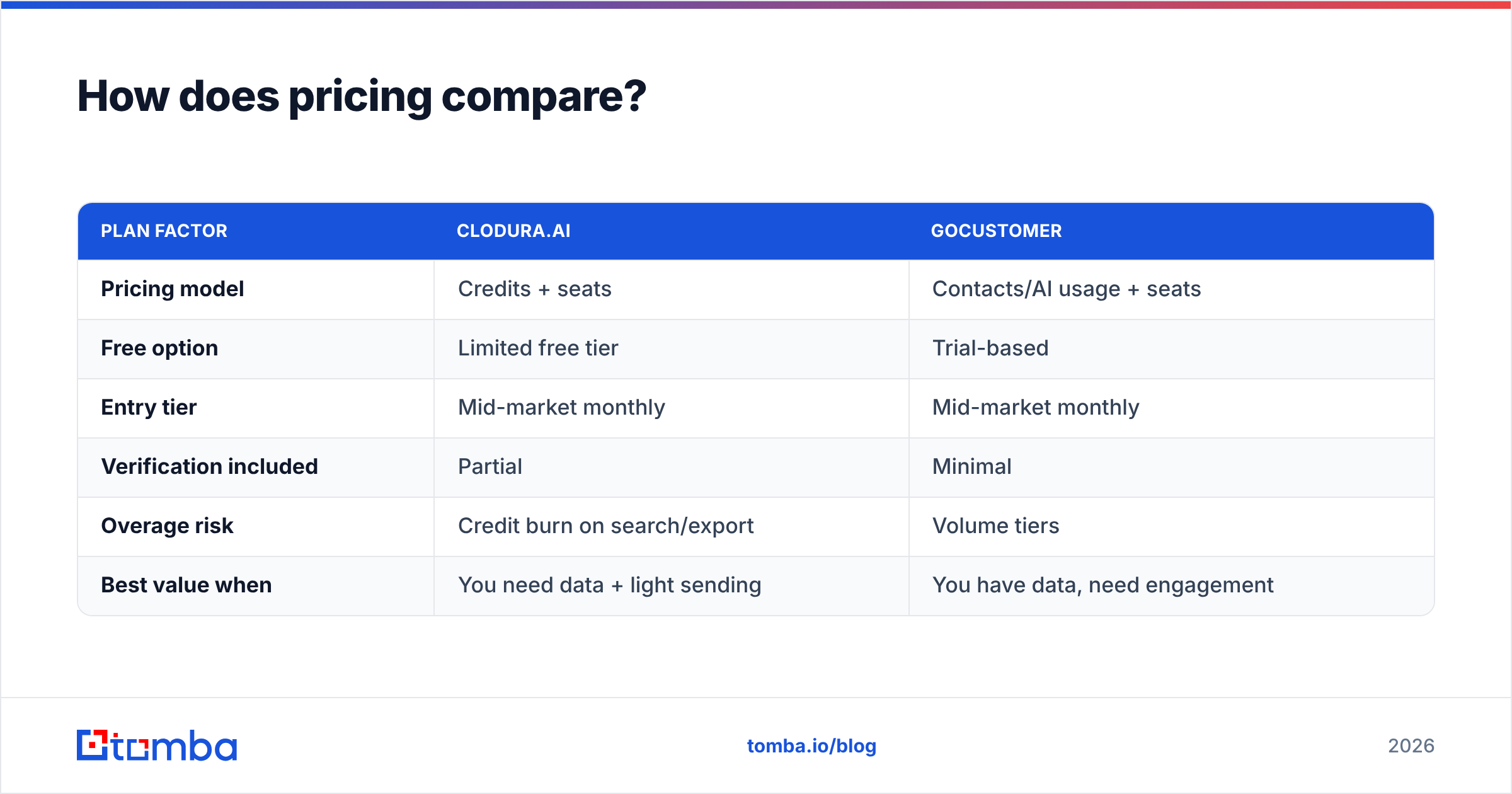
Both tools sit in the mid-market band. But they price on different units, so raw sticker comparisons mislead. Clodura.ai prices around database access, credits, and seats. GoCustomer prices around contacts engaged, AI usage, and seats. Always confirm current numbers directly, because vendors change tiers often.
| Plan factor | Clodura.ai | GoCustomer |
|---|---|---|
| Pricing model | Credits + seats | Contacts/AI usage + seats |
| Free option | Limited free tier | Trial-based |
| Entry tier | Mid-market monthly | Mid-market monthly |
| Verification included | Partial | Minimal |
| Overage risk | Credit burn on search/export | Volume tiers |
| Best value when | You need data + light sending | You have data, need engagement |
The hidden cost in both cases is verification and re-finding. Say you pay for a database, an engagement tool, and cleanup. The bill compounds fast. That's why many lean teams anchor on one platform for its core strength. Then they add a usage-based finder for the data layer.
For reference, a dedicated finder/verifier like Tomba prices simply. There's a Free tier with 25 searches/month, Starter at $49/mo, Growth at $99/mo, and Pro at $249/mo, with Enterprise custom. You can see the full breakdown on the Tomba pricing page. Slotting that under either tool is often cheaper than paying for a second full platform just to clean your list.
Can you use both Clodura.ai and GoCustomer together?#
Yes — and for some teams it's the strongest setup. The two cover opposite halves of the funnel. So a combined stack looks like this: Clodura.ai sources and segments accounts. A dedicated finder/verifier cleans and enriches the export. Then GoCustomer runs the AI-personalized engagement.
The real question is whether you need both at full price. A growing outbound team with real volume usually justifies it. A small team or a part-time founder rarely does. You'll get more mileage from one platform plus a focused data tool. If you're evaluating the broader market, independent reviews on G2 and analyst coverage from Gartner help you sanity-check vendor claims. Clodura's own product site also lays out its current feature set.
Quick fit summary#
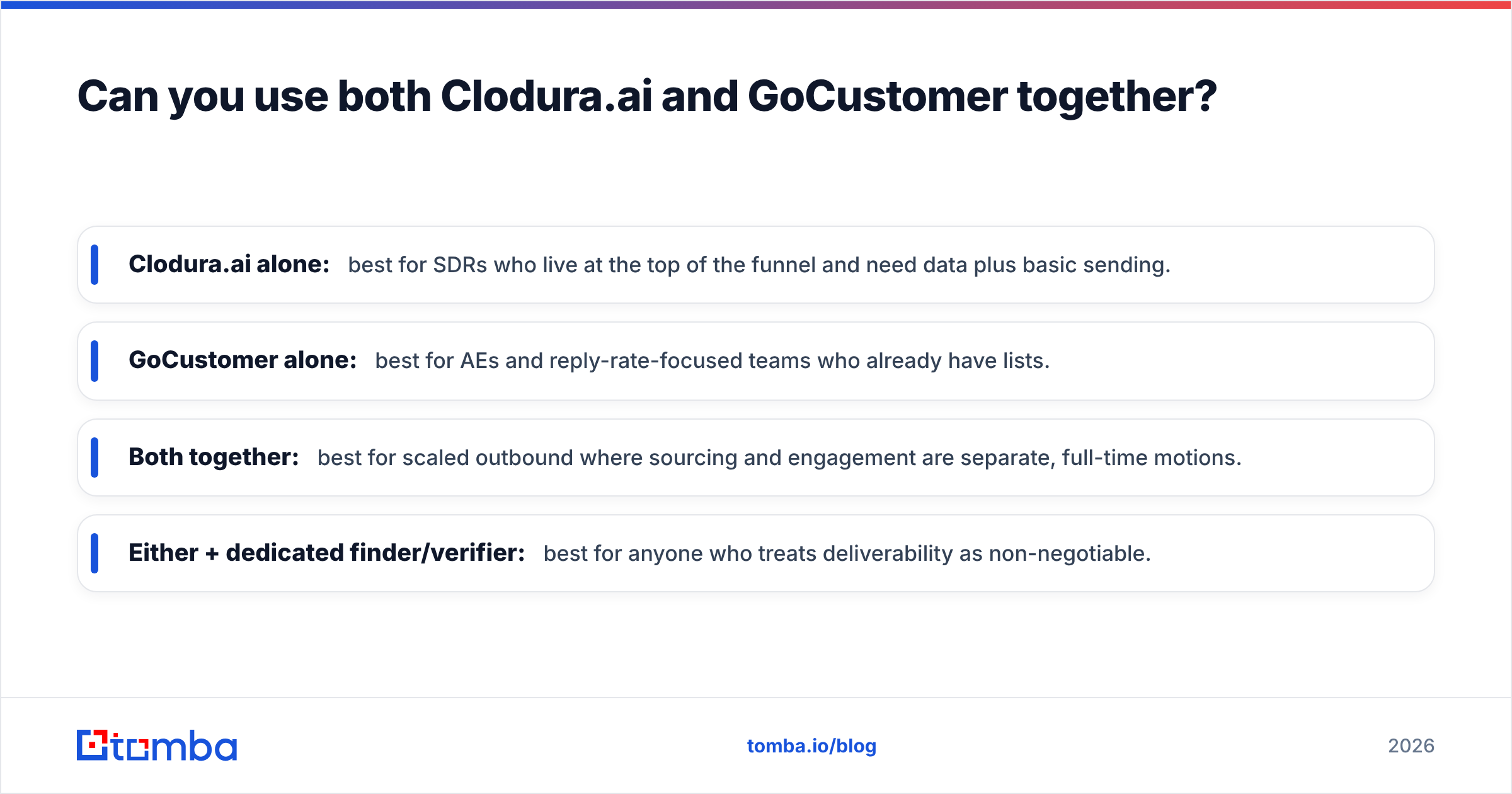
- Clodura.ai alone: best for SDRs who live at the top of the funnel and need data plus basic sending.
- GoCustomer alone: best for AEs and reply-rate-focused teams who already have lists.
- Both together: best for scaled outbound where sourcing and engagement are separate, full-time motions.
- Either + dedicated finder/verifier: best for anyone who treats deliverability as non-negotiable.
What about deliverability and domain health?#
Both platforms can send email. But neither makes your domain bulletproof. Email deliverability is mostly decided upstream of any sequencer. It comes down to authentication records, list hygiene, warmup, and bounce control. No AI subject line saves a domain that's been blasting unverified addresses.
The non-negotiables, regardless of which tool you choose:
- Authenticate your sending domain (SPF, DKIM, DMARC) before any campaign.
- Verify every address and remove catch-alls and role accounts at risk of bouncing.
- Warm up new sending domains gradually rather than spiking volume.
- Monitor bounce and complaint rates and pause when they climb.
Clodura.ai's bundled verification helps with step two. But it isn't a substitute for a dedicated pass. GoCustomer largely assumes you've handled hygiene before import. In both cases, the data layer does the heavy lifting for inbox placement. That's exactly why it deserves a specialist tool, not a checkbox feature.
The verdict: Cloduraai vs Gocustomer in 2026#
There's no universal winner, because they're not the same product. Clodura.ai wins when your problem is finding the right people. Its database, org charts, and technographics are the draw, and the bundled finder gets you moving. GoCustomer wins when your problem is converting people you've already found. Its AI personalization is the genuine differentiator.
But one decision quietly determines your results — and it's neither platform. It's the quality of the contact data flowing through them. Stale or unverified emails sink even the best database and the smartest AI copy.
If your stack is missing a reliable, accurate data layer, start there. The Tomba Email Finder finds professional email addresses by domain, name, or company. It verifies them before they ever hit your sequence. So whether you choose Clodura.ai, GoCustomer, or both, every message lands on a real, deliverable inbox. Try the Free tier, then scale on Tomba pricing as your outbound grows.
Ready to find emails that actually work?
Join 150,000+ professionals who stopped guessing and started sending. Free credits on signup — no credit card required.
Get the Tomba newsletter
Practical outbound tactics and product updates — once every two weeks.
About the author