Cloduraai vs Grata 2026: B2B Data Tools Compared
Clodura.AI vs Grata is a mismatch on paper: one finds buyers and emails, the other sources private companies for dealmakers. Here's which fits your team in 2026 — and where a leaner finder beats both.
Most "cloduraai vs grata" searches compare two tools that barely overlap. That makes the choice feel confusing. But the two tools do different jobs. One is a sales-prospecting engine. It finds buyers and their emails. The other is a private-market platform. It finds companies for dealmakers. Knowing this difference up front saves you from buying the wrong category.
This guide keeps it simple. We cover what each tool does, where its data is strong, what it costs, and which one fits your stack in 2026.
TL;DR: Clodura.AI vs Grata in five bullets#
- Clodura.AI is a B2B sales-intelligence and sales-engagement platform: contact database, email finder, sequences, and buyer-intent signals aimed at SDRs and growth teams.
- Grata is a deal-sourcing and private-company search engine built for private equity, M&A advisors, and corporate development — it indexes private companies, not buyer personas.
- They rarely compete. Want to book meetings? Look at Clodura. Want to find acquisition or investment targets? Look at Grata.
- Pricing diverges sharply. Clodura targets sales-team budgets. Grata is enterprise deal-sourcing software priced for investment firms.
- If your real need is just accurate emails to reach decision-makers, a focused finder like Tomba does that job for a fraction of either platform's cost.
What are Clodura.AI and Grata?#
Clodura.AI markets itself as an all-in-one sales prospecting platform. It bundles several things in one login. You get a B2B contact database (it claims hundreds of millions of contacts). You also get an email finder and verifier, direct-dial discovery, and buyer-intent and technographic signals. On top of that, it adds a sales-engagement layer for cold email sequences and cadences. The target user is a sales development rep or a small revenue team that wants prospecting data and outreach tooling in one place. You can read its own positioning on the Clodura.AI homepage.
Grata is a different animal. It's a deal-sourcing platform that helps you discover and research private companies — the kind that don't show up cleanly in standard databases because they have no public filings. Grata's search uses natural-language queries and similar-company matching. It surfaces middle-market businesses by what they actually do. It then layers on financial signals, headcount, ownership, and contact info for the deal team. Its audience is private equity associates, investment bankers, and corporate development teams, as described on the Grata homepage.
So the honest framing of "cloduraai vs grata" is buyer discovery vs business discovery. Clodura helps you sell to companies. Grata helps you buy or invest in them.

Wait — ignore that mental model for a second and look at the core overlap. It's small but it matters: both tools sell you "company + contact data." That overlap is exactly where buyers get confused and overpay.
How do Clodura.AI and Grata differ at a glance?#
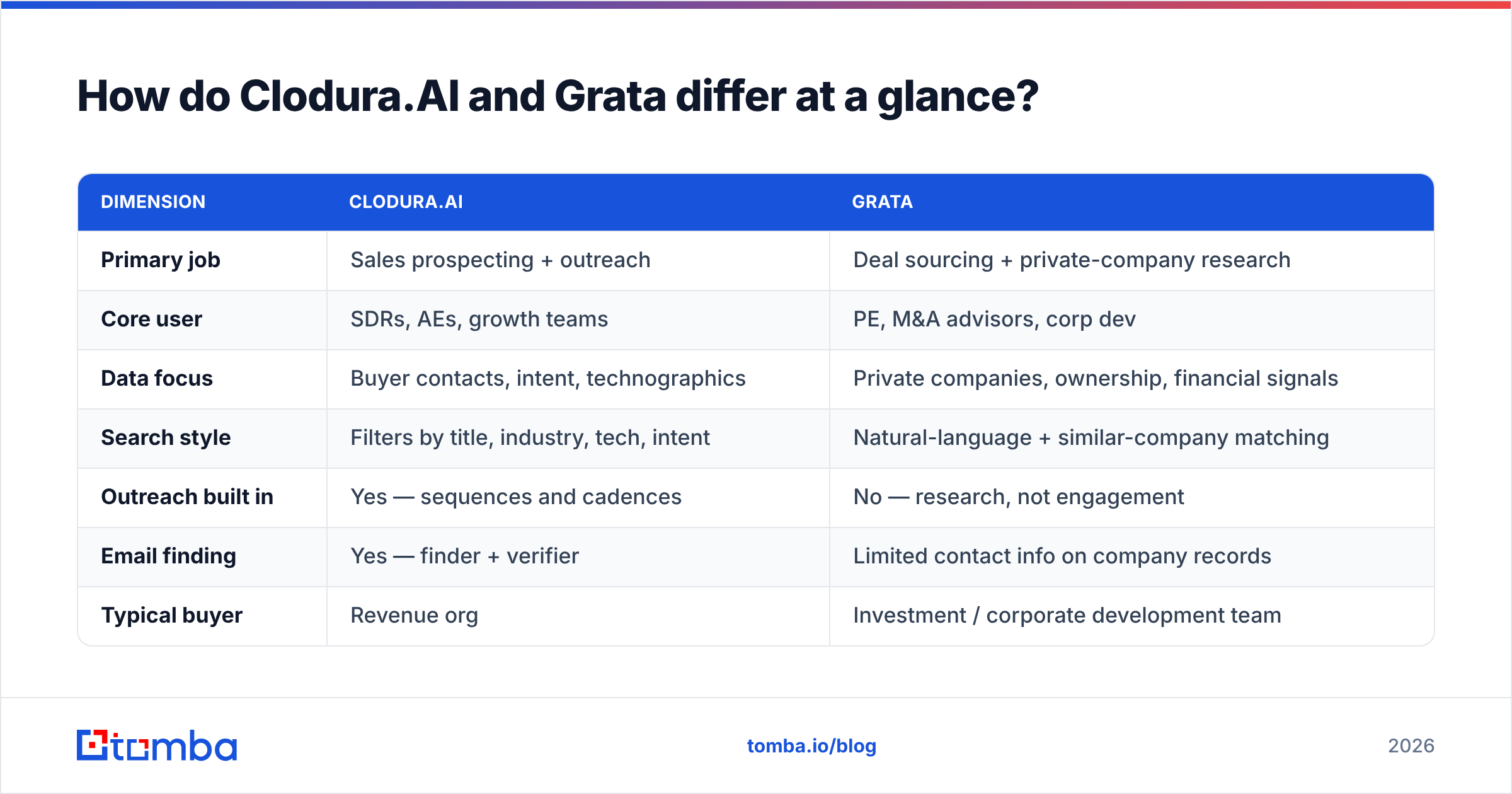
Here's the side-by-side. Use it to confirm which category you're actually shopping in before you book a demo.
| Dimension | Clodura.AI | Grata |
|---|---|---|
| Primary job | Sales prospecting + outreach | Deal sourcing + private-company research |
| Core user | SDRs, AEs, growth teams | PE, M&A advisors, corp dev |
| Data focus | Buyer contacts, intent, technographics | Private companies, ownership, financial signals |
| Search style | Filters by title, industry, tech, intent | Natural-language + similar-company matching |
| Outreach built in | Yes — sequences and cadences | No — research, not engagement |
| Email finding | Yes — finder + verifier | Limited contact info on company records |
| Typical buyer | Revenue org | Investment / corporate development team |
| Pricing model | Per-seat sales tooling | Enterprise deal-sourcing platform |
The takeaway in one line. Need to "send 200 cold emails this week"? Grata is the wrong tool. Need to "find 40 founder-owned manufacturers in the Midwest doing $10M–$50M"? Clodura is the wrong tool.
What is Clodura.AI best for?#
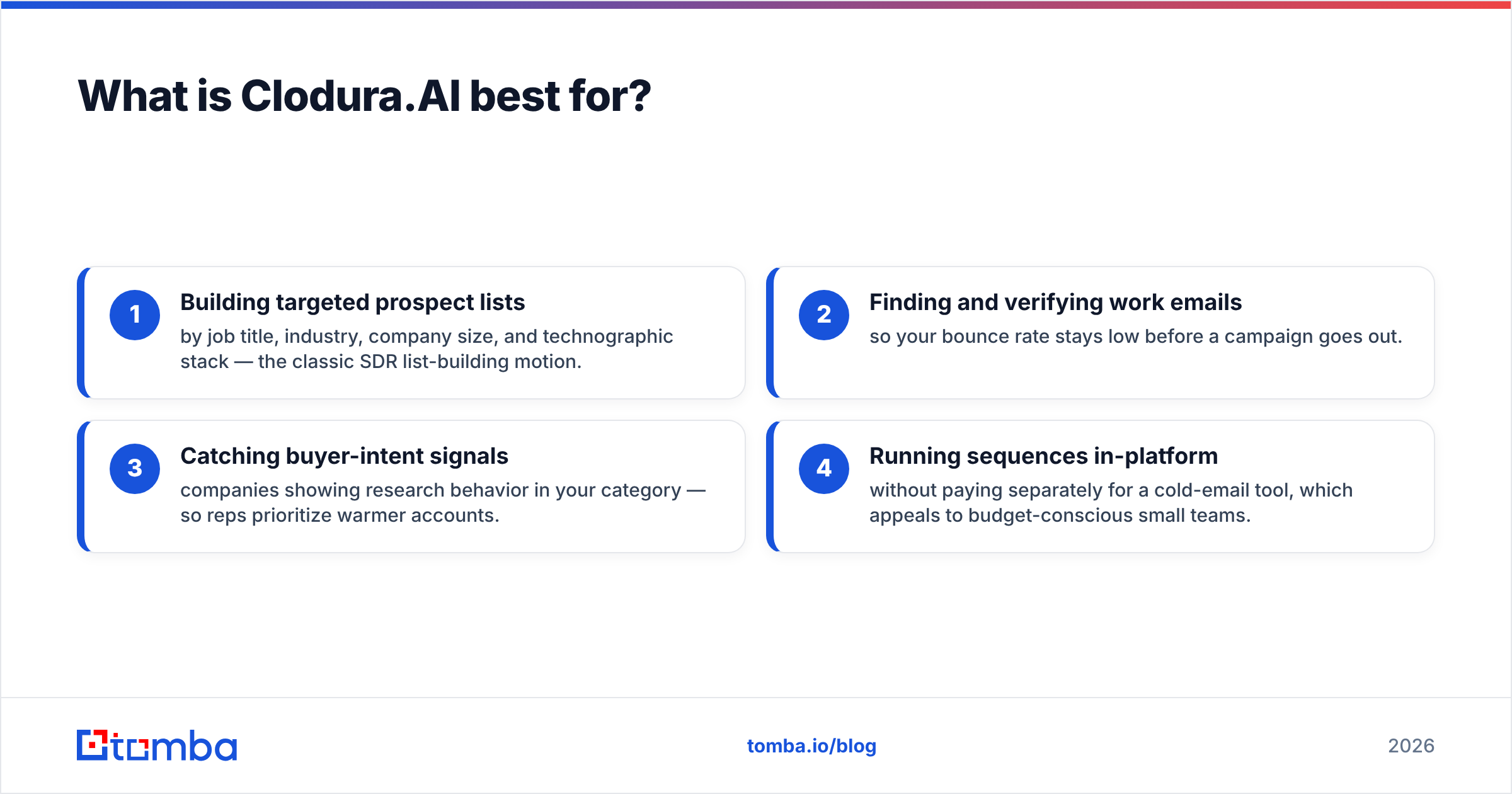
Clodura.AI fits teams that want prospecting data and outreach in a single subscription. Its strongest use cases:
- Building targeted prospect lists by job title, industry, company size, and technographic stack — the classic SDR list-building motion.
- Finding and verifying work emails so your bounce rate stays low before a campaign goes out.
- Catching buyer-intent signals — companies showing research behavior in your category — so reps prioritize warmer accounts.
- Running sequences in-platform without paying separately for a cold-email tool, which appeals to budget-conscious small teams.
Where Clodura gets challenged is depth and accuracy at scale. All-in-one platforms spread engineering across many features. So the contact data and email verification can lag the specialists. If deliverability is your bottleneck, you'll often still run found addresses through a dedicated email verifier before trusting them. User reviews and feature breakdowns on G2 are a useful sanity check on how the data holds up versus the marketing claims.
What is Grata best for?#
Grata earns its keep when your "lead" is an entire company you might acquire or invest in, not a contact you want to email a demo link to.
- Sourcing off-market and bootstrapped companies that don't appear in public-filing databases.
- Thematic searches — "find companies like X" or describe a niche in plain language and surface lookalikes.
- Building and tracking deal pipelines with company-level signals: ownership type, headcount growth, funding, and acquisition history.
- Mapping a fragmented market for a roll-up or platform-investment thesis.
Grata is genuinely strong at what it does. There's no real email-finder substitute for that deal-sourcing job. But it's priced and scoped for investment workflows. A startup SDR asking "should I use Grata to find leads?" is asking the wrong question. It's not a cold-outreach prospecting tool, and paying enterprise deal-sourcing rates to send cold emails makes no sense.
Cloduraai vs Grata: how does pricing compare?#
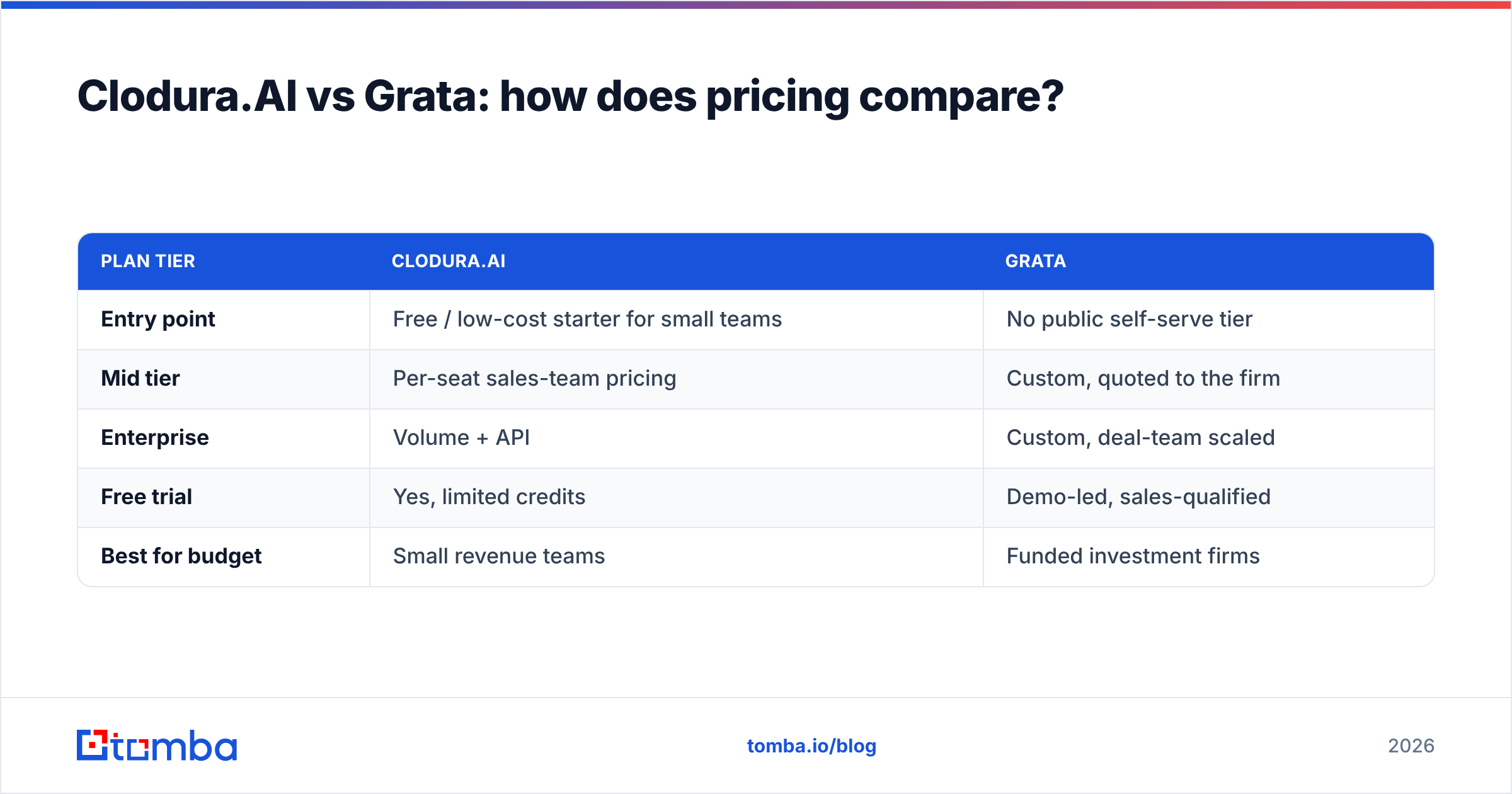
Pricing is where the category gap becomes a budget gap. Exact figures change, so confirm on each vendor's site. But the shape is consistent:
| Plan tier | Clodura.AI | Grata |
|---|---|---|
| Entry point | Free / low-cost starter for small teams | No public self-serve tier |
| Mid tier | Per-seat sales-team pricing | Custom, quoted to the firm |
| Enterprise | Volume + API | Custom, deal-team scaled |
| Free trial | Yes, limited credits | Demo-led, sales-qualified |
| Best for budget | Small revenue teams | Funded investment firms |
Clodura sits in the reachable-for-a-startup range. Grata is enterprise software sold through demos. Its pricing is matched to the value of closing a single acquisition. That justifies the cost for its audience and prices it out of everyone else's.
Maybe your decision comes down to one thing: "I need accurate contact data without a five-figure platform commitment." That's the signal to look at a focused finder instead of either all-in-one. Compare against transparent Tomba pricing before you sign anything annual.
/blog/generated/memes/2026-06-25/cloduraai-vs-grata-meme-2.png
Which tool has better data accuracy?#
It depends on what you're measuring. The two aren't measuring the same thing.
- Grata is judged on company coverage — how many real private businesses it surfaces, and how reliably its "similar company" matching captures a niche. On private-market breadth it's a leader.
- Clodura.AI is judged on contact accuracy — are the emails real, are the titles current, do the direct dials connect. Here, all-in-one platforms are consistently mid-pack. The data is usable but not the sharpest available. That's why many teams pair it with a dedicated verification step.
Here's the hard truth for cold outreach. A bundled database's email accuracy is only as good as its last refresh. "Good enough" addresses quietly tank your sender reputation through bounces. That's the gap a specialist closes. Run your finds through real-time verification, or source them from a finder built around accuracy. Either way, you protect deliverability in a way a multi-feature suite rarely prioritizes.
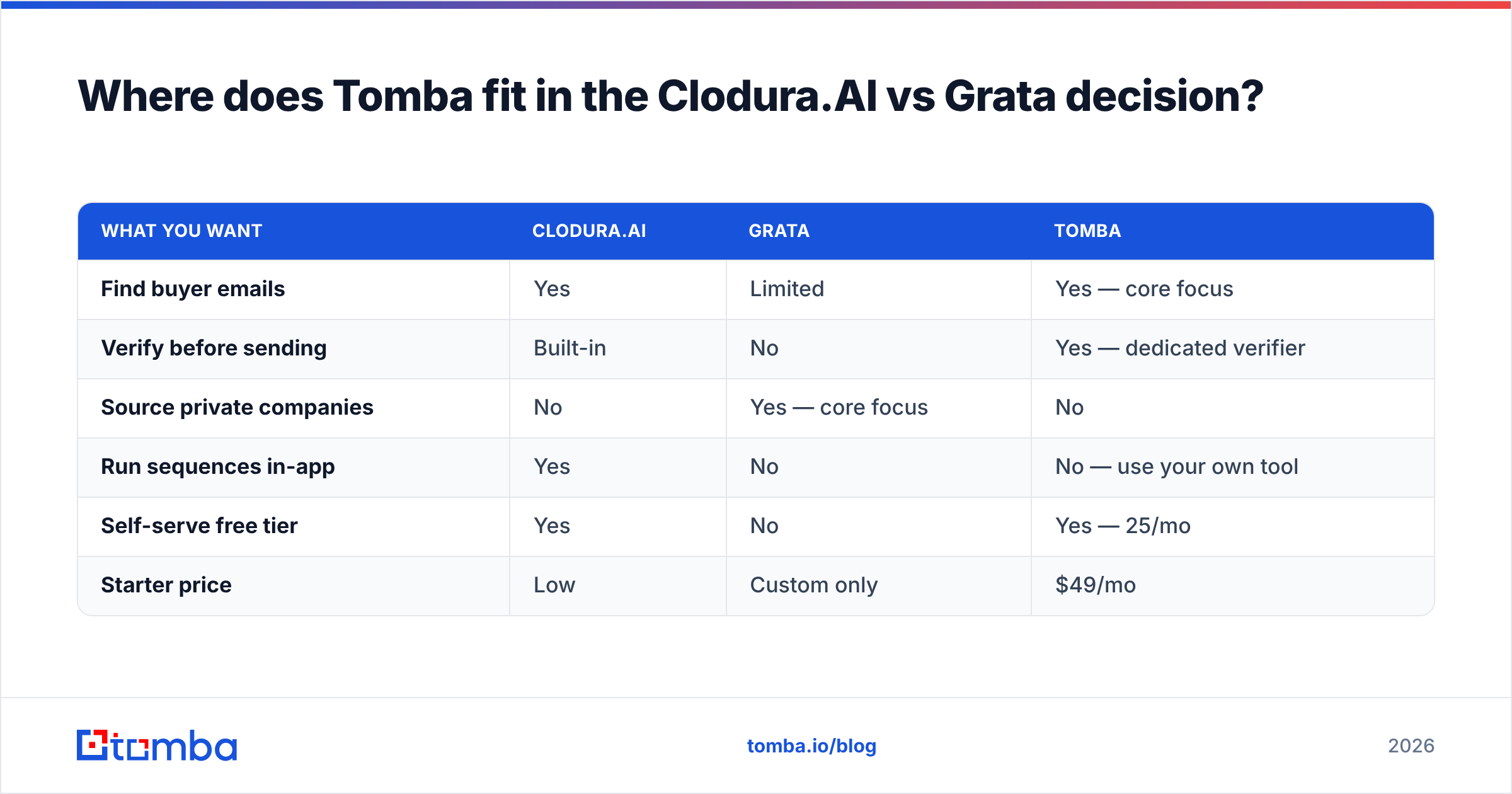
Where does Tomba fit in the Clodura.AI vs Grata decision?#
Tomba isn't a deal-sourcing tool — it won't replace Grata for an M&A thesis. But for the most common reason people compare these platforms, reaching decision-makers by email, Tomba does the core job more accurately and far more cheaply than a bundled suite.
Here's the practical split:
- You need acquisition or investment targets → Grata. Nothing on this list replaces it.
- You need a full outreach suite and accept mid-tier data → Clodura.AI.
- You need accurate emails and contact data to run outreach in tools you already own → Tomba.
Tomba focuses on one thing and ships several ways to do it. Use the email finder to find addresses by name and domain. Use domain search to pull every public email on a company. Use data enrichment to fill in records you already have. No mandatory engagement layer, no enterprise-only quote.
| What you want | Clodura.AI | Grata | Tomba |
|---|---|---|---|
| Find buyer emails | Yes | Limited | Yes — core focus |
| Verify before sending | Built-in | No | Yes — dedicated verifier |
| Source private companies | No | Yes — core focus | No |
| Run sequences in-app | Yes | No | No — use your own tool |
| Self-serve free tier | Yes | No | Yes — 25/mo |
| Starter price | Low | Custom only | $49/mo |
The point isn't that Tomba beats Grata at Grata's job — it doesn't compete there. It's that a lot of "cloduraai vs grata" shoppers don't need either heavyweight. They need clean, verified contact data and the freedom to plug it into whatever CRM or sequencer they already run.
Cloduraai vs Grata: which should you choose?#
Make the call on job-to-be-done, not feature lists:
- Choose Grata if you source companies to acquire or invest in, work in PE/M&A/corp dev, and need private-market coverage that public databases miss. The price is justified by the value of one good deal.
- Choose Clodura.AI if you're a small-to-mid revenue team that wants prospecting data plus sequences in one affordable login, and you're comfortable verifying emails before big sends.
- Choose a focused finder like Tomba if your real need is accurate contact data and emails — and you'd rather not pay all-in-one prices or get locked into a deal-sourcing platform you'll never fully use.
Most teams searching this comparison are quietly in that third bucket. They typed "cloduraai vs grata" because both came up in a roundup, not because they genuinely need deal-sourcing intelligence.
FAQ#
Is Clodura.AI a competitor to Grata? Not really. Clodura is a sales-prospecting and outreach platform. Grata is a deal-sourcing engine for private-company research. They share the words "B2B data" but serve different jobs and buyers.
Can I use Grata for cold email prospecting? It's not designed for it. Grata surfaces companies for dealmakers and isn't a cold-outreach tool. For prospecting emails, a finder plus verifier — or Clodura's built-in engagement — is the right category.
Which is cheaper, Clodura.AI or Grata? Clodura, by a wide margin. It's priced for sales teams with an accessible entry point. Grata is custom-quoted enterprise software for investment firms.
What if I just need accurate emails? Use a dedicated finder. Tomba's free tier gives you 25 searches a month, with paid plans from $49/mo — far below an all-in-one suite or a deal-sourcing platform.
The bottom line#
Clodura.AI and Grata aren't really rivals — they're answers to two different questions. Grata wins deal sourcing. Clodura wins affordable all-in-one prospecting. But if you're here because you need verified emails to reach the right people, you don't need to buy a platform sized for someone else's job.
Start with the Tomba Email Finder. Find professional email addresses by name, company, or domain. Verify them before you send, and keep your outreach landing in inboxes — without paying for features you'll never open. Spin up the free tier, run a few searches, and see how accurate "focused" really is.
// get started
Find, verify and enrich your first contacts today
Start on the free plan with 25 searches a month, then scale when your team is ready.
Free plan · No credit card required · GDPR & CCPA
// about the author