Cloduraai vs GrowMeOrganic 2026: Which B2B Tool Wins?
Clodura.AI vs GrowMeOrganic compared on data accuracy, sequencing, pricing, and fit. See which B2B prospecting platform earns your budget in 2026 — and where a dedicated email finder beats both.
Cloduraai vs GrowMeOrganic: The 2026 B2B Prospecting Showdown
Choosing between Clodura.AI and GrowMeOrganic comes down to one question: do you want a built-in B2B contact database with sales-intelligence signals, or a LinkedIn-first scraping and outreach engine? This guide breaks down both on data, deliverability, automation, and price — and shows where a focused email finder beats either at the part that actually matters: getting a valid address.
TL;DR — Which one should you pick?#
- Pick Clodura.AI if you want an all-in-one platform with its own B2B database, buyer-intent and technographic signals, and built-in email sequencing — and you sell to mid-market or enterprise accounts in North America.
- Pick GrowMeOrganic if your motion is LinkedIn-led, you want unlimited-style email extraction and drip campaigns at a flat price, and you serve SMB or agency clients on a tighter budget.
- Data accuracy is the real differentiator. Both bundle "free" credits, but bundled emails go stale fast. A dedicated email verifier is non-negotiable before you send.
- Neither is a pure email finder. If your bottleneck is finding and verifying addresses at scale, a specialist like Tomba will out-accuracy both platforms' bundled data.
- Budget reality: GrowMeOrganic wins on entry price; Clodura.AI wins on depth of intelligence. Match the tool to your deal size, not the other way around.
What is Clodura.AI?#
Clodura.AI is an all-in-one sales prospecting platform built around its own B2B contact database (it advertises 600M+ contacts and 18M+ companies). Beyond raw contacts, it leans into sales intelligence: buyer-intent signals, org charts, technographics, and direct-dial phone numbers. On top of the data, it ships an email-sequencing engine so reps can build cadences without leaving the tool.
In practice, Clodura positions itself as a lighter, cheaper alternative to ZoomInfo or Apollo for teams that want database + intent + outreach in one subscription. Its strength is breadth — you can go from "build a list of CTOs at SaaS companies using AWS" to "send a 4-step sequence" inside one login.
The tradeoff: because the database is broad and self-reported in places, accuracy varies by region and seniority. North American director-and-above data tends to be solid; long-tail SMB and non-US records degrade faster. That's why even Clodura users layer a verification step before campaigns go out.
What is GrowMeOrganic?#
GrowMeOrganic is a LinkedIn-first prospecting and outreach suite. Its core appeal is extraction: pull leads and emails from LinkedIn, Sales Navigator, Google Maps, and other sources, then run drip email campaigns — typically marketed with "unlimited" usage framing at a flat monthly rate.
Where Clodura starts from a database, GrowMeOrganic starts from a Chrome extension and a workflow. You browse, you scrape, you enrich, you sequence. That makes it a favorite among founders, agencies, and SMB sales teams who live inside LinkedIn and want predictable pricing rather than per-credit metering.
The catch is the same one every scraper faces: emails extracted or guessed from profiles are pattern-derived, not verified at the SMTP layer. Volume is high; confidence is not. Run those lists through a bulk email finder and verifier and a meaningful slice will be catch-all or invalid.
Cloduraai vs GrowMeOrganic: side-by-side comparison#
Here's the head-to-head on the attributes that decide most purchases.
| Attribute | Clodura.AI | GrowMeOrganic |
|---|---|---|
| Core model | Built-in B2B database + intelligence | LinkedIn/Maps scraping + outreach |
| Contact coverage | 600M+ contacts, 18M+ companies | Sourced live from LinkedIn/Sales Nav |
| Buyer-intent signals | Yes (intent + technographics) | No (extraction-focused) |
| Direct-dial phones | Yes | Limited |
| Email sequencing | Built-in | Built-in (drip campaigns) |
| Pricing model | Tiered, per-seat/credit | Flat-rate, "unlimited"-style |
| Best-fit team | Mid-market & enterprise, US-heavy | SMB, agencies, founders |
| Free option | Free tier with limited credits | Free trial |
| Verification | Basic, recommend external | Basic, recommend external |
The pattern is clear: Clodura is a depth play, GrowMeOrganic is a volume-and-price play. Neither is wrong — they're built for different buyers.
)
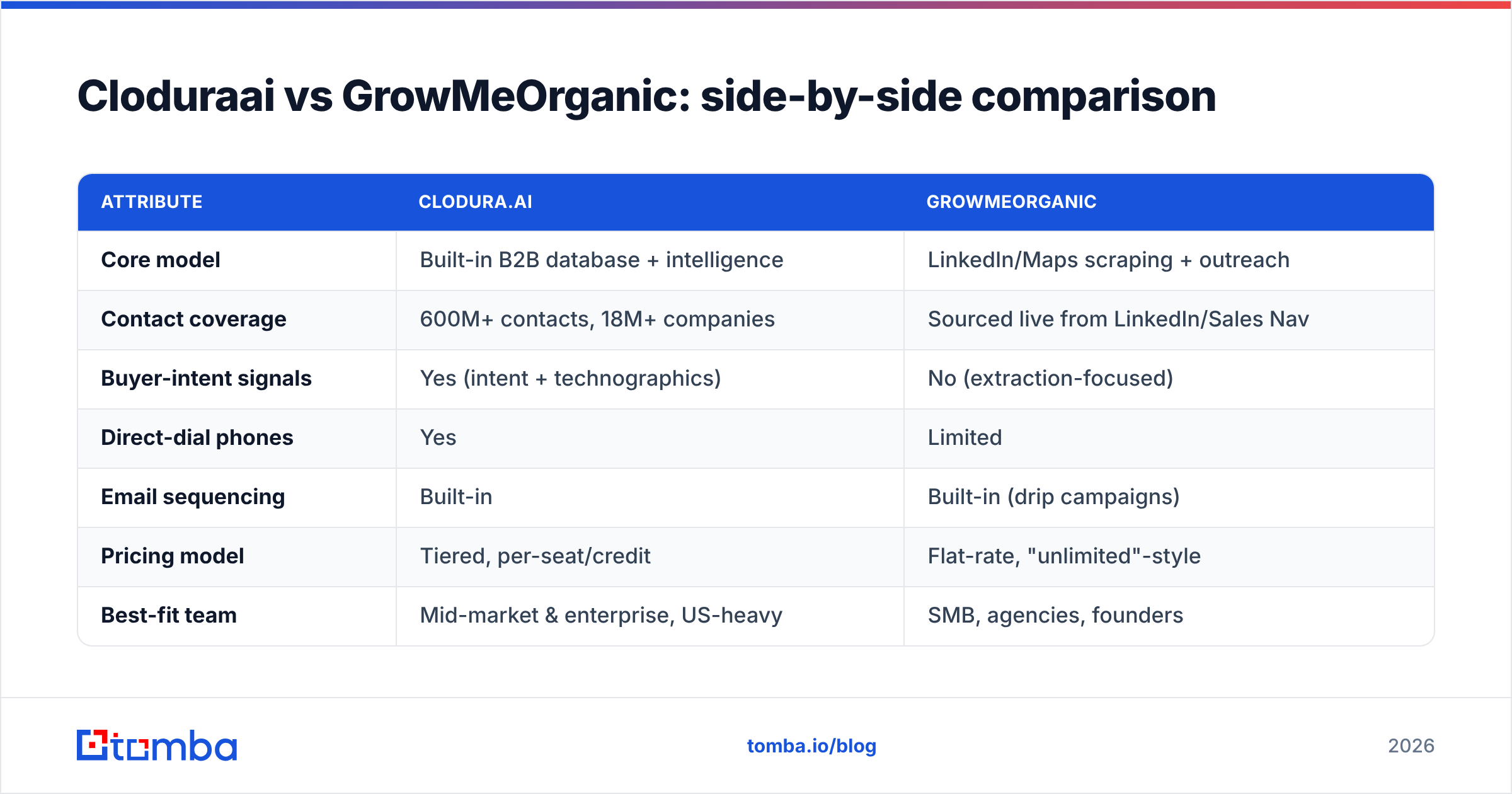
Is Clodura.AI better than GrowMeOrganic for data accuracy?#
For verified, intent-rich data on North American mid-market and enterprise accounts, Clodura.AI is generally the stronger source. Its database is maintained and enriched centrally, and the intent layer helps you prioritize accounts that are actually in-market — something GrowMeOrganic simply doesn't offer.
But "better database" doesn't mean "send without checking." Here's how accuracy actually breaks down across both tools:
- Senior US contacts — Clodura tends to lead; centralized maintenance keeps director+ records fresher.
- SMB and long-tail — Both degrade; self-reported and scraped data ages within months.
- Non-US regions — Coverage thins for both; EMEA and APAC records are spottier.
- LinkedIn-sourced emails — GrowMeOrganic's strength in reach is also its risk: pattern-guessed addresses need SMTP confirmation.
- Catch-all domains — Neither reliably tells you whether a catch-all inbox will actually accept mail; use a dedicated catch-all verifier.
The practical rule: whichever platform you choose, treat its emails as candidates, not confirmations. Bounce rates above 3–5% put your domain reputation at risk, and Google and Microsoft punish senders fast. This is exactly why a verification step belongs in every workflow — see how email deliverability hinges on list hygiene.
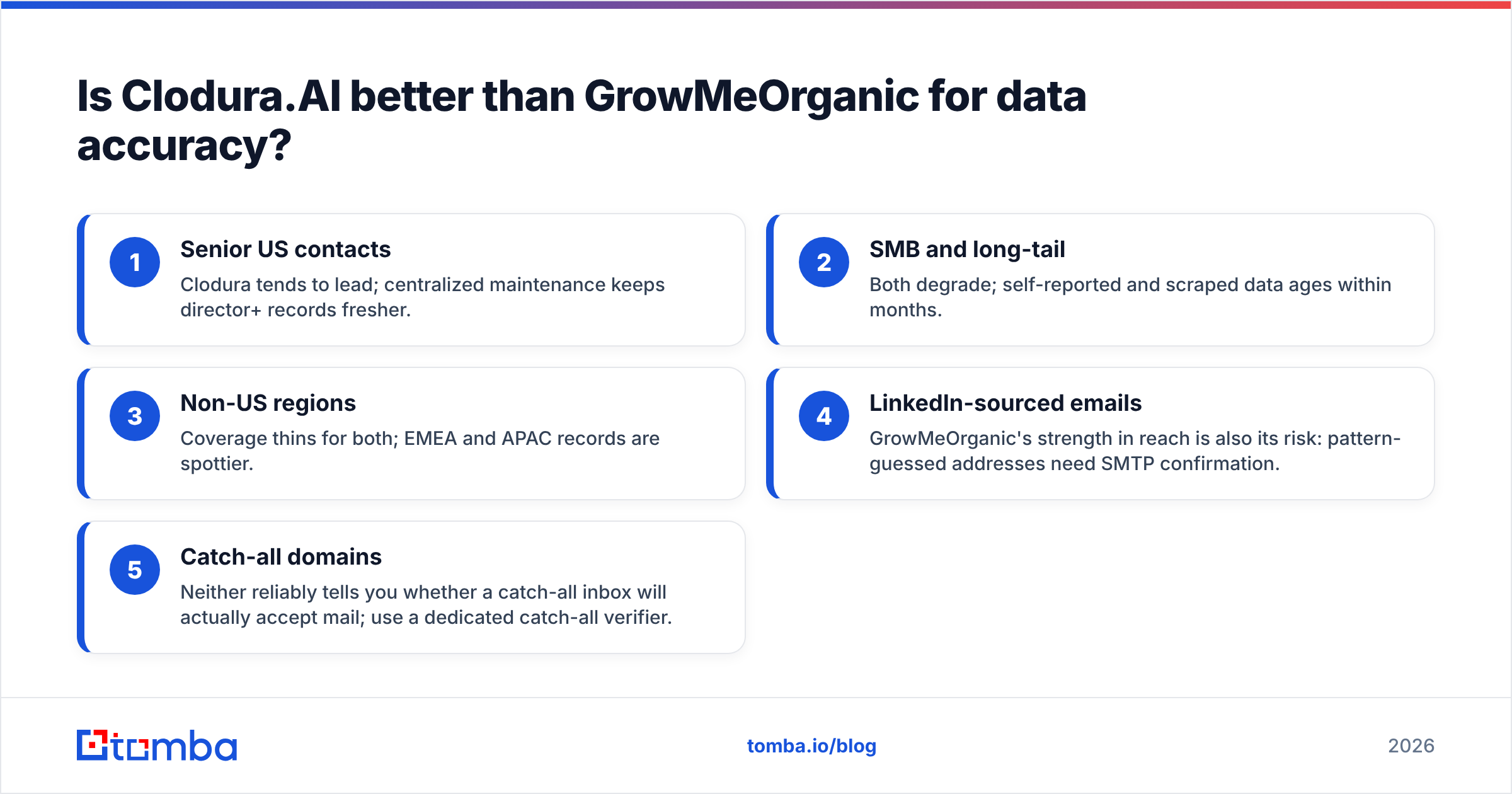
How do Clodura.AI and GrowMeOrganic compare on outreach and automation?#
Both ship email sequencing, but they think about it differently.
Clodura.AI treats sequencing as the last mile of an intelligence workflow: you build a list informed by intent, then trigger a cadence. It's tidy for reps who want one tool, though power users often find the sequencer less flexible than dedicated platforms like Outreach or Salesloft.
GrowMeOrganic treats outreach as the product. Drip campaigns, LinkedIn-adjacent workflows, and flat-rate sending make it attractive for high-volume founders and agencies running many small campaigns. The risk is that "unlimited send" plus "unverified scrape" is a recipe for deliverability damage if you skip hygiene.
| Outreach factor | Clodura.AI | GrowMeOrganic |
|---|---|---|
| Sequencing depth | Moderate | Moderate, volume-friendly |
| LinkedIn workflow | Light | Strong |
| Sending limits | Plan-based | Flat/"unlimited" framing |
| Deliverability tooling | Basic | Basic |
| Best for | Targeted, intent-led cadences | High-volume drip campaigns |
If outreach is your core need and you want best-in-class control, you may end up pairing either tool with a specialist sender. Compare dedicated options on our Instantly alternative and Reply.io alternative breakdowns.
What about pricing — which is cheaper in 2026?#
GrowMeOrganic usually wins on raw entry price thanks to its flat-rate, unlimited-style plans, which appeal to budget-conscious SMBs and agencies. Clodura.AI costs more but bundles intelligence (intent, technographics, direct dials) that flat-rate scrapers don't include — so "cheaper" depends entirely on whether you need those signals.
A few buying notes for 2026:
- Watch the credit math. Both advertise generous allowances; real costs show up when you bulk-export and a chunk of records bounce. You pay twice — once for the credit, once for the reputation hit.
- Factor in verification. Neither platform's bundled verification replaces a dedicated checker. Budget for it.
- Match price to deal size. If your ACV is $20k+, Clodura's intelligence pays for itself. If you're running $500 agency retainers, GrowMeOrganic's flat price fits better.
Always confirm current numbers on the vendors' own pages — clodura.ai and growmeorganic.com — and cross-check user-reported pricing on G2 before committing.
)
Where do both tools fall short — and what fills the gap?#
Both Clodura.AI and GrowMeOrganic are platforms: they try to do database, enrichment, and outreach in one box. The cost of that breadth is that no single piece is best-in-class — and the email-finding piece is usually the weakest link, because bundled data ages and scraped guesses go unverified.
If your actual bottleneck is "I need the right email address, confirmed valid, at scale," a focused specialist beats either platform. That's the gap Tomba fills:
- Higher first-pass accuracy — the email finder resolves addresses by name, domain, or company, with a confidence score on every result.
- Real verification — SMTP-level checks, catch-all handling, and a reverse email lookup for enrichment.
- Workflow-friendly — a Tomba API, Chrome extension, Sheets add-on, and HubSpot/Salesforce integrations so verification slots into the stack you already run.
- Honest, transparent Tomba pricing — a free tier with 25 searches/month, then Starter at $49/mo, Growth at $99/mo, and Pro at $249/mo.
The smart pattern in 2026 isn't "one tool to rule them all." It's: use Clodura.AI or GrowMeOrganic for discovery and signals, then run every list through a dedicated finder and verifier before a single email leaves your domain.
Cloduraai vs GrowMeOrganic: which should you choose?#
Here's the decision in one line: Clodura.AI for intelligence-led, mid-market US selling; GrowMeOrganic for LinkedIn-led, budget-conscious SMB volume. Both need a verification layer bolted on.
| Your situation | Best pick |
|---|---|
| Enterprise/mid-market, US-heavy, need intent | Clodura.AI |
| LinkedIn-first, SMB/agency, flat budget | GrowMeOrganic |
| Highest email accuracy at scale | Add Tomba on top |
| Need direct dials + technographics | Clodura.AI |
| Running many high-volume drip campaigns | GrowMeOrganic |
Neither platform is a bad choice for its intended buyer. The mistake is assuming the bundled email data is campaign-ready — it isn't, for either one.
The bottom line#
Clodura.AI and GrowMeOrganic solve different problems. Clodura is a sales-intelligence platform that happens to do outreach; GrowMeOrganic is an outreach engine that happens to scrape data. Pick based on deal size, region, and whether buyer-intent signals move your number.
But whichever you choose, protect your sender reputation: discovery is only half the job, and unverified lists quietly kill deliverability. Run every address through Tomba's Email Finder and verifier before you press send — start free with 25 searches a month, scale to a paid plan when your pipeline does, and stop paying twice for emails that bounce. That's the cheapest performance upgrade your outbound will get this year.
// get started
Find, verify and enrich your first contacts today
Start on the free plan with 25 searches a month, then scale when your team is ready.
Free plan · No credit card required · GDPR & CCPA
// about the author