Clodura.ai vs HitHorizons 2026: B2B Data Tools Compared
Clodura.ai vs HitHorizons in 2026: prospecting engine or European company database? Compare data coverage, pricing, contact accuracy, and the best-fit use case before you commit.
TL;DR
Choosing between Clodura.ai vs HitHorizons comes down to one question: do you need contacts to email, or company records to study? Here is the short answer.
- Clodura.ai is an all-in-one outbound prospecting platform. It bundles a contact database, email sequencing, and intent signals. It is built for sales teams that want to find and email leads in one place.
- HitHorizons is a company-data database. It is strongest on European firmographics because it draws on official business registries. It is not a contact-email engine or a sequencing tool.
- In the Clodura.ai vs HitHorizons matchup, they are not true rivals. Pick Clodura.ai if you need contacts plus outreach. Pick HitHorizons if you need verified company records, especially across the EU.
- Both rely on database matches, so contact-email accuracy drops on long-tail domains. Pairing either one with a real-time verification layer fixes most bounce problems.
- If your bottleneck is simply getting accurate, deliverable email addresses, a dedicated finder-and-verifier like Tomba is cheaper and more accurate than a full platform you'll half-use.
What are Clodura.ai and HitHorizons?#
The short version: Clodura.ai sells you prospects to email. HitHorizons sells you company intelligence. Both get called "B2B data" tools, so people lump them together. But they solve different jobs.
Clodura.ai is a sales-intelligence and engagement platform. It bundles a contact database, direct-dial phone numbers, buyer-intent signals, an email sequencer, and a basic CRM layer. The company advertises hundreds of millions of B2B contacts. The pitch is simple: prospect to pipeline without leaving the tool. It targets SDRs and small sales teams who want one subscription instead of three.
HitHorizons is a company-data provider. Its core asset is a large database of company records. The records come from official registries and other public filings. Coverage is strongest in Europe, where registry data is rich and standardized. You use it to look up firmographics — legal name, registration number, industry code, revenue band, employee count, and corporate hierarchy. You can also enrich or screen company lists through its UI or API. It is a company database first. People-level contact data is not its focus.
That distinction drives everything below. One tool is built to launch outreach. The other is built to understand companies.
Clodura.ai vs HitHorizons: how do they compare at a glance?#
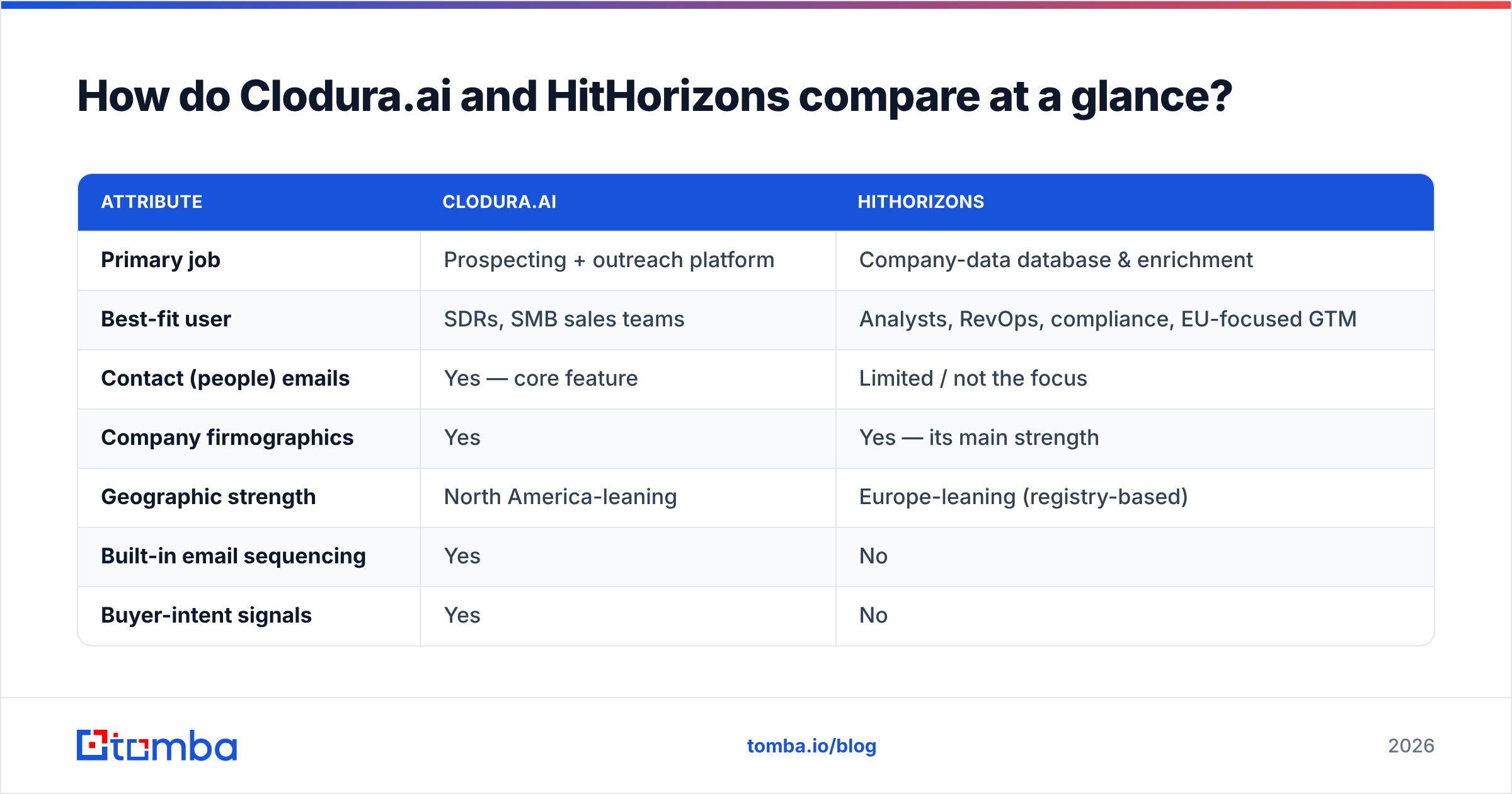
| Attribute | Clodura.ai | HitHorizons |
|---|---|---|
| Primary job | Prospecting + outreach platform | Company-data database & enrichment |
| Best-fit user | SDRs, SMB sales teams | Analysts, RevOps, compliance, EU-focused GTM |
| Contact (people) emails | Yes — core feature | Limited / not the focus |
| Company firmographics | Yes | Yes — its main strength |
| Geographic strength | North America-leaning | Europe-leaning (registry-based) |
| Built-in email sequencing | Yes | No |
| Buyer-intent signals | Yes | No |
| API access | Yes (higher tiers) | Yes |
| Free option | Limited free/trial | Limited lookup tier |
| Typical pricing model | Per-seat SaaS, annual-leaning | Credit/subscription for data access |
Use this as a sorting hat, not a scoreboard. A high row count doesn't mean a tool wins. It means the tools are aimed at different buyers. Try to run an EU due-diligence workflow inside Clodura.ai, and you'll fight the product. Try to run a 5,000-prospect cold-email campaign out of HitHorizons, and you'll fight it just as hard.

Which one has better data coverage and accuracy?#
In the Clodura.ai vs HitHorizons coverage debate, it depends on whether you mean companies or people.
For company records, HitHorizons has a real edge in Europe. It leans on official business registries, so its firmographics tend to be clean and authoritative for EU markets. That includes registration numbers, legal entity status, and official industry codes. Building account lists for German, French, or Nordic territories? Screening vendors for compliance? That registry lineage matters. You can read how registry-based providers position themselves on the HitHorizons site.
For people and their emails, Clodura.ai is the more complete of the two. The reason is simple: contact data is part of its product and barely part of HitHorizons'. Clodura advertises large contact volumes and direct dials. That is what an SDR needs to start a sequence. See how the platform frames its database on the Clodura.ai homepage.
Here's the catch that applies to both. Database-sourced contact emails are snapshots. People change jobs. Companies rename mailboxes. Catch-all domains hide whether an address even exists. Independent reviews on G2 routinely flag bounce rates and stale records as the top complaint across this whole category — not just for these two vendors. A platform that says it has 300 million contacts is telling you about its ceiling, not your campaign's deliverability.
That's why the smart workflow is simple. Treat any platform's contact export as a candidate list. Then run it through a dedicated email verifier before you send. Verification is where bounce rates actually get fixed, and it's the cheapest insurance in your stack.
How does pricing compare?#
Pricing is where the Clodura.ai vs HitHorizons comparison gets murky. Neither vendor publishes simple, fully transparent self-serve pricing, so treat any number as "request a quote" territory. The shapes of the pricing, however, differ.
- Clodura.ai is per-seat SaaS. You buy access for each rep. Better rates usually need an annual commitment, and credits or export caps are tiered by plan. Because it bundles database, sequencing, and intent, the per-seat number looks higher than a point tool. You pay for the suite whether or not every rep uses every module.
- HitHorizons is closer to a data-access model. You pay a subscription and/or credits for company lookups and enrichment, plus API pricing for programmatic pulls. You're paying for data volume and API calls, not seats running campaigns.
The practical budgeting question is utilization. Suite tools like Clodura.ai only pay off if your team genuinely uses the sequencer and intent data. Already running outreach in Instantly, Salesloft, or HubSpot? Then you're paying twice for overlapping features. And if all you needed was deliverable email addresses, both options are an expensive way to get them.
For comparison, a focused finder-plus-verifier is built around exactly that need. Tomba pricing starts with a free tier (25 searches/month). Paid plans run Starter at $49/mo, Growth at $99/mo, and Pro at $249/mo. You pay for accurate contacts and verification, not seats and modules you'll ignore.
When should you choose Clodura.ai?#
Choose Clodura.ai when your bottleneck is the whole outbound motion, not just data. Concretely:
- You're an SMB sales team that wants one tool. You don't have a RevOps function wiring together five vendors. A single login that finds contacts, sequences them, and tracks replies is worth the premium.
- You sell mainly into North America. Clodura's contact coverage skews to where its data is densest. Its intent signals are most useful in large, well-tracked markets.
- You want buyer-intent baked in. Maybe acting on "this account is researching your category" is part of your play. That signal lives inside Clodura, not in a pure company database.
- Your reps live in the sequencer. The value of a suite is the workflow, not the row count. If reps will actually use the built-in cadences, the bundling pays off.
Where it disappoints: deep European firmographics, registry-grade company records, and any hope that bundled contact emails are inbox-ready without verification.
When should you choose HitHorizons?#
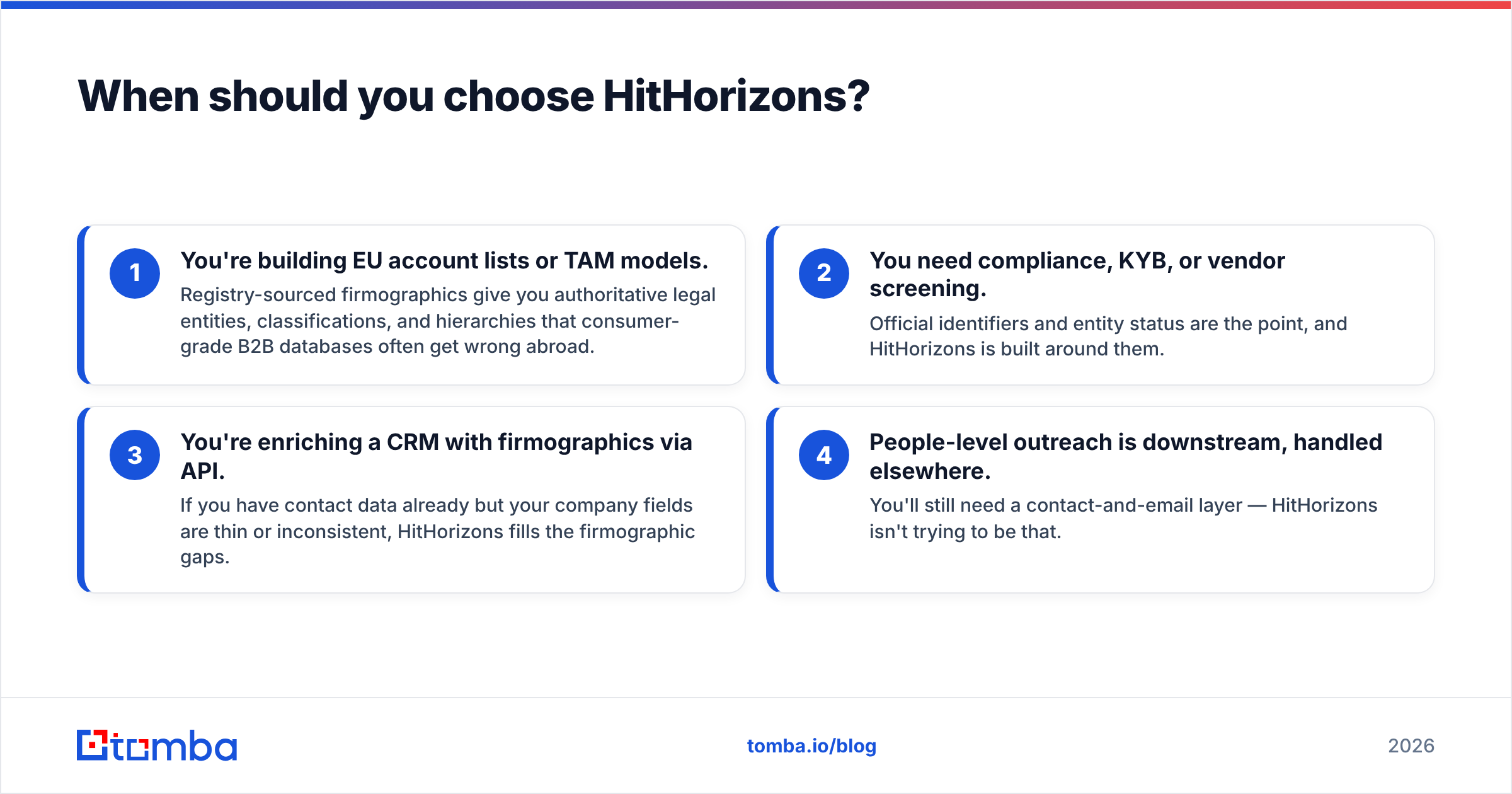
Choose HitHorizons when the company is the unit of work and Europe is in scope:
- You're building EU account lists or TAM models. Registry-sourced firmographics give you authoritative legal entities, classifications, and hierarchies. Consumer-grade B2B databases often get these wrong abroad.
- You need compliance, KYB, or vendor screening. Official identifiers and entity status are the point, and HitHorizons is built around them.
- You're enriching a CRM with firmographics via API. Maybe you have contact data already, but your company fields are thin. HitHorizons fills those firmographic gaps.
- People-level outreach happens elsewhere. You'll still need a contact-and-email layer. HitHorizons isn't trying to be that.
Where it disappoints: anyone expecting a turnkey prospecting tool. There's no sequencer, no intent feed, and contact emails are not the strength. It's an input to your GTM stack, not the cockpit.
What's the gap both tools leave open?#
Deliverable, person-level email addresses on demand — and verification you can trust.
Clodura gives you contacts, but ships them as database snapshots that go stale and bounce. HitHorizons gives you excellent company data, but doesn't center on the individual's working email at all. In both cases, the moment you email a specific human at a specific domain, you're back to the oldest problem in outbound: is this address real, and will it land?
This is the slot a dedicated email-data tool fills. A purpose-built email finder turns a name and a company domain into the most likely address. Then it confirms that address against the mail server in real time, instead of returning a months-old database row. For account-based work, domain search pulls every discoverable address pattern at a company. You stop guessing whether it's first.last@ or finitial@. And when you've bought a list from any platform, bulk verification before import protects your sender reputation.
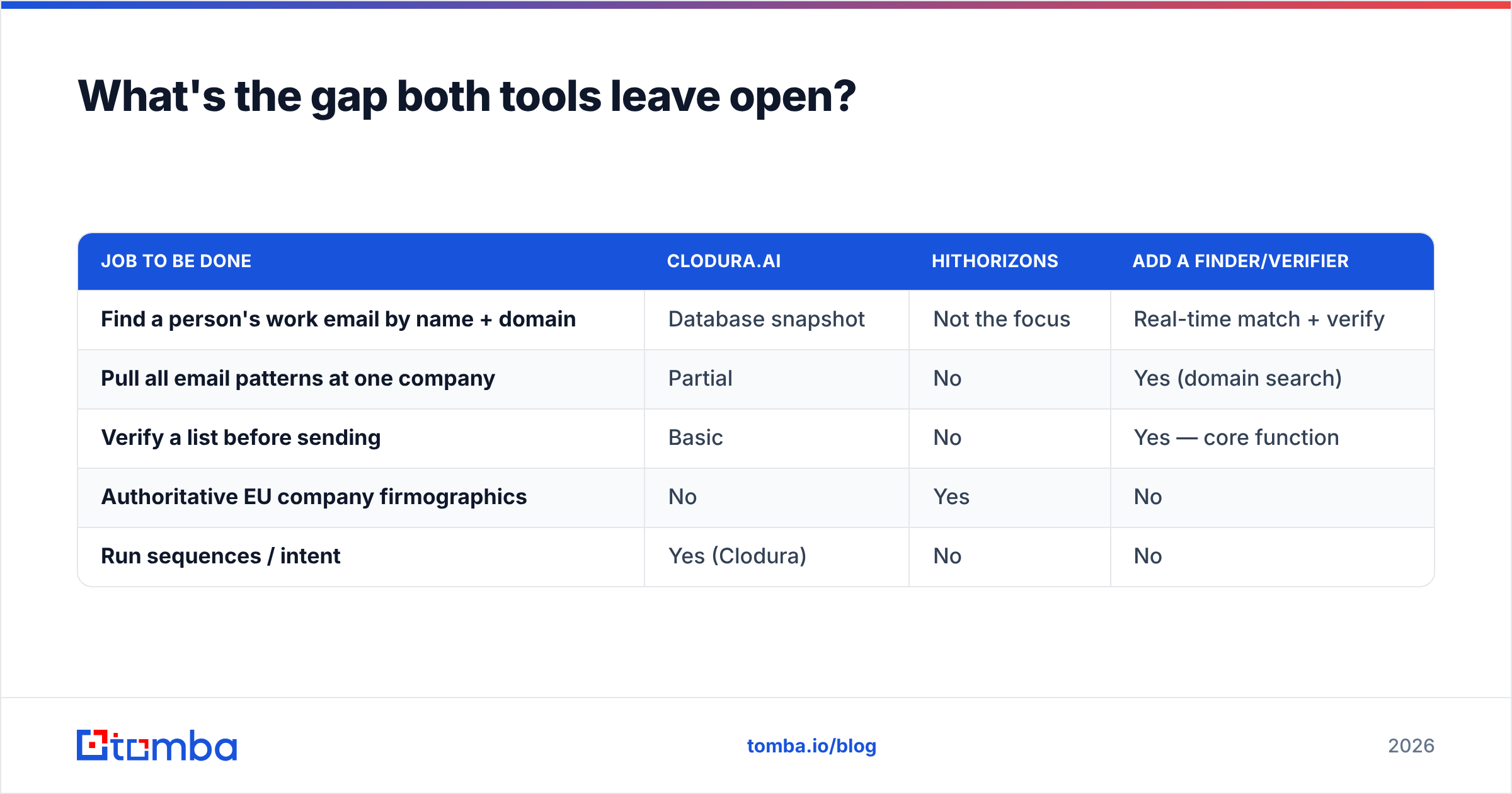
Here's how the roles divide cleanly:
| Job to be done | Clodura.ai | HitHorizons | Add a finder/verifier |
|---|---|---|---|
| Find a person's work email by name + domain | Database snapshot | Not the focus | Real-time match + verify |
| Pull all email patterns at one company | Partial | No | Yes (domain search) |
| Verify a list before sending | Basic | No | Yes — core function |
| Authoritative EU company firmographics | No | Yes | No |
| Run sequences / intent | Yes (Clodura) | No | No |
The takeaway isn't "replace your platform." A thin, accurate finder-and-verifier layer makes whatever platform you choose perform better. It fixes the one metric — deliverability — that database vendors structurally can't guarantee.
Can you combine these tools instead of choosing?#
Yes, and for many teams that's the right answer. You don't have to settle the Clodura.ai vs HitHorizons debate at all. A realistic 2026 stack looks like this:
- HitHorizons for company truth — building and screening EU-heavy account lists with registry-grade firmographics.
- Clodura.ai (or your existing outreach tool) for sequencing and intent once accounts are chosen.
- Tomba as the contact-and-verification layer. It turns "this account looks good" into "here is the VP's verified, deliverable email" — via the Tomba Email Finder, bulk verification, and a clean B2B database you can query by domain.
That separation of concerns beats over-buying a single suite that's mediocre at the parts you don't need. You pay for company data where it's authoritative, outreach where your reps work, and contact accuracy where bounces are decided.
Frequently asked questions#
Is Clodura.ai a direct competitor to HitHorizons? Not really. Clodura.ai is a prospecting and outreach platform with contact data. HitHorizons is a company-data database, strongest in Europe. They overlap on firmographics but serve different buyers.
In the Clodura.ai vs HitHorizons matchup, which is more accurate for emails? Clodura.ai, by default, because contact emails are part of its product while HitHorizons focuses on company records. But both serve database snapshots, so real-time verification still matters before you send.
Which is better for European data? HitHorizons, thanks to its registry-based company records across EU markets. Clodura.ai leans toward North American coverage.
Do I still need an email verifier if I use either tool? Yes. Stale and catch-all addresses are the main reason cold campaigns bounce. A dedicated verifier protects your sender reputation no matter where the list came from.
The bottom line#
Clodura.ai vs HitHorizons isn't a head-to-head — it's a fork in your workflow. Want an all-in-one engine to find and email North American prospects? Choose Clodura.ai. Need authoritative, registry-grade company data for European GTM, compliance, or enrichment? Choose HitHorizons. Either way, neither one guarantees that the email you send today actually lands.
That's the gap to close first. Maybe your real goal is accurate, deliverable contacts without paying for a suite you'll half-use. If so, start with the Tomba Email Finder: find emails by name or domain, verify them in real time, and enrich them with contact enrichment — on a free tier that lets you test accuracy before you spend a dollar. Build the platform decision on top of clean data, not the other way around.
// get started
Find, verify and enrich your first contacts today
Start on the free plan with 25 searches a month, then scale when your team is ready.
Free plan · No credit card required · GDPR & CCPA
// about the author