Cloduraai vs Infofree 2026: Which B2B Lead Data Tool Wins?
Clodura.ai and Infofree both promise B2B leads, but they target very different buyers. Here is an honest 2026 breakdown of data, pricing, and accuracy.
Cloduraai vs Infofree: The 2026 B2B Lead Data Showdown
You are choosing between Clodura.ai and Infofree because you need pipeline, not another tool that fills a CRM with bounced emails. Both sell the same promise: more qualified leads, faster. They go about it in almost opposite ways.
TL;DR
- Clodura.ai is a modern sales-intelligence platform built for outbound teams: a 600M+ contact database, buyer intent signals, technographics, and a built-in sequencer.
- Infofree is a low-cost, US-focused list and mailing-database service aimed at small businesses, insurance agents, and local sales reps who want cheap lists and a simple CRM.
- Accuracy is the real differentiator. Both databases decay; neither verifies emails in real time the way a dedicated tool does.
- Pricing splits the audience: Infofree wins on raw monthly cost; Clodura.ai wins on data depth and automation.
- Best move for cold outreach: pull leads from either, then verify and enrich every address with a real-time tool before you send.
What is Clodura.ai?#
Clodura.ai is a B2B sales-prospecting and intelligence platform. Think of it as a research analyst who never sleeps: it maps companies, finds decision-makers, flags who is showing buying intent, and hands you a sequence to reach them.
The platform leans on a self-reported database of roughly 600 million contacts and 18 million companies, plus org charts, direct dials, technographic data (what software a company runs), and intent signals. There is a native email sequencer, so some teams run their whole top-of-funnel inside it.
Clodura.ai targets SDR teams, agencies, and mid-market sales orgs that run structured outbound and care about why now signals, not just a name and an email.
What is Infofree?#
Infofree is a sales-leads and mailing-list service built for small businesses and individual reps. It is the spiritual descendant of the old printed business-directory model, brought online with a flat monthly subscription.
You get access to a US-centric database of businesses and consumers, unlimited list downloads on most plans, a basic CRM (Free CRM), and email/mailing tools. The pitch is volume at a predictable price: insurance agents, realtors, and local B2B reps who want to pull a list of "all dentists in Ohio" and start dialing.
Infofree does not really play in the intent-data or technographic space. It is a database-and-dialer product, and it prices itself accordingly.
Cloduraai vs Infofree: How do they compare at a glance?#
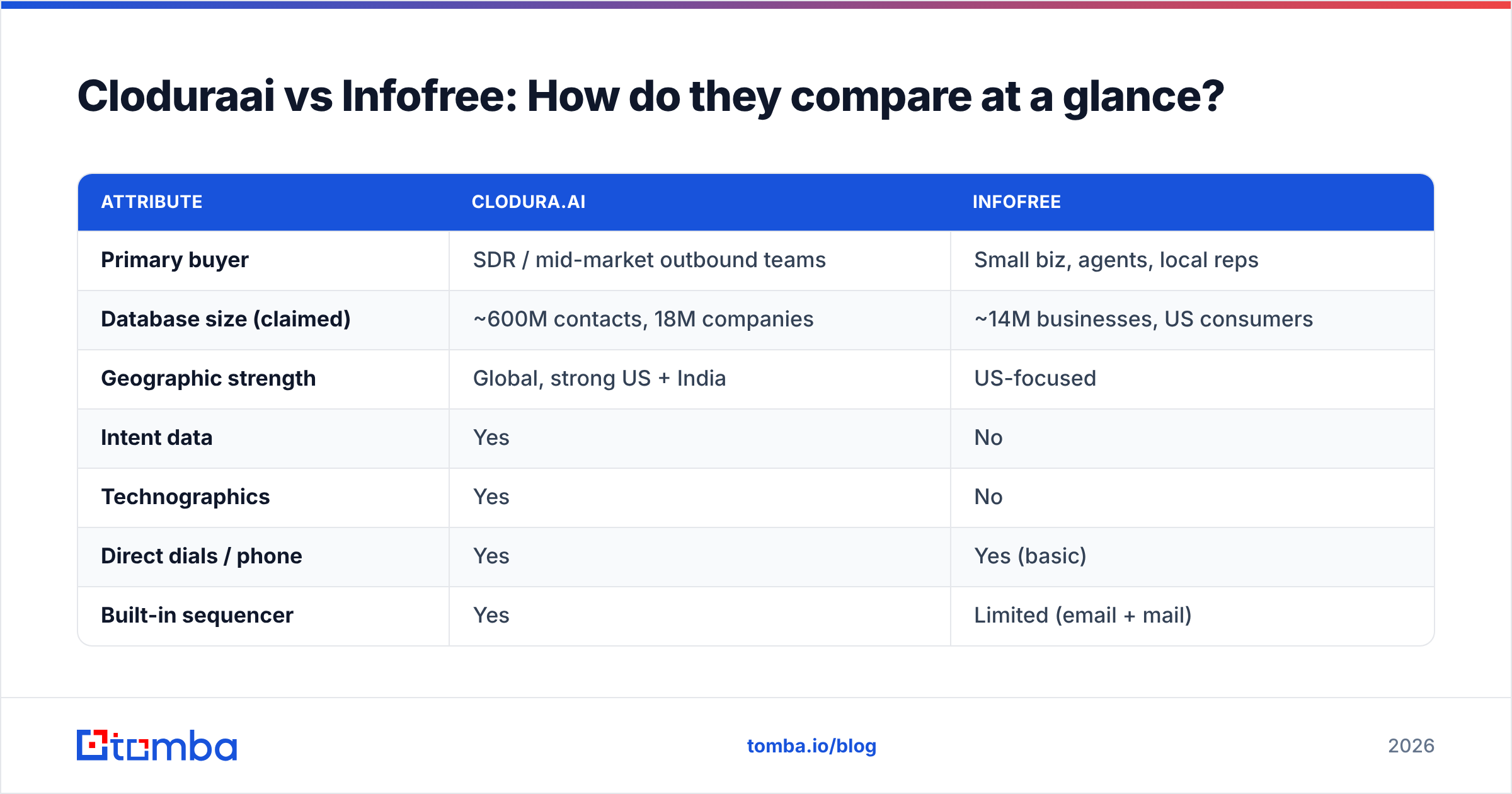
Here is the honest side-by-side. Numbers reflect publicly listed positioning as of 2026; always confirm current tiers on each vendor's site before buying.
| Attribute | Clodura.ai | Infofree |
|---|---|---|
| Primary buyer | SDR / mid-market outbound teams | Small biz, agents, local reps |
| Database size (claimed) | ~600M contacts, 18M companies | ~14M businesses, US consumers |
| Geographic strength | Global, strong US + India | US-focused |
| Intent data | Yes | No |
| Technographics | Yes | No |
| Direct dials / phone | Yes | Yes (basic) |
| Built-in sequencer | Yes | Limited (email + mail) |
| CRM | Light, integrations | Free CRM included |
| Entry price | Free tier, then ~$33–$50+/user/mo | ~$50/mo flat-ish tiers |
| Best for | Signal-driven outbound | Cheap bulk lists |
The pattern is clear: Clodura.ai is the heavier, signal-rich platform; Infofree is the lean, cheap list machine.
Is Clodura.ai better than Infofree for outbound?#
For modern, multi-touch outbound, Clodura.ai is the stronger fit. The reason is structure, not just size.
Consider how a real outbound play works. You are not blasting one email to a static list. You are sequencing five to nine touches across email, phone, and LinkedIn, and you want to prioritize accounts that are actually in-market. Clodura.ai's intent signals and technographics let you build a segment like "companies hiring SDRs that use Salesforce and visited a competitor's pricing page." Infofree cannot do that. It can give you "companies in SIC code X within 50 miles," which is useful for a different motion entirely.
Where Infofree wins is simplicity and cost for high-volume, low-complexity work. If you sell life insurance and you need 2,000 local small-business owners to call this month, Infofree's flat pricing and unlimited downloads are hard to beat on a per-lead basis.
Both approaches share one weakness, which we will get to: the data goes stale, and neither tool verifies an email at the moment you hit send.
How accurate is the data in Cloduraai vs Infofree?#
This is the question that actually decides your bounce rate, and the uncomfortable answer is: trust, but verify — every time.
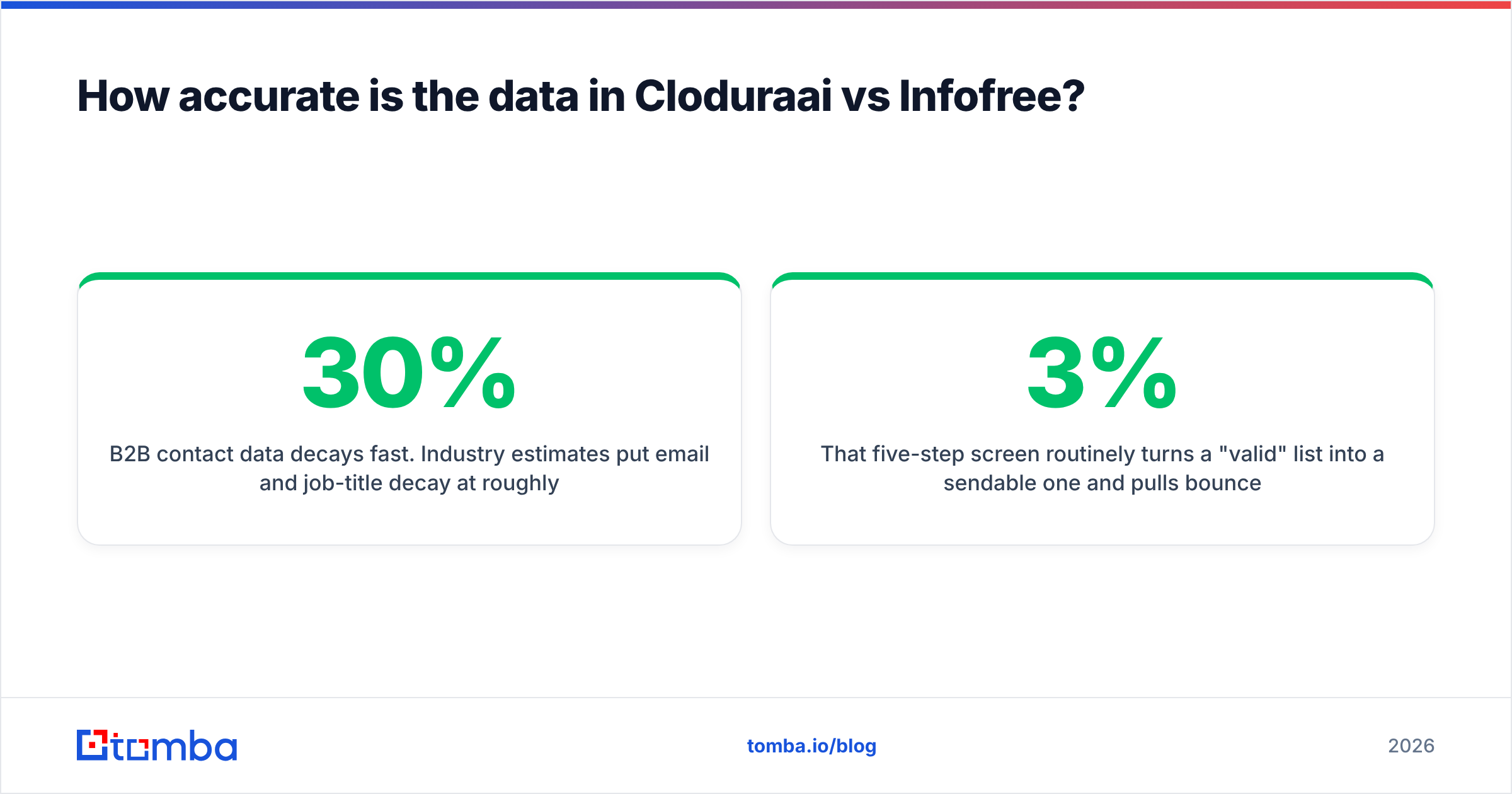
B2B contact data decays fast. Industry estimates put email and job-title decay at roughly 22–30% per year because people change jobs, companies rebrand, and domains get retired. A 600-million-record database does not escape this; it amplifies it. A list that was 95% accurate at collection can be 70% accurate eighteen months later.
Clodura.ai does run validation on its records and exposes confidence indicators, which helps. Infofree's lists, being broader and cheaper, tend to carry more risk on the email side — they were historically strong on postal and phone data, weaker on deliverable business email.
Here is the practical workflow that protects your sender reputation regardless of which platform you pick:
- Pull the raw list from Clodura.ai or Infofree.
- Verify every email with a real-time email verifier before import — this catches dead mailboxes the source database missed.
- Re-find missing or risky contacts with a dedicated email finder so gaps don't kill a sequence.
- Screen catch-all domains using a catch-all verifier, since those inflate "valid" counts without being deliverable.
- Enrich the survivors with phone, title, and firmographic fields before they ever reach a rep.
That five-step screen routinely turns a "valid" list into a sendable one and pulls bounce rates under the 2–3% threshold that mailbox providers tolerate. Skipping it is the single most common reason cold campaigns get throttled.
For the deeper mechanics of why bounces tank your inbox placement, the email deliverability glossary entry is a solid primer, and tools like G2 let you cross-check how real customers rate each platform's data quality.
What does Cloduraai vs Infofree pricing look like?#
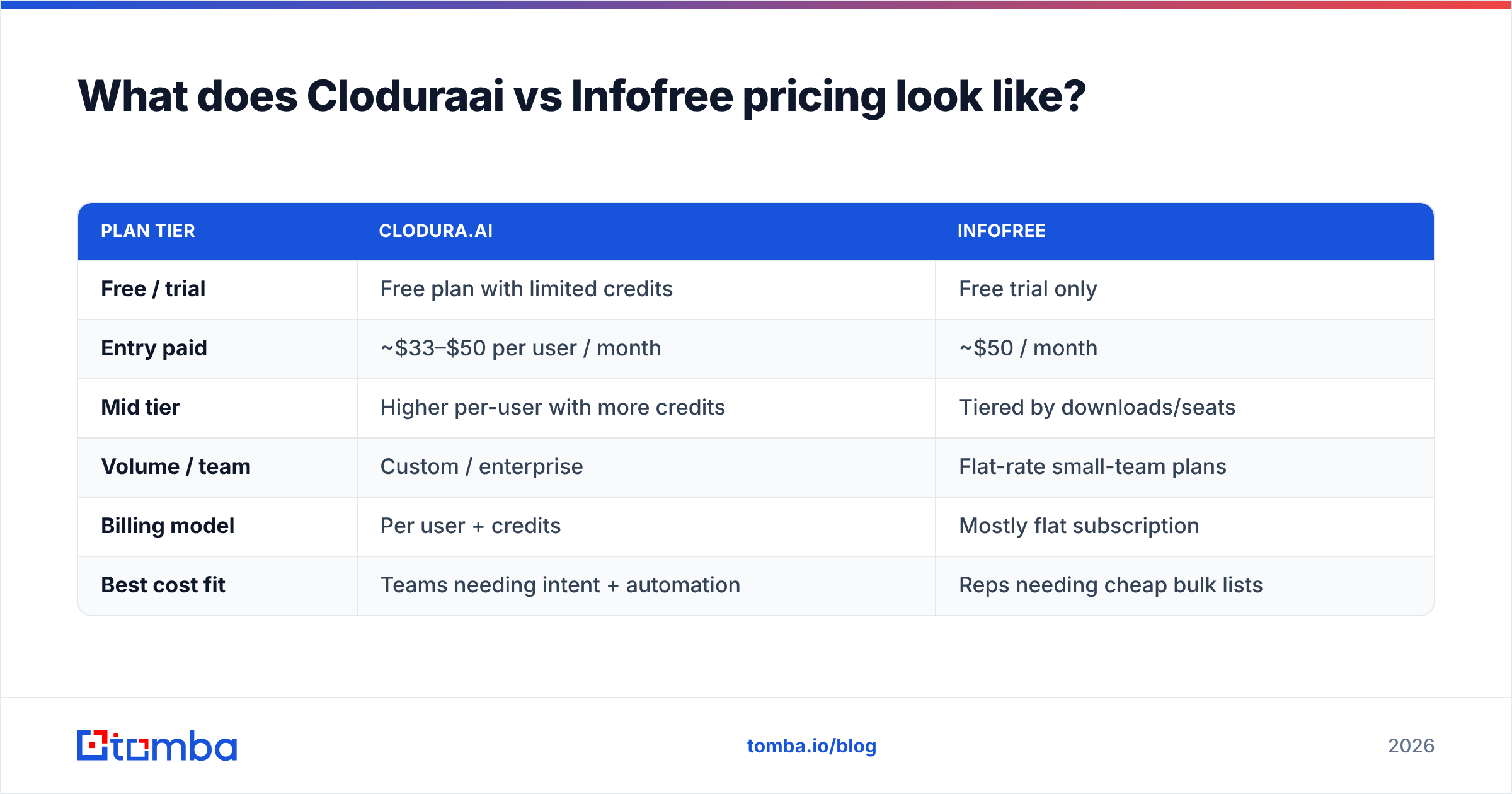
Pricing is where these two genuinely serve different wallets.
| Plan tier | Clodura.ai | Infofree |
|---|---|---|
| Free / trial | Free plan with limited credits | Free trial only |
| Entry paid | ~$33–$50 per user / month | ~$50 / month |
| Mid tier | Higher per-user with more credits | Tiered by downloads/seats |
| Volume / team | Custom / enterprise | Flat-rate small-team plans |
| Billing model | Per user + credits | Mostly flat subscription |
| Best cost fit | Teams needing intent + automation | Reps needing cheap bulk lists |
Infofree's flat, predictable subscription appeals to solo reps and tiny teams who hate credit math. Clodura.ai's credit-and-seat model scales with usage, which is fairer for teams that prospect in bursts but can get expensive at scale.
Worth noting: neither price includes the verification step you actually need. When you factor that in, a focused tool with transparent Tomba pricing — a free tier of 25 searches, then $49/mo Starter, $99/mo Growth, and $249/mo Pro — often costs less than upgrading a bloated all-in-one just to unlock a verification add-on.
Which one fits your team? (A decision framework)#
Match the tool to your motion, not the marketing.
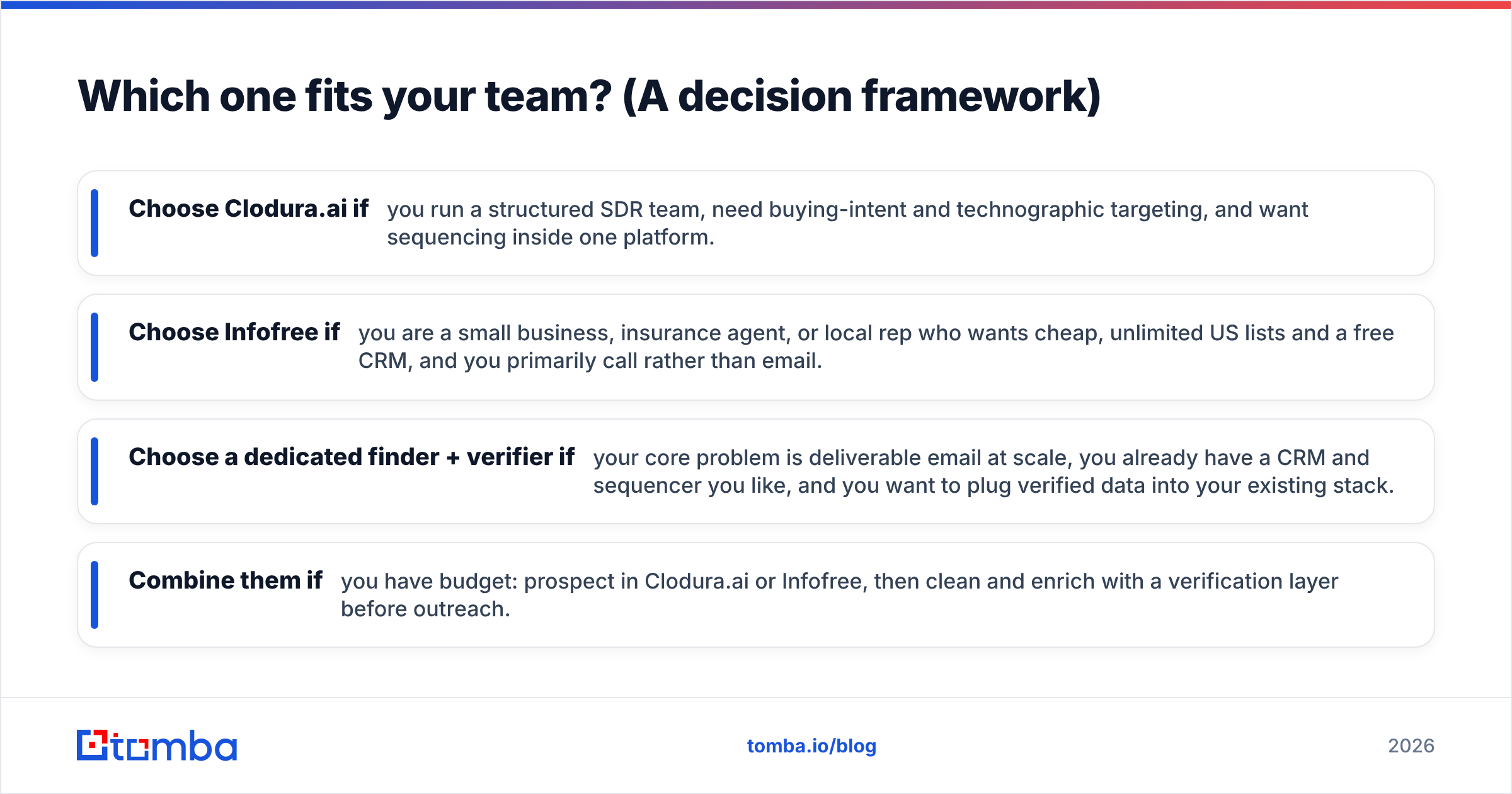
- Choose Clodura.ai if you run a structured SDR team, need buying-intent and technographic targeting, and want sequencing inside one platform.
- Choose Infofree if you are a small business, insurance agent, or local rep who wants cheap, unlimited US lists and a free CRM, and you primarily call rather than email.
- Choose a dedicated finder + verifier if your core problem is deliverable email at scale, you already have a CRM and sequencer you like, and you want to plug verified data into your existing stack.
- Combine them if you have budget: prospect in Clodura.ai or Infofree, then clean and enrich with a verification layer before outreach.
Most teams discover their real bottleneck is not "where do I find names" but "why do 25% of my emails bounce." That is a verification problem, and no amount of database size fixes it on its own.
What are the main pros and cons?#
A quick gut-check before you commit budget.
Clodura.ai — pros: large global database, intent signals, technographics, built-in sequencer, free starting tier. Clodura.ai — cons: per-user pricing climbs fast, learning curve, data still needs verification, depth can overwhelm small teams.
Infofree — pros: very low cost, flat pricing, unlimited US list downloads, free CRM, simple for non-technical reps. Infofree — cons: US-centric, no intent/technographic data, weaker business-email deliverability, limited automation.
Neither is a bad product. They are aimed at different buyers, and the worst outcome is paying for Clodura.ai's depth when you need Infofree's simplicity — or paying for either when your actual gap is verified, deliverable contact data.
Where does a dedicated email finder fit in?#
A specialized finder is the layer both platforms skip: real-time discovery and verification at the moment of outreach.
Instead of trusting an 18-month-old record, you query a name and domain and get a freshly validated address with a confidence score. This is exactly the use case for domain search when you want every reachable contact at a target company, and for bulk email finder when you are processing a list exported from Clodura.ai or Infofree.
Because it slots into your existing CRM and sequencer through standard integrations, you do not rip out your stack — you make the data in it trustworthy. Vendor-neutral review sites like Capterra and the broader concept of B2B data quality on Wikipedia both reinforce the same point: source breadth and source accuracy are different problems, and you need to solve both.
Frequently asked questions#
Is Clodura.ai or Infofree better for cold email? Clodura.ai, for most teams, because of its sequencer and segmentation. But run every address through a verifier first — Clodura.ai's database, like all databases, carries decayed records that will bounce.
Is Infofree good value? Yes, if you need cheap, high-volume US lists and you mainly call. Its flat pricing is excellent for solo reps. It is weaker if deliverable business email is your priority.
Do I still need a verification tool if I use one of these? Almost always. Both are data sources, not real-time validators. Verifying before you send is what keeps your bounce rate and sender reputation healthy.
Can I use them together with a finder? That is the strongest setup: prospect in Clodura.ai or Infofree, then find and verify with a dedicated tool, then enrich, then sequence.
The bottom line#
Clodura.ai and Infofree solve different versions of the same job. Clodura.ai is the signal-rich platform for structured outbound teams; Infofree is the budget list engine for small reps and agents. Pick by your motion and your wallet — but do not mistake database size for data quality.
Whichever you choose, the leads only matter if they land in real inboxes. Start with the Tomba Email Finder to find and verify professional addresses in real time, run your exported lists through verification before every send, and watch your bounce rate — not just your contact count — become the number you actually trust. Spin up the free tier with 25 searches and test it against a list from either platform before you commit a dollar to outreach.
// get started
Find, verify and enrich your first contacts today
Start on the free plan with 25 searches a month, then scale when your team is ready.
Free plan · No credit card required · GDPR & CCPA
// about the author