Clodura.ai vs Jeeva AI (2026): AI Sales Tools Compared
Clodura.ai vs Jeeva AI in 2026: how an all-in-one prospecting database stacks up against an autonomous AI SDR on data, pricing, automation, and accuracy.
You are choosing between two very different bets. Clodura.ai sells you a prospecting database with built-in sequencing. Jeeva AI sells you an autonomous AI sales rep that prospects, writes, and follows up on its own. Picking the wrong one wastes a quarter of pipeline.
This guide breaks down Clodura.ai vs Jeeva AI on the things that actually move outbound numbers: data coverage, accuracy, automation, pricing, and where each one quietly fails. No vendor spin — just what each tool is good at and where you should bring your own stack.
TL;DR — Clodura.ai vs Jeeva AI#
- Clodura.ai is a self-serve B2B database plus cadence tool. Strong if you want a large contact pool, technographics, and email sequences in one login.
- Jeeva AI is an "AI SDR" platform. Strong if you want autonomous agents to research, write, and send outbound with minimal human touch.
- Data accuracy is the deciding factor for both, and neither publishes independent verification rates you can fully trust — so you should verify before you send.
- Pricing models differ sharply: Clodura leans credit/seat tiers; Jeeva leans per-agent/usage. Run the math on your real send volume.
- The smart move for many teams: keep your sequencer, but pair either tool with a dedicated, accuracy-first email source like Tomba Email Finder to cut bounces.
What is Clodura.ai?#
Clodura.ai is an all-in-one sales prospecting platform built around a large B2B contact database. Think of it as a phone book with a megaphone attached: you search for accounts and contacts, then launch email cadences without leaving the app.
Its core pieces:
- Contact database — millions of company and contact records with direct dials and email addresses.
- Technographics and intent — filters for the tools a company uses and buying signals.
- Email sequencing — multi-step cadences with basic automation and tracking.
- Email verification — an in-built check to reduce obvious invalid addresses.
- Chrome extension — pull contacts while browsing LinkedIn or company sites.
The pitch is consolidation. Instead of stitching a data enrichment provider to a separate sender, you get search and send under one roof. That's genuinely useful for small teams who don't want five subscriptions. The trade-off is that "good at everything" usually means "best at nothing" — the database is broad but accuracy varies by region and seniority, and the sequencer is lighter than a dedicated platform.
What is Jeeva AI?#
Jeeva AI is an autonomous AI SDR platform. Rather than handing you a search bar, it hands you an agent that runs the prospecting motion for you: it identifies accounts, finds contacts, researches them, drafts personalized messages, and manages follow-ups.
Where Clodura assumes a human drives, Jeeva assumes the machine drives and the human supervises. The analogy: Clodura is a well-stocked kitchen, Jeeva is a meal-kit robot that cooks while you watch.
Its core pieces:
- AI SDR agents — autonomous prospecting and outreach with limited human input.
- Lead research and enrichment — pulls context to personalize at scale.
- AI copywriting — generates first-touch and follow-up messages.
- Multichannel orchestration — email plus social touches in sequence.
- CRM sync — pushes activity back into your pipeline of record.
Jeeva's strength is leverage. One operator can run the volume that used to need a team. The risk is the same as any autonomous system: when the underlying data is wrong, the AI confidently emails the wrong person with a perfectly written, perfectly useless message. Automation multiplies whatever data quality you feed it — good or bad.
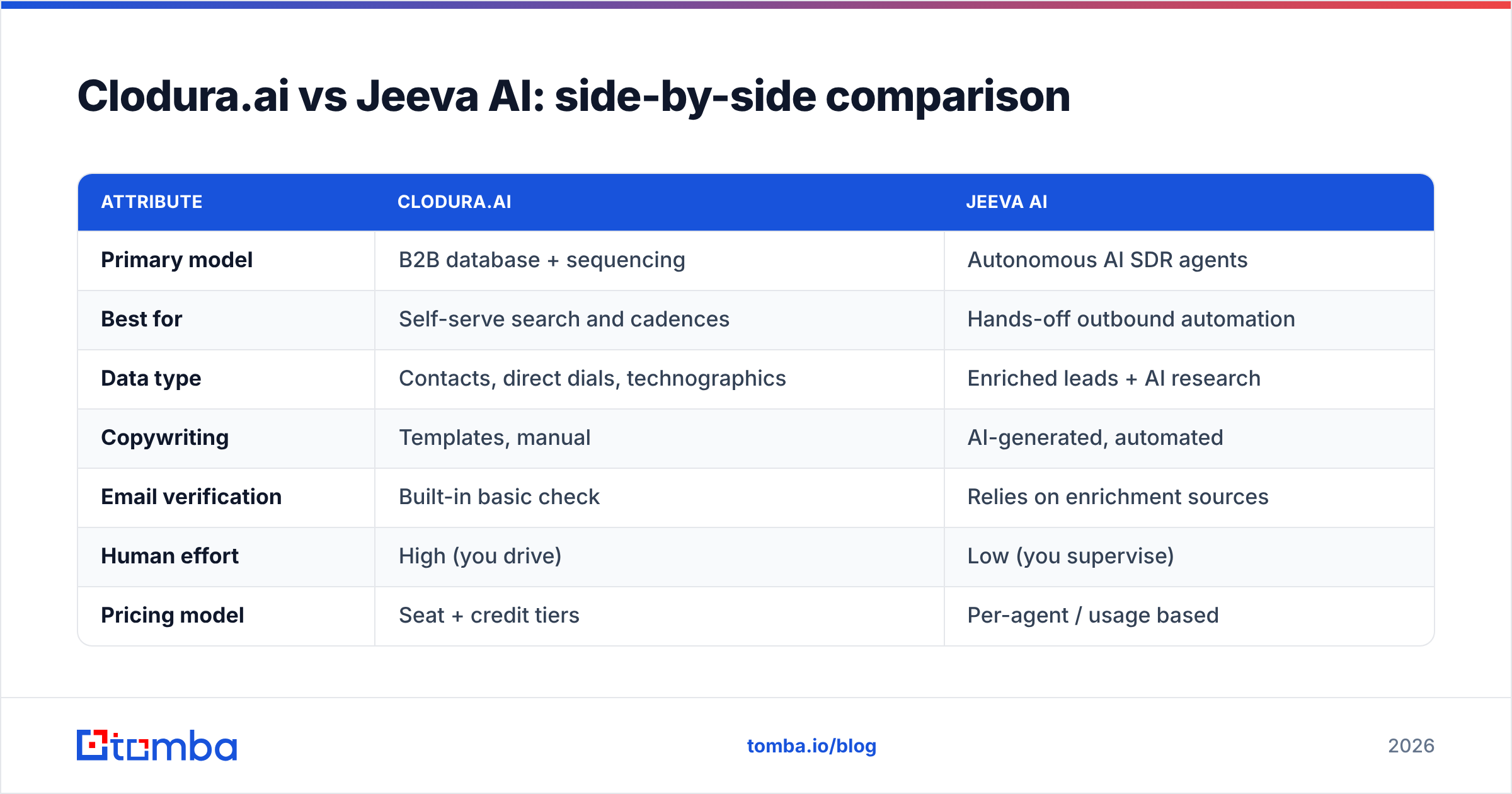
Clodura.ai vs Jeeva AI: side-by-side comparison#
| Attribute | Clodura.ai | Jeeva AI |
|---|---|---|
| Primary model | B2B database + sequencing | Autonomous AI SDR agents |
| Best for | Self-serve search and cadences | Hands-off outbound automation |
| Data type | Contacts, direct dials, technographics | Enriched leads + AI research |
| Copywriting | Templates, manual | AI-generated, automated |
| Email verification | Built-in basic check | Relies on enrichment sources |
| Human effort | High (you drive) | Low (you supervise) |
| Pricing model | Seat + credit tiers | Per-agent / usage based |
| Free option | Limited free plan | Demo / trial led |
| Learning curve | Moderate | Low to use, harder to trust |
| Main risk | Data accuracy by segment | Automation amplifies bad data |
The headline difference: Clodura gives you control and raw inputs; Jeeva gives you speed and abstraction. Neither is strictly better. A two-person founder-led team that wants to learn outbound will get more from Clodura's transparency. A scaling team drowning in manual steps will get more from Jeeva's automation — provided they trust the data.
Which has better data accuracy?#
Accuracy is where both tools live or die, and it's the question vendors are vaguest about. Here's the honest framing: a large database does not equal an accurate one. Volume and freshness pull in opposite directions, because the more records you hold, the harder they are to keep current.
Clodura's database is broad, but like every aggregator, accuracy degrades on senior titles, smaller companies, and non-US regions where source data is thinner. Its built-in verification catches obvious junk but is not a substitute for a real-time SMTP-level check.
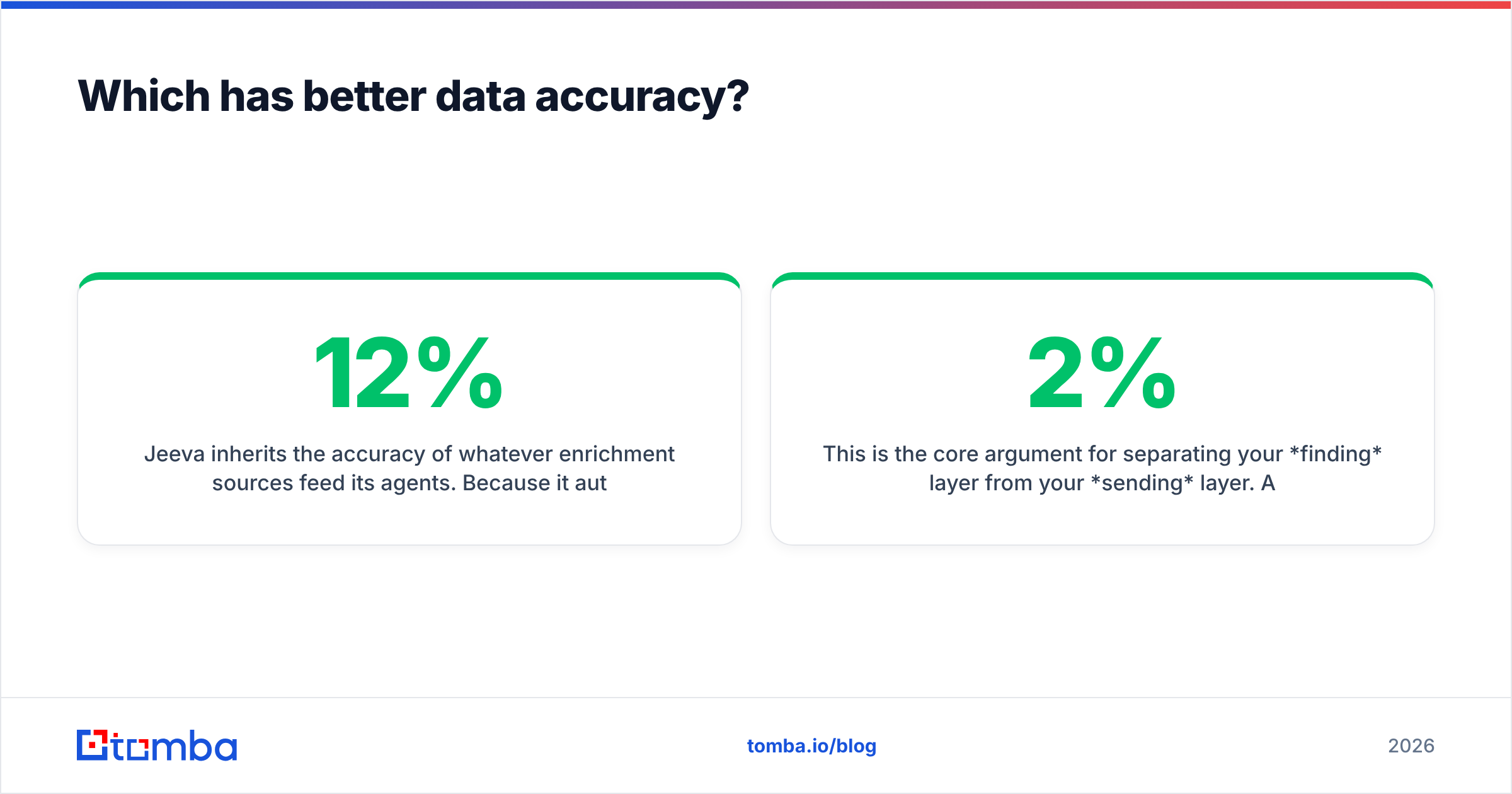
Jeeva inherits the accuracy of whatever enrichment sources feed its agents. Because it automates sending, a 12% bad-email rate doesn't just waste your time — it actively damages your sender reputation at machine speed. Autonomous outreach on dirty data is how new domains get throttled.
This is the core argument for separating your finding layer from your sending layer. A dedicated email verifier run on any list — Clodura's, Jeeva's, or your own — before it hits the sequencer is the single highest-ROI step in the whole stack. Bounces under 2% keep you out of spam folders; bounces over 5% start the slow death of your domain.
How do Clodura.ai and Jeeva AI price?#
Pricing is the second deciding factor, and the two use different logic, so a flat "X is cheaper" comparison misleads.
- Clodura.ai uses seat-based plans with credit limits for contact reveals and email sends. Costs scale with how many users and how many records you pull. Predictable if your team size is stable.
- Jeeva AI leans toward per-agent and usage-based pricing tied to the volume of autonomous activity. Costs scale with how much work the AI does, which can be efficient or surprising depending on throughput.
The trap with both is the same: the sticker price covers the platform, not the cleanup. If you're paying again to verify and de-duplicate exported data, the real cost per deliverable contact is higher than the plan suggests. Always divide total spend by contacts you actually reached, not contacts you downloaded.
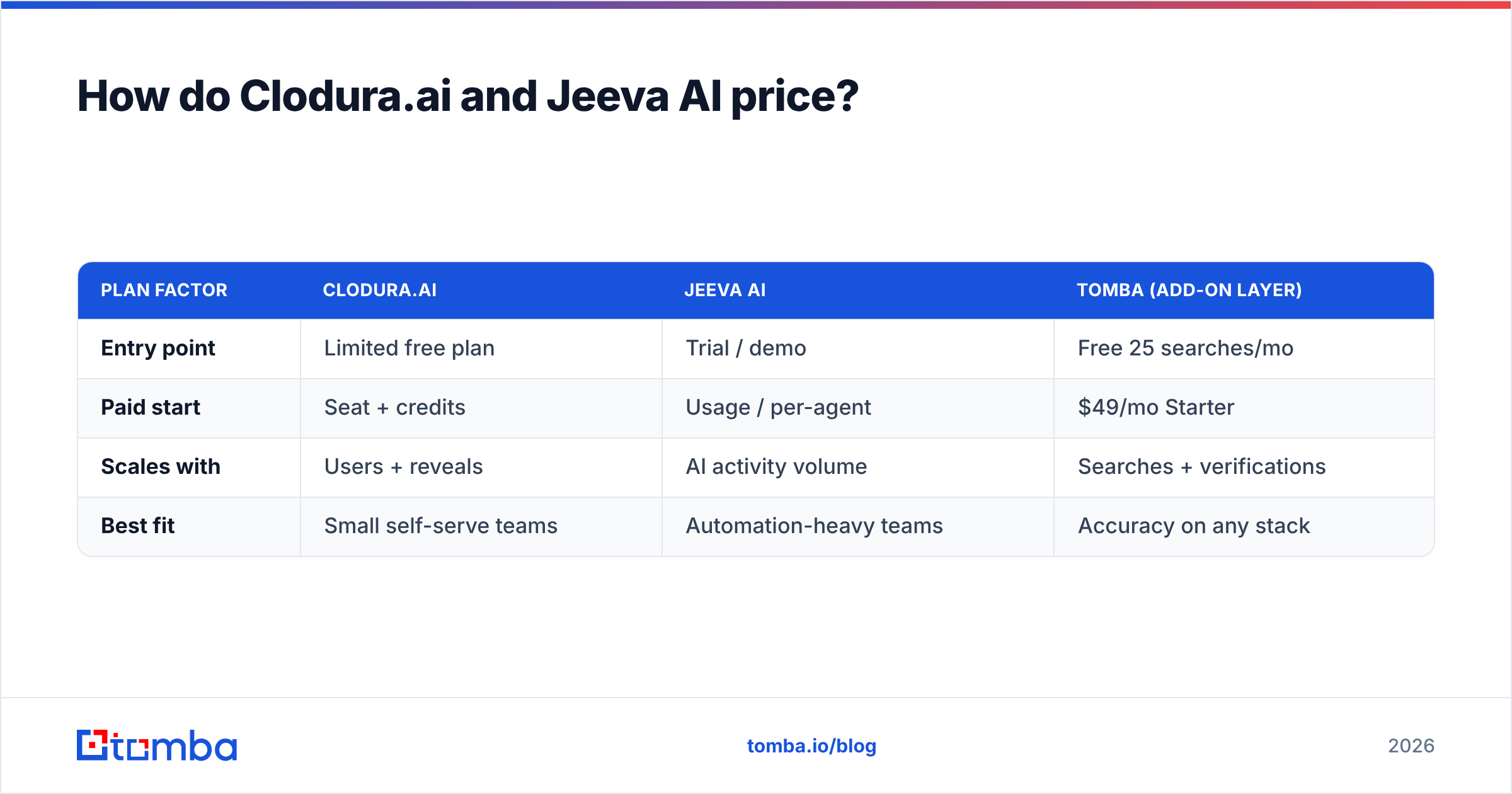
For reference, a focused tool like Tomba prices transparently — a free tier with 25 searches a month, then Tomba pricing at $49/mo Starter, $99/mo Growth, and $249/mo Pro — so you can bolt accuracy onto either platform without committing to another all-in-one suite. Check current rates on each vendor's own page before deciding; pricing pages change faster than blog posts.
| Plan factor | Clodura.ai | Jeeva AI | Tomba (add-on layer) |
|---|---|---|---|
| Entry point | Limited free plan | Trial / demo | Free 25 searches/mo |
| Paid start | Seat + credits | Usage / per-agent | $49/mo Starter |
| Scales with | Users + reveals | AI activity volume | Searches + verifications |
| Best fit | Small self-serve teams | Automation-heavy teams | Accuracy on any stack |
Which should you choose?#
Match the tool to your bottleneck, not the marketing.
Choose Clodura.ai if your bottleneck is finding contacts and you want one login for search plus light sequencing. It suits small teams, early-stage outbound, and anyone who wants to see and control the raw data before sending. You'll do more manual work, but you'll understand your funnel.
Choose Jeeva AI if your bottleneck is human hours and you're comfortable supervising autonomous agents. It suits scaling teams who already know their ICP cold and need to multiply output. Just go in clear-eyed about data quality, because automation removes the human gut-check that would otherwise catch a wrong contact.
Choose neither as your sole stack if deliverability is your real constraint. Both are reasonable front-ends; neither is a deliverability platform. The pattern that wins in 2026 is modular: a strong finder, a strict verifier, and a sender you control — instead of one suite that does all three at 70%.
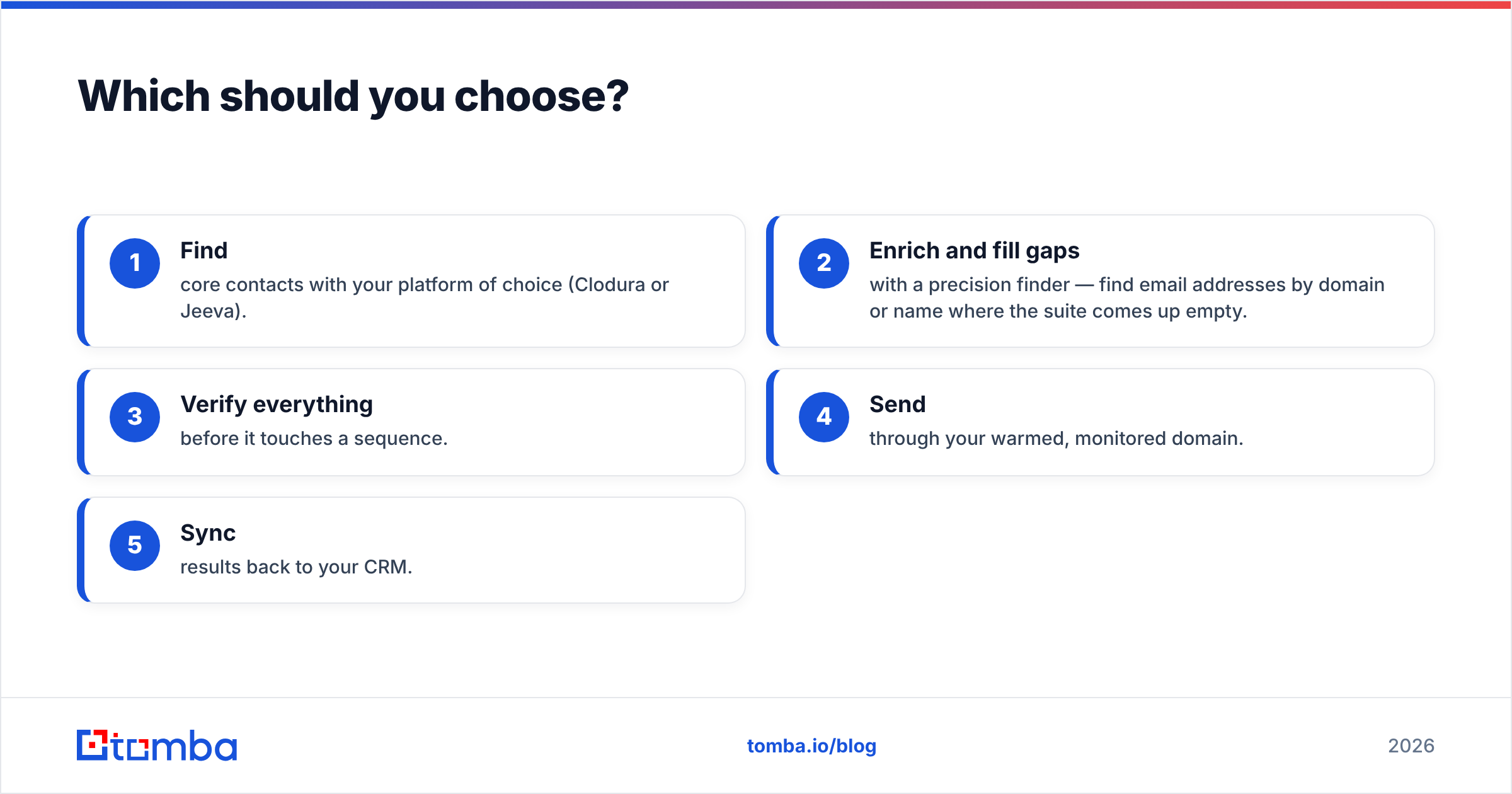
A practical hybrid many teams land on:
- Find core contacts with your platform of choice (Clodura or Jeeva).
- Enrich and fill gaps with a precision finder — find email addresses by domain or name where the suite comes up empty.
- Verify everything before it touches a sequence.
- Send through your warmed, monitored domain.
- Sync results back to your CRM.
This is more moving parts, but each part is best-in-class, and you stop paying the "all-in-one tax" of mediocre accuracy. For teams worried about complexity, most of these tools — including Tomba — connect through Zapier and native CRM integrations, so the stack feels like one workflow.
Frequently asked questions#
Is Clodura.ai or Jeeva AI better for cold email? Jeeva automates more of the cold email motion, but Clodura gives you more control over the data going in. For cold email specifically, the limiting factor isn't the tool — it's whether the addresses are valid. Verify first regardless of which you pick.
Does Jeeva AI replace SDRs? It reduces the manual load and can run high-volume outbound with one supervisor, but it doesn't replace judgment, qualification calls, or relationship building. Treat it as leverage, not a full headcount swap.
Can I use Tomba alongside Clodura.ai or Jeeva AI? Yes. Tomba is intentionally modular — use the email finder and verifier to fill gaps and clean lists from either platform before you send. It connects via the Tomba API and standard integrations.
Which is more accurate? Neither publishes a fully independent accuracy benchmark you should take at face value. Run a sample of 100 contacts from each through an independent verifier and measure your own bounce rate — that's the only number that matters for your domain.
What about direct dials and phone numbers? Clodura includes direct dials in its database. If phone coverage is a priority and you want validated numbers, pair either platform with a dedicated phone finder so you're not dialing dead lines.
The bottom line#
Clodura.ai and Jeeva AI solve different problems. Clodura is a database-first platform for teams that want to drive; Jeeva is an automation-first platform for teams that want to supervise. Both are credible — and both rise or fall on the accuracy of the data underneath them.
That's exactly why your finding-and-verification layer shouldn't be an afterthought bundled into a suite. Start with a free tier of Tomba Email Finder, test it against whatever your platform returns, and keep only the contacts that actually deliver. Clean data makes a mediocre tool good and a good tool unstoppable — the order of operations is find, verify, then send. Get that right and the Clodura-vs-Jeeva debate becomes a much smaller decision.
Compare current features on Clodura.ai, Jeeva AI, and read peer reviews on G2 before you commit a budget line — then layer accuracy on top.
// get started
Find, verify and enrich your first contacts today
Start on the free plan with 25 searches a month, then scale when your team is ready.
Free plan · No credit card required · GDPR & CCPA
// about the author