Clodura.AI vs Kitt.AI 2026: Which B2B Sales Tool Wins?
A neutral, hands-on breakdown of Clodura.AI vs Kitt.AI — pricing, data accuracy, automation, and where each B2B sales tool actually earns its seat in your stack in 2026.
Choosing between Clodura.AI and Kitt.AI usually comes down to one question your sales team keeps avoiding: do you need an all-in-one prospecting database, or a lighter outreach assistant that plugs into the data you already have? Both tools promise more pipeline with less manual grind, but they solve different halves of the problem.
This is a neutral, feature-by-feature comparison — not a sales pitch. We'll look at where each platform is strong, where it quietly costs you, and how to decide which one belongs in your 2026 stack.
TL;DR — Clodura.AI vs Kitt.AI at a glance#
- Clodura.AI is a full-stack B2B sales intelligence platform: a built-in contact database, intent signals, email/phone discovery, and sequencing in one login. Best for teams that want everything under one roof.
- Kitt.AI is a lighter, automation-first outreach tool focused on AI-assisted messaging and workflow triggers. Best for teams that already own their data and want to move faster on send.
- Data accuracy is the deciding factor for both — and it's the area where bundled databases age fastest. A dedicated verification layer matters regardless of which you pick.
- Pricing models differ sharply: Clodura.AI charges for database access and credits; Kitt.AI charges per seat and automation volume. Your cost depends entirely on how many net-new contacts you need each month.
- Neither tool is a true email-accuracy specialist. Pairing either with a focused email finder and email verifier is how high-performing teams keep bounce rates low.
What is Clodura.AI?#
Clodura.AI is a B2B sales prospecting and intelligence platform aimed at outbound teams that want their database, signals, and outreach in a single place. Its pitch is breadth: you search a built-in contact universe, layer on intent and technographic filters, pull emails and direct dials, then push those contacts into sequences without leaving the app.
For a small SDR team that doesn't already own a data source, that consolidation is genuinely useful. You're not stitching together a separate database vendor, a verification tool, and a sequencer — it's one subscription, one onboarding, one bill.
The trade-off is the trade-off every bundled database makes: the contact data is only as fresh as the last refresh cycle, and you pay for the whole platform even if you only use one slice of it. Roughly 25–30% of B2B contact data decays every year as people change jobs, so a database that looked great in your trial can quietly degrade. That's why teams cross-check bundled records against a dedicated source before a big send.
(Note: replace the placeholder above with a real Clodura.AI prospecting-dashboard screenshot during editing — keep visuals topic-specific.)
What is Kitt.AI?#
Kitt.AI takes the opposite approach. Instead of trying to own the data layer, it focuses on the action layer — AI-assisted message drafting, automated follow-up logic, and workflow triggers that fire off the contacts and signals you feed it. Think of it less as a warehouse and more as a fast assembly line: you bring the raw parts, it moves them through outreach quickly.
That makes Kitt.AI attractive for teams that already have a CRM full of contacts, a separate enrichment source, or an existing list and simply want better automation and messaging on top. The lighter footprint usually means a lower per-seat cost and faster setup.
The flip side: Kitt.AI is only as good as the data you pour into it. If your CRM is full of stale or unverified addresses, faster automation just means you hit spam traps faster. Garbage in, garbage out — at scale.
(Note: swap for a real Kitt.AI workflow-builder screenshot during editing.)
Clodura.AI vs Kitt.AI: full feature comparison#
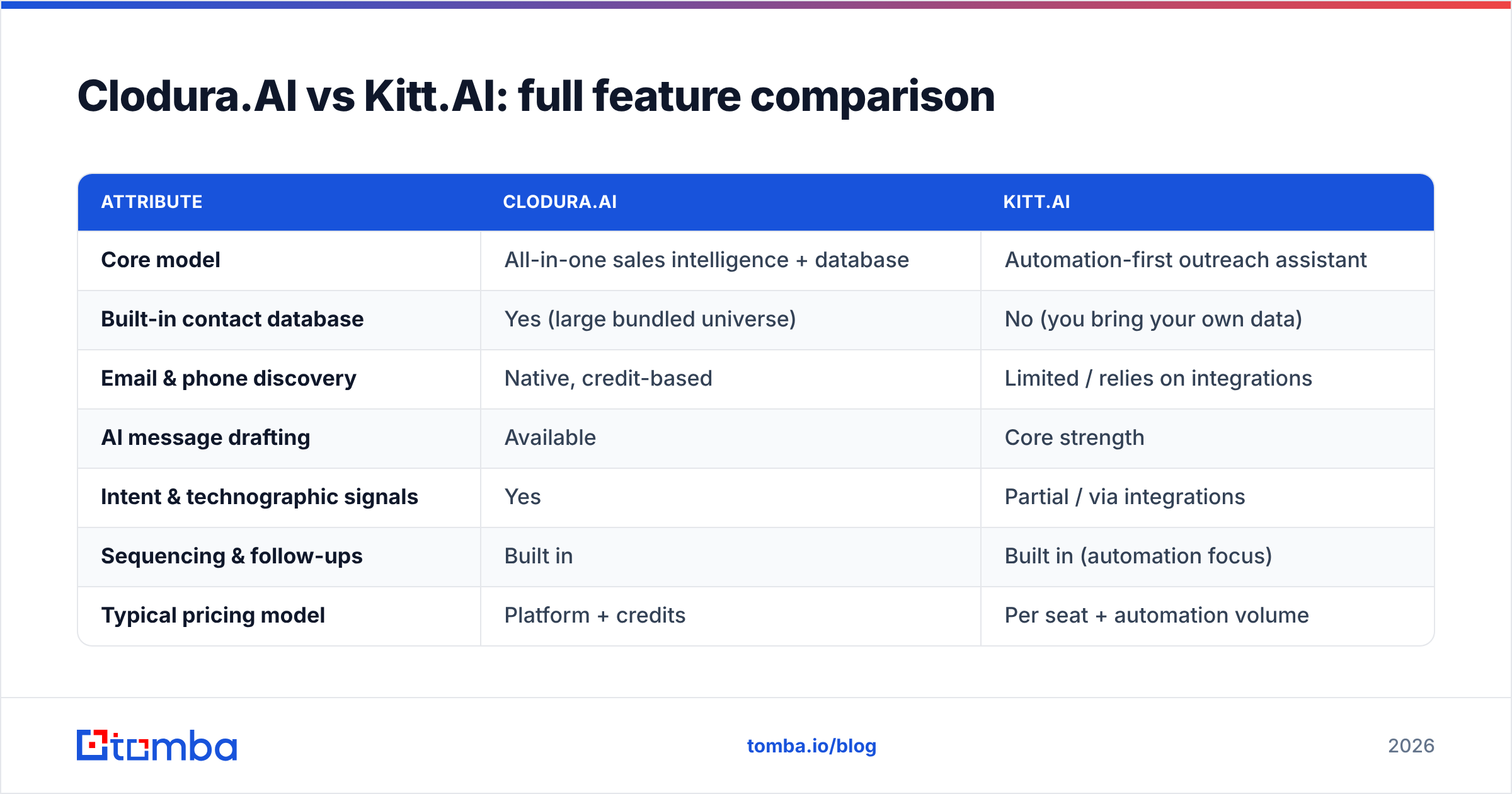
Here's how the two tools line up on the attributes that actually change your results. Use this as a shortlist filter, not gospel — verify current pricing on each vendor's site before you buy.
| Attribute | Clodura.AI | Kitt.AI |
|---|---|---|
| Core model | All-in-one sales intelligence + database | Automation-first outreach assistant |
| Built-in contact database | Yes (large bundled universe) | No (you bring your own data) |
| Email & phone discovery | Native, credit-based | Limited / relies on integrations |
| AI message drafting | Available | Core strength |
| Intent & technographic signals | Yes | Partial / via integrations |
| Sequencing & follow-ups | Built in | Built in (automation focus) |
| Typical pricing model | Platform + credits | Per seat + automation volume |
| Best for | Teams without an existing data source | Teams that own their data already |
| Learning curve | Higher (more surface area) | Lower (focused scope) |
The pattern is clear: Clodura.AI sells breadth, Kitt.AI sells speed. Neither is "better" in the abstract — it depends on whether your bottleneck is finding contacts or acting on them.
Which one has more accurate data?#
Clodura.AI wins on raw coverage simply because it ships a database; Kitt.AI doesn't compete here by design. But coverage and accuracy are not the same thing. A platform can show you a million contacts and still hand you a 20% bounce rate if those records aren't re-verified in real time.
This is the uncomfortable truth about every bundled-database tool, Clodura.AI included: the database is a snapshot, and snapshots rot. The teams that keep deliverability high treat the bundled data as a starting point, then run candidate emails through a real-time verification step before sending. That's where a focused tool earns its keep — and why so many ops leaders run a separate data enrichment and verification layer alongside whatever prospecting platform they standardize on.
If you want to pressure-test any vendor's accuracy claim, pull a sample of 100 contacts, run them through an independent verifier, and measure the real valid rate. Marketing decks say 95%; your sample tells the truth.
How do they compare on pricing?#
Pricing is where the two diverge most, and where buyers get surprised.
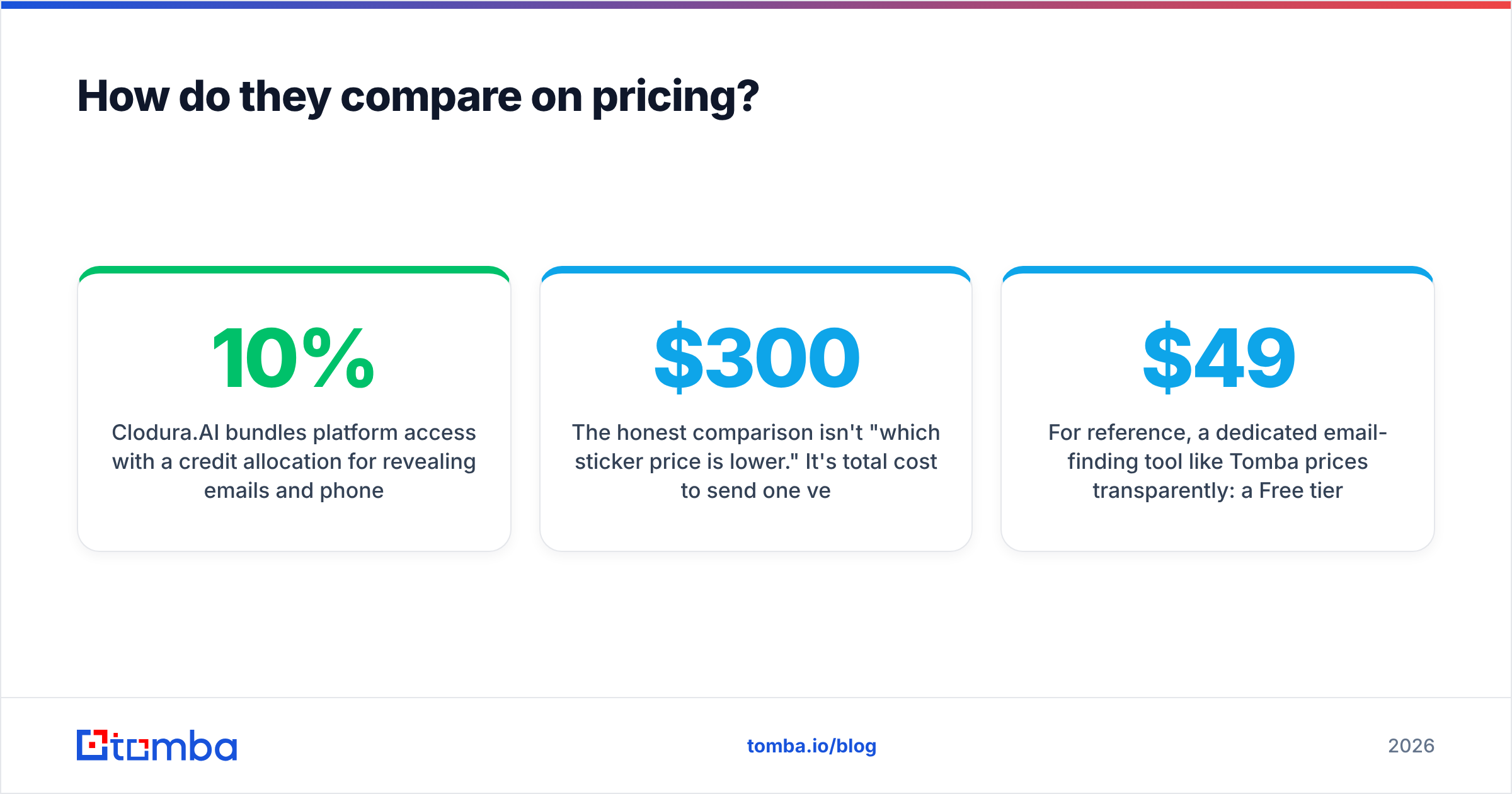
- Clodura.AI bundles platform access with a credit allocation for revealing emails and phone numbers. Heavy prospecting months burn credits fast, and overages add up. You're paying for the database whether you use 10% or 90% of it.
- Kitt.AI typically charges per seat plus automation volume. Because it doesn't carry a database, the base cost is usually lower — but you'll need a separate data subscription, which belongs in your total-cost math.
The honest comparison isn't "which sticker price is lower." It's total cost to send one verified, deliverable email. A cheap automation tool with a separate $300/month data vendor can easily cost more than a bundled platform — or far less, if you already own your data.
For reference, a dedicated email-finding tool like Tomba prices transparently: a Free tier with 25 searches/month, Starter at $49/mo, Growth at $99/mo, and Pro at $249/mo. You can see full Tomba pricing to model the cost of bolting a precise accuracy layer onto either Clodura.AI or Kitt.AI.
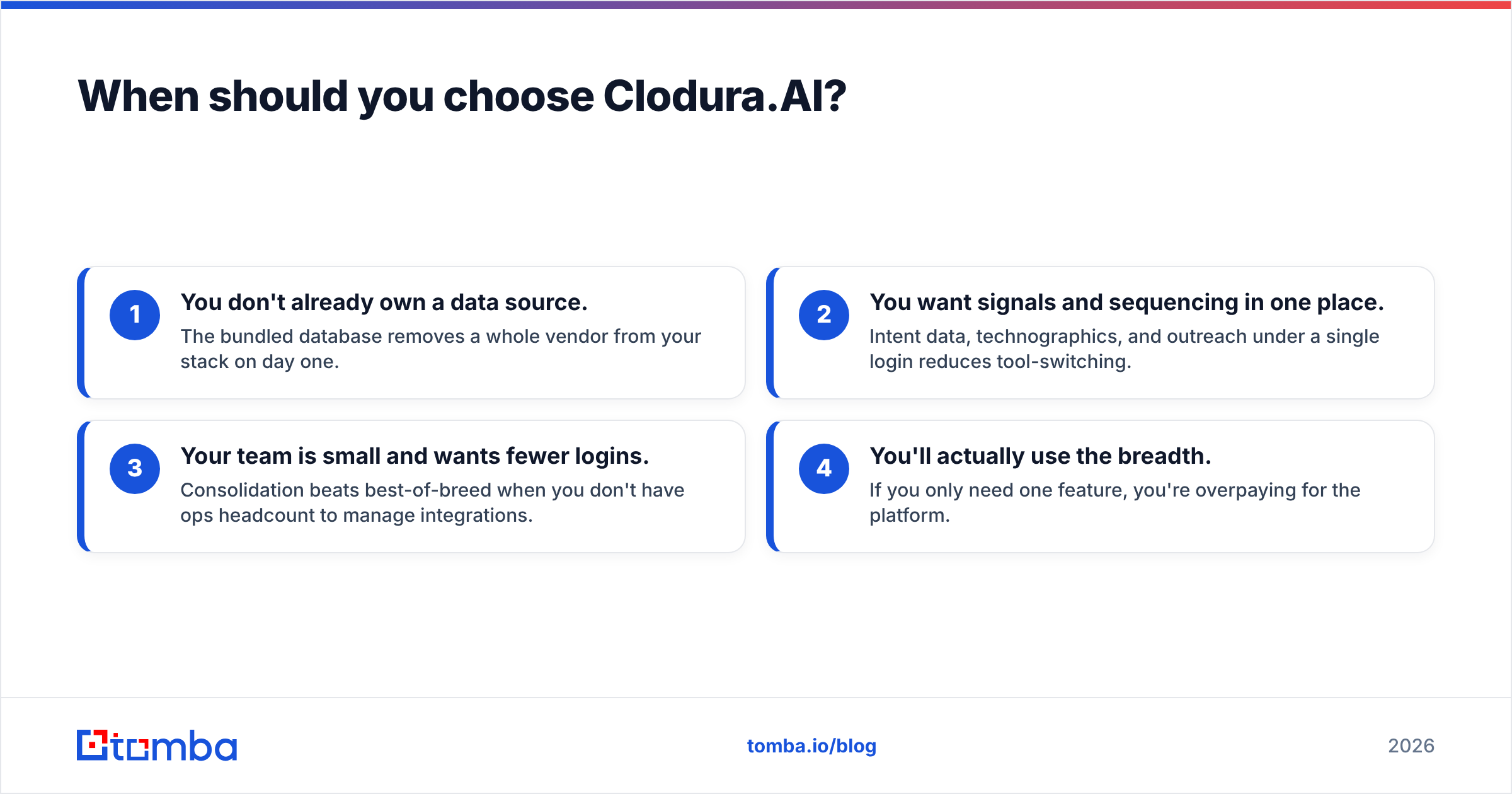
When should you choose Clodura.AI?#
Pick Clodura.AI if:
- You don't already own a data source. The bundled database removes a whole vendor from your stack on day one.
- You want signals and sequencing in one place. Intent data, technographics, and outreach under a single login reduces tool-switching.
- Your team is small and wants fewer logins. Consolidation beats best-of-breed when you don't have ops headcount to manage integrations.
- You'll actually use the breadth. If you only need one feature, you're overpaying for the platform.
Just go in clear-eyed about data decay — and budget for a verification pass before high-volume sends.
When should you choose Kitt.AI?#
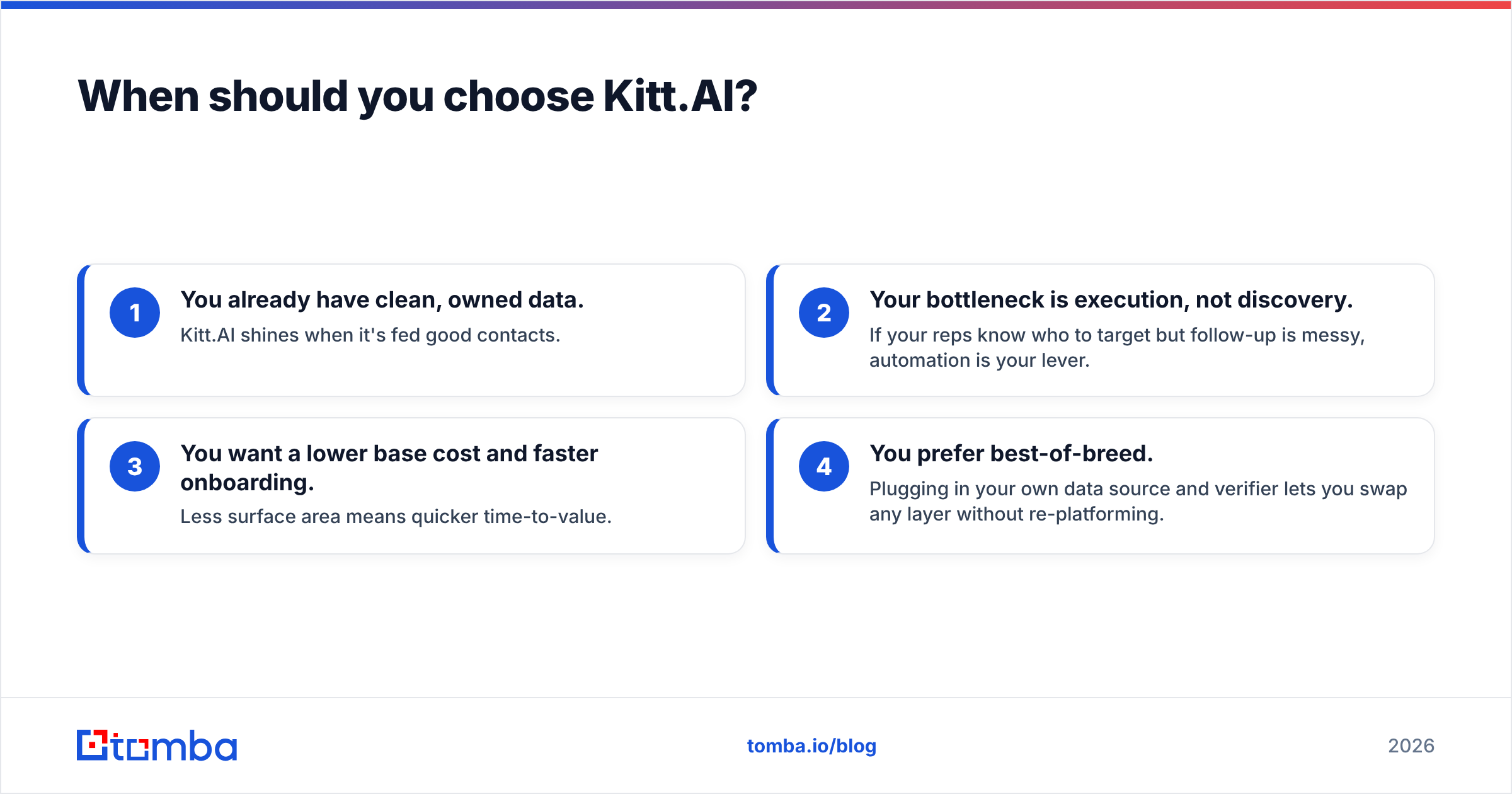
Pick Kitt.AI if:
- You already have clean, owned data. Kitt.AI shines when it's fed good contacts.
- Your bottleneck is execution, not discovery. If your reps know who to target but follow-up is messy, automation is your lever.
- You want a lower base cost and faster onboarding. Less surface area means quicker time-to-value.
- You prefer best-of-breed. Plugging in your own data source and verifier lets you swap any layer without re-platforming.
The catch is non-negotiable: invest in data quality upstream, or fast automation just amplifies bad lists.

What's the missing layer in both tools?#
Neither Clodura.AI nor Kitt.AI is built primarily as an email-accuracy engine — that's not a knock, it's just scope. Clodura.AI optimizes for breadth; Kitt.AI optimizes for action. The verification and discovery layer that protects your sender reputation sits underneath both.
That's the gap a focused finder fills. With Tomba you can:
- Find addresses precisely by name, company, or domain search — useful whether you're enriching a Clodura.AI export or feeding Kitt.AI's automation.
- Verify before you send, dropping risky and catch-all addresses so your bounce rate stays low.
- Enrich at scale through the Tomba API, so accuracy is automatic rather than a manual chore.
Think of your prospecting platform as the car and the data layer as the fuel. A faster car with bad fuel still stalls. The teams that win in 2026 separate those concerns: one tool to act, one tool to keep the data clean.
For independent perspective on both platforms, check verified user reviews on G2 and Capterra, and confirm current feature sets on the Clodura.AI homepage before committing.
The verdict: Clodura.AI vs Kitt.AI#
There's no single winner — there's a winner for your situation:
- Choose Clodura.AI if you need a database and don't want to manage multiple vendors. You're buying convenience and coverage.
- Choose Kitt.AI if you already own your data and your real problem is moving faster on outreach. You're buying speed and a lower base cost.
- Either way, add a dedicated accuracy layer. Both tools get more valuable when the emails flowing through them are verified and current.
The biggest mistake teams make is treating the platform decision as the whole decision. The platform moves contacts; the data layer determines whether those contacts were real in the first place.
Get the accuracy layer right#
Whichever platform you land on, your deliverability lives or dies on data quality. Tomba's Email Finder gives you precise, source-cited professional emails by name, company, or domain — and the built-in verifier keeps your bounce rate low before a single message goes out. Start free with 25 searches a month, then scale on a plan that fits your volume. Pair it with Clodura.AI or Kitt.AI and you get the best of both worlds: a platform that acts fast, on data you can actually trust.
// get started
Find, verify and enrich your first contacts today
Start on the free plan with 25 searches a month, then scale when your team is ready.
Free plan · No credit card required · GDPR & CCPA
// about the author