Clodura.ai vs LeadEngine.ai: Best B2B Prospecting Tool 2026
Clodura.ai and LeadEngine.ai both promise clean B2B contact data and outbound automation. Here is the honest, side-by-side breakdown of pricing, data accuracy, and which one fits your sales motion in 2026.
Choosing between Clodura.ai and LeadEngine.ai usually comes down to one question your demos never answer cleanly: which platform actually puts a working email and phone number in front of your reps, and at what price? Both market themselves as all-in-one B2B prospecting engines. They are not the same tool, and the gap matters when you are spending real budget on outbound.
This is a neutral teardown. No vendor here is perfect, and the "winner" depends entirely on your team size, your sales motion, and how much you care about data freshness over feature bloat.
TL;DR — Which one should you pick?#
- Clodura.ai is the heavier, more mature platform: a large B2B database, built-in sequencing, intent signals, and org charts. Best for mid-market teams that want one suite for data plus outreach.
- LeadEngine.ai is leaner and AI-first: faster to onboard, lighter on legacy features, and priced for smaller teams or solo founders running targeted campaigns.
- Data accuracy is the real differentiator, not feature count. Both decay fast; verify before you send regardless of which you buy.
- Cost scales differently — Clodura's credits get expensive at volume; LeadEngine's caps frustrate heavy senders.
- If you only need clean, verified contact data, a focused tool like Tomba often beats paying for a full suite you half-use.
What are Clodura.ai and LeadEngine.ai?#
Think of these two as different-sized Swiss Army knives for outbound sales. Both bundle a contact database, email and phone discovery, and some flavor of campaign automation into a single subscription. The promise is the same: stop stitching together five tools and run prospecting from one dashboard.
Clodura.ai has been around longer and shows it. It pitches a database of hundreds of millions of B2B contacts, direct-dial phone numbers, technographic and intent data, org-chart mapping, and a native email sequencer. It is built for teams that want to research, build lists, and launch sequences without leaving the platform. You can read user reviews on G2 and Capterra to see how that breadth plays out in practice — and where the data gaps show up.
LeadEngine.ai is the newer, AI-forward entrant. It leans on AI to build lists from a description of your ideal customer, enrich contacts, and draft outreach. The trade-off is a smaller feature surface and a smaller database, which is fine if your targeting is narrow and you value speed over depth.
The honest framing: Clodura is a platform, LeadEngine is a tool. Neither replaces verifying your data before you hit send.

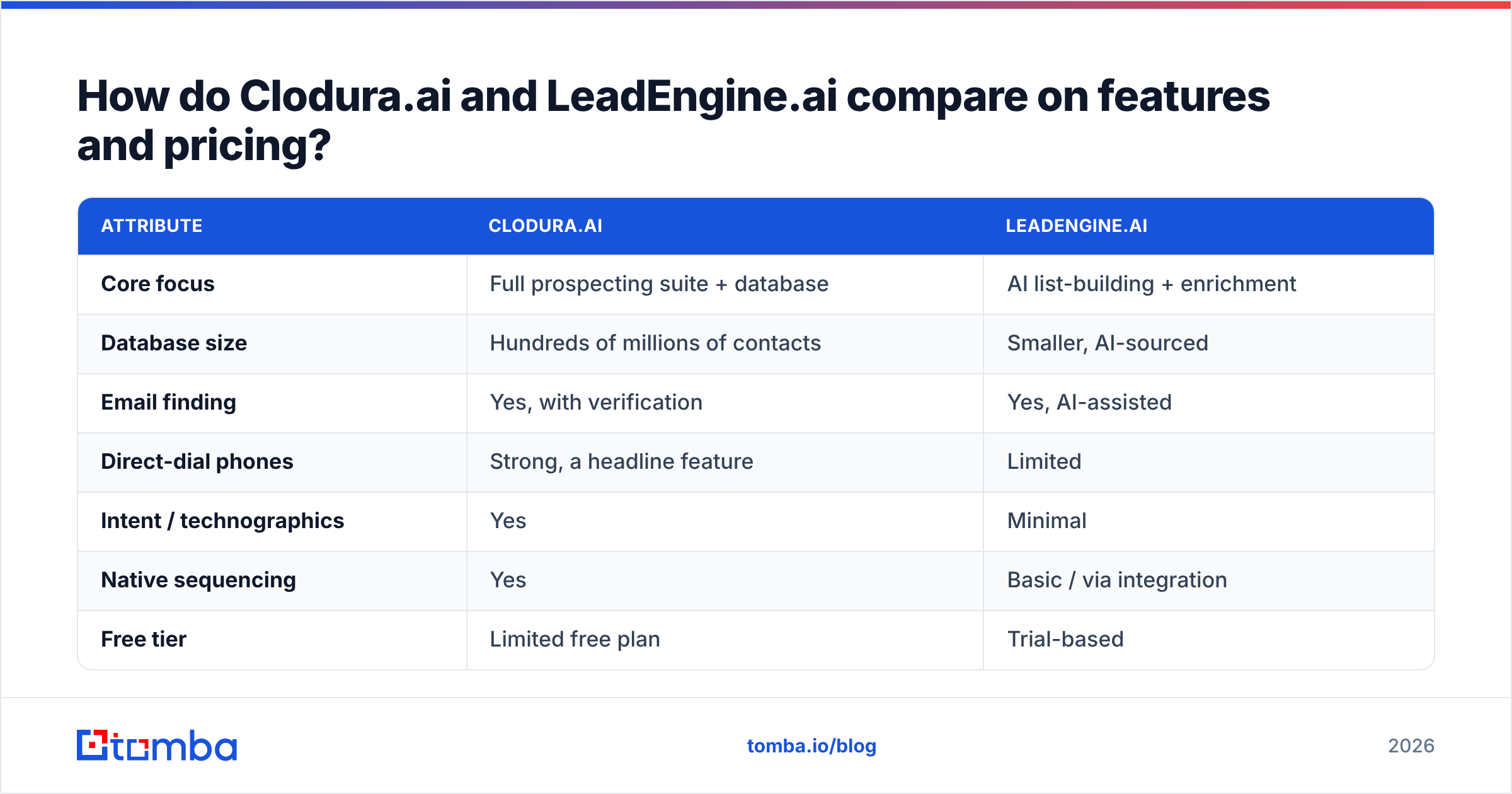
How do Clodura.ai and LeadEngine.ai compare on features and pricing?#
Here is the side-by-side. Treat exact prices as directional — both vendors change tiers and gate features behind sales calls — but the shape of the decision holds.
| Attribute | Clodura.ai | LeadEngine.ai |
|---|---|---|
| Core focus | Full prospecting suite + database | AI list-building + enrichment |
| Database size | Hundreds of millions of contacts | Smaller, AI-sourced |
| Email finding | Yes, with verification | Yes, AI-assisted |
| Direct-dial phones | Strong, a headline feature | Limited |
| Intent / technographics | Yes | Minimal |
| Native sequencing | Yes | Basic / via integration |
| Free tier | Limited free plan | Trial-based |
| Entry paid price | ~$33–$99/user/mo (annual) | Lower entry, tighter caps |
| Best for | Mid-market sales teams | Solo founders, small teams |
| Learning curve | Steeper | Fast |
A few things this table makes obvious:
- Clodura wins on breadth. If you need org charts, intent signals, and dialing in one place, LeadEngine simply does not compete at that depth.
- LeadEngine wins on simplicity. A two-person team does not need technographic filtering; they need 200 good contacts by Friday.
- Phone data favors Clodura. Direct dials are its calling card. If cold calling is core to your motion, weigh this heavily.
- Both gate the good stuff. Real database access and higher send volumes live in upper tiers on both platforms.
The mistake teams make is buying the bigger suite for features they will never configure. If 80% of your value comes from finding and verifying contact data, you are overpaying for the other 20%.
Which platform has more accurate data?#
Neither vendor will hand you a clean accuracy benchmark, so judge by mechanism, not marketing. Clodura refreshes a large database on a schedule and runs verification on emails before surfacing them. LeadEngine assembles contacts more dynamically with AI, which can mean fresher records in narrow niches but thinner coverage outside them.
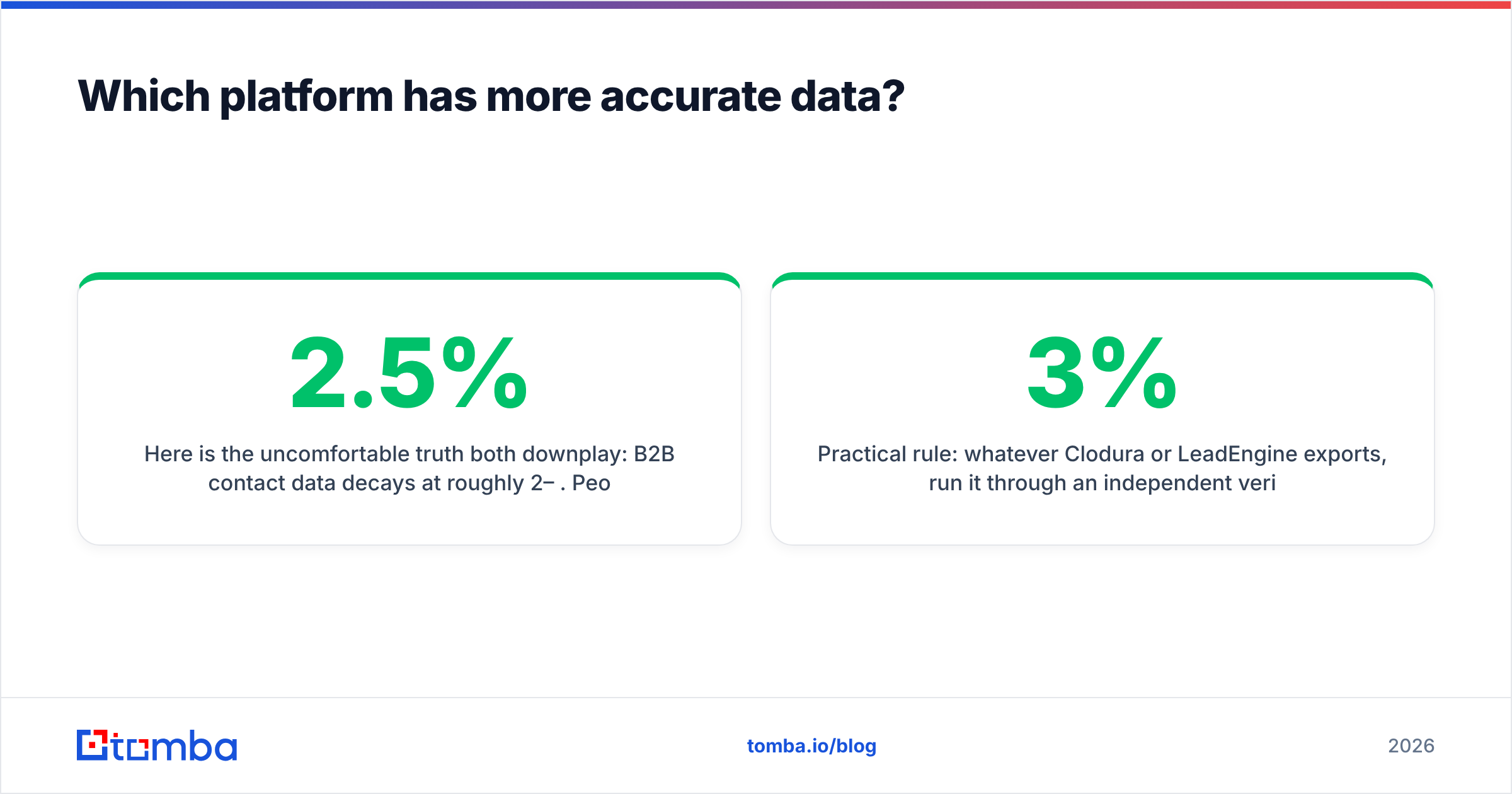
Here is the uncomfortable truth both downplay: B2B contact data decays at roughly 2–2.5% per month. People change jobs, companies rebrand, mailboxes get deactivated. A database that was 95% accurate in January is materially worse by summer if it is not continuously re-verified. This is why a real-time email verifier belongs in your stack no matter which platform you pick — the suite's "verified" stamp is a snapshot, not a guarantee at send time.

Catch-all domains are the other trap. A large share of corporate domains accept any address at the SMTP layer, so a tool can mark an email "valid" when the mailbox does not exist. If your list skews toward enterprise targets, you want a dedicated catch-all verifier rather than trusting a generic green checkmark from either suite.
Practical rule: whatever Clodura or LeadEngine exports, run it through an independent verification pass before it touches your sending domain. Bounces above 3% put your sender reputation at risk, and no amount of data volume is worth a burned domain.
Is Clodura.ai better than LeadEngine.ai for cold outreach?#
For end-to-end outreach run inside one tool, Clodura is the more complete answer. Its native sequencer, intent data, and dialer mean a mid-market SDR team can research, build, and launch without exporting anything. That tight loop is genuinely useful when you are running high volume across multiple segments.
LeadEngine is better when your outreach is surgical. If you are a founder targeting 150 specific accounts, the AI list-building gets you a usable set fast, and you can push contacts into your own sequencer or CRM. Paying for Clodura's full apparatus to send 150 emails a month is poor economics.
A clean way to decide:
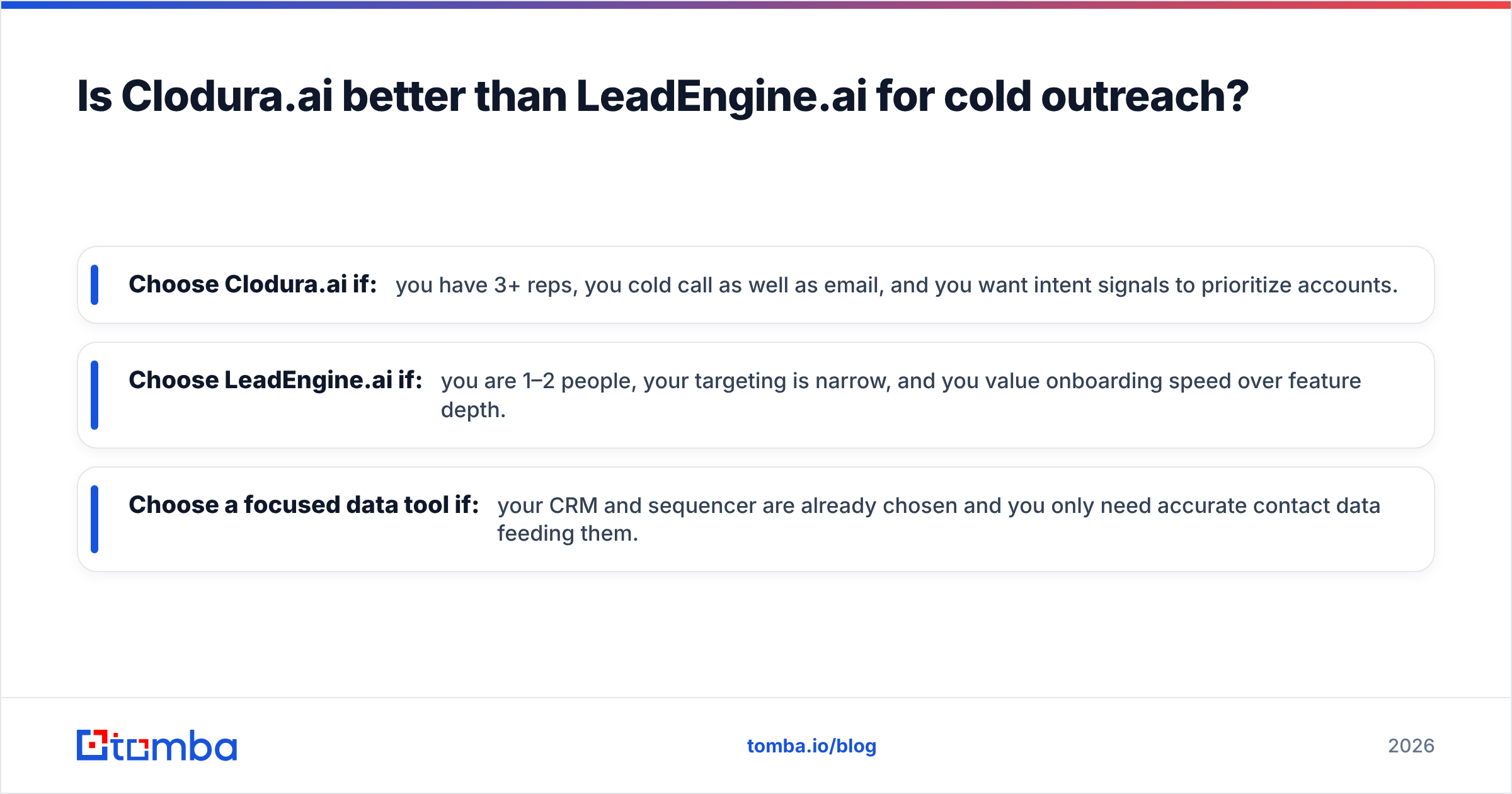
- Choose Clodura.ai if: you have 3+ reps, you cold call as well as email, and you want intent signals to prioritize accounts.
- Choose LeadEngine.ai if: you are 1–2 people, your targeting is narrow, and you value onboarding speed over feature depth.
- Choose a focused data tool if: your CRM and sequencer are already chosen and you only need accurate contact data feeding them.
That third option is where many teams land once they audit usage. You can pull verified contacts by company using a domain search or find specific people with a dedicated email finder, then route them into the outreach tools you already pay for. Less overlap, lower cost, fewer half-used seats.
What does each tool cost at scale?#
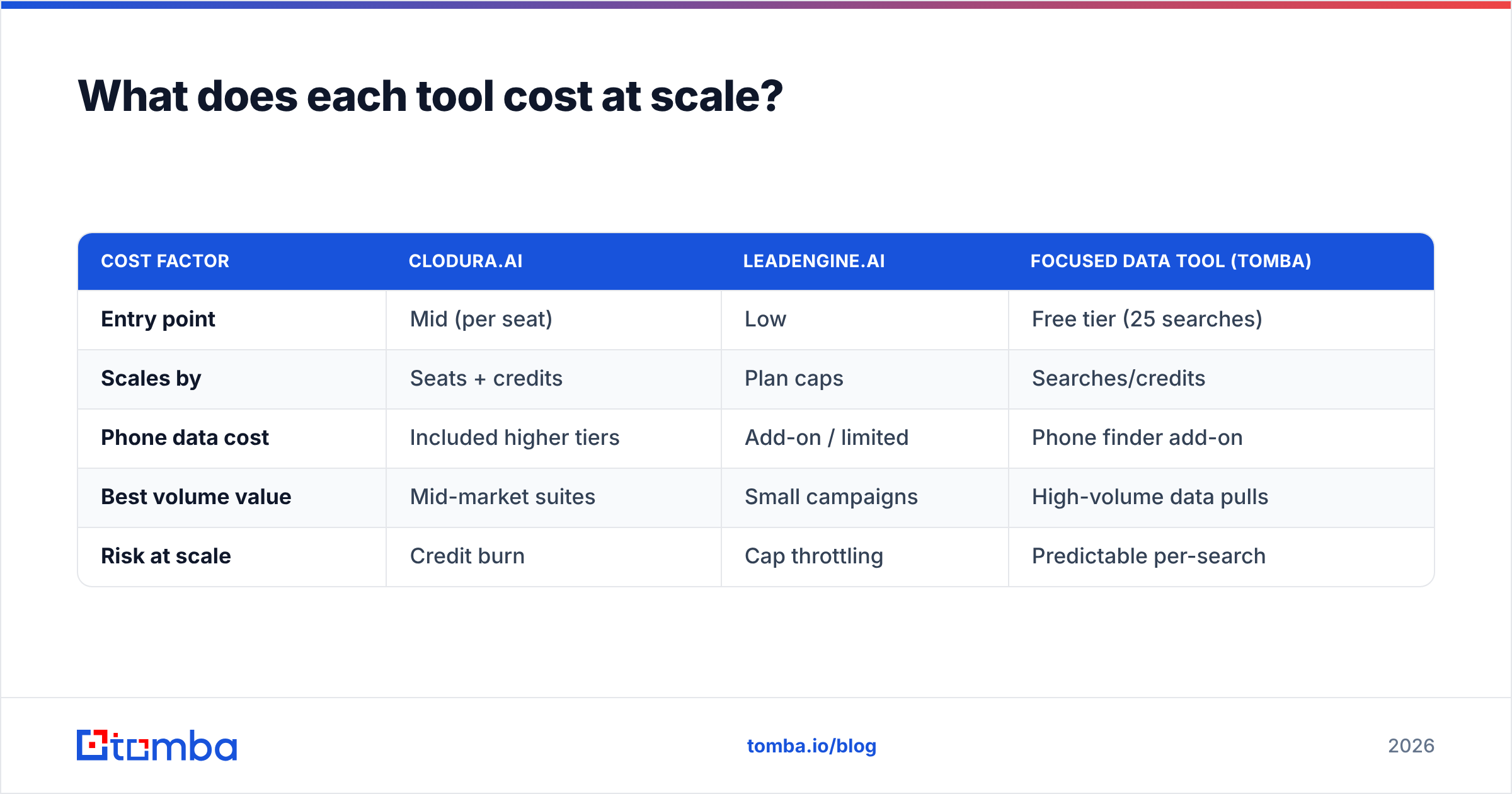
Pricing pain shows up differently on each platform. Clodura's credit model and per-seat pricing add up quickly once you have a real team pulling phone numbers and running enrichment — the headline entry price is not what a five-rep team actually pays. LeadEngine is cheaper to start but enforces tighter monthly caps, so heavy senders hit ceilings and either upgrade or wait.
| Cost factor | Clodura.ai | LeadEngine.ai | Focused data tool (Tomba) |
|---|---|---|---|
| Entry point | Mid (per seat) | Low | Free tier (25 searches) |
| Scales by | Seats + credits | Plan caps | Searches/credits |
| Phone data cost | Included higher tiers | Add-on / limited | Phone finder add-on |
| Best volume value | Mid-market suites | Small campaigns | High-volume data pulls |
| Risk at scale | Credit burn | Cap throttling | Predictable per-search |
For context on a transparent, data-only pricing model, compare against published Tomba pricing: a free tier with 25 searches, Starter at $49/mo, Growth at $99/mo, and Pro at $249/mo. The point is not that one number beats another — it is that you should map your real monthly contact volume to each model before signing an annual deal. Suites look cheap per seat and expensive per verified contact; focused tools are the reverse.
When should you skip both and use a dedicated data tool?#
Skip the suite when you have already standardized on a CRM and sequencer and the only gap is reliable contact data. Buying a second platform that duplicates your sequencer and CRM is how SaaS budgets quietly balloon.
In that case, the cleaner architecture is a focused finder-plus-verifier feeding your existing stack:
- Find — pull emails by person or company with an email finder or bulk job.
- Verify — run every address through verification to keep bounces under 3%.
- Enrich — add firmographic and role data only where you need it.
- Route — push clean records into HubSpot, Salesforce, or your sequencer via native integrations or the Tomba API.
This is also the better path if you are evaluating Clodura or LeadEngine purely for their database. You get comparable contact data without paying for sequencing and intent modules you will not use. If you are mid-evaluation and want a low-risk way to benchmark data quality, a free tier lets you test accuracy on your own target accounts before committing — which is exactly how you should be judging any of these tools.
The honest verdict#
Clodura.ai is the stronger all-in-one platform; LeadEngine.ai is the lighter, faster, cheaper-to-start option. If you want one suite for a mid-market team that calls and emails, Clodura earns its price. If you are small and surgical, LeadEngine removes friction. But for a large share of teams, the real answer is neither: you already own a CRM and a sequencer, and what you actually need is clean, verified data flowing into them without a second bloated subscription.
Whatever you choose, verify before you send. Data accuracy — not feature count — is what determines whether your campaigns land in the inbox or the spam folder.
Want to test data quality before you commit to a suite? Start free with the Tomba Email Finder — 25 searches a month, no credit card — and run your real target accounts through it. If the verified emails beat what Clodura or LeadEngine return on your own list, you have your answer, and you can scale on transparent pricing without paying for modules you never open.
// get started
Find, verify and enrich your first contacts today
Start on the free plan with 25 searches a month, then scale when your team is ready.
Free plan · No credit card required · GDPR & CCPA
// about the author