Clodura.ai vs LeadFuze 2026: Which B2B Lead Tool Wins?
Clodura.ai and LeadFuze both promise fresh B2B leads with verified emails — but they win on very different jobs. Here's the honest 2026 breakdown.
Clodura.ai vs LeadFuze: The Honest 2026 Comparison
Choosing a B2B lead-generation platform usually comes down to one question that the marketing pages refuse to answer plainly: will the contact data actually connect? Clodura.ai and LeadFuze both sell themselves as all-in-one prospecting engines with millions of company records and "verified" emails baked in. They are not the same tool, though, and picking the wrong one wastes a quarter of pipeline.
This is a neutral breakdown of where each platform earns its price, where it falls short, and how to decide based on the job you actually have — not the feature list.
TL;DR#
- Clodura.ai is the better fit if you want an account-based engine with org charts, technographics, and intent signals stitched into one dashboard. It leans toward mid-market and enterprise prospecting.
- LeadFuze is the better fit if you want fast, list-building simplicity — define an audience, hit "go," and export verified leads into your CRM or outreach tool.
- Data accuracy is the real decider. Both rebuild lists from public sources, and both go stale; verifying emails before send matters more than any database size claim.
- Pricing favors LeadFuze for small teams getting started, while Clodura.ai's value shows up once you need intent data and multi-touch sequencing in the same seat.
- If your bottleneck is email accuracy rather than discovery, pair either tool with a dedicated email verifier instead of trusting a single "verified" flag.
What is Clodura.ai?#
Clodura.ai is a sales intelligence and prospecting platform built around account-based selling. Think of it as a research analyst, a contact database, and a sequencing tool sharing one desk. You start with a company, drill into its org chart, see the tech it runs, watch for buying signals, and then pull direct-dial numbers and email addresses for the people who matter.
Its core pitch is depth per account. Instead of just handing you a flat list of names, it tries to answer why now — funding events, hiring spikes, technology changes — so reps prioritize accounts that are already in motion. That intent layer is the feature most often cited in G2 reviews as the reason teams pick it over a plain list builder.
What is LeadFuze?#
LeadFuze is a lead-list builder with automation hooks. Its signature feature, "Fuzebot," lets you describe an audience — role, industry, headcount, location, even the software a company uses — and then continuously builds and de-duplicates lists matching that profile. New matching leads get added automatically and existing CRM contacts get filtered out so you do not pay for duplicates.
Where Clodura.ai is account-first, LeadFuze is list-first. The workflow is closer to "set an audience recipe, let it cook, export to your sequencer." That simplicity is exactly why smaller teams and agencies like it: less time configuring, faster path to a usable list.

How do Clodura.ai and LeadFuze compare at a glance?#
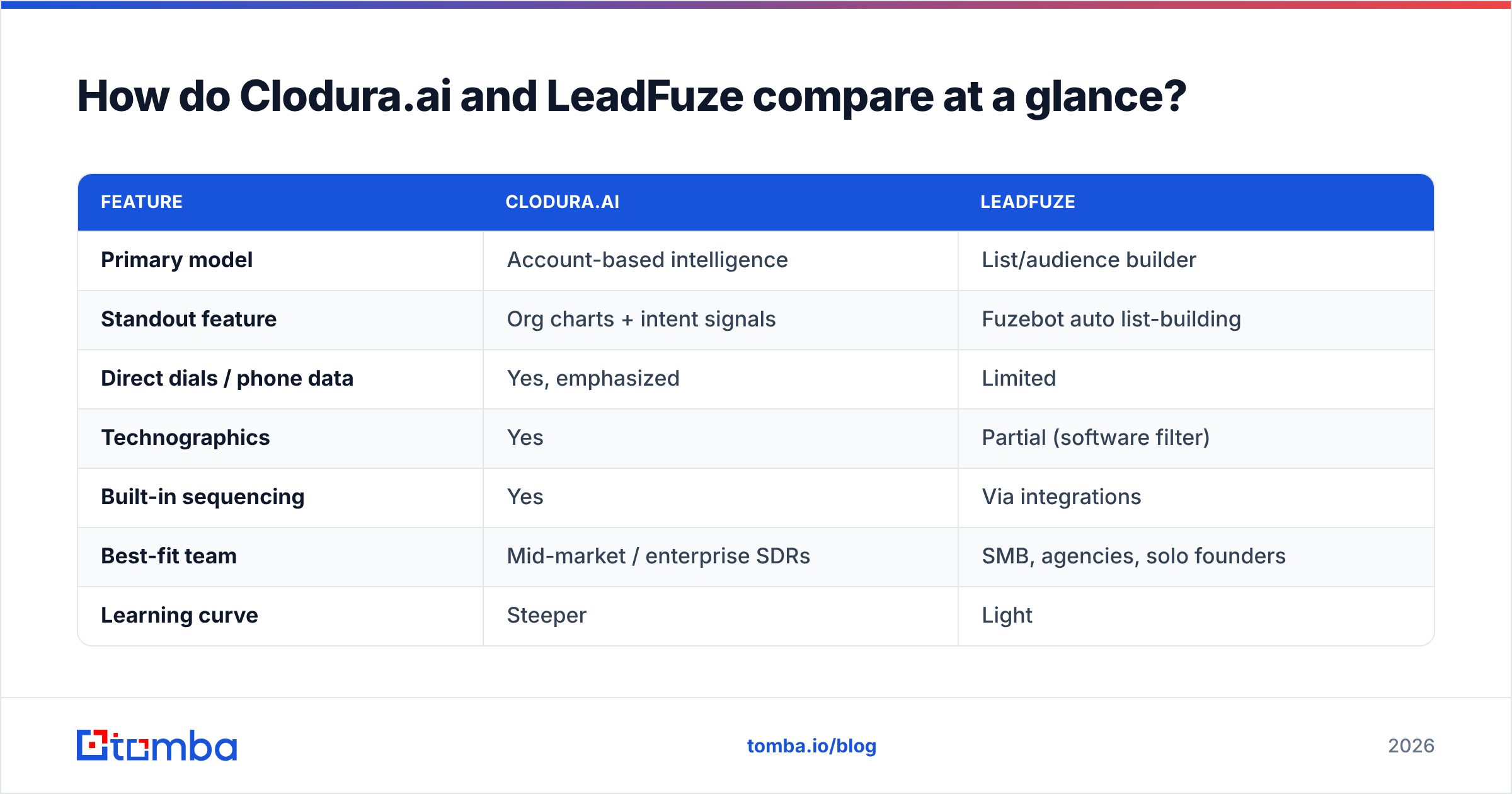
The fastest way to see the split is feature by feature. Both tools overlap on the basics — contact data, exports, CRM sync — but diverge sharply on intent and account depth.
| Feature | Clodura.ai | LeadFuze |
|---|---|---|
| Primary model | Account-based intelligence | List/audience builder |
| Standout feature | Org charts + intent signals | Fuzebot auto list-building |
| Direct dials / phone data | Yes, emphasized | Limited |
| Technographics | Yes | Partial (software filter) |
| Built-in sequencing | Yes | Via integrations |
| Best-fit team | Mid-market / enterprise SDRs | SMB, agencies, solo founders |
| Learning curve | Steeper | Light |
| Free trial | Limited free tier | Limited free leads |
Neither row makes one tool "win." A 4-person agency drowning in Clodura.ai's account depth would ship faster on LeadFuze. A 30-rep enterprise team running ABM would find LeadFuze too shallow on org structure. Match the tool to the motion.
Which has better data accuracy?#
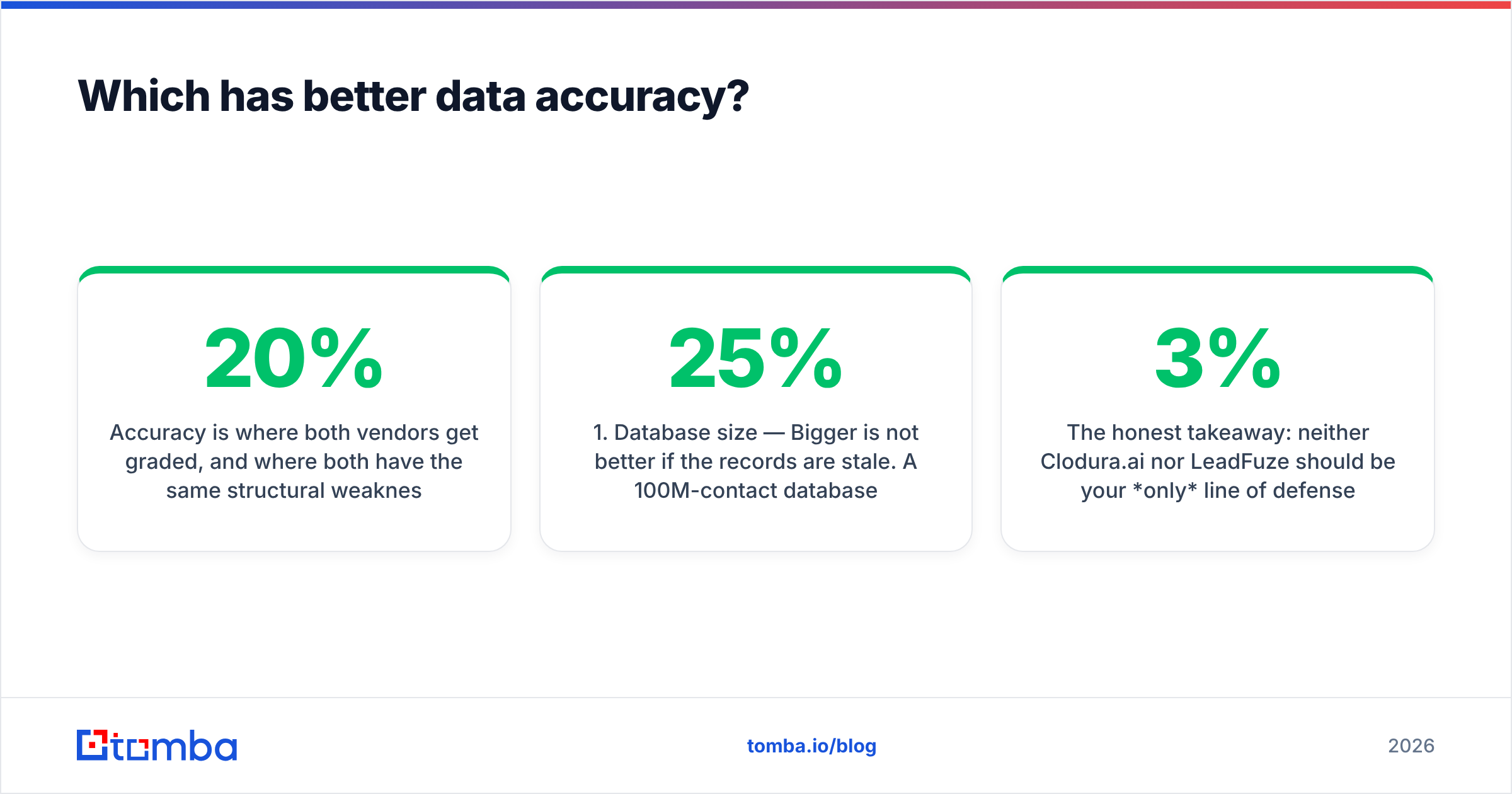
Accuracy is where both vendors get graded, and where both have the same structural weakness. Sales databases are rebuilt from public web sources, scraped profiles, and contributed records. People change jobs roughly every 2-3 years, which means somewhere between 20% and 30% of any B2B database decays annually regardless of the logo on the dashboard. "Verified" usually means the address passed a syntax and server check at some point in the past — not that it is deliverable today.
Here is the practical breakdown of what each accuracy claim really means:
- Database size — Bigger is not better if the records are stale. A 100M-contact database with 25% decay has more dead emails than a tightly maintained 40M one.
- "Verified" badge — Treat it as "checked once," not "checked this week." Re-verify before any send.
- Catch-all domains — Many corporate domains accept every address, so a "valid" result can still bounce. A dedicated catch-all verifier is the only reliable check here.
- Direct dials — Phone accuracy decays faster than email and is harder to validate at scale.
- Coverage gaps — Both tools are stronger on North American mid-market and weaker on EMEA SMB and non-English records.
The honest takeaway: neither Clodura.ai nor LeadFuze should be your only line of defense against bounces. Run your exported list through a separate verification pass before it touches a sending domain. That single habit protects your sender reputation more than any database upgrade, because a bounce rate above 2-3% is what triggers spam folder placement in the first place.
How does pricing compare?#
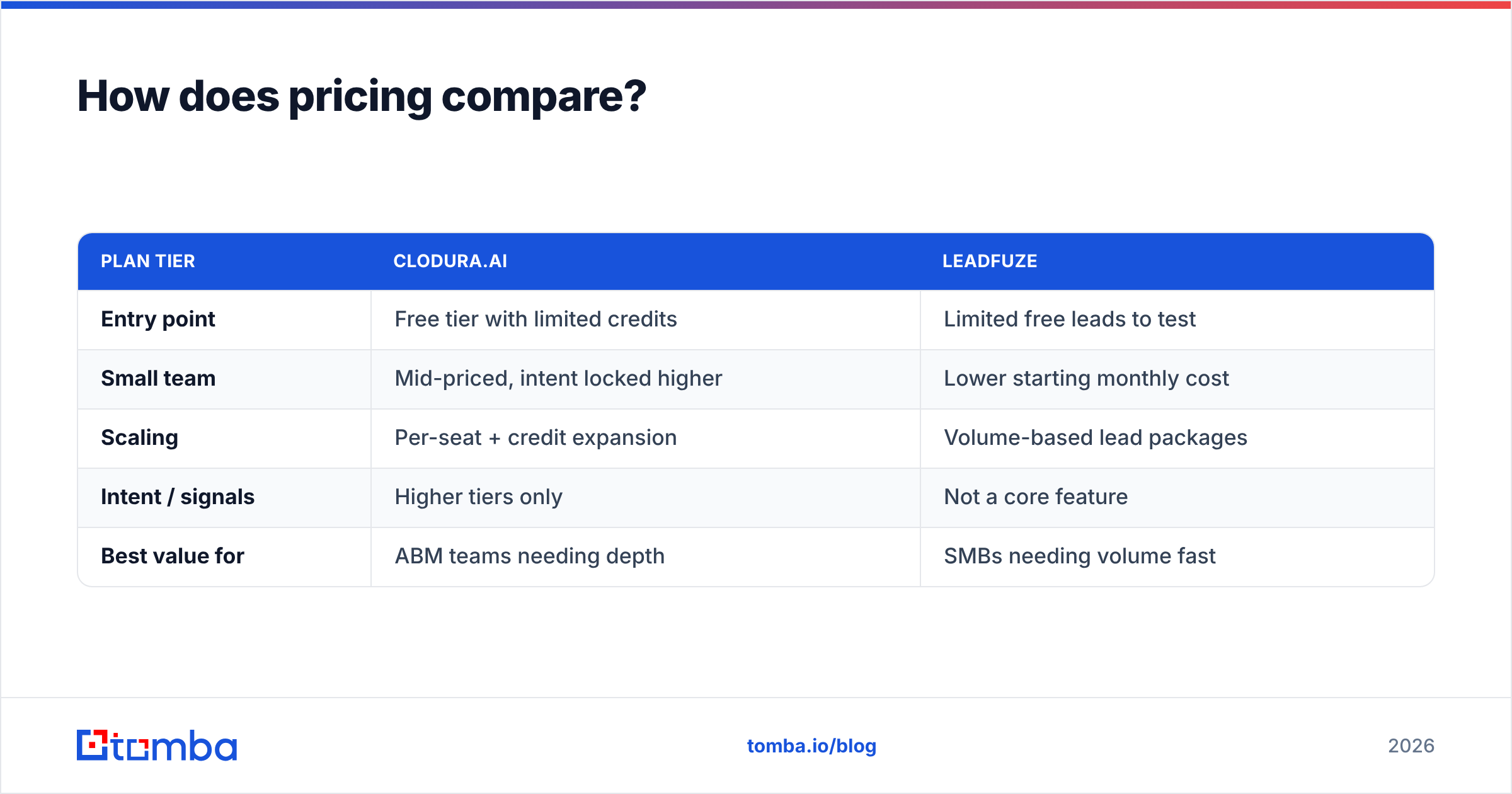
Both platforms gate their best features behind higher tiers and quote credits or lead volumes rather than flat unlimited access. Exact numbers shift, so confirm on each vendor's current pricing page before committing — but the shape of the pricing tells you who each tool is built for.
| Plan tier | Clodura.ai | LeadFuze |
|---|---|---|
| Entry point | Free tier with limited credits | Limited free leads to test |
| Small team | Mid-priced, intent locked higher | Lower starting monthly cost |
| Scaling | Per-seat + credit expansion | Volume-based lead packages |
| Intent / signals | Higher tiers only | Not a core feature |
| Best value for | ABM teams needing depth | SMBs needing volume fast |
LeadFuze tends to win the "cheapest path to a usable list" comparison. Clodura.ai tends to win once you would otherwise be buying a separate intent-data subscription, because bundling that into one seat removes a line item. If you are early-stage and just need contacts to start conversations, the lower entry cost matters. If intent signals would change which accounts you call first, paying up is rational.
For context on how a focused tool prices when you only need finding and verification rather than a full suite, compare against transparent Tomba pricing — a Free tier at 25 searches per month, Starter at $49/mo, and Growth at $99/mo. The point is not that one model beats the other; it is that an all-in-one suite and a specialist tool are priced for different jobs.
Is Clodura.ai better than LeadFuze for cold outreach?#
It depends on whether your outreach is account-based or volume-based.
Clodura.ai suits account-based outreach. If your sequences are personalized around a company's funding round, a new VP hire, or a tech-stack change, the intent layer feeds that personalization directly. You can build a sequence inside the platform and reference the exact signal that made the account relevant. For complex, multi-threaded deals, that context is worth the steeper setup.
LeadFuze suits volume outreach. If your model is "build a clean 2,000-lead list of marketing directors at SaaS companies and run a tight 4-email sequence," LeadFuze gets you to the export faster. You then push the list into a dedicated sender and run your cold email playbook there.
One caveat that applies to both: built-in or bolted-on, the sending engine is only as safe as the list feeding it. High-volume cold email on unverified data is the fastest way to land a domain on a blocklist. Whichever tool you pick, the deliverability fundamentals — warmed domain, authenticated DNS, verified recipients — sit outside the prospecting tool and remain your responsibility.
What are the main weaknesses of each tool?#
No neutral comparison is complete without the failure modes. Here is where each one frustrates users.
Clodura.ai weaknesses:
- Steeper learning curve; new reps need onboarding time before the depth pays off.
- Intent and signal features are locked to higher tiers, so the cheapest plan undersells the platform.
- Heavier interface can feel like overkill for simple list pulls.
LeadFuze weaknesses:
- Shallower account intelligence — limited org charts and weaker direct-dial coverage.
- Less suited to true ABM motions that depend on org structure.
- List quality still requires external verification before high-volume sending.
Both share the universal weakness already covered: data decays, and "verified" is a snapshot, not a guarantee.
When should you use a dedicated email finder instead?#
Reach for a specialist when discovery is not your bottleneck — accuracy is. Plenty of teams already know exactly which 500 companies they want and which roles to target. They do not need a giant database or an audience recipe; they need correct, deliverable addresses for a known list, plus the ability to verify at scale.
That is a different shape of problem than either Clodura.ai or LeadFuze is optimized for. A focused email finder lets you go from a domain and a name to a verified address, run a domain search to pull every public address at a company, and push the whole thing through verification — without paying for intent dashboards and sequencing seats you will not use. For teams that live in spreadsheets, a bulk email finder or the Google Sheets add-on often replaces the "list builder" step entirely.
The decision tree is simple:
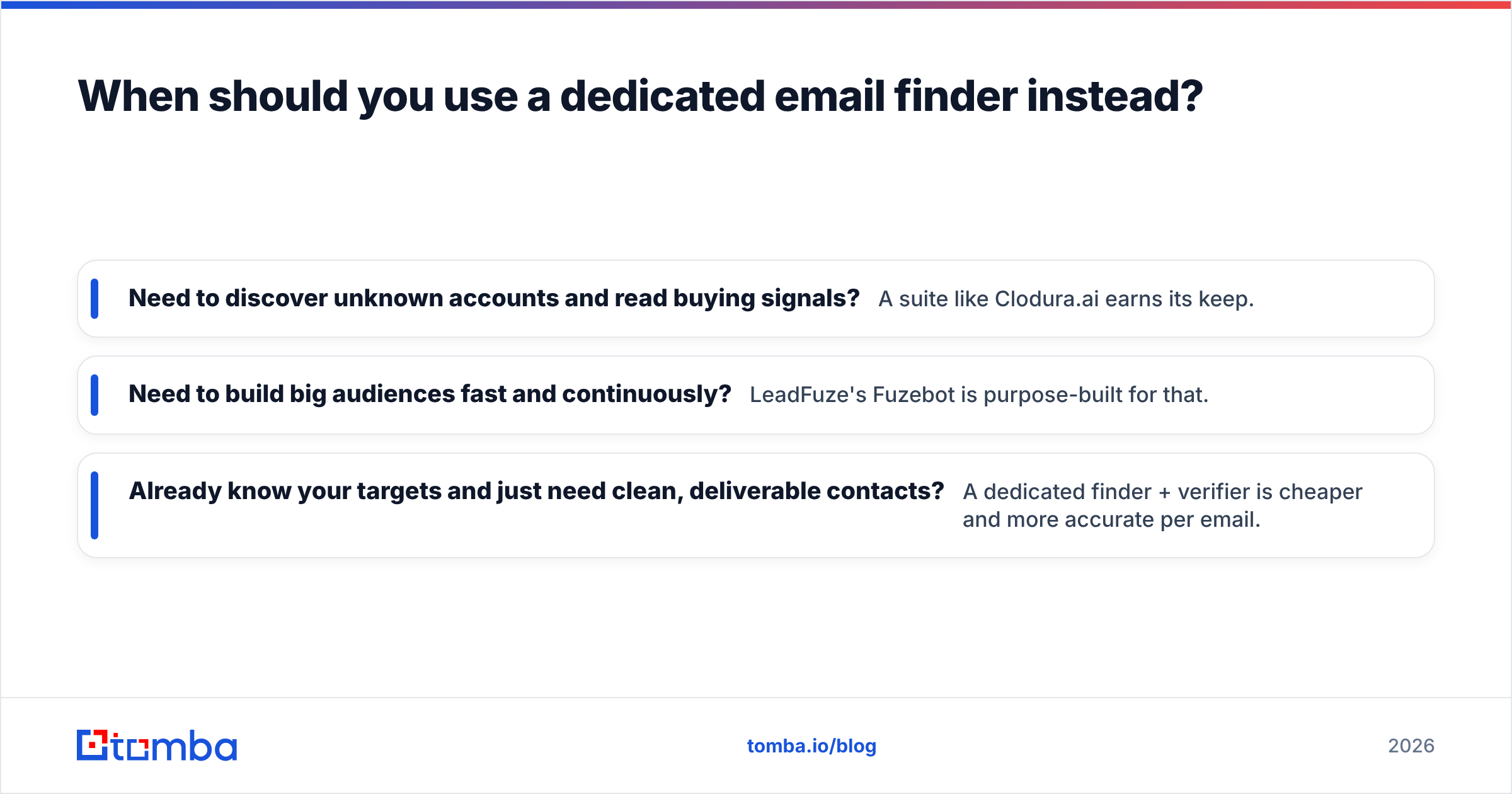
- Need to discover unknown accounts and read buying signals? A suite like Clodura.ai earns its keep.
- Need to build big audiences fast and continuously? LeadFuze's Fuzebot is purpose-built for that.
- Already know your targets and just need clean, deliverable contacts? A dedicated finder + verifier is cheaper and more accurate per email.
How do you choose between Clodura.ai and LeadFuze?#
Conclusion first: pick Clodura.ai for depth, LeadFuze for speed, and a specialist finder for accuracy on known targets.
Run your own situation through three questions:
- Is your motion account-based or volume-based? ABM and complex deals point to Clodura.ai. Wide, repeatable outreach points to LeadFuze.
- Do buying signals change your priorities? If intent data would reorder which accounts you call today, pay for it. If not, do not subsidize a feature you will ignore.
- Where does your pipeline actually leak? If it leaks at discovery, buy a suite. If it leaks at deliverability, no database upgrade fixes that — verification does.
Whatever you choose, build verification into the workflow rather than trusting a single badge. Export, verify, then send. That order keeps your bounce rate low, your domain reputation intact, and your reps talking to real people instead of dead inboxes.
The bottom line#
Clodura.ai and LeadFuze solve adjacent but distinct problems. Clodura.ai is the account-intelligence platform for teams running deliberate, signal-driven ABM. LeadFuze is the fast list engine for teams that need clean audiences without the configuration overhead. Both are legitimate; the wrong pick just means you pay for capabilities you never touch — or hit a depth ceiling you cannot break through.
And both share one limitation worth repeating: the "verified" label inside any prospecting suite is a moment-in-time check, not a promise of deliverability. If your goal is to find correct, deliverable email addresses for the people you actually want to reach — and to verify them before they ever touch your sending domain — start with the Tomba Email Finder. Begin on the free tier, find emails by domain or by name, verify in the same flow, and only pay once it is moving real pipeline. That is the cheapest insurance your outreach engine can buy.
// get started
Find, verify and enrich your first contacts today
Start on the free plan with 25 searches a month, then scale when your team is ready.
Free plan · No credit card required · GDPR & CCPA
// about the author