Cloudura.ai vs LeadRocks 2026: Which B2B Lead Tool Wins?
Cloudura.ai and LeadRocks both promise affordable B2B contact data, but they solve different problems. Here's an honest, side-by-side breakdown for 2026.
TL;DR
- Cloudura.ai is a broader GTM/prospecting platform: a contact database plus sales-engagement features, aimed at teams that want to find and sequence leads in one place.
- LeadRocks is a LinkedIn-centric B2B contact database, popular for its lifetime/credit-based deals and simple "search a company, export contacts" workflow.
- Pick Cloudura.ai if you want database + outreach bundled; pick LeadRocks if you mainly want cheap bulk LinkedIn contacts and you'll handle sending elsewhere.
- Both rely on pre-collected databases, so the real question is data freshness and email accuracy — and that's where a real-time verification layer matters most.
- If accuracy is your priority, pairing either tool (or replacing both) with a live email finder and verifier like Tomba protects your sender reputation.
What are Cloudura.ai and LeadRocks?#
Cloudura.ai and LeadRocks both sell the same core promise — "stop guessing, get B2B contacts" — but they aim at different buyers.
Think of it like buying produce. LeadRocks is the bulk warehouse: walk in, grab a crate of contacts by company or title, pay a flat rate, leave. Cloudura.ai is the meal-kit service: it hands you the contacts and the tools to cook the outreach — sequences, enrichment, and workflow in one subscription.
LeadRocks built its reputation on AppSumo-style lifetime and credit deals. You search by company, role, or LinkedIn URL, and it returns names, titles, emails, and phone numbers pulled from its stored database. It's deliberately simple and cheap, which is why solo founders and small agencies like it.
Cloudura.ai positions itself as a wider go-to-market platform. Alongside the database, it leans into prospecting workflow — list building, enrichment, and outreach features — so a small sales team can run more of the funnel without stitching five tools together.
Neither is a pure real-time email finder. Both serve results from a database they've already compiled, which has big implications for accuracy that we'll get to.

How do Cloudura.ai and LeadRocks compare at a glance?#
Here's the honest side-by-side. Pricing on credit-based tools shifts often, so treat these as directional and confirm on each vendor's site before buying.
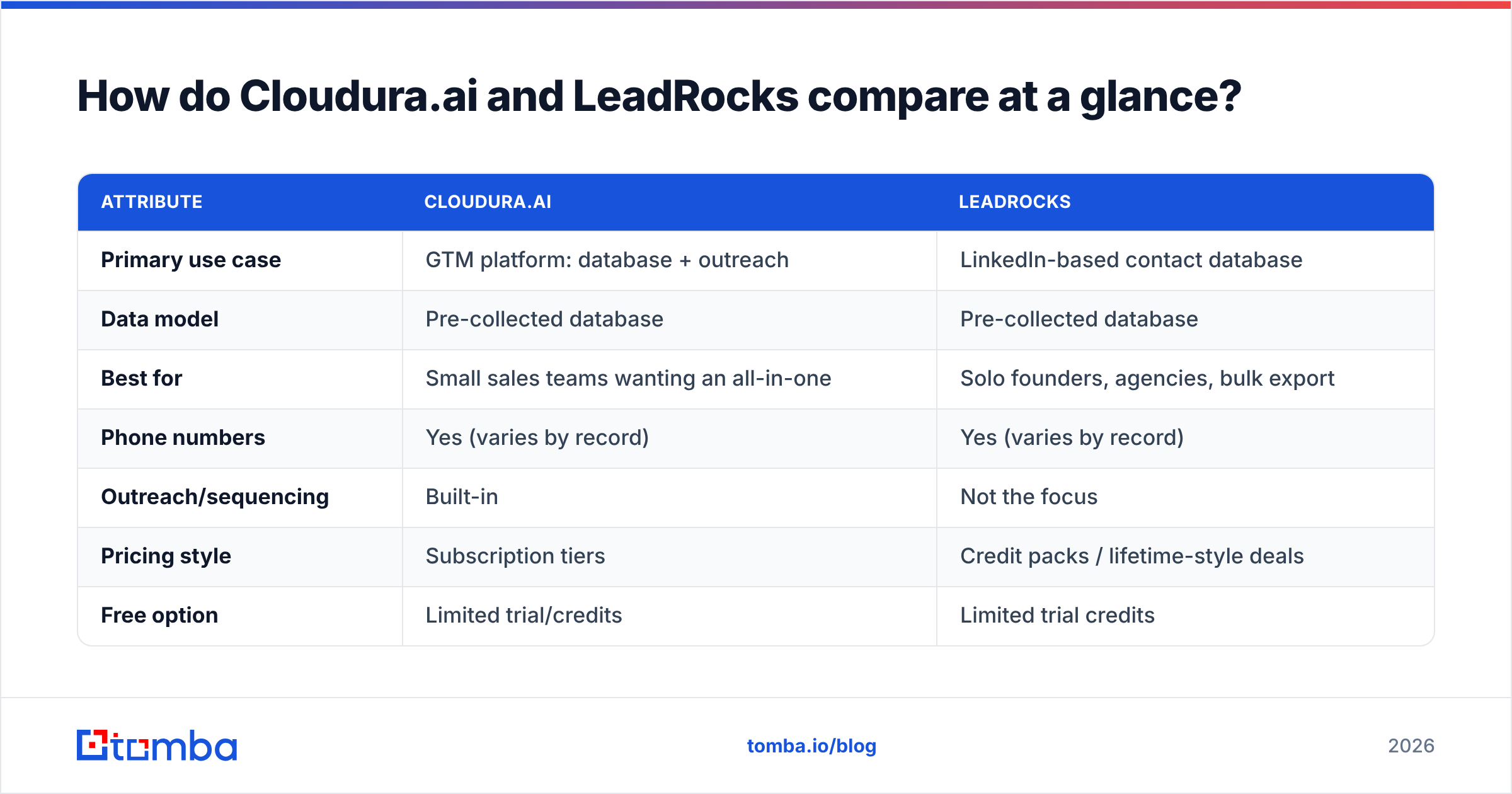
| Attribute | Cloudura.ai | LeadRocks |
|---|---|---|
| Primary use case | GTM platform: database + outreach | LinkedIn-based contact database |
| Data model | Pre-collected database | Pre-collected database |
| Best for | Small sales teams wanting an all-in-one | Solo founders, agencies, bulk export |
| Phone numbers | Yes (varies by record) | Yes (varies by record) |
| Outreach/sequencing | Built-in | Not the focus |
| Pricing style | Subscription tiers | Credit packs / lifetime-style deals |
| Free option | Limited trial/credits | Limited trial credits |
| Email verification | Basic | Basic |
The pattern: Cloudura.ai bundles more, LeadRocks costs less per contact for straightforward exports. If your bottleneck is "I need 2,000 contacts this week," LeadRocks is hard to beat on price. If your bottleneck is "my reps waste hours moving between tools," Cloudura.ai's bundle earns its keep.
Which has better data accuracy?#
Neither tool publishes an independently audited accuracy rate you should take at face value — and that's the point. Database-first tools are only as fresh as their last crawl.
People change jobs constantly. B2B email data decays at roughly 2–3% per month, which compounds to a quarter or more of a list going stale within a year. When a tool serves a stored email that was scraped months ago, you get three failure modes:
- Hard bounces — the mailbox no longer exists, which directly damages your domain reputation.
- Catch-all uncertainty — the domain accepts everything, so a "valid" result is really a maybe.
- Role/title drift — the person moved companies, so even a deliverable email reaches the wrong context.
This is why a verification step is non-negotiable regardless of which tool you choose. Run every export through an email verifier before you send, and use a catch-all verifier on ambiguous domains. A cheap list that bounces is more expensive than a small clean one — because the damage to your sending domain follows you for months.
Rule of thumb: judge a database tool not by how many contacts it returns, but by what percentage survive verification.
Cloudura.ai vs LeadRocks: pros and cons#
Use this to match the tool to how you actually work.
Cloudura.ai — strengths
- All-in-one workflow keeps prospecting and outreach in one tab.
- Better fit for teams running structured sequences.
- Enrichment built in, so records arrive more complete.
Cloudura.ai — weaknesses
- Higher commitment — you pay for the platform, not just the data.
- Jack-of-all-trades risk — bundled outreach rarely beats dedicated sending tools.
- Accuracy still depends on database freshness.
LeadRocks — strengths
- Low cost per contact, especially on credit/lifetime deals.
- Dead-simple export flow — search, select, download.
- Strong for LinkedIn-sourced lists by company and role.
LeadRocks — weaknesses
- No serious outreach engine — you'll need a separate sender.
- Verification is light, so cleanup falls on you.
- Bulk-first design can reward quantity over precision.

Is either one a real-time email finder?#
No — and this is the most important distinction for deliverability. Both Cloudura.ai and LeadRocks return records from a stored index. A true email finder instead resolves an address at query time from a name and domain, then validates it against the mail server before handing it to you.
The difference shows up in your bounce rate. A static database might be 80% accurate the day it was built and 65% accurate a year later. A real-time finder + verifier re-checks the address now, so you're working from the live state of the mailbox, not a snapshot.
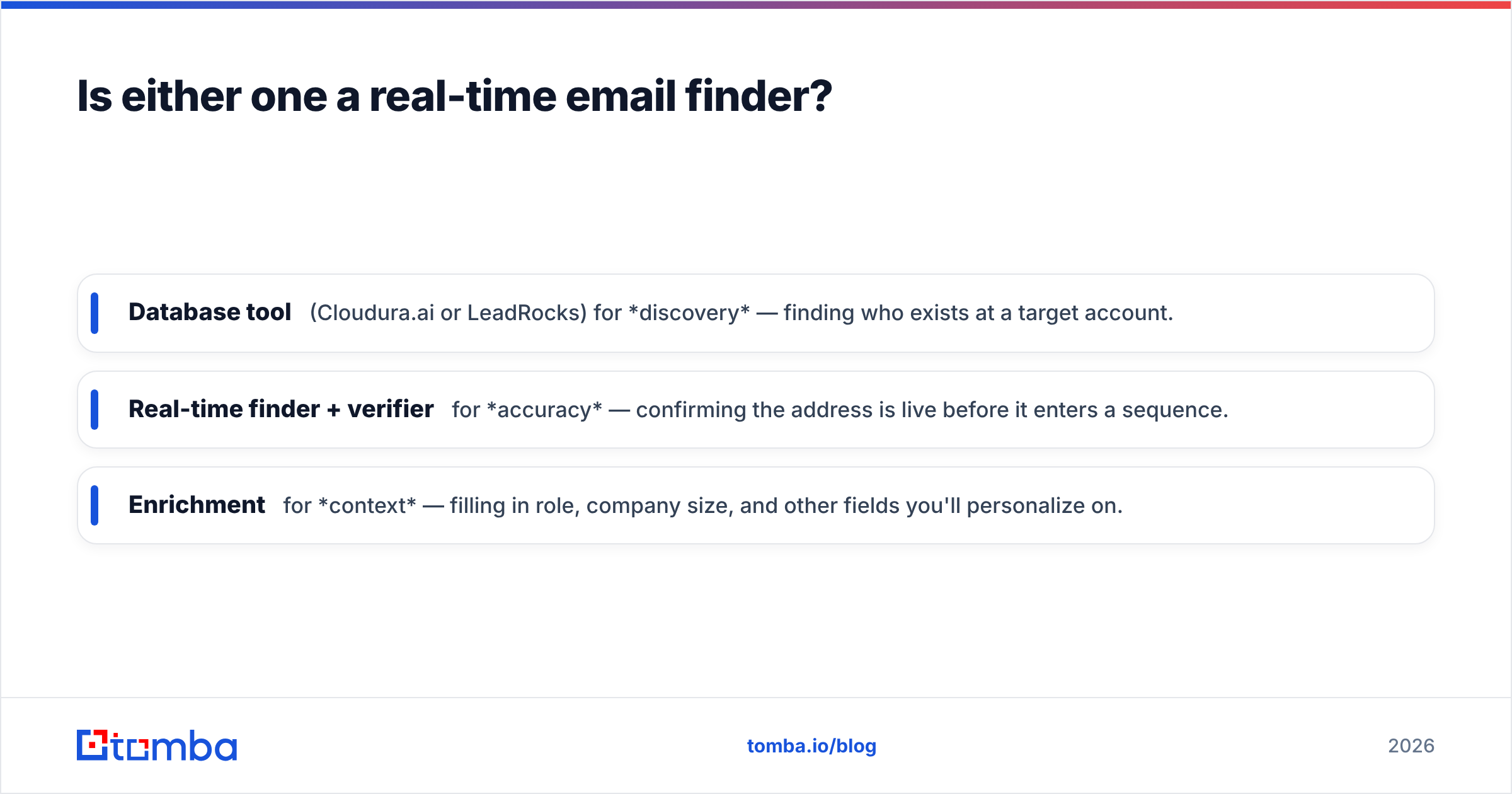
That's why many teams run a hybrid stack:
- Database tool (Cloudura.ai or LeadRocks) for discovery — finding who exists at a target account.
- Real-time finder + verifier for accuracy — confirming the address is live before it enters a sequence.
- Enrichment for context — filling in role, company size, and other fields you'll personalize on.
You can build that accuracy layer with Tomba's domain search to map who works at a company, then verify, then push clean records into your CRM. For ongoing list hygiene at scale, a bulk email finder handles thousands of lookups in one pass.
How should you choose between Cloudura.ai and LeadRocks?#
Match the tool to your real constraint, not the feature list.
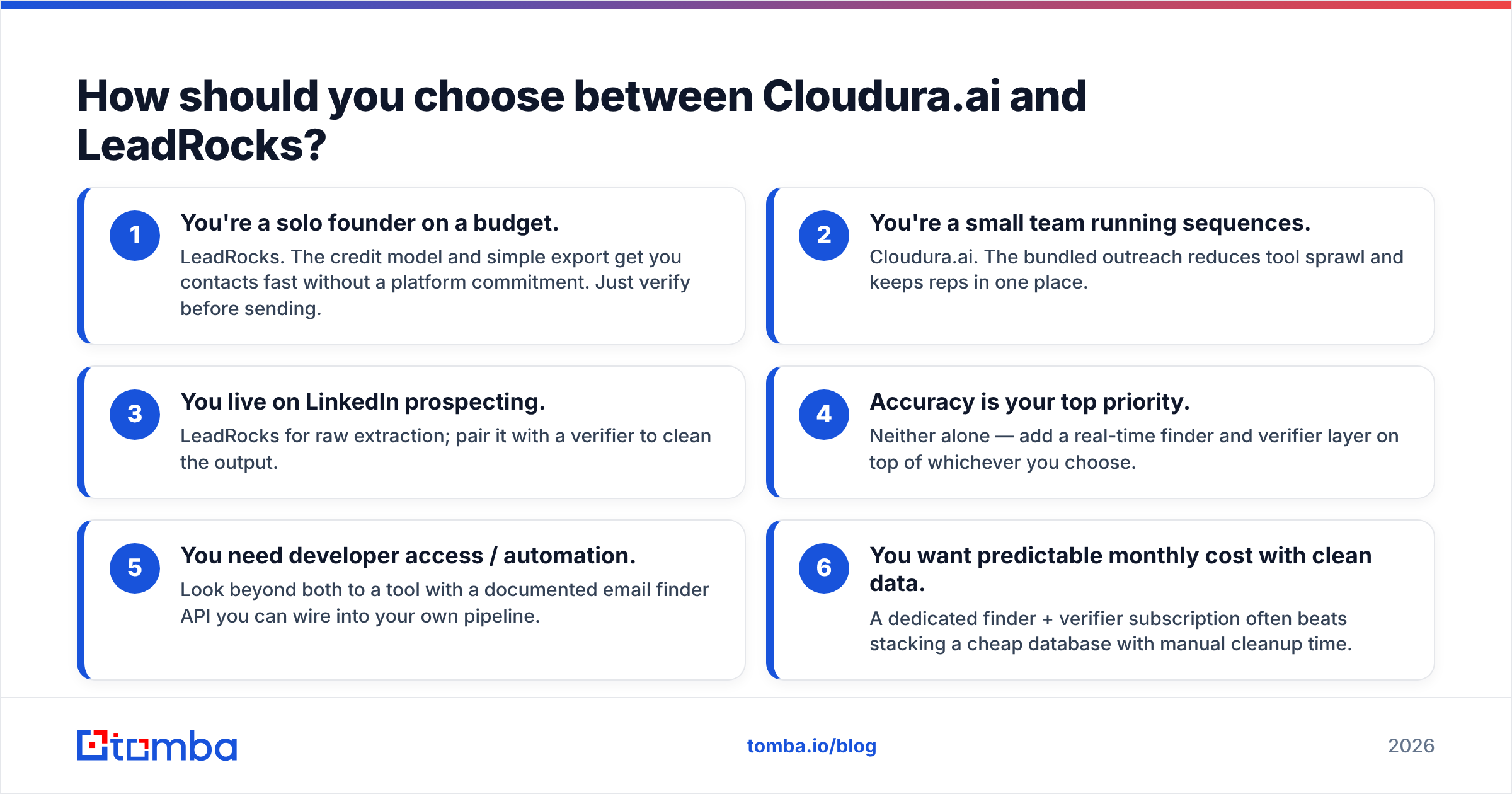
- You're a solo founder on a budget. LeadRocks. The credit model and simple export get you contacts fast without a platform commitment. Just verify before sending.
- You're a small team running sequences. Cloudura.ai. The bundled outreach reduces tool sprawl and keeps reps in one place.
- You live on LinkedIn prospecting. LeadRocks for raw extraction; pair it with a verifier to clean the output.
- Accuracy is your top priority. Neither alone — add a real-time finder and verifier layer on top of whichever you choose.
- You need developer access / automation. Look beyond both to a tool with a documented email finder API you can wire into your own pipeline.
- You want predictable monthly cost with clean data. A dedicated finder + verifier subscription often beats stacking a cheap database with manual cleanup time.
The uncomfortable truth: the cheapest crate of contacts is rarely the cheapest outcome. Factor in the hours spent cleaning bounces and the reputation cost of a bad send, and "affordable" data can quietly become your most expensive channel.
Where does Tomba fit in this comparison?#
Tomba isn't trying to be a giant static database you export in bulk — it's the accuracy layer that makes any prospecting stack trustworthy. Cloudura.ai and LeadRocks are good at discovery; Tomba is built for verification and live lookup.
A practical workflow looks like this:
- Use a database tool to identify target accounts and contacts.
- Run those names and domains through Tomba's email finder to resolve and confirm addresses in real time.
- Verify the full list, then enrich with data enrichment so every record is sequence-ready.
Tomba's pricing is straightforward: a Free tier with 25 searches/month, Starter at $49/mo, Growth at $99/mo, Pro at $249/mo, and custom Enterprise. You're paying for verified accuracy and live lookups, not a snapshot that ages the moment it's exported. For independent reviews of all three categories of tool, G2 is a reasonable place to sanity-check vendor claims against real user feedback.
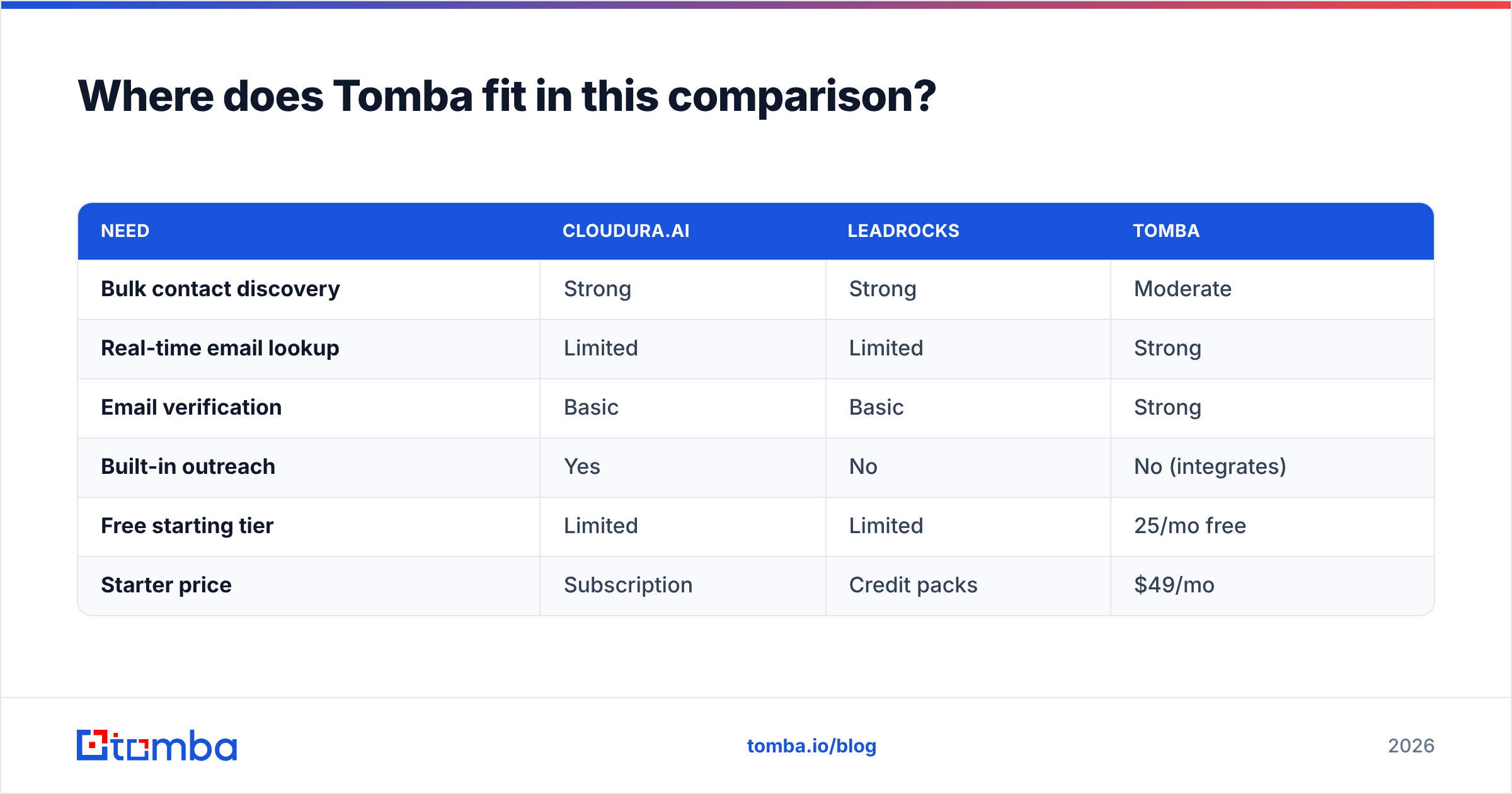
| Need | Cloudura.ai | LeadRocks | Tomba |
|---|---|---|---|
| Bulk contact discovery | Strong | Strong | Moderate |
| Real-time email lookup | Limited | Limited | Strong |
| Email verification | Basic | Basic | Strong |
| Built-in outreach | Yes | No | No (integrates) |
| Free starting tier | Limited | Limited | 25/mo free |
| Starter price | Subscription | Credit packs | $49/mo |
Final verdict#
Choose LeadRocks for cheap, fast, LinkedIn-sourced bulk contacts when you'll handle sending and verification yourself. Choose Cloudura.ai when a small team wants discovery and outreach bundled into one subscription and is willing to pay for the convenience. Both are legitimate picks — but both share the same weakness: stored data ages, and aging data quietly burns your deliverability.
That's the gap to close. Before any contact from either tool enters a campaign, resolve and confirm it live. Start free with the Tomba Email Finder — 25 searches a month, no card required — and see how many of your "verified" database contacts actually survive a real-time check. Clean data isn't the expensive option; it's the one that keeps your domain sending for years.
// get started
Find, verify and enrich your first contacts today
Start on the free plan with 25 searches a month, then scale when your team is ready.
Free plan · No credit card required · GDPR & CCPA
// about the author